Methods of Computing Depreciation I More at: http://www.businessstudiespedia.com/ Page 1
What are the Methods of Computing Depreciation
Depreciation can be charged based on different methods which are
found suitable in different circumstances relevant to nature of assets
and business. Further, it is not necessary that an enterprise employ
single method for all classes of its depreciable assets.
There are several methods that can be used for depreciating the
cost of assets for financial reporting. The most common methods
are: (i) Straight line method, (ii) two accelerated methods known as
the declining-balance method and sum-of-the-years’ digits methods.
Each of them is proper for certain circumstances. For example, a
company may use straight line depreciation on some assets and sum-
of-the-years’ digits method for other assets.
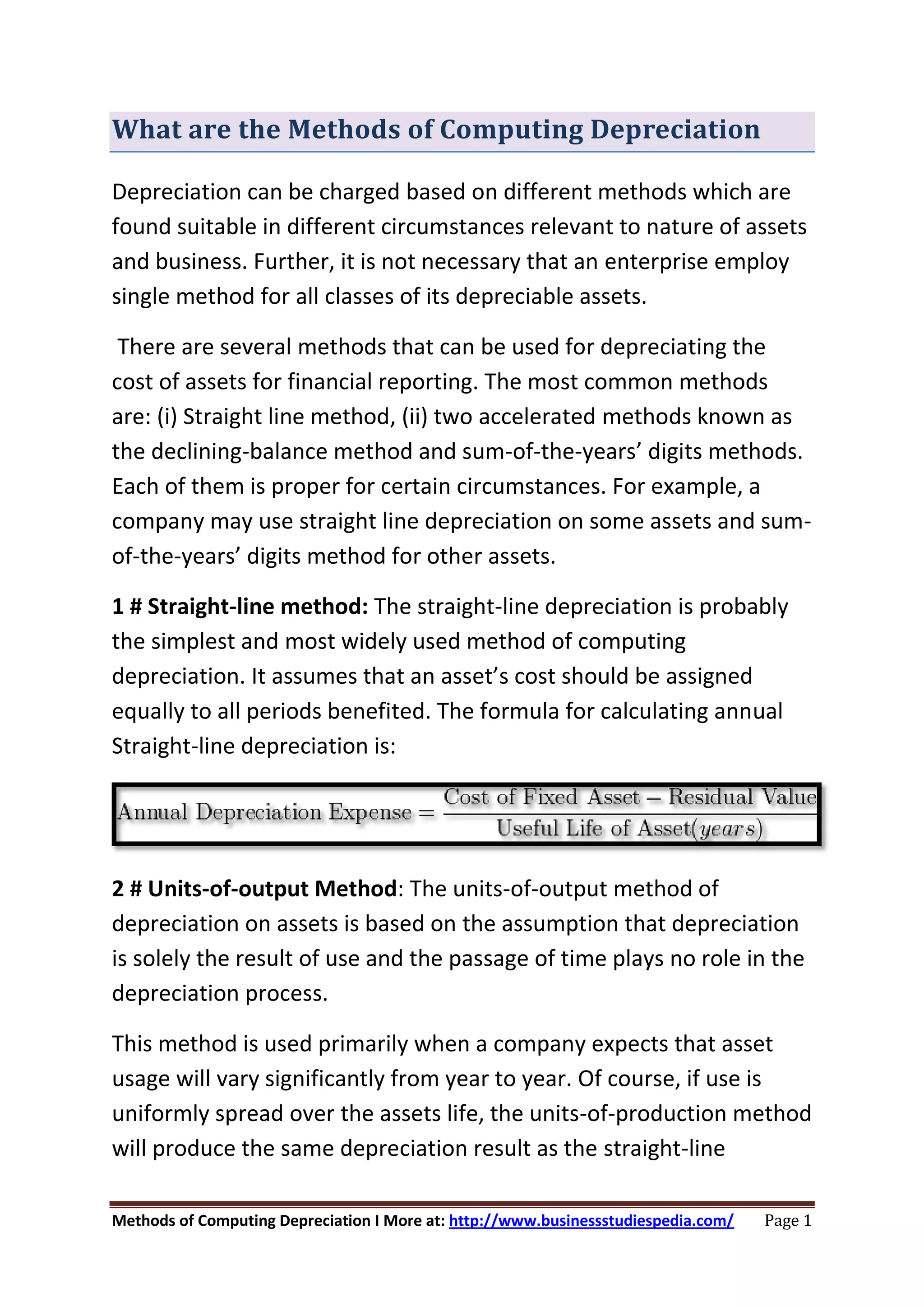
1 # Straight-line method: The straight-line depreciation is probably
the simplest and most widely used method of computing
depreciation. It assumes that an asset’s cost should be assigned
equally to all periods benefited. The formula for calculating annual
Straight-line depreciation is:
2 # Units-of-output Method: The units-of-output method of
depreciation on assets is based on the assumption that depreciation
is solely the result of use and the passage of time plays no role in the
depreciation process.
This method is used primarily when a company expects that asset
usage will vary significantly from year to year. Of course, if use is
uniformly spread over the assets life, the units-of-production method
will produce the same depreciation result as the straight-line
Methods of Computing Depreciation I More at: http://www.businessstudiespedia.com/ Page 2
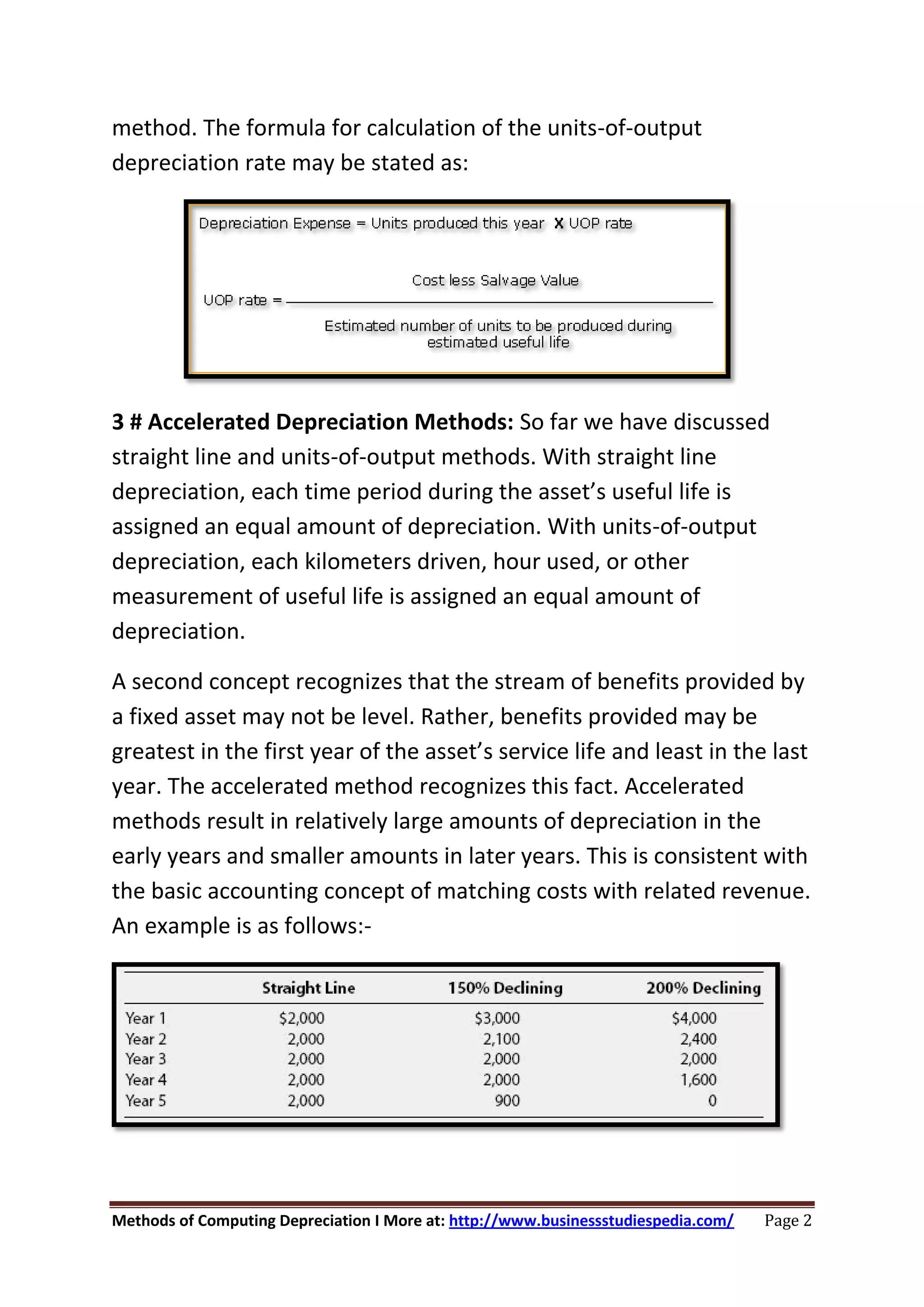
method. The formula for calculation of the units-of-output
depreciation rate may be stated as:
3 # Accelerated Depreciation Methods: So far we have discussed
straight line and units-of-output methods. With straight line
depreciation, each time period during the asset’s useful life is
assigned an equal amount of depreciation. With units-of-output
depreciation, each kilometers driven, hour used, or other
measurement of useful life is assigned an equal amount of
depreciation.
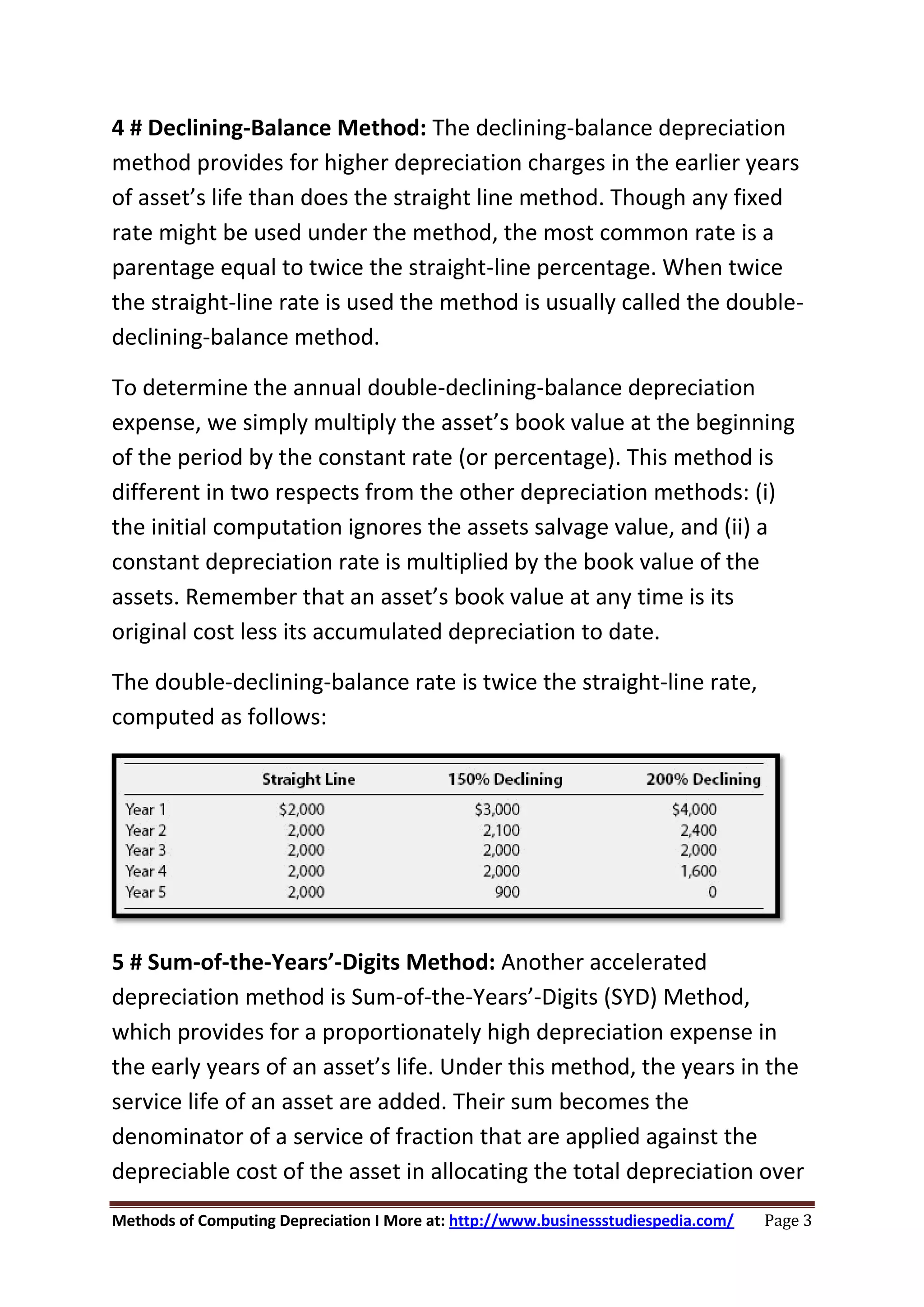
A second concept recognizes that the stream of benefits provided by
a fixed asset may not be level. Rather, benefits provided may be
greatest in the first year of the asset’s service life and least in the last
year. The accelerated method recognizes this fact. Accelerated
methods result in relatively large amounts of depreciation in the
early years and smaller amounts in later years. This is consistent with
the basic accounting concept of matching costs with related revenue.
An example is as follows:-
Methods of Computing Depreciation I More at: http://www.businessstudiespedia.com/ Page 3
4 # Declining-Balance Method: The declining-balance depreciation
method provides for higher depreciation charges in the earlier years
of asset’s life than does the straight line method. Though any fixed
rate might be used under the method, the most common rate is a
parentage equal to twice the straight-line percentage. When twice
the straight-line rate is used the method is usually called the double-
declining-balance method.
To determine the annual double-declining-balance depreciation
expense, we simply multiply the asset’s book value at the beginning
of the period by the constant rate (or percentage). This method is
different in two respects from the other depreciation methods: (i)
the initial computation ignores the assets salvage value, and (ii) a
constant depreciation rate is multiplied by the book value of the
assets. Remember that an asset’s book value at any time is its
original cost less its accumulated depreciation to date.
The double-declining-balance rate is twice the straight-line rate,
computed as follows:
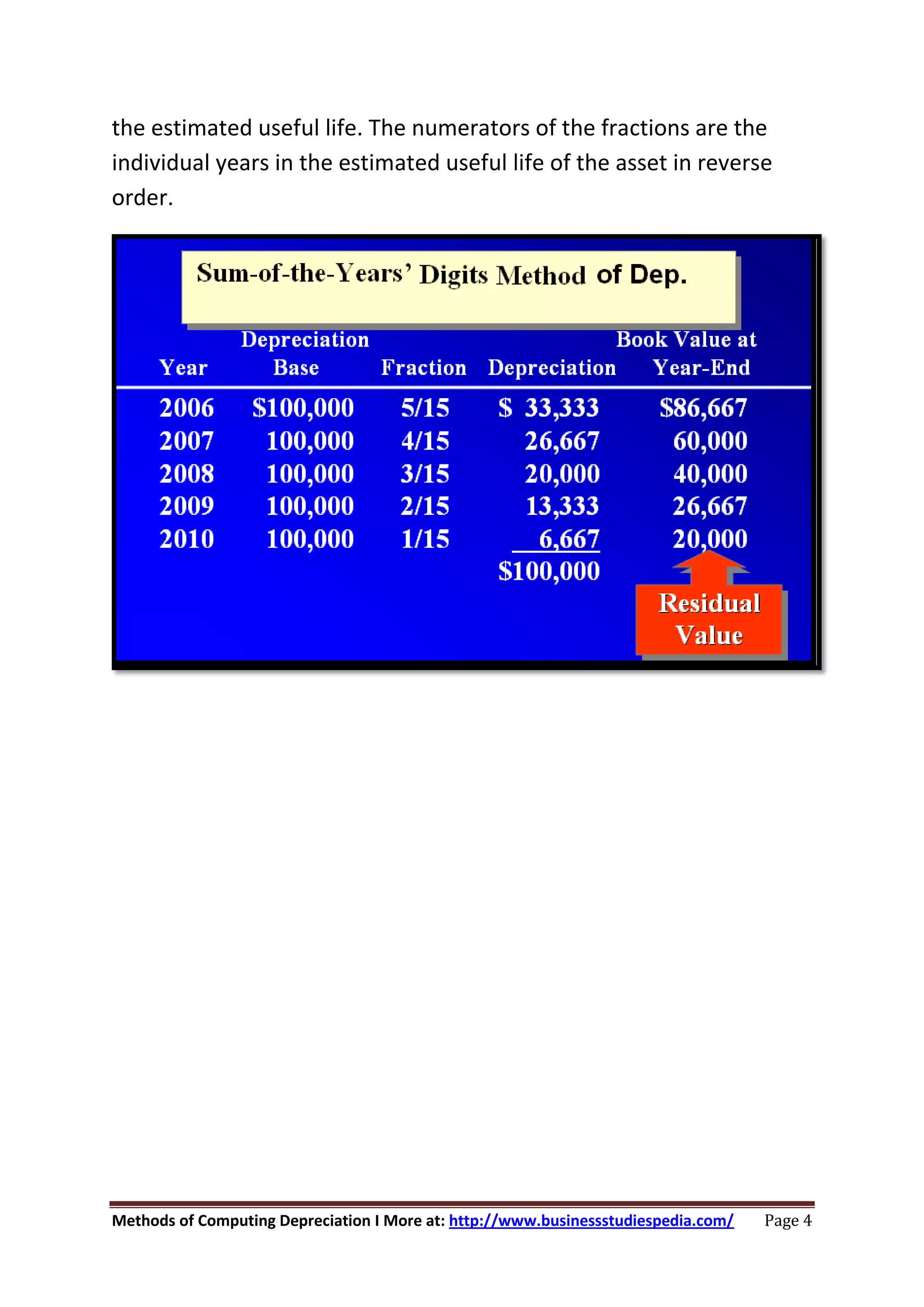
5 # Sum-of-the-Years’-Digits Method: Another accelerated
depreciation method is Sum-of-the-Years’-Digits (SYD) Method,
which provides for a proportionately high depreciation expense in
the early years of an asset’s life. Under this method, the years in the
service life of an asset are added. Their sum becomes the
denominator of a service of fraction that are applied against the
depreciable cost of the asset in allocating the total depreciation over
Methods of Computing Depreciation I More at: http://www.businessstudiespedia.com/ Page 4
the estimated useful life. The numerators of the fractions are the
individual years in the estimated useful life of the asset in reverse
order.

Methods of computing depreciation

  • 1.
    Methods of ComputingDepreciation I More at: http://www.businessstudiespedia.com/ Page 1 What are the Methods of Computing Depreciation Depreciation can be charged based on different methods which are found suitable in different circumstances relevant to nature of assets and business. Further, it is not necessary that an enterprise employ single method for all classes of its depreciable assets. There are several methods that can be used for depreciating the cost of assets for financial reporting. The most common methods are: (i) Straight line method, (ii) two accelerated methods known as the declining-balance method and sum-of-the-years’ digits methods. Each of them is proper for certain circumstances. For example, a company may use straight line depreciation on some assets and sum- of-the-years’ digits method for other assets. 1 # Straight-line method: The straight-line depreciation is probably the simplest and most widely used method of computing depreciation. It assumes that an asset’s cost should be assigned equally to all periods benefited. The formula for calculating annual Straight-line depreciation is: 2 # Units-of-output Method: The units-of-output method of depreciation on assets is based on the assumption that depreciation is solely the result of use and the passage of time plays no role in the depreciation process. This method is used primarily when a company expects that asset usage will vary significantly from year to year. Of course, if use is uniformly spread over the assets life, the units-of-production method will produce the same depreciation result as the straight-line
  • 2.
    Methods of ComputingDepreciation I More at: http://www.businessstudiespedia.com/ Page 2 method. The formula for calculation of the units-of-output depreciation rate may be stated as: 3 # Accelerated Depreciation Methods: So far we have discussed straight line and units-of-output methods. With straight line depreciation, each time period during the asset’s useful life is assigned an equal amount of depreciation. With units-of-output depreciation, each kilometers driven, hour used, or other measurement of useful life is assigned an equal amount of depreciation. A second concept recognizes that the stream of benefits provided by a fixed asset may not be level. Rather, benefits provided may be greatest in the first year of the asset’s service life and least in the last year. The accelerated method recognizes this fact. Accelerated methods result in relatively large amounts of depreciation in the early years and smaller amounts in later years. This is consistent with the basic accounting concept of matching costs with related revenue. An example is as follows:-
  • 3.
    Methods of ComputingDepreciation I More at: http://www.businessstudiespedia.com/ Page 3 4 # Declining-Balance Method: The declining-balance depreciation method provides for higher depreciation charges in the earlier years of asset’s life than does the straight line method. Though any fixed rate might be used under the method, the most common rate is a parentage equal to twice the straight-line percentage. When twice the straight-line rate is used the method is usually called the double- declining-balance method. To determine the annual double-declining-balance depreciation expense, we simply multiply the asset’s book value at the beginning of the period by the constant rate (or percentage). This method is different in two respects from the other depreciation methods: (i) the initial computation ignores the assets salvage value, and (ii) a constant depreciation rate is multiplied by the book value of the assets. Remember that an asset’s book value at any time is its original cost less its accumulated depreciation to date. The double-declining-balance rate is twice the straight-line rate, computed as follows: 5 # Sum-of-the-Years’-Digits Method: Another accelerated depreciation method is Sum-of-the-Years’-Digits (SYD) Method, which provides for a proportionately high depreciation expense in the early years of an asset’s life. Under this method, the years in the service life of an asset are added. Their sum becomes the denominator of a service of fraction that are applied against the depreciable cost of the asset in allocating the total depreciation over
  • 4.
    Methods of ComputingDepreciation I More at: http://www.businessstudiespedia.com/ Page 4 the estimated useful life. The numerators of the fractions are the individual years in the estimated useful life of the asset in reverse order.