DNA
DNA was first recognized and identified by the Swiss
biologist, Johannes Friedrich Miescher in 1869 during his
research on white blood cells.
The double helix structure of a DNA molecule was later
discovered through the experimental data by James Watson
and Francis Crick. Finally, it was proved that DNA is
responsible for storing the genetic information in living
organisms.
Salahaddin university,college of education,biology department
2020-2021
What is DNA?
“DNA is a group of molecules that is responsible for carrying and
transmitting the hereditary materials or the genetic instructions
from parents to offsprings.”
This is also true for viruses as most of these entities have either
RNA or DNA as their genetic material. For instance, some viruses
may have RNA as their genetic material, while others have DNA
as the genetic material. The Human Immunodeficiency Virus
(HIV) contains RNA, which is then converted into DNA after
attaching itself to the host cell.
.
DNA Types
Who Discovered DNA?
There are three different DNA types:
A-DNA: It is a right-handed double helix similar to the B-
DNA form. Dehydrated DNA takes an A form that protects
the DNA during extreme condition such as desiccation.
Protein binding also removes the solvent from DNA and
the DNA takes an A form.
B-DNA: This is the most common DNA conformation and
is a right-handed helix. Majority of DNA has a B type
conformation under normal physiological conditions.
Z-DNA: Z-DNA is a left-handed DNA where the double
helix winds to the left in a zig-zag pattern. It was
discovered by Andres Wang and Alexander Rich. It is
found ahead of the start site of a gene and hence, is
believed to play some role in gene regulation.
DNA Structure
The DNA structure can be thought of like a twisted ladder. This structure is
described as a double-helix, as illustrated in the figure above. It is a nucleic acid,
and all nucleic acids are made up of nucleotides. The DNA molecule is
composed of units called nucleotides, and each nucleotide is composed of three
different components, such as sugar, phosphate groups and nitrogen bases.
The basic building blocks of DNA are nucleotides, which are composed of a
sugar group, a phosphate group, and a nitrogen base. The sugar and phosphate
groups link the nucleotides together to form each strand of DNA. Adenine (A),
Thymine (T), Guanine (G) and Cytosine (C) are four types of nitrogen bases.
These 4 Nitrogenous bases pair together in the following way: A with T, and C
with G. These base pairs are essential for the DNA’s double helix structure,
which resembles a twisted ladder.
The order of the nitrogenous bases determines the genetic code or the DNA’s
instructions.
DNA Structure
Among the three components of DNA structure, sugar is the one which
forms the backbone of the DNA molecule. It is also called deoxyribose.
The nitrogenous bases of the opposite strands form hydrogen bonds,
forming a ladder-like structure.
Structure of DNA
The DNA molecule consists of 4 nitrogen bases, namely adenine (A),
thymine (T), cytosine (C) and Guanine (G) which ultimately forms the
structure of a nucleotide. The A and G are purines and the C and T
are pyrimidines.
The two strands of DNA run in opposite directions. These strands are
held together by the hydrogen bond that is present between the two
complementary bases. The strands are helically twisted, where each
strand forms a right-handed coil and ten nucleotides make up a
single turn.
The pitch of each helix is 3.4 nm. Hence, the distance between two
consecutive base pairs (i.e., hydrogen-bonded bases of the opposite
strands) is 0.34 nm.
DNA is the genetic material which carries all the hereditary
information. Genes are the small segments of DNA, consisting
mostly of 250 – 2 million base pairs. A gene code for a
polypeptide molecule, where three nitrogenous bases
sequence stands for one amino acid.
Polypeptide chains are further folded in secondary, tertiary and
quaternary structure to form different proteins. As every
organism contains many genes in their DNA, different types of
proteins can be formed. Proteins are the main functional and
structural molecules in most of the organisms. Apart from
storing genetic information, DNA is involved in:
Replication process: Transferring the genetic information from
one cell to its daughters and from one generation to the next
and equal distribution of DNA during the cell division
Mutations: The changes which occur in the DNA sequences
Transcription
Cellular Metabolism
DNA Fingerprinting
Gene Therapy
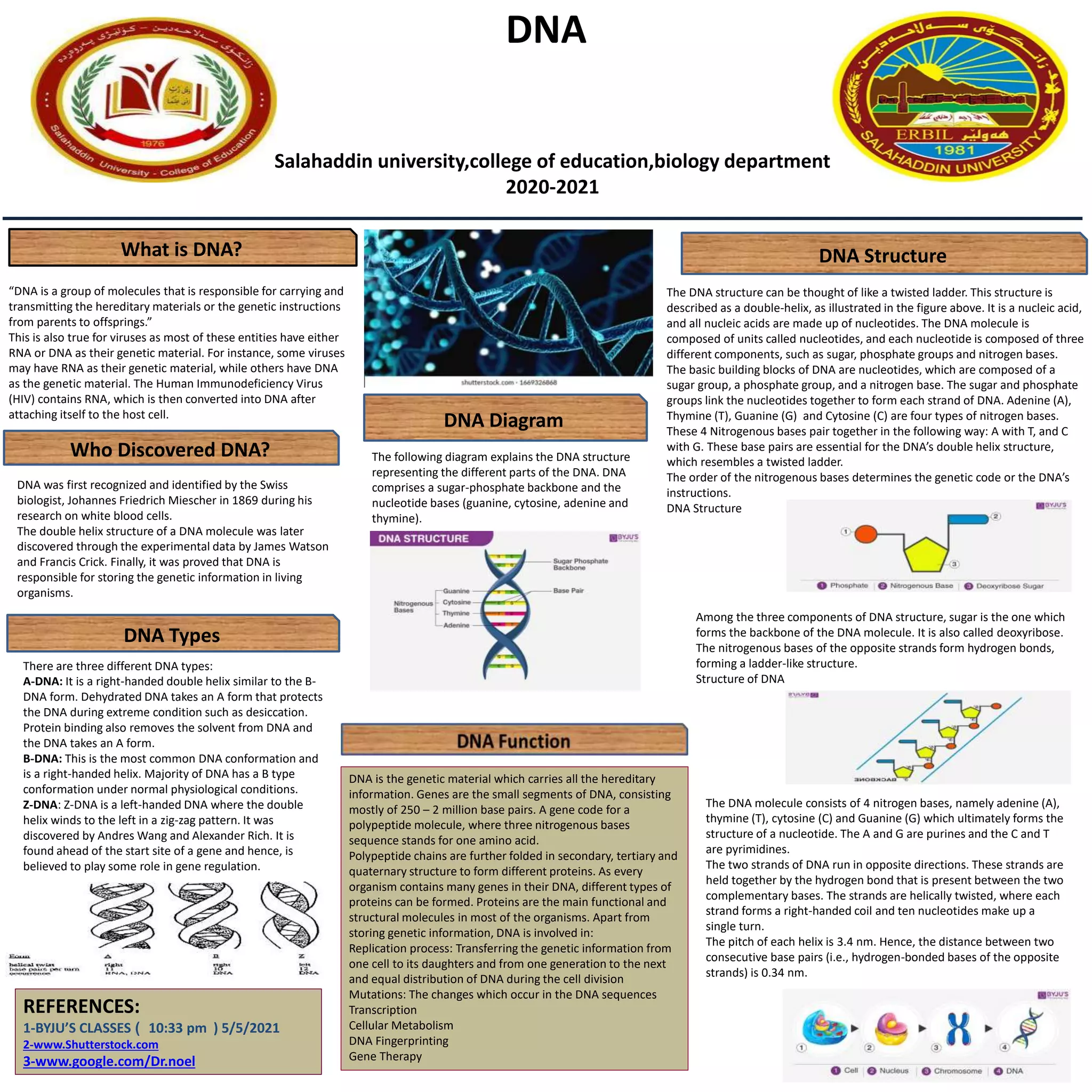
DNA Diagram
The following diagram explains the DNA structure
representing the different parts of the DNA. DNA
comprises a sugar-phosphate backbone and the
nucleotide bases (guanine, cytosine, adenine and
thymine).
REFERENCES:
10:33 pm ) 5/5/2021
)
1-BYJU’S CLASSES
2-www.Shutterstock.com
3-www.google.com/Dr.noel
PREPARED BY:Asma Afan Majid
Marwa Ali Abdullah
SUPERVISED BY:Dr.Wand Khals Ali
DNA
DNA was first recognized and identified by the Swiss
biologist, Johannes Friedrich Miescher in 1869 during his
research on white blood cells.
The double helix structure of a DNA molecule was later
discovered through the experimental data by James Watson
and Francis Crick. Finally, it was proved that DNA is
responsible for storing the genetic information in living
organisms.
Salahaddin university,college of education,biology department
2020-2021
What is DNA?
“DNA is a group of molecules that is responsible for carrying and
transmitting the hereditary materials or the genetic instructions
from parents to offsprings.”
This is also true for viruses as most of these entities have either
RNA or DNA as their genetic material. For instance, some viruses
may have RNA as their genetic material, while others have DNA
as the genetic material. The Human Immunodeficiency Virus
(HIV) contains RNA, which is then converted into DNA after
attaching itself to the host cell.
.
DNA Types
Who Discovered DNA?
There are three different DNA types:
A-DNA: It is a right-handed double helix similar to the B-
DNA form. Dehydrated DNA takes an A form that protects
the DNA during extreme condition such as desiccation.
Protein binding also removes the solvent from DNA and
the DNA takes an A form.
B-DNA: This is the most common DNA conformation and
is a right-handed helix. Majority of DNA has a B type
conformation under normal physiological conditions.
Z-DNA: Z-DNA is a left-handed DNA where the double
helix winds to the left in a zig-zag pattern. It was
discovered by Andres Wang and Alexander Rich. It is
found ahead of the start site of a gene and hence, is
believed to play some role in gene regulation.
DNA Structure
The DNA structure can be thought of like a twisted ladder. This structure is
described as a double-helix, as illustrated in the figure above. It is a nucleic acid,
and all nucleic acids are made up of nucleotides. The DNA molecule is
composed of units called nucleotides, and each nucleotide is composed of three
different components, such as sugar, phosphate groups and nitrogen bases.
The basic building blocks of DNA are nucleotides, which are composed of a
sugar group, a phosphate group, and a nitrogen base. The sugar and phosphate
groups link the nucleotides together to form each strand of DNA. Adenine (A),
Thymine (T), Guanine (G) and Cytosine (C) are four types of nitrogen bases.
These 4 Nitrogenous bases pair together in the following way: A with T, and C
with G. These base pairs are essential for the DNA’s double helix structure,
which resembles a twisted ladder.
The order of the nitrogenous bases determines the genetic code or the DNA’s
instructions.
DNA Structure
Among the three components of DNA structure, sugar is the one which
forms the backbone of the DNA molecule. It is also called deoxyribose.
The nitrogenous bases of the opposite strands form hydrogen bonds,
forming a ladder-like structure.
Structure of DNA
The DNA molecule consists of 4 nitrogen bases, namely adenine (A),
thymine (T), cytosine (C) and Guanine (G) which ultimately forms the
structure of a nucleotide. The A and G are purines and the C and T
are pyrimidines.
The two strands of DNA run in opposite directions. These strands are
held together by the hydrogen bond that is present between the two
complementary bases. The strands are helically twisted, where each
strand forms a right-handed coil and ten nucleotides make up a
single turn.
The pitch of each helix is 3.4 nm. Hence, the distance between two
consecutive base pairs (i.e., hydrogen-bonded bases of the opposite
strands) is 0.34 nm.
DNA is the genetic material which carries all the hereditary
information. Genes are the small segments of DNA, consisting
mostly of 250 – 2 million base pairs. A gene code for a
polypeptide molecule, where three nitrogenous bases
sequence stands for one amino acid.
Polypeptide chains are further folded in secondary, tertiary and
quaternary structure to form different proteins. As every
organism contains many genes in their DNA, different types of
proteins can be formed. Proteins are the main functional and
structural molecules in most of the organisms. Apart from
storing genetic information, DNA is involved in:
Replication process: Transferring the genetic information from
one cell to its daughters and from one generation to the next
and equal distribution of DNA during the cell division
Mutations: The changes which occur in the DNA sequences
Transcription
Cellular Metabolism
DNA Fingerprinting
Gene Therapy
DNA Diagram
The following diagram explains the DNA structure
representing the different parts of the DNA. DNA
comprises a sugar-phosphate backbone and the
nucleotide bases (guanine, cytosine, adenine and
thymine).
REFERENCES:
10:33 pm ) 5/5/2021
)
1-BYJU’S CLASSES
2-www.Shutterstock.com
3-www.google.com/Dr.noel

asma poster.pptx

  • 1.
    DNA DNA was firstrecognized and identified by the Swiss biologist, Johannes Friedrich Miescher in 1869 during his research on white blood cells. The double helix structure of a DNA molecule was later discovered through the experimental data by James Watson and Francis Crick. Finally, it was proved that DNA is responsible for storing the genetic information in living organisms. Salahaddin university,college of education,biology department 2020-2021 What is DNA? “DNA is a group of molecules that is responsible for carrying and transmitting the hereditary materials or the genetic instructions from parents to offsprings.” This is also true for viruses as most of these entities have either RNA or DNA as their genetic material. For instance, some viruses may have RNA as their genetic material, while others have DNA as the genetic material. The Human Immunodeficiency Virus (HIV) contains RNA, which is then converted into DNA after attaching itself to the host cell. . DNA Types Who Discovered DNA? There are three different DNA types: A-DNA: It is a right-handed double helix similar to the B- DNA form. Dehydrated DNA takes an A form that protects the DNA during extreme condition such as desiccation. Protein binding also removes the solvent from DNA and the DNA takes an A form. B-DNA: This is the most common DNA conformation and is a right-handed helix. Majority of DNA has a B type conformation under normal physiological conditions. Z-DNA: Z-DNA is a left-handed DNA where the double helix winds to the left in a zig-zag pattern. It was discovered by Andres Wang and Alexander Rich. It is found ahead of the start site of a gene and hence, is believed to play some role in gene regulation. DNA Structure The DNA structure can be thought of like a twisted ladder. This structure is described as a double-helix, as illustrated in the figure above. It is a nucleic acid, and all nucleic acids are made up of nucleotides. The DNA molecule is composed of units called nucleotides, and each nucleotide is composed of three different components, such as sugar, phosphate groups and nitrogen bases. The basic building blocks of DNA are nucleotides, which are composed of a sugar group, a phosphate group, and a nitrogen base. The sugar and phosphate groups link the nucleotides together to form each strand of DNA. Adenine (A), Thymine (T), Guanine (G) and Cytosine (C) are four types of nitrogen bases. These 4 Nitrogenous bases pair together in the following way: A with T, and C with G. These base pairs are essential for the DNA’s double helix structure, which resembles a twisted ladder. The order of the nitrogenous bases determines the genetic code or the DNA’s instructions. DNA Structure Among the three components of DNA structure, sugar is the one which forms the backbone of the DNA molecule. It is also called deoxyribose. The nitrogenous bases of the opposite strands form hydrogen bonds, forming a ladder-like structure. Structure of DNA The DNA molecule consists of 4 nitrogen bases, namely adenine (A), thymine (T), cytosine (C) and Guanine (G) which ultimately forms the structure of a nucleotide. The A and G are purines and the C and T are pyrimidines. The two strands of DNA run in opposite directions. These strands are held together by the hydrogen bond that is present between the two complementary bases. The strands are helically twisted, where each strand forms a right-handed coil and ten nucleotides make up a single turn. The pitch of each helix is 3.4 nm. Hence, the distance between two consecutive base pairs (i.e., hydrogen-bonded bases of the opposite strands) is 0.34 nm. DNA is the genetic material which carries all the hereditary information. Genes are the small segments of DNA, consisting mostly of 250 – 2 million base pairs. A gene code for a polypeptide molecule, where three nitrogenous bases sequence stands for one amino acid. Polypeptide chains are further folded in secondary, tertiary and quaternary structure to form different proteins. As every organism contains many genes in their DNA, different types of proteins can be formed. Proteins are the main functional and structural molecules in most of the organisms. Apart from storing genetic information, DNA is involved in: Replication process: Transferring the genetic information from one cell to its daughters and from one generation to the next and equal distribution of DNA during the cell division Mutations: The changes which occur in the DNA sequences Transcription Cellular Metabolism DNA Fingerprinting Gene Therapy DNA Diagram The following diagram explains the DNA structure representing the different parts of the DNA. DNA comprises a sugar-phosphate backbone and the nucleotide bases (guanine, cytosine, adenine and thymine). REFERENCES: 10:33 pm ) 5/5/2021 ) 1-BYJU’S CLASSES 2-www.Shutterstock.com 3-www.google.com/Dr.noel
  • 2.
    PREPARED BY:Asma AfanMajid Marwa Ali Abdullah SUPERVISED BY:Dr.Wand Khals Ali DNA DNA was first recognized and identified by the Swiss biologist, Johannes Friedrich Miescher in 1869 during his research on white blood cells. The double helix structure of a DNA molecule was later discovered through the experimental data by James Watson and Francis Crick. Finally, it was proved that DNA is responsible for storing the genetic information in living organisms. Salahaddin university,college of education,biology department 2020-2021 What is DNA? “DNA is a group of molecules that is responsible for carrying and transmitting the hereditary materials or the genetic instructions from parents to offsprings.” This is also true for viruses as most of these entities have either RNA or DNA as their genetic material. For instance, some viruses may have RNA as their genetic material, while others have DNA as the genetic material. The Human Immunodeficiency Virus (HIV) contains RNA, which is then converted into DNA after attaching itself to the host cell. . DNA Types Who Discovered DNA? There are three different DNA types: A-DNA: It is a right-handed double helix similar to the B- DNA form. Dehydrated DNA takes an A form that protects the DNA during extreme condition such as desiccation. Protein binding also removes the solvent from DNA and the DNA takes an A form. B-DNA: This is the most common DNA conformation and is a right-handed helix. Majority of DNA has a B type conformation under normal physiological conditions. Z-DNA: Z-DNA is a left-handed DNA where the double helix winds to the left in a zig-zag pattern. It was discovered by Andres Wang and Alexander Rich. It is found ahead of the start site of a gene and hence, is believed to play some role in gene regulation. DNA Structure The DNA structure can be thought of like a twisted ladder. This structure is described as a double-helix, as illustrated in the figure above. It is a nucleic acid, and all nucleic acids are made up of nucleotides. The DNA molecule is composed of units called nucleotides, and each nucleotide is composed of three different components, such as sugar, phosphate groups and nitrogen bases. The basic building blocks of DNA are nucleotides, which are composed of a sugar group, a phosphate group, and a nitrogen base. The sugar and phosphate groups link the nucleotides together to form each strand of DNA. Adenine (A), Thymine (T), Guanine (G) and Cytosine (C) are four types of nitrogen bases. These 4 Nitrogenous bases pair together in the following way: A with T, and C with G. These base pairs are essential for the DNA’s double helix structure, which resembles a twisted ladder. The order of the nitrogenous bases determines the genetic code or the DNA’s instructions. DNA Structure Among the three components of DNA structure, sugar is the one which forms the backbone of the DNA molecule. It is also called deoxyribose. The nitrogenous bases of the opposite strands form hydrogen bonds, forming a ladder-like structure. Structure of DNA The DNA molecule consists of 4 nitrogen bases, namely adenine (A), thymine (T), cytosine (C) and Guanine (G) which ultimately forms the structure of a nucleotide. The A and G are purines and the C and T are pyrimidines. The two strands of DNA run in opposite directions. These strands are held together by the hydrogen bond that is present between the two complementary bases. The strands are helically twisted, where each strand forms a right-handed coil and ten nucleotides make up a single turn. The pitch of each helix is 3.4 nm. Hence, the distance between two consecutive base pairs (i.e., hydrogen-bonded bases of the opposite strands) is 0.34 nm. DNA is the genetic material which carries all the hereditary information. Genes are the small segments of DNA, consisting mostly of 250 – 2 million base pairs. A gene code for a polypeptide molecule, where three nitrogenous bases sequence stands for one amino acid. Polypeptide chains are further folded in secondary, tertiary and quaternary structure to form different proteins. As every organism contains many genes in their DNA, different types of proteins can be formed. Proteins are the main functional and structural molecules in most of the organisms. Apart from storing genetic information, DNA is involved in: Replication process: Transferring the genetic information from one cell to its daughters and from one generation to the next and equal distribution of DNA during the cell division Mutations: The changes which occur in the DNA sequences Transcription Cellular Metabolism DNA Fingerprinting Gene Therapy DNA Diagram The following diagram explains the DNA structure representing the different parts of the DNA. DNA comprises a sugar-phosphate backbone and the nucleotide bases (guanine, cytosine, adenine and thymine). REFERENCES: 10:33 pm ) 5/5/2021 ) 1-BYJU’S CLASSES 2-www.Shutterstock.com 3-www.google.com/Dr.noel