DNA forms and structures
PRESENTATION BY:
MUHAMMAD AWAIS TARIQ
0723-BH-E-ZOO-20
What is DNA?
 DNA is a group of molecules that is responsible for carrying and transmitting the
hereditary materials or the genetic instructions from parents to offsprings.
 DNA is known as Deoxyribonucleic acid.It is an organic compound that has a
unique molecular structure.
 It is found in all prokaryotic and eukaryotic cells.
 Nuclear DNA is the DNA contained within the nucleus of every cells in eukaryotic
organisms.
 It codes for the majority of organisms genome.
 The DNA present in the mitochondria of the cell is termed as mitochondrial DNA.It
is inherited from mother to the child.
 In humans,there are approximately 16,000 base pairs of mitochondrial DNA.
 Similarly plastids have their own DNA and they play an essential role in
photosynthesis.
Discovery of DNA
 DNA was first recognized and identified by the Swiss biologist Johanes Friedrich
Meischer in 1869 during his research on white blood cells.
 The double helical structure of a DNA molecule was later discovered through the
experimental data by James Watson and Francis Crick.
 It was proved that DNA is responsible for storing genetic information in living
organisms.
DNA Diagram
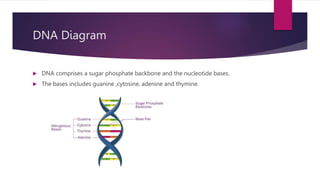
 DNA comprises a sugar phosphate backbone and the nucleotide bases.
 The bases includes guanine ,cytosine, adenine and thymine.
Chargaff’s Rule
 Erwin Chargaff ,a biochemist ,discovered that the number of nitrogenous bases in
the DNA was present in equal quantities.
 The amount of A is equal to T ,whereas the amount of C is equal to G.
 A=T;C=G
DNA Structure
 The DNA structure can be thought of as a twisted ladder.This structure is
described as a double helix .
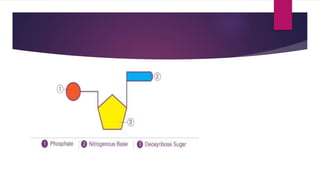
 It is a nucleic acid and all nucleic acids are made up of Nucleotide and each
nucleotide is composed of three different components such as sugar ,phosphate
groups and nitrogenous bases.
 The sugar and phosphate group links the Nucleotides together to form each
strand of DNA.
 There are 4 Nitrogenous base pairs together in the following way:A with T ,and C
with G.
 These base pairs are essential for the DNA’s double helical structure ,which
resembles a twisted ladder.
 The order of the nitrogenous bases determine the genetic code or the DNA’s
instructions.
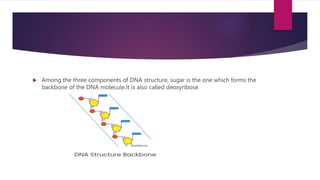
 Among the three components of DNA structure, sugar is the one which forms the
backbone of the DNA molecule.It is also called deoxyribose.
 The two strands of DNA run in opposite directions. These strands are held
together by the hydrogen band that is present between the two complementary
bases.
 The strands are helical twisted ,where each strand forms a right handed coil,and
then Nucleotides makes up a single turn.
 The pitch of each helix is 3.4 nm.Hence ,the distance between two consecutive
base pairs is 0.34nm.
DNA Types
 There are three different DNA types which are as follows:
 A-DNA
 B-DNA
 Z-DNA
A DNA
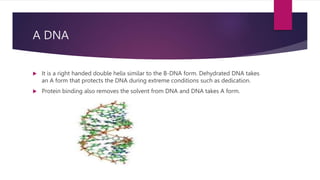
 It is a right handed double helix similar to the B-DNA form. Dehydrated DNA takes
an A form that protects the DNA during extreme conditions such as dedication.
 Protein binding also removes the solvent from DNA and DNA takes A form.
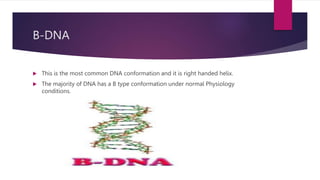
B-DNA
 This is the most common DNA conformation and it is right handed helix.
 The majority of DNA has a B type conformation under normal Physiology
conditions.
Z-DNA
 Z-DNA is a left handed DNA where the double helix winds to the left in zig zag
pattern.
 It was discovered by Andres Wang and Alexander Rich.
 It is found ahead of the start site of a gene and hence, is believed to play some
role in gene regulation.
DNA Function
 DNA is the genetic material which carries all the hereditary information. Apart
from storing genetic information, DNA is involved in:
 Replication process:Transferring the genetic information from one cell to its
daughter and from one generation to next and equal distribution of DNA during
the cell division.
 Mutations.
 Transcription
 Cellular metabolism
 Gene therapy

DNA forms and Structures 0723bh-e-zoo-20.pptx

  • 1.
    DNA forms andstructures PRESENTATION BY: MUHAMMAD AWAIS TARIQ 0723-BH-E-ZOO-20
  • 2.
    What is DNA? DNA is a group of molecules that is responsible for carrying and transmitting the hereditary materials or the genetic instructions from parents to offsprings.  DNA is known as Deoxyribonucleic acid.It is an organic compound that has a unique molecular structure.  It is found in all prokaryotic and eukaryotic cells.  Nuclear DNA is the DNA contained within the nucleus of every cells in eukaryotic organisms.  It codes for the majority of organisms genome.
  • 3.
     The DNApresent in the mitochondria of the cell is termed as mitochondrial DNA.It is inherited from mother to the child.  In humans,there are approximately 16,000 base pairs of mitochondrial DNA.  Similarly plastids have their own DNA and they play an essential role in photosynthesis.
  • 4.
    Discovery of DNA DNA was first recognized and identified by the Swiss biologist Johanes Friedrich Meischer in 1869 during his research on white blood cells.  The double helical structure of a DNA molecule was later discovered through the experimental data by James Watson and Francis Crick.  It was proved that DNA is responsible for storing genetic information in living organisms.
  • 5.
    DNA Diagram  DNAcomprises a sugar phosphate backbone and the nucleotide bases.  The bases includes guanine ,cytosine, adenine and thymine.
  • 6.
    Chargaff’s Rule  ErwinChargaff ,a biochemist ,discovered that the number of nitrogenous bases in the DNA was present in equal quantities.  The amount of A is equal to T ,whereas the amount of C is equal to G.  A=T;C=G
  • 7.
    DNA Structure  TheDNA structure can be thought of as a twisted ladder.This structure is described as a double helix .  It is a nucleic acid and all nucleic acids are made up of Nucleotide and each nucleotide is composed of three different components such as sugar ,phosphate groups and nitrogenous bases.  The sugar and phosphate group links the Nucleotides together to form each strand of DNA.
  • 8.
     There are4 Nitrogenous base pairs together in the following way:A with T ,and C with G.  These base pairs are essential for the DNA’s double helical structure ,which resembles a twisted ladder.  The order of the nitrogenous bases determine the genetic code or the DNA’s instructions.
  • 10.
     Among thethree components of DNA structure, sugar is the one which forms the backbone of the DNA molecule.It is also called deoxyribose.
  • 11.
     The twostrands of DNA run in opposite directions. These strands are held together by the hydrogen band that is present between the two complementary bases.  The strands are helical twisted ,where each strand forms a right handed coil,and then Nucleotides makes up a single turn.  The pitch of each helix is 3.4 nm.Hence ,the distance between two consecutive base pairs is 0.34nm.
  • 12.
    DNA Types  Thereare three different DNA types which are as follows:  A-DNA  B-DNA  Z-DNA
  • 13.
    A DNA  Itis a right handed double helix similar to the B-DNA form. Dehydrated DNA takes an A form that protects the DNA during extreme conditions such as dedication.  Protein binding also removes the solvent from DNA and DNA takes A form.
  • 14.
    B-DNA  This isthe most common DNA conformation and it is right handed helix.  The majority of DNA has a B type conformation under normal Physiology conditions.
  • 15.
    Z-DNA  Z-DNA isa left handed DNA where the double helix winds to the left in zig zag pattern.  It was discovered by Andres Wang and Alexander Rich.  It is found ahead of the start site of a gene and hence, is believed to play some role in gene regulation.
  • 16.
    DNA Function  DNAis the genetic material which carries all the hereditary information. Apart from storing genetic information, DNA is involved in:  Replication process:Transferring the genetic information from one cell to its daughter and from one generation to next and equal distribution of DNA during the cell division.  Mutations.  Transcription  Cellular metabolism  Gene therapy