Dental Products
Abhishek B Rai
Dental Products
Dental hygiene has been associated with daily routines since long. Poor
dental health in India can be regarded to ignorance, illiteracy, habits of chewing
tobacco/pan/pan masala etc.
Dental health as well as dental hygiene can be maintained with literacy
about dental anatomy, physiology and pathophysiology, and regular care of teeth.
Teeth play fundamental part in digestion by biting and chewing and
mechanically breaking the food and with the help of tongue mixing the saliva,
making the food wet and beginning the process of digestion.
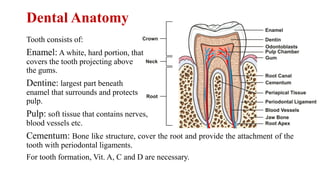
Dental Anatomy
Tooth consists of:
Enamel: A white, hard portion, that
covers the tooth projecting above
the gums.
Dentine: largest part beneath
enamel that surrounds and protects
pulp.
Pulp: soft tissue that contains nerves,
blood vessels etc.
Cementum: Bone like structure, cover the root and provide the attachment of the
tooth with periodontal ligaments.
For tooth formation, Vit. A, C and D are necessary.
Common terminology
Abscess: Serious infection that may lead to severe decay. Symptoms include pain
and swelling. Treatment includes Root Canal Therapy.
Bleaching: Applying a bleaching agent like Hydrogen peroxide to whiten
discoloured or stained teeth.
Bonding: Attaching tooth coloured materials to stained/damaged teeth to restore
tooth’s colour/shape.
Bridge/fixed bridge: one or more artificial teeth fixed in mouth by attachments to
neighbouring teeth which is generally joined by crowns of either sides of the
artificial teeth.
Crown/Cap: Artificial cover for a decayed/damaged tooth. Generally made up of
plastic, metal, porcelain or composition of porcelain and metal.
Filling: Material used to fill a cavity. Usually composed of a amalgam, plastic,
porcelain or gold.
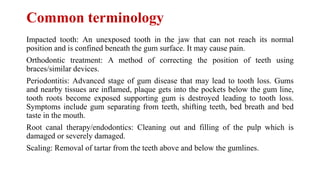
Common terminology
Impacted tooth: An unexposed tooth in the jaw that can not reach its normal
position and is confined beneath the gum surface. It may cause pain.
Orthodontic treatment: A method of correcting the position of teeth using
braces/similar devices.
Periodontitis: Advanced stage of gum disease that may lead to tooth loss. Gums
and nearby tissues are inflamed, plaque gets into the pockets below the gum line,
tooth roots become exposed supporting gum is destroyed leading to tooth loss.
Symptoms include gum separating from teeth, shifting teeth, bed breath and bed
taste in the mouth.
Root canal therapy/endodontics: Cleaning out and filling of the pulp which is
damaged or severely damaged.
Scaling: Removal of tartar from the teeth above and below the gumlines.
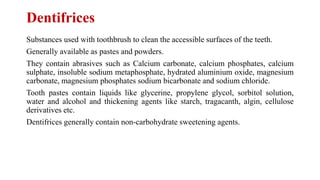
Dentifrices
Substances used with toothbrush to clean the accessible surfaces of the teeth.
Generally available as pastes and powders.
They contain abrasives such as Calcium carbonate, calcium phosphates, calcium
sulphate, insoluble sodium metaphosphate, hydrated aluminium oxide, magnesium
carbonate, magnesium phosphates sodium bicarbonate and sodium chloride.
Tooth pastes contain liquids like glycerine, propylene glycol, sorbitol solution,
water and alcohol and thickening agents like starch, tragacanth, algin, cellulose
derivatives etc.
Dentifrices generally contain non-carbohydrate sweetening agents.
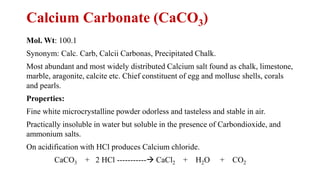
Calcium Carbonate (CaCO3)
Mol. Wt: 100.1
Synonym: Calc. Carb, Calcii Carbonas, Precipitated Chalk.
Most abundant and most widely distributed Calcium salt found as chalk, limestone,
marble, aragonite, calcite etc. Chief constituent of egg and mollusc shells, corals
and pearls.
Properties:
Fine white microcrystalline powder odorless and tasteless and stable in air.
Practically insoluble in water but soluble in the presence of Carbondioxide, and
ammonium salts.
On acidification with HCl produces Calcium chloride.
CaCO3 + 2 HCl -----------→ CaCl2 + H2O + CO2
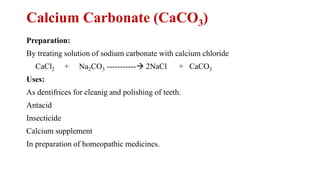
Calcium Carbonate (CaCO3)
Preparation:
By treating solution of sodium carbonate with calcium chloride
CaCl2 + Na2CO3 -----------→ 2NaCl + CaCO3
Uses:
As dentifrices for cleanig and polishing of teeth.
Antacid
Insecticide
Calcium supplement
In preparation of homeopathic medicines.
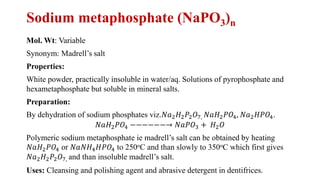
Sodium metaphosphate (NaPO3)n
Mol. Wt: Variable
Synonym: Madrell’s salt
Properties:
White powder, practically insoluble in water/aq. Solutions of pyrophosphate and
hexametaphosphate but soluble in mineral salts.
Preparation:
By dehydration of sodium phosphates viz.𝑁𝑎2𝐻2𝑃2𝑂7, 𝑁𝑎𝐻2𝑃𝑂4, 𝑁𝑎2𝐻𝑃𝑂4.
𝑁𝑎𝐻2𝑃𝑂4 −−−−−−→ 𝑁𝑎𝑃𝑂3 + 𝐻2𝑂
Polymeric sodium metaphosphate ie madrell’s salt can be obtained by heating
𝑁𝑎𝐻2𝑃𝑂4 or 𝑁𝑎𝑁𝐻4𝐻𝑃𝑂4 to 250oC and than slowly to 350oC which first gives
𝑁𝑎2𝐻2𝑃2𝑂7, and than insoluble madrell’s salt.
Uses: Cleansing and polishing agent and abrasive detergent in dentifrices.
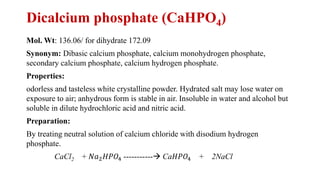
Dicalcium phosphate (CaHPO4)
Mol. Wt: 136.06/ for dihydrate 172.09
Synonym: Dibasic calcium phosphate, calcium monohydrogen phosphate,
secondary calcium phosphate, calcium hydrogen phosphate.
Properties:
odorless and tasteless white crystalline powder. Hydrated salt may lose water on
exposure to air; anhydrous form is stable in air. Insoluble in water and alcohol but
soluble in dilute hydrochloric acid and nitric acid.
Preparation:
By treating neutral solution of calcium chloride with disodium hydrogen
phosphate.
CaCl2 + 𝑁𝑎2𝐻𝑃𝑂4 -----------→ Ca𝐻𝑃𝑂4 + 2NaCl
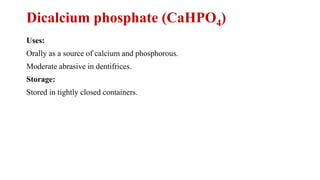
Dicalcium phosphate (CaHPO4)
Uses:
Orally as a source of calcium and phosphorous.
Moderate abrasive in dentifrices.
Storage:
Stored in tightly closed containers.
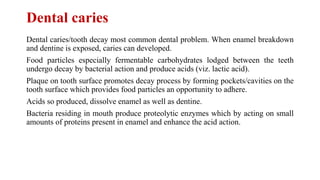
Dental caries
Dental caries/tooth decay most common dental problem. When enamel breakdown
and dentine is exposed, caries can developed.
Food particles especially fermentable carbohydrates lodged between the teeth
undergo decay by bacterial action and produce acids (viz. lactic acid).
Plaque on tooth surface promotes decay process by forming pockets/cavities on the
tooth surface which provides food particles an opportunity to adhere.
Acids so produced, dissolve enamel as well as dentine.
Bacteria residing in mouth produce proteolytic enzymes which by acting on small
amounts of proteins present in enamel and enhance the acid action.
Dental Caries
Prevention:
Proper oral and dental hygiene can prevent the dental caries along with other oro-
dental anomalies.
Brushing the teeth regularly, removes any material /particles from tooth surface
before it hardens into calculus.
Dental Caries
Role of Fluoride:
Fluoride is anticariogenic agent. It replaces the hydroxyl ions in hydroxy apatite
with fluoride ion to from fluorapatite in the outer surface of the enamel.
Fluoride in low concentration (1 – 2 ppm) if present in drinking water can prevent
the caries in the population.
Orally it is administered in the form of NaF tablets or drops added in water/juice.
2% NaF solution and 8% SnF2 solution topically is commonly used for this
purpose.
Sodium Fluoride (NaF)
Mol. Wt: 41.99
Properties:
White powder or colourless crystals, Soluble in water and practically insoluble in
alcohol. Aqueous solution corrodes glass bottles.
On acidification with mineral acid produces Hydrofluoric acid.
NaF + HCl -----------→ HF + NaCl
Preparation:
By Neutralizing hydrofluoric acid with sod. Carbonate
2HF + Na2CO3 -----------→ 2NaF + H20 + CO2
Double decomposition of calcium fluoride with sod. carbonate
CaF2 + Na2CO3 -----------→ 2NaF + CaCO3
Sodium Fluoride (NaF)
Uses:
Prophylaxis of dental caries.
Sodium fluoride due to its fluoride ion is an important agent in dental practice for
retarding or preventing dental caries.
It also decreases microbial acid production.
Sodium fluoride in 2 % aqueous solution is widely used topically; occasionally the
solution is applied to the surface of dry teeth periodically over several times in a
year.
Storage:
Should be stored in airtight containers.
As it corrodes common glass bottles aqueous solution of NaF should be stored in
pyrex bottles in dark for period not exceeding 6 months
Stannous Fluoride (SnF2)
Mol. Wt: 156.69
Properties:
Also termed as tin fluoride, it is a colorless crystalline powder with bitter salty
taste. It is freely soluble in water and practically insoluble in alcohol, ether and
chloroform.
Aqueous solution is acidic (pH ~ 3) due to hydrolysis and on standing develops a
fine white ppt of Stannous hydroxide.
Preparation:
By heating stannous oxide with HF(g) in absence of oxygen.
SnO + 2HF -----------→ 2SnF2 + H2O
Stannous Fluoride (SnF2)
Uses:
Superior to NaF as:
➢Simplified application (Single application of 8% Stannous fluoride solution is
sufficient for 6mnts–1 yr.)
➢Greater effectiveness (stannous ions enhance anticariogenic action).
➢Used only topically.
Storage:
Should be stored in airtight containers.
Exposure to air is avoided as it can lead to oxidation into stannic fluoride (SnF4) or
stannic oxyfluoride (SnOF2) which are less efficient than stannous fluoride as
anticariogenic agent.
Desensitizing agents
Substances that decrease hypersensitivity of the teeth when applied to their outer
surface especially where erosion has occurred ie. near gumline.
As a result of application, sensitivity of teeth towards cold and heat is reduced.
Substances like Ammoniacal silver nitrate solution, formaldehyde solution,
liquified phenol, Zinc chloride solution, 10% strontium chloride in tooth paste
function as desensitizing agents.
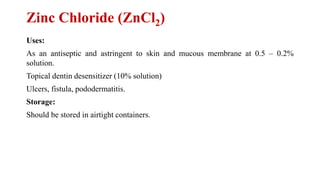
Zinc Chloride (ZnCl2)
Mol. Wt: 136.28
Synonym: Butter of zinc
Properties:
White or nearly white odorless crystalline granules.
1 in 10 solution is acidic (pH ~ 4). With excess water forms zinc oxychloride. Very
soluble in water and freely soluble in alcohol and glycerin.
Aqueous and alcoholic solution is turbid due to formation of zincoxychloride but
clear when HCl is added.
Preparation:
By heating metallic zinc with moderately conc. HCl.
Zn + 2HCl -----------→ ZnCl2 + H2
Zinc Chloride (ZnCl2)
Uses:
As an antiseptic and astringent to skin and mucous membrane at 0.5 – 0.2%
solution.
Topical dentin desensitizer (10% solution)
Ulcers, fistula, pododermatitis.
Storage:
Should be stored in airtight containers.
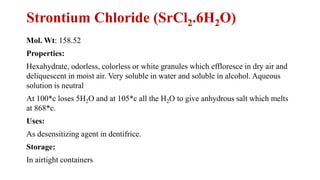
Strontium Chloride (SrCl2.6H2O)
Mol. Wt: 158.52
Properties:
Hexahydrate, odorless, colorless or white granules which effloresce in dry air and
deliquescent in moist air. Very soluble in water and soluble in alcohol. Aqueous
solution is neutral
At 100*c loses 5H2O and at 105*c all the H2O to give anhydrous salt which melts
at 868*c.
Uses:
As desensitizing agent in dentifrice.
Storage:
In airtight containers
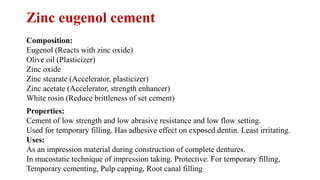
Zinc eugenol cement
Composition:
Eugenol (Reacts with zinc oxide)
Olive oil (Plasticizer)
Zinc oxide
Zinc stearate (Accelerator, plasticizer)
Zinc acetate (Accelerator, strength enhancer)
White rosin (Reduce brittleness of set cement)
Properties:
Cement of low strength and low abrasive resistance and low flow setting.
Used for temporary filling. Has adhesive effect on exposed dentin. Least irritating.
Uses:
As an impression material during construction of complete dentures.
In mucostatic technique of impression taking. Protective. For temporary filling,
Temporary cementing, Pulp capping, Root canal filling
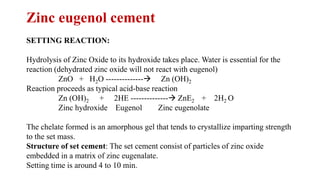
Zinc eugenol cement
SETTING REACTION:
Hydrolysis of Zinc Oxide to its hydroxide takes place. Water is essential for the
reaction (dehydrated zinc oxide will not react with eugenol)
ZnO + H2O --------------→ Zn (OH)2
Reaction proceeds as typical acid-base reaction
Zn (OH)2 + 2HE --------------→ ZnE2 + 2H2 O
Zinc hydroxide Eugenol Zinc eugenolate
The chelate formed is an amorphous gel that tends to crystallize imparting strength
to the set mass.
Structure of set cement: The set cement consist of particles of zinc oxide
embedded in a matrix of zinc eugenalate.
Setting time is around 4 to 10 min.
Zinc eugenol cement
Classification :
Type I ZOE – For temporary cementation
Type II ZOE – Permanent cementation
Type III ZOE – Temporary filling, Thermal insulation
Type IV ZOE – Cavity liners
Thank You

Dental products

  • 1.
  • 2.
    Dental Products Dental hygienehas been associated with daily routines since long. Poor dental health in India can be regarded to ignorance, illiteracy, habits of chewing tobacco/pan/pan masala etc. Dental health as well as dental hygiene can be maintained with literacy about dental anatomy, physiology and pathophysiology, and regular care of teeth. Teeth play fundamental part in digestion by biting and chewing and mechanically breaking the food and with the help of tongue mixing the saliva, making the food wet and beginning the process of digestion.
  • 3.
    Dental Anatomy Tooth consistsof: Enamel: A white, hard portion, that covers the tooth projecting above the gums. Dentine: largest part beneath enamel that surrounds and protects pulp. Pulp: soft tissue that contains nerves, blood vessels etc. Cementum: Bone like structure, cover the root and provide the attachment of the tooth with periodontal ligaments. For tooth formation, Vit. A, C and D are necessary.
  • 4.
    Common terminology Abscess: Seriousinfection that may lead to severe decay. Symptoms include pain and swelling. Treatment includes Root Canal Therapy. Bleaching: Applying a bleaching agent like Hydrogen peroxide to whiten discoloured or stained teeth. Bonding: Attaching tooth coloured materials to stained/damaged teeth to restore tooth’s colour/shape. Bridge/fixed bridge: one or more artificial teeth fixed in mouth by attachments to neighbouring teeth which is generally joined by crowns of either sides of the artificial teeth. Crown/Cap: Artificial cover for a decayed/damaged tooth. Generally made up of plastic, metal, porcelain or composition of porcelain and metal. Filling: Material used to fill a cavity. Usually composed of a amalgam, plastic, porcelain or gold.
  • 5.
    Common terminology Impacted tooth:An unexposed tooth in the jaw that can not reach its normal position and is confined beneath the gum surface. It may cause pain. Orthodontic treatment: A method of correcting the position of teeth using braces/similar devices. Periodontitis: Advanced stage of gum disease that may lead to tooth loss. Gums and nearby tissues are inflamed, plaque gets into the pockets below the gum line, tooth roots become exposed supporting gum is destroyed leading to tooth loss. Symptoms include gum separating from teeth, shifting teeth, bed breath and bed taste in the mouth. Root canal therapy/endodontics: Cleaning out and filling of the pulp which is damaged or severely damaged. Scaling: Removal of tartar from the teeth above and below the gumlines.
  • 6.
    Dentifrices Substances used withtoothbrush to clean the accessible surfaces of the teeth. Generally available as pastes and powders. They contain abrasives such as Calcium carbonate, calcium phosphates, calcium sulphate, insoluble sodium metaphosphate, hydrated aluminium oxide, magnesium carbonate, magnesium phosphates sodium bicarbonate and sodium chloride. Tooth pastes contain liquids like glycerine, propylene glycol, sorbitol solution, water and alcohol and thickening agents like starch, tragacanth, algin, cellulose derivatives etc. Dentifrices generally contain non-carbohydrate sweetening agents.
  • 7.
    Calcium Carbonate (CaCO3) Mol.Wt: 100.1 Synonym: Calc. Carb, Calcii Carbonas, Precipitated Chalk. Most abundant and most widely distributed Calcium salt found as chalk, limestone, marble, aragonite, calcite etc. Chief constituent of egg and mollusc shells, corals and pearls. Properties: Fine white microcrystalline powder odorless and tasteless and stable in air. Practically insoluble in water but soluble in the presence of Carbondioxide, and ammonium salts. On acidification with HCl produces Calcium chloride. CaCO3 + 2 HCl -----------→ CaCl2 + H2O + CO2
  • 8.
    Calcium Carbonate (CaCO3) Preparation: Bytreating solution of sodium carbonate with calcium chloride CaCl2 + Na2CO3 -----------→ 2NaCl + CaCO3 Uses: As dentifrices for cleanig and polishing of teeth. Antacid Insecticide Calcium supplement In preparation of homeopathic medicines.
  • 9.
    Sodium metaphosphate (NaPO3)n Mol.Wt: Variable Synonym: Madrell’s salt Properties: White powder, practically insoluble in water/aq. Solutions of pyrophosphate and hexametaphosphate but soluble in mineral salts. Preparation: By dehydration of sodium phosphates viz.𝑁𝑎2𝐻2𝑃2𝑂7, 𝑁𝑎𝐻2𝑃𝑂4, 𝑁𝑎2𝐻𝑃𝑂4. 𝑁𝑎𝐻2𝑃𝑂4 −−−−−−→ 𝑁𝑎𝑃𝑂3 + 𝐻2𝑂 Polymeric sodium metaphosphate ie madrell’s salt can be obtained by heating 𝑁𝑎𝐻2𝑃𝑂4 or 𝑁𝑎𝑁𝐻4𝐻𝑃𝑂4 to 250oC and than slowly to 350oC which first gives 𝑁𝑎2𝐻2𝑃2𝑂7, and than insoluble madrell’s salt. Uses: Cleansing and polishing agent and abrasive detergent in dentifrices.
  • 10.
    Dicalcium phosphate (CaHPO4) Mol.Wt: 136.06/ for dihydrate 172.09 Synonym: Dibasic calcium phosphate, calcium monohydrogen phosphate, secondary calcium phosphate, calcium hydrogen phosphate. Properties: odorless and tasteless white crystalline powder. Hydrated salt may lose water on exposure to air; anhydrous form is stable in air. Insoluble in water and alcohol but soluble in dilute hydrochloric acid and nitric acid. Preparation: By treating neutral solution of calcium chloride with disodium hydrogen phosphate. CaCl2 + 𝑁𝑎2𝐻𝑃𝑂4 -----------→ Ca𝐻𝑃𝑂4 + 2NaCl
  • 11.
    Dicalcium phosphate (CaHPO4) Uses: Orallyas a source of calcium and phosphorous. Moderate abrasive in dentifrices. Storage: Stored in tightly closed containers.
  • 12.
    Dental caries Dental caries/toothdecay most common dental problem. When enamel breakdown and dentine is exposed, caries can developed. Food particles especially fermentable carbohydrates lodged between the teeth undergo decay by bacterial action and produce acids (viz. lactic acid). Plaque on tooth surface promotes decay process by forming pockets/cavities on the tooth surface which provides food particles an opportunity to adhere. Acids so produced, dissolve enamel as well as dentine. Bacteria residing in mouth produce proteolytic enzymes which by acting on small amounts of proteins present in enamel and enhance the acid action.
  • 13.
    Dental Caries Prevention: Proper oraland dental hygiene can prevent the dental caries along with other oro- dental anomalies. Brushing the teeth regularly, removes any material /particles from tooth surface before it hardens into calculus.
  • 14.
    Dental Caries Role ofFluoride: Fluoride is anticariogenic agent. It replaces the hydroxyl ions in hydroxy apatite with fluoride ion to from fluorapatite in the outer surface of the enamel. Fluoride in low concentration (1 – 2 ppm) if present in drinking water can prevent the caries in the population. Orally it is administered in the form of NaF tablets or drops added in water/juice. 2% NaF solution and 8% SnF2 solution topically is commonly used for this purpose.
  • 15.
    Sodium Fluoride (NaF) Mol.Wt: 41.99 Properties: White powder or colourless crystals, Soluble in water and practically insoluble in alcohol. Aqueous solution corrodes glass bottles. On acidification with mineral acid produces Hydrofluoric acid. NaF + HCl -----------→ HF + NaCl Preparation: By Neutralizing hydrofluoric acid with sod. Carbonate 2HF + Na2CO3 -----------→ 2NaF + H20 + CO2 Double decomposition of calcium fluoride with sod. carbonate CaF2 + Na2CO3 -----------→ 2NaF + CaCO3
  • 16.
    Sodium Fluoride (NaF) Uses: Prophylaxisof dental caries. Sodium fluoride due to its fluoride ion is an important agent in dental practice for retarding or preventing dental caries. It also decreases microbial acid production. Sodium fluoride in 2 % aqueous solution is widely used topically; occasionally the solution is applied to the surface of dry teeth periodically over several times in a year. Storage: Should be stored in airtight containers. As it corrodes common glass bottles aqueous solution of NaF should be stored in pyrex bottles in dark for period not exceeding 6 months
  • 17.
    Stannous Fluoride (SnF2) Mol.Wt: 156.69 Properties: Also termed as tin fluoride, it is a colorless crystalline powder with bitter salty taste. It is freely soluble in water and practically insoluble in alcohol, ether and chloroform. Aqueous solution is acidic (pH ~ 3) due to hydrolysis and on standing develops a fine white ppt of Stannous hydroxide. Preparation: By heating stannous oxide with HF(g) in absence of oxygen. SnO + 2HF -----------→ 2SnF2 + H2O
  • 18.
    Stannous Fluoride (SnF2) Uses: Superiorto NaF as: ➢Simplified application (Single application of 8% Stannous fluoride solution is sufficient for 6mnts–1 yr.) ➢Greater effectiveness (stannous ions enhance anticariogenic action). ➢Used only topically. Storage: Should be stored in airtight containers. Exposure to air is avoided as it can lead to oxidation into stannic fluoride (SnF4) or stannic oxyfluoride (SnOF2) which are less efficient than stannous fluoride as anticariogenic agent.
  • 19.
    Desensitizing agents Substances thatdecrease hypersensitivity of the teeth when applied to their outer surface especially where erosion has occurred ie. near gumline. As a result of application, sensitivity of teeth towards cold and heat is reduced. Substances like Ammoniacal silver nitrate solution, formaldehyde solution, liquified phenol, Zinc chloride solution, 10% strontium chloride in tooth paste function as desensitizing agents.
  • 20.
    Zinc Chloride (ZnCl2) Mol.Wt: 136.28 Synonym: Butter of zinc Properties: White or nearly white odorless crystalline granules. 1 in 10 solution is acidic (pH ~ 4). With excess water forms zinc oxychloride. Very soluble in water and freely soluble in alcohol and glycerin. Aqueous and alcoholic solution is turbid due to formation of zincoxychloride but clear when HCl is added. Preparation: By heating metallic zinc with moderately conc. HCl. Zn + 2HCl -----------→ ZnCl2 + H2
  • 21.
    Zinc Chloride (ZnCl2) Uses: Asan antiseptic and astringent to skin and mucous membrane at 0.5 – 0.2% solution. Topical dentin desensitizer (10% solution) Ulcers, fistula, pododermatitis. Storage: Should be stored in airtight containers.
  • 22.
    Strontium Chloride (SrCl2.6H2O) Mol.Wt: 158.52 Properties: Hexahydrate, odorless, colorless or white granules which effloresce in dry air and deliquescent in moist air. Very soluble in water and soluble in alcohol. Aqueous solution is neutral At 100*c loses 5H2O and at 105*c all the H2O to give anhydrous salt which melts at 868*c. Uses: As desensitizing agent in dentifrice. Storage: In airtight containers
  • 23.
    Zinc eugenol cement Composition: Eugenol(Reacts with zinc oxide) Olive oil (Plasticizer) Zinc oxide Zinc stearate (Accelerator, plasticizer) Zinc acetate (Accelerator, strength enhancer) White rosin (Reduce brittleness of set cement) Properties: Cement of low strength and low abrasive resistance and low flow setting. Used for temporary filling. Has adhesive effect on exposed dentin. Least irritating. Uses: As an impression material during construction of complete dentures. In mucostatic technique of impression taking. Protective. For temporary filling, Temporary cementing, Pulp capping, Root canal filling
  • 24.
    Zinc eugenol cement SETTINGREACTION: Hydrolysis of Zinc Oxide to its hydroxide takes place. Water is essential for the reaction (dehydrated zinc oxide will not react with eugenol) ZnO + H2O --------------→ Zn (OH)2 Reaction proceeds as typical acid-base reaction Zn (OH)2 + 2HE --------------→ ZnE2 + 2H2 O Zinc hydroxide Eugenol Zinc eugenolate The chelate formed is an amorphous gel that tends to crystallize imparting strength to the set mass. Structure of set cement: The set cement consist of particles of zinc oxide embedded in a matrix of zinc eugenalate. Setting time is around 4 to 10 min.
  • 25.
    Zinc eugenol cement Classification: Type I ZOE – For temporary cementation Type II ZOE – Permanent cementation Type III ZOE – Temporary filling, Thermal insulation Type IV ZOE – Cavity liners
  • 26.