COMMERCIAL TOOTHPASTE
PRESENTED BY:
ALIYA RAZA
FINAL YEAR BDS
GUIDED BY:-
DR. RENUKA NAGARALE
H.O.D, PUBLIC HEALTH DENTISTRY
DR. SHRIKANTH MURALIDHARAN
DR. REKHA SHITOLE
1
19 • Fresh breath toothpaste
20
• Tooth whitening
toothpaste
22 • Advantages
24 • Disadvantages
26 • Prices
30 • Current status in India
39 • Conclusion
41 • References
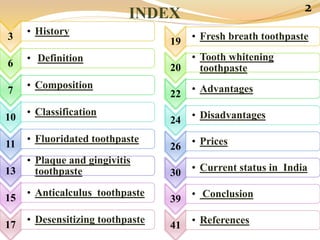
INDEX
3 • History
6 • Definition
7 • Composition
10 • Classification
11 • Fluoridated toothpaste
13
• Plaque and gingivitis
toothpaste
15 • Anticalculus toothpaste
17 • Desensitizing toothpaste
2
Tooth powder was generally used among the Romans,
who used a variety of substances, such as the bones,
hoofs, and horns of certain animals; crabs; egg-shells,
and the shells of the oyster. They were reduced to a fine
powder after having been previously burnt, and
sometimes mixed with honey. It wasn’t until 1824, when
American dentist named Peabody started adding soap to
his paste that things started to change.
3
In 1873, Colgate started to mass produce their soap based
toothpastes in jars.
The first ‘tube’ of toothpaste was invented when Dr Lucius
Sheffield introduced his crème dentifrice in 1886.
It wasn’t long thereafter, that Colgate started selling their
toothpastes in collapsible tubes as well.
Fluorides were introduced to toothpastes in 1960’s.
4
Many of the innovations in toothpaste after fluoride
breakthrough involved the addition of ingredients
with special abilities to toothpastes and toothpaste
packaging.
In 1980’s the tartar control dentifrice claimed that they
could control tartar (calculus) build up around teeth.
In 1990’s toothpaste for sensitive teeth was introduced.
5
Dentifrice is the French word for toothpaste
Dentifrice is a paste, gel or powder used with a toothbrush
as an accessory to clean and to maintain the aesthetics and
health of teeth.
According to A.D.A (American Dental Association)
A dentifrice is a substance used with a toothbrush for the
purpose of cleaning the accessible surfaces of the teeth.
6
COMPOSITION OF TOOTHPASTE
Component Amount
(wt%)
Materials Purpose
Abrasive 20-55% Calcium carbonate/
Dibasic calcium
phosphate dihydrate /
Hydrated alumina/
Hydrated silica/
Sodium bicarbonate or
Mixtures of abrasives
Removal of
plaque /stain/
polish tooth
surface
Humectant 20-35% Sorbitol, glycerin maintains
moisture
Water 15-25% Deionized water Suspension
agent
7
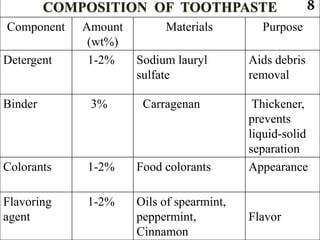
COMPOSITION OF TOOTHPASTE
Component Amount
(wt%)
Materials Purpose
Detergent 1-2% Sodium lauryl
sulfate
Aids debris
removal
Binder 3% Carragenan Thickener,
prevents
liquid-solid
separation
Colorants 1-2% Food colorants Appearance
Flavoring
agent
1-2% Oils of spearmint,
peppermint,
Cinnamon
Flavor
8
COMPOSITION OF TOOTHPASTE
Component Amount
(wt%)
Materials Purpose
Fluoride 0-1% SodiumMonofluor
ophosphate/
Sodium fluoride/
Stannous fluoride
Prevents dental
caries
Tartar control
agents
0-1% Tetra sodium
pyrophosphate/
Tetra potassium
pyrophosphate
Inhibits calcium
formation above
the gingival
margin.
Desensitizing
agents
0-5% Potassium nitrate,
Strontium
chloride, Arginine
Promotes
occlusion of
dentinal tubules.
9
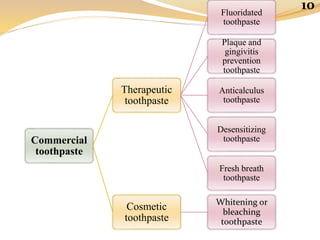
Commercial
toothpaste
Therapeutic
toothpaste
Fluoridated
toothpaste
Plaque and
gingivitis
prevention
toothpaste
Anticalculus
toothpaste
Desensitizing
toothpaste
Fresh breath
toothpaste
Cosmetic
toothpaste
Whitening or
bleaching
toothpaste
10
FLUORIDATED TOOTHPASTE
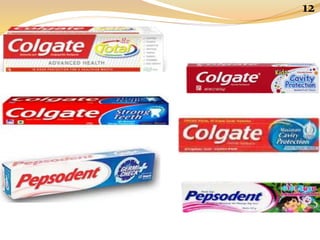
 Marketed as anticaries toothpaste or cavity protection
toothpaste.
 They contain sodium monofluorophosphate/sodium
fluoride/stannous fluoride.
 Fluoride helps in preventing tooth decay by:
Promoting tooth remineralization
Inhibiting oral bacteria’s ability to create acids
By making the tooth more caries resistant.
11
12
PLAQUE AND GINGIVITIS PREVENTION
TOOTHPASTE
 Marketed as antiplaque and gum protection
toothpaste.
 They contain sodium lauryl sulphate, triclosan, zinc
and stannous ions.
 They have antibacterial properties and prevent the
formation of plaque
13
14
ANTICALCULUS TOOTHPASTE
 Marketed as anti-tartar toothpaste.
 They contain tetrapotassium and tetrasodium
pyrophosphates, sodium hexametaphosphate, and
zinc.
 Dentifrices containing anti-calculus agents reduce the
formation of calculus but do not reduce the levels of
preexisting calculus.
15
16
DESENSITIZING TOOTHPASTE
 Marketed as antisensitivity toothpastes.
 They contain Potassium nitrate, potassium citrate and
Strontium chloride.
 There are two mechanisms by which desensitizing
dentifrices can work.
1. By preventing the transmission of neural signals,
thereby preventing pain
2. By blocking the dentinal tubules.
17
18
FRESH BREATH TOOTHPASTE
 They contain peppermint, spearmint or menthol.
 They contain enhanced flavoring agents along with
antibacterial to fight halitosis.
19
TOOTH WHITENING TOOTHPASTE
[COSMETIC TOOTHPASTE]
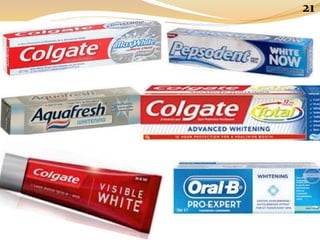
 These toothpastes have abrasion value that is higher
than in normal toothpaste to mechanically remove
food, tobacco, smoking and other extrinsic stains from
teeth.
 Surface stains can be reduced by adding various
chemicals to toothpaste.
 Most of the stain molecules are included in pellicle
which contains protein therefore, enzymes such as
protease and papaine create a whitening effect.
20
21
ADVANTAGES
 Delivers active ingredients such as fluoride or xylitol
to help prevent tooth and gum disease.
 Recent advances in toothpaste enable high efficacy of
oral health delivery
Special toothpaste for kids with fluoride and relatively
low abrasion value
Desensitizing toothpaste
Whitening toothpaste
22
• Toothpaste with flavoring agents that help to eliminate
or mask halitosis. These are available in various
flavors hence giving consumers choice.
• Easy to use, available in collapsible tubes.
• Combination of various contents available sp as to
combat different oral healthcare needs at once.
23
DISADVANTAGES
 Extended consumption of large volumes of fluoridated
toothpaste can result in fluorosis. Fluoridated
toothpaste can be either acutely toxic if swallowed in
large amounts or chronically toxic if swallowed in any
amount consistently.
 Triclosan, an active ingredient in many toothpastes
can combine with chlorine in tap water to form
chloroform which is a human carcinogen. According
to some scientists it can leave unborn babies brain
damaged.
24
 Although in several studies whitening toothpaste
show the ability to improve tooth color they have side
effects. The most significant one is enamel and dentin
abrasion which in turn leads to increased tooth
sensitivity.
25
PRICES OF DIFFERENT TOOTHPASTE
AVAILABLE COMMERCIALLY
TOOTHPASTE
WEIGHT
(in Gms)
PRICE
(Rs.)
(INR)
COLGATE PALMOLIVE LTD.
Colgate cavity protection 200 82
Colgate strong teeth 200 84
Colgate kids 80 82
Colgate total pro gum health 140 112
Colgate anti tartar whitening 140 100
26
TOOTHPASTE
WEIGHT
(in Gms)
PRICE
(Rs.)
(INR)
Colgate maxfresh 140 80
Colgate sensitive 80 100
Colgate sensitive pro-relief 80 120
Colgate maxwhite 140 90
Colgate visible white 100 87
Colgate advanced whitening 140 105
27
TOOTHPASTE
WEIGHT
(in Gms)
PRICE
(Rs.)
(INR)
HINDUSTAN UNILEVER LTD.
Pepsodent germicheck 200 85
Pepsodent G-Gumcare 140 98
Pepsodent for kids 80 80
Pepsodent center fresh 150 81
Pepsodent white 140 99
Pepsodent sensitive 40 70
Closeup 140 80
28
TOOTHPASTE
WEIGHT
(in Gms)
PRICE
(Rs.)
(INR)
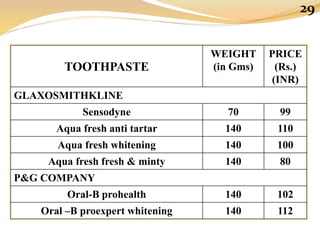
GLAXOSMITHKLINE
Sensodyne 70 99
Aqua fresh anti tartar 140 110
Aqua fresh whitening 140 100
Aqua fresh fresh & minty 140 80
P&G COMPANY
Oral-B prohealth 140 102
Oral –B proexpert whitening 140 112
29
CURRENT STATUS OF COMMERCIAL
TOOTHPASTE IN INDIA
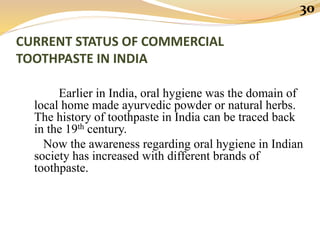
Earlier in India, oral hygiene was the domain of
local home made ayurvedic powder or natural herbs.
The history of toothpaste in India can be traced back
in the 19th century.
Now the awareness regarding oral hygiene in Indian
society has increased with different brands of
toothpaste.
30
Top five brands of commercial toothpaste in India:
1. Colgate- Colgate Palmolive Ltd.
2. Closeup- Hindustan unilever Ltd.
3. Sensodyne- GlaxoSmithKline
4. OralB- P&G company (Procter and Gamble)
5. Pepsodent- Hindustan unilever Ltd.
31
Colgate:
In 1937, when handcarts were used to distribute
Colgate dental cream, Colgate Palmolive (India) today
has become the widest distributor of oral care and
hygiene products in India.
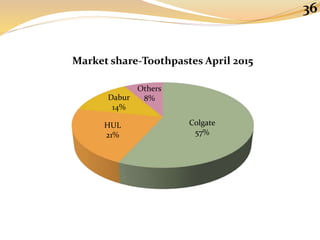
In 2015 Colgate had a market share of 57%.
32
Hindustan unilever Ltd. :
Closeup: Closeup is the original youth brand of
India. Ever since its launch in 1975, closeup was the
first gel toothpaste to be launched in India and has led
gel toothpaste segment ever since. Closeup became
the first gel toothpaste with fluoride in Indian market.
33
Pepsodent: Pepsodent launched in 1993 was the
first toothpaste with a unique antibacterial agent to
address the consumer needs of checking gums even
hours after brushing. Pepsodent’s most recent
campaign aims at educating consumers on need for
gum protection.
The Hindustan unilever Ltd. as of April 2015 holds
a market share of 21.5% in tooth industry in India.
34
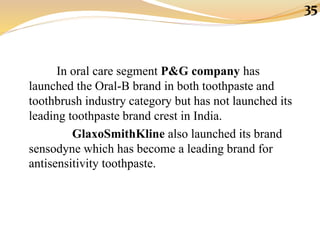
In oral care segment P&G company has
launched the Oral-B brand in both toothpaste and
toothbrush industry category but has not launched its
leading toothpaste brand crest in India.
GlaxoSmithKline also launched its brand
sensodyne which has become a leading brand for
antisensitivity toothpaste.
35
Colgate
57%
HUL
21%
Dabur
14%
Others
8%
Market share-Toothpastes April 2015
36
0
100
200
300
400
500
600
Brazil USA Phillippenes China India
599
547
374
280
147
Per capita toothpaste consumption
(in grams/per year)
37
Almost one third of the Indian population does not have
access to any of the modern oral health care facilities.
With the per capita consumption of toothpaste in India at
about 147g is the lowest in the world
In India, oral care market offers huge potential
as penetration and per capita consumption of oral care
products is very low. However rising per capita
income and increasing awareness is driving demands
of oral care products.
Consumers have started switching to value
added toothpaste like gels, mouthwashes and teeth
whitening products. In rural areas consumers are
switching from toothpowder to toothpastes.
38
CONCLUSION
• The clinical team has a responsibility to keep up-to
date with the ever-increasing development and
marketing of dentifrices
• Dentifrice recommendations should be patient
specific.
• Considerations include any complaint or request the
patient may have as well as any potential
contraindications or relative contraindications.
39
• If a patient is allergic or sensitive to an ingredient, all
dentifrices containing that ingredient should be
avoided.
• If the patient suffers from erosion, a low RDA
dentifrice should be selected.
• If a patient is experiencing hypersensitivity, a
desensitizing dentifrice containing potassium nitrate
or stannous fluoride can be recommended.
40
REFERENCES
 Essentials of public health dentistry- Soben Peter 5th
edition.
 Carranza’s clinical periodontology 10th edition
 www.acaedemia.eu.in/pallavimadanshetty-
dentifrice.ppt
 www.blog.sanasecurities.com/colgatevsprocter&ganbl
e-marketpositioninganalysis/
41
 www.colgate.co.in
 www.slideshare.net/toothpasteindustryinindiaanalysis/
 www.google.co.in/toothpaste-150209130349-
conversion-gate01.pptx
42
Thank
you!

Commercial toothpaste

  • 1.
    COMMERCIAL TOOTHPASTE PRESENTED BY: ALIYARAZA FINAL YEAR BDS GUIDED BY:- DR. RENUKA NAGARALE H.O.D, PUBLIC HEALTH DENTISTRY DR. SHRIKANTH MURALIDHARAN DR. REKHA SHITOLE 1
  • 2.
    19 • Freshbreath toothpaste 20 • Tooth whitening toothpaste 22 • Advantages 24 • Disadvantages 26 • Prices 30 • Current status in India 39 • Conclusion 41 • References INDEX 3 • History 6 • Definition 7 • Composition 10 • Classification 11 • Fluoridated toothpaste 13 • Plaque and gingivitis toothpaste 15 • Anticalculus toothpaste 17 • Desensitizing toothpaste 2
  • 3.
    Tooth powder wasgenerally used among the Romans, who used a variety of substances, such as the bones, hoofs, and horns of certain animals; crabs; egg-shells, and the shells of the oyster. They were reduced to a fine powder after having been previously burnt, and sometimes mixed with honey. It wasn’t until 1824, when American dentist named Peabody started adding soap to his paste that things started to change. 3
  • 4.
    In 1873, Colgatestarted to mass produce their soap based toothpastes in jars. The first ‘tube’ of toothpaste was invented when Dr Lucius Sheffield introduced his crème dentifrice in 1886. It wasn’t long thereafter, that Colgate started selling their toothpastes in collapsible tubes as well. Fluorides were introduced to toothpastes in 1960’s. 4
  • 5.
    Many of theinnovations in toothpaste after fluoride breakthrough involved the addition of ingredients with special abilities to toothpastes and toothpaste packaging. In 1980’s the tartar control dentifrice claimed that they could control tartar (calculus) build up around teeth. In 1990’s toothpaste for sensitive teeth was introduced. 5
  • 6.
    Dentifrice is theFrench word for toothpaste Dentifrice is a paste, gel or powder used with a toothbrush as an accessory to clean and to maintain the aesthetics and health of teeth. According to A.D.A (American Dental Association) A dentifrice is a substance used with a toothbrush for the purpose of cleaning the accessible surfaces of the teeth. 6
  • 7.
    COMPOSITION OF TOOTHPASTE ComponentAmount (wt%) Materials Purpose Abrasive 20-55% Calcium carbonate/ Dibasic calcium phosphate dihydrate / Hydrated alumina/ Hydrated silica/ Sodium bicarbonate or Mixtures of abrasives Removal of plaque /stain/ polish tooth surface Humectant 20-35% Sorbitol, glycerin maintains moisture Water 15-25% Deionized water Suspension agent 7
  • 8.
    COMPOSITION OF TOOTHPASTE ComponentAmount (wt%) Materials Purpose Detergent 1-2% Sodium lauryl sulfate Aids debris removal Binder 3% Carragenan Thickener, prevents liquid-solid separation Colorants 1-2% Food colorants Appearance Flavoring agent 1-2% Oils of spearmint, peppermint, Cinnamon Flavor 8
  • 9.
    COMPOSITION OF TOOTHPASTE ComponentAmount (wt%) Materials Purpose Fluoride 0-1% SodiumMonofluor ophosphate/ Sodium fluoride/ Stannous fluoride Prevents dental caries Tartar control agents 0-1% Tetra sodium pyrophosphate/ Tetra potassium pyrophosphate Inhibits calcium formation above the gingival margin. Desensitizing agents 0-5% Potassium nitrate, Strontium chloride, Arginine Promotes occlusion of dentinal tubules. 9
  • 10.
  • 11.
    FLUORIDATED TOOTHPASTE  Marketedas anticaries toothpaste or cavity protection toothpaste.  They contain sodium monofluorophosphate/sodium fluoride/stannous fluoride.  Fluoride helps in preventing tooth decay by: Promoting tooth remineralization Inhibiting oral bacteria’s ability to create acids By making the tooth more caries resistant. 11
  • 12.
  • 13.
    PLAQUE AND GINGIVITISPREVENTION TOOTHPASTE  Marketed as antiplaque and gum protection toothpaste.  They contain sodium lauryl sulphate, triclosan, zinc and stannous ions.  They have antibacterial properties and prevent the formation of plaque 13
  • 14.
  • 15.
    ANTICALCULUS TOOTHPASTE  Marketedas anti-tartar toothpaste.  They contain tetrapotassium and tetrasodium pyrophosphates, sodium hexametaphosphate, and zinc.  Dentifrices containing anti-calculus agents reduce the formation of calculus but do not reduce the levels of preexisting calculus. 15
  • 16.
  • 17.
    DESENSITIZING TOOTHPASTE  Marketedas antisensitivity toothpastes.  They contain Potassium nitrate, potassium citrate and Strontium chloride.  There are two mechanisms by which desensitizing dentifrices can work. 1. By preventing the transmission of neural signals, thereby preventing pain 2. By blocking the dentinal tubules. 17
  • 18.
  • 19.
    FRESH BREATH TOOTHPASTE They contain peppermint, spearmint or menthol.  They contain enhanced flavoring agents along with antibacterial to fight halitosis. 19
  • 20.
    TOOTH WHITENING TOOTHPASTE [COSMETICTOOTHPASTE]  These toothpastes have abrasion value that is higher than in normal toothpaste to mechanically remove food, tobacco, smoking and other extrinsic stains from teeth.  Surface stains can be reduced by adding various chemicals to toothpaste.  Most of the stain molecules are included in pellicle which contains protein therefore, enzymes such as protease and papaine create a whitening effect. 20
  • 21.
  • 22.
    ADVANTAGES  Delivers activeingredients such as fluoride or xylitol to help prevent tooth and gum disease.  Recent advances in toothpaste enable high efficacy of oral health delivery Special toothpaste for kids with fluoride and relatively low abrasion value Desensitizing toothpaste Whitening toothpaste 22
  • 23.
    • Toothpaste withflavoring agents that help to eliminate or mask halitosis. These are available in various flavors hence giving consumers choice. • Easy to use, available in collapsible tubes. • Combination of various contents available sp as to combat different oral healthcare needs at once. 23
  • 24.
    DISADVANTAGES  Extended consumptionof large volumes of fluoridated toothpaste can result in fluorosis. Fluoridated toothpaste can be either acutely toxic if swallowed in large amounts or chronically toxic if swallowed in any amount consistently.  Triclosan, an active ingredient in many toothpastes can combine with chlorine in tap water to form chloroform which is a human carcinogen. According to some scientists it can leave unborn babies brain damaged. 24
  • 25.
     Although inseveral studies whitening toothpaste show the ability to improve tooth color they have side effects. The most significant one is enamel and dentin abrasion which in turn leads to increased tooth sensitivity. 25
  • 26.
    PRICES OF DIFFERENTTOOTHPASTE AVAILABLE COMMERCIALLY TOOTHPASTE WEIGHT (in Gms) PRICE (Rs.) (INR) COLGATE PALMOLIVE LTD. Colgate cavity protection 200 82 Colgate strong teeth 200 84 Colgate kids 80 82 Colgate total pro gum health 140 112 Colgate anti tartar whitening 140 100 26
  • 27.
    TOOTHPASTE WEIGHT (in Gms) PRICE (Rs.) (INR) Colgate maxfresh140 80 Colgate sensitive 80 100 Colgate sensitive pro-relief 80 120 Colgate maxwhite 140 90 Colgate visible white 100 87 Colgate advanced whitening 140 105 27
  • 28.
    TOOTHPASTE WEIGHT (in Gms) PRICE (Rs.) (INR) HINDUSTAN UNILEVERLTD. Pepsodent germicheck 200 85 Pepsodent G-Gumcare 140 98 Pepsodent for kids 80 80 Pepsodent center fresh 150 81 Pepsodent white 140 99 Pepsodent sensitive 40 70 Closeup 140 80 28
  • 29.
    TOOTHPASTE WEIGHT (in Gms) PRICE (Rs.) (INR) GLAXOSMITHKLINE Sensodyne 7099 Aqua fresh anti tartar 140 110 Aqua fresh whitening 140 100 Aqua fresh fresh & minty 140 80 P&G COMPANY Oral-B prohealth 140 102 Oral –B proexpert whitening 140 112 29
  • 30.
    CURRENT STATUS OFCOMMERCIAL TOOTHPASTE IN INDIA Earlier in India, oral hygiene was the domain of local home made ayurvedic powder or natural herbs. The history of toothpaste in India can be traced back in the 19th century. Now the awareness regarding oral hygiene in Indian society has increased with different brands of toothpaste. 30
  • 31.
    Top five brandsof commercial toothpaste in India: 1. Colgate- Colgate Palmolive Ltd. 2. Closeup- Hindustan unilever Ltd. 3. Sensodyne- GlaxoSmithKline 4. OralB- P&G company (Procter and Gamble) 5. Pepsodent- Hindustan unilever Ltd. 31
  • 32.
    Colgate: In 1937, whenhandcarts were used to distribute Colgate dental cream, Colgate Palmolive (India) today has become the widest distributor of oral care and hygiene products in India. In 2015 Colgate had a market share of 57%. 32
  • 33.
    Hindustan unilever Ltd.: Closeup: Closeup is the original youth brand of India. Ever since its launch in 1975, closeup was the first gel toothpaste to be launched in India and has led gel toothpaste segment ever since. Closeup became the first gel toothpaste with fluoride in Indian market. 33
  • 34.
    Pepsodent: Pepsodent launchedin 1993 was the first toothpaste with a unique antibacterial agent to address the consumer needs of checking gums even hours after brushing. Pepsodent’s most recent campaign aims at educating consumers on need for gum protection. The Hindustan unilever Ltd. as of April 2015 holds a market share of 21.5% in tooth industry in India. 34
  • 35.
    In oral caresegment P&G company has launched the Oral-B brand in both toothpaste and toothbrush industry category but has not launched its leading toothpaste brand crest in India. GlaxoSmithKline also launched its brand sensodyne which has become a leading brand for antisensitivity toothpaste. 35
  • 36.
  • 37.
    0 100 200 300 400 500 600 Brazil USA PhillippenesChina India 599 547 374 280 147 Per capita toothpaste consumption (in grams/per year) 37 Almost one third of the Indian population does not have access to any of the modern oral health care facilities. With the per capita consumption of toothpaste in India at about 147g is the lowest in the world
  • 38.
    In India, oralcare market offers huge potential as penetration and per capita consumption of oral care products is very low. However rising per capita income and increasing awareness is driving demands of oral care products. Consumers have started switching to value added toothpaste like gels, mouthwashes and teeth whitening products. In rural areas consumers are switching from toothpowder to toothpastes. 38
  • 39.
    CONCLUSION • The clinicalteam has a responsibility to keep up-to date with the ever-increasing development and marketing of dentifrices • Dentifrice recommendations should be patient specific. • Considerations include any complaint or request the patient may have as well as any potential contraindications or relative contraindications. 39
  • 40.
    • If apatient is allergic or sensitive to an ingredient, all dentifrices containing that ingredient should be avoided. • If the patient suffers from erosion, a low RDA dentifrice should be selected. • If a patient is experiencing hypersensitivity, a desensitizing dentifrice containing potassium nitrate or stannous fluoride can be recommended. 40
  • 41.
    REFERENCES  Essentials ofpublic health dentistry- Soben Peter 5th edition.  Carranza’s clinical periodontology 10th edition  www.acaedemia.eu.in/pallavimadanshetty- dentifrice.ppt  www.blog.sanasecurities.com/colgatevsprocter&ganbl e-marketpositioninganalysis/ 41
  • 42.
     www.colgate.co.in  www.slideshare.net/toothpasteindustryinindiaanalysis/ www.google.co.in/toothpaste-150209130349- conversion-gate01.pptx 42
  • 43.