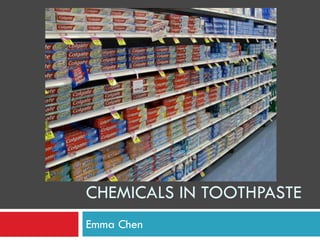
CHEMICALS IN TOOTHPASTE
Emma Chen
Summary
Toothpaste is basically a gel or paste dentifrice used
with toothbrush to maintain oral hygiene and clean
our teeth and gum.
fluoride
Abrasives
Surfactants
Fluoride
What fluoride does is that helps
strengthening the enamel of your
teeth, which is why it is important.
Fluoride can act as a base. It can
combine with proton (H+). The
formula is F– + H+ → HF.
By a process of remineralisation
the fluoride turns into fluoride
rich compounds known as
apatite. This in turn strengthens
the enamel, protecting it from
dissolving in acid.
Abrasives
Abrasives help to clean your teeth by
removing plaque stains, polishing
your teeth and most importantly
getting rid of those nasty remnants
of that delicious food you have been
eating.
Toothpaste contains calcium
carbonate (CaCO3) as a "polishing
agent" to remove plaque and other
matter from teeth. (As the hardness
of CaCO3 is less than that of tooth
enamel but more than that of the
contaminating agent.)
Surfactants
surfactants are present in toothpaste
to loose the stuck food and plaque so
that your toothpaste can whisk it
away. There are always 1-3%
surfactants in the toothpaste.
After the debris has been scraped off
the tooth enamel tissue by the brush
bristles and paste abrasives, it goes in
to the bulk “brushing solution”. This
debris interacts with the surfactant to
form a small number of micelles.
(molecules remove nasty stains)
(work with fluoride)
https://www.youtube.com/watch?v=ak22Lkk1yIs
Why does Toothpaste Make Orange Juice Taste Bad ?
Implication
Toothpaste acts as a base, which neutralize the acids in
our mouth.
This topic is so important because it is connected with
out daily life. We have food everyday and most of the
food we consume are composed of different types of
food acid, toothpaste can work to prevent
decalcification or tooth decay.
Work Cited
Hefferren, John. "Laboratory Analysis of Toothpastes Containing Anticaries Agents."
Journal of the society of cosmetic chemists. 18.Feb.5 (1967): 135-140. Print.
<http://journal.scconline.org/pdf/cc1967/cc018n02/p00135-p00140.pdf?
origin=publication_detail>.
"What makes toothpaste work?." The human touch of chemistry. N.p.. Web. 12 Apr 2014.
<http://humantouchofchemistry.com/what-makes-toothpaste-work.htm>.
"How does toothpaste works?." Chemistry in my daily life. Yewhong Charles Choong, 13
May 2009. Web. 12 Apr. 2014.
<http://chemistry-kiddo.blogspot.com/2009/05/how-does-toothpaste-
works.html>.

Toothpaste

  • 1.
  • 2.
    Summary Toothpaste is basicallya gel or paste dentifrice used with toothbrush to maintain oral hygiene and clean our teeth and gum. fluoride Abrasives Surfactants
  • 3.
    Fluoride What fluoride doesis that helps strengthening the enamel of your teeth, which is why it is important. Fluoride can act as a base. It can combine with proton (H+). The formula is F– + H+ → HF. By a process of remineralisation the fluoride turns into fluoride rich compounds known as apatite. This in turn strengthens the enamel, protecting it from dissolving in acid.
  • 4.
    Abrasives Abrasives help toclean your teeth by removing plaque stains, polishing your teeth and most importantly getting rid of those nasty remnants of that delicious food you have been eating. Toothpaste contains calcium carbonate (CaCO3) as a "polishing agent" to remove plaque and other matter from teeth. (As the hardness of CaCO3 is less than that of tooth enamel but more than that of the contaminating agent.)
  • 5.
    Surfactants surfactants are presentin toothpaste to loose the stuck food and plaque so that your toothpaste can whisk it away. There are always 1-3% surfactants in the toothpaste. After the debris has been scraped off the tooth enamel tissue by the brush bristles and paste abrasives, it goes in to the bulk “brushing solution”. This debris interacts with the surfactant to form a small number of micelles. (molecules remove nasty stains) (work with fluoride)
  • 6.
  • 7.
    Implication Toothpaste acts asa base, which neutralize the acids in our mouth. This topic is so important because it is connected with out daily life. We have food everyday and most of the food we consume are composed of different types of food acid, toothpaste can work to prevent decalcification or tooth decay.
  • 8.
    Work Cited Hefferren, John."Laboratory Analysis of Toothpastes Containing Anticaries Agents." Journal of the society of cosmetic chemists. 18.Feb.5 (1967): 135-140. Print. <http://journal.scconline.org/pdf/cc1967/cc018n02/p00135-p00140.pdf? origin=publication_detail>. "What makes toothpaste work?." The human touch of chemistry. N.p.. Web. 12 Apr 2014. <http://humantouchofchemistry.com/what-makes-toothpaste-work.htm>. "How does toothpaste works?." Chemistry in my daily life. Yewhong Charles Choong, 13 May 2009. Web. 12 Apr. 2014. <http://chemistry-kiddo.blogspot.com/2009/05/how-does-toothpaste- works.html>.