CERAMICS
CONTENTS
Introduction
Historical Background
Composition of Dental Porcelains
Classification
Condensation
Firing
Glazing of Dental porcelain
Metal ceramics
Requirements of metal-ceramic substructur
Types of Metal-ceramic bonding
Metal Ceramic alloys
Methods of strengthening ceramics
Types of metal-ceramic bond failure
Benefits and drawbacks of metal ceramics
Bibliography
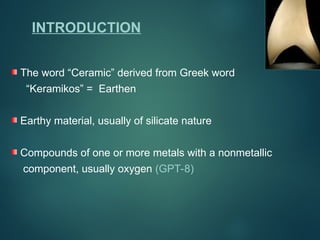
The word “Ceramic” derived from Greek word
“Keramikos” = Earthen
Earthy material, usually of silicate nature
Compounds of one or more metals with a nonmetallic
component, usually oxygen (GPT-8)
INTRODUCTION
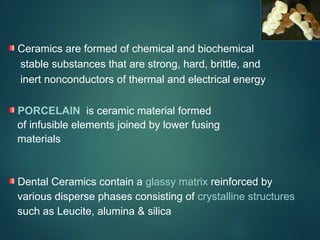
Ceramics are formed of chemical and biochemical
stable substances that are strong, hard, brittle, and
inert nonconductors of thermal and electrical energy
PORCELAIN is ceramic material formed
of infusible elements joined by lower fusing
materials
Dental Ceramics contain a glassy matrix reinforced by
various disperse phases consisting of crystalline structures
such as Leucite, alumina & silica
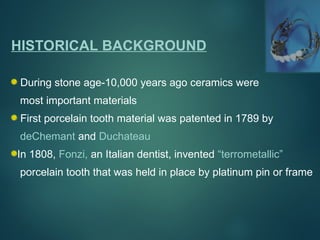
HISTORICAL BACKGROUND
During stone age-10,000 years ago ceramics were
most important materials
First porcelain tooth material was patented in 1789 by
deChemant and Duchateau
In 1808, Fonzi, an Italian dentist, invented “terrometallic”
porcelain tooth that was held in place by platinum pin or frame
Dr. Charles Land introduced one of the first
ceramic crowns to dentistry in 1903
First commercial porcelain was developed by vita
zahnfabrik in about 1963
The end of the 20th
century saw the introduction of
several innovative systems for fabricating all-ceramic
dental restorations
COMPOSITION OF DENTAL PORCELAINS
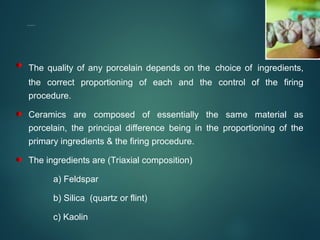
The quality of any porcelain depends on the choice of ingredients,
the correct proportioning of each and the control of the firing
procedure.
Ceramics are composed of essentially the same material as
porcelain, the principal difference being in the proportioning of the
primary ingredients & the firing procedure.
The ingredients are (Triaxial composition)
a) Feldspar
b) Silica (quartz or flint)
c) Kaolin
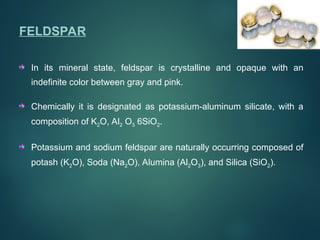
FELDSPAR
In its mineral state, feldspar is crystalline and opaque with an
indefinite color between gray and pink.
Chemically it is designated as potassium-aluminum silicate, with a
composition of K2O, Al2 O3 6SiO2.
Potassium and sodium feldspar are naturally occurring composed of
potash (K2O), Soda (Na2O), Alumina (Al2O3), and Silica (SiO2).
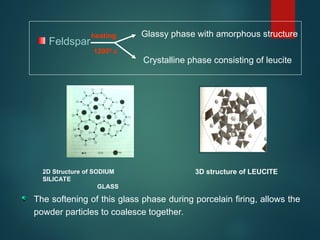
The softening of this glass phase during porcelain firing, allows the
powder particles to coalesce together.
3D structure of LEUCITE
2D Structure of SODIUM
SILICATE
GLASS
Feldspar
Glassy phase with amorphous structure
Crystalline phase consisting of leucite
heating
12000
c
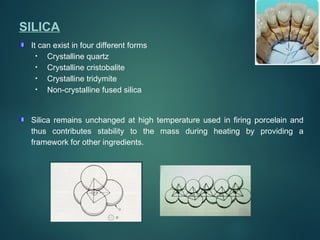
SILICA
It can exist in four different forms
• Crystalline quartz
• Crystalline cristobalite
• Crystalline tridymite
• Non-crystalline fused silica
Silica remains unchanged at high temperature used in firing porcelain and
thus contributes stability to the mass during heating by providing a
framework for other ingredients.
KAOLIN
It is produced naturally by weathering of feldspar during which the soluble
potassium silicate is washed out by acidic water. In this process the residue
is deposited at the bottom of the streams in the form of clay.
Kaolin gives porcelain its property of opaqueness.
COLOUR PIGMENTS
Added to the porcelain in small quantities to obtain delicate shades
necessary to simulate natural teeth.
Prepared by grinding metallic oxides with fine glass and feldspar, fusing the
mixture in a furnace and regrinding to powder.
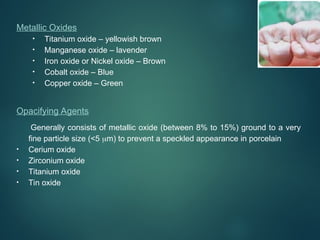
Metallic Oxides
• Titanium oxide – yellowish brown
• Manganese oxide – lavender
• Iron oxide or Nickel oxide – Brown
• Cobalt oxide – Blue
• Copper oxide – Green
Opacifying Agents
Generally consists of metallic oxide (between 8% to 15%) ground to a very
fine particle size (<5 m) to prevent a speckled appearance in porcelain
• Cerium oxide
• Zirconium oxide
• Titanium oxide
• Tin oxide
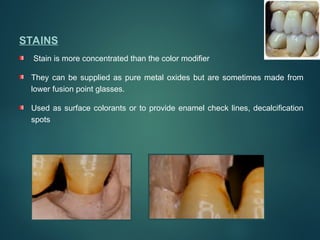
STAINS
Stain is more concentrated than the color modifier
They can be supplied as pure metal oxides but are sometimes made from
lower fusion point glasses.
Used as surface colorants or to provide enamel check lines, decalcification
spots
GLASS MODIFIERS
Crystalline silica
Decreases viscosity
Lowers softening temperature
Increases thermal expansion
Too high a modifier concentration
Reduces chemical durability
Glass may crystallize during porcelain firing
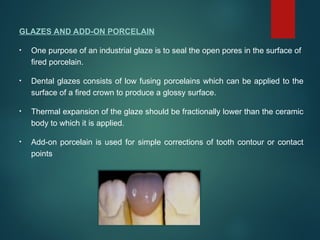
GLAZES AND ADD-ON PORCELAIN
• One purpose of an industrial glaze is to seal the open pores in the surface of
fired porcelain.
• Dental glazes consists of low fusing porcelains which can be applied to the
surface of a fired crown to produce a glossy surface.
• Thermal expansion of the glaze should be fractionally lower than the ceramic
body to which it is applied.
• Add-on porcelain is used for simple corrections of tooth contour or contact
points
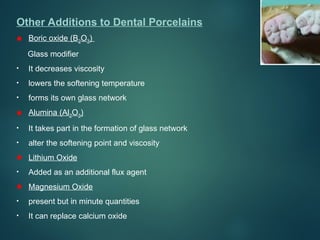
Other Additions to Dental Porcelains
Boric oxide (B2O3)
Glass modifier
• It decreases viscosity
• lowers the softening temperature
• forms its own glass network
Alumina (Al2O3)
• It takes part in the formation of glass network
• alter the softening point and viscosity
Lithium Oxide
• Added as an additional flux agent
Magnesium Oxide
• present but in minute quantities
• It can replace calcium oxide
DEVITRIFICATION AND THERMAL EXPANSION
“Vitrification” in ceramic terms is development of a liquid phase by
reaction or melting, which on cooling forms glassy phase.
This structure is termed ‘Vitreous’
When too many glass forming silica tetrahydra are disrupted in dental
porcelain, the glass may crystallize or devitrify
The regular aluminous porcelains are less susceptible to devitrification
due to their higher silica to alkali ratio
The aluminous porcelains contain much less soda and their thermal
expansions are too lower
FRITTING
• The mixture of leucite and glassy phase is cooled very
rapidly i.e. quenched in water
• This causes the mass to shatter in small fragments and
the product obtained is called frit which is ball-milled
• The process of blending, melting and quenching the
glass components it termed fritting
CLASSIFICATION
Dental ceramics are classified according to their;
Firing temperature
Type of porcelain
According to the use
Processing methods
Substructure material
Methods of fabricating ceramic restorations
Methods of firing
According to application
 According to Firing Temperatures
High Fusing 13000
C
denture teeth
Superior strength, insolubility and translucency
Medium fusing 11000
-13000
C
denture teeth, metal-ceramic restoration
Low fusing 8500
C-11000
C
metal-ceramic restorations
Ultra low fusing <8500
C
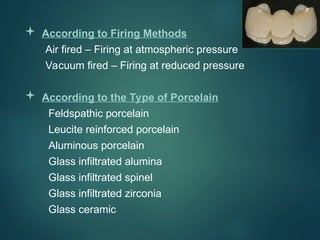
 According to Firing Methods
Air fired – Firing at atmospheric pressure
Vacuum fired – Firing at reduced pressure
 According to the Type of Porcelain
Feldspathic porcelain
Leucite reinforced porcelain
Aluminous porcelain
Glass infiltrated alumina
Glass infiltrated spinel
Glass infiltrated zirconia
Glass ceramic
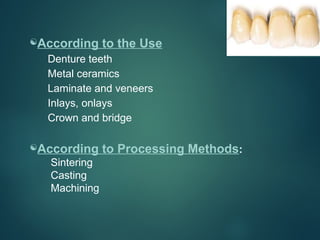
According to the Use
Denture teeth
Metal ceramics
Laminate and veneers
Inlays, onlays
Crown and bridge
According to Processing Methods:
Sintering
Casting
Machining
☻According to the method of Applications
All porcelain
Porcelain fused to metal
☻According to the Substructure Material
Cast metal
Swaged metal
Glass ceramic
Sintered glass ceramic
CAD/ CAM Porcelain
Sintered ceramic core
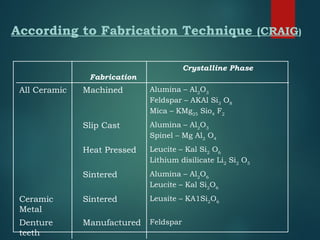
According to Fabrication Technique (CRAIG)
Fabrication
Crystalline Phase
All Ceramic Machined Alumina – Al2
O3
Feldspar – AKAl Si3
O8
Mica – KMg25
Sio4
F2
Slip Cast Alumina – Al2
O3
Spinel – Mg Al2
O4
Heat Pressed Leucite – Kal Si2
O6
Lithium disilicate Li2
Si2
O5
Sintered Alumina – Al2
O6
Leucite – Kal Si2
O6
Ceramic
Metal
Sintered Leusite – KA1Si2
O6
Denture
teeth
Manufactured Feldspar
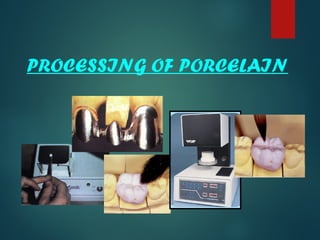
PROCESSING OF PORCELAIN
Condensation of Dental Porcelain
The process of packing the particles together and
removing the liquid binder is known as condensation
Distilled water-most commonly used liquid binder
Other binders: Glycerin, propylene glycol or alcohol
Dense packing of powder particles
-lower firing shrinkage
-less porosity in fired porcelain
Condensing methods
Vibration
Spatulation
Brush techniques
Vibration method
Manual or ultrasonic
Mild vibration is used to pack the wet powder densely on the underlying
framework
Excess water is blotted or wiped away with clean tissueor fine brush,
and condensation occurs toward blotted or brushed area
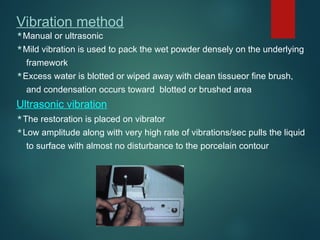
Ultrasonic vibration
The restoration is placed on vibrator
Low amplitude along with very high rate of vibrations/sec pulls the liquid
to surface with almost no disturbance to the porcelain contour
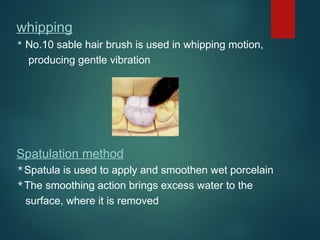
whipping
 No.10 sable hair brush is used in whipping motion,
producing gentle vibration
Spatulation method
Spatula is used to apply and smoothen wet porcelain
The smoothing action brings excess water to the
surface, where it is removed
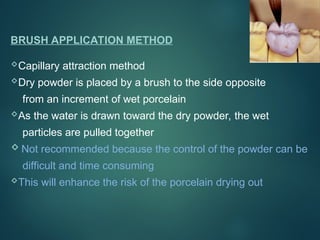
BRUSH APPLICATION METHOD
Capillary attraction method
Dry powder is placed by a brush to the side opposite
from an increment of wet porcelain
As the water is drawn toward the dry powder, the wet
particles are pulled together
 Not recommended because the control of the powder can be
difficult and time consuming
This will enhance the risk of the porcelain drying out
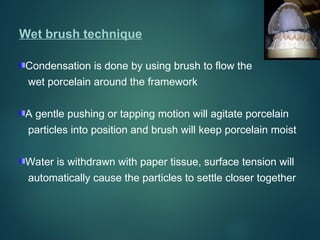
Wet brush technique
Condensation is done by using brush to flow the
wet porcelain around the framework
A gentle pushing or tapping motion will agitate porcelain
particles into position and brush will keep porcelain moist
Water is withdrawn with paper tissue, surface tension will
automatically cause the particles to settle closer together
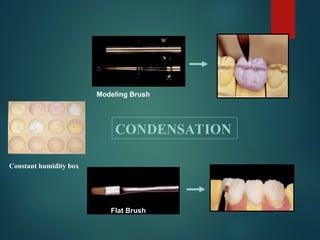
Modeling Brush
Flat Brush
Constant humidity box
CONDENSATION
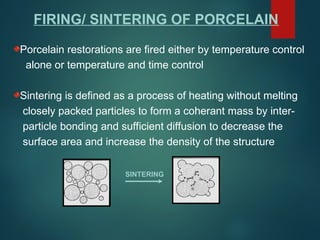
FIRING/ SINTERING OF PORCELAIN
Porcelain restorations are fired either by temperature control
alone or temperature and time control
Sintering is defined as a process of heating without melting
closely packed particles to form a coherant mass by inter-
particle bonding and sufficient diffusion to decrease the
surface area and increase the density of the structure
SINTERING
AIR FIRING
During firing, partial fusion of particles at their point of contact
Temp sintered glass gradually flows to fill up air spaces
Air becomes trapped in form of voids because fused mass is
too viscous to allow all the air to escape
porosity reduces translucency and strength
•Very slow maturation period is ideal
•30-400
c below maximum firing temperature is recommended
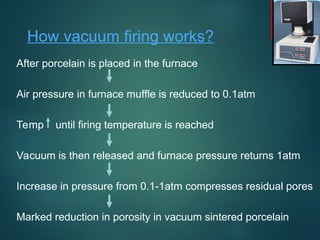
How vacuum firing works?
After porcelain is placed in the furnace
Air pressure in furnace muffle is reduced to 0.1atm
Temp until firing temperature is reached
Vacuum is then released and furnace pressure returns 1atm
Increase in pressure from 0.1-1atm compresses residual pores
Marked reduction in porosity in vacuum sintered porcelain
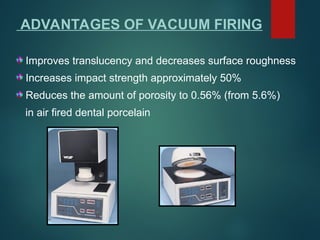
ADVANTAGES OF VACUUM FIRING
Improves translucency and decreases surface roughness
Increases impact strength approximately 50%
Reduces the amount of porosity to 0.56% (from 5.6%)
in air fired dental porcelain
DIFFUSIBLE GAS FIRING
It is an alternate method which uses the principle of diffusion to secure
improved density in fused porcelain
A diffusible gas such as helium may be introduced to furnace at low
pressure during sintering stage
The helium gas is entrapped instead of air in interstitial spaces
Since its molecular diameter is smaller than porcelain lattice, its diffuses
outward under pressure of shrinking porcelain
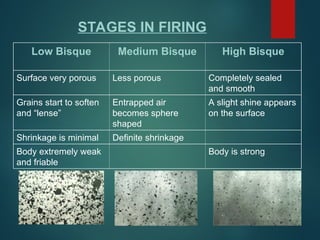
Low Bisque Medium Bisque High Bisque
Surface very porous Less porous Completely sealed
and smooth
Grains start to soften
and “lense”
Entrapped air
becomes sphere
shaped
A slight shine appears
on the surface
Shrinkage is minimal Definite shrinkage
Body extremely weak
and friable
Body is strong
STAGES IN FIRING
GLAZING OF PORCELAIN
After porcelain is cleaned and any necessary stains
are applied, it is returned to the furnace for final glaze firing
Usually, the glazing step is very short
When glazing temperature is reached, a thin glassy
film (glaze) is formed by viscous flow on the porcelain
surface
Natural glaze enhances transverse strength, esthetics and
reduces crack propagation
Over glazing should be avoided
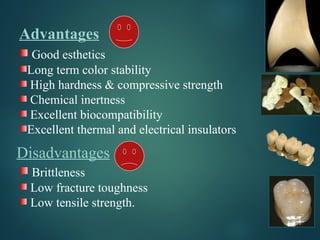
Advantages
Good esthetics
Long term color stability
High hardness & compressive strength
Chemical inertness
Excellent biocompatibility
Excellent thermal and electrical insulators
Disadvantages
Brittleness
Low fracture toughness
Low tensile strength.
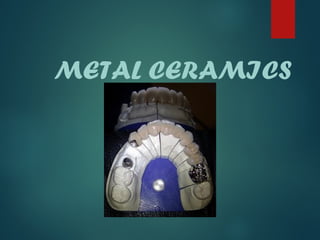
METAL CERAMICS
Requirements for metal-ceramic system
High fusion temperature of alloy
Fusion temperature of ceramic should be low
Ceramic must wet the alloy
Good bond between ceramic and metal is essential
Compatible coefficients of thermal expansion of
ceramic and metal is necessary
Adequate stiffness and strength of alloy core
High sag resistance of alloy is essential
An accurate metal coping is required
Adequate design of restoration is critical
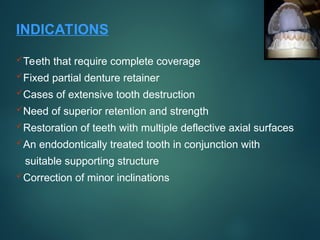
INDICATIONS
Teeth that require complete coverage
Fixed partial denture retainer
Cases of extensive tooth destruction
Need of superior retention and strength
Restoration of teeth with multiple deflective axial surfaces
An endodontically treated tooth in conjunction with
suitable supporting structure
Correction of minor inclinations
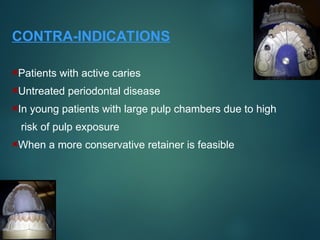
CONTRA-INDICATIONS
Patients with active caries
Untreated periodontal disease
In young patients with large pulp chambers due to high
risk of pulp exposure
When a more conservative retainer is feasible
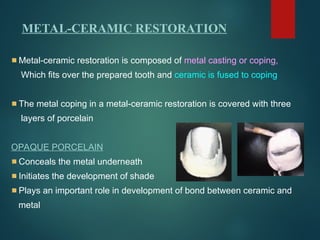
Metal-ceramic restoration is composed of metal casting or coping,
Which fits over the prepared tooth and ceramic is fused to coping
The metal coping in a metal-ceramic restoration is covered with three
layers of porcelain
OPAQUE PORCELAIN
Conceals the metal underneath
Initiates the development of shade
Plays an important role in development of bond between ceramic and
metal
METAL-CERAMIC RESTORATION
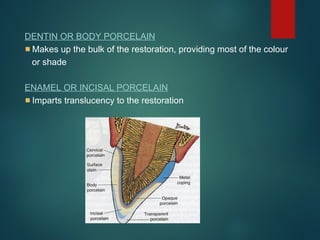
DENTIN OR BODY PORCELAIN
Makes up the bulk of the restoration, providing most of the colour
or shade
ENAMEL OR INCISAL PORCELAIN
Imparts translucency to the restoration
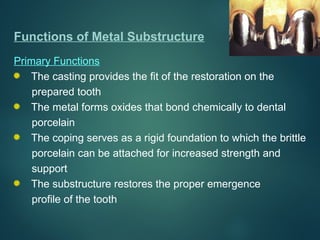
Functions of Metal Substructure
Primary Functions
The casting provides the fit of the restoration on the
prepared tooth
The metal forms oxides that bond chemically to dental
porcelain
The coping serves as a rigid foundation to which the brittle
porcelain can be attached for increased strength and
support
The substructure restores the proper emergence
profile of the tooth
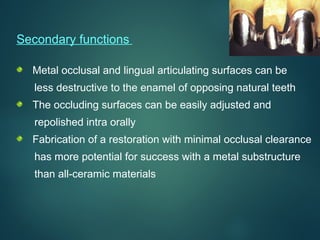
Secondary functions
Metal occlusal and lingual articulating surfaces can be
less destructive to the enamel of opposing natural teeth
The occluding surfaces can be easily adjusted and
repolished intra orally
Fabrication of a restoration with minimal occlusal clearance
has more potential for success with a metal substructure
than all-ceramic materials
FARICATION OF METAL-CERAMIC RESTORATION
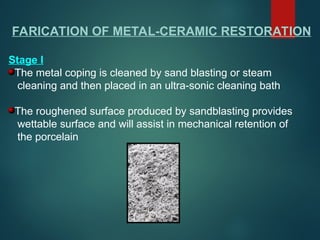
Stage I
The metal coping is cleaned by sand blasting or steam
cleaning and then placed in an ultra-sonic cleaning bath
The roughened surface produced by sandblasting provides
wettable surface and will assist in mechanical retention of
the porcelain
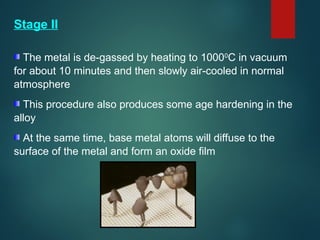
Stage II
The metal is de-gassed by heating to 10000
C in vacuum
for about 10 minutes and then slowly air-cooled in normal
atmosphere
This procedure also produces some age hardening in the
alloy
At the same time, base metal atoms will diffuse to the
surface of the metal and form an oxide film
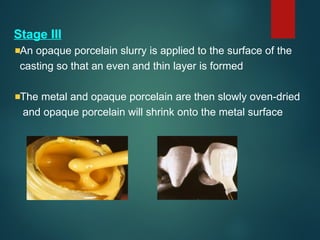
Stage III
An opaque porcelain slurry is applied to the surface of the
casting so that an even and thin layer is formed
The metal and opaque porcelain are then slowly oven-dried
and opaque porcelain will shrink onto the metal surface
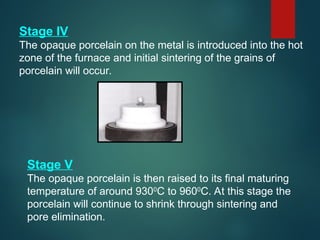
Stage IV
The opaque porcelain on the metal is introduced into the hot
zone of the furnace and initial sintering of the grains of
porcelain will occur.
Stage V
The opaque porcelain is then raised to its final maturing
temperature of around 9300
C to 9600
C. At this stage the
porcelain will continue to shrink through sintering and
pore elimination.
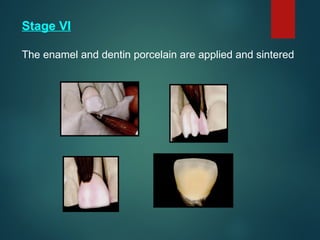
Stage VI
The enamel and dentin porcelain are applied and sintered
DEGASSING
The term degassing refers to a procedure recommended
to clean the metal to remove entrapped surface gases
such as hydrogen
The procedure is important for removal of volatile
contaminants that might not otherwise be eliminated either
by metal finishing, steam cleaning, or air abrading
This process also allows specific oxides to form on the
metal surface which responsible for the chemical bond
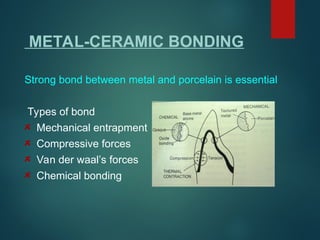
METAL-CERAMIC BONDING
Strong bond between metal and porcelain is essential
Types of bond
Mechanical entrapment
Compressive forces
Van der waal’s forces
Chemical bonding
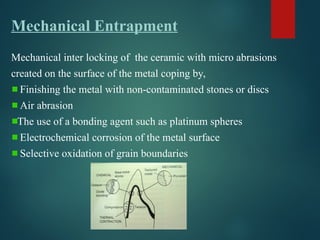
Mechanical Entrapment
Mechanical inter locking of the ceramic with micro abrasions
created on the surface of the metal coping by,
Finishing the metal with non-contaminated stones or discs
Air abrasion
The use of a bonding agent such as platinum spheres
Electrochemical corrosion of the metal surface
Selective oxidation of grain boundaries
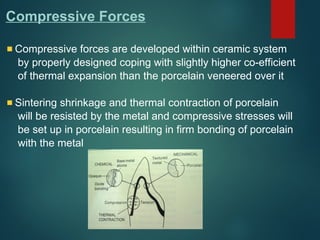
Compressive Forces
Compressive forces are developed within ceramic system
by properly designed coping with slightly higher co-efficient
of thermal expansion than the porcelain veneered over it
Sintering shrinkage and thermal contraction of porcelain
will be resisted by the metal and compressive stresses will
be set up in porcelain resulting in firm bonding of porcelain
with the metal
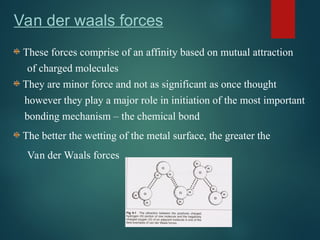
Van der waals forces
These forces comprise of an affinity based on mutual attraction
of charged molecules
They are minor force and not as significant as once thought
however they play a major role in initiation of the most important
bonding mechanism – the chemical bond
The better the wetting of the metal surface, the greater the
Van der Waals forces
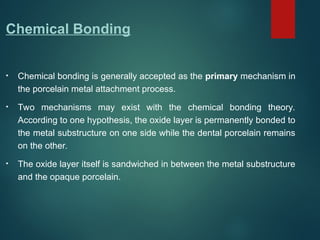
Chemical Bonding
• Chemical bonding is generally accepted as the primary mechanism in
the porcelain metal attachment process.
• Two mechanisms may exist with the chemical bonding theory.
According to one hypothesis, the oxide layer is permanently bonded to
the metal substructure on one side while the dental porcelain remains
on the other.
• The oxide layer itself is sandwiched in between the metal substructure
and the opaque porcelain.
The second theory which is more accepted, suggests that
the surface oxides dissolves or dissolved by the opaque
layer of the porcelain
The porcelain is then brought into atomic contact with the
metal surface for enhanced wetting and direct chemical
bonding so that metal and porcelain share electron
Both covalent and ionic bonds are thought to form but
only a monomolecular layer of oxide is believed to be
required for chemical bonding to occur.
METAL-CERAMIC ALLOYS
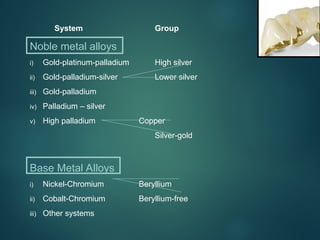
System Group
Noble metal alloys
i) Gold-platinum-palladium High silver
ii) Gold-palladium-silver Lower silver
iii) Gold-palladium
iv) Palladium – silver
v) High palladium Copper
Silver-gold
Base Metal Alloys
i) Nickel-Chromium Beryllium
ii) Cobalt-Chromium Beryllium-free
iii) Other systems
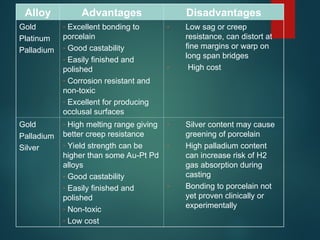
Alloy Advantages Disadvantages
Gold
Platinum
Palladium
- Excellent bonding to
porcelain
- Good castability
- Easily finished and
polished
- Corrosion resistant and
non-toxic
- Excellent for producing
occlusal surfaces
- Low sag or creep
resistance, can distort at
fine margins or warp on
long span bridges
- High cost
Gold
Palladium
Silver
- High melting range giving
better creep resistance
- Yield strength can be
higher than some Au-Pt Pd
alloys
- Good castability
- Easily finished and
polished
- Non-toxic
- Low cost
- Silver content may cause
greening of porcelain
- High palladium content
can increase risk of H2
gas absorption during
casting
- Bonding to porcelain not
yet proven clinically or
experimentally
Alloy Advantages Disadvantages
Palladium
Silver
Alloys
- High yield strength and
modulus of elasticity
- Suitable for long span
bridges
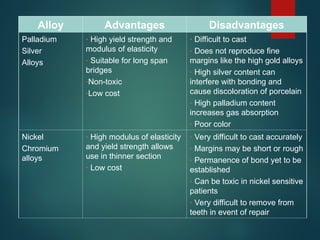
-Non-toxic
-Low cost
- Difficult to cast
- Does not reproduce fine
margins like the high gold alloys
- High silver content can
interfere with bonding and
cause discoloration of porcelain
- High palladium content
increases gas absorption
- Poor color
Nickel
Chromium
alloys
- High modulus of elasticity
and yield strength allows
use in thinner section
- Low cost
- Very difficult to cast accurately
- Margins may be short or rough
- Permanence of bond yet to be
established
- Can be toxic in nickel sensitive
patients
- Very difficult to remove from
teeth in event of repair
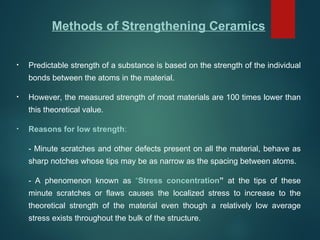
Methods of Strengthening Ceramics
• Predictable strength of a substance is based on the strength of the individual
bonds between the atoms in the material.
• However, the measured strength of most materials are 100 times lower than
this theoretical value.
• Reasons for low strength:
- Minute scratches and other defects present on all the material, behave as
sharp notches whose tips may be as narrow as the spacing between atoms.
- A phenomenon known as “Stress concentration” at the tips of these
minute scratches or flaws causes the localized stress to increase to the
theoretical strength of the material even though a relatively low average
stress exists throughout the bulk of the structure.
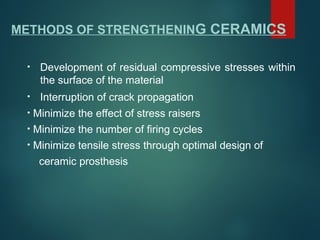
METHODS OF STRENGTHENING CERAMICS
• Development of residual compressive stresses within
the surface of the material
• Interruption of crack propagation
• Minimize the effect of stress raisers
• Minimize the number of firing cycles
• Minimize tensile stress through optimal design of
ceramic prosthesis
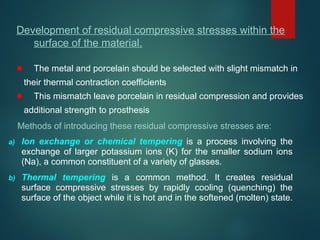
Methods of introducing these residual compressive stresses are:
a) Ion exchange or chemical tempering is a process involving the
exchange of larger potassium ions (K) for the smaller sodium ions
(Na), a common constituent of a variety of glasses.
b) Thermal tempering is a common method. It creates residual
surface compressive stresses by rapidly cooling (quenching) the
surface of the object while it is hot and in the softened (molten) state.
Development of residual compressive stresses within the
surface of the material.
The metal and porcelain should be selected with slight mismatch in
their thermal contraction coefficients
This mismatch leave porcelain in residual compression and provides
additional strength to prosthesis
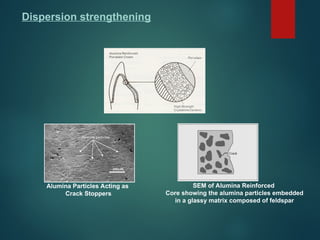
DISPERSION STRENGTHENING
Reinforcing with dispersed phase of different material that
is capable of hindering crack from propagating through the
material is known…
Dental ceramics containing primarily glass phase can be
strengthened by increasing the crystal content
•Leucite
•Lithia disilicate
•Alumina
•Magnesia-alumina spinel
•Zirconia
Dispersion strengthening
Alumina Particles Acting as
Crack Stoppers
SEM of Alumina Reinforced
Core showing the alumina particles embedded
in a glassy matrix composed of feldspar
TRANSFORMATION TOUGHENING
This technique involves the incorporation of a crystalline material
that is capable of undergoing a change in crystal structure when
placed under stress
The crystal material usually used is termed partially stabilized
zirconia (PSZ)
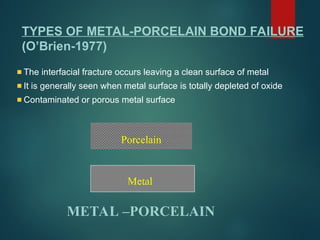
Porcelain
Metal
METAL –PORCELAIN
The interfacial fracture occurs leaving a clean surface of metal
It is generally seen when metal surface is totally depleted of oxide
Contaminated or porous metal surface
TYPES OF METAL-PORCELAIN BOND FAILURE
(O’Brien-1977)
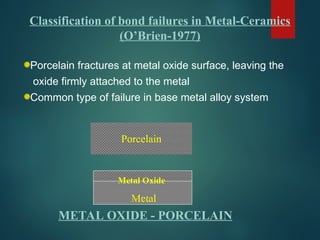
Classification of bond failures in Metal-Ceramics
(O’Brien-1977)
Porcelain
Metal
Metal Oxide
METAL OXIDE - PORCELAIN
Porcelain fractures at metal oxide surface, leaving the
oxide firmly attached to the metal
Common type of failure in base metal alloy system
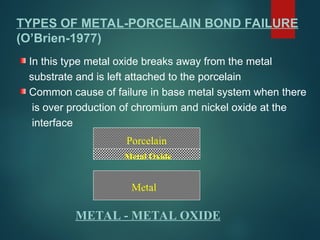
Metal
METAL - METAL OXIDE
Porcelain
Metal Oxide
TYPES OF METAL-PORCELAIN BOND FAILURE
(O’Brien-1977)
In this type metal oxide breaks away from the metal
substrate and is left attached to the porcelain
Common cause of failure in base metal system when there
is over production of chromium and nickel oxide at the
interface
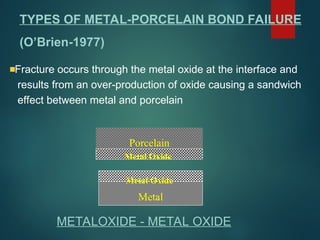
Porcelain
Metal Oxide
Metal Oxide
Metal
METALOXIDE - METAL OXIDE
TYPES OF METAL-PORCELAIN BOND FAILURE
(O’Brien-1977)
Fracture occurs through the metal oxide at the interface and
results from an over-production of oxide causing a sandwich
effect between metal and porcelain
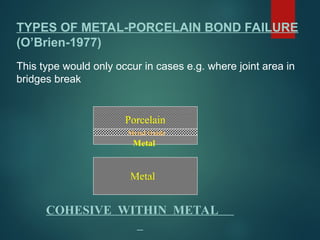
Metal
COHESIVE WITHIN METAL
Porcelain
Metal Oxide
Metal
TYPES OF METAL-PORCELAIN BOND FAILURE
(O’Brien-1977)
This type would only occur in cases e.g. where joint area in
bridges break
Porcelain
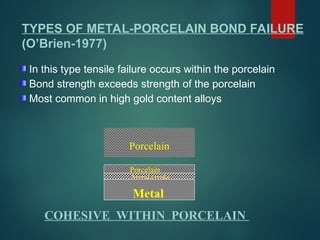
COHESIVE WITHIN PORCELAIN
Metal Oxide
Metal
Porcelain
TYPES OF METAL-PORCELAIN BOND FAILURE
(O’Brien-1977)
In this type tensile failure occurs within the porcelain
Bond strength exceeds strength of the porcelain
Most common in high gold content alloys
Fracture resistant
Esthetic fixed partial denture
Maximum retention
Easy correction of the axial form
superior marginal fit
Close simulation of natural appearance.
BENEFITS
Increased potential of gingival problems
More tooth reduction
Possible abrasive damage to opposing dentition
Inhalation of silicon dust
Difficult in accurate shade selection
Chemical degradation
Plaque accumulation
Difficulty to obtain accurate occlusion in glazed porcelain
Inferior esthetics compare to all-ceramic material
DRAWBACKS
Bibliography
Phillips science of dental materials{10th
and 11th edition}
The science and art of dental ceramics vol:1-John.w.mclean
Restorative dental materials-Craig 11TH
EDITION
Essentials of Dental ceramics – An Artistic approach
Gerard j. Chiche, Alain Pinaul
Fundamentals of Tooth Preparation – ShillingBurg
Contemporary Fixed Prosthodontics – Rosenstial, Land
Fujimoto.
Bibliography
Ozcan M, Niedermeier W: Clinical study on reasons for and
location of failures of metal-ceramic restorations and survival
of repairs IJP Vol. 15 2002
Kelly JR, Nishimura I: Ceramics in dentistry: Historical roots
and current prospectives JPD 200175:18-32
Robert J. Dent et al: Effect of Oxidation on Ceramo-metal bond
strength JPD 1982, Vol.47.
Lepold H. Kluser et al: Polished Versus Autoglazed Porcelain
surfaces. JPD 1982, vol.47.
Richard Jacob A Comparison of the Abrasiveness of 6 Ceramic
Surfaces and Gold : JPD 1991, Vol 32
ceramics in dentistry,classification,techniques

ceramics in dentistry,classification,techniques

  • 1.
  • 2.
    CONTENTS Introduction Historical Background Composition ofDental Porcelains Classification Condensation Firing Glazing of Dental porcelain Metal ceramics Requirements of metal-ceramic substructur Types of Metal-ceramic bonding Metal Ceramic alloys Methods of strengthening ceramics Types of metal-ceramic bond failure Benefits and drawbacks of metal ceramics Bibliography
  • 3.
    The word “Ceramic”derived from Greek word “Keramikos” = Earthen Earthy material, usually of silicate nature Compounds of one or more metals with a nonmetallic component, usually oxygen (GPT-8) INTRODUCTION
  • 4.
    Ceramics are formedof chemical and biochemical stable substances that are strong, hard, brittle, and inert nonconductors of thermal and electrical energy PORCELAIN is ceramic material formed of infusible elements joined by lower fusing materials Dental Ceramics contain a glassy matrix reinforced by various disperse phases consisting of crystalline structures such as Leucite, alumina & silica
  • 5.
    HISTORICAL BACKGROUND During stoneage-10,000 years ago ceramics were most important materials First porcelain tooth material was patented in 1789 by deChemant and Duchateau In 1808, Fonzi, an Italian dentist, invented “terrometallic” porcelain tooth that was held in place by platinum pin or frame
  • 6.
    Dr. Charles Landintroduced one of the first ceramic crowns to dentistry in 1903 First commercial porcelain was developed by vita zahnfabrik in about 1963 The end of the 20th century saw the introduction of several innovative systems for fabricating all-ceramic dental restorations
  • 7.
    COMPOSITION OF DENTALPORCELAINS The quality of any porcelain depends on the choice of ingredients, the correct proportioning of each and the control of the firing procedure. Ceramics are composed of essentially the same material as porcelain, the principal difference being in the proportioning of the primary ingredients & the firing procedure. The ingredients are (Triaxial composition) a) Feldspar b) Silica (quartz or flint) c) Kaolin
  • 8.
    FELDSPAR In its mineralstate, feldspar is crystalline and opaque with an indefinite color between gray and pink. Chemically it is designated as potassium-aluminum silicate, with a composition of K2O, Al2 O3 6SiO2. Potassium and sodium feldspar are naturally occurring composed of potash (K2O), Soda (Na2O), Alumina (Al2O3), and Silica (SiO2).
  • 9.
    The softening ofthis glass phase during porcelain firing, allows the powder particles to coalesce together. 3D structure of LEUCITE 2D Structure of SODIUM SILICATE GLASS Feldspar Glassy phase with amorphous structure Crystalline phase consisting of leucite heating 12000 c
  • 10.
    SILICA It can existin four different forms • Crystalline quartz • Crystalline cristobalite • Crystalline tridymite • Non-crystalline fused silica Silica remains unchanged at high temperature used in firing porcelain and thus contributes stability to the mass during heating by providing a framework for other ingredients.
  • 11.
    KAOLIN It is producednaturally by weathering of feldspar during which the soluble potassium silicate is washed out by acidic water. In this process the residue is deposited at the bottom of the streams in the form of clay. Kaolin gives porcelain its property of opaqueness. COLOUR PIGMENTS Added to the porcelain in small quantities to obtain delicate shades necessary to simulate natural teeth. Prepared by grinding metallic oxides with fine glass and feldspar, fusing the mixture in a furnace and regrinding to powder.
  • 12.
    Metallic Oxides • Titaniumoxide – yellowish brown • Manganese oxide – lavender • Iron oxide or Nickel oxide – Brown • Cobalt oxide – Blue • Copper oxide – Green Opacifying Agents Generally consists of metallic oxide (between 8% to 15%) ground to a very fine particle size (<5 m) to prevent a speckled appearance in porcelain • Cerium oxide • Zirconium oxide • Titanium oxide • Tin oxide
  • 13.
    STAINS Stain is moreconcentrated than the color modifier They can be supplied as pure metal oxides but are sometimes made from lower fusion point glasses. Used as surface colorants or to provide enamel check lines, decalcification spots
  • 14.
    GLASS MODIFIERS Crystalline silica Decreasesviscosity Lowers softening temperature Increases thermal expansion Too high a modifier concentration Reduces chemical durability Glass may crystallize during porcelain firing
  • 15.
    GLAZES AND ADD-ONPORCELAIN • One purpose of an industrial glaze is to seal the open pores in the surface of fired porcelain. • Dental glazes consists of low fusing porcelains which can be applied to the surface of a fired crown to produce a glossy surface. • Thermal expansion of the glaze should be fractionally lower than the ceramic body to which it is applied. • Add-on porcelain is used for simple corrections of tooth contour or contact points
  • 16.
    Other Additions toDental Porcelains Boric oxide (B2O3) Glass modifier • It decreases viscosity • lowers the softening temperature • forms its own glass network Alumina (Al2O3) • It takes part in the formation of glass network • alter the softening point and viscosity Lithium Oxide • Added as an additional flux agent Magnesium Oxide • present but in minute quantities • It can replace calcium oxide
  • 17.
    DEVITRIFICATION AND THERMALEXPANSION “Vitrification” in ceramic terms is development of a liquid phase by reaction or melting, which on cooling forms glassy phase. This structure is termed ‘Vitreous’ When too many glass forming silica tetrahydra are disrupted in dental porcelain, the glass may crystallize or devitrify The regular aluminous porcelains are less susceptible to devitrification due to their higher silica to alkali ratio The aluminous porcelains contain much less soda and their thermal expansions are too lower
  • 18.
    FRITTING • The mixtureof leucite and glassy phase is cooled very rapidly i.e. quenched in water • This causes the mass to shatter in small fragments and the product obtained is called frit which is ball-milled • The process of blending, melting and quenching the glass components it termed fritting
  • 19.
    CLASSIFICATION Dental ceramics areclassified according to their; Firing temperature Type of porcelain According to the use Processing methods Substructure material Methods of fabricating ceramic restorations Methods of firing According to application
  • 20.
     According toFiring Temperatures High Fusing 13000 C denture teeth Superior strength, insolubility and translucency Medium fusing 11000 -13000 C denture teeth, metal-ceramic restoration Low fusing 8500 C-11000 C metal-ceramic restorations Ultra low fusing <8500 C
  • 21.
     According toFiring Methods Air fired – Firing at atmospheric pressure Vacuum fired – Firing at reduced pressure  According to the Type of Porcelain Feldspathic porcelain Leucite reinforced porcelain Aluminous porcelain Glass infiltrated alumina Glass infiltrated spinel Glass infiltrated zirconia Glass ceramic
  • 22.
    According to theUse Denture teeth Metal ceramics Laminate and veneers Inlays, onlays Crown and bridge According to Processing Methods: Sintering Casting Machining
  • 23.
    ☻According to themethod of Applications All porcelain Porcelain fused to metal ☻According to the Substructure Material Cast metal Swaged metal Glass ceramic Sintered glass ceramic CAD/ CAM Porcelain Sintered ceramic core
  • 24.
    According to FabricationTechnique (CRAIG) Fabrication Crystalline Phase All Ceramic Machined Alumina – Al2 O3 Feldspar – AKAl Si3 O8 Mica – KMg25 Sio4 F2 Slip Cast Alumina – Al2 O3 Spinel – Mg Al2 O4 Heat Pressed Leucite – Kal Si2 O6 Lithium disilicate Li2 Si2 O5 Sintered Alumina – Al2 O6 Leucite – Kal Si2 O6 Ceramic Metal Sintered Leusite – KA1Si2 O6 Denture teeth Manufactured Feldspar
  • 25.
  • 26.
    Condensation of DentalPorcelain The process of packing the particles together and removing the liquid binder is known as condensation Distilled water-most commonly used liquid binder Other binders: Glycerin, propylene glycol or alcohol Dense packing of powder particles -lower firing shrinkage -less porosity in fired porcelain Condensing methods Vibration Spatulation Brush techniques
  • 27.
    Vibration method Manual orultrasonic Mild vibration is used to pack the wet powder densely on the underlying framework Excess water is blotted or wiped away with clean tissueor fine brush, and condensation occurs toward blotted or brushed area Ultrasonic vibration The restoration is placed on vibrator Low amplitude along with very high rate of vibrations/sec pulls the liquid to surface with almost no disturbance to the porcelain contour
  • 28.
    whipping  No.10 sablehair brush is used in whipping motion, producing gentle vibration Spatulation method Spatula is used to apply and smoothen wet porcelain The smoothing action brings excess water to the surface, where it is removed
  • 29.
    BRUSH APPLICATION METHOD Capillaryattraction method Dry powder is placed by a brush to the side opposite from an increment of wet porcelain As the water is drawn toward the dry powder, the wet particles are pulled together  Not recommended because the control of the powder can be difficult and time consuming This will enhance the risk of the porcelain drying out
  • 30.
    Wet brush technique Condensationis done by using brush to flow the wet porcelain around the framework A gentle pushing or tapping motion will agitate porcelain particles into position and brush will keep porcelain moist Water is withdrawn with paper tissue, surface tension will automatically cause the particles to settle closer together
  • 31.
    Modeling Brush Flat Brush Constanthumidity box CONDENSATION
  • 32.
    FIRING/ SINTERING OFPORCELAIN Porcelain restorations are fired either by temperature control alone or temperature and time control Sintering is defined as a process of heating without melting closely packed particles to form a coherant mass by inter- particle bonding and sufficient diffusion to decrease the surface area and increase the density of the structure SINTERING
  • 33.
    AIR FIRING During firing,partial fusion of particles at their point of contact Temp sintered glass gradually flows to fill up air spaces Air becomes trapped in form of voids because fused mass is too viscous to allow all the air to escape porosity reduces translucency and strength •Very slow maturation period is ideal •30-400 c below maximum firing temperature is recommended
  • 34.
    How vacuum firingworks? After porcelain is placed in the furnace Air pressure in furnace muffle is reduced to 0.1atm Temp until firing temperature is reached Vacuum is then released and furnace pressure returns 1atm Increase in pressure from 0.1-1atm compresses residual pores Marked reduction in porosity in vacuum sintered porcelain
  • 35.
    ADVANTAGES OF VACUUMFIRING Improves translucency and decreases surface roughness Increases impact strength approximately 50% Reduces the amount of porosity to 0.56% (from 5.6%) in air fired dental porcelain
  • 36.
    DIFFUSIBLE GAS FIRING Itis an alternate method which uses the principle of diffusion to secure improved density in fused porcelain A diffusible gas such as helium may be introduced to furnace at low pressure during sintering stage The helium gas is entrapped instead of air in interstitial spaces Since its molecular diameter is smaller than porcelain lattice, its diffuses outward under pressure of shrinking porcelain
  • 37.
    Low Bisque MediumBisque High Bisque Surface very porous Less porous Completely sealed and smooth Grains start to soften and “lense” Entrapped air becomes sphere shaped A slight shine appears on the surface Shrinkage is minimal Definite shrinkage Body extremely weak and friable Body is strong STAGES IN FIRING
  • 38.
    GLAZING OF PORCELAIN Afterporcelain is cleaned and any necessary stains are applied, it is returned to the furnace for final glaze firing Usually, the glazing step is very short When glazing temperature is reached, a thin glassy film (glaze) is formed by viscous flow on the porcelain surface Natural glaze enhances transverse strength, esthetics and reduces crack propagation Over glazing should be avoided
  • 39.
    Advantages Good esthetics Long termcolor stability High hardness & compressive strength Chemical inertness Excellent biocompatibility Excellent thermal and electrical insulators Disadvantages Brittleness Low fracture toughness Low tensile strength.
  • 40.
  • 41.
    Requirements for metal-ceramicsystem High fusion temperature of alloy Fusion temperature of ceramic should be low Ceramic must wet the alloy Good bond between ceramic and metal is essential Compatible coefficients of thermal expansion of ceramic and metal is necessary Adequate stiffness and strength of alloy core High sag resistance of alloy is essential An accurate metal coping is required Adequate design of restoration is critical
  • 42.
    INDICATIONS Teeth that requirecomplete coverage Fixed partial denture retainer Cases of extensive tooth destruction Need of superior retention and strength Restoration of teeth with multiple deflective axial surfaces An endodontically treated tooth in conjunction with suitable supporting structure Correction of minor inclinations
  • 43.
    CONTRA-INDICATIONS Patients with activecaries Untreated periodontal disease In young patients with large pulp chambers due to high risk of pulp exposure When a more conservative retainer is feasible
  • 44.
    Metal-ceramic restoration iscomposed of metal casting or coping, Which fits over the prepared tooth and ceramic is fused to coping The metal coping in a metal-ceramic restoration is covered with three layers of porcelain OPAQUE PORCELAIN Conceals the metal underneath Initiates the development of shade Plays an important role in development of bond between ceramic and metal METAL-CERAMIC RESTORATION
  • 45.
    DENTIN OR BODYPORCELAIN Makes up the bulk of the restoration, providing most of the colour or shade ENAMEL OR INCISAL PORCELAIN Imparts translucency to the restoration
  • 46.
    Functions of MetalSubstructure Primary Functions The casting provides the fit of the restoration on the prepared tooth The metal forms oxides that bond chemically to dental porcelain The coping serves as a rigid foundation to which the brittle porcelain can be attached for increased strength and support The substructure restores the proper emergence profile of the tooth
  • 47.
    Secondary functions Metal occlusaland lingual articulating surfaces can be less destructive to the enamel of opposing natural teeth The occluding surfaces can be easily adjusted and repolished intra orally Fabrication of a restoration with minimal occlusal clearance has more potential for success with a metal substructure than all-ceramic materials
  • 48.
    FARICATION OF METAL-CERAMICRESTORATION Stage I The metal coping is cleaned by sand blasting or steam cleaning and then placed in an ultra-sonic cleaning bath The roughened surface produced by sandblasting provides wettable surface and will assist in mechanical retention of the porcelain
  • 49.
    Stage II The metalis de-gassed by heating to 10000 C in vacuum for about 10 minutes and then slowly air-cooled in normal atmosphere This procedure also produces some age hardening in the alloy At the same time, base metal atoms will diffuse to the surface of the metal and form an oxide film
  • 50.
    Stage III An opaqueporcelain slurry is applied to the surface of the casting so that an even and thin layer is formed The metal and opaque porcelain are then slowly oven-dried and opaque porcelain will shrink onto the metal surface
  • 51.
    Stage IV The opaqueporcelain on the metal is introduced into the hot zone of the furnace and initial sintering of the grains of porcelain will occur. Stage V The opaque porcelain is then raised to its final maturing temperature of around 9300 C to 9600 C. At this stage the porcelain will continue to shrink through sintering and pore elimination.
  • 52.
    Stage VI The enameland dentin porcelain are applied and sintered
  • 53.
    DEGASSING The term degassingrefers to a procedure recommended to clean the metal to remove entrapped surface gases such as hydrogen The procedure is important for removal of volatile contaminants that might not otherwise be eliminated either by metal finishing, steam cleaning, or air abrading This process also allows specific oxides to form on the metal surface which responsible for the chemical bond
  • 54.
    METAL-CERAMIC BONDING Strong bondbetween metal and porcelain is essential Types of bond Mechanical entrapment Compressive forces Van der waal’s forces Chemical bonding
  • 55.
    Mechanical Entrapment Mechanical interlocking of the ceramic with micro abrasions created on the surface of the metal coping by, Finishing the metal with non-contaminated stones or discs Air abrasion The use of a bonding agent such as platinum spheres Electrochemical corrosion of the metal surface Selective oxidation of grain boundaries
  • 56.
    Compressive Forces Compressive forcesare developed within ceramic system by properly designed coping with slightly higher co-efficient of thermal expansion than the porcelain veneered over it Sintering shrinkage and thermal contraction of porcelain will be resisted by the metal and compressive stresses will be set up in porcelain resulting in firm bonding of porcelain with the metal
  • 57.
    Van der waalsforces These forces comprise of an affinity based on mutual attraction of charged molecules They are minor force and not as significant as once thought however they play a major role in initiation of the most important bonding mechanism – the chemical bond The better the wetting of the metal surface, the greater the Van der Waals forces
  • 58.
    Chemical Bonding • Chemicalbonding is generally accepted as the primary mechanism in the porcelain metal attachment process. • Two mechanisms may exist with the chemical bonding theory. According to one hypothesis, the oxide layer is permanently bonded to the metal substructure on one side while the dental porcelain remains on the other. • The oxide layer itself is sandwiched in between the metal substructure and the opaque porcelain.
  • 59.
    The second theorywhich is more accepted, suggests that the surface oxides dissolves or dissolved by the opaque layer of the porcelain The porcelain is then brought into atomic contact with the metal surface for enhanced wetting and direct chemical bonding so that metal and porcelain share electron Both covalent and ionic bonds are thought to form but only a monomolecular layer of oxide is believed to be required for chemical bonding to occur.
  • 60.
  • 61.
    System Group Noble metalalloys i) Gold-platinum-palladium High silver ii) Gold-palladium-silver Lower silver iii) Gold-palladium iv) Palladium – silver v) High palladium Copper Silver-gold Base Metal Alloys i) Nickel-Chromium Beryllium ii) Cobalt-Chromium Beryllium-free iii) Other systems
  • 62.
    Alloy Advantages Disadvantages Gold Platinum Palladium -Excellent bonding to porcelain - Good castability - Easily finished and polished - Corrosion resistant and non-toxic - Excellent for producing occlusal surfaces - Low sag or creep resistance, can distort at fine margins or warp on long span bridges - High cost Gold Palladium Silver - High melting range giving better creep resistance - Yield strength can be higher than some Au-Pt Pd alloys - Good castability - Easily finished and polished - Non-toxic - Low cost - Silver content may cause greening of porcelain - High palladium content can increase risk of H2 gas absorption during casting - Bonding to porcelain not yet proven clinically or experimentally
  • 63.
    Alloy Advantages Disadvantages Palladium Silver Alloys -High yield strength and modulus of elasticity - Suitable for long span bridges -Non-toxic -Low cost - Difficult to cast - Does not reproduce fine margins like the high gold alloys - High silver content can interfere with bonding and cause discoloration of porcelain - High palladium content increases gas absorption - Poor color Nickel Chromium alloys - High modulus of elasticity and yield strength allows use in thinner section - Low cost - Very difficult to cast accurately - Margins may be short or rough - Permanence of bond yet to be established - Can be toxic in nickel sensitive patients - Very difficult to remove from teeth in event of repair
  • 64.
    Methods of StrengtheningCeramics • Predictable strength of a substance is based on the strength of the individual bonds between the atoms in the material. • However, the measured strength of most materials are 100 times lower than this theoretical value. • Reasons for low strength: - Minute scratches and other defects present on all the material, behave as sharp notches whose tips may be as narrow as the spacing between atoms. - A phenomenon known as “Stress concentration” at the tips of these minute scratches or flaws causes the localized stress to increase to the theoretical strength of the material even though a relatively low average stress exists throughout the bulk of the structure.
  • 65.
    METHODS OF STRENGTHENINGCERAMICS • Development of residual compressive stresses within the surface of the material • Interruption of crack propagation • Minimize the effect of stress raisers • Minimize the number of firing cycles • Minimize tensile stress through optimal design of ceramic prosthesis
  • 66.
    Methods of introducingthese residual compressive stresses are: a) Ion exchange or chemical tempering is a process involving the exchange of larger potassium ions (K) for the smaller sodium ions (Na), a common constituent of a variety of glasses. b) Thermal tempering is a common method. It creates residual surface compressive stresses by rapidly cooling (quenching) the surface of the object while it is hot and in the softened (molten) state. Development of residual compressive stresses within the surface of the material. The metal and porcelain should be selected with slight mismatch in their thermal contraction coefficients This mismatch leave porcelain in residual compression and provides additional strength to prosthesis
  • 67.
    DISPERSION STRENGTHENING Reinforcing withdispersed phase of different material that is capable of hindering crack from propagating through the material is known… Dental ceramics containing primarily glass phase can be strengthened by increasing the crystal content •Leucite •Lithia disilicate •Alumina •Magnesia-alumina spinel •Zirconia
  • 68.
    Dispersion strengthening Alumina ParticlesActing as Crack Stoppers SEM of Alumina Reinforced Core showing the alumina particles embedded in a glassy matrix composed of feldspar
  • 69.
    TRANSFORMATION TOUGHENING This techniqueinvolves the incorporation of a crystalline material that is capable of undergoing a change in crystal structure when placed under stress The crystal material usually used is termed partially stabilized zirconia (PSZ)
  • 70.
    Porcelain Metal METAL –PORCELAIN The interfacialfracture occurs leaving a clean surface of metal It is generally seen when metal surface is totally depleted of oxide Contaminated or porous metal surface TYPES OF METAL-PORCELAIN BOND FAILURE (O’Brien-1977)
  • 71.
    Classification of bondfailures in Metal-Ceramics (O’Brien-1977) Porcelain Metal Metal Oxide METAL OXIDE - PORCELAIN Porcelain fractures at metal oxide surface, leaving the oxide firmly attached to the metal Common type of failure in base metal alloy system
  • 72.
    Metal METAL - METALOXIDE Porcelain Metal Oxide TYPES OF METAL-PORCELAIN BOND FAILURE (O’Brien-1977) In this type metal oxide breaks away from the metal substrate and is left attached to the porcelain Common cause of failure in base metal system when there is over production of chromium and nickel oxide at the interface
  • 73.
    Porcelain Metal Oxide Metal Oxide Metal METALOXIDE- METAL OXIDE TYPES OF METAL-PORCELAIN BOND FAILURE (O’Brien-1977) Fracture occurs through the metal oxide at the interface and results from an over-production of oxide causing a sandwich effect between metal and porcelain
  • 74.
    Metal COHESIVE WITHIN METAL Porcelain MetalOxide Metal TYPES OF METAL-PORCELAIN BOND FAILURE (O’Brien-1977) This type would only occur in cases e.g. where joint area in bridges break
  • 75.
    Porcelain COHESIVE WITHIN PORCELAIN MetalOxide Metal Porcelain TYPES OF METAL-PORCELAIN BOND FAILURE (O’Brien-1977) In this type tensile failure occurs within the porcelain Bond strength exceeds strength of the porcelain Most common in high gold content alloys
  • 76.
    Fracture resistant Esthetic fixedpartial denture Maximum retention Easy correction of the axial form superior marginal fit Close simulation of natural appearance. BENEFITS
  • 77.
    Increased potential ofgingival problems More tooth reduction Possible abrasive damage to opposing dentition Inhalation of silicon dust Difficult in accurate shade selection Chemical degradation Plaque accumulation Difficulty to obtain accurate occlusion in glazed porcelain Inferior esthetics compare to all-ceramic material DRAWBACKS
  • 78.
    Bibliography Phillips science ofdental materials{10th and 11th edition} The science and art of dental ceramics vol:1-John.w.mclean Restorative dental materials-Craig 11TH EDITION Essentials of Dental ceramics – An Artistic approach Gerard j. Chiche, Alain Pinaul Fundamentals of Tooth Preparation – ShillingBurg Contemporary Fixed Prosthodontics – Rosenstial, Land Fujimoto.
  • 79.
    Bibliography Ozcan M, NiedermeierW: Clinical study on reasons for and location of failures of metal-ceramic restorations and survival of repairs IJP Vol. 15 2002 Kelly JR, Nishimura I: Ceramics in dentistry: Historical roots and current prospectives JPD 200175:18-32 Robert J. Dent et al: Effect of Oxidation on Ceramo-metal bond strength JPD 1982, Vol.47. Lepold H. Kluser et al: Polished Versus Autoglazed Porcelain surfaces. JPD 1982, vol.47. Richard Jacob A Comparison of the Abrasiveness of 6 Ceramic Surfaces and Gold : JPD 1991, Vol 32

Editor's Notes

  • #10 linked silicate unit which forms continuous network in glass
  • #12 these r sum of the oxides and their respective color contribution to porcelain
  • #31 whichever