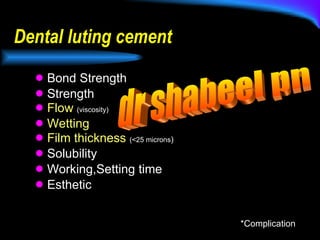
Dental luting cement Bond Strength Strength Flow   (viscosity) Wetting Film thickness   (<25 microns ) Solubility Working,Setting time Esthetic *Complication dr shabeel pn
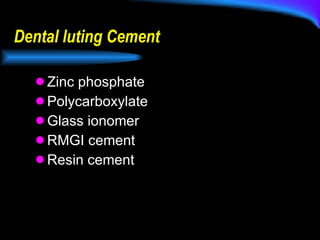
Dental luting Cement Zinc phosphate Polycarboxylate Glass ionomer RMGI cement Resin cement
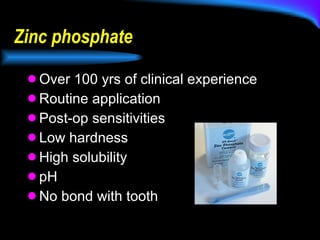
Zinc phosphate Over 100 yrs of clinical experience Routine application Post-op sensitivities Low hardness High solubility pH No bond with tooth
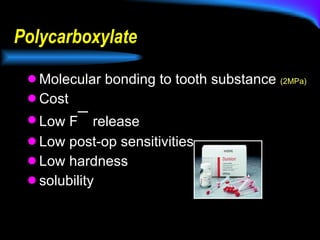
Polycarboxylate Molecular bonding to tooth substance  (2MPa) Cost Low F ¯  release Low post-op sensitivities Low hardness solubility
Glass ionomer Molecular bonding to tooth substance F ¯  release Cost-Eff. Minimal dimentional change Occa. post-op sensitivities Sensitive to water Limited application (ceramics) (High caries risk) (3-5MPa)
RMGI Molecular bonding to tooth substance F ¯  release Low solubility Fewer post-op sensitivities Application ?  (ceramics,composite) (>10MPa)
Resin cement High adhesive  quality  (18-20MPa) ⇧  Retention High hardness Low solubility All metal, ceramic,composite (indirect) Occa. Post-op sensitivities
Adhesive quality Non-adhesive  (zinc phosphate) Micromechanical bonding  (resin cement) Molecular adhesion  (polycarboxylate,GI,RMGI)
Dental Cement Zinc phosphate Polycarboxylate Glass ionomer RMGI cement Resin cement Conventional Adhesive
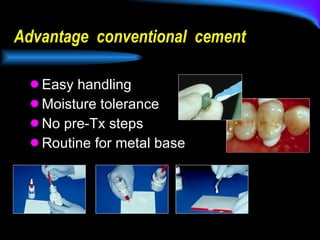
Advantage  conventional  cement Easy handling Moisture tolerance No pre-Tx steps Routine for metal base
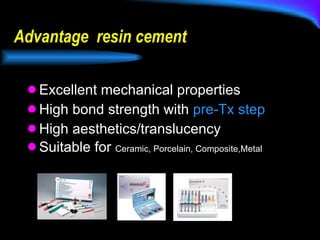
Advantage  resin cement Excellent mechanical properties High bond strength with  pre-Tx step High aesthetics/translucency Suitable for  Ceramic, Porcelain, Composite,Metal
Resin cement  Matrix Primer Filler Coupling agent
Resin cement  Matrix - Dimethacrylate Primer- Dicrylate Filler  -  Quartz, silica  Coupling agent- Silane dimethacrylate
Total etch  Rely X ARC , Variolink II ,Calibra ,C&B Self-etch  Panavia F Self-Adhesive   Rely X Unicem Resin cement
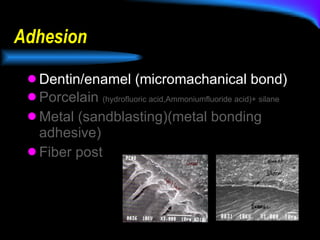
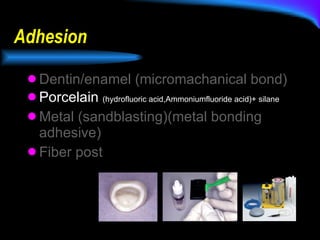
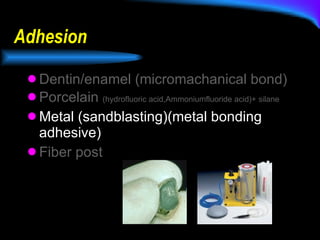
Adhesion Dentin/enamel (micromachanical bond) Porcelain  (hydrofluoric acid,Ammoniumfluoride acid)+ silane Metal (sandblasting)(metal bonding adhesive) Fiber post
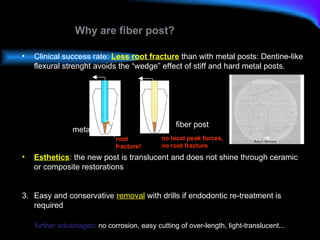
Why are fiber post? Clinical success rate:  Less root fracture  than with metal posts:   Dentine-like flexural strenght avoids the “wedge” effect of stiff and hard metal posts. metal fiber post Esthetics :  the new post is translucent and does not shine through ceramic or composite restorations 3. Easy and conservative  removal  with drills if endodontic re-treatment is required  further advantages :  no corrosion, easy cutting of over-length, light-translucent... root  fracture! no local peak forces,  no root fracture
Resin cement  Bond strength > Zinc phosphate 10  times ↑  Retention Reinforced  ceramic - base  Crown Adhesive system  (micromachanical bond-tooth) (chemical bond-porcelain,metal) Low solubility ↓  leakage
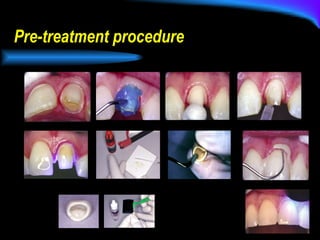
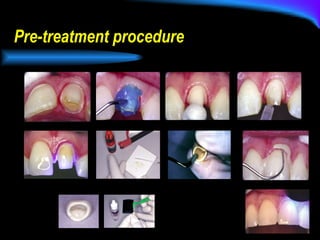
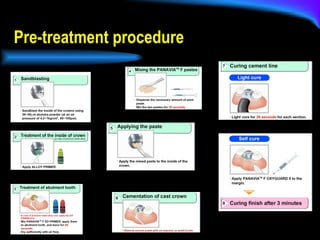
Pre-treatment procedure
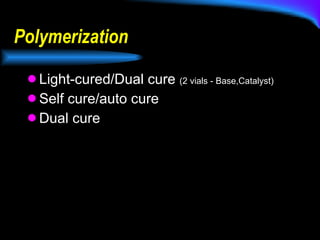
Polymerization Light-cured/Dual cure  (2 vials - Base,Catalyst) Self cure/auto cure Dual cure
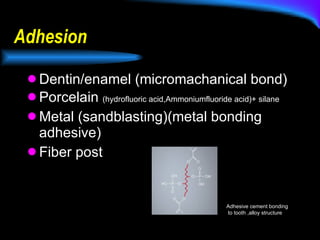
Adhesion Dentin/enamel (micromachanical bond) Porcelain  (hydrofluoric acid,Ammoniumfluoride acid)+ silane Metal (sandblasting)(metal bonding adhesive) Fiber post Adhesive cement bonding to tooth ,alloy structure
Anesthetic Isolate  (pack cord) Light cure 2-3 sec Include 3-5 shades,silane Remove solvent- can inhibit setting of resin cement Excess bonding – poor fit,low strength Temp NE Clinical Tips
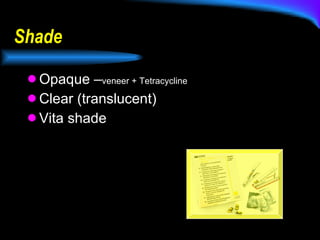
Shade Opaque – veneer + Tetracycline Clear (translucent) Vita shade

Dental Cement

  • 1.
    Dental luting cementBond Strength Strength Flow (viscosity) Wetting Film thickness (<25 microns ) Solubility Working,Setting time Esthetic *Complication dr shabeel pn
  • 2.
    Dental luting CementZinc phosphate Polycarboxylate Glass ionomer RMGI cement Resin cement
  • 3.
    Zinc phosphate Over100 yrs of clinical experience Routine application Post-op sensitivities Low hardness High solubility pH No bond with tooth
  • 4.
    Polycarboxylate Molecular bondingto tooth substance (2MPa) Cost Low F ¯ release Low post-op sensitivities Low hardness solubility
  • 5.
    Glass ionomer Molecularbonding to tooth substance F ¯ release Cost-Eff. Minimal dimentional change Occa. post-op sensitivities Sensitive to water Limited application (ceramics) (High caries risk) (3-5MPa)
  • 6.
    RMGI Molecular bondingto tooth substance F ¯ release Low solubility Fewer post-op sensitivities Application ? (ceramics,composite) (>10MPa)
  • 7.
    Resin cement Highadhesive quality (18-20MPa) ⇧ Retention High hardness Low solubility All metal, ceramic,composite (indirect) Occa. Post-op sensitivities
  • 8.
    Adhesive quality Non-adhesive (zinc phosphate) Micromechanical bonding (resin cement) Molecular adhesion (polycarboxylate,GI,RMGI)
  • 9.
    Dental Cement Zincphosphate Polycarboxylate Glass ionomer RMGI cement Resin cement Conventional Adhesive
  • 10.
    Advantage conventional cement Easy handling Moisture tolerance No pre-Tx steps Routine for metal base
  • 11.
    Advantage resincement Excellent mechanical properties High bond strength with pre-Tx step High aesthetics/translucency Suitable for Ceramic, Porcelain, Composite,Metal
  • 12.
    Resin cement Matrix Primer Filler Coupling agent
  • 13.
    Resin cement Matrix - Dimethacrylate Primer- Dicrylate Filler - Quartz, silica Coupling agent- Silane dimethacrylate
  • 14.
    Total etch Rely X ARC , Variolink II ,Calibra ,C&B Self-etch Panavia F Self-Adhesive Rely X Unicem Resin cement
  • 15.
    Adhesion Dentin/enamel (micromachanicalbond) Porcelain (hydrofluoric acid,Ammoniumfluoride acid)+ silane Metal (sandblasting)(metal bonding adhesive) Fiber post
  • 16.
    Adhesion Dentin/enamel (micromachanicalbond) Porcelain (hydrofluoric acid,Ammoniumfluoride acid)+ silane Metal (sandblasting)(metal bonding adhesive) Fiber post
  • 17.
    Adhesion Dentin/enamel (micromachanicalbond) Porcelain (hydrofluoric acid,Ammoniumfluoride acid)+ silane Metal (sandblasting)(metal bonding adhesive) Fiber post
  • 18.
    Adhesion Dentin/enamel (micromachanicalbond) Porcelain (hydrofluoric acid,Ammoniumfluoride acid)+ silane Metal (sandblasting)(metal bonding adhesive) Fiber post
  • 19.
    Why are fiberpost? Clinical success rate: Less root fracture than with metal posts: Dentine-like flexural strenght avoids the “wedge” effect of stiff and hard metal posts. metal fiber post Esthetics : the new post is translucent and does not shine through ceramic or composite restorations 3. Easy and conservative removal with drills if endodontic re-treatment is required further advantages : no corrosion, easy cutting of over-length, light-translucent... root fracture! no local peak forces, no root fracture
  • 20.
    Resin cement Bond strength > Zinc phosphate 10 times ↑ Retention Reinforced ceramic - base Crown Adhesive system (micromachanical bond-tooth) (chemical bond-porcelain,metal) Low solubility ↓ leakage
  • 21.
  • 22.
  • 23.
  • 24.
    Polymerization Light-cured/Dual cure (2 vials - Base,Catalyst) Self cure/auto cure Dual cure
  • 25.
    Adhesion Dentin/enamel (micromachanicalbond) Porcelain (hydrofluoric acid,Ammoniumfluoride acid)+ silane Metal (sandblasting)(metal bonding adhesive) Fiber post Adhesive cement bonding to tooth ,alloy structure
  • 26.
    Anesthetic Isolate (pack cord) Light cure 2-3 sec Include 3-5 shades,silane Remove solvent- can inhibit setting of resin cement Excess bonding – poor fit,low strength Temp NE Clinical Tips
  • 27.
    Shade Opaque –veneer + Tetracycline Clear (translucent) Vita shade