GLASS IONOMER CEMENT
BY: NIKHILA N KASHYAP
CONTENTS
 Introduction
 History
 Composition
 Classification
 Dispensing
 Manipulation
 Setting reaction
 Properties
 Indications and contraindications
 Advantages and disadvantages
INTRODUCTION
 What is a cement?
 A cement is a substance that hardens to act
as a base ,liner ,filling material ,or adhesives
to bind devices or prosthesis to the tooth
structure or to each other.
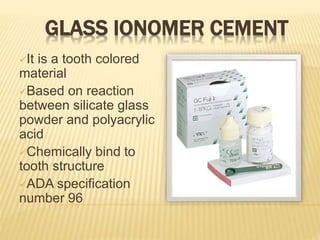
GLASS IONOMER CEMENT
It is a tooth colored
material
Based on reaction
between silicate glass
powder and polyacrylic
acid
Chemically bind to
tooth structure
ADA specification
number 96
HISTORY
 Invented in 1969
 Reported by wilson and kent in 1972
 The term was coined by B.E KENT
 Other names:
Ionomer poly-carboxylate acid
ISO terminology Poly-alkenoate cement
Since its extensive usage to replace the
dentin-dentin substitute , man-made dentin,
artificial dentin
ASPA- alumino silicate poly-acrylate.
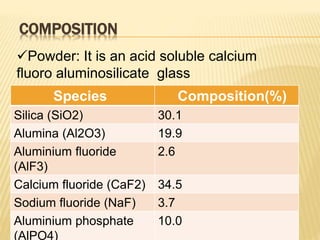
COMPOSITION
Species Composition(%)
Silica (SiO2) 30.1
Alumina (Al2O3) 19.9
Aluminium fluoride
(AlF3)
2.6
Calcium fluoride (CaF2) 34.5
Sodium fluoride (NaF) 3.7
Aluminium phosphate
(AlPO4)
10.0
Powder: It is an acid soluble calcium
fluoro aluminosilicate glass
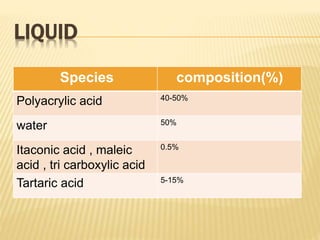
LIQUID
Species composition(%)
Polyacrylic acid 40-50%
water 50%
Itaconic acid , maleic
acid , tri carboxylic acid
0.5%
Tartaric acid 5-15%
CLASSIFICATION
According to A.D Wilson
I. Type 1: Luting agents
II. Type 2: Restorative cements
a)aesthetic filling material
b)bis-reinforced filling material
III Type 3: Lining, base and fissure sealing
materials
According to application
 Type 1) luting
 Type 2) restoration
 Type 3) liners and base
 Type 4) pit and fissures sealants
 Type 5) luting for orthodontic purpose
 Type 6) core build up material
 Type 7) fluoride releasing GIC
 Type 8) for ART
 Type 9) for pediatric purpose
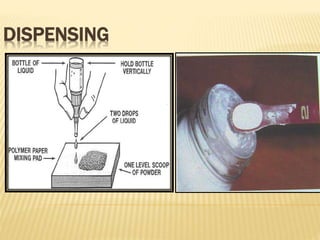
DISPENSING
Commercially
available in 2 forms
1. Encapsulated
2. Powder and
liquid
MANIPULATION
1) Tooth preparation:
 Pumice slurry is used to remove the smear
layer.
 Etched with phosphoric acid and rinse
 tooth surface should be cleaned and dried
for sustained adhesion .
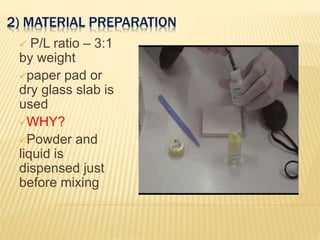
2) MATERIAL PREPARATION
 P/L ratio – 3:1
by weight
paper pad or
dry glass slab is
used
WHY?
Powder and
liquid is
dispensed just
before mixing
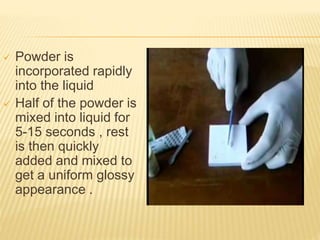
 Powder is
incorporated rapidly
into the liquid
 Half of the powder is
mixed into liquid for
5-15 seconds , rest
is then quickly
added and mixed to
get a uniform glossy
appearance .
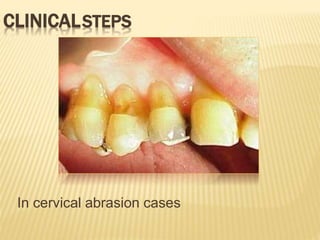
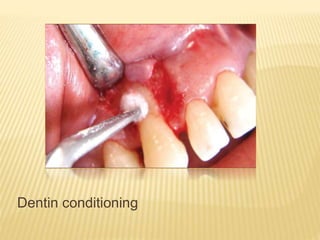
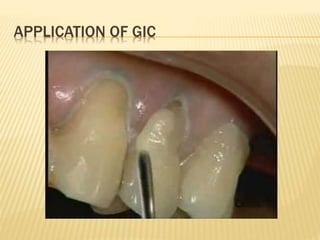
CLINICALSTEPS
In cervical abrasion cases
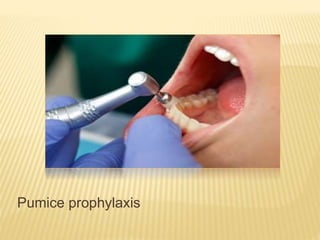
Pumice prophylaxis
Dentin conditioning
APPLICATION OF GIC
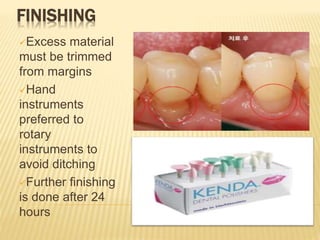
FINISHING
Excess material
must be trimmed
from margins
Hand
instruments
preferred to
rotary
instruments to
avoid ditching
Further finishing
is done after 24
hours
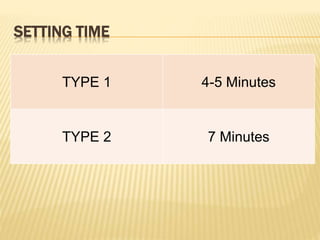
SETTING TIME
TYPE 1 4-5 Minutes
TYPE 2 7 Minutes
SETTING REACTION
 Stage 1) Dissolution
 Stage 2)precipitation of salts, gelation and
hardening.
 Stage 3) hydration of salts
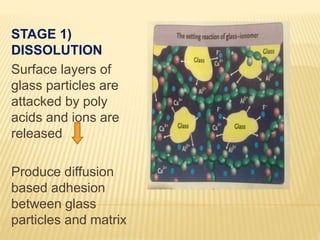
STAGE 1)
DISSOLUTION
Surface layers of
glass particles are
attacked by poly
acids and ions are
released
Produce diffusion
based adhesion
between glass
particles and matrix
STAGE 2) PRECIPITATION, GELATION AND
HARDENING
Calcium and aluminium ions bind to poly
ions
Initial clinical set-Cross linking of ca ions -4-
10 minutes from setting
Next 24 hours –less mobile aluminium ions
bound within the cement matrix – more rigid
cross linking
Fluoride and phosphate ions forms
insoluble salts and complexes
Sodium ions – binds the powder to matrix
STAGE 3) HYDRATION OF SALTS
 progressive hydration of matrix salts
 Sharp improvement in physical properties
SETTING RATE
 Manufacturer controlled
glass composition
glass fusion temperature,
powder particle size,
tartaric acid concentration
 Operator controlled
Mixing temperature-storage of slab and
powder in a refrigerator increases the working time
up to 25%
Powder: liquid ratio-inadequate liquid
results in a decline in translucency and physical
properties
PROPERTIES
 Adhesion: chemically binds to tooth structure
 Bio compatibility: resistance to plaque ,
plaque fails to thrive on the surface of GIC
 Pulpal response to GIC: formation of dentin
bridge occur when used to protect a
mechanical or traumatic exposure of pulp
 Remineralising effect
 Solubility : initial solubility is high due to
leaching of intermediate products
is low when compared to zinc
phosphate and zinc polycarboxylate
 Dimensional change : volumetric setting
contraction of approximately 3%
 Strength : susceptibility to brittle fracture .
Weak and lack rigidity when compared to
composites and amalgams
 Abrasion resistance : immediately after
placement-less resistance to abrasion , as
they mature their resistance improves
 Thermal diffusivity
 Color and translucency: type II a) restorative
esthetic material provide adequate color
matching and translucency
 Radiopacity:more radiopaque than dentin and
several exceed that of enamel
 Anticariogenic property: fluoride is released at
the time of mixing and lies within the matrix
- flouride reserviour
MODIFICATIONF OF GIC
1) Water settable GIC
Liquid used is clean water
Liquid is delivered in a freeze dried form ,which is
incorporated into the powder
2) Resin modified GIC
Powder component consist of ion leachable
fluroalumino silicate glass particles and initiator for
light curing
Liquid component consist of water and poly acrylic acid
with methacrylate and hydroxyl ethyl methacrylate
monomer
3) Metal modified GIC
GIC have been modified by addition of filler
particles, to improve strength fracture toughness
and resistance to wear
Silver alloy admix / miracle mix
This is made by mixing of spherical silver
amalgam alloy powder with glass ionomer
powder
Cerment
Bonding of silver particles to glass ionomer
particles by fusion through high temperature
sintering
3) Compomer
It is a composite resin that uses and ionomer
glass which is the major component of glass
ionomer as the filler
Small quantity of dehydrated poly alkenoic acid
incorporated with filler particles
Setting reaction is light activated
Adhesive system used with compomer is
based on acid etch found with all composite
resin
ATRAUMATIC RESTORATIVE TREATMENT
PRINCIPLES
1.Removing carious tooth tissue using hand
instruments only
2.Restoring the cavity with adhesive
material(glass ionomer)
Why GIC?
Chemically binds to enamel and dentin
Flouride release to prevent and arrest caries
Biocompatible – no irritation to pulp and gingiva
INDICATIONS
 Type I) useful in patients with high caries index
 Type II) restoring of erosion / abrasion lesions without
cavity preparation
sealing and filling occlusal pits and fissures
restorations of class III lesions
repair of defective margin in restoration
core build up
intermediate restoration
 Type III) lining of all types of cavities where a biological
seal and cariostatic action are required
sealing and filling of occlusal fissures showing
early signs of caries
CONTRAINDICATIONS
 Class IV carious lesions or fractured incisors
 Class II carious lesions where conventional
cavities are prepared
 Replacement of existing amalgam restoration
 Lost cusp areas
ADVANTAGES
 Inherent adhesion to tooth structure
 Good marginal seal
 Anticariogenic property
 Biocompatibility
 Minimal cavity preparation required
 Restoration in primary dentition
DISADANTAGES
 Low fracture resistance
 Low wear resistance
 Water sensitive during setting phase
 Less esthetics compared to composites
Glass ionomer cement

Glass ionomer cement

  • 1.
    GLASS IONOMER CEMENT BY:NIKHILA N KASHYAP
  • 2.
    CONTENTS  Introduction  History Composition  Classification  Dispensing  Manipulation  Setting reaction  Properties  Indications and contraindications  Advantages and disadvantages
  • 3.
    INTRODUCTION  What isa cement?  A cement is a substance that hardens to act as a base ,liner ,filling material ,or adhesives to bind devices or prosthesis to the tooth structure or to each other.
  • 4.
    GLASS IONOMER CEMENT Itis a tooth colored material Based on reaction between silicate glass powder and polyacrylic acid Chemically bind to tooth structure ADA specification number 96
  • 5.
    HISTORY  Invented in1969  Reported by wilson and kent in 1972  The term was coined by B.E KENT  Other names: Ionomer poly-carboxylate acid ISO terminology Poly-alkenoate cement Since its extensive usage to replace the dentin-dentin substitute , man-made dentin, artificial dentin ASPA- alumino silicate poly-acrylate.
  • 6.
    COMPOSITION Species Composition(%) Silica (SiO2)30.1 Alumina (Al2O3) 19.9 Aluminium fluoride (AlF3) 2.6 Calcium fluoride (CaF2) 34.5 Sodium fluoride (NaF) 3.7 Aluminium phosphate (AlPO4) 10.0 Powder: It is an acid soluble calcium fluoro aluminosilicate glass
  • 7.
    LIQUID Species composition(%) Polyacrylic acid40-50% water 50% Itaconic acid , maleic acid , tri carboxylic acid 0.5% Tartaric acid 5-15%
  • 8.
    CLASSIFICATION According to A.DWilson I. Type 1: Luting agents II. Type 2: Restorative cements a)aesthetic filling material b)bis-reinforced filling material III Type 3: Lining, base and fissure sealing materials
  • 9.
    According to application Type 1) luting  Type 2) restoration  Type 3) liners and base  Type 4) pit and fissures sealants  Type 5) luting for orthodontic purpose  Type 6) core build up material  Type 7) fluoride releasing GIC  Type 8) for ART  Type 9) for pediatric purpose
  • 10.
    DISPENSING Commercially available in 2forms 1. Encapsulated 2. Powder and liquid
  • 11.
    MANIPULATION 1) Tooth preparation: Pumice slurry is used to remove the smear layer.  Etched with phosphoric acid and rinse  tooth surface should be cleaned and dried for sustained adhesion .
  • 12.
    2) MATERIAL PREPARATION P/L ratio – 3:1 by weight paper pad or dry glass slab is used WHY? Powder and liquid is dispensed just before mixing
  • 13.
     Powder is incorporatedrapidly into the liquid  Half of the powder is mixed into liquid for 5-15 seconds , rest is then quickly added and mixed to get a uniform glossy appearance .
  • 14.
  • 15.
  • 16.
  • 17.
  • 18.
    FINISHING Excess material must betrimmed from margins Hand instruments preferred to rotary instruments to avoid ditching Further finishing is done after 24 hours
  • 19.
    SETTING TIME TYPE 14-5 Minutes TYPE 2 7 Minutes
  • 20.
    SETTING REACTION  Stage1) Dissolution  Stage 2)precipitation of salts, gelation and hardening.  Stage 3) hydration of salts
  • 21.
    STAGE 1) DISSOLUTION Surface layersof glass particles are attacked by poly acids and ions are released Produce diffusion based adhesion between glass particles and matrix
  • 22.
    STAGE 2) PRECIPITATION,GELATION AND HARDENING Calcium and aluminium ions bind to poly ions Initial clinical set-Cross linking of ca ions -4- 10 minutes from setting Next 24 hours –less mobile aluminium ions bound within the cement matrix – more rigid cross linking Fluoride and phosphate ions forms insoluble salts and complexes Sodium ions – binds the powder to matrix
  • 23.
    STAGE 3) HYDRATIONOF SALTS  progressive hydration of matrix salts  Sharp improvement in physical properties
  • 24.
    SETTING RATE  Manufacturercontrolled glass composition glass fusion temperature, powder particle size, tartaric acid concentration  Operator controlled Mixing temperature-storage of slab and powder in a refrigerator increases the working time up to 25% Powder: liquid ratio-inadequate liquid results in a decline in translucency and physical properties
  • 25.
    PROPERTIES  Adhesion: chemicallybinds to tooth structure  Bio compatibility: resistance to plaque , plaque fails to thrive on the surface of GIC  Pulpal response to GIC: formation of dentin bridge occur when used to protect a mechanical or traumatic exposure of pulp  Remineralising effect
  • 26.
     Solubility :initial solubility is high due to leaching of intermediate products is low when compared to zinc phosphate and zinc polycarboxylate  Dimensional change : volumetric setting contraction of approximately 3%  Strength : susceptibility to brittle fracture . Weak and lack rigidity when compared to composites and amalgams  Abrasion resistance : immediately after placement-less resistance to abrasion , as they mature their resistance improves
  • 27.
     Thermal diffusivity Color and translucency: type II a) restorative esthetic material provide adequate color matching and translucency  Radiopacity:more radiopaque than dentin and several exceed that of enamel  Anticariogenic property: fluoride is released at the time of mixing and lies within the matrix - flouride reserviour
  • 28.
    MODIFICATIONF OF GIC 1)Water settable GIC Liquid used is clean water Liquid is delivered in a freeze dried form ,which is incorporated into the powder 2) Resin modified GIC Powder component consist of ion leachable fluroalumino silicate glass particles and initiator for light curing Liquid component consist of water and poly acrylic acid with methacrylate and hydroxyl ethyl methacrylate monomer
  • 29.
    3) Metal modifiedGIC GIC have been modified by addition of filler particles, to improve strength fracture toughness and resistance to wear Silver alloy admix / miracle mix This is made by mixing of spherical silver amalgam alloy powder with glass ionomer powder Cerment Bonding of silver particles to glass ionomer particles by fusion through high temperature sintering
  • 30.
    3) Compomer It isa composite resin that uses and ionomer glass which is the major component of glass ionomer as the filler Small quantity of dehydrated poly alkenoic acid incorporated with filler particles Setting reaction is light activated Adhesive system used with compomer is based on acid etch found with all composite resin
  • 31.
    ATRAUMATIC RESTORATIVE TREATMENT PRINCIPLES 1.Removingcarious tooth tissue using hand instruments only 2.Restoring the cavity with adhesive material(glass ionomer) Why GIC? Chemically binds to enamel and dentin Flouride release to prevent and arrest caries Biocompatible – no irritation to pulp and gingiva
  • 32.
    INDICATIONS  Type I)useful in patients with high caries index  Type II) restoring of erosion / abrasion lesions without cavity preparation sealing and filling occlusal pits and fissures restorations of class III lesions repair of defective margin in restoration core build up intermediate restoration  Type III) lining of all types of cavities where a biological seal and cariostatic action are required sealing and filling of occlusal fissures showing early signs of caries
  • 33.
    CONTRAINDICATIONS  Class IVcarious lesions or fractured incisors  Class II carious lesions where conventional cavities are prepared  Replacement of existing amalgam restoration  Lost cusp areas
  • 34.
    ADVANTAGES  Inherent adhesionto tooth structure  Good marginal seal  Anticariogenic property  Biocompatibility  Minimal cavity preparation required  Restoration in primary dentition
  • 35.
    DISADANTAGES  Low fractureresistance  Low wear resistance  Water sensitive during setting phase  Less esthetics compared to composites