- PRESENTED BY
ROSHNI MAURYA
Zinc Oxide – Eugenol (ZOE) Impression Paste
Zinc Oxide –Eugenol (ZOE) Cement
Zinc Oxide – Eugenol (ZOE) Filling material
Periodontal Pack
 For full arch edentulous impression
without or minor undercut.
wash impression
surgical paste
 Bite registration paste
 TUBE I
 Zinc oxide (ZnO) 87%
 Oil( FIXED VEGETABLE/MINERAL) 13%
 Eugenol 12~15%
 Oil
 Rosin 50%
 Filler (kaolin) 20%
 Resinous balsam 10%
 Acc. Soln(Cacl2), color 5%
Non eugenol paste Carboxylic acids
Zinc oxide-eugenol
Impression paste
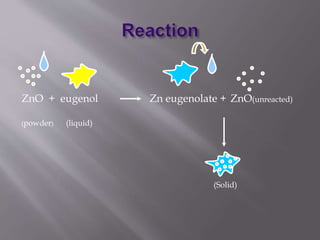
ZnO + eugenol Zn eugenolate + ZnO(unreacted)
(powder) (liquid)
(Solid)
@ Very low viscosity
@ Low dimensional change 0.1%
@ Irreversible chemical change
Disinfection : 2% alkaline
glutarldehyde solution
 Equal length of the two paste is extruded
shorten by increase
Temperature&Humidity
 Working time 3-5 min
 Mixing time 45-60 s
 Mixed with stainless steel spatula in paper
pad or glass slab
 Materials are classified as:
 HARD PASTE(TYPE 1)
 SOFT PASTE(TYPE 2)
 FINAL SETTING :
 Type 1: within 10 mins
 Type 2 : 15 mins
Manipulation
 Accuracy of soft tissue impression (mucostatic)
 Inexpensive
 Adhere well to dental compound
 Good surface detail reproduction
 Good dimensional stability
May irritating to soft tissue
Inadequate working or setting time
-excessive humidity and/or temperature
Distortion-unstable tray
 ZOE cement introduced in 1858, is used as a
 Protective , sedative lining in deep carious cavities,
 For temporary filling
 Temporary cementing
 Pulp capping
 Root canal filling
 Periodontal / surgical packing
 Depending on their use they vary widely in their
properties. In general, they are cements of low
strength, are least irritating of all dental cements, are
known to have an obtundant effect on exposed dentin.
 CLASSIFICATION: (ADA SP. NO. 30) 4 TYPES
 TYPE 1 ZOE- for temporary cementation
 TYPE II ZOE – permanent cementation
 TYPE III ZOE – temporary filling, thermal
insulation
 TYPE IV ZOE – cavity liners
 AVAILABLE AS :
 Powder, liquid
 Two paste system
 Unmodified
 Tempac - type III
 Cavitic - type IV
 Tempbond - type I
 EBA alumina modified
 Opotow
 Alumina EBA - type II
 Polymer modifies
 Fynal - type II
 IRM - type III
 Non- eugenol
 Nogenol - type I
 Freegenol - type I
 POWDER
 Zinc oxide – 69.0% - principal ingredient
 White rosin - 29.3% - To reduce brittleness of set cement
 Zinc stearate -1.0% - Accelerator , plasticizer
 Zinc acetate – 0.7% - Is added in some powders, acts with eugenol in a
similar manner as zinc oxide
LIQUID
 Eugenol – 85.0 - Reacts with zinc oxide
 Olive oil - 15.0 - Plasticizer
 Zinc oxide is also main constituent of gutta-percha points mainly used in
endodontic root canal filling, commonly known as GP Points.
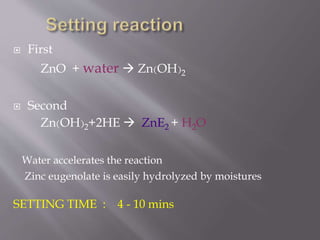
 First
ZnO + water  Zn(OH)2
 Second
Zn(OH)2+2HE  ZnE2 + H2O
SETTING TIME : 4 - 10 mins
Water accelerates the reaction
Zinc eugenolate is easily hydrolyzed by moistures
 Complete reaction between zinc oxide and
eugenol takes about 12 hrs. this is too slow for
clinical convenience.
 Manufacture: most active ZnO powders are
those formed from zinc salts like zinc
hydroxide, zinc carbonate by heating at 3000
degree Celsius.
 Particle size : smaller particles sets faster.
 Accelerators : Alcohol, glacial acetic acid, water
 Heat : cooling glass slab, slows reaction
 Retarders : the set can be treated with glycol ,
glycerin
 p/l ratio : higher the ratio, faster the set.
 MECHANICAL PROPERTIES:
 Compressive strength : are relatively weak cements.
Ranges from a low of 3 -4 Mpa upto 50-55 MPa.
 Tensile strength : 0.32- 5.3 MPa
 Modulus of elasticity : 0.22 – 5.3 GPa
 THERMAL PROPERTIES:
 Thermal conductivity : 3.98[Cal. Sec-1 cm-2]x
10-4
 Co-efficient of thermal expansion : 35x10-
6/celsius
 Solubility and Disintegration : solubility is highest
among cements (0.4 wt %) . Disintegrate in oral fluids.
Solubility is reduced by increasing p/l ratio.
 Film thickness :is 25 um, is higher than other
cements.
 Adhesion : do not adhere well to enamel or dentin
 Biological properties :
 PH and effect on pulp: PH is 7 -8 ; pulpal response
classified as mild
 Bacteriostatic and obtundant properties
 Optical properties : set cement is opaque
Type Setting
time
[min]
Compressive
strength
[MPa]
Solubility
[%]
Film
thickness
[µm]
Type I 4-10 35 maximum 2.5 25
Type II 4-10 35 maximum 1.5 25
Type III 4-10 35 maximum 1.5 -
 P/L SYSTEM: p/l ratio : 4:1- 6:1 by wt
 Oil of orange is used to clean eugenol cement
from instruments.
 TWO PASTE SYSTEM: equal lts. Of each paste
are dispersed and mixed until a uniform color
is observed.
 SETTING TIME :4-10 MINS
 ZOE cements set quickly in mouth due to
moisture and heat.
25
26
 Introduced to improve mechanical properties of Zoë cement.
Modified ZOE cements are:
 EBA-Alumina modified cements
 Polymer reinforced
 EBA- ALUMINA MODIFIED CEMENTS:
 COMPOSITION
 POWDER : Zinc oxide- 70 %
 Alumina- 30 %
 LIQUID : EBA- 62.5 %
 Eugenol- 37.5 %
 PROPERTIES : Better than unmodified ZOE
 Com. St.- higher 55 Mpa
 Tensile St.- 4.1 Mpa
 Modulus of elasticity – 2.5 GPa
 Film thickness - 25um
 Solubility, disintegration in water -0.05 %wt
Glass slab are recommended for EBA- alumina
modified cements. after dispensing , powder is inco.
Into liquid in bulk, kneaded for 30 secs, and then
stropped for an additional 60 secs with broad strokes
of spatula to obtain a creamy consistency. They have
long working times.
SETTING TIME:
9.5 MINS
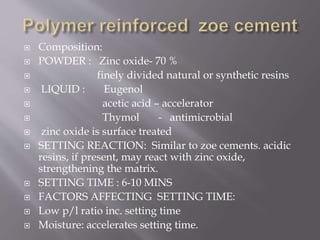
 Composition:
 POWDER : Zinc oxide- 70 %
 finely divided natural or synthetic resins
 LIQUID : Eugenol
 acetic acid – accelerator
 Thymol - antimicrobial
 zinc oxide is surface treated
 SETTING REACTION: Similar to zoe cements. acidic
resins, if present, may react with zinc oxide,
strengthening the matrix.
 SETTING TIME : 6-10 MINS
 FACTORS AFFECTING SETTING TIME:
 Low p/l ratio inc. setting time
 Moisture: accelerates setting time.
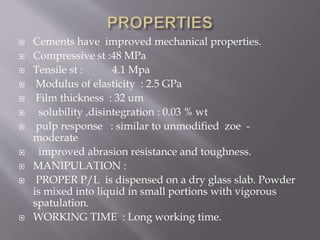
 Cements have improved mechanical properties.
 Compressive st :48 MPa
 Tensile st : 4.1 Mpa
 Modulus of elasticity : 2.5 GPa
 Film thickness : 32 um
 solubility ,disintegration : 0.03 % wt
 pulp response : similar to unmodified zoe -
moderate
 improved abrasion resistance and toughness.
 MANIPULATION :
 PROPER P/L is dispensed on a dry glass slab. Powder
is mixed into liquid in small portions with vigorous
spatulation.
 WORKING TIME : Long working time.
 Luting agent
 As base
 As temporary filling material,
 As cavity liner
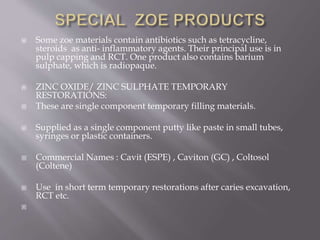
 Some zoe materials contain antibiotics such as tetracycline,
steroids as anti- inflammatory agents. Their principal use is in
pulp capping and RCT. One product also contains barium
sulphate, which is radiopaque.
 ZINC OXIDE/ ZINC SULPHATE TEMPORARY
RESTORATIONS:
 These are single component temporary filling materials.
 Supplied as a single component putty like paste in small tubes,
syringes or plastic containers.
 Commercial Names : Cavit (ESPE) , Caviton (GC) , Coltosol
(Coltene)
 Use in short term temporary restorations after caries excavation,
RCT etc.

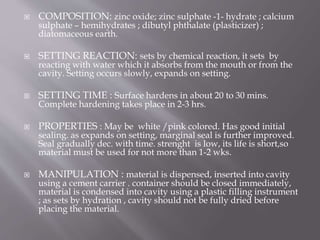
 COMPOSITION: zinc oxide; zinc sulphate -1- hydrate ; calcium
sulphate – hemihydrates ; dibutyl phthalate (plasticizer) ;
diatomaceous earth.
 SETTING REACTION: sets by chemical reaction, it sets by
reacting with water which it absorbs from the mouth or from the
cavity. Setting occurs slowly, expands on setting.
 SETTING TIME : Surface hardens in about 20 to 30 mins.
Complete hardening takes place in 2-3 hrs.
 PROPERTIES : May be white /pink colored. Has good initial
sealing. as expands on setting, marginal seal is further improved.
Seal gradually dec. with time. strenght is low, its life is short,so
material must be used for not more than 1-2 wks.
 MANIPULATION : material is dispensed, inserted into cavity
using a cement carrier . container should be closed immediately,
material is condensed into cavity using a plastic filling instrument
; as sets by hydration , cavity should not be fully dried before
placing the material.
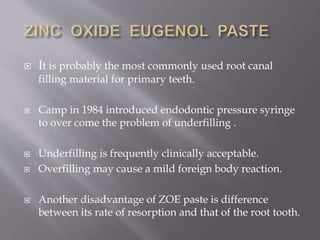
 It is probably the most commonly used root canal
filling material for primary teeth.
 Camp in 1984 introduced endodontic pressure syringe
to over come the problem of underfilling .
 Underfilling is frequently clinically acceptable.
 Overfilling may cause a mild foreign body reaction.
 Another disadvantage of ZOE paste is difference
between its rate of resorption and that of the root tooth.
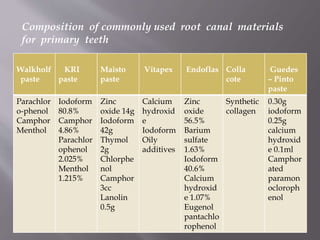
Walkholf
paste
KRI
paste
Maisto
paste
Vitapex Endoflas Colla
cote
Guedes
– Pinto
paste
Parachlor
o-phenol
Camphor
Menthol
Iodoform
80.8%
Camphor
4.86%
Parachlor
ophenol
2.025%
Menthol
1.215%
Zinc
oxide 14g
Iodoform
42g
Thymol
2g
Chlorphe
nol
Camphor
3cc
Lanolin
0.5g
Calcium
hydroxid
e
Iodoform
Oily
additives
Zinc
oxide
56.5%
Barium
sulfate
1.63%
Iodoform
40.6%
Calcium
hydroxid
e 1.07%
Eugenol
pantachlo
rophenol
Synthetic
collagen
0.30g
iodoform
0.25g
calcium
hydroxid
e 0.1ml
Camphor
ated
paramon
ocloroph
enol
Composition of commonly used root canal materials
for primary teeth
Properties ZOE Ca(OH)2 with
Iodoform
(VITAPEX)
KRI Paste
1. Restore at the same rate
as the tooth
2. Harmless
3. Overfill resorbs
4. Antiseptic
5. Easily applied
6. Adheres to the wall
7. Easily removed
8. Radiopaque
9. No discoloration
Y
Y
Y
Y
Y
Y
Y
Y
Y
Y
Y
Y
Y
Y
Y
Y
Y
Y
Y
Y
Y
Comparison of materials used for
pulpectomy in primary teeth
 The material has been involved in a wide range
of applications in dentistry, including use as an
impression material for edentulous mouths, a
surgical dressing, bite registration paste,
temporary filling material, root canal filling
material, cementing medium, temporary
relining material for dentures . The physical
and mechanical properties and handling
characteristics generally are inferior to those of
other long –term luting cements. Main
advantage of improved ZOE cements is their
biocompatibility.
cement
type
setting
time
(min)
film
thickness
(um)
24-hr
compress
ive
strength
(MPa)
24-hr
Diametr
al tensile
strength
(MPa)
elastic
modulus
(GPa)
solublity
in water
pulp
respon
se
Zinc
phosphate 5.5 20 104 5.5 13.5 0.06 Moder
ate
ZOE (type
I)
4.0-10 25 6-28 - - 0.04 Mild
ZOE-
EBA(type
II)
9.5 25 55
4.1 5.0 0.08 Mild
ZOE plus
polymer
(type III)
6.0-10 32 48
4.1 2.5 0.04 Mild
GIC 7.0 24 86 6.2 7.3 1.25 Mild
to
moder
ate
THANK YOU

Zinc oxide eugenol

  • 1.
  • 2.
    Zinc Oxide –Eugenol (ZOE) Impression Paste Zinc Oxide –Eugenol (ZOE) Cement Zinc Oxide – Eugenol (ZOE) Filling material Periodontal Pack
  • 3.
     For fullarch edentulous impression without or minor undercut. wash impression surgical paste  Bite registration paste
  • 5.
     TUBE I Zinc oxide (ZnO) 87%  Oil( FIXED VEGETABLE/MINERAL) 13%
  • 6.
     Eugenol 12~15% Oil  Rosin 50%  Filler (kaolin) 20%  Resinous balsam 10%  Acc. Soln(Cacl2), color 5% Non eugenol paste Carboxylic acids
  • 7.
  • 8.
    ZnO + eugenolZn eugenolate + ZnO(unreacted) (powder) (liquid) (Solid)
  • 9.
    @ Very lowviscosity @ Low dimensional change 0.1% @ Irreversible chemical change Disinfection : 2% alkaline glutarldehyde solution
  • 10.
     Equal lengthof the two paste is extruded shorten by increase Temperature&Humidity  Working time 3-5 min  Mixing time 45-60 s  Mixed with stainless steel spatula in paper pad or glass slab
  • 11.
     Materials areclassified as:  HARD PASTE(TYPE 1)  SOFT PASTE(TYPE 2)  FINAL SETTING :  Type 1: within 10 mins  Type 2 : 15 mins
  • 12.
  • 13.
     Accuracy ofsoft tissue impression (mucostatic)  Inexpensive  Adhere well to dental compound  Good surface detail reproduction  Good dimensional stability
  • 14.
    May irritating tosoft tissue Inadequate working or setting time -excessive humidity and/or temperature Distortion-unstable tray
  • 15.
     ZOE cementintroduced in 1858, is used as a  Protective , sedative lining in deep carious cavities,  For temporary filling  Temporary cementing  Pulp capping  Root canal filling  Periodontal / surgical packing  Depending on their use they vary widely in their properties. In general, they are cements of low strength, are least irritating of all dental cements, are known to have an obtundant effect on exposed dentin.
  • 16.
     CLASSIFICATION: (ADASP. NO. 30) 4 TYPES  TYPE 1 ZOE- for temporary cementation  TYPE II ZOE – permanent cementation  TYPE III ZOE – temporary filling, thermal insulation  TYPE IV ZOE – cavity liners  AVAILABLE AS :  Powder, liquid  Two paste system
  • 17.
     Unmodified  Tempac- type III  Cavitic - type IV  Tempbond - type I  EBA alumina modified  Opotow  Alumina EBA - type II  Polymer modifies  Fynal - type II  IRM - type III  Non- eugenol  Nogenol - type I  Freegenol - type I
  • 18.
     POWDER  Zincoxide – 69.0% - principal ingredient  White rosin - 29.3% - To reduce brittleness of set cement  Zinc stearate -1.0% - Accelerator , plasticizer  Zinc acetate – 0.7% - Is added in some powders, acts with eugenol in a similar manner as zinc oxide LIQUID  Eugenol – 85.0 - Reacts with zinc oxide  Olive oil - 15.0 - Plasticizer  Zinc oxide is also main constituent of gutta-percha points mainly used in endodontic root canal filling, commonly known as GP Points.
  • 19.
     First ZnO +water  Zn(OH)2  Second Zn(OH)2+2HE  ZnE2 + H2O SETTING TIME : 4 - 10 mins Water accelerates the reaction Zinc eugenolate is easily hydrolyzed by moistures
  • 20.
     Complete reactionbetween zinc oxide and eugenol takes about 12 hrs. this is too slow for clinical convenience.  Manufacture: most active ZnO powders are those formed from zinc salts like zinc hydroxide, zinc carbonate by heating at 3000 degree Celsius.  Particle size : smaller particles sets faster.  Accelerators : Alcohol, glacial acetic acid, water  Heat : cooling glass slab, slows reaction  Retarders : the set can be treated with glycol , glycerin  p/l ratio : higher the ratio, faster the set.
  • 21.
     MECHANICAL PROPERTIES: Compressive strength : are relatively weak cements. Ranges from a low of 3 -4 Mpa upto 50-55 MPa.  Tensile strength : 0.32- 5.3 MPa  Modulus of elasticity : 0.22 – 5.3 GPa  THERMAL PROPERTIES:  Thermal conductivity : 3.98[Cal. Sec-1 cm-2]x 10-4  Co-efficient of thermal expansion : 35x10- 6/celsius
  • 22.
     Solubility andDisintegration : solubility is highest among cements (0.4 wt %) . Disintegrate in oral fluids. Solubility is reduced by increasing p/l ratio.  Film thickness :is 25 um, is higher than other cements.  Adhesion : do not adhere well to enamel or dentin  Biological properties :  PH and effect on pulp: PH is 7 -8 ; pulpal response classified as mild  Bacteriostatic and obtundant properties  Optical properties : set cement is opaque
  • 23.
    Type Setting time [min] Compressive strength [MPa] Solubility [%] Film thickness [µm] Type I4-10 35 maximum 2.5 25 Type II 4-10 35 maximum 1.5 25 Type III 4-10 35 maximum 1.5 -
  • 24.
     P/L SYSTEM:p/l ratio : 4:1- 6:1 by wt  Oil of orange is used to clean eugenol cement from instruments.  TWO PASTE SYSTEM: equal lts. Of each paste are dispersed and mixed until a uniform color is observed.  SETTING TIME :4-10 MINS  ZOE cements set quickly in mouth due to moisture and heat.
  • 25.
  • 26.
  • 27.
     Introduced toimprove mechanical properties of Zoë cement. Modified ZOE cements are:  EBA-Alumina modified cements  Polymer reinforced  EBA- ALUMINA MODIFIED CEMENTS:  COMPOSITION  POWDER : Zinc oxide- 70 %  Alumina- 30 %  LIQUID : EBA- 62.5 %  Eugenol- 37.5 %  PROPERTIES : Better than unmodified ZOE  Com. St.- higher 55 Mpa  Tensile St.- 4.1 Mpa  Modulus of elasticity – 2.5 GPa  Film thickness - 25um  Solubility, disintegration in water -0.05 %wt
  • 28.
    Glass slab arerecommended for EBA- alumina modified cements. after dispensing , powder is inco. Into liquid in bulk, kneaded for 30 secs, and then stropped for an additional 60 secs with broad strokes of spatula to obtain a creamy consistency. They have long working times. SETTING TIME: 9.5 MINS
  • 29.
     Composition:  POWDER: Zinc oxide- 70 %  finely divided natural or synthetic resins  LIQUID : Eugenol  acetic acid – accelerator  Thymol - antimicrobial  zinc oxide is surface treated  SETTING REACTION: Similar to zoe cements. acidic resins, if present, may react with zinc oxide, strengthening the matrix.  SETTING TIME : 6-10 MINS  FACTORS AFFECTING SETTING TIME:  Low p/l ratio inc. setting time  Moisture: accelerates setting time.
  • 30.
     Cements haveimproved mechanical properties.  Compressive st :48 MPa  Tensile st : 4.1 Mpa  Modulus of elasticity : 2.5 GPa  Film thickness : 32 um  solubility ,disintegration : 0.03 % wt  pulp response : similar to unmodified zoe - moderate  improved abrasion resistance and toughness.  MANIPULATION :  PROPER P/L is dispensed on a dry glass slab. Powder is mixed into liquid in small portions with vigorous spatulation.  WORKING TIME : Long working time.
  • 31.
     Luting agent As base  As temporary filling material,  As cavity liner
  • 32.
     Some zoematerials contain antibiotics such as tetracycline, steroids as anti- inflammatory agents. Their principal use is in pulp capping and RCT. One product also contains barium sulphate, which is radiopaque.  ZINC OXIDE/ ZINC SULPHATE TEMPORARY RESTORATIONS:  These are single component temporary filling materials.  Supplied as a single component putty like paste in small tubes, syringes or plastic containers.  Commercial Names : Cavit (ESPE) , Caviton (GC) , Coltosol (Coltene)  Use in short term temporary restorations after caries excavation, RCT etc. 
  • 33.
     COMPOSITION: zincoxide; zinc sulphate -1- hydrate ; calcium sulphate – hemihydrates ; dibutyl phthalate (plasticizer) ; diatomaceous earth.  SETTING REACTION: sets by chemical reaction, it sets by reacting with water which it absorbs from the mouth or from the cavity. Setting occurs slowly, expands on setting.  SETTING TIME : Surface hardens in about 20 to 30 mins. Complete hardening takes place in 2-3 hrs.  PROPERTIES : May be white /pink colored. Has good initial sealing. as expands on setting, marginal seal is further improved. Seal gradually dec. with time. strenght is low, its life is short,so material must be used for not more than 1-2 wks.  MANIPULATION : material is dispensed, inserted into cavity using a cement carrier . container should be closed immediately, material is condensed into cavity using a plastic filling instrument ; as sets by hydration , cavity should not be fully dried before placing the material.
  • 34.
     It isprobably the most commonly used root canal filling material for primary teeth.  Camp in 1984 introduced endodontic pressure syringe to over come the problem of underfilling .  Underfilling is frequently clinically acceptable.  Overfilling may cause a mild foreign body reaction.  Another disadvantage of ZOE paste is difference between its rate of resorption and that of the root tooth.
  • 35.
    Walkholf paste KRI paste Maisto paste Vitapex Endoflas Colla cote Guedes –Pinto paste Parachlor o-phenol Camphor Menthol Iodoform 80.8% Camphor 4.86% Parachlor ophenol 2.025% Menthol 1.215% Zinc oxide 14g Iodoform 42g Thymol 2g Chlorphe nol Camphor 3cc Lanolin 0.5g Calcium hydroxid e Iodoform Oily additives Zinc oxide 56.5% Barium sulfate 1.63% Iodoform 40.6% Calcium hydroxid e 1.07% Eugenol pantachlo rophenol Synthetic collagen 0.30g iodoform 0.25g calcium hydroxid e 0.1ml Camphor ated paramon ocloroph enol Composition of commonly used root canal materials for primary teeth
  • 36.
    Properties ZOE Ca(OH)2with Iodoform (VITAPEX) KRI Paste 1. Restore at the same rate as the tooth 2. Harmless 3. Overfill resorbs 4. Antiseptic 5. Easily applied 6. Adheres to the wall 7. Easily removed 8. Radiopaque 9. No discoloration Y Y Y Y Y Y Y Y Y Y Y Y Y Y Y Y Y Y Y Y Y Comparison of materials used for pulpectomy in primary teeth
  • 37.
     The materialhas been involved in a wide range of applications in dentistry, including use as an impression material for edentulous mouths, a surgical dressing, bite registration paste, temporary filling material, root canal filling material, cementing medium, temporary relining material for dentures . The physical and mechanical properties and handling characteristics generally are inferior to those of other long –term luting cements. Main advantage of improved ZOE cements is their biocompatibility.
  • 38.
    cement type setting time (min) film thickness (um) 24-hr compress ive strength (MPa) 24-hr Diametr al tensile strength (MPa) elastic modulus (GPa) solublity in water pulp respon se Zinc phosphate5.5 20 104 5.5 13.5 0.06 Moder ate ZOE (type I) 4.0-10 25 6-28 - - 0.04 Mild ZOE- EBA(type II) 9.5 25 55 4.1 5.0 0.08 Mild ZOE plus polymer (type III) 6.0-10 32 48 4.1 2.5 0.04 Mild GIC 7.0 24 86 6.2 7.3 1.25 Mild to moder ate
  • 39.