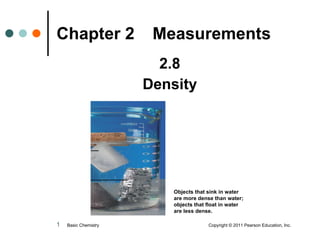
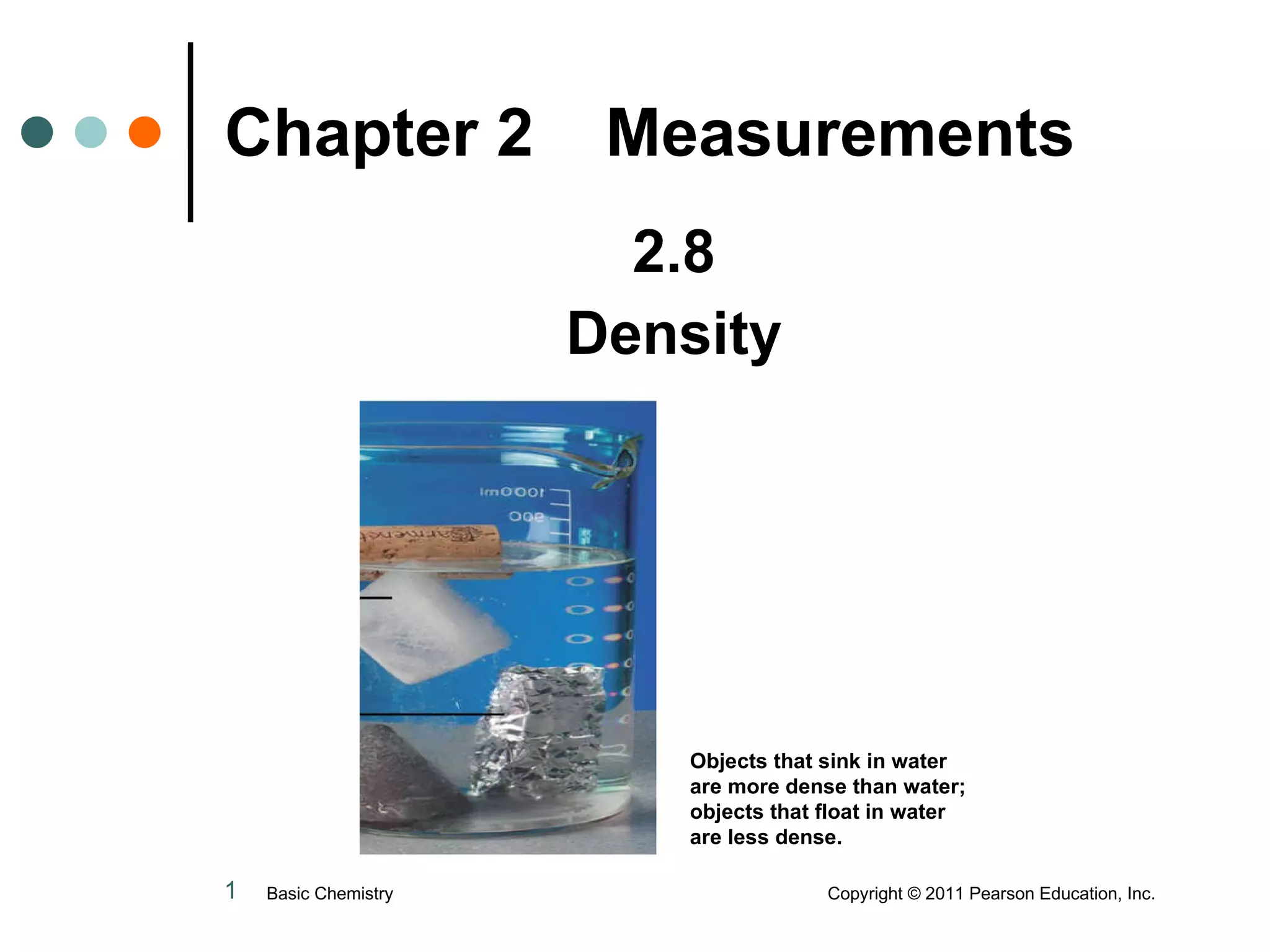
2.8 Density Chapter 2 Measurements Basic Chemistry    Copyright © 2011 Pearson Education, Inc. Objects that sink in water are more dense than water; objects that float in water are less dense.
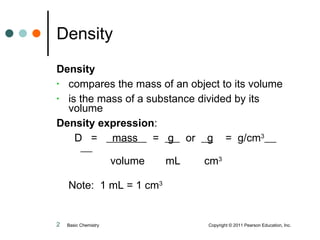
Density compares the mass of an object to its volume is the mass of a substance divided by its volume Density expression : D  =  mass  =  g  or  g   =  g/cm 3     volume  mL  cm 3 Note:  1 mL = 1 cm 3 Density Basic Chemistry    Copyright © 2011 Pearson Education, Inc.
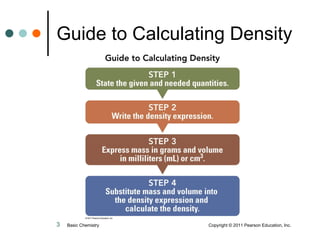
Guide to Calculating Density Basic Chemistry    Copyright © 2011 Pearson Education, Inc.
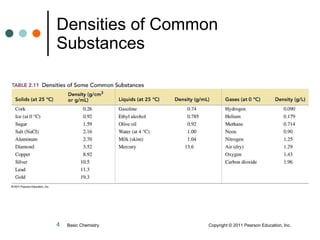
Densities of Common Substances Basic Chemistry    Copyright © 2011 Pearson Education, Inc.
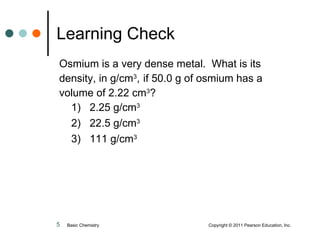
Osmium is a very dense metal.  What is its density, in g/cm 3 ,   if 50.0 g of osmium has a volume of 2.22 cm 3 ? 1)  2.25 g/cm 3 2)  22.5 g/cm 3 3)  111 g/cm 3 Learning Check Basic Chemistry    Copyright © 2011 Pearson Education, Inc.
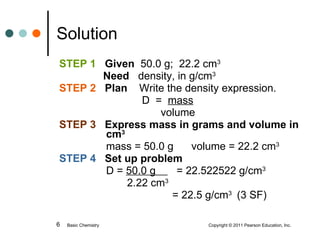
STEP 1  Given  50.0 g;  22.2 cm 3    Need  density, in g/cm 3  STEP 2   Plan   Write the density expression.   D  =  mass       volume STEP 3  Express mass in grams and volume in    cm 3   mass = 50.0 g  volume = 22.2 cm 3 STEP 4   Set up problem   D =  50.0 g  = 22.522522 g/cm 3    2.22 cm 3       = 22.5 g/cm 3  (3 SF)   Solution Basic Chemistry    Copyright © 2011 Pearson Education, Inc.
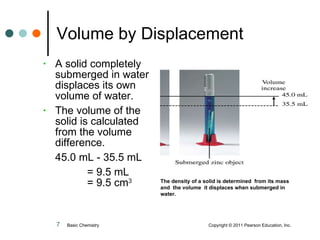
Volume by Displacement A solid completely submerged in water displaces its own volume of water. The volume of the solid is calculated from the volume difference. 45.0 mL - 35.5 mL    = 9.5 mL    = 9.5 cm 3 The density of a solid is determined  from its mass and  the volume  it displaces when submerged in water. Basic Chemistry    Copyright © 2011 Pearson Education, Inc.
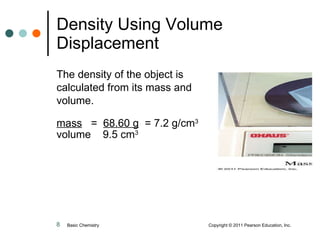
Density Using Volume Displacement The density of the object is calculated from its mass and volume.  mass   =  68.60 g   = 7.2 g/cm 3 volume  9.5 cm 3 Basic Chemistry    Copyright © 2011 Pearson Education, Inc.
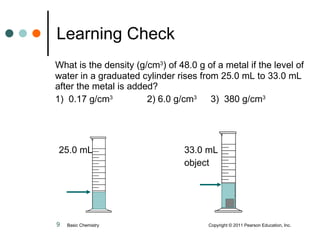
What is the density (g/cm 3 ) of 48.0 g of a metal if the level of water in a graduated cylinder rises from 25.0 mL to 33.0 mL after the metal is added?  1)  0.17 g/cm 3   2) 6.0 g/cm 3   3)  380 g/cm 3 25.0 mL    33.0 mL     object Learning Check Basic Chemistry    Copyright © 2011 Pearson Education, Inc.
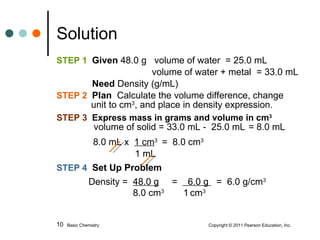
STEP 1  Given  48.0 g  volume of water  = 25.0 mL   volume of water + metal  = 33.0 mL   Need  Density (g/mL) STEP 2   Plan   Calculate the volume difference, change   unit to cm 3 , and place in density expression.  STEP 3  Express mass in grams and volume in cm 3   volume of solid = 33.0 mL -  25.0 mL = 8.0 mL 8.0 mL x  1 cm 3  =  8.0 cm 3 1 mL STEP 4  Set Up Problem   Density =  48.0 g   =  6.0 g  =  6.0 g/cm 3    8.0 cm 3  1   cm 3 Solution Basic Chemistry    Copyright © 2011 Pearson Education, Inc.
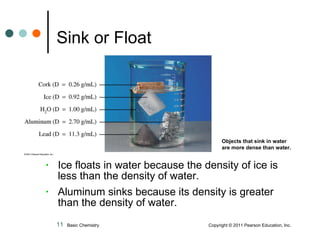
Sink or Float Ice floats in water because the density of ice is less than the density of water.  Aluminum sinks because its density is greater than the density of water. Basic Chemistry    Copyright © 2011 Pearson Education, Inc. Objects that sink in water are more dense than water.
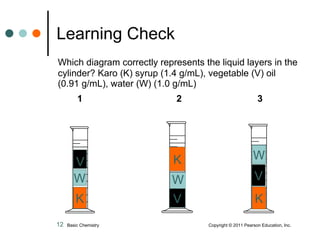
Which diagram correctly represents the liquid layers in the cylinder? Karo (K) syrup (1.4 g/mL), vegetable (V) oil (0.91 g/mL), water (W) (1.0 g/mL) 1  2  3 Learning Check W W K K K V V V W Basic Chemistry    Copyright © 2011 Pearson Education, Inc.
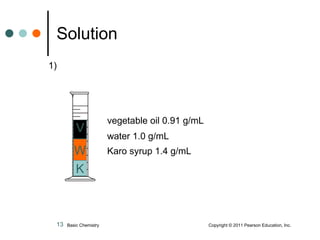
1) vegetable oil 0.91 g/mL water 1.0 g/mL   Karo syrup 1.4 g/mL Solution K W V Basic Chemistry    Copyright © 2011 Pearson Education, Inc.
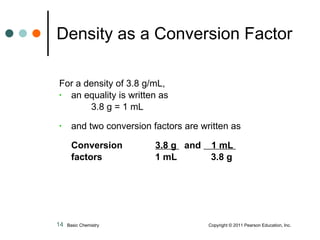
For a density of 3.8 g/mL,  an equality is written as  3.8 g = 1 mL  and two conversion factors are written as  Conversion  3.8 g  and  1 mL  factors 1 mL  3.8 g   Density as a Conversion Factor Basic Chemistry    Copyright © 2011 Pearson Education, Inc.
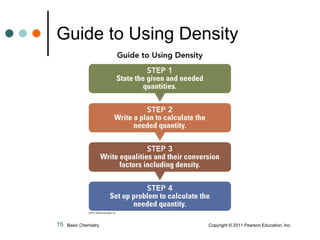
Guide to Using Density Basic Chemistry    Copyright © 2011 Pearson Education, Inc.
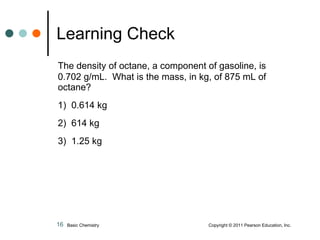
The density of octane, a component of gasoline, is 0.702 g/mL.  What is the mass, in kg, of 875 mL of octane? 1)  0.614 kg 2)  614 kg 3)  1.25 kg Learning Check Basic Chemistry    Copyright © 2011 Pearson Education, Inc.
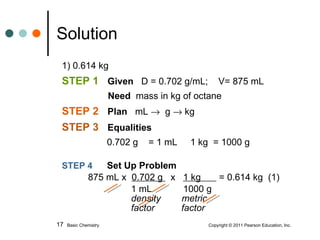
1) 0.614 kg STEP 1  Given   D = 0.702 g/mL;  V= 875 mL   Need   mass in kg of octane STEP 2  Plan   mL     g    kg STEP 3   Equalities     0.702 g  = 1 mL  1 kg  = 1000 g  STEP 4   Set Up Problem   875 mL x  0.702 g  x  1 kg  = 0.614 kg  (1)     1 mL  1000 g   density  metric    factor    factor  Solution Basic Chemistry    Copyright © 2011 Pearson Education, Inc.
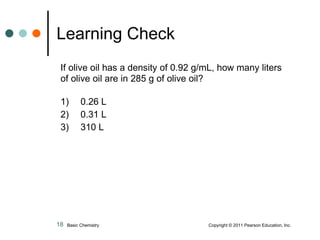
If olive oil has a density of 0.92 g/mL, how many liters of olive oil are in 285 g of olive oil? 1)  0.26 L 2)  0.31 L 3)  310 L Learning Check Basic Chemistry    Copyright © 2011 Pearson Education, Inc.
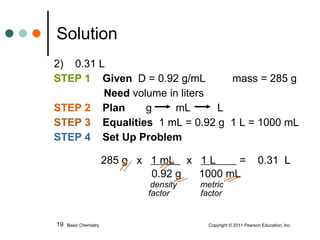
2)  0.31 L STEP 1  Given   D = 0.92 g/mL  mass = 285 g   Need  volume in liters STEP 2  Plan   g  mL  L  STEP 3   Equalities   1 mL = 0.92 g  1 L = 1000 mL STEP 4  Set Up Problem     285 g  x  1 mL  x  1 L  =  0.31  L   0.92 g  1000 mL  density  metric         factor   factor Solution Basic Chemistry    Copyright © 2011 Pearson Education, Inc.
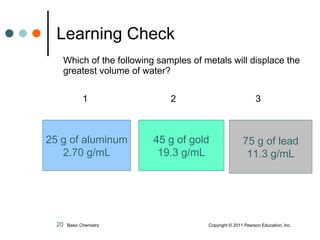
Which of the following samples of metals will displace the greatest volume of water? 1   2   3   Learning Check 25 g of aluminum 2.70 g/mL 45 g of gold 19.3 g/mL 75 g of lead 11.3 g/mL Basic Chemistry    Copyright © 2011 Pearson Education, Inc.
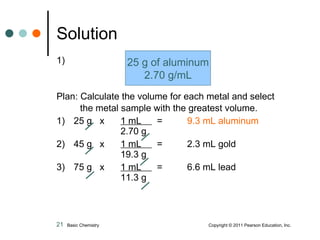
1) Plan: Calculate the volume for each metal and select the metal sample with the greatest volume. 1)   25 g  x  1 mL  =    9.3 mL aluminum 2.70 g  2)   45 g  x  1 mL  =   2.3 mL gold 19.3 g  3)   75 g  x  1 mL  =   6.6 mL lead 11.3 g Solution 25 g of aluminum 2.70 g/mL Basic Chemistry    Copyright © 2011 Pearson Education, Inc.

2 8 density

  • 1.
    2.8 Density Chapter2 Measurements Basic Chemistry Copyright © 2011 Pearson Education, Inc. Objects that sink in water are more dense than water; objects that float in water are less dense.
  • 2.
    Density compares themass of an object to its volume is the mass of a substance divided by its volume Density expression : D = mass = g or g = g/cm 3 volume mL cm 3 Note: 1 mL = 1 cm 3 Density Basic Chemistry Copyright © 2011 Pearson Education, Inc.
  • 3.
    Guide to CalculatingDensity Basic Chemistry Copyright © 2011 Pearson Education, Inc.
  • 4.
    Densities of CommonSubstances Basic Chemistry Copyright © 2011 Pearson Education, Inc.
  • 5.
    Osmium is avery dense metal. What is its density, in g/cm 3 , if 50.0 g of osmium has a volume of 2.22 cm 3 ? 1) 2.25 g/cm 3 2) 22.5 g/cm 3 3) 111 g/cm 3 Learning Check Basic Chemistry Copyright © 2011 Pearson Education, Inc.
  • 6.
    STEP 1 Given 50.0 g; 22.2 cm 3 Need density, in g/cm 3 STEP 2 Plan Write the density expression. D = mass volume STEP 3 Express mass in grams and volume in cm 3 mass = 50.0 g volume = 22.2 cm 3 STEP 4 Set up problem D = 50.0 g = 22.522522 g/cm 3 2.22 cm 3 = 22.5 g/cm 3 (3 SF) Solution Basic Chemistry Copyright © 2011 Pearson Education, Inc.
  • 7.
    Volume by DisplacementA solid completely submerged in water displaces its own volume of water. The volume of the solid is calculated from the volume difference. 45.0 mL - 35.5 mL = 9.5 mL = 9.5 cm 3 The density of a solid is determined from its mass and the volume it displaces when submerged in water. Basic Chemistry Copyright © 2011 Pearson Education, Inc.
  • 8.
    Density Using VolumeDisplacement The density of the object is calculated from its mass and volume. mass = 68.60 g = 7.2 g/cm 3 volume 9.5 cm 3 Basic Chemistry Copyright © 2011 Pearson Education, Inc.
  • 9.
    What is thedensity (g/cm 3 ) of 48.0 g of a metal if the level of water in a graduated cylinder rises from 25.0 mL to 33.0 mL after the metal is added? 1) 0.17 g/cm 3 2) 6.0 g/cm 3 3) 380 g/cm 3 25.0 mL 33.0 mL object Learning Check Basic Chemistry Copyright © 2011 Pearson Education, Inc.
  • 10.
    STEP 1 Given 48.0 g volume of water = 25.0 mL volume of water + metal = 33.0 mL Need Density (g/mL) STEP 2 Plan Calculate the volume difference, change unit to cm 3 , and place in density expression. STEP 3 Express mass in grams and volume in cm 3 volume of solid = 33.0 mL - 25.0 mL = 8.0 mL 8.0 mL x 1 cm 3 = 8.0 cm 3 1 mL STEP 4 Set Up Problem Density = 48.0 g = 6.0 g = 6.0 g/cm 3 8.0 cm 3 1 cm 3 Solution Basic Chemistry Copyright © 2011 Pearson Education, Inc.
  • 11.
    Sink or FloatIce floats in water because the density of ice is less than the density of water. Aluminum sinks because its density is greater than the density of water. Basic Chemistry Copyright © 2011 Pearson Education, Inc. Objects that sink in water are more dense than water.
  • 12.
    Which diagram correctlyrepresents the liquid layers in the cylinder? Karo (K) syrup (1.4 g/mL), vegetable (V) oil (0.91 g/mL), water (W) (1.0 g/mL) 1 2 3 Learning Check W W K K K V V V W Basic Chemistry Copyright © 2011 Pearson Education, Inc.
  • 13.
    1) vegetable oil0.91 g/mL water 1.0 g/mL Karo syrup 1.4 g/mL Solution K W V Basic Chemistry Copyright © 2011 Pearson Education, Inc.
  • 14.
    For a densityof 3.8 g/mL, an equality is written as 3.8 g = 1 mL and two conversion factors are written as Conversion 3.8 g and 1 mL factors 1 mL 3.8 g Density as a Conversion Factor Basic Chemistry Copyright © 2011 Pearson Education, Inc.
  • 15.
    Guide to UsingDensity Basic Chemistry Copyright © 2011 Pearson Education, Inc.
  • 16.
    The density ofoctane, a component of gasoline, is 0.702 g/mL. What is the mass, in kg, of 875 mL of octane? 1) 0.614 kg 2) 614 kg 3) 1.25 kg Learning Check Basic Chemistry Copyright © 2011 Pearson Education, Inc.
  • 17.
    1) 0.614 kgSTEP 1 Given D = 0.702 g/mL; V= 875 mL Need mass in kg of octane STEP 2 Plan mL  g  kg STEP 3 Equalities 0.702 g = 1 mL 1 kg = 1000 g STEP 4 Set Up Problem 875 mL x 0.702 g x 1 kg = 0.614 kg (1) 1 mL 1000 g density metric factor factor Solution Basic Chemistry Copyright © 2011 Pearson Education, Inc.
  • 18.
    If olive oilhas a density of 0.92 g/mL, how many liters of olive oil are in 285 g of olive oil? 1) 0.26 L 2) 0.31 L 3) 310 L Learning Check Basic Chemistry Copyright © 2011 Pearson Education, Inc.
  • 19.
    2) 0.31L STEP 1 Given D = 0.92 g/mL mass = 285 g Need volume in liters STEP 2 Plan g mL L STEP 3 Equalities 1 mL = 0.92 g 1 L = 1000 mL STEP 4 Set Up Problem 285 g x 1 mL x 1 L = 0.31 L 0.92 g 1000 mL density metric factor factor Solution Basic Chemistry Copyright © 2011 Pearson Education, Inc.
  • 20.
    Which of thefollowing samples of metals will displace the greatest volume of water? 1 2 3 Learning Check 25 g of aluminum 2.70 g/mL 45 g of gold 19.3 g/mL 75 g of lead 11.3 g/mL Basic Chemistry Copyright © 2011 Pearson Education, Inc.
  • 21.
    1) Plan: Calculatethe volume for each metal and select the metal sample with the greatest volume. 1) 25 g x 1 mL = 9.3 mL aluminum 2.70 g 2) 45 g x 1 mL = 2.3 mL gold 19.3 g 3) 75 g x 1 mL = 6.6 mL lead 11.3 g Solution 25 g of aluminum 2.70 g/mL Basic Chemistry Copyright © 2011 Pearson Education, Inc.