DENGUE
Dr.MADHUMITA SINGH
PG GENERAL MEDICINE
1
DENGUE IS ALSO KNOWN AS
Philippine hemorrhagic fever
Thai hemorrhagic fever
Singapore hemorrhagic fever
Onyong- Nyang Fever
West Nile Fever
Dandy fever
Break Bone Fever
Dengue like Disease
2
CAUSATIVE AGENT
Dengue virus is a Arbovirus from the
genus Flavivirus
Single stranded RNA virus
Four species – Den 1,2,3,4
Infection with one serotype provides
lifelong immunity for that species.
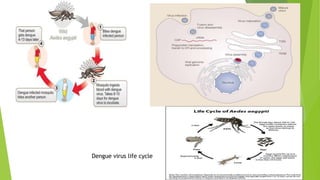
Transmitted by mosquito ,Aedes aegypti
closely associated with human
habitation.
3
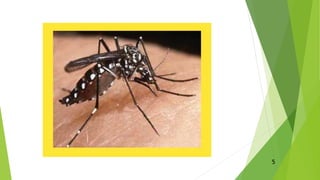
ADES AEGYPTI MOSQUITO
Lays its eggs in clean, stagnant water.
One distinct physical feature – black and white
stripes on its body and legs – Tiger mosquito
Bites during the day.
On average, a female Aedes mosquito can lay
about 300 eggs during her life span of 14 to 21
days.
Only the female Aedes mosquito feeds on blood.
This is because they need the protein found in
blood to produce eggs. Male mosquitoes feed only
on plant nectar
4
Dengue virus life cycle
5
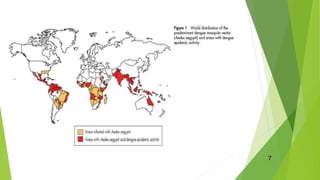
EPEDIOMOLOGY
Rapid expansion of urbanization
Inadequate closed drainage
↑ movement of human population within and
between countries
Insecticide resistance in mosquito vector
population are few of the reasons for ↑ dengue
transmission in recent years
6
7
CLINICAL FEATURES
a) Classic Dengue – Break Bone fever
Incubation period is 4 – 6 days ( range 3 -14)
Abrupt onset of fever, chills, headache, retro
orbital pain and backache
Fever is 39 – 40◦ C; remission of 2days followed by
second febrile phase for 1 -2 d.
Biphasic curve or saddle back fever.
Fever lasts for 5- 7 days
8
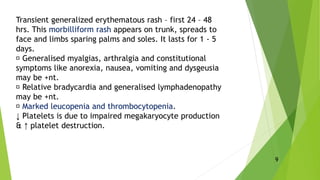
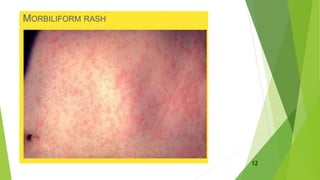
Transient generalized erythematous rash – first 24 – 48
hrs. This morbilliform rash appears on trunk, spreads to
face and limbs sparing palms and soles. It lasts for 1 - 5
days.
Generalised myalgias, arthralgia and constitutional
symptoms like anorexia, nausea, vomiting and dysgeusia
may be +nt.
Relative bradycardia and generalised lymphadenopathy
may be +nt.
Marked leucopenia and thrombocytopenia.
↓ Platelets is due to impaired megakaryocyte production
& ↑ platelet destruction.
9
10
11
12
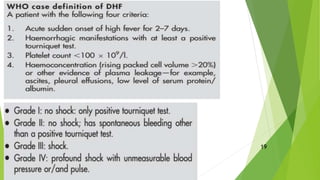
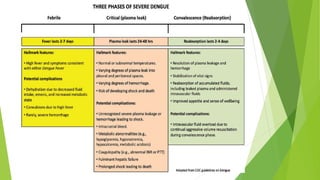
b) Dengue Hemorrhagic fever
Is defined as acute febrile illness with minor
or major bleeding, thrombocytopenia (platelet
≤ 1.0 lakh/mm) & evidence of plasma leakage-
>hemoconcentration (↑hematocrit ) & pleural
or other effusions ( serositis).
Primarily in children and young adults.
Susceptibility ↓ after 12 yrs of age.
DHF, DSS develops arround 3rd to 7th day
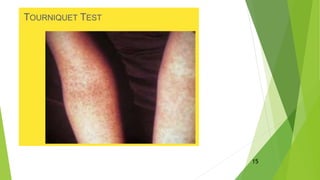
+ve Tournquet test – inflate the BP cuff
13
on upper arm to midway between systolic and
diastoic BP for 5 min. +ve test > 20 petechiae/ 2.5
cm square. Also known as Hess Test.
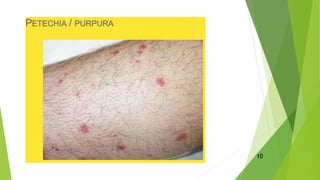
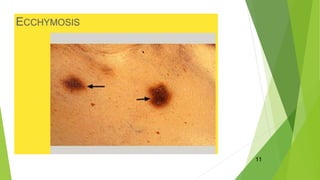
Petechiae, bruised skin ,S/c bleeding in
venipuncture site seen in most cases.
Transudate due to excessive capillary leakage leads
to pleural effusion & ascites.
Progressively ↓platelet count, ↑ hematocrit
indicate probability of impending shock.
14
15
c) Dengue shock syndrome
DSS is DHF with signs of circulatory failure
Warning signs are intense, sustained abdominal
pain,persistent vomiting, restlessness or lethargy &
sudden change from fever to hypothermia with
sweating and prostration.
Pt. may recover with i/v fluids, but shock may
recur.
Once shock sets in ,mortality is high, 12 -44%
16
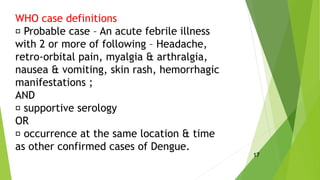
WHO case definitions
Probable case – An acute febrile illness
with 2 or more of following – Headache,
retro-orbital pain, myalgia & arthralgia,
nausea & vomiting, skin rash, hemorrhagic
manifestations ;
AND
supportive serology
OR
occurrence at the same location & time
as other confirmed cases of Dengue.
17
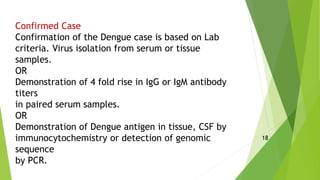
Confirmed Case
Confirmation of the Dengue case is based on Lab
criteria. Virus isolation from serum or tissue
samples.
OR
Demonstration of 4 fold rise in IgG or IgM antibody
titers
in paired serum samples.
OR
Demonstration of Dengue antigen in tissue, CSF by
immunocytochemistry or detection of genomic
sequence
by PCR.
18
CRITERIA FOR DHF
19
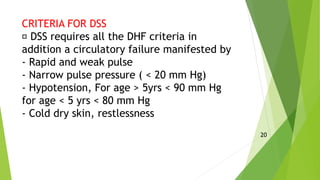
CRITERIA FOR DSS
DSS requires all the DHF criteria in
addition a circulatory failure manifested by
- Rapid and weak pulse
- Narrow pulse pressure ( < 20 mm Hg)
- Hypotension, For age > 5yrs < 90 mm Hg
for age < 5 yrs < 80 mm Hg
- Cold dry skin, restlessness
20
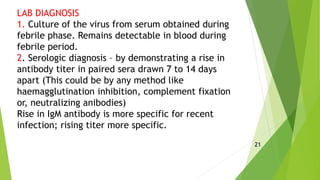
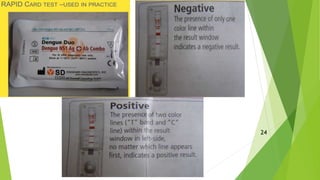
LAB DIAGNOSIS
1. Culture of the virus from serum obtained during
febrile phase. Remains detectable in blood during
febrile period.
2. Serologic diagnosis – by demonstrating a rise in
antibody titer in paired sera drawn 7 to 14 days
apart (This could be by any method like
haemagglutination inhibition, complement fixation
or, neutralizing anibodies)
Rise in IgM antibody is more specific for recent
infection; rising titer more specific.
21
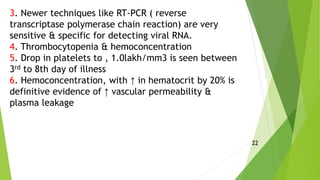
3. Newer techniques like RT-PCR ( reverse
transcriptase polymerase chain reaction) are very
sensitive & specific for detecting viral RNA.
4. Thrombocytopenia & hemoconcentration
5. Drop in platelets to , 1.0lakh/mm3 is seen between
3rd to 8th day of illness
6. Hemoconcentration, with ↑ in hematocrit by 20% is
definitive evidence of ↑ vascular permeability &
plasma leakage
22
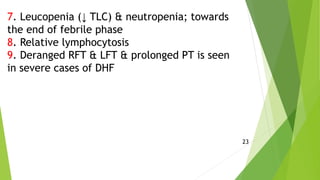
7. Leucopenia (↓ TLC) & neutropenia; towards
the end of febrile phase
8. Relative lymphocytosis
9. Deranged RFT & LFT & prolonged PT is seen
in severe cases of DHF
23
24
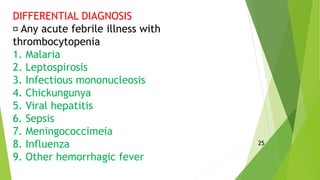
DIFFERENTIAL DIAGNOSIS
Any acute febrile illness with
thrombocytopenia
1. Malaria
2. Leptospirosis
3. Infectious mononucleosis
4. Chickungunya
5. Viral hepatitis
6. Sepsis
7. Meningococcimeia
8. Influenza
9. Other hemorrhagic fever
25
26
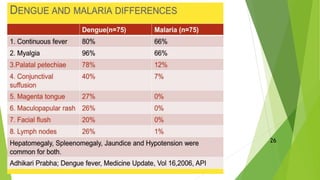
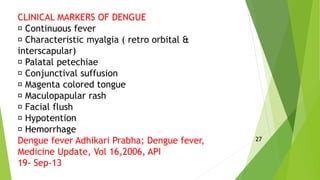
CLINICAL MARKERS OF DENGUE
Continuous fever
Characteristic myalgia ( retro orbital &
interscapular)
Palatal petechiae
Conjunctival suffusion
Magenta colored tongue
Maculopapular rash
Facial flush
Hypotention
Hemorrhage
Dengue fever Adhikari Prabha; Dengue fever,
Medicine Update, Vol 16,2006, API
19- Sep-13
27
TREATMENT
Symptomatic - Paracetamol for fever &
myalgia.
Aspirin, NSAIDS avoided due to risk of erosive
gastritis and bleeding.
Rest
Oral rehydration
In DHF careful & repeated estimation of
volume status & fluid replacement is corner-
stone of management. Use isotonic i/v fluids. 28
TREATMENT 2
Because patients have loss of plasma they
must be given isotonic solution or plasma
expanders.
Platelets are replaced if the count is less than
10000 /mm3 or clinical bleeding is +nt. It is
better to give Single donor apheresis Platelets
(SDAP) as compared to RDP to lower the risk of
alloimmunization
29
TREATMENT 3
Besides bleeding other complications are
ARDS,renal failure, hepatic failure &
encephalopathy.
30
PREVENTION AND CONTROL
It is by control of mosquitoes which live & breed in
stagnant water in and around the house.
Lays eggs preferentially in jars, discarded containers,
coconut shells, old tires etc.
Year round breeding
Tropical regions like India are its favorite zones.
How to prevent mosquito spread?
Do not allow empty vessels, coconut shells, plastic
containers, flower pots, tires etc to collect rain water
in them
Frequently (once in 2-3 days) empty all water storage
containers
31
PREVENTION AND CONTROL 2
Vector control can be done by simple measures like
using insect repellants, indoor space spray
insecticides .
How to prevent mosquito bites?
Screen your homes with mosquito screens like
Netlon .
Wear full clothing – long sleeves
Apply mosquito repellents like Odomos, Goodnignt
Keep Dengue fever patient under mosquito net
32
Vaccination against dengue
The first dengue vaccine, Dengvaxia® (CYD-TDV) developed by
Sanofi Pasteur was licensed in December 2015 and has now
been approved by regulatory authorities in ~20 countries.
WHO position on the CYD-TDV vaccine( WHO UPDATED-9
NOV.2019)
As described in the WHO position paper on the Dengvaxia
vaccine (September 2018) the live attenuated dengue vaccine
CYD-TDV has been shown in clinical trials to be efficacious and
safe in persons who have had a previous dengue virus infection
(seropositive individuals). However, it carries an increased risk
of severe dengue in those who experience their first natural
dengue infection after vaccination (those who were
seronegative at the time of vaccination). Vaccination should be
considered as part of an integrated dengue prevention and
control strategy.
33
REFERENCES
 THE BMJ CLINICAL REVIEW-2015 UPDATES AND 2004 UPDATES
 WHO RECENT PUBLICATION (2019, 4TH, NOVEMBER)
 HARRISONS PRINCIPAL OF INTERNAL MEDICINE 20TH EDITION
 API TEXT BOOK OF MEDICINE
34

Dengue

  • 1.
  • 2.
    DENGUE IS ALSOKNOWN AS Philippine hemorrhagic fever Thai hemorrhagic fever Singapore hemorrhagic fever Onyong- Nyang Fever West Nile Fever Dandy fever Break Bone Fever Dengue like Disease 2
  • 3.
    CAUSATIVE AGENT Dengue virusis a Arbovirus from the genus Flavivirus Single stranded RNA virus Four species – Den 1,2,3,4 Infection with one serotype provides lifelong immunity for that species. Transmitted by mosquito ,Aedes aegypti closely associated with human habitation. 3
  • 4.
    ADES AEGYPTI MOSQUITO Laysits eggs in clean, stagnant water. One distinct physical feature – black and white stripes on its body and legs – Tiger mosquito Bites during the day. On average, a female Aedes mosquito can lay about 300 eggs during her life span of 14 to 21 days. Only the female Aedes mosquito feeds on blood. This is because they need the protein found in blood to produce eggs. Male mosquitoes feed only on plant nectar 4
  • 5.
  • 6.
  • 7.
    EPEDIOMOLOGY Rapid expansion ofurbanization Inadequate closed drainage ↑ movement of human population within and between countries Insecticide resistance in mosquito vector population are few of the reasons for ↑ dengue transmission in recent years 6
  • 8.
  • 9.
    CLINICAL FEATURES a) ClassicDengue – Break Bone fever Incubation period is 4 – 6 days ( range 3 -14) Abrupt onset of fever, chills, headache, retro orbital pain and backache Fever is 39 – 40◦ C; remission of 2days followed by second febrile phase for 1 -2 d. Biphasic curve or saddle back fever. Fever lasts for 5- 7 days 8
  • 10.
    Transient generalized erythematousrash – first 24 – 48 hrs. This morbilliform rash appears on trunk, spreads to face and limbs sparing palms and soles. It lasts for 1 - 5 days. Generalised myalgias, arthralgia and constitutional symptoms like anorexia, nausea, vomiting and dysgeusia may be +nt. Relative bradycardia and generalised lymphadenopathy may be +nt. Marked leucopenia and thrombocytopenia. ↓ Platelets is due to impaired megakaryocyte production & ↑ platelet destruction. 9
  • 11.
  • 12.
  • 13.
  • 14.
    b) Dengue Hemorrhagicfever Is defined as acute febrile illness with minor or major bleeding, thrombocytopenia (platelet ≤ 1.0 lakh/mm) & evidence of plasma leakage- >hemoconcentration (↑hematocrit ) & pleural or other effusions ( serositis). Primarily in children and young adults. Susceptibility ↓ after 12 yrs of age. DHF, DSS develops arround 3rd to 7th day +ve Tournquet test – inflate the BP cuff 13
  • 15.
    on upper armto midway between systolic and diastoic BP for 5 min. +ve test > 20 petechiae/ 2.5 cm square. Also known as Hess Test. Petechiae, bruised skin ,S/c bleeding in venipuncture site seen in most cases. Transudate due to excessive capillary leakage leads to pleural effusion & ascites. Progressively ↓platelet count, ↑ hematocrit indicate probability of impending shock. 14
  • 16.
  • 17.
    c) Dengue shocksyndrome DSS is DHF with signs of circulatory failure Warning signs are intense, sustained abdominal pain,persistent vomiting, restlessness or lethargy & sudden change from fever to hypothermia with sweating and prostration. Pt. may recover with i/v fluids, but shock may recur. Once shock sets in ,mortality is high, 12 -44% 16
  • 18.
    WHO case definitions Probablecase – An acute febrile illness with 2 or more of following – Headache, retro-orbital pain, myalgia & arthralgia, nausea & vomiting, skin rash, hemorrhagic manifestations ; AND supportive serology OR occurrence at the same location & time as other confirmed cases of Dengue. 17
  • 19.
    Confirmed Case Confirmation ofthe Dengue case is based on Lab criteria. Virus isolation from serum or tissue samples. OR Demonstration of 4 fold rise in IgG or IgM antibody titers in paired serum samples. OR Demonstration of Dengue antigen in tissue, CSF by immunocytochemistry or detection of genomic sequence by PCR. 18
  • 20.
  • 21.
    CRITERIA FOR DSS DSSrequires all the DHF criteria in addition a circulatory failure manifested by - Rapid and weak pulse - Narrow pulse pressure ( < 20 mm Hg) - Hypotension, For age > 5yrs < 90 mm Hg for age < 5 yrs < 80 mm Hg - Cold dry skin, restlessness 20
  • 23.
    LAB DIAGNOSIS 1. Cultureof the virus from serum obtained during febrile phase. Remains detectable in blood during febrile period. 2. Serologic diagnosis – by demonstrating a rise in antibody titer in paired sera drawn 7 to 14 days apart (This could be by any method like haemagglutination inhibition, complement fixation or, neutralizing anibodies) Rise in IgM antibody is more specific for recent infection; rising titer more specific. 21
  • 24.
    3. Newer techniqueslike RT-PCR ( reverse transcriptase polymerase chain reaction) are very sensitive & specific for detecting viral RNA. 4. Thrombocytopenia & hemoconcentration 5. Drop in platelets to , 1.0lakh/mm3 is seen between 3rd to 8th day of illness 6. Hemoconcentration, with ↑ in hematocrit by 20% is definitive evidence of ↑ vascular permeability & plasma leakage 22
  • 25.
    7. Leucopenia (↓TLC) & neutropenia; towards the end of febrile phase 8. Relative lymphocytosis 9. Deranged RFT & LFT & prolonged PT is seen in severe cases of DHF 23
  • 26.
  • 27.
    DIFFERENTIAL DIAGNOSIS Any acutefebrile illness with thrombocytopenia 1. Malaria 2. Leptospirosis 3. Infectious mononucleosis 4. Chickungunya 5. Viral hepatitis 6. Sepsis 7. Meningococcimeia 8. Influenza 9. Other hemorrhagic fever 25
  • 28.
  • 29.
    CLINICAL MARKERS OFDENGUE Continuous fever Characteristic myalgia ( retro orbital & interscapular) Palatal petechiae Conjunctival suffusion Magenta colored tongue Maculopapular rash Facial flush Hypotention Hemorrhage Dengue fever Adhikari Prabha; Dengue fever, Medicine Update, Vol 16,2006, API 19- Sep-13 27
  • 30.
    TREATMENT Symptomatic - Paracetamolfor fever & myalgia. Aspirin, NSAIDS avoided due to risk of erosive gastritis and bleeding. Rest Oral rehydration In DHF careful & repeated estimation of volume status & fluid replacement is corner- stone of management. Use isotonic i/v fluids. 28
  • 31.
    TREATMENT 2 Because patientshave loss of plasma they must be given isotonic solution or plasma expanders. Platelets are replaced if the count is less than 10000 /mm3 or clinical bleeding is +nt. It is better to give Single donor apheresis Platelets (SDAP) as compared to RDP to lower the risk of alloimmunization 29
  • 32.
    TREATMENT 3 Besides bleedingother complications are ARDS,renal failure, hepatic failure & encephalopathy. 30
  • 33.
    PREVENTION AND CONTROL Itis by control of mosquitoes which live & breed in stagnant water in and around the house. Lays eggs preferentially in jars, discarded containers, coconut shells, old tires etc. Year round breeding Tropical regions like India are its favorite zones. How to prevent mosquito spread? Do not allow empty vessels, coconut shells, plastic containers, flower pots, tires etc to collect rain water in them Frequently (once in 2-3 days) empty all water storage containers 31
  • 34.
    PREVENTION AND CONTROL2 Vector control can be done by simple measures like using insect repellants, indoor space spray insecticides . How to prevent mosquito bites? Screen your homes with mosquito screens like Netlon . Wear full clothing – long sleeves Apply mosquito repellents like Odomos, Goodnignt Keep Dengue fever patient under mosquito net 32
  • 35.
    Vaccination against dengue Thefirst dengue vaccine, Dengvaxia® (CYD-TDV) developed by Sanofi Pasteur was licensed in December 2015 and has now been approved by regulatory authorities in ~20 countries. WHO position on the CYD-TDV vaccine( WHO UPDATED-9 NOV.2019) As described in the WHO position paper on the Dengvaxia vaccine (September 2018) the live attenuated dengue vaccine CYD-TDV has been shown in clinical trials to be efficacious and safe in persons who have had a previous dengue virus infection (seropositive individuals). However, it carries an increased risk of severe dengue in those who experience their first natural dengue infection after vaccination (those who were seronegative at the time of vaccination). Vaccination should be considered as part of an integrated dengue prevention and control strategy. 33
  • 36.
    REFERENCES  THE BMJCLINICAL REVIEW-2015 UPDATES AND 2004 UPDATES  WHO RECENT PUBLICATION (2019, 4TH, NOVEMBER)  HARRISONS PRINCIPAL OF INTERNAL MEDICINE 20TH EDITION  API TEXT BOOK OF MEDICINE
  • 37.