


















Jennifer Bisgard 
Khulisa 
Management 
Services
Monitoring & Evaluation?
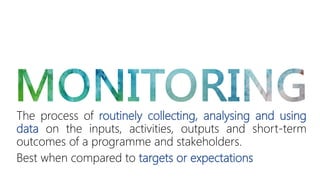
The process of routinely collecting, analysing and using 
data on the inputs, activities, outputs and short-term 
outcomes of a programme and stakeholders. 
Best when compared to targets or expectations
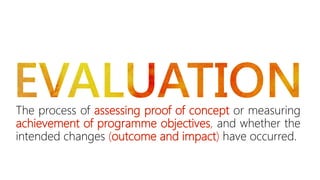
The process of assessing proof of concept or measuring 
achievement of programme objectives, and whether the 
intended changes (outcome and impact) have occurred.
what you don’t measure can’t 
be managed
Why do M&E?
the number
move beyond the number
managers and directors want 
data driven decisions
stakeholders want to collaborate with 
effective programmes
programmes want to communicate 
their success, reach and impact
programmes want to demonstrate 
their accountability
donors want to know that their 
funding produced results
new funders and stakeholders 
want to know what works
everyone wants to learn
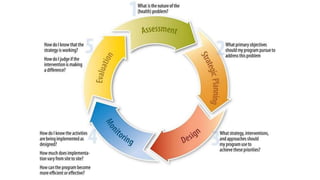
Role of M&E in the 
Programme Life Cycle
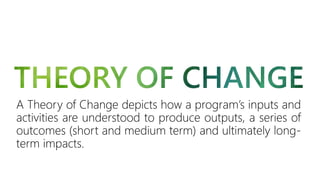
A Theory of Change depicts how a program’s inputs and 
activities are understood to produce outputs, a series of 
outcomes (short and medium term) and ultimately long-term 
impacts.
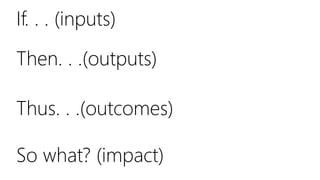
If. . . (inputs) 
Then. . .(outputs) 
Thus. . .(outcomes) 
So what? (impact)
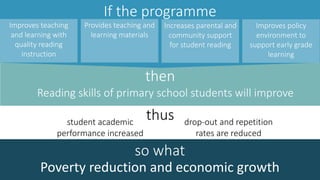
If the programme 
then 
Improves teaching 
and learning with 
quality reading 
instruction 
Provides teaching and 
learning materials 
Increases parental and 
community support 
for student reading 
Improves policy 
environment to 
support early grade 
learning 
Reading skills of primary school students will improve 
thus student academic 
performance increased 
drop-out and repetition 
rates are reduced 
so what 
Poverty reduction and economic growth
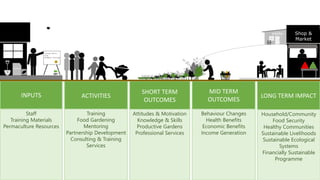
Graphical representation of the theory of change.
crèche Shop & 
Market 
COMPOST 
INPUTS ACTIVITIES 
SHORT TERM 
OUTCOMES 
MID TERM 
OUTCOMES 
LONG TERM IMPACT 
Staff 
Training Materials 
Permaculture Resources 
Training 
Food Gardening 
Mentoring 
Partnership Development 
Consulting & Training 
Services 
Attitudes & Motivation 
Knowledge & Skills 
Productive Gardens 
Professional Services 
Behaviour Changes 
Health Benefits 
Economic Benefits 
Income Generation 
Household/Community 
Food Security 
Healthy Communities 
Sustainable Livelihoods 
Sustainable Ecological 
Systems 
Financially Sustainable 
Programme
Methodology
hundreds of methodologies
based on context
within time and budget 
constraints
potential evaluation use
ensuring quality
Where are the Evaluators?
Khulisa 
Management 
Services
Resources
Tools
Questions? 
Khulisa Management Services 
26 7th Avenue 
Parktown North 
2193 
jbisgard@khulisa.com

Demystifying M&E - Jennifer Bisgard

Editor's Notes

  • #3 M&E systems track what is being done in relation to plans and whether the programme is making a difference Monitoring and evaluation help improve performance and achieve results. Performance is defined as progress towards and achievement of results
  • #4 Monitoring is the routine tracking of the key elements of programme/project performance (usually inputs and outputs) through record-keeping, regular reporting and surveillance systems, as well as observation and surveys. Monitoring helps program or project managers determine which areas require greater effort and identify areas which might contribute to an improved response. Traditional monitoring focuses on implementation monitoring-tracking of inputs, activities and outputs. Often used to assess compliance with workplans and budgets Results-based monitoring involves the collection of information on how effectively the project is performing-demonstrates whether a project is achieving its stated goals
  • #5 Evaluation is a collection of activities designed to determine the worth of a project or intervention This includes measuring the extent to which the changes that have occurred are attributable to your programme’s interventions.
  • #6 M&E go together… There is no evaluation without monitoring, in order to evaluate, you must be monitoring What you don’t measure can’t be managed
  • #8 In M&E these are the Indicators Used to compare Compare outcomes to programme expectations Before and after- what is the difference An Indicator is a variable that measures one aspect of a program/project Indicators are used to measure progress towards a specific objective or goal. Indicators are typically numerical.
  • #9 However, the role of qualitative information in M&E should not be neglected. So we have the difference but why is there a difference… move beyond the number to find out if the program worked and ask more questions: Where did it work? What contributed to it working? For who did it work? Under what circumstance
  • #10 In other words, is the work you are doing driven by data?
  • #19 At the onset of any evaluation it is important to document the program’s theory of change. A Theory of Change graphically depicts how a program’s inputs and activities are understood to produce outputs, a series of outcomes (short and medium term) and ultimately long-term impacts. This is usually represented in a logic model, which is a graphical representation of the theory of change. The logic model includes inputs (what is invested), outputs (activities and participants reached) and outcomes. The logic frame also documents the key assumptions underpinning each step. The development of a Theory of Change is a collaborative process in which evaluators facilitate program leadership (i.e. the Secretariat) to develop and document the framework.
  • #20 e.g if...then...thus
  • #21 e.g.
  • #22 There are varying frameworks applied to the selection of M&E indicators. Indicators are used at different levels to measure what goes into a program or project and what comes out of it. The input-process (activity)-output-outcome framework is most common. M&E frameworks consist of a comprehensive list of inputs, outputs, outcome indicators that will be used to monitor and evaluate programme performance Knowing why you are collecting data will assist in planning and decision-making
  • #23 INPUTS = the set of resources that are the basic materials of the programme = Financing (money), staff and staff time, facilities, equipment, supplies, and other items used in programme operation. E.g. The hours of staff time/salary, Travel costs, Lesson materials, Trainers/Staff ACTIVITIES = the set of actions in which programme inputs are utilised to achieve the results expected from the programme = actions through which inputs are employed to achieve the objectives of the programme. = what the project does with the inputs to fulfil its objectives E.g. training, materials development, delivering Saturday school classes, hosting exhibitions, teacher training etc. OUTPUTS = the results obtained at the end of activities using inputs = the direct products of programme activities = tangible or physically-discernable deliverables = the results of programme activities = achievements or things that have been produced by project managers or service providers Outputs are usually measured in terms of the volume of work accomplished. For example: E.g. Training participant assessment results, Numbers of contact sessions conducted, Numbers of participants served, shown by participant registers, Numbers of training reports received , Number of people attending the exhibition centre OUTCOMES = Are the effects of programme/project outputs. = Considered the programme’s long term results = Refer to the change expected as a consequence of the input/activity/output. = Are the long term benefits or changes for individuals or populations or systems during or after directly participating in programme activities (2-5 years). e.g. Improvement in Maths & Science results, greater number of learners enrolling in MST studies, employment IMPACTS = The long-term, population-level, results of the programme’s outcomes. = Ultimate outcome to be achieved over the long-term. = are generally achieved in 5-10 years
  • #24 Choosing the correct methodology The M&E field is wide and varied
  • #25 Important to match methods to programme types When are “real world” evaluations more appropriate? Methodologies Quantitative e.g: Qualitative e.g: Most Significant Change Appreciative Inquiry Additionality
  • #26 Important to match methods to programme types When are “real world” evaluations more appropriate? Methodologies Quantitative e.g: Qualitative e.g: Most Significant Change Appreciative Inquiry Additionality
  • #27 Important to match methods to programme types When are “real world” evaluations more appropriate? Methodologies Quantitative e.g: Qualitative e.g: Most Significant Change Appreciative Inquiry Additionality
  • #28 Important to match methods to programme types When are “real world” evaluations more appropriate? Methodologies Quantitative e.g: Qualitative e.g: Most Significant Change Appreciative Inquiry Additionality
  • #29 Important to match methods to programme types When are “real world” evaluations more appropriate? Methodologies Quantitative e.g: Qualitative e.g: Most Significant Change Appreciative Inquiry Additionality
  • #31 Khulisa SAMEA AfrEA LinkedIN DEVEX
  • #34 Tools4dev opendatakit