Establishing a culture of
Monitoring and Evaluation
SPREADING THE WORD, (RE)TURNING THE CULTURE (PART 1)
Mr. Vilimaka Foliaki,
M&E Advisor
Tonga Education Support Program, Phase 2
Ministry of Education
TONGA
Professional Development Training
Ministry of Education and Training
TONGA
Wednesday 12 August – Thursday August 2015
Goals of these
training
workshops
1. Describe Monitoring and Evaluation in the context of your own
unit as well as MET as a whole;
2. Articulate the importance of M&E to your work, MET, and
national development;
3. (Describe the four (4) core elements of a M&E System;)
4. Describe what indicators are and identify examples from your
own work context.
5. Use the Logical Framework Approach to draw a Logframe for
your own work;
6. Provide conceptual clarity for how different people/sections of
MET are working towards common goals and the key roles that
M&E activities play in attaining these goals.
7. Provide conceptual clarity for the importance of M&E to
quality data, policy, decision-making, and development in MET.
1. Establish a culture of
M&E in the Ministry
of Education and
Training;
2. To realize that M&E is
nothing new’ – is a
‘normal part of our
work;
3. To appreciate the
importance of M&E to
quality data, decision-
making, and progress.
At the end of these workshops, you will be able to:
M&E basically
• Mirrors our
performance
• Reflects our
performance
and reduces the
chances of
error.
• Imagine
shaving/puttin
g on make-up
without using
a mirror
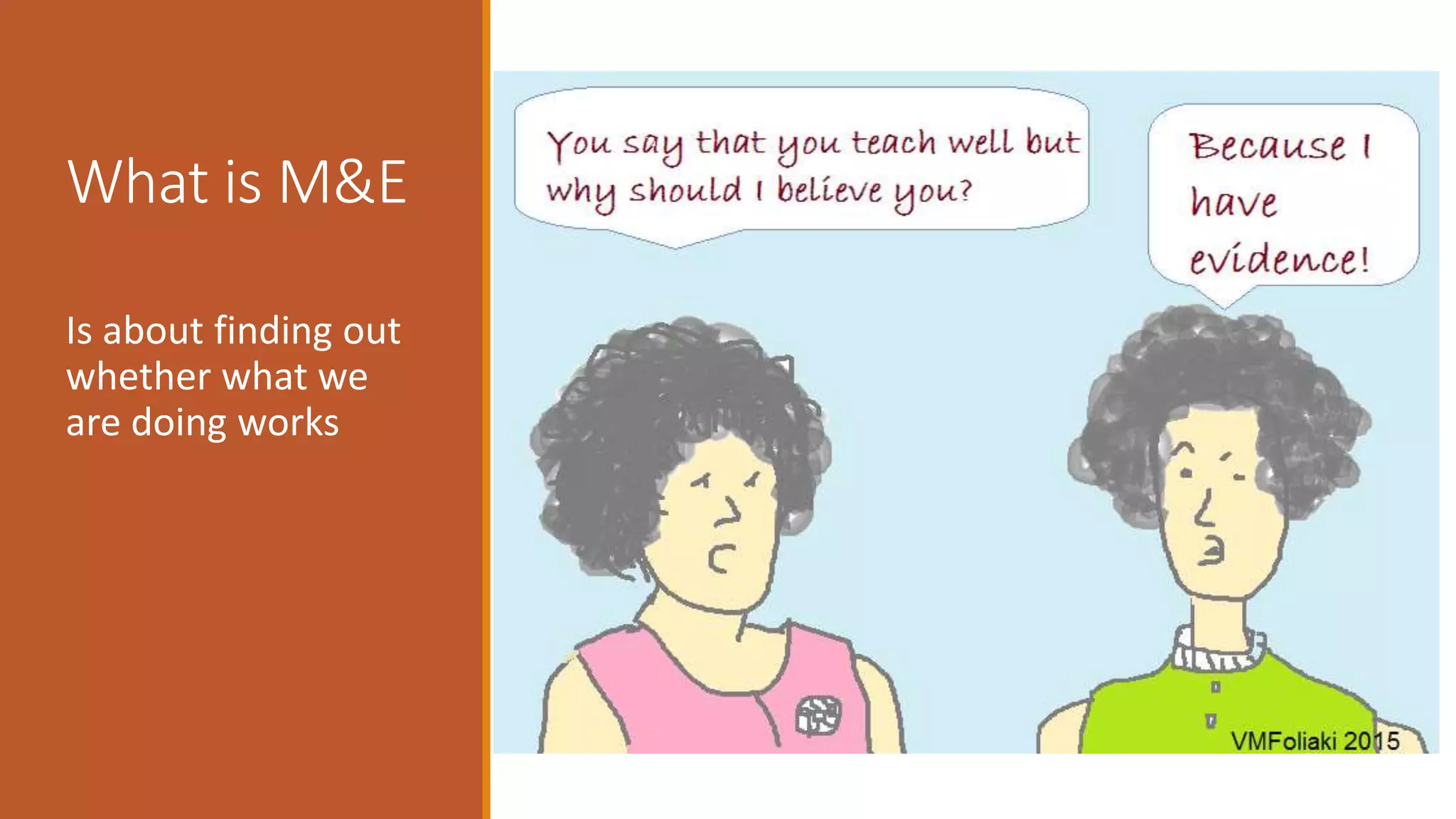
What is M&E
Is about finding out
whether what we
are doing works
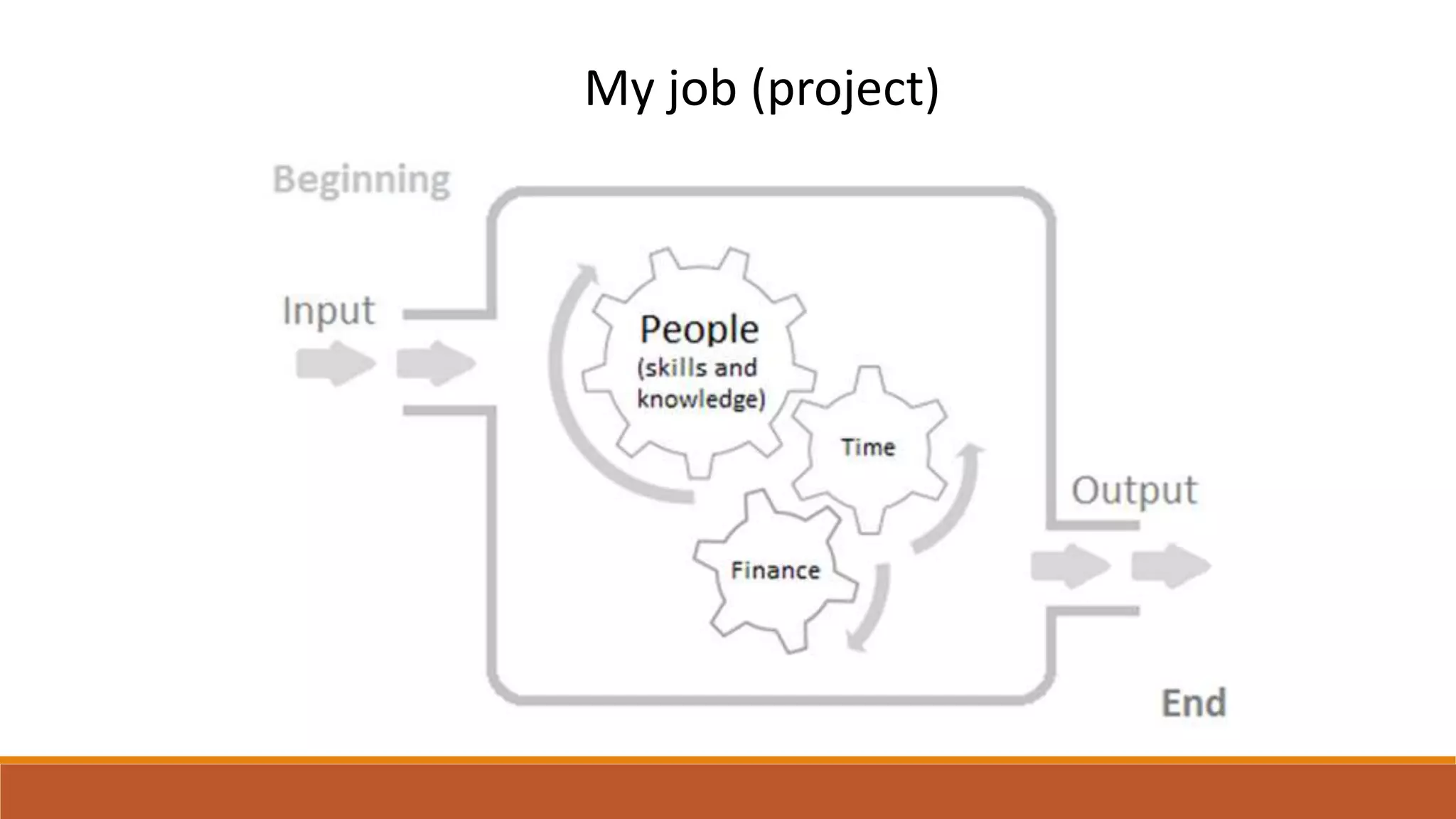
My job (project)
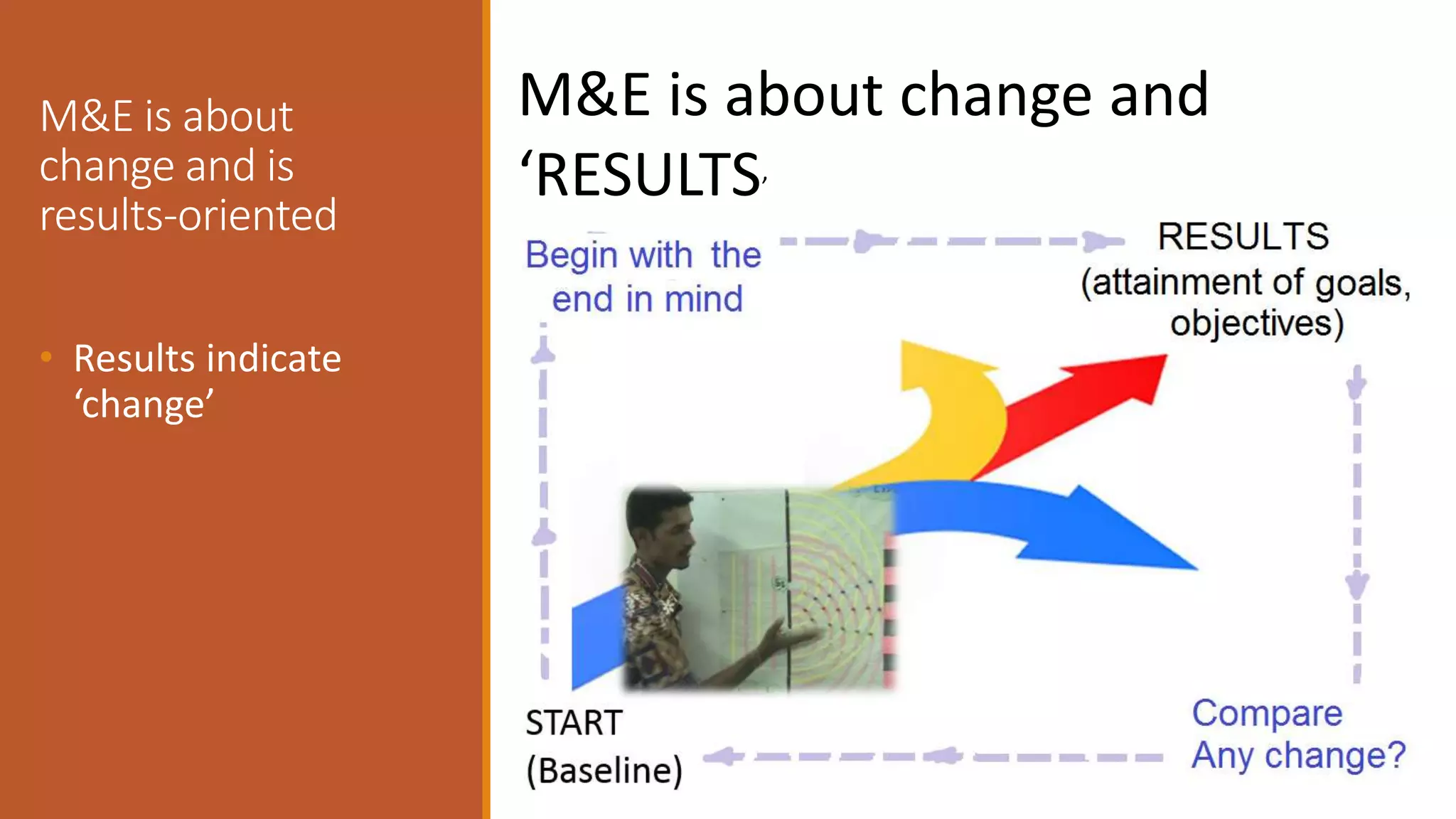
M&E is about
change and is
results-oriented
• Results indicate
‘change’
M&E is about change and
‘RESULTS’
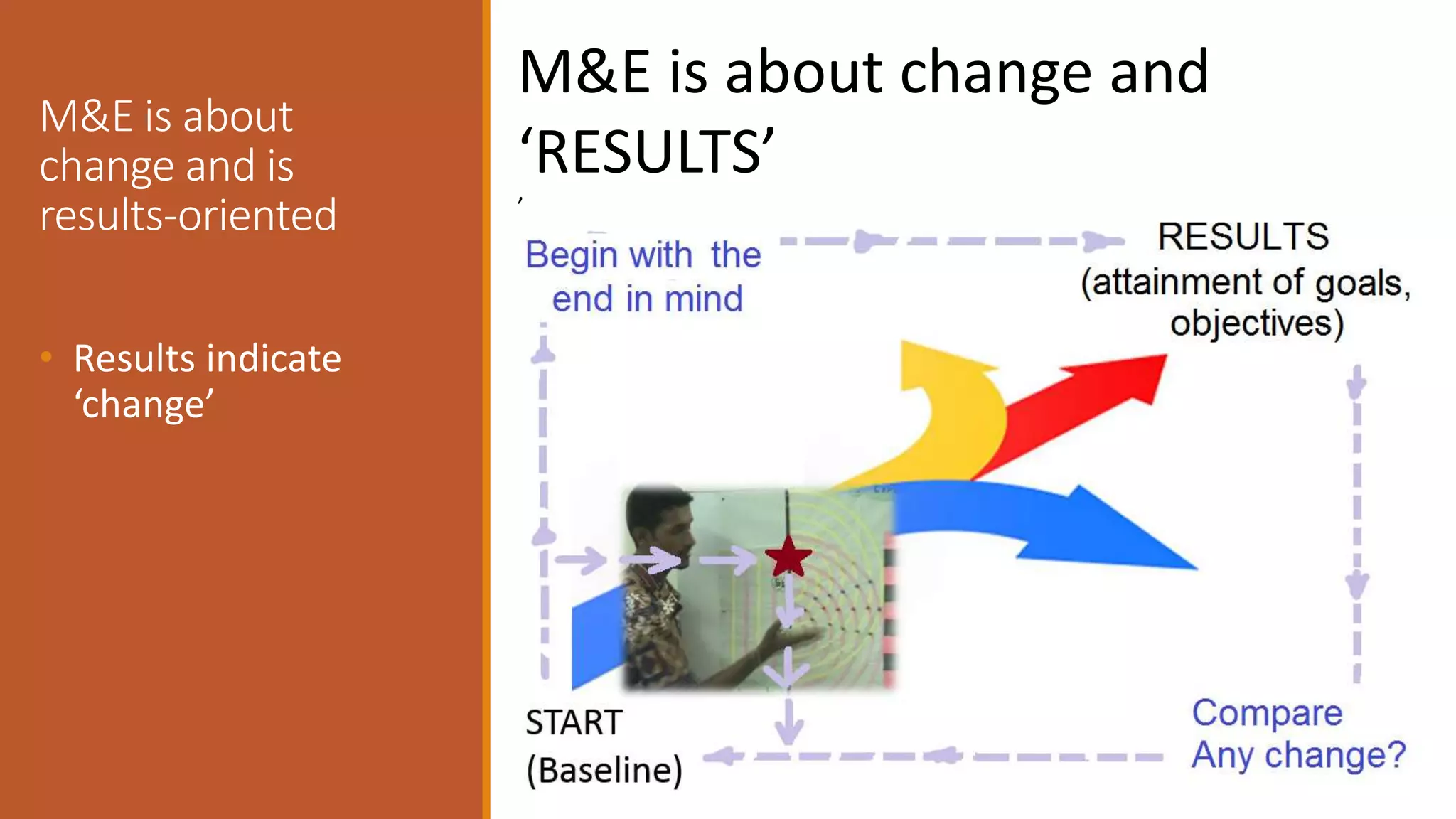
M&E is about
change and is
results-oriented
• Results indicate
‘change’
M&E is about change and
‘RESULTS’
’
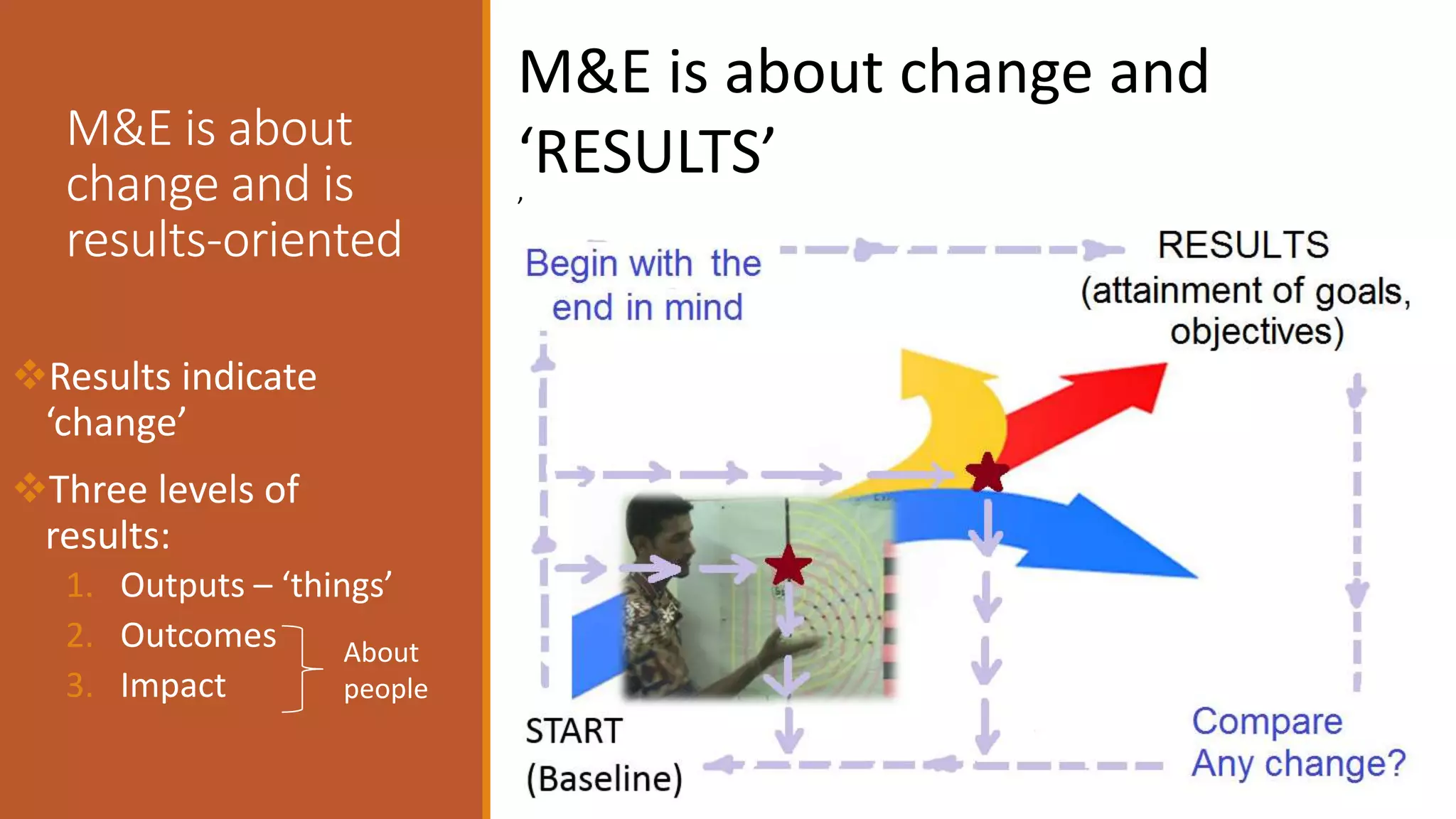
Results indicate
‘change’
Three levels of
results:
1. Outputs – ‘things’
2. Outcomes
3. Impact
M&E is about
change and is
results-oriented
M&E is about change and
‘RESULTS’
’
About
people
At the
beginning,
you already
have what
the ‘end’
results
should look
like:
 Change
happens in
between
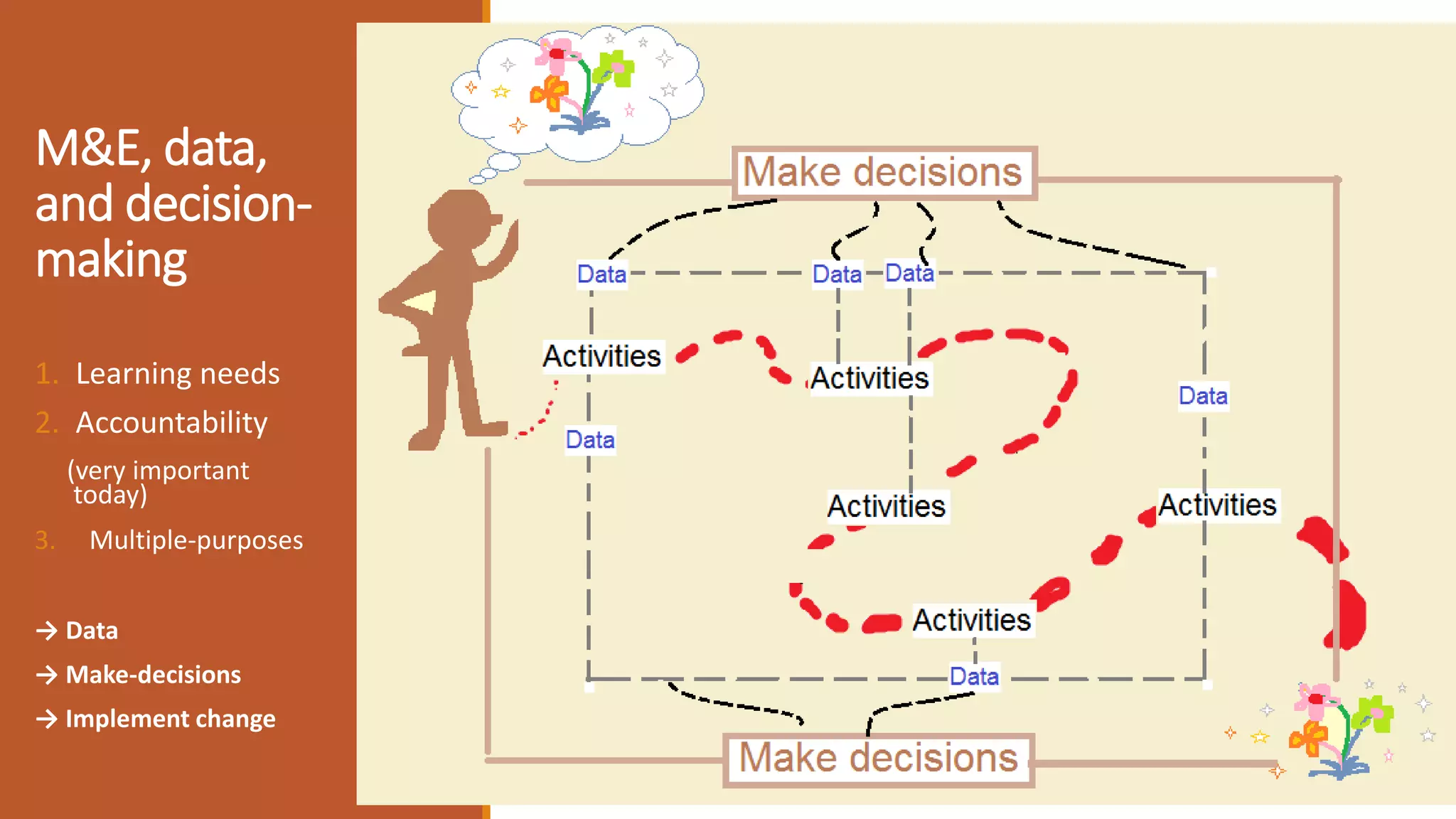
M&E, data,
and decision-
making
1. Learning needs
2. Accountability
(very important
today)
3. Multiple-purposes
→ Data
→ Make-decisions
→ Implement change
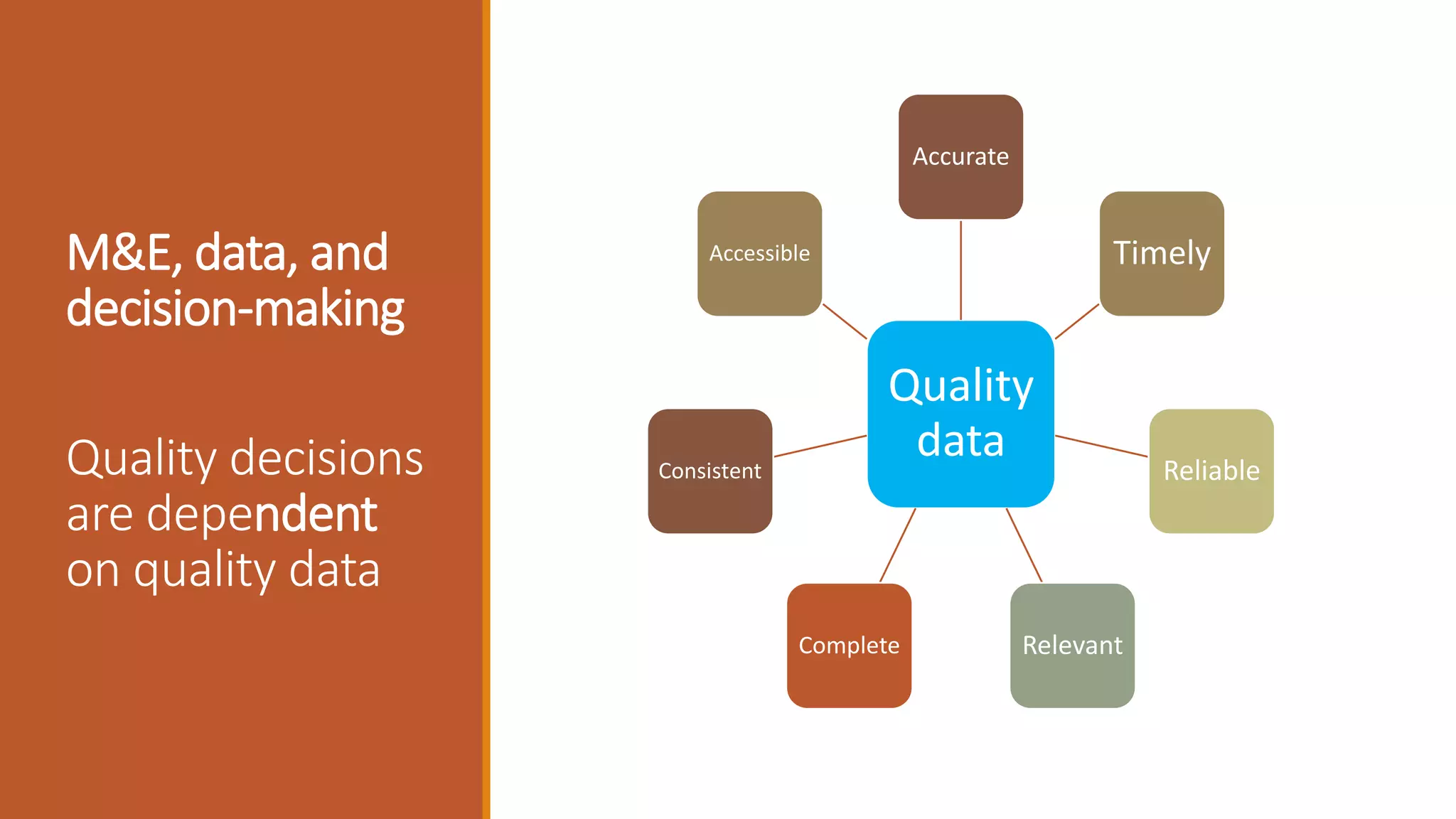
Quality
data
Accurate
Timely
Reliable
RelevantComplete
Consistent
Accessible
Quality decisions
are dependent
on quality data
M&E, data, and
decision-making
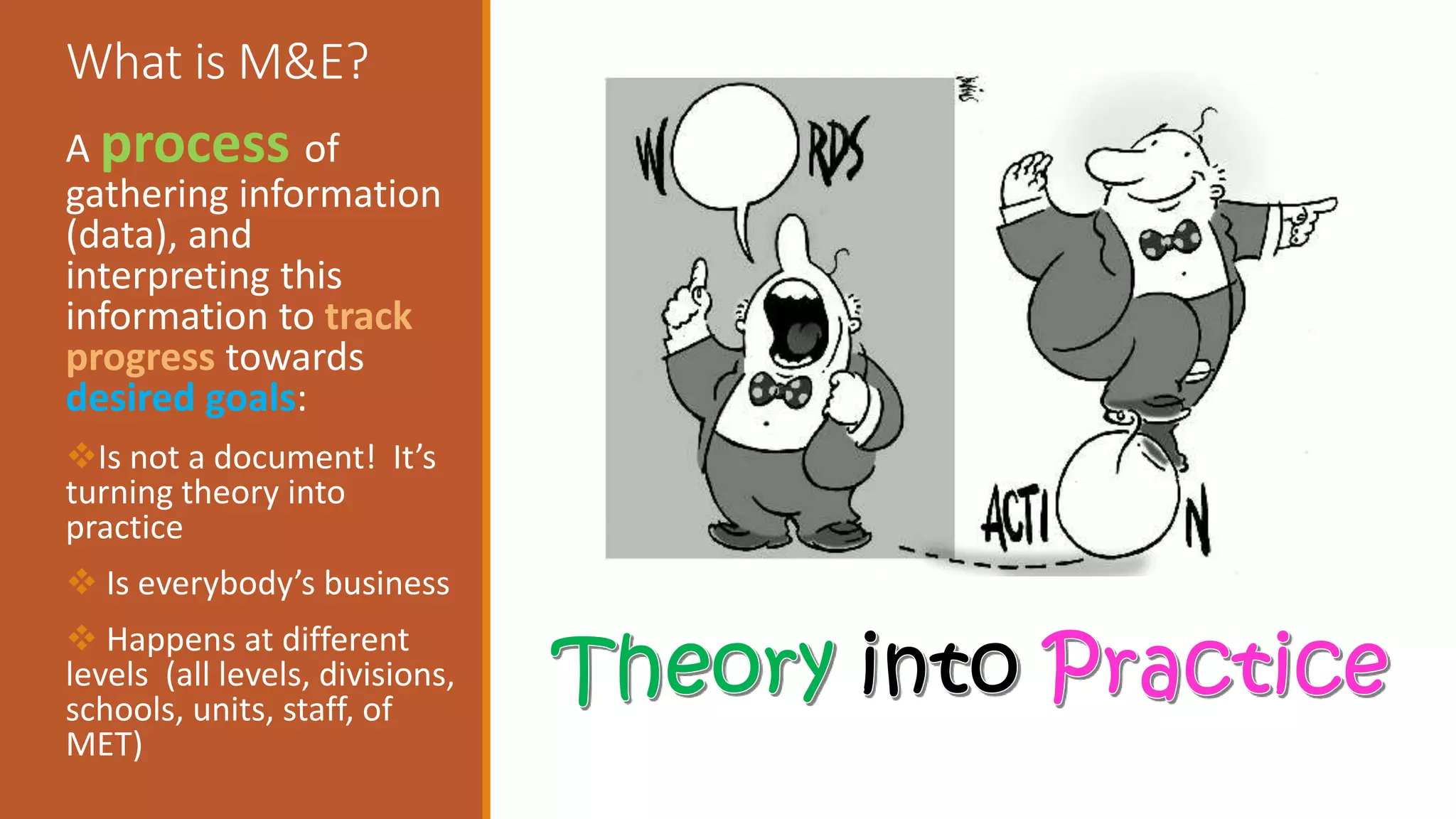
What is M&E?
A process of
gathering information
(data), and
interpreting this
information to track
progress towards
desired goals:
Is not a document! It’s
turning theory into
practice
 Is everybody’s business
 Happens at different
levels (all levels, divisions,
schools, units, staff, of
MET)
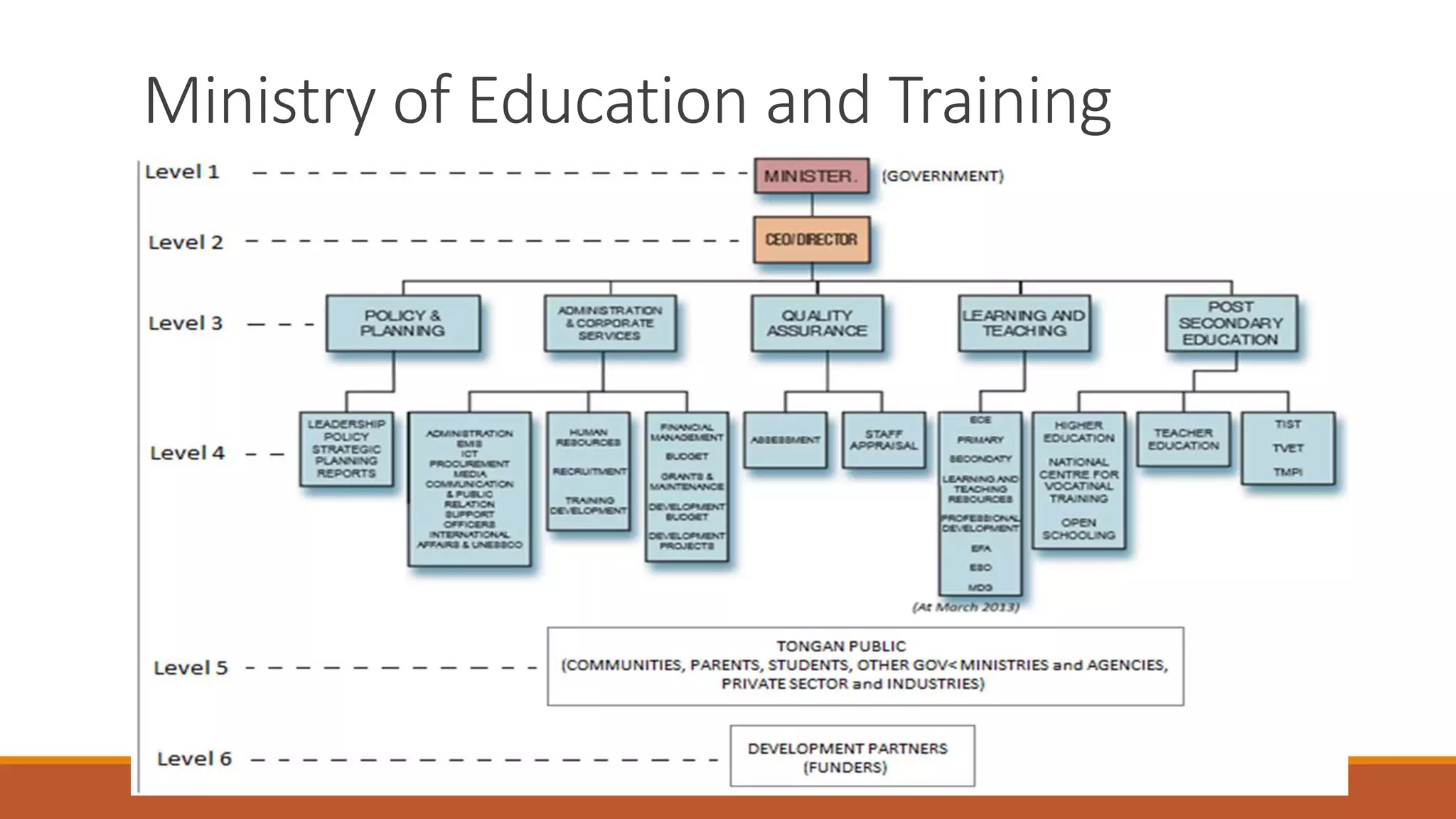
Ministry of Education and Training
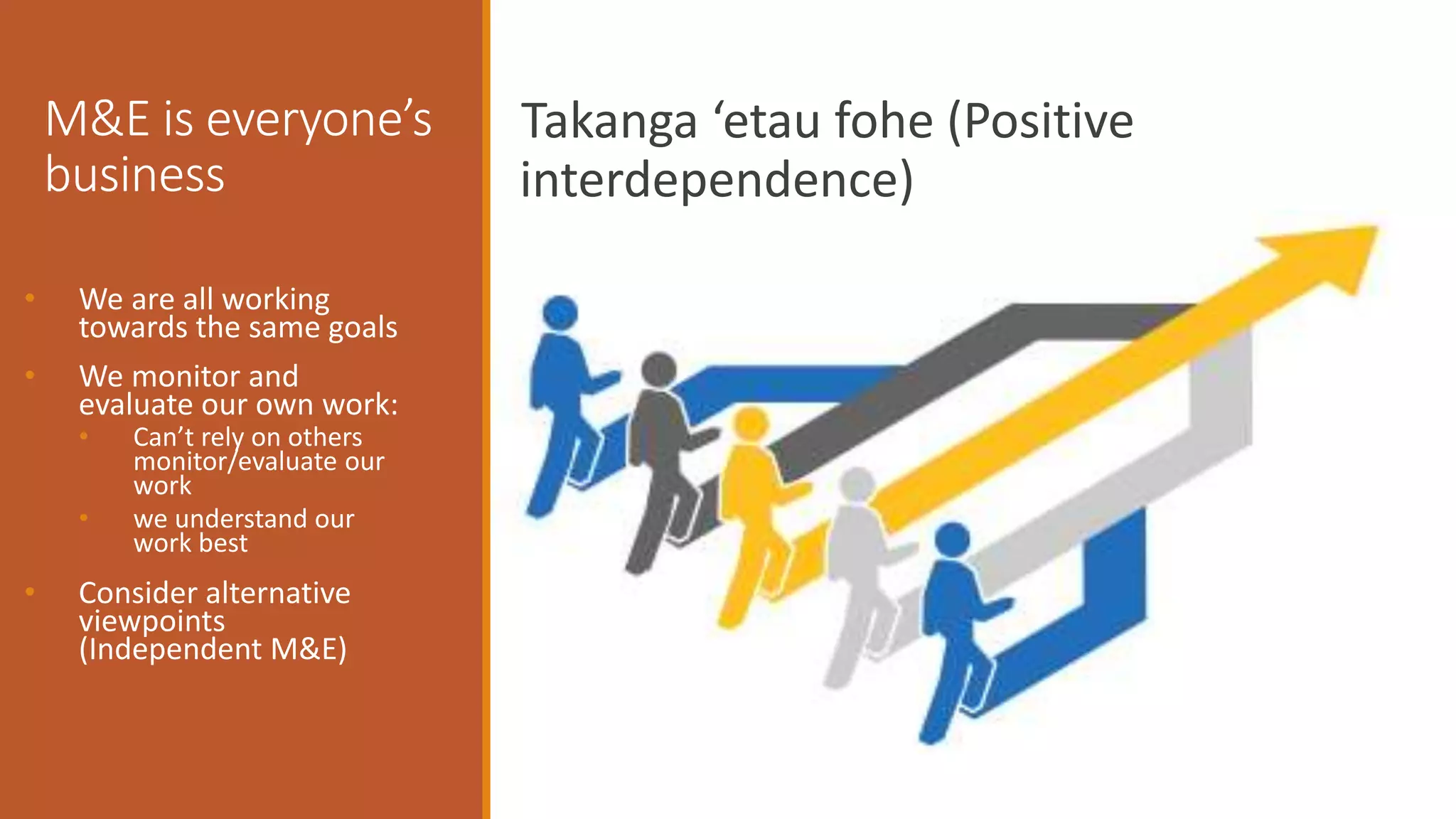
M&E is everyone’s
business
Takanga ‘etau fohe (Positive
interdependence)
• We are all working
towards the same goals
• We monitor and
evaluate our own work:
• Can’t rely on others
monitor/evaluate our
work
• we understand our
work best
• Consider alternative
viewpoints
(Independent M&E)
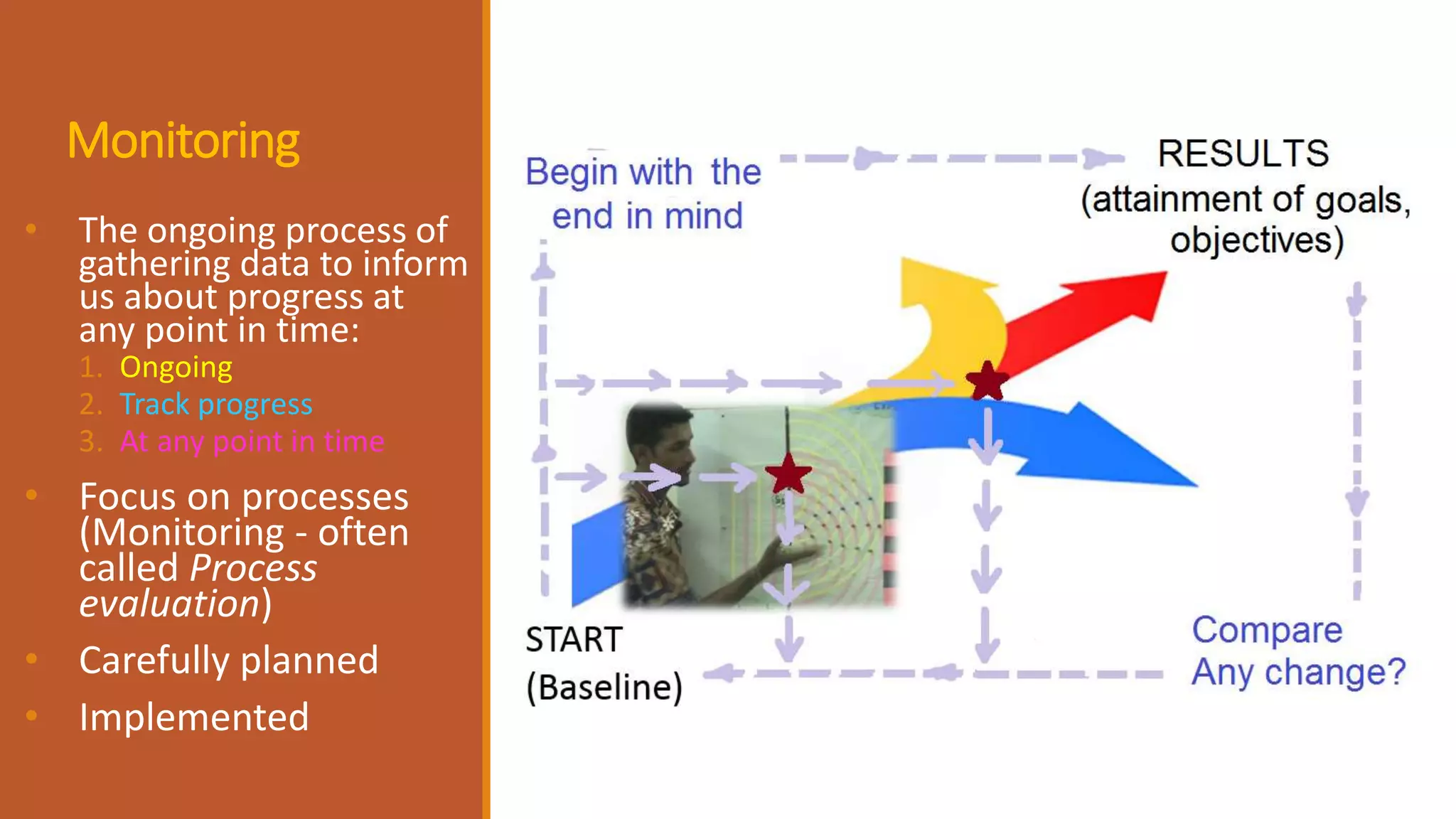
Monitoring
• The ongoing process of
gathering data to inform
us about progress at
any point in time:
1. Ongoing
2. Track progress
3. At any point in time
• Focus on processes
(Monitoring - often
called Process
evaluation)
• Carefully planned
• Implemented
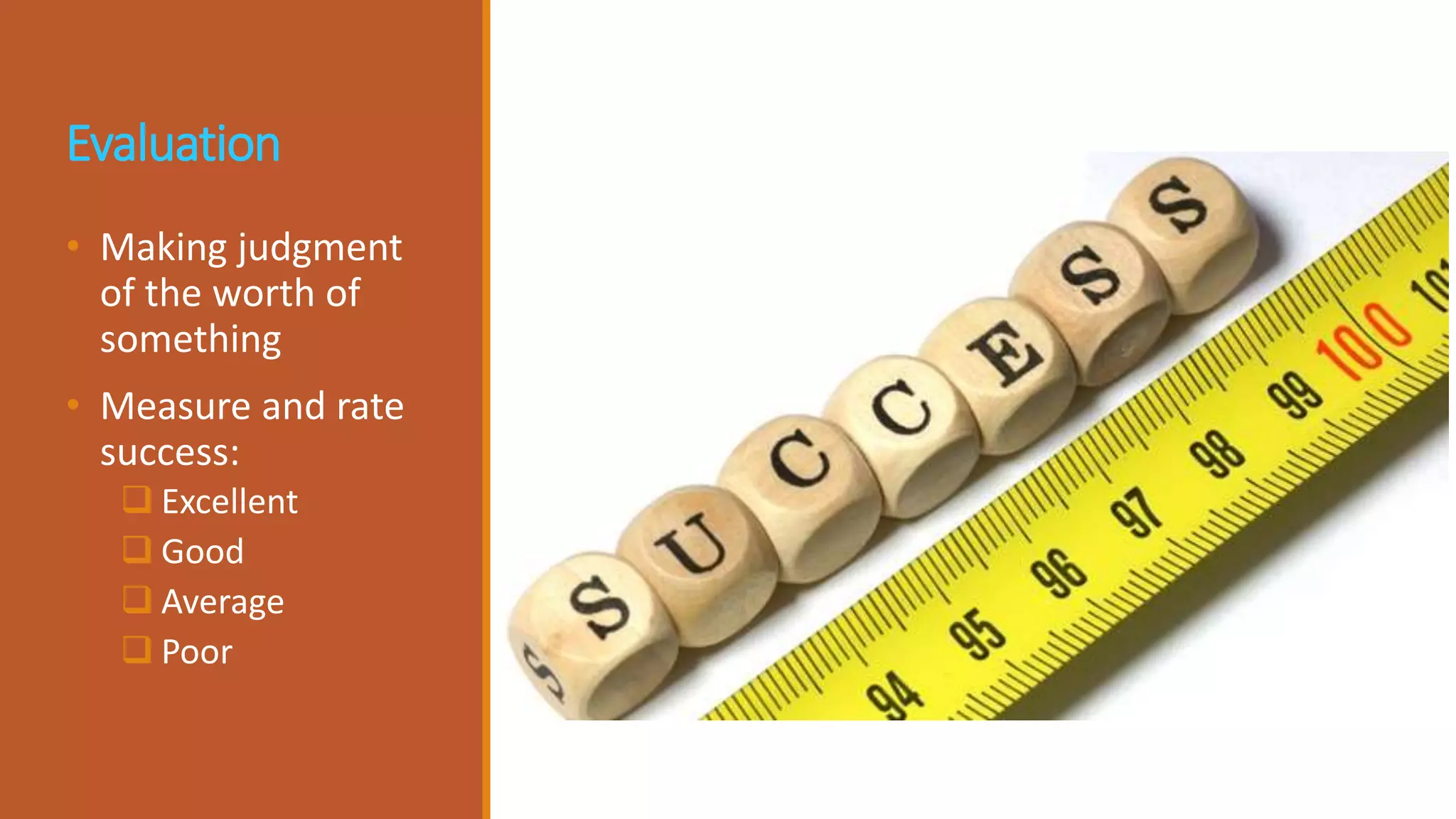
Evaluation
• Making judgment
of the worth of
something
• Measure and rate
success:
 Excellent
 Good
 Average
 Poor
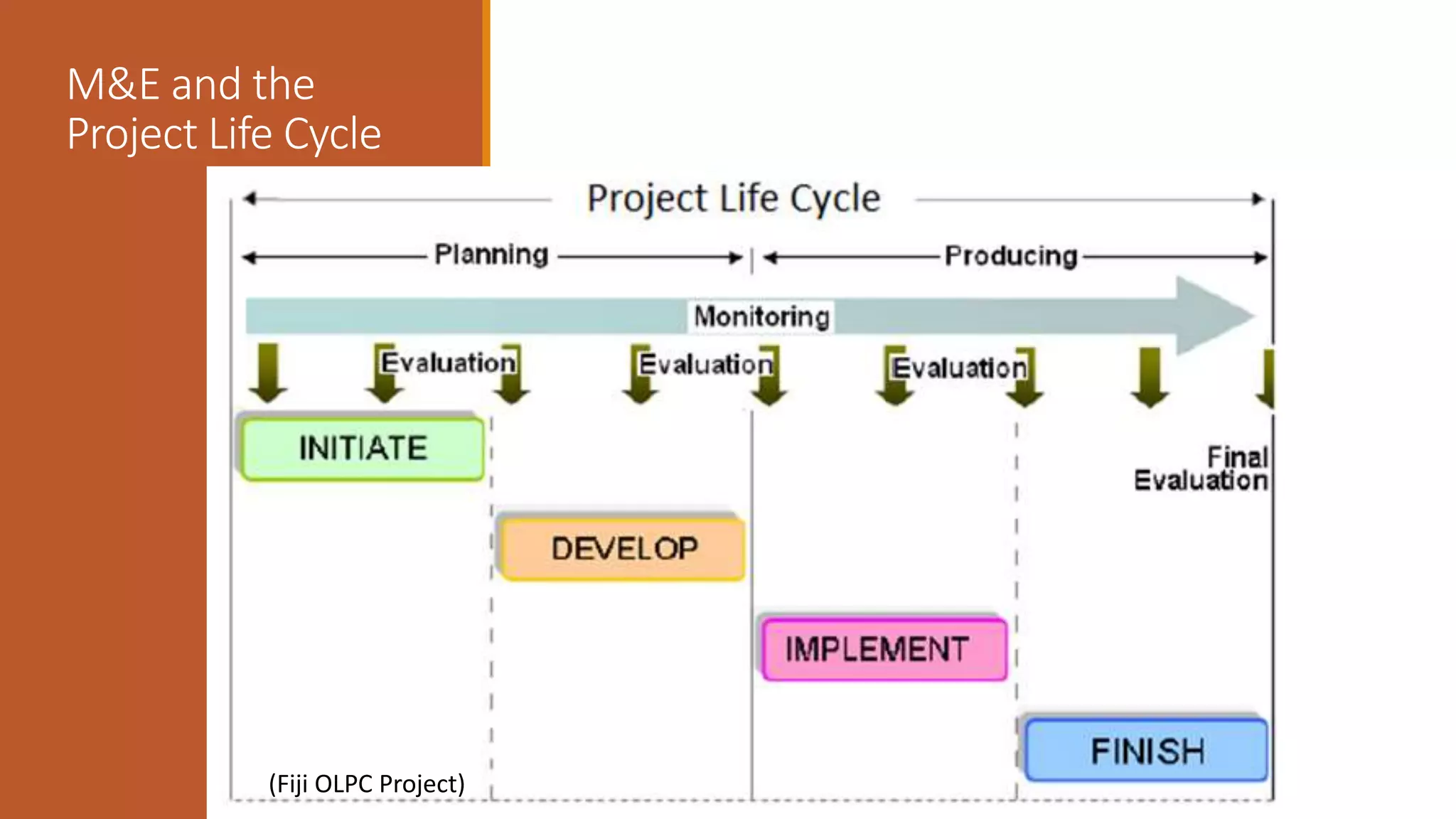
M&E and the
Project Life Cycle
(Fiji OLPC Project)
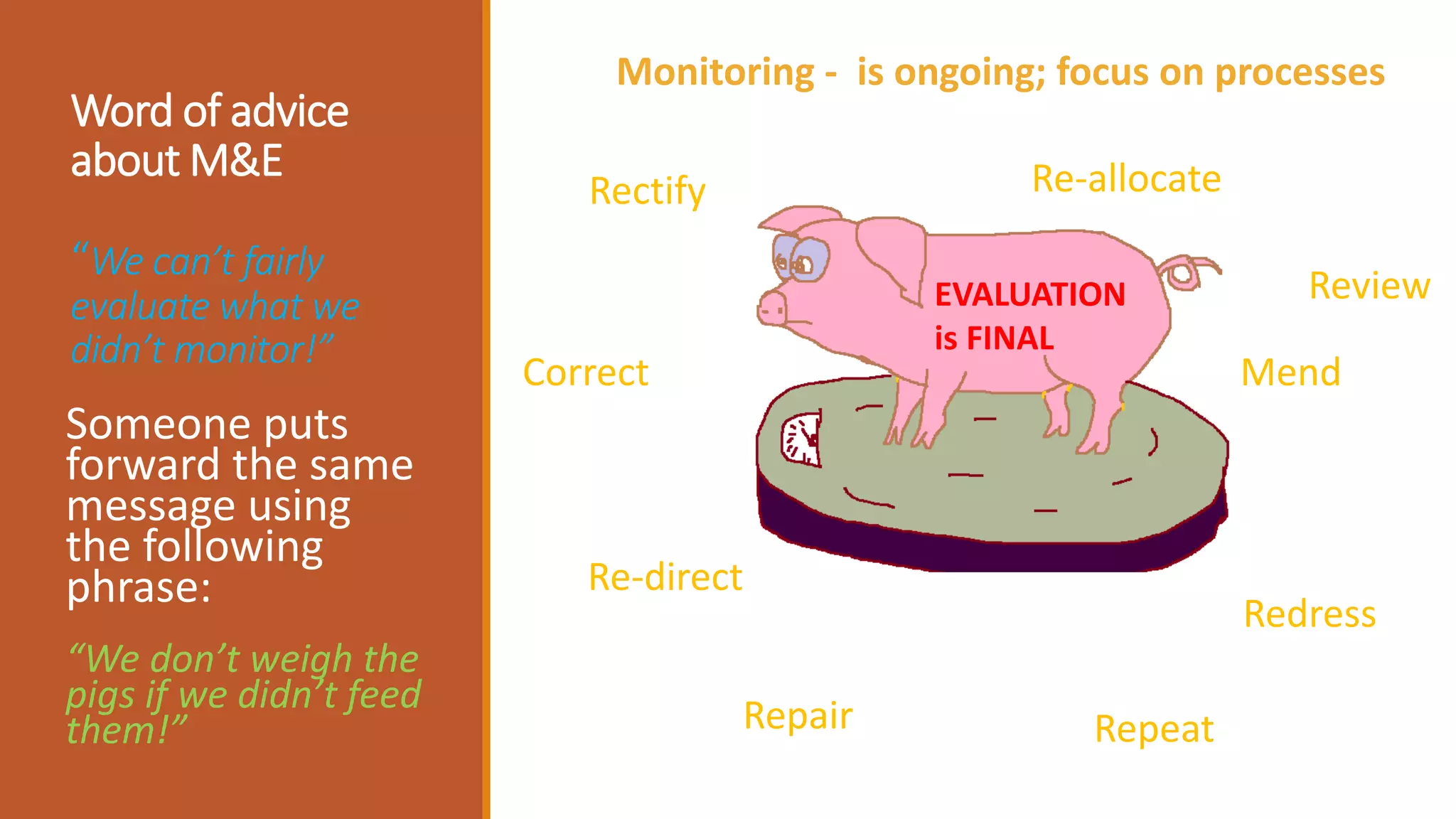
Word of advice
about M&E
“We can’t fairly
evaluate what we
didn’t monitor!”
Someone puts
forward the same
message using
the following
phrase:
“We don’t weigh the
pigs if we didn’t feed
them!”
Monitoring - is ongoing; focus on processes
EVALUATION
is FINAL
Rectify
Mend
Repair Repeat
Redress
Correct
Re-allocate
Re-direct
Review
M&E
in a nutshell
It’s not new
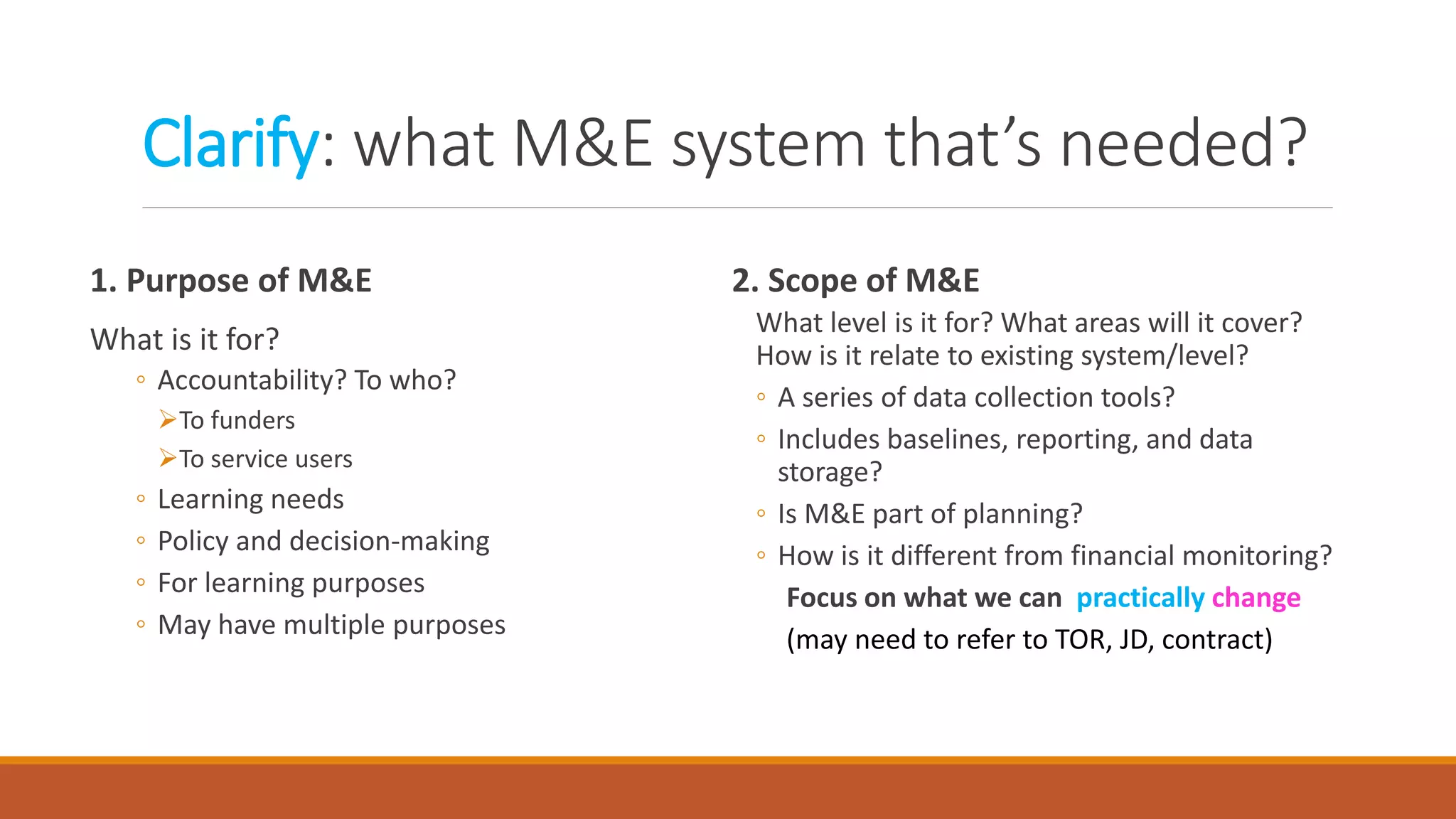
Clarify: what M&E system that’s needed?
2. Scope of M&E
What level is it for? What areas will it cover?
How is it relate to existing system/level?
◦ A series of data collection tools?
◦ Includes baselines, reporting, and data
storage?
◦ Is M&E part of planning?
◦ How is it different from financial monitoring?
Focus on what we can practically change
(may need to refer to TOR, JD, contract)
1. Purpose of M&E
What is it for?
◦ Accountability? To who?
To funders
To service users
◦ Learning needs
◦ Policy and decision-making
◦ For learning purposes
◦ May have multiple purposes
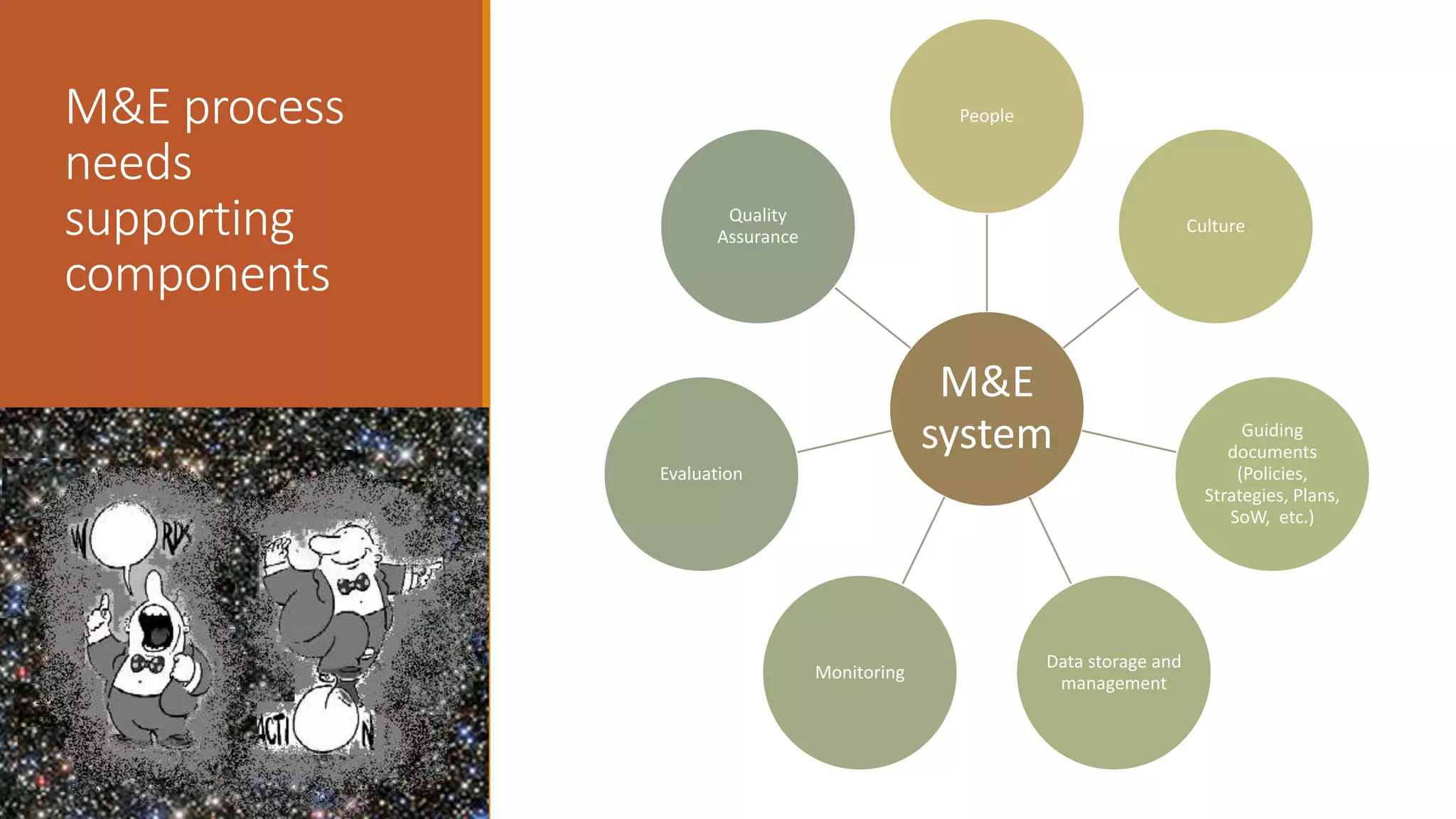
M&E process
needs
supporting
components
M&E
system
People
Culture
Guiding
documents
(Policies,
Strategies, Plans,
SoW, etc.)
Data storage and
management
Monitoring
Evaluation
Quality
Assurance
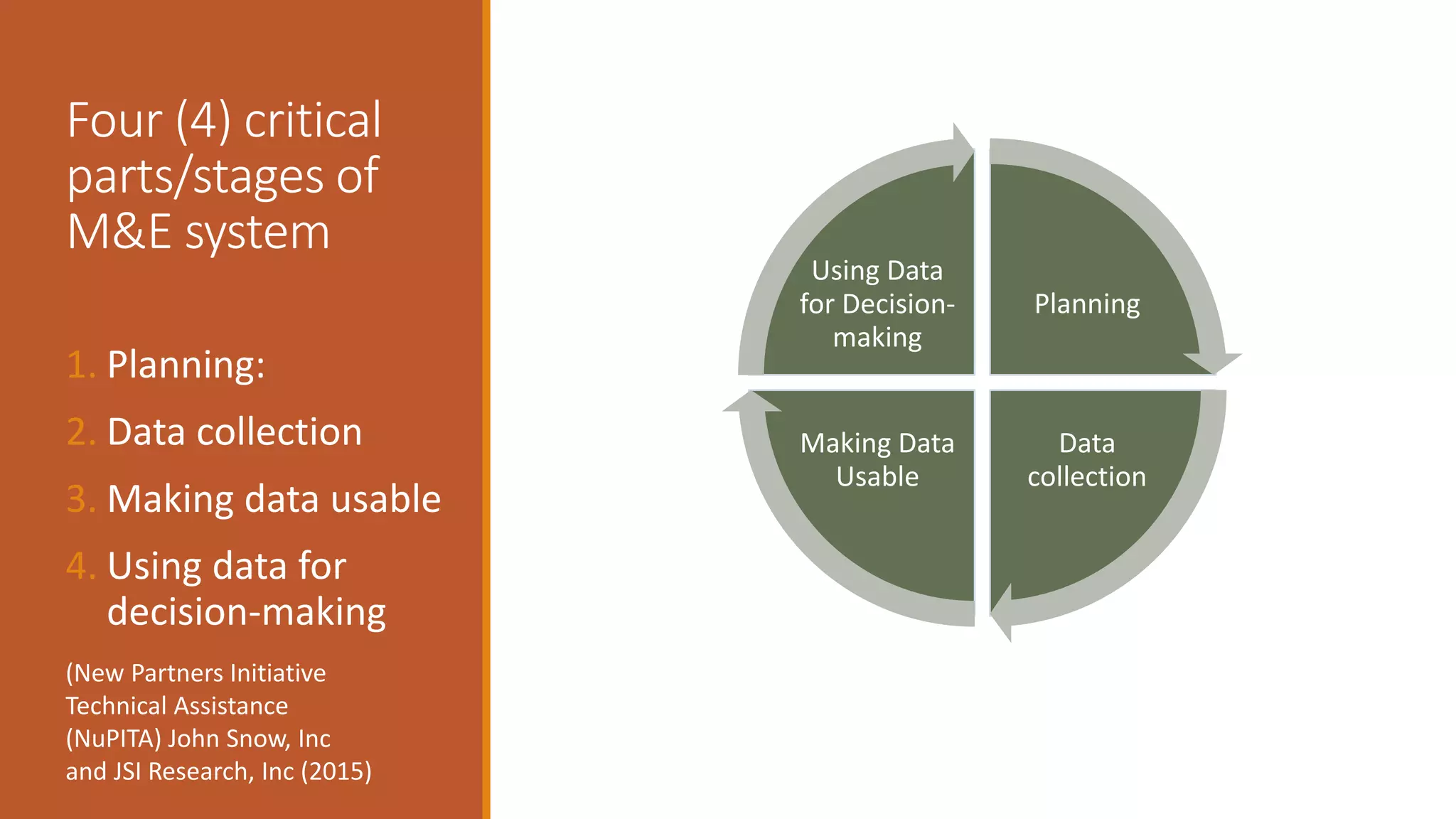
Four (4) critical
parts/stages of
M&E system
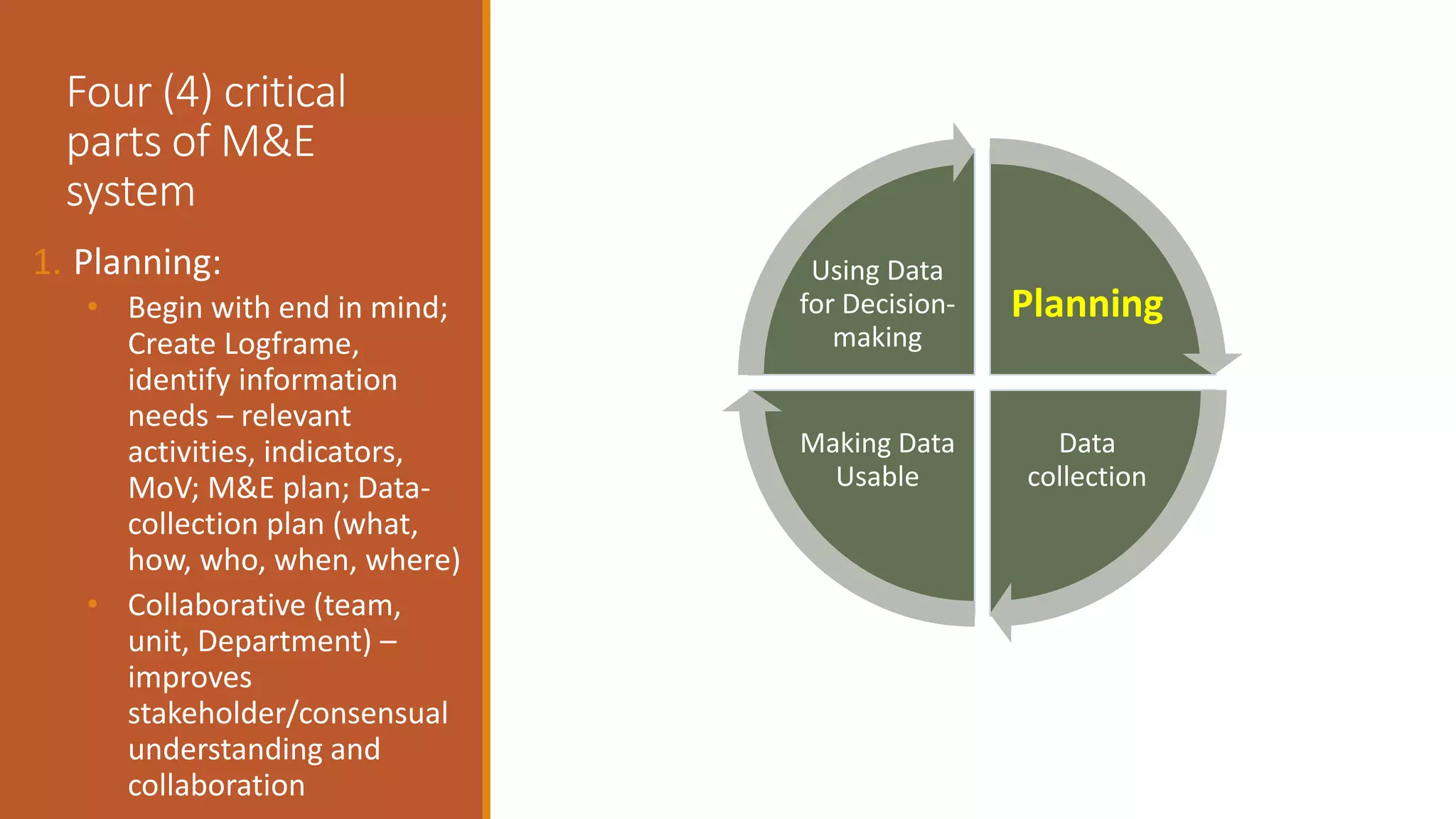
1. Planning:
2. Data collection
3. Making data usable
4. Using data for
decision-making
(New Partners Initiative
Technical Assistance
(NuPITA) John Snow, Inc
and JSI Research, Inc (2015)
Planning
Data
collection
Making Data
Usable
Using Data
for Decision-
making
Four (4) critical
parts of M&E
system
1. Planning:
• Begin with end in mind;
Create Logframe,
identify information
needs – relevant
activities, indicators,
MoV; M&E plan; Data-
collection plan (what,
how, who, when, where)
• Collaborative (team,
unit, Department) –
improves
stakeholder/consensual
understanding and
collaboration
Planning
Data
collection
Making Data
Usable
Using Data
for Decision-
making
Four (4) critical
parts of M&E
system
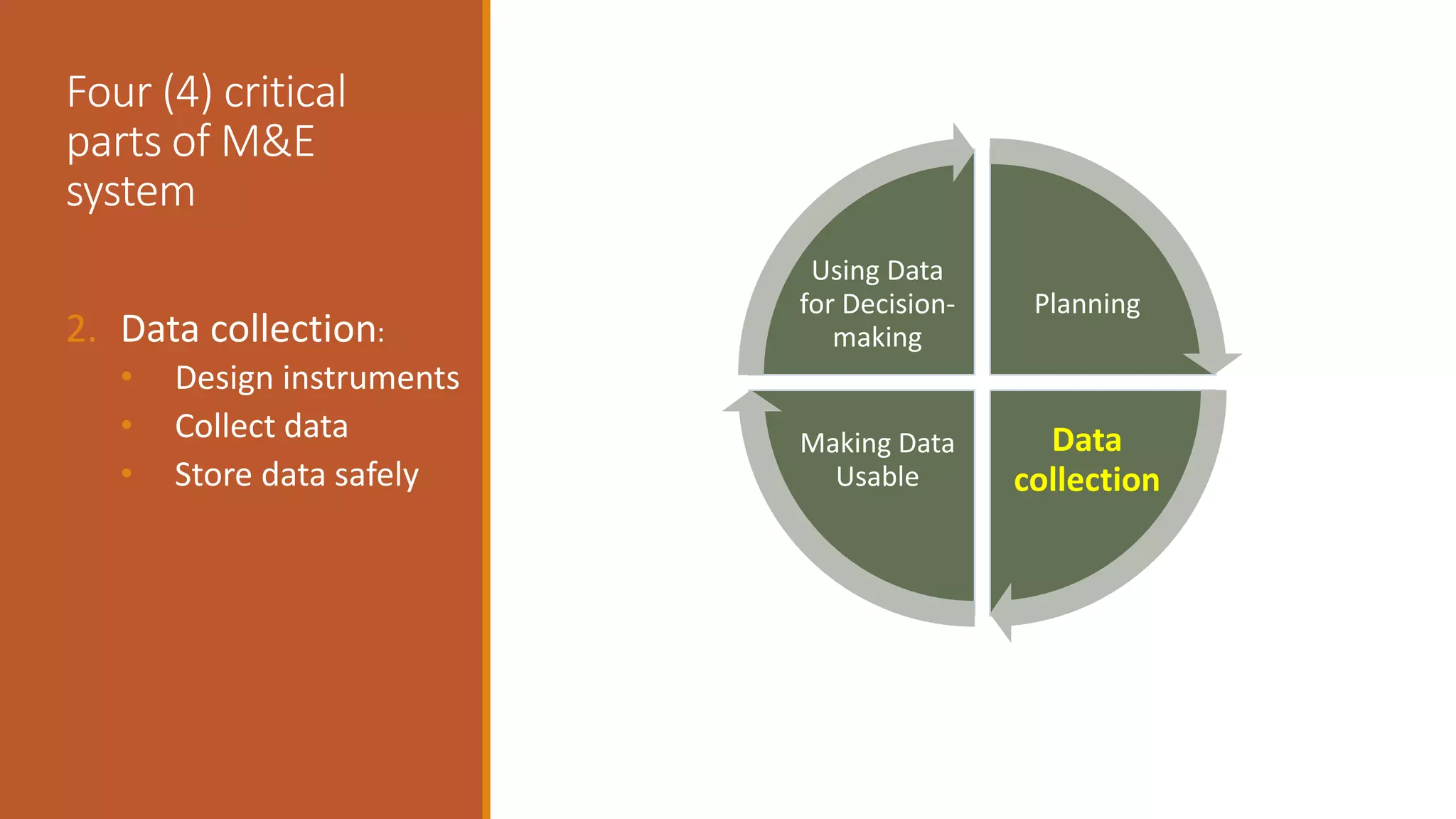
2. Data collection:
• Design instruments
• Collect data
• Store data safely
Planning
Data
collection
Making Data
Usable
Using Data
for Decision-
making
Four (4) critical
parts of M&E
system
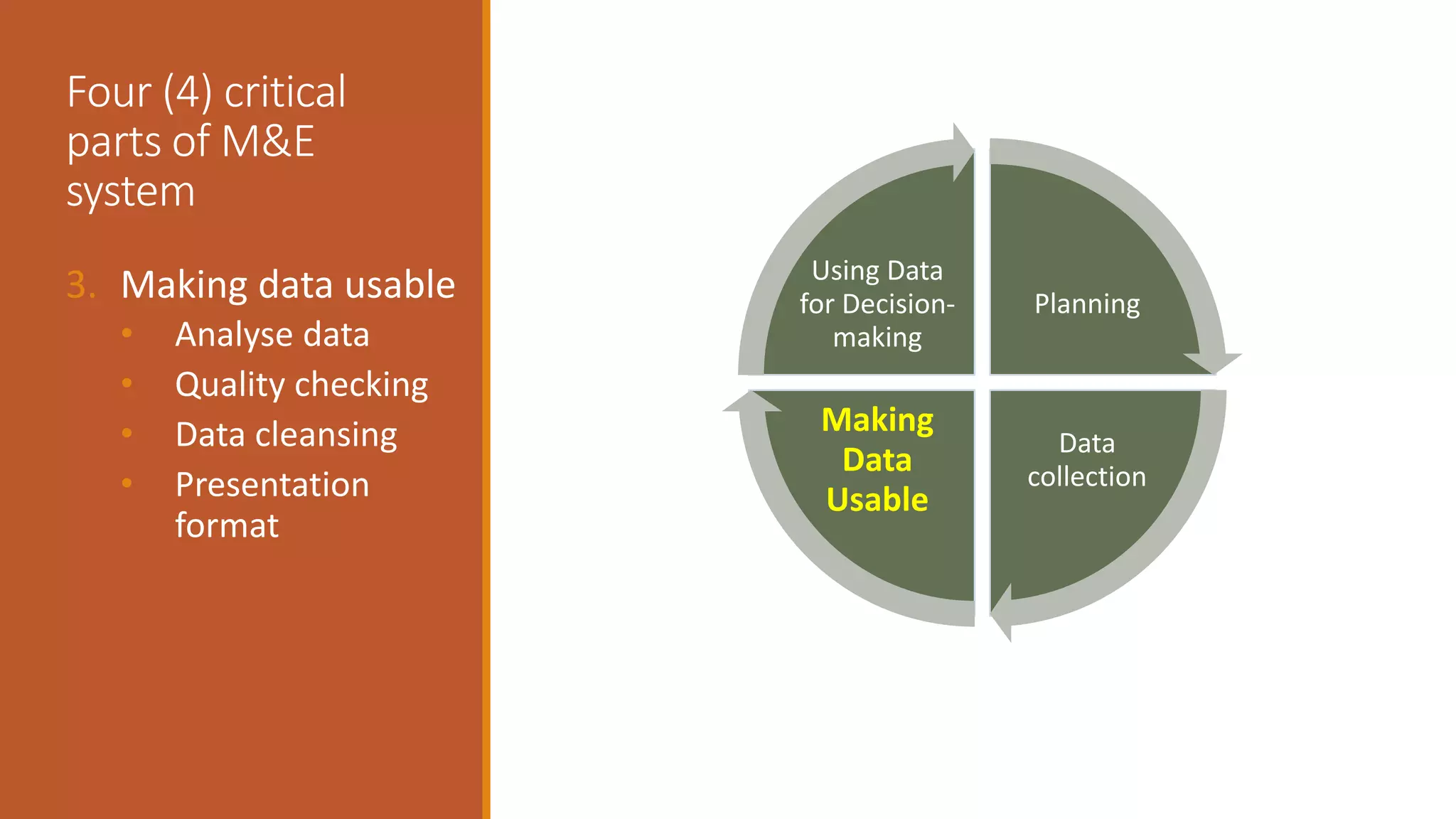
3. Making data usable
• Analyse data
• Quality checking
• Data cleansing
• Presentation
format
Planning
Data
collection
Making
Data
Usable
Using Data
for Decision-
making
Four (4) critical
parts of M&E
system
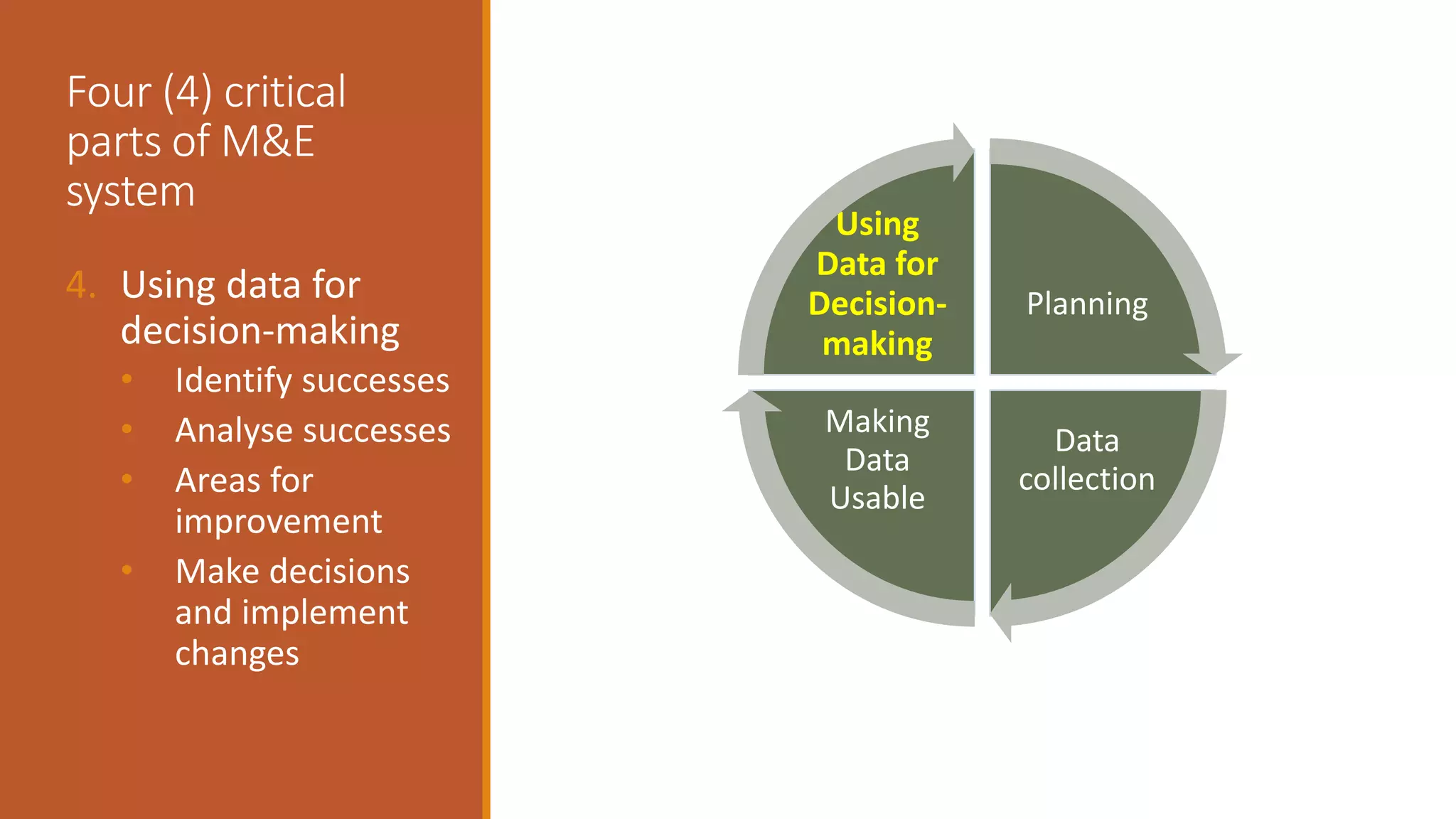
4. Using data for
decision-making
• Identify successes
• Analyse successes
• Areas for
improvement
• Make decisions
and implement
changes
Planning
Data
collection
Making
Data
Usable
Using
Data for
Decision-
making
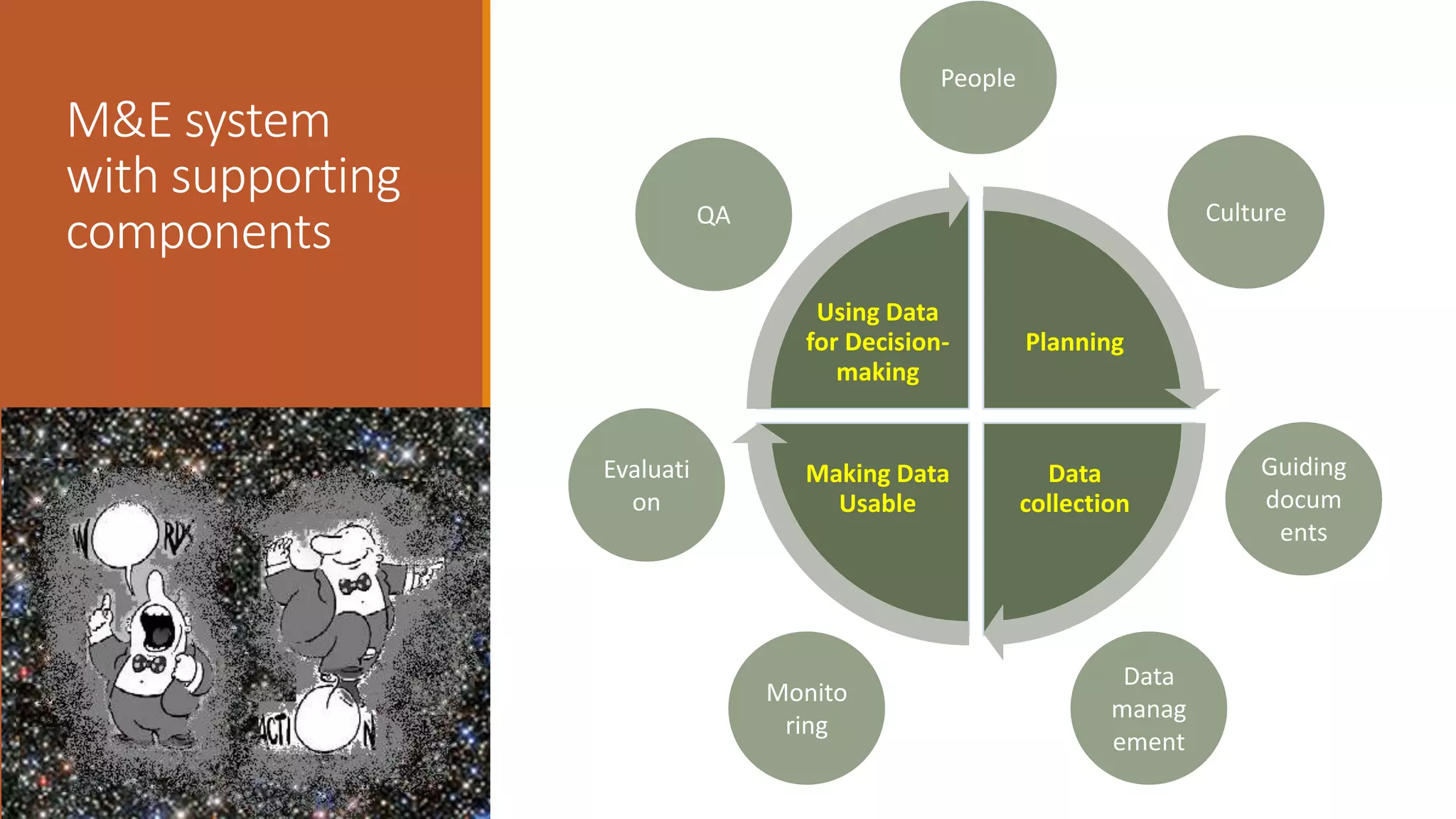
M&E system
with supporting
components
Planning
Data
collection
Making Data
Usable
Using Data
for Decision-
making
People
CultureQA
Evaluati
on
Monito
ring
Data
manag
ement
Guiding
docum
ents
People
• Often ‘ignored’
• Awareness:
• M&E
• Nature of their work
• Aware of common
goals, and the part
that each
staff/team/division
plays
It’s NOT new to Education!
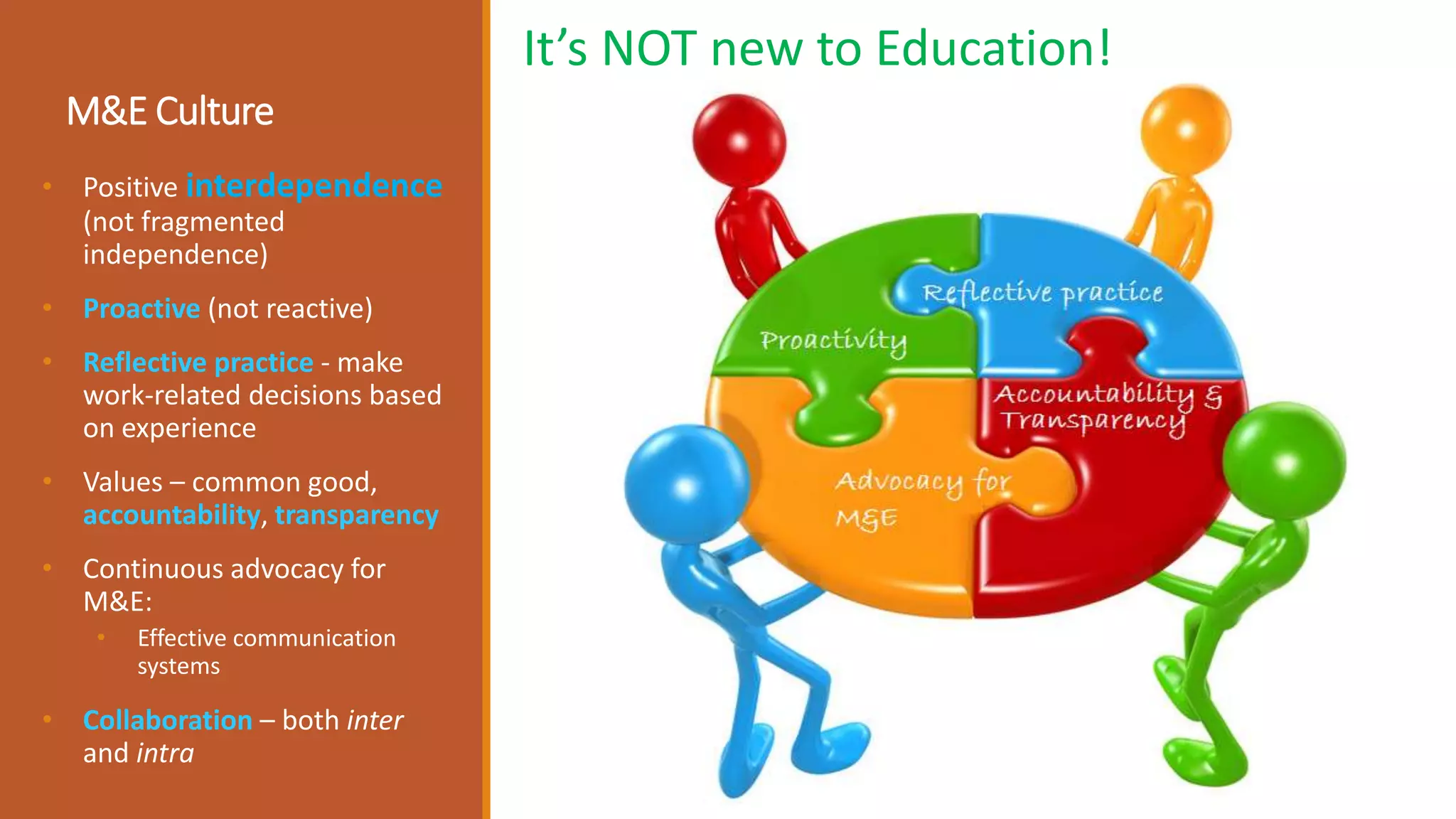
M&E Culture
• Positive interdependence
(not fragmented
independence)
• Proactive (not reactive)
• Reflective practice - make
work-related decisions based
on experience
• Values – common good,
accountability, transparency
• Continuous advocacy for
M&E:
• Effective communication
systems
• Collaboration – both inter
and intra
It’s NOT new to Education!
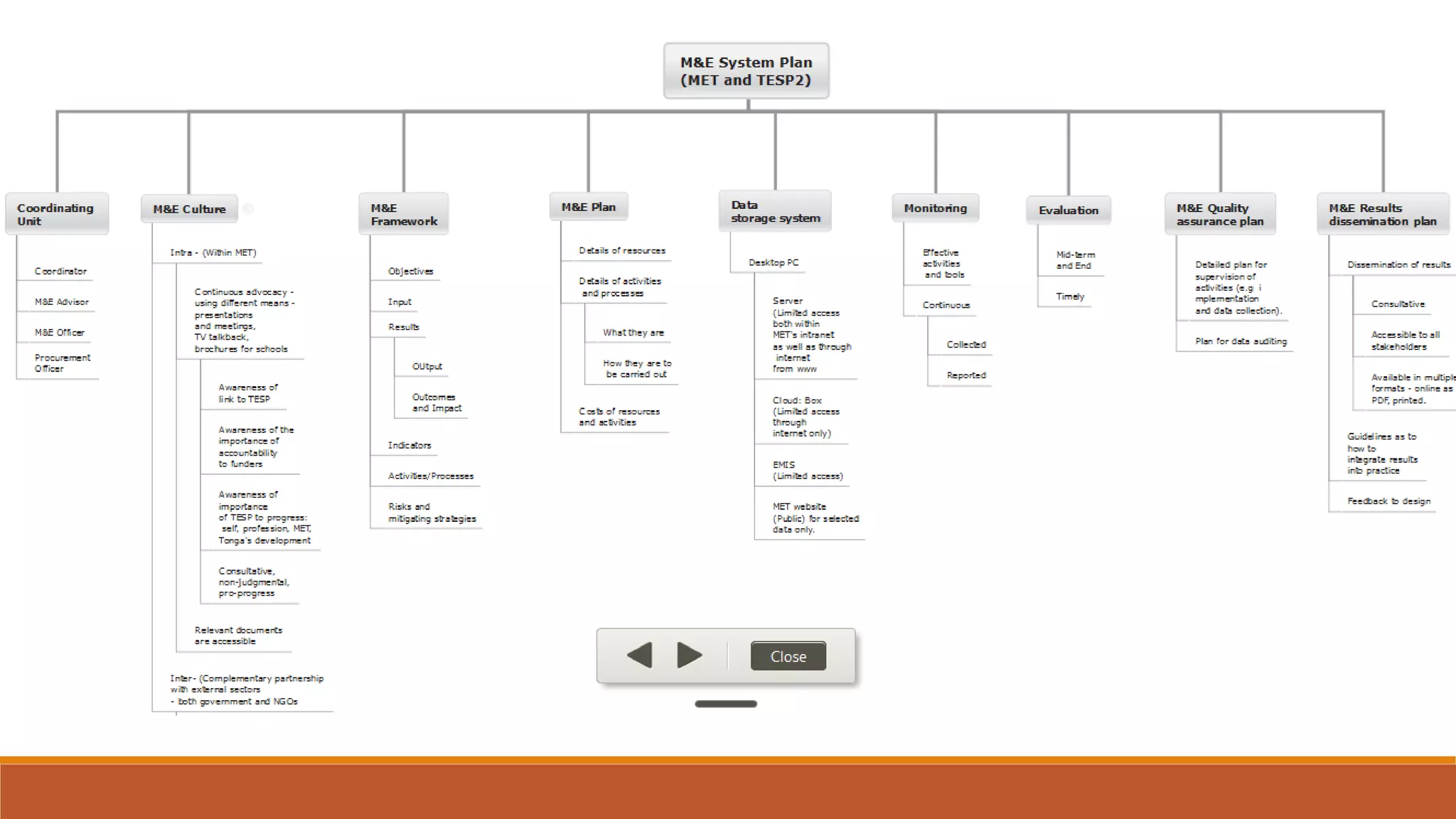
Coordinating
Unit for M&E
Where? How?
• PP, QA, SPA?
Core responsibilities
• Overall
coordination
Members?: CEO, IT,
EMIS, PP, etc
It’s NOT new to Education!
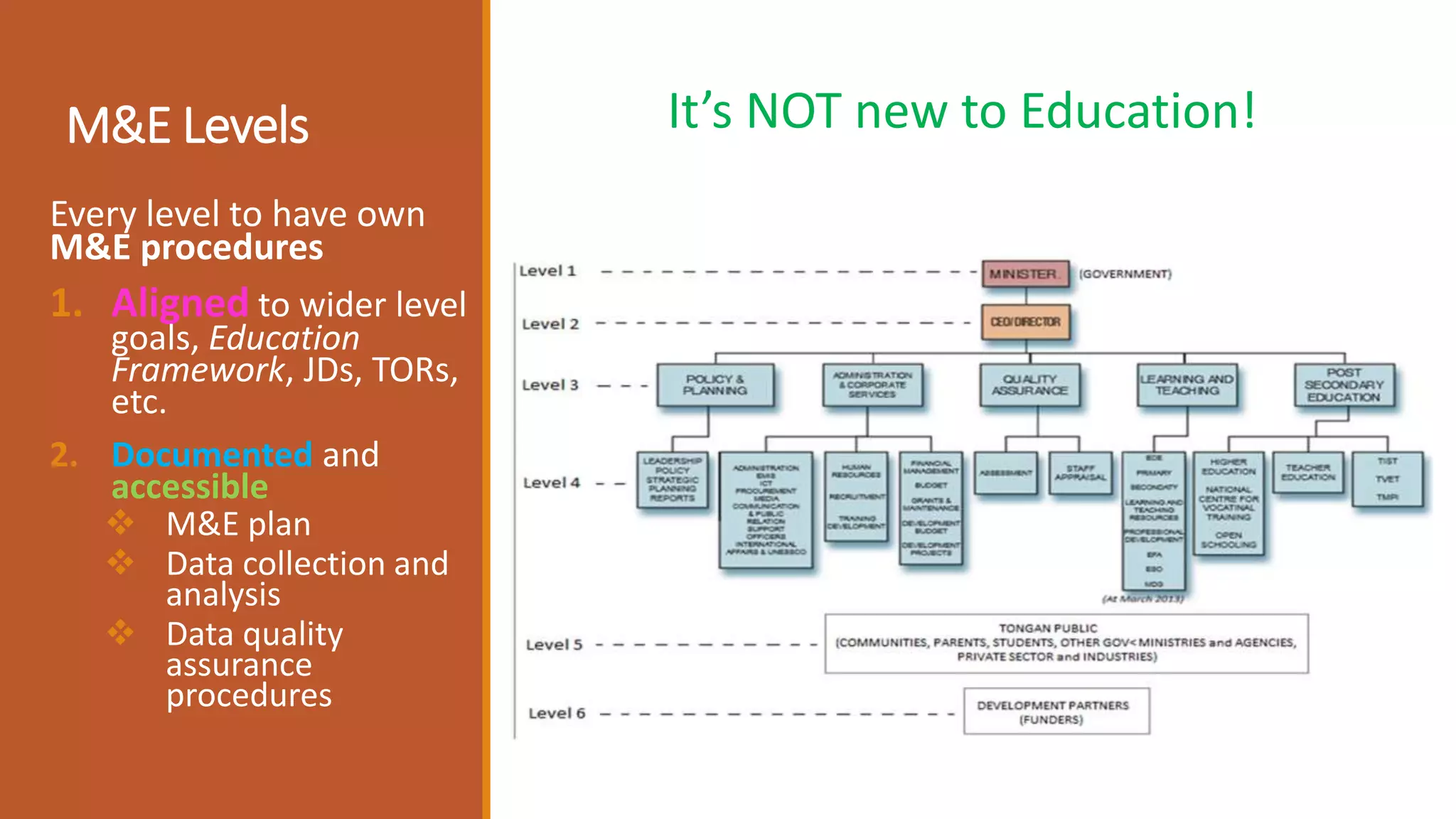
M&E Levels
Every level to have own
M&E procedures
1. Aligned to wider level
goals, Education
Framework, JDs, TORs,
etc.
2. Documented and
accessible
 M&E plan
 Data collection and
analysis
 Data quality
assurance
procedures
It’s NOT new to Education!
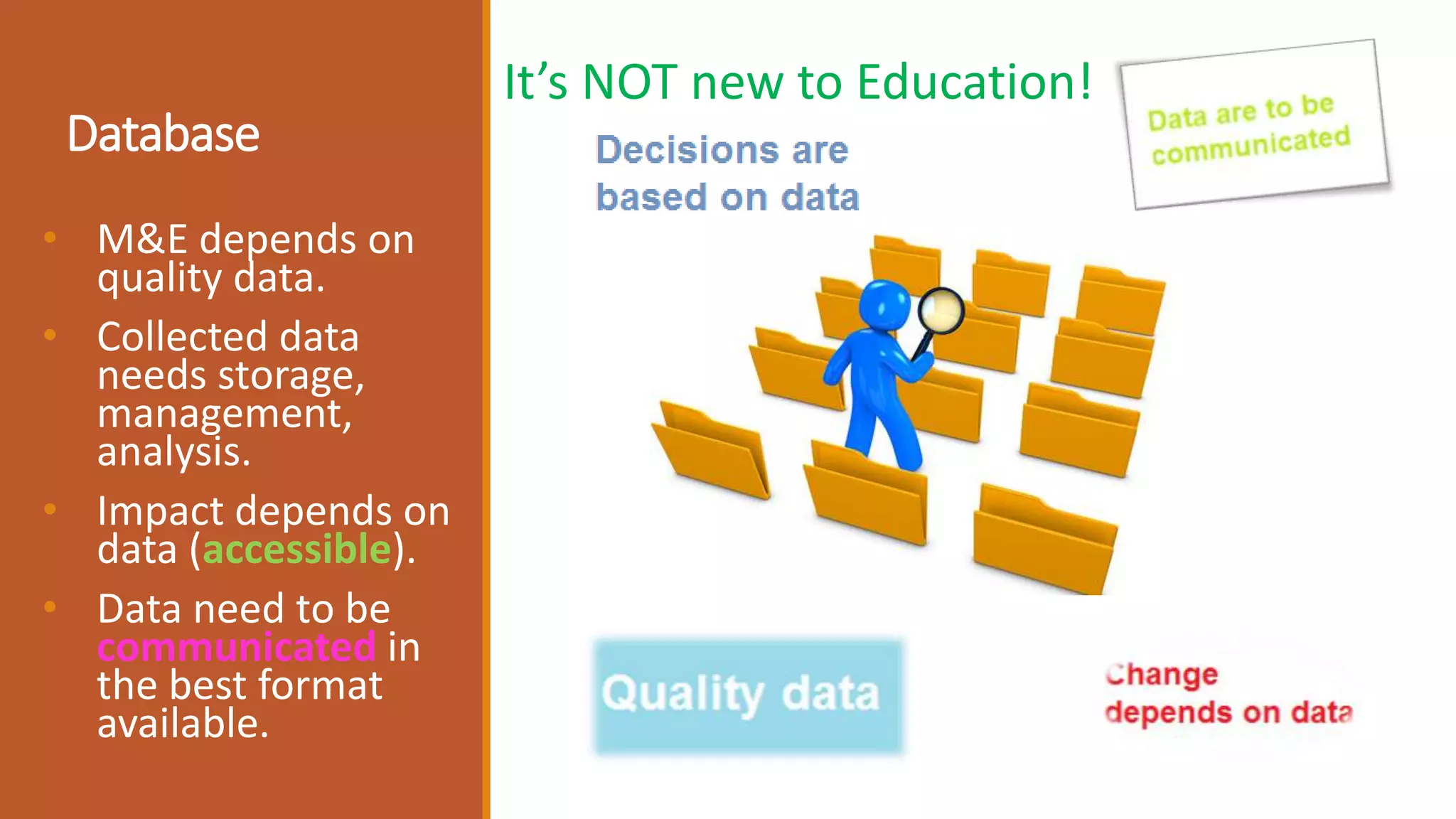
Database
• M&E depends on
quality data.
• Collected data
needs storage,
management,
analysis.
• Impact depends on
data (accessible).
• Data need to be
communicated in
the best format
available.
It’s NOT new to Education!
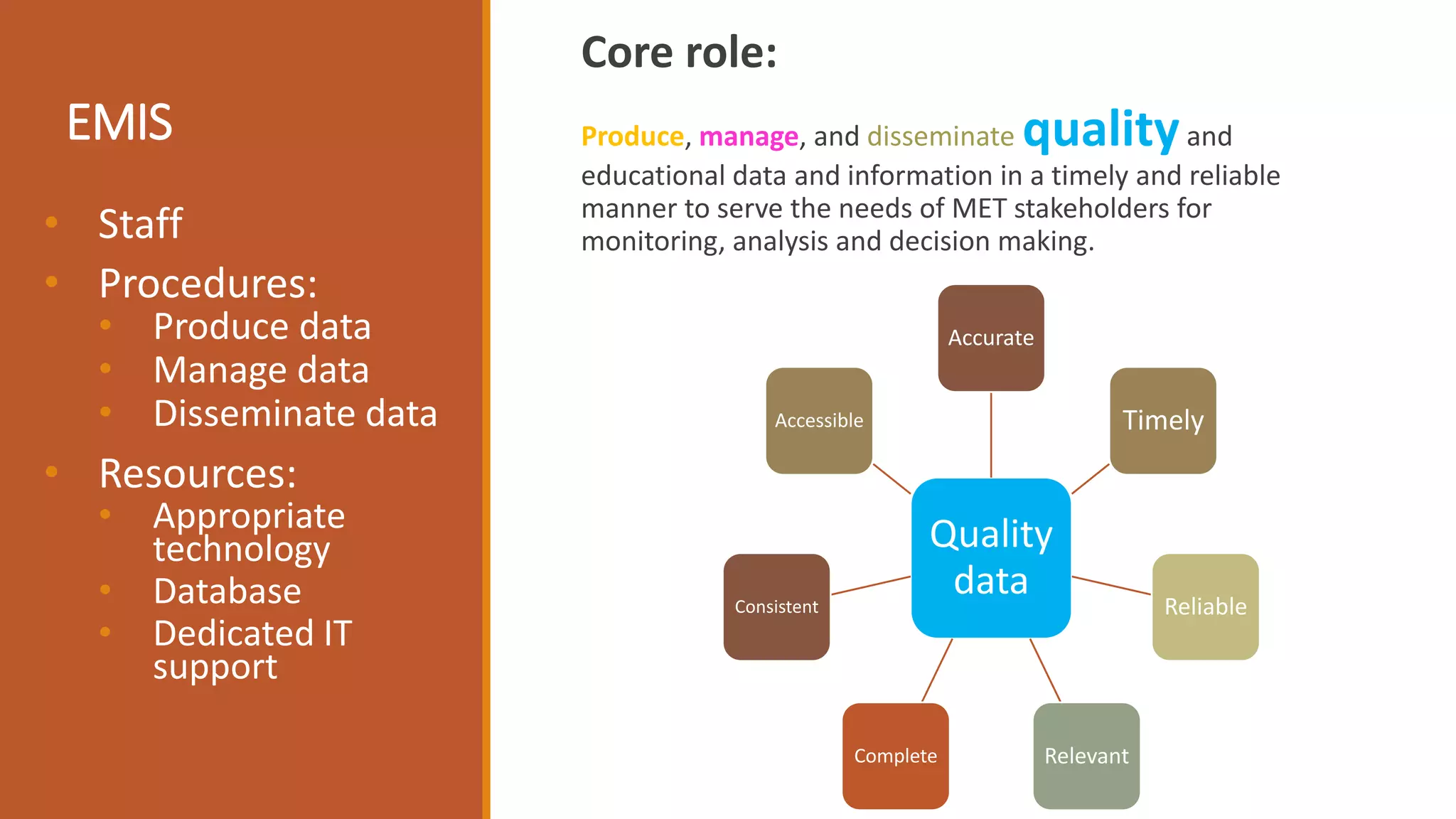
EMIS
Core role:
Produce, manage, and disseminate qualityand
educational data and information in a timely and reliable
manner to serve the needs of MET stakeholders for
monitoring, analysis and decision making.• Staff
• Procedures:
• Produce data
• Manage data
• Disseminate data
• Resources:
• Appropriate
technology
• Database
• Dedicated IT
support
Quality
data
Accurate
Timely
Reliable
RelevantComplete
Consistent
Accessible

Monitoring and evaluation (Part 1)

  • 1.
    Establishing a cultureof Monitoring and Evaluation SPREADING THE WORD, (RE)TURNING THE CULTURE (PART 1) Mr. Vilimaka Foliaki, M&E Advisor Tonga Education Support Program, Phase 2 Ministry of Education TONGA Professional Development Training Ministry of Education and Training TONGA Wednesday 12 August – Thursday August 2015
  • 2.
    Goals of these training workshops 1.Describe Monitoring and Evaluation in the context of your own unit as well as MET as a whole; 2. Articulate the importance of M&E to your work, MET, and national development; 3. (Describe the four (4) core elements of a M&E System;) 4. Describe what indicators are and identify examples from your own work context. 5. Use the Logical Framework Approach to draw a Logframe for your own work; 6. Provide conceptual clarity for how different people/sections of MET are working towards common goals and the key roles that M&E activities play in attaining these goals. 7. Provide conceptual clarity for the importance of M&E to quality data, policy, decision-making, and development in MET. 1. Establish a culture of M&E in the Ministry of Education and Training; 2. To realize that M&E is nothing new’ – is a ‘normal part of our work; 3. To appreciate the importance of M&E to quality data, decision- making, and progress. At the end of these workshops, you will be able to:
  • 3.
    M&E basically • Mirrorsour performance • Reflects our performance and reduces the chances of error. • Imagine shaving/puttin g on make-up without using a mirror
  • 4.
    What is M&E Isabout finding out whether what we are doing works
  • 5.
  • 6.
    M&E is about changeand is results-oriented • Results indicate ‘change’ M&E is about change and ‘RESULTS’
  • 7.
    M&E is about changeand is results-oriented • Results indicate ‘change’ M&E is about change and ‘RESULTS’ ’
  • 8.
    Results indicate ‘change’ Three levelsof results: 1. Outputs – ‘things’ 2. Outcomes 3. Impact M&E is about change and is results-oriented M&E is about change and ‘RESULTS’ ’ About people
  • 9.
    At the beginning, you already havewhat the ‘end’ results should look like:  Change happens in between
  • 10.
    M&E, data, and decision- making 1.Learning needs 2. Accountability (very important today) 3. Multiple-purposes → Data → Make-decisions → Implement change
  • 11.
  • 12.
    What is M&E? Aprocess of gathering information (data), and interpreting this information to track progress towards desired goals: Is not a document! It’s turning theory into practice  Is everybody’s business  Happens at different levels (all levels, divisions, schools, units, staff, of MET)
  • 13.
  • 14.
    M&E is everyone’s business Takanga‘etau fohe (Positive interdependence) • We are all working towards the same goals • We monitor and evaluate our own work: • Can’t rely on others monitor/evaluate our work • we understand our work best • Consider alternative viewpoints (Independent M&E)
  • 15.
    Monitoring • The ongoingprocess of gathering data to inform us about progress at any point in time: 1. Ongoing 2. Track progress 3. At any point in time • Focus on processes (Monitoring - often called Process evaluation) • Carefully planned • Implemented
  • 16.
    Evaluation • Making judgment ofthe worth of something • Measure and rate success:  Excellent  Good  Average  Poor
  • 17.
    M&E and the ProjectLife Cycle (Fiji OLPC Project)
  • 18.
    Word of advice aboutM&E “We can’t fairly evaluate what we didn’t monitor!” Someone puts forward the same message using the following phrase: “We don’t weigh the pigs if we didn’t feed them!” Monitoring - is ongoing; focus on processes EVALUATION is FINAL Rectify Mend Repair Repeat Redress Correct Re-allocate Re-direct Review
  • 19.
  • 20.
    Clarify: what M&Esystem that’s needed? 2. Scope of M&E What level is it for? What areas will it cover? How is it relate to existing system/level? ◦ A series of data collection tools? ◦ Includes baselines, reporting, and data storage? ◦ Is M&E part of planning? ◦ How is it different from financial monitoring? Focus on what we can practically change (may need to refer to TOR, JD, contract) 1. Purpose of M&E What is it for? ◦ Accountability? To who? To funders To service users ◦ Learning needs ◦ Policy and decision-making ◦ For learning purposes ◦ May have multiple purposes
  • 21.
  • 23.
    Four (4) critical parts/stagesof M&E system 1. Planning: 2. Data collection 3. Making data usable 4. Using data for decision-making (New Partners Initiative Technical Assistance (NuPITA) John Snow, Inc and JSI Research, Inc (2015) Planning Data collection Making Data Usable Using Data for Decision- making
  • 24.
    Four (4) critical partsof M&E system 1. Planning: • Begin with end in mind; Create Logframe, identify information needs – relevant activities, indicators, MoV; M&E plan; Data- collection plan (what, how, who, when, where) • Collaborative (team, unit, Department) – improves stakeholder/consensual understanding and collaboration Planning Data collection Making Data Usable Using Data for Decision- making
  • 25.
    Four (4) critical partsof M&E system 2. Data collection: • Design instruments • Collect data • Store data safely Planning Data collection Making Data Usable Using Data for Decision- making
  • 26.
    Four (4) critical partsof M&E system 3. Making data usable • Analyse data • Quality checking • Data cleansing • Presentation format Planning Data collection Making Data Usable Using Data for Decision- making
  • 27.
    Four (4) critical partsof M&E system 4. Using data for decision-making • Identify successes • Analyse successes • Areas for improvement • Make decisions and implement changes Planning Data collection Making Data Usable Using Data for Decision- making
  • 28.
    M&E system with supporting components Planning Data collection MakingData Usable Using Data for Decision- making People CultureQA Evaluati on Monito ring Data manag ement Guiding docum ents
  • 29.
    People • Often ‘ignored’ •Awareness: • M&E • Nature of their work • Aware of common goals, and the part that each staff/team/division plays It’s NOT new to Education!
  • 30.
    M&E Culture • Positiveinterdependence (not fragmented independence) • Proactive (not reactive) • Reflective practice - make work-related decisions based on experience • Values – common good, accountability, transparency • Continuous advocacy for M&E: • Effective communication systems • Collaboration – both inter and intra It’s NOT new to Education!
  • 31.
    Coordinating Unit for M&E Where?How? • PP, QA, SPA? Core responsibilities • Overall coordination Members?: CEO, IT, EMIS, PP, etc It’s NOT new to Education!
  • 32.
    M&E Levels Every levelto have own M&E procedures 1. Aligned to wider level goals, Education Framework, JDs, TORs, etc. 2. Documented and accessible  M&E plan  Data collection and analysis  Data quality assurance procedures It’s NOT new to Education!
  • 33.
    Database • M&E dependson quality data. • Collected data needs storage, management, analysis. • Impact depends on data (accessible). • Data need to be communicated in the best format available. It’s NOT new to Education!
  • 34.
    EMIS Core role: Produce, manage,and disseminate qualityand educational data and information in a timely and reliable manner to serve the needs of MET stakeholders for monitoring, analysis and decision making.• Staff • Procedures: • Produce data • Manage data • Disseminate data • Resources: • Appropriate technology • Database • Dedicated IT support Quality data Accurate Timely Reliable RelevantComplete Consistent Accessible