ASCA National Model Susan R. Rose, Ph.D. Oldham County Counselor Institute June 11, 2009
What prevents me from embracing new ideas? I am comfortable (amid the chaos) I know this job – it is predictable I know what is expected of me I have a vision of a stable future I have a routine This is just another in a long line  of  new ideas, to come and go and ….
We have a sales job to do: We need to sell this program to our administration both at the district level and at the school level We need to sell this program to ourselves
What others are saying … “ Little evidence exists between the intended effects of counseling activities and the students’ perception of the usefulness of guidance at their schools.” - Zoe Corwin, AERA, April 2004
“ What do counselors do?” The Old Question was …
The New Question … “ How are students different  B ECAUSE  of the school counseling program?“
The New Essential Question: How Has Student Achievement Increased  as a Result   of What Counselors Do? School Counseling Programs are about RESULTS.
“ The American School Counselor Association has created the National Model for School Counseling Programs to connect school counseling with current educational reform movements that emphasize student achievement and success.”    (ASCA, 2003).
National Model Programs: Are focused on improving academic achievement and eliminating the achievement gap .  Operate from a mission that is connect with the school district’s mission and educational reform agendas.
National Model Programs: Operate from a formal set of Student Learning Objectives that are connected to National Standards aligned with State Curriculum Frameworks aligned with district standards based on measurable student learning outcomes Are data-driven and accountable for student outcomes
ASCA National Model
The ASCA National Model Overview of the Model The Themes Leadership Advocacy Collaboration Systemic Change
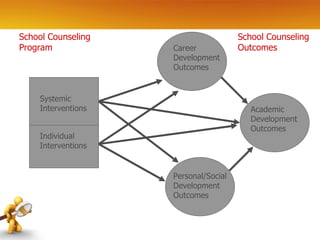
Systemic Interventions Individual Interventions Career Development Outcomes Personal/Social Development Outcomes Academic Development Outcomes School Counseling Program School Counseling Outcomes
Systemic Interventions Individual Interventions Career Development Outcomes Personal/Social Development Outcomes Academic Development Outcomes School Counseling Program School Counseling Outcomes Strong Evidence Weak Evidence
“ By aligning the School Counseling Program with district and school mission, reform initiatives and school improvement plans, professional school counselors are leaders and partners in systemic change to ensure equity and access to quality education and to promote career and personal/social development for all students .”
The Law of Parsimony If we work with We reach Individuals 1-10 Small groups 12-24 Classrooms 30-60 Teachers 100-300 School Climate 1000+
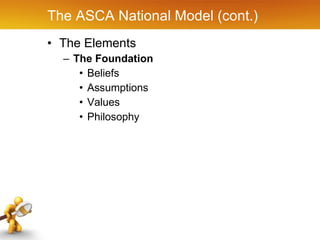
The ASCA National Model (cont.) The Elements The Foundation Beliefs Assumptions Values Philosophy
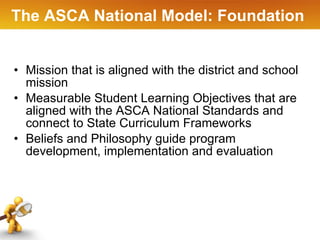
The ASCA National Model: Foundation Mission that is aligned with the district and school mission  Measurable Student Learning Objectives that are aligned with the ASCA National Standards and connect to State Curriculum Frameworks Beliefs and Philosophy guide program development, implementation and evaluation
Vision Good :  Your School’s Vision Better:  Your District’s Vision Best:  Counselor Vision for    your district Stephen Covey’s Habit#2:  Begin with the End in mind. The Cheshire Cat said: “If you don’t know where you’re going, you’ll end up somewhere else.”
Mission Example:  _________ County School Counselors will provide a school counseling program that will lead to student excellence in academic, career awareness, and social/personal development through working with students, parents, teachers, and others in the community.
The ASCA National Model The Delivery System School Guidance Curriculum Individual Student Planning Responsive Services System Support
The ASCA National Model: Delivery System Guidance Curriculum--structured developmental lessons connected with academic areas Individual Student Planning--work with students and families to help all students develop personal goals and future plans Responsive Services--meeting immediate student needs through crisis counseling, referral and follow-up System Support--activities targeted at maintaining and enhancing the educational environment and school climate
The ASCA National Model The Management System Management Agreements Advisory Council Use of Data Action Plans Use of Time Calendars
The ASCA National Model: Management System Agreements with administrations ensure effective implementation of the guidance program connection of the program to student needs connection of the program to district reform initiatives and school improvement plans. Advisory Councils of parents, students, teachers, administrators, and community members to ensure that the program initiatives are responsive to   needs.
The ASCA National Model: Management System Data-driven management Use of data to plan, monitor, evaluate, and modify interventions Use of data to document how students are different as a consequence of program Day-to day operation of the School Counseling Program is monitored and coordinated through Action Plans Audits of Time Use Use of Master Calendars
School Counselors must be proficient in:  Accessing data  Analyzing data  Interpreting data  Presenting data  School Counselors must use data to: Create urgency for change  Change attitudes, policies & practices Point out the system inequities Advocate for system change ASCA National Model: Counselors Using Data to Spur Systemic Change
Use of Time Day Planner Spiral Bound Notebook to log meetings, calls, etc. Phone Log Calendars Disseminated to the faculty, staff, parents These documents are not only to document your time (Cover your ****), but also to make people aware of your contribution
Calendar Example Guidance Lesson – Test Taking Skills 11:40 – SBARC Mtg. 12:40 - SBARC Mtg. 9:00 – Meet w/ Hardship Trfr. Students 12:40 - SBARC Mtg. 3:00 – Mtg. w/parent re: student’s retention 9:30 – A-Team Mtg. 11:30 - SBARC Mtg. 2:30 – Leadership Mtg. 7:00 – Mtg. w/Teacher and Parent 9:30 – SBARC Mtg. 12:40 - SBARC Mtg. 9:30 - SBARC Mtg. 12:40 - SBARC Mtg. 2:30 – Tardy Detention 8:00 –  29 11:00 BAC Training  - Off Campus 12:40 - SBARC Mtg. Shacklette visiting Flexible Professional Development Day – No School for Students 9:30 - SBARC Mtg. 11:30 – ECE Placement Mtg. 2:40 – Leadership Mtg. District M.S. Counseling Mtg. – Off Campus 2:30 – Faculty Mtg. 9:30 - SBARC Mtg. 12:40 - SBARC Mtg. 1:30 - SBARC Mtg. 9:30 - SBARC Mtg. 1:30 - SBARC Mtg. 2:30 – ECE Dept. Mtg. Scheduling,  Walk-Throughs, Parent Meetings, Student Counseling & Conferences, etc. 9:30 – A-Team Mtg. 8:40 - SBARC Mtg. 3:00 - SBARC Mtg. for Eisenhower 5 th  grader at Eisenhower ILP Training at eMain – Off Campus 11:30 - SBARC Mtg. Scheduling,  Walk-Throughs, Parent Meetings, Student Counseling & Conferences, etc. Guidance, Walk-Throughs Guidance, Walk-Throughs Guidance, Walk-Throughs Scheduling,  Walk-Throughs, Parent Meetings, Student Counseling & Conferences, etc. 9:30 – A-Team Mtg. w/Dr. Ledford 3:30 Paint Ball Team  outing w/staff 1 3 2 4 5 7 8 9 10 11 12 13 14 15 16 17 19 20 21 22 23 24 25 26 27 28 29 30 31 6 18
ASCA National Model: Counselors Using Data to Spur Systemic Change To describe problems, plan programs, and target interventions to help students and to change systems. To measure the outcomes of interventions and modify interventions based on results. To account annually for results to constituencies in Result Reports. To account annually for results to supervisors in school counselor performance evaluations. To periodically evaluate the performance of the school counseling program. To demonstrate the impact of school counseling on student achievement.
The ASCA National Model The Flow
The ASCA National Model: Accountability System Yearly Results Reports, including quantitative data on student change, are shared with all stakeholders. School Counselor Performance Standards are used in annual performance evaluations. Periodic Program Audit is used to ensure that the Program is targeted at the right goals and implementing interventions effectively.
RAMP Show your administrators, school board and the community at large that you're committed to delivering a comprehensive, data-driven school counseling program.  Based on the ASCA National Model, the RAMP designation:  Gives you the confidence that your program aligns with a nationally accepted and recognized model  Helps you evaluate your program and areas for improvement  Increases your skills and knowledge of school counseling  Enhances your program's efforts toward academic achievement and student success  Identifies your school as an exemplary educational environment
RAMP If your program successfully answers the question, "How are students different because of what school counselors do?" then you're ready to show the world that your program is "ramped up.” When your program achieves RAMP status, you receive: An engraved plaque Letter sent to your school board, principal and superintendent  Template press release for you to individualize and send to local press  Use of RAMP logo for your business cards, letterhead, Web site or printed materials  Recognition at ASCA's annual conference  Two tickets to the RAMP Awards Luncheon at ASCA's annual conference  Recognition in  ASCA School Counselo r magazine and on ASCA's Web site
Contact Information: Dr. Susan R. Rose (502) 468 – 1480 [email_address] www.CounselingToday.com
REFERENCES The ASCA National Model: A Framework for School Counseling Programs - Second Edition ASCA National Model Workbook

Asca national model

  • 1.
    ASCA National ModelSusan R. Rose, Ph.D. Oldham County Counselor Institute June 11, 2009
  • 2.
    What prevents mefrom embracing new ideas? I am comfortable (amid the chaos) I know this job – it is predictable I know what is expected of me I have a vision of a stable future I have a routine This is just another in a long line of new ideas, to come and go and ….
  • 3.
    We have asales job to do: We need to sell this program to our administration both at the district level and at the school level We need to sell this program to ourselves
  • 4.
    What others aresaying … “ Little evidence exists between the intended effects of counseling activities and the students’ perception of the usefulness of guidance at their schools.” - Zoe Corwin, AERA, April 2004
  • 5.
    “ What docounselors do?” The Old Question was …
  • 6.
    The New Question… “ How are students different B ECAUSE of the school counseling program?“
  • 7.
    The New EssentialQuestion: How Has Student Achievement Increased as a Result of What Counselors Do? School Counseling Programs are about RESULTS.
  • 8.
    “ The AmericanSchool Counselor Association has created the National Model for School Counseling Programs to connect school counseling with current educational reform movements that emphasize student achievement and success.” (ASCA, 2003).
  • 9.
    National Model Programs:Are focused on improving academic achievement and eliminating the achievement gap . Operate from a mission that is connect with the school district’s mission and educational reform agendas.
  • 10.
    National Model Programs:Operate from a formal set of Student Learning Objectives that are connected to National Standards aligned with State Curriculum Frameworks aligned with district standards based on measurable student learning outcomes Are data-driven and accountable for student outcomes
  • 11.
  • 12.
    The ASCA NationalModel Overview of the Model The Themes Leadership Advocacy Collaboration Systemic Change
  • 13.
    Systemic Interventions IndividualInterventions Career Development Outcomes Personal/Social Development Outcomes Academic Development Outcomes School Counseling Program School Counseling Outcomes
  • 14.
    Systemic Interventions IndividualInterventions Career Development Outcomes Personal/Social Development Outcomes Academic Development Outcomes School Counseling Program School Counseling Outcomes Strong Evidence Weak Evidence
  • 15.
    “ By aligningthe School Counseling Program with district and school mission, reform initiatives and school improvement plans, professional school counselors are leaders and partners in systemic change to ensure equity and access to quality education and to promote career and personal/social development for all students .”
  • 16.
    The Law ofParsimony If we work with We reach Individuals 1-10 Small groups 12-24 Classrooms 30-60 Teachers 100-300 School Climate 1000+
  • 17.
    The ASCA NationalModel (cont.) The Elements The Foundation Beliefs Assumptions Values Philosophy
  • 18.
    The ASCA NationalModel: Foundation Mission that is aligned with the district and school mission Measurable Student Learning Objectives that are aligned with the ASCA National Standards and connect to State Curriculum Frameworks Beliefs and Philosophy guide program development, implementation and evaluation
  • 19.
    Vision Good : Your School’s Vision Better: Your District’s Vision Best: Counselor Vision for your district Stephen Covey’s Habit#2: Begin with the End in mind. The Cheshire Cat said: “If you don’t know where you’re going, you’ll end up somewhere else.”
  • 20.
    Mission Example: _________ County School Counselors will provide a school counseling program that will lead to student excellence in academic, career awareness, and social/personal development through working with students, parents, teachers, and others in the community.
  • 21.
    The ASCA NationalModel The Delivery System School Guidance Curriculum Individual Student Planning Responsive Services System Support
  • 22.
    The ASCA NationalModel: Delivery System Guidance Curriculum--structured developmental lessons connected with academic areas Individual Student Planning--work with students and families to help all students develop personal goals and future plans Responsive Services--meeting immediate student needs through crisis counseling, referral and follow-up System Support--activities targeted at maintaining and enhancing the educational environment and school climate
  • 23.
    The ASCA NationalModel The Management System Management Agreements Advisory Council Use of Data Action Plans Use of Time Calendars
  • 24.
    The ASCA NationalModel: Management System Agreements with administrations ensure effective implementation of the guidance program connection of the program to student needs connection of the program to district reform initiatives and school improvement plans. Advisory Councils of parents, students, teachers, administrators, and community members to ensure that the program initiatives are responsive to needs.
  • 25.
    The ASCA NationalModel: Management System Data-driven management Use of data to plan, monitor, evaluate, and modify interventions Use of data to document how students are different as a consequence of program Day-to day operation of the School Counseling Program is monitored and coordinated through Action Plans Audits of Time Use Use of Master Calendars
  • 26.
    School Counselors mustbe proficient in: Accessing data Analyzing data Interpreting data Presenting data School Counselors must use data to: Create urgency for change Change attitudes, policies & practices Point out the system inequities Advocate for system change ASCA National Model: Counselors Using Data to Spur Systemic Change
  • 27.
    Use of TimeDay Planner Spiral Bound Notebook to log meetings, calls, etc. Phone Log Calendars Disseminated to the faculty, staff, parents These documents are not only to document your time (Cover your ****), but also to make people aware of your contribution
  • 28.
    Calendar Example GuidanceLesson – Test Taking Skills 11:40 – SBARC Mtg. 12:40 - SBARC Mtg. 9:00 – Meet w/ Hardship Trfr. Students 12:40 - SBARC Mtg. 3:00 – Mtg. w/parent re: student’s retention 9:30 – A-Team Mtg. 11:30 - SBARC Mtg. 2:30 – Leadership Mtg. 7:00 – Mtg. w/Teacher and Parent 9:30 – SBARC Mtg. 12:40 - SBARC Mtg. 9:30 - SBARC Mtg. 12:40 - SBARC Mtg. 2:30 – Tardy Detention 8:00 – 29 11:00 BAC Training - Off Campus 12:40 - SBARC Mtg. Shacklette visiting Flexible Professional Development Day – No School for Students 9:30 - SBARC Mtg. 11:30 – ECE Placement Mtg. 2:40 – Leadership Mtg. District M.S. Counseling Mtg. – Off Campus 2:30 – Faculty Mtg. 9:30 - SBARC Mtg. 12:40 - SBARC Mtg. 1:30 - SBARC Mtg. 9:30 - SBARC Mtg. 1:30 - SBARC Mtg. 2:30 – ECE Dept. Mtg. Scheduling, Walk-Throughs, Parent Meetings, Student Counseling & Conferences, etc. 9:30 – A-Team Mtg. 8:40 - SBARC Mtg. 3:00 - SBARC Mtg. for Eisenhower 5 th grader at Eisenhower ILP Training at eMain – Off Campus 11:30 - SBARC Mtg. Scheduling, Walk-Throughs, Parent Meetings, Student Counseling & Conferences, etc. Guidance, Walk-Throughs Guidance, Walk-Throughs Guidance, Walk-Throughs Scheduling, Walk-Throughs, Parent Meetings, Student Counseling & Conferences, etc. 9:30 – A-Team Mtg. w/Dr. Ledford 3:30 Paint Ball Team outing w/staff 1 3 2 4 5 7 8 9 10 11 12 13 14 15 16 17 19 20 21 22 23 24 25 26 27 28 29 30 31 6 18
  • 29.
    ASCA National Model:Counselors Using Data to Spur Systemic Change To describe problems, plan programs, and target interventions to help students and to change systems. To measure the outcomes of interventions and modify interventions based on results. To account annually for results to constituencies in Result Reports. To account annually for results to supervisors in school counselor performance evaluations. To periodically evaluate the performance of the school counseling program. To demonstrate the impact of school counseling on student achievement.
  • 30.
    The ASCA NationalModel The Flow
  • 31.
    The ASCA NationalModel: Accountability System Yearly Results Reports, including quantitative data on student change, are shared with all stakeholders. School Counselor Performance Standards are used in annual performance evaluations. Periodic Program Audit is used to ensure that the Program is targeted at the right goals and implementing interventions effectively.
  • 32.
    RAMP Show youradministrators, school board and the community at large that you're committed to delivering a comprehensive, data-driven school counseling program. Based on the ASCA National Model, the RAMP designation: Gives you the confidence that your program aligns with a nationally accepted and recognized model Helps you evaluate your program and areas for improvement Increases your skills and knowledge of school counseling Enhances your program's efforts toward academic achievement and student success Identifies your school as an exemplary educational environment
  • 33.
    RAMP If yourprogram successfully answers the question, "How are students different because of what school counselors do?" then you're ready to show the world that your program is "ramped up.” When your program achieves RAMP status, you receive: An engraved plaque Letter sent to your school board, principal and superintendent Template press release for you to individualize and send to local press Use of RAMP logo for your business cards, letterhead, Web site or printed materials Recognition at ASCA's annual conference Two tickets to the RAMP Awards Luncheon at ASCA's annual conference Recognition in ASCA School Counselo r magazine and on ASCA's Web site
  • 34.
    Contact Information: Dr.Susan R. Rose (502) 468 – 1480 [email_address] www.CounselingToday.com
  • 35.
    REFERENCES The ASCANational Model: A Framework for School Counseling Programs - Second Edition ASCA National Model Workbook

Editor's Notes

  • #12 SO this leads up to the ASCA National Model As you view the graphic, you will notice there are four areas FOUNDATION DELIVERY SYSTEM MANAGEMENT SYSTEM ACCOUNTABILITY The visual show that the foundation, a program’s core beliefs, philosophy and mission, dictates both how the program is management and how it is delivered. These two components go hand in hand: Delivery system is the ways in which counselors deliver services. The management system ensures that the delivery system is planned, organized, directed and controlled in a systematic fashion for every student. Both the delivery and management lead to the Accountability component. And accountability leads back to the foundation because results of our program lead to program improvement, which begins once again with the foundation.