Project Management
Logical Framework Approach (LFA)
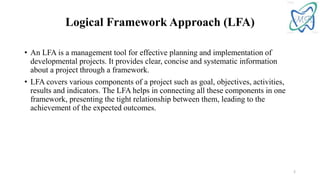
• An LFA is a management tool for effective planning and implementation of
developmental projects. It provides clear, concise and systematic information
about a project through a framework.
• LFA covers various components of a project such as goal, objectives, activities,
results and indicators. The LFA helps in connecting all these components in one
framework, presenting the tight relationship between them, leading to the
achievement of the expected outcomes.
2
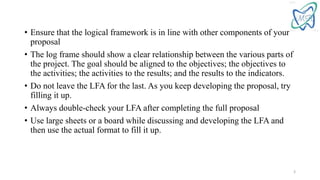
• Ensure that the logical framework is in line with other components of your
proposal
• The log frame should show a clear relationship between the various parts of
the project. The goal should be aligned to the objectives; the objectives to
the activities; the activities to the results; and the results to the indicators.
• Do not leave the LFA for the last. As you keep developing the proposal, try
filling it up.
• Always double-check your LFA after completing the full proposal
• Use large sheets or a board while discussing and developing the LFA and
then use the actual format to fill it up.
3
Goal Ultimate objective; A project goal is a very general, high-level and long-term
objective of the project. The goal cannot be achieved by the project on its
own since there will be other forces like the Government, other agencies
etc. also working to achieve it. It is a major benchmark to compare work
between different projects.
Objective Objectives are the specific objectives the project works to achieve within
the stipulated time.
Activities or
input
Activities or inputs are actions undertaken by the project or
the organization to achieve the set objectives
Output Immediate result; Outputs are immediate results that we achieve soon
after the completion the project or any specific project activity.
4
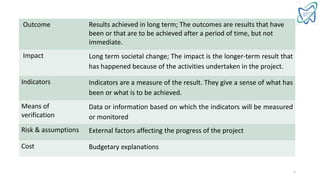
Outcome Results achieved in long term; The outcomes are results that have
been or that are to be achieved after a period of time, but not
immediate.
Impact Long term societal change; The impact is the longer-term result that
has happened because of the activities undertaken in the project.
Indicators Indicators are a measure of the result. They give a sense of what has
been or what is to be achieved.
Means of
verification
Data or information based on which the indicators will be measured
or monitored
Risk & assumptions External factors affecting the progress of the project
Cost Budgetary explanations
5
Types of results
1. Quantitative results: the results which can be measured objectively
i. Increase in income
ii. Increase/change in production capacity
2. Qualitative results: the results of which can be measured but not objectively.
i. Increase in societal behavior
ii. Increase in skills
iii. Increase in awareness
iv. Increase in self esteem
6
What is a Good Result?
• A Result should be SMART
S SPECIFIC
M MEASURABLE
A ACHIEVABLE
R REALISTIC
T TIME-BOUND
7
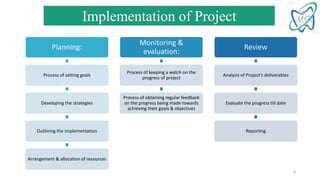
Planning:
Process of setting goals
Developing the strategies
Outlining the implementation
Arrangement & allocation of resources
Monitoring &
evaluation:
Process of keeping a watch on the
progress of project
Process of obtaining regular feedback
on the progress being made towards
achieving their goals & objectives
Review
Analysis of Project’s deliverables
Evaluate the progress till date
Reporting
Implementation of Project
8
What is Monitoring?
Monitoring is the continuous collection of data and information on specified indicators
to assess the implementation of a development intervention in relation to activity
schedules and expenditure of allocated funds, and progress and achievements in
relation to its intended outcome.
Monitoring involves following things:
• Monitoring day-to-day follow-up of activities during implementation to measure
progress and identify deviations
• Requires routine follow-up to ensure activities are proceeding as planned and are on
schedule
• Needs continuous assessment of activities and results
• Answers the question, “what are we doing?”
9
Evaluation
Evaluation is the periodic assessment of the design implementation, outcome,
and impact of a development intervention. It should assess the relevance and
achievement of the intended outcome, and implementation performance in terms
of effectiveness and efficiency, and the nature, distribution, and sustainability of
impact.
• Evaluation is a systematic way of learning from experience to improve current
activities and promote better planning for future action
• designed specifically with the intention to attribute changes to the intervention
itself
• the question, “what have we achieved and what impact have we had?”
10
Evaluation process
• Understand project, determine questions & issues, identify methodology, prepare TOR, prepare work
plan- Nature & scope of evaluation
Planning
• Gather data, prepare, analyze & formulate findings – gathering & analysis of data
Doing
• Identify major finding & make possible recommendations – proposals for action
Reporting
• Implement recommendation to modify interventions, remove barriers, inform future policy
interventions and show the way
Application
11
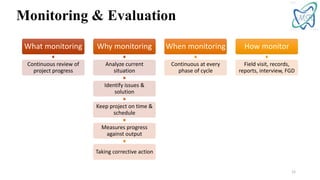
Monitoring & Evaluation
What monitoring
Continuous review of
project progress
Why monitoring
Analyze current
situation
Identify issues &
solution
Keep project on time &
schedule
Measures progress
against output
Taking corrective action
When monitoring
Continuous at every
phase of cycle
How monitor
Field visit, records,
reports, interview, FGD
12
Monitoring tools
Reporting &
Analysis
Annual project
report
Progress or
quarterly
report
Project
delivery report
Substantive
project
documentation
Validation Field visit
Spot check
visit
External
assessment
Client
surveys
Evaluations
Participation
Outcome
groups
Steering
committee
Stakeholder
meeting
Focus group
meeting
Annual
review
13
Monitoring & Evaluation indicators
• Describe the material, financial, technological, and human resources
invested in a product, service or program
Input indicators
• Describe activities carried out to achieve the desired results of an
intervention; they show what is done & how well it is done
Process indicators
• Describe the immediate result of an intervention
Output indicators
14
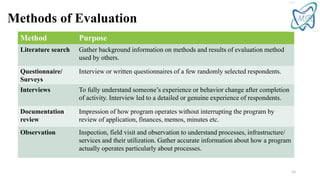
Method Purpose
Literature search Gather background information on methods and results of evaluation method
used by others.
Questionnaire/
Surveys
Interview or written questionnaires of a few randomly selected respondents.
Interviews To fully understand someone’s experience or behavior change after completion
of activity. Interview led to a detailed or genuine experience of respondents.
Documentation
review
Impression of how program operates without interrupting the program by
review of application, finances, memos, minutes etc.
Observation Inspection, field visit and observation to understand processes, infrastructure/
services and their utilization. Gather accurate information about how a program
actually operates particularly about processes.
Methods of Evaluation
15
Focus groups A focus group brings together a representative group of 8 to 10 peoples from
similar background and asked a series of questionnaire related to the task at
hand. It is also used for analysis of specific, complex problems in order to
identify attitudes and priorities in sample groups.
Case studies In-depth review of small number of selected cases to fully understand or
depict beneficiaries experiences in a program and conduct comprehensive
examination through comparison of cases.
Key informant
interviews
Interviews with persons who are knowledgeable about the community
targeted by the project.
Direct
measurement
Registration of quantifiable or classifiable data by means of an analytical
Instrument.
16
Monitoring & Evaluation report
Executive summary
Brief terms of
reference
Main findings
Conclusion &
recommendati
on
Lessons learnt
Introduction
Project
description
Purpose of
evaluation
Who
requested for
the evaluation
Terms of reference
Outline of
main tasks
Duration of
assignment
submission of
draft & final
report
The M & E team
Names of
team members
Qualification
& experience
Roles to be
played
17
Methodology
used
How M&E was
carried out – methods
& justifications
Period to be taken
for each
methodology
chosen
Limitations of
the
methodology
used
How problems
was solved &
authenticity of
the report
Main findings List findings
Collate &
process data
Analyze &
interpret
findings
Conclusion &
recommendatio
n
Major
conclusion &
justification
Recommendation to
improve the future
projects
Lesson learnt
Learning
experience
What worked well & what didn’t
worked well
Annexes Detailed terms
of reference
Brief resumes for
team members
Photos of sample
products / outcomes
18
19

Project management

  • 1.
  • 2.
    Logical Framework Approach(LFA) • An LFA is a management tool for effective planning and implementation of developmental projects. It provides clear, concise and systematic information about a project through a framework. • LFA covers various components of a project such as goal, objectives, activities, results and indicators. The LFA helps in connecting all these components in one framework, presenting the tight relationship between them, leading to the achievement of the expected outcomes. 2
  • 3.
    • Ensure thatthe logical framework is in line with other components of your proposal • The log frame should show a clear relationship between the various parts of the project. The goal should be aligned to the objectives; the objectives to the activities; the activities to the results; and the results to the indicators. • Do not leave the LFA for the last. As you keep developing the proposal, try filling it up. • Always double-check your LFA after completing the full proposal • Use large sheets or a board while discussing and developing the LFA and then use the actual format to fill it up. 3
  • 4.
    Goal Ultimate objective;A project goal is a very general, high-level and long-term objective of the project. The goal cannot be achieved by the project on its own since there will be other forces like the Government, other agencies etc. also working to achieve it. It is a major benchmark to compare work between different projects. Objective Objectives are the specific objectives the project works to achieve within the stipulated time. Activities or input Activities or inputs are actions undertaken by the project or the organization to achieve the set objectives Output Immediate result; Outputs are immediate results that we achieve soon after the completion the project or any specific project activity. 4
  • 5.
    Outcome Results achievedin long term; The outcomes are results that have been or that are to be achieved after a period of time, but not immediate. Impact Long term societal change; The impact is the longer-term result that has happened because of the activities undertaken in the project. Indicators Indicators are a measure of the result. They give a sense of what has been or what is to be achieved. Means of verification Data or information based on which the indicators will be measured or monitored Risk & assumptions External factors affecting the progress of the project Cost Budgetary explanations 5
  • 6.
    Types of results 1.Quantitative results: the results which can be measured objectively i. Increase in income ii. Increase/change in production capacity 2. Qualitative results: the results of which can be measured but not objectively. i. Increase in societal behavior ii. Increase in skills iii. Increase in awareness iv. Increase in self esteem 6
  • 7.
    What is aGood Result? • A Result should be SMART S SPECIFIC M MEASURABLE A ACHIEVABLE R REALISTIC T TIME-BOUND 7
  • 8.
    Planning: Process of settinggoals Developing the strategies Outlining the implementation Arrangement & allocation of resources Monitoring & evaluation: Process of keeping a watch on the progress of project Process of obtaining regular feedback on the progress being made towards achieving their goals & objectives Review Analysis of Project’s deliverables Evaluate the progress till date Reporting Implementation of Project 8
  • 9.
    What is Monitoring? Monitoringis the continuous collection of data and information on specified indicators to assess the implementation of a development intervention in relation to activity schedules and expenditure of allocated funds, and progress and achievements in relation to its intended outcome. Monitoring involves following things: • Monitoring day-to-day follow-up of activities during implementation to measure progress and identify deviations • Requires routine follow-up to ensure activities are proceeding as planned and are on schedule • Needs continuous assessment of activities and results • Answers the question, “what are we doing?” 9
  • 10.
    Evaluation Evaluation is theperiodic assessment of the design implementation, outcome, and impact of a development intervention. It should assess the relevance and achievement of the intended outcome, and implementation performance in terms of effectiveness and efficiency, and the nature, distribution, and sustainability of impact. • Evaluation is a systematic way of learning from experience to improve current activities and promote better planning for future action • designed specifically with the intention to attribute changes to the intervention itself • the question, “what have we achieved and what impact have we had?” 10
  • 11.
    Evaluation process • Understandproject, determine questions & issues, identify methodology, prepare TOR, prepare work plan- Nature & scope of evaluation Planning • Gather data, prepare, analyze & formulate findings – gathering & analysis of data Doing • Identify major finding & make possible recommendations – proposals for action Reporting • Implement recommendation to modify interventions, remove barriers, inform future policy interventions and show the way Application 11
  • 12.
    Monitoring & Evaluation Whatmonitoring Continuous review of project progress Why monitoring Analyze current situation Identify issues & solution Keep project on time & schedule Measures progress against output Taking corrective action When monitoring Continuous at every phase of cycle How monitor Field visit, records, reports, interview, FGD 12
  • 13.
    Monitoring tools Reporting & Analysis Annualproject report Progress or quarterly report Project delivery report Substantive project documentation Validation Field visit Spot check visit External assessment Client surveys Evaluations Participation Outcome groups Steering committee Stakeholder meeting Focus group meeting Annual review 13
  • 14.
    Monitoring & Evaluationindicators • Describe the material, financial, technological, and human resources invested in a product, service or program Input indicators • Describe activities carried out to achieve the desired results of an intervention; they show what is done & how well it is done Process indicators • Describe the immediate result of an intervention Output indicators 14
  • 15.
    Method Purpose Literature searchGather background information on methods and results of evaluation method used by others. Questionnaire/ Surveys Interview or written questionnaires of a few randomly selected respondents. Interviews To fully understand someone’s experience or behavior change after completion of activity. Interview led to a detailed or genuine experience of respondents. Documentation review Impression of how program operates without interrupting the program by review of application, finances, memos, minutes etc. Observation Inspection, field visit and observation to understand processes, infrastructure/ services and their utilization. Gather accurate information about how a program actually operates particularly about processes. Methods of Evaluation 15
  • 16.
    Focus groups Afocus group brings together a representative group of 8 to 10 peoples from similar background and asked a series of questionnaire related to the task at hand. It is also used for analysis of specific, complex problems in order to identify attitudes and priorities in sample groups. Case studies In-depth review of small number of selected cases to fully understand or depict beneficiaries experiences in a program and conduct comprehensive examination through comparison of cases. Key informant interviews Interviews with persons who are knowledgeable about the community targeted by the project. Direct measurement Registration of quantifiable or classifiable data by means of an analytical Instrument. 16
  • 17.
    Monitoring & Evaluationreport Executive summary Brief terms of reference Main findings Conclusion & recommendati on Lessons learnt Introduction Project description Purpose of evaluation Who requested for the evaluation Terms of reference Outline of main tasks Duration of assignment submission of draft & final report The M & E team Names of team members Qualification & experience Roles to be played 17
  • 18.
    Methodology used How M&E was carriedout – methods & justifications Period to be taken for each methodology chosen Limitations of the methodology used How problems was solved & authenticity of the report Main findings List findings Collate & process data Analyze & interpret findings Conclusion & recommendatio n Major conclusion & justification Recommendation to improve the future projects Lesson learnt Learning experience What worked well & what didn’t worked well Annexes Detailed terms of reference Brief resumes for team members Photos of sample products / outcomes 18
  • 19.