D I S O R D E R S O F T H O U G H T
C O N T E N T
P R E S E N T E D B Y - D R .T E S I T A S H E R R Y ( P G S T U D E
N T )
M O D E R A T O R - D R . V I N O T H
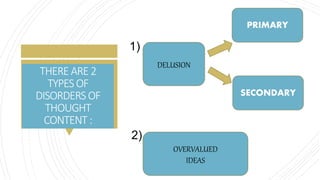
THEREARE2
TYPESOF
DISORDERSOF
THOUGHT
CONTENT :
2)
DELUSION
PRIMARY
SECONDARY
OVERVALUED
IDEAS
1)
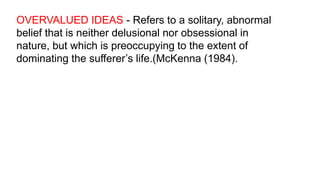
OVERVALUED IDEAS - Refers to a solitary, abnormal
belief that is neither delusional nor obsessional in
nature, but which is preoccupying to the extent of
dominating the sufferer’s life.(McKenna (1984).
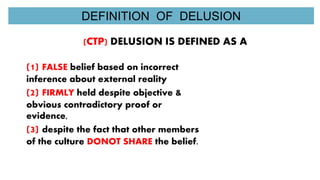
DEFINITION OF DELUSION
(CTP) DELUSION IS DEFINED AS A
(1) FALSE belief based on incorrect
inference about external reality
(2) FIRMLY held despite objective &
obvious contradictory proof or
evidence,
(3) despite the fact that other members
of the culture DONOT SHARE the belief.
A DELUSION IS A FALSE UNSHAKEABLE
BELIEF, which is out of keeping with the patient’s
social,culture,religious background or his/her level of
intelligence and it is due to internal morbid process(the
fact it is false makes it easy to recognise but this is not
its essential quality). (FISH)
A DELUSION IS A FALSE UNSHAKEABLE
BELIEF WHICH ARISES FROM INTERNAL MORBID
PROCESSES.It is easily recognisable when it is not
keeping with the person’s educational & cultural
background. (HAMILTON)
Karl Jaspers was the first to define the three main
criteria for a belief to be considered delusional in his
1913 book General Psychopathology.
These criteria are:
 Certainty (held with absolute conviction)
 Incorrigibility (not changeable by compelling counterargument
or proof to the contrary)
 Impossibility or falsity of content (implausible, bizarre or
patently untrue).
PRIMARY DELUSION - True delusions, result of
primary delusional experience ( due to faulty thinking
and self-monitoring) which cannot be deduced from
any other morbid phenomena(diagnostic of
schizophrenia but may be seen in organic disorders
like epileptic psychoses).
• Delusion is not occurring in response to
another psychopathology
SECONDARY DELUSION - Delusion-like ideas which can
be understandably derived from some other morbid
psychological phenomena;( perceptual disturbances, intense
emotions & personality disorder).
• Arising from some other morbid experience
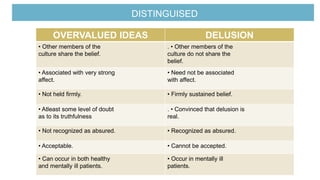
DISTINGUISED
OVERVALUED IDEAS DELUSION
• Other members of the
culture share the belief.
. • Other members of the
culture do not share the
belief.
• Associated with very strong
affect.
• Need not be associated
with affect.
• Not held firmly. • Firmly sustained belief.
• Atleast some level of doubt
as to its truthfulness
. • Convinced that delusion is
real.
• Not recognized as absured. • Recognized as absured.
• Acceptable. • Cannot be accepted.
• Can occur in both healthy
and mentally ill patients.
• Occur in mentally ill
patients.
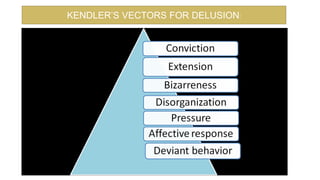
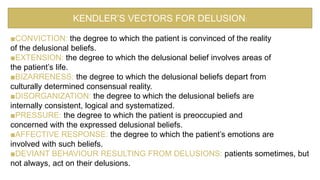
KENDLER’S VECTORS FOR DELUSION:
■CONVICTION: the degree to which the patient is convinced of the reality
of the delusional beliefs.
■EXTENSION: the degree to which the delusional belief involves areas of
the patient’s life.
■BIZARRENESS: the degree to which the delusional beliefs depart from
culturally determined consensual reality.
■DISORGANIZATION: the degree to which the delusional beliefs are
internally consistent, logical and systematized.
■PRESSURE: the degree to which the patient is preoccupied and
concerned with the expressed delusional beliefs.
■AFFECTIVE RESPONSE: the degree to which the patient’s emotions are
involved with such beliefs.
■DEVIANT BEHAVIOUR RESULTING FROM DELUSIONS: patients sometimes, but
not always, act on their delusions.
KENDLER’S VECTORS FOR DELUSION:
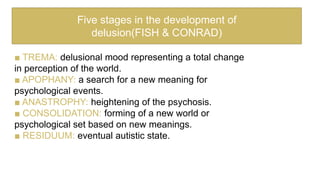
■ TREMA: delusional mood representing a total change
in perception of the world.
■ APOPHANY: a search for a new meaning for
psychological events.
■ ANASTROPHY: heightening of the psychosis.
■ CONSOLIDATION: forming of a new world or
psychological set based on new meanings.
■ RESIDUUM: eventual autistic state.
Five stages in the development of
delusion(FISH & CONRAD)
(1)Disorders of brain functioning.
(2) Background influences of temperament
& personality.
(3) Maintenance of self-esteem.
(4) role of affect.
(5) As a response to perceptual disturbances.
(6) As a response to depersonalisation.
(7) Associated with cognitive overload.
FACTORS CONCERNED WITH
GENERATION OF DELUSIONS
1. The inertia of changing ideas and the need for
consistency
2. Poverty of interpersonal communication
3. Aggressive behavior resulting from persecutory
delusions provokes hostility
4. Delusions impair respect for and competence of
the sufferer and promote compensatory delusional
interpretation.
None of these factors are absolute but any or all may act
synergistically to initiate and maintain delusion
Factors concerned in the maintenance of delusions:
• Uncertain and may differ from one disorder to another.
• Dysfunction of prefrontal and temporal lobes 1
and the basal ganglia 2 has
been suggested.
• Dysregulation of Dopamine.
• Endocannabinoid and adenosine systems may be involved.3
1.(Leposavic et al,2009)
2,3. (Morrison and murray,2009)
PATHOPHYSIOLOGY OF DELUSIONS
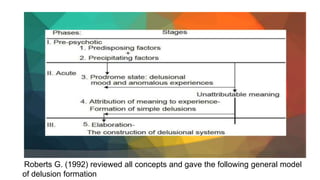
Roberts G. (1992) reviewed all concepts and gave the following general model
of delusion formation
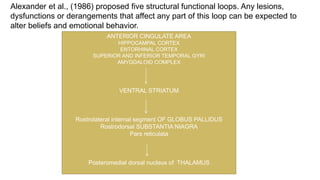
Alexander et al., (1986) proposed five structural functional loops. Any lesions,
dysfunctions or derangements that affect any part of this loop can be expected to
alter beliefs and emotional behavior.
ANTERIOR CINGULATE AREA
HIPPOCAMPAL CORTEX
ENTORHINAL CORTEX
SUPERIOR AND INFERIOR TEMPORAL GYRI
AMYGDALOID COMPLEX
VENTRAL STRIATUM
Rostrolateral internal segment OF GLOBUS PALLIDUS
Rostrodorsal SUBSTANTIA NIAGRA
Pars reticulata
Posteromedial dorsal nucleus of THALAMUS
PRIMARY DELUSIONS
1.Autochthonous delusion (delusional intuition)
2.Delusional percept
3.Delusional atmosphere
4.Delusional memory
1.Autochthonous delusion (delusional intuition)
• These are delusions that appear to arise suddenly
‘out of the blue’.
• It suddenly appears fully formed in patient’s mind.
• Diagnostic of schizophrenia only if they are BIZARRE
• They can occur in normal individuals secondary to mood &
personality disorder.
2.Delusional percept-(APOPHANOUS)
This is present when the patient receives a normal perception that is
then interpreted with delusional meaning.
It is a first rank symptom of schizophrenia.
EXAMPLE:
A woman said, ‘every night blood is being injected out of my arms.
When asked for her evidence, she explained that
she had little brown spots on her arms and therefore knew
that she was being injected. The interviewer looked at the
spots on her arms, rolled up his sleeve and showed her spots
identical in appearance on his own arm. He said that they had
been on his arm as long as he could remember and were
called ‘freckles’. She agreed that both sets of spots looked
similar and accepted his explanation of his own spots, but she
still insisted that her freckles proved that she was being
injected in her sleep. This was a delusional percept.
In this state patient has the knowledge that there is
something going on around him which concerns him,
but he does not know what it is.
3.Delusional atmosphere(DELUSIONAL MOOD)
delusional memory is the delusional interpretation of a normal
memory. These are sometimes called retrospective delusions. An
event that occurred in the past is explained in a delusional way.
4.Delusional memory
EXAMPLE:
A man aged 50 whose mental illness had lasted for about
two years claimed that his health had been permanently
affected since the age of 16, when he had had ‘an operation
to remove his appendix’. He now believed that the operation
had been an excuse to ‘implant a golden convolvulus’ in his
bowels.
SECONDARY DELUSIONS
Can be understood as arising from some other morbid experience-
1) Projection: projection occurs in the non-psychotic some other
explanation is necessary to account for the excessive projection
which occurs in delusions, particularly those of persecution.
2) Latent homosexuality (Freud): the different ways in which this is
denied gave rise to delusions of persecution, erotomania, jealousy
and grandeur.
3) Depressive moods
4) Hallucinations
5) Psychogenic reaction : In abnormally suspicious personalities.
6) Sensitive personalities
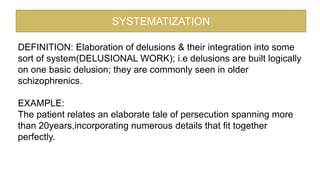
DEFINITION: Elaboration of delusions & their integration into some
sort of system(DELUSIONAL WORK); i.e delusions are built logically
on one basic delusion; they are commonly seen in older
schizophrenics.
EXAMPLE:
The patient relates an elaborate tale of persecution spanning more
than 20years,incorporating numerous details that fit together
perfectly.
SYSTEMATIZATION
DELUSIONS ON THE BASIS OF
CONTENT OF DELUSIONS
(1) DELUSIONS OF PERSECUTION
(2) DELUSIONS OF JEALOUSY
(3) DELUSIONS OF LOVE
(4) GRANDIOSE DELUSIONS
(5) DELUSIONS OF ILL HEALTH
(6) DELUSIONS OF GUILT
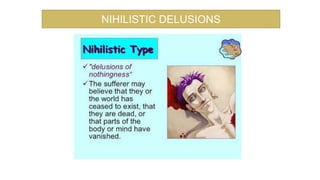
(7) NIHILISTIC DELUSIONS
(8) DELUSIONS OF POVERTY
DELUSIONS OF PERSECUTION
DELUSIONS OF JEALOUSY
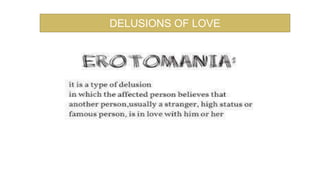
DELUSIONS OF LOVE
GRANDIOSE DELUSIONS
DELUSIONS OF ILL HEALTH
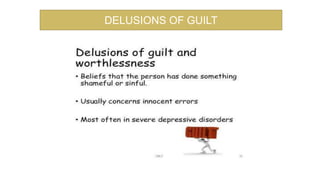
DELUSIONS OF GUILT
NIHILISTIC DELUSIONS
DELUSIONS OF POVERTY
• The capgras syndrome– familiar person is
been replaced by stranger(exact double)
• Syndrome of Fregoli- stranger is familiar
• Syndrome of intermetamorphosis- others undergo radical
changes in physical and psychological identity, culminating in a
different person altogether.
NAMED DELUSIONS
• Syndrome of subjective doubles- another person is physically
transformed to his own self.
• Ekbom syndrome- patient believes that he is
infested with small but macroscopic
organisms.
• Cotard’s syndrome- typically seen in psychotic
depression usually in elderly.
• De Clerambault Syndrome- delusion of love.
• Shared delusion – communicated insanity,
Folie a deux, Folie a Communique.
Once a simple delusional belief is adopted with conviction, the subsequent
course is very variable.
• Some patients have fleeting or brief delusional states, spontaneously
remitting and returning to normal.
• Others respond well to standard treatment.
• Others elaborate and develop their belief into a
comprehensive system which may remain unaltered
even with regular medication
RESOLUTION OF DELUSION
• Encapsulation: Patients vary very much in the degree to which they can
maintain their original personality and adapt to a normal life. It is frequently
seen in residual states.
• In some cases one sees a longitudinal splitting as it were in the current of life,
both the reality adapted and the delusional life go on alongside each other.
• On certain occasions (e.g. Meeting certain people, return to familiar locations,
meeting the doctor who had treated the patient) the delusional complex comes
to the surface and florid symptoms reappear.
PATTERN OF RESOLUTION
THANK YOU

Disorders of thought content

  • 1.
    D I SO R D E R S O F T H O U G H T C O N T E N T P R E S E N T E D B Y - D R .T E S I T A S H E R R Y ( P G S T U D E N T ) M O D E R A T O R - D R . V I N O T H
  • 2.
  • 3.
    OVERVALUED IDEAS -Refers to a solitary, abnormal belief that is neither delusional nor obsessional in nature, but which is preoccupying to the extent of dominating the sufferer’s life.(McKenna (1984).
  • 4.
    DEFINITION OF DELUSION (CTP)DELUSION IS DEFINED AS A (1) FALSE belief based on incorrect inference about external reality (2) FIRMLY held despite objective & obvious contradictory proof or evidence, (3) despite the fact that other members of the culture DONOT SHARE the belief.
  • 5.
    A DELUSION ISA FALSE UNSHAKEABLE BELIEF, which is out of keeping with the patient’s social,culture,religious background or his/her level of intelligence and it is due to internal morbid process(the fact it is false makes it easy to recognise but this is not its essential quality). (FISH) A DELUSION IS A FALSE UNSHAKEABLE BELIEF WHICH ARISES FROM INTERNAL MORBID PROCESSES.It is easily recognisable when it is not keeping with the person’s educational & cultural background. (HAMILTON)
  • 6.
    Karl Jaspers wasthe first to define the three main criteria for a belief to be considered delusional in his 1913 book General Psychopathology. These criteria are:  Certainty (held with absolute conviction)  Incorrigibility (not changeable by compelling counterargument or proof to the contrary)  Impossibility or falsity of content (implausible, bizarre or patently untrue).
  • 7.
    PRIMARY DELUSION -True delusions, result of primary delusional experience ( due to faulty thinking and self-monitoring) which cannot be deduced from any other morbid phenomena(diagnostic of schizophrenia but may be seen in organic disorders like epileptic psychoses). • Delusion is not occurring in response to another psychopathology
  • 8.
    SECONDARY DELUSION -Delusion-like ideas which can be understandably derived from some other morbid psychological phenomena;( perceptual disturbances, intense emotions & personality disorder). • Arising from some other morbid experience
  • 9.
    DISTINGUISED OVERVALUED IDEAS DELUSION •Other members of the culture share the belief. . • Other members of the culture do not share the belief. • Associated with very strong affect. • Need not be associated with affect. • Not held firmly. • Firmly sustained belief. • Atleast some level of doubt as to its truthfulness . • Convinced that delusion is real. • Not recognized as absured. • Recognized as absured. • Acceptable. • Cannot be accepted. • Can occur in both healthy and mentally ill patients. • Occur in mentally ill patients.
  • 10.
  • 11.
    ■CONVICTION: the degreeto which the patient is convinced of the reality of the delusional beliefs. ■EXTENSION: the degree to which the delusional belief involves areas of the patient’s life. ■BIZARRENESS: the degree to which the delusional beliefs depart from culturally determined consensual reality. ■DISORGANIZATION: the degree to which the delusional beliefs are internally consistent, logical and systematized. ■PRESSURE: the degree to which the patient is preoccupied and concerned with the expressed delusional beliefs. ■AFFECTIVE RESPONSE: the degree to which the patient’s emotions are involved with such beliefs. ■DEVIANT BEHAVIOUR RESULTING FROM DELUSIONS: patients sometimes, but not always, act on their delusions. KENDLER’S VECTORS FOR DELUSION:
  • 12.
    ■ TREMA: delusionalmood representing a total change in perception of the world. ■ APOPHANY: a search for a new meaning for psychological events. ■ ANASTROPHY: heightening of the psychosis. ■ CONSOLIDATION: forming of a new world or psychological set based on new meanings. ■ RESIDUUM: eventual autistic state. Five stages in the development of delusion(FISH & CONRAD)
  • 13.
    (1)Disorders of brainfunctioning. (2) Background influences of temperament & personality. (3) Maintenance of self-esteem. (4) role of affect. (5) As a response to perceptual disturbances. (6) As a response to depersonalisation. (7) Associated with cognitive overload. FACTORS CONCERNED WITH GENERATION OF DELUSIONS
  • 14.
    1. The inertiaof changing ideas and the need for consistency 2. Poverty of interpersonal communication 3. Aggressive behavior resulting from persecutory delusions provokes hostility 4. Delusions impair respect for and competence of the sufferer and promote compensatory delusional interpretation. None of these factors are absolute but any or all may act synergistically to initiate and maintain delusion Factors concerned in the maintenance of delusions:
  • 15.
    • Uncertain andmay differ from one disorder to another. • Dysfunction of prefrontal and temporal lobes 1 and the basal ganglia 2 has been suggested. • Dysregulation of Dopamine. • Endocannabinoid and adenosine systems may be involved.3 1.(Leposavic et al,2009) 2,3. (Morrison and murray,2009) PATHOPHYSIOLOGY OF DELUSIONS
  • 16.
    Roberts G. (1992)reviewed all concepts and gave the following general model of delusion formation
  • 17.
    Alexander et al.,(1986) proposed five structural functional loops. Any lesions, dysfunctions or derangements that affect any part of this loop can be expected to alter beliefs and emotional behavior. ANTERIOR CINGULATE AREA HIPPOCAMPAL CORTEX ENTORHINAL CORTEX SUPERIOR AND INFERIOR TEMPORAL GYRI AMYGDALOID COMPLEX VENTRAL STRIATUM Rostrolateral internal segment OF GLOBUS PALLIDUS Rostrodorsal SUBSTANTIA NIAGRA Pars reticulata Posteromedial dorsal nucleus of THALAMUS

  • 18.
    PRIMARY DELUSIONS 1.Autochthonous delusion(delusional intuition) 2.Delusional percept 3.Delusional atmosphere 4.Delusional memory
  • 19.
    1.Autochthonous delusion (delusionalintuition) • These are delusions that appear to arise suddenly ‘out of the blue’. • It suddenly appears fully formed in patient’s mind. • Diagnostic of schizophrenia only if they are BIZARRE • They can occur in normal individuals secondary to mood & personality disorder.
  • 20.
    2.Delusional percept-(APOPHANOUS) This ispresent when the patient receives a normal perception that is then interpreted with delusional meaning. It is a first rank symptom of schizophrenia.
  • 21.
    EXAMPLE: A woman said,‘every night blood is being injected out of my arms. When asked for her evidence, she explained that she had little brown spots on her arms and therefore knew that she was being injected. The interviewer looked at the spots on her arms, rolled up his sleeve and showed her spots identical in appearance on his own arm. He said that they had been on his arm as long as he could remember and were called ‘freckles’. She agreed that both sets of spots looked similar and accepted his explanation of his own spots, but she still insisted that her freckles proved that she was being injected in her sleep. This was a delusional percept.
  • 22.
    In this statepatient has the knowledge that there is something going on around him which concerns him, but he does not know what it is. 3.Delusional atmosphere(DELUSIONAL MOOD)
  • 23.
    delusional memory isthe delusional interpretation of a normal memory. These are sometimes called retrospective delusions. An event that occurred in the past is explained in a delusional way. 4.Delusional memory
  • 24.
    EXAMPLE: A man aged50 whose mental illness had lasted for about two years claimed that his health had been permanently affected since the age of 16, when he had had ‘an operation to remove his appendix’. He now believed that the operation had been an excuse to ‘implant a golden convolvulus’ in his bowels.
  • 25.
    SECONDARY DELUSIONS Can beunderstood as arising from some other morbid experience- 1) Projection: projection occurs in the non-psychotic some other explanation is necessary to account for the excessive projection which occurs in delusions, particularly those of persecution. 2) Latent homosexuality (Freud): the different ways in which this is denied gave rise to delusions of persecution, erotomania, jealousy and grandeur. 3) Depressive moods 4) Hallucinations 5) Psychogenic reaction : In abnormally suspicious personalities. 6) Sensitive personalities
  • 26.
    DEFINITION: Elaboration ofdelusions & their integration into some sort of system(DELUSIONAL WORK); i.e delusions are built logically on one basic delusion; they are commonly seen in older schizophrenics. EXAMPLE: The patient relates an elaborate tale of persecution spanning more than 20years,incorporating numerous details that fit together perfectly. SYSTEMATIZATION
  • 27.
    DELUSIONS ON THEBASIS OF CONTENT OF DELUSIONS (1) DELUSIONS OF PERSECUTION (2) DELUSIONS OF JEALOUSY (3) DELUSIONS OF LOVE (4) GRANDIOSE DELUSIONS (5) DELUSIONS OF ILL HEALTH (6) DELUSIONS OF GUILT (7) NIHILISTIC DELUSIONS (8) DELUSIONS OF POVERTY
  • 28.
  • 29.
  • 30.
  • 31.
  • 32.
  • 33.
  • 34.
  • 35.
  • 36.
    • The capgrassyndrome– familiar person is been replaced by stranger(exact double) • Syndrome of Fregoli- stranger is familiar • Syndrome of intermetamorphosis- others undergo radical changes in physical and psychological identity, culminating in a different person altogether. NAMED DELUSIONS
  • 37.
    • Syndrome ofsubjective doubles- another person is physically transformed to his own self. • Ekbom syndrome- patient believes that he is infested with small but macroscopic organisms. • Cotard’s syndrome- typically seen in psychotic depression usually in elderly. • De Clerambault Syndrome- delusion of love. • Shared delusion – communicated insanity, Folie a deux, Folie a Communique.
  • 38.
    Once a simpledelusional belief is adopted with conviction, the subsequent course is very variable. • Some patients have fleeting or brief delusional states, spontaneously remitting and returning to normal. • Others respond well to standard treatment. • Others elaborate and develop their belief into a comprehensive system which may remain unaltered even with regular medication RESOLUTION OF DELUSION
  • 39.
    • Encapsulation: Patientsvary very much in the degree to which they can maintain their original personality and adapt to a normal life. It is frequently seen in residual states. • In some cases one sees a longitudinal splitting as it were in the current of life, both the reality adapted and the delusional life go on alongside each other. • On certain occasions (e.g. Meeting certain people, return to familiar locations, meeting the doctor who had treated the patient) the delusional complex comes to the surface and florid symptoms reappear. PATTERN OF RESOLUTION
  • 40.