Presented by:
Kaustubh S. Garud
Roll No. 503006
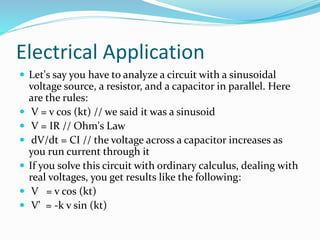
Electrical Application
 Let's say you have to analyze a circuit with a sinusoidal
voltage source, a resistor, and a capacitor in parallel. Here
are the rules:
 V = v cos (kt) // we said it was a sinusoid
 V = IR // Ohm's Law
 dV/dt = CI // the voltage across a capacitor increases as
you run current through it
 If you solve this circuit with ordinary calculus, dealing with
real voltages, you get results like the following:
 V = v cos (kt)
 V' = -k v sin (kt)
 V = v cos (kt) + iv sin (kt)
 Let's do similar calculus now:
 V' = - kv sin (kt) + i kv cos (kt)
 Looks even uglier, right? Well, let's rearrange V' a bit:
 V' = -kv sin (kt) + i kv cos(kt)
= ik v cos(kt) - kv sin (kt) // switched terms
= (ik) [ v cos (kt) + iv sin (kt) ] // algebra I factoring
= (ik) V
 So, now to take the derivative of V, we just multiply by (ik)!
 Now, here's where things get strange. We had
 dV/dt = CI
 But now, for our half-real/half-imaginary sinusoid, we
know that V' = (ik) V. So, now, our capacitor works like this:
 (ik) V = CI
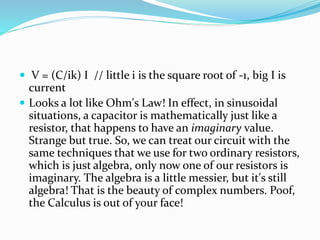
 V = (C/ik) I // little i is the square root of -1, big I is
current
 Looks a lot like Ohm's Law! In effect, in sinusoidal
situations, a capacitor is mathematically just like a
resistor, that happens to have an imaginary value.
Strange but true. So, we can treat our circuit with the
same techniques that we use for two ordinary resistors,
which is just algebra, only now one of our resistors is
imaginary. The algebra is a little messier, but it's still
algebra! That is the beauty of complex numbers. Poof,
the Calculus is out of your face!
Quaternions
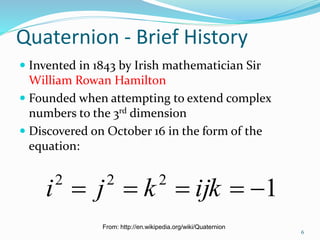
Quaternion - Brief History
 Invented in 1843 by Irish mathematician Sir
William Rowan Hamilton
 Founded when attempting to extend complex
numbers to the 3rd dimension
 Discovered on October 16 in the form of the
equation:
1222
 ijkkji
6
From: http://en.wikipedia.org/wiki/Quaternion
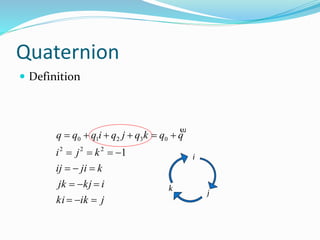
Quaternion
 Definition
jikki
ikjjk
kjiij
kji
qqkqjqiqqq





1222
03210

i
j
k
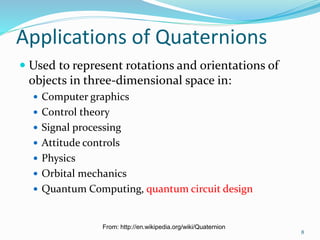
Applications of Quaternions
 Used to represent rotations and orientations of
objects in three-dimensional space in:
 Computer graphics
 Control theory
 Signal processing
 Attitude controls
 Physics
 Orbital mechanics
 Quantum Computing, quantum circuit design
8
From: http://en.wikipedia.org/wiki/Quaternion
Advantages of Quaternions
 Avoids Gimbal Lock
 Faster multiplication algorithms to combine successive
rotations than using rotation matrices
 Easier to normalize than rotation matrices
 Interpolation
 Mathematically stable – suitable for statistics
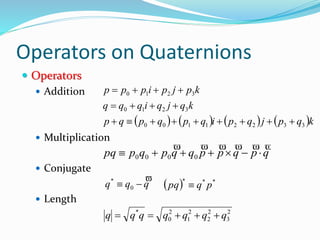
 Operators
 Addition
 Multiplication
 Conjugate
 Length
       kqpjqpiqpqpqp
kqjqiqqq
kpjpippp
33221100
3210
3210



qpqppqqpqppq

 0000
qqq

 0
*
  ***
pqpq 
2
3
2
2
2
1
2
0
*
qqqqqqq 
Operators on Quaternions
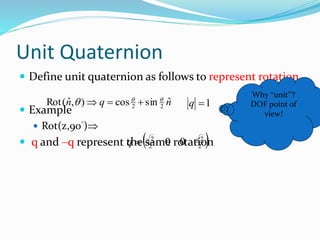
 Define unit quaternion as follows to represent rotation
 Example
 Rot(z,90°)
 q and –q represent the same rotation
nqn ˆsincos),ˆ(Rot 22

  1q
 2
2
2
2
00q
Why “unit”?
DOF point of
view!
Unit Quaternion
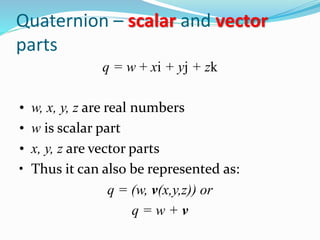
q = w + xi + yj + zk
• w, x, y, z are real numbers
• w is scalar part
• x, y, z are vector parts
• Thus it can also be represented as:
q = (w, v(x,y,z)) or
q = w + v
Quaternion – scalar and vector
parts
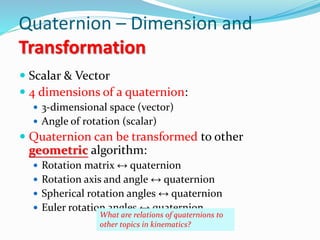
 Scalar & Vector
 4 dimensions of a quaternion:
 3-dimensional space (vector)
 Angle of rotation (scalar)
 Quaternion can be transformed to other
geometric algorithm:
 Rotation matrix ↔ quaternion
 Rotation axis and angle ↔ quaternion
 Spherical rotation angles ↔ quaternion
 Euler rotation angles ↔ quaternion
What are relations of quaternions to
other topics in kinematics?
Quaternion – Dimension and
Transformation
Details of Quaternion
Operations
Quaternion Operations
 Addition/subtraction
 Multiplication
 Division
 Conjugate
 Magnitude
 Normalization
 Transformations
 Concatenation
Quaternion Operations
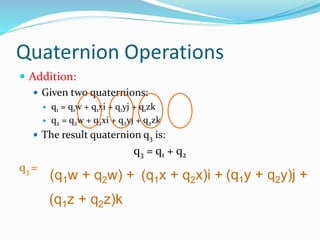
 Addition:
 Given two quaternions:
 q1 = q1w + q1xi + q1yj + q1zk
 q2 = q2w + q2xi + q2yj + q2zk
 The result quaternion q3 is:
q3 = q1 + q2
q3 =
(q1w + q2w) + (q1x + q2x)i + (q1y + q2y)j +
(q1z + q2z)k
Quaternion Operations
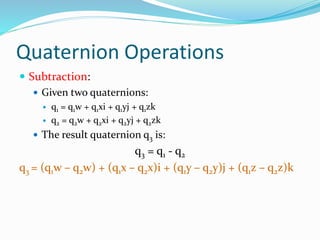
 Subtraction:
 Given two quaternions:
 q1 = q1w + q1xi + q1yj + q1zk
 q2 = q2w + q2xi + q2yj + q2zk
 The result quaternion q3 is:
q3 = q1 - q2
q3 = (q1w – q2w) + (q1x – q2x)i + (q1y – q2y)j + (q1z – q2z)k
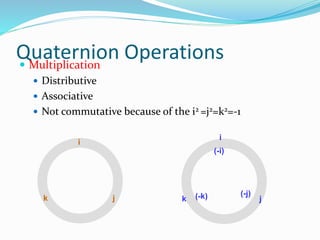
Quaternion Operations Multiplication
 Distributive
 Associative
 Not commutative because of the i2 =j2=k2=-1
i
jk
i
jk (-k) (-j)
(-i)
Quaternion Operations
 Multiplication
 Given two quaternions:
 q1 = q1w + q1xi + q1yj + q1zk
 q2 = q2w + q2xi + q2yj + q2zk
 The result quaternion q3 is:
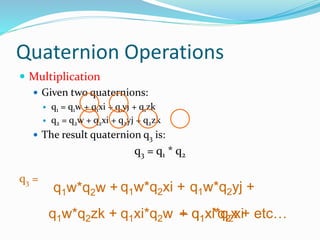
q3 = q1 * q2
q3 =
q1w*q2w + q1w*q2xi + q1w*q2yj +
q1w*q2zk + q1xi*q2w + q1xi*q2xi– q1x*q2x + etc…
Quaternion Operations
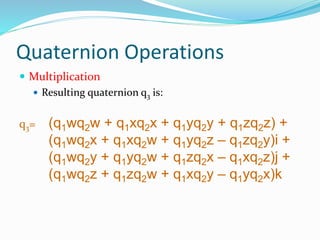
 Multiplication
 Resulting quaternion q3 is:
q3= (q1wq2w + q1xq2x + q1yq2y + q1zq2z) +
(q1wq2x + q1xq2w + q1yq2z – q1zq2y)i +
(q1wq2y + q1yq2w + q1zq2x – q1xq2z)j +
(q1wq2z + q1zq2w + q1xq2y – q1yq2x)k
Quaternion Operations Multiplication
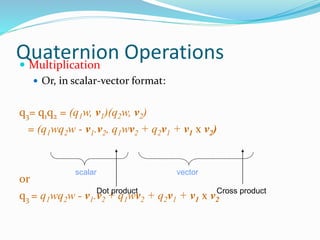
 Or, in scalar-vector format:
q3= q1q2 = (q1w, v1)(q2w, v2)
= (q1wq2w - v1.v2, q1wv2 + q2v1 + v1 x v2)
or
q3 = q1wq2w - v1.v2 + q1wv2 + q2v1 + v1 x v2
Dot product Cross product
scalar vector
Quaternion Operations
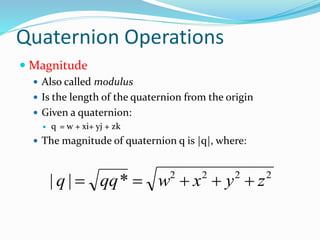
 Magnitude
 Also called modulus
 Is the length of the quaternion from the origin
 Given a quaternion:
 q = w + xi+ yj + zk
 The magnitude of quaternion q is |q|, where:
2222
*|| zyxwqqq 
Quaternion Operations
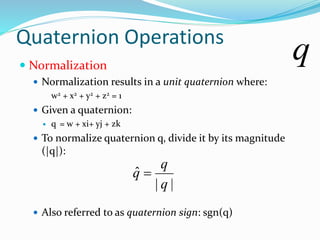
 Normalization
 Normalization results in a unit quaternion where:
w2 + x2 + y2 + z2 = 1
 Given a quaternion:
 q = w + xi+ yj + zk
 To normalize quaternion q, divide it by its magnitude
(|q|):
 Also referred to as quaternion sign: sgn(q)
q
||
ˆ
q
q
q 
Quaternion Operations
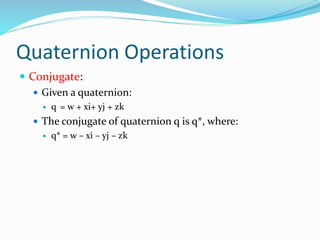
 Conjugate:
 Given a quaternion:
 q = w + xi+ yj + zk
 The conjugate of quaternion q is q*, where:
 q* = w – xi – yj – zk
Quaternion Operations
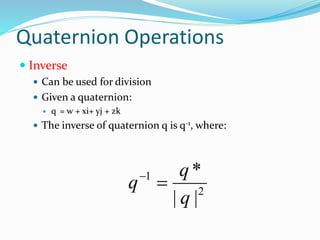
 Inverse
 Can be used for division
 Given a quaternion:
 q = w + xi+ yj + zk
 The inverse of quaternion q is q-1, where:
2
1
||
*
q
q
q 
Quaternion Rotations
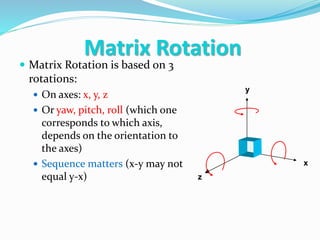
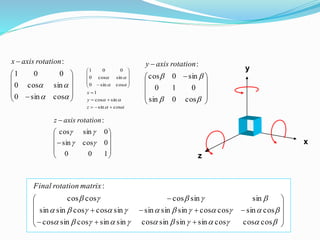
 Matrix Rotation is based on 3
rotations:
 On axes: x, y, z
 Or yaw, pitch, roll (which one
corresponds to which axis,
depends on the orientation to
the axes)
 Sequence matters (x-y may not
equal y-x)
x
y
z
Matrix Rotation




cossin
sincos
1
cossin0
sincos0
001














z
y
x













cossin0
sincos0
001
:rotationaxisx









 



cos0sin
010
sin0cos
:rotationaxisy












100
0cossin
0sincos
:


rotationaxisz
x
y
z
















coscoscossinsinsincossinsincossincos
cossincoscossinsinsinsincoscossinsin
sinsincoscoscos
:matrixrotationFinal
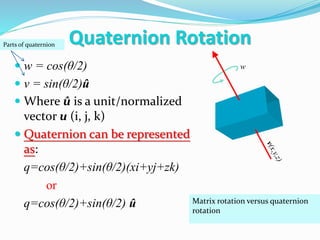
 w = cos(θ/2)
 v = sin(θ/2)û
 Where û is a unit/normalized
vector u (i, j, k)
 Quaternion can be represented
as:
q=cos(θ/2)+sin(θ/2)(xi+yj+zk)
or
q=cos(θ/2)+sin(θ/2) û
w
Parts of quaternion
Matrix rotation versus quaternion
rotation
Quaternion Rotation
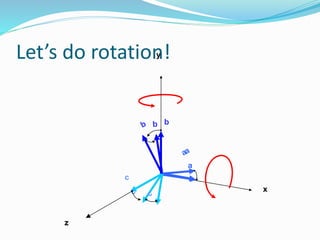
Let’s do rotation!
x
y
z
Let’s do rotation!
x
y
z
b
a
c
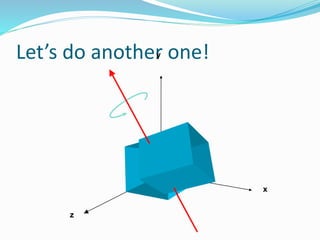
Let’s do another one!
x
y
z
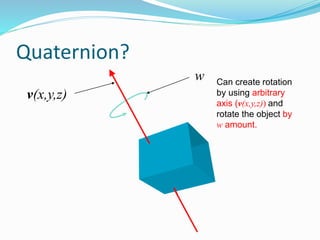
Quaternion?
v(x,y,z)
w Can create rotation
by using arbitrary
axis (v(x,y,z)) and
rotate the object by
w amount.
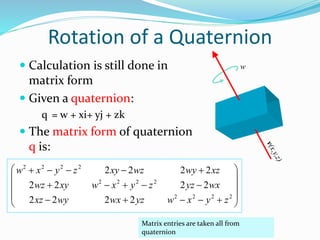
 Calculation is still done in
matrix form
 Given a quaternion:
q = w + xi+ yj + zk
 The matrix form of quaternion
q is:
w













2222
2222
2222
2222
2222
2222
zyxwyzwxwyxz
wxyzzyxwxywz
xzwywzxyzyxw
Matrix entries are taken all from
quaternion
Rotation of a Quaternion
Quaternion Rotation
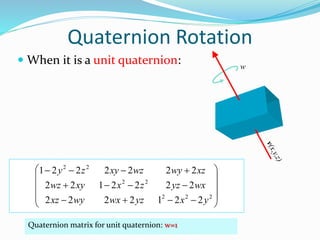
 When it is a unit quaternion: w













222
22
22
2212222
2222122
2222221
yxyzwxwyxz
wxyzzxxywz
xzwywzxyzy
Quaternion matrix for unit quaternion: w=1
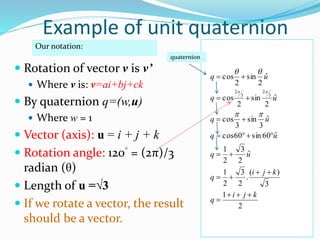
 Rotation of vector v is v’
 Where v is: v=ai+bj+ck
 By quaternion q=(w,u)
 Where w = 1
 Vector (axis): u = i + j + k
 Rotation angle: 120° = (2π)/3
radian (θ)
 Length of u =√3
 If we rotate a vector, the result
should be a vector.
2
1
3
)(
.
2
3
2
1
ˆ
2
3
2
1
ˆ60sin60cos
ˆ
3
sin
3
cos
ˆ
2
sin
2
cos
ˆ
2
sin
2
cos
3
2
3
2
kji
q
kji
q
uq
uq
uq
uq
uq












Our notation:
quaternion
Example of unit quaternion
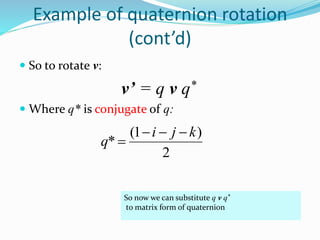
 So to rotate v:
v’ = q v q*
 Where q* is conjugate of q:
2
)1(
*
kji
q


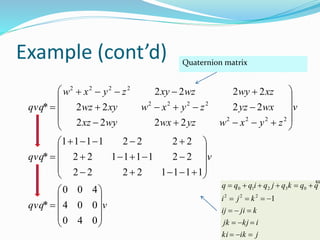
So now we can substitute q v q*
to matrix form of quaternion
Example of quaternion rotation
(cont’d)
Example (cont’d)
vqvq
vqvq
v
zyxwyzwxwyxz
wxyzzyxwxywz
xzwywzxyzyxw
qvq







































040
004
400
*
11112222
22111122
22221111
*
2222
2222
2222
*
2222
2222
2222
Quaternion matrix
jikki
ikjjk
kjiij
kji
qqkqjqiqqq





1222
03210


application of complex numbers