IS THE FOUNDATION
ANTIBIOTICS – NOT A
SUBSTITUTE
Definition
 Asepsis is the state of being free from
disease-causing contaminants (such as
bacteria, viruses, fungi, and parasites) or,
preventing contact with microorganisms.
 The term asepsis often refers to those
practices used to promote or induce asepsis
in an operative field in surgery or medicine
to prevent infection.
ASEPSIS
Medical Surgical
any practice that
helps reduce the
number and spread
of microorganisms.
the complete
removal of
microorganisms and
their spores from the
surface of an object
Source of
infectious
organisms
Exogenous Endogenous
 Operating
room(air)
 Surgical
instruments
 Surgical
team
• Patient’s
resident
flora
• MOST
IMPORTA
NT
SOURCE
CHAIN OF
INFECTION
Surgical asepsis
involves proper
preparation of
Facilities &
environment
Surgical site
Surgixcal
equipment
Surgical
team
Surgical asepsis
Interrupting at the
level of casuative
organism & reservoir
Interrupting at the level
of portal of exit & entry
 Hand washing
 Patient skin
preparation
 Disinfectants on
objeects
 Sterilisation of
instruments &
drapes
 Proper attire
 Gloves, gown,
mask, surgical
drapes
During the procedure
 The following precautions must be taken by the
scrub practitioner:
 The sterile field should be constantly observed
and not left unattended at any time
 Conversation should be kept to a minimum in the
surgical area
 The number of personnel in the theatre and
around the surgical field should be limited
 Movement around the sterile field, including the
opening and closing of doors should be kept to a
minimum
 Non-perforating devices should be used to secure
equipment to the sterile field
 Non-sterile equipment should be covered
with sterile barriers before placing them in or
over the sterile field
 Scrub staff should remain should remain close
to the sterile field
 When changing positions scrub staff should
pass back-to-back or face-to-face
 Scrubbed staff should avoid changing levels,
ie sitting and standing
 A wide space should be observed between
scrubbed staff and non-scrubbed staff
 The level of the surgical field is established by
the level of the surgical site
 The following precautions must be taken by unsterile
staff:
 Unsterile staff should face the sterile field on
approach
 Unsterile staff should not touch or lean over the
sterile field
 Unsterile staff should not walk between two
components of the sterile field
 If extra items are required to be added to the sterile
field the packaging must be inspected to ensure that:
 It is the required item.
 The package integrity has been maintained.
 The sterilisation indicator is present.
 It has not exceeded its expiry date.
 The packaging is not wet
 Removal of microorganisms and their spores
must be complete, or the article is not sterile.
 Disinfection
 To remove as many micoorganisms as possible
from a surface by physical or chemical means.
 Articles or surfaces that cannot be sterilized in the
OR or special procedure room must be disinfected.
Proper hand washing
Opening sterile pack
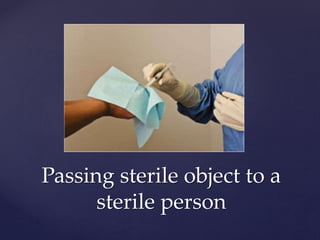
Passing sterile object to a
sterile person
Putting an object in the
sterile field
Transferring a sterile
object
Draping for Sterile
Procedure
Removing and
Reapplying Dressings
• You must not remove or reapply dressing
• All dressings must be treated as if they are
contaminated, because drainage from
wounds may harbor pathogenic
microorganisms
• By following such simple day to day practices
in the operating room we can minimise the
infection rates
• Hence surgeons may even not rely on
antibiotics for the complete result of their
surgical outcome without any infective
complications

Asepsis

  • 1.
    IS THE FOUNDATION ANTIBIOTICS– NOT A SUBSTITUTE
  • 2.
    Definition  Asepsis isthe state of being free from disease-causing contaminants (such as bacteria, viruses, fungi, and parasites) or, preventing contact with microorganisms.  The term asepsis often refers to those practices used to promote or induce asepsis in an operative field in surgery or medicine to prevent infection.
  • 4.
    ASEPSIS Medical Surgical any practicethat helps reduce the number and spread of microorganisms. the complete removal of microorganisms and their spores from the surface of an object
  • 6.
    Source of infectious organisms Exogenous Endogenous Operating room(air)  Surgical instruments  Surgical team • Patient’s resident flora • MOST IMPORTA NT SOURCE
  • 7.
  • 9.
    Surgical asepsis involves proper preparationof Facilities & environment Surgical site Surgixcal equipment Surgical team
  • 10.
    Surgical asepsis Interrupting atthe level of casuative organism & reservoir Interrupting at the level of portal of exit & entry  Hand washing  Patient skin preparation  Disinfectants on objeects  Sterilisation of instruments & drapes  Proper attire  Gloves, gown, mask, surgical drapes
  • 12.
    During the procedure The following precautions must be taken by the scrub practitioner:  The sterile field should be constantly observed and not left unattended at any time  Conversation should be kept to a minimum in the surgical area  The number of personnel in the theatre and around the surgical field should be limited  Movement around the sterile field, including the opening and closing of doors should be kept to a minimum  Non-perforating devices should be used to secure equipment to the sterile field
  • 13.
     Non-sterile equipmentshould be covered with sterile barriers before placing them in or over the sterile field  Scrub staff should remain should remain close to the sterile field  When changing positions scrub staff should pass back-to-back or face-to-face  Scrubbed staff should avoid changing levels, ie sitting and standing  A wide space should be observed between scrubbed staff and non-scrubbed staff  The level of the surgical field is established by the level of the surgical site
  • 14.
     The followingprecautions must be taken by unsterile staff:  Unsterile staff should face the sterile field on approach  Unsterile staff should not touch or lean over the sterile field  Unsterile staff should not walk between two components of the sterile field  If extra items are required to be added to the sterile field the packaging must be inspected to ensure that:  It is the required item.  The package integrity has been maintained.  The sterilisation indicator is present.  It has not exceeded its expiry date.  The packaging is not wet
  • 15.
     Removal ofmicroorganisms and their spores must be complete, or the article is not sterile.  Disinfection  To remove as many micoorganisms as possible from a surface by physical or chemical means.  Articles or surfaces that cannot be sterilized in the OR or special procedure room must be disinfected.
  • 18.
  • 19.
  • 20.
    Passing sterile objectto a sterile person
  • 21.
    Putting an objectin the sterile field
  • 22.
  • 23.
  • 24.
    Removing and Reapplying Dressings •You must not remove or reapply dressing • All dressings must be treated as if they are contaminated, because drainage from wounds may harbor pathogenic microorganisms
  • 25.
    • By followingsuch simple day to day practices in the operating room we can minimise the infection rates • Hence surgeons may even not rely on antibiotics for the complete result of their surgical outcome without any infective complications