Motivational Interviewing
The Basics
JohnDye MRC LICDC-CS
Sami Clinician
Twin Valley Behavioral Healthcare
2020 West Broad Street Columbus ,Ohio 43223
The Definition of MI
Motivational Interviewing is an effective way of talking with
individuals about the work of change.
What makes MI effective?
MI is evidenced based, 1200 publications or more supports it’s effectiveness.
There are four core principles of MI:
Express empathy----Build rapport
Roll with resistance---respect client autonomy
Develop discrepancy----Elicit pros and cons….identify between
goals and current behavior.
Support self-efficacy----communicate to the client he/she is
capable of change.
CORE PRINCIPLES
Change is not quick or easy.
What kind of change are we talking about?
People face many decisions that require change at every stage of life.
Addictions/Drugs Housing Career Marriage/Relationships
That’s just to name a few.
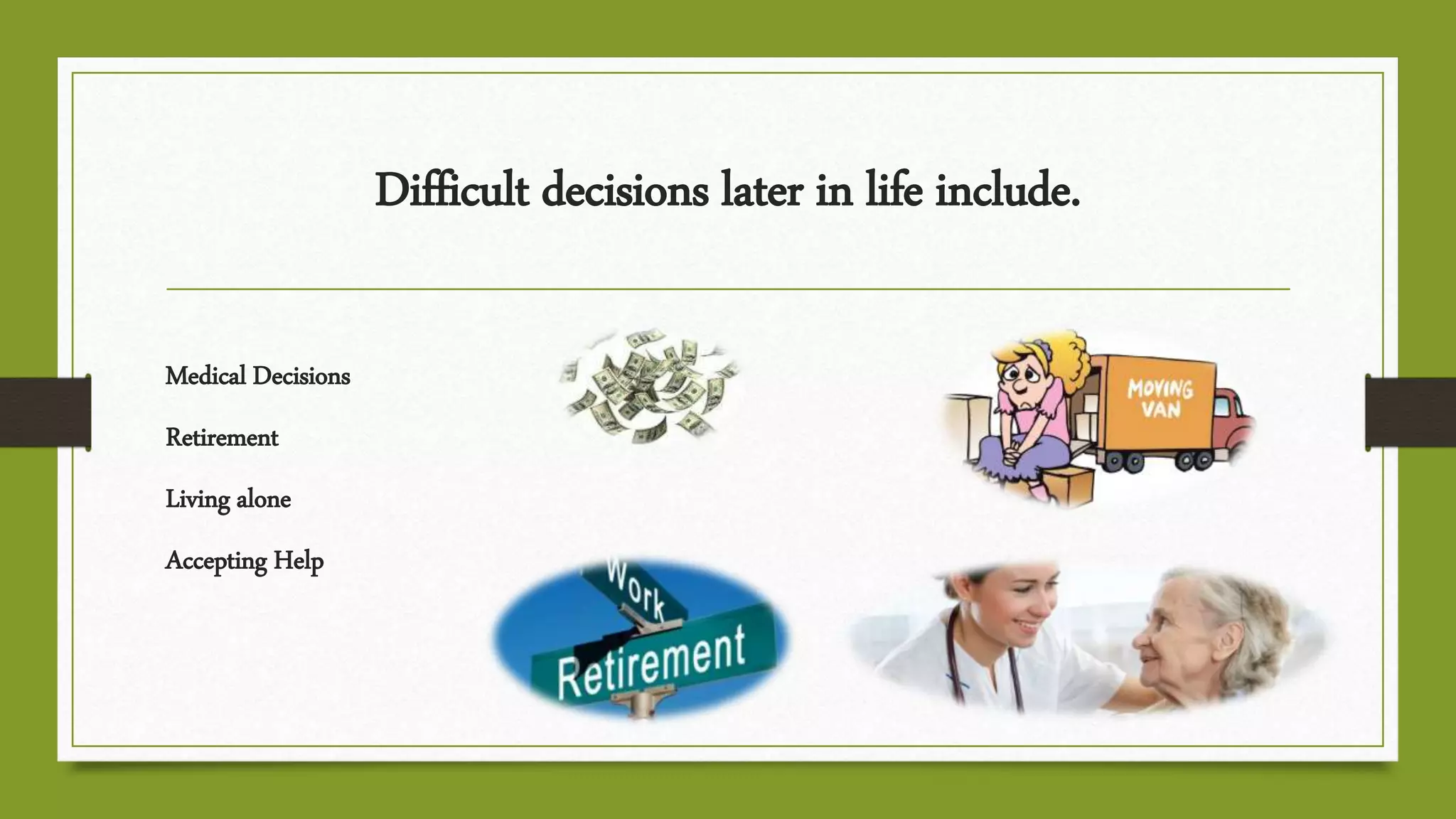
Difficult decisions later in life include.
Medical Decisions
Retirement
Living alone
Accepting Help
When change is hard its NOT always because of
Lack of information
Laziness
Oppositional personality
Denial
When change is hard its often because of
Ambivalence
Wanting and not wanting change at the
same time.
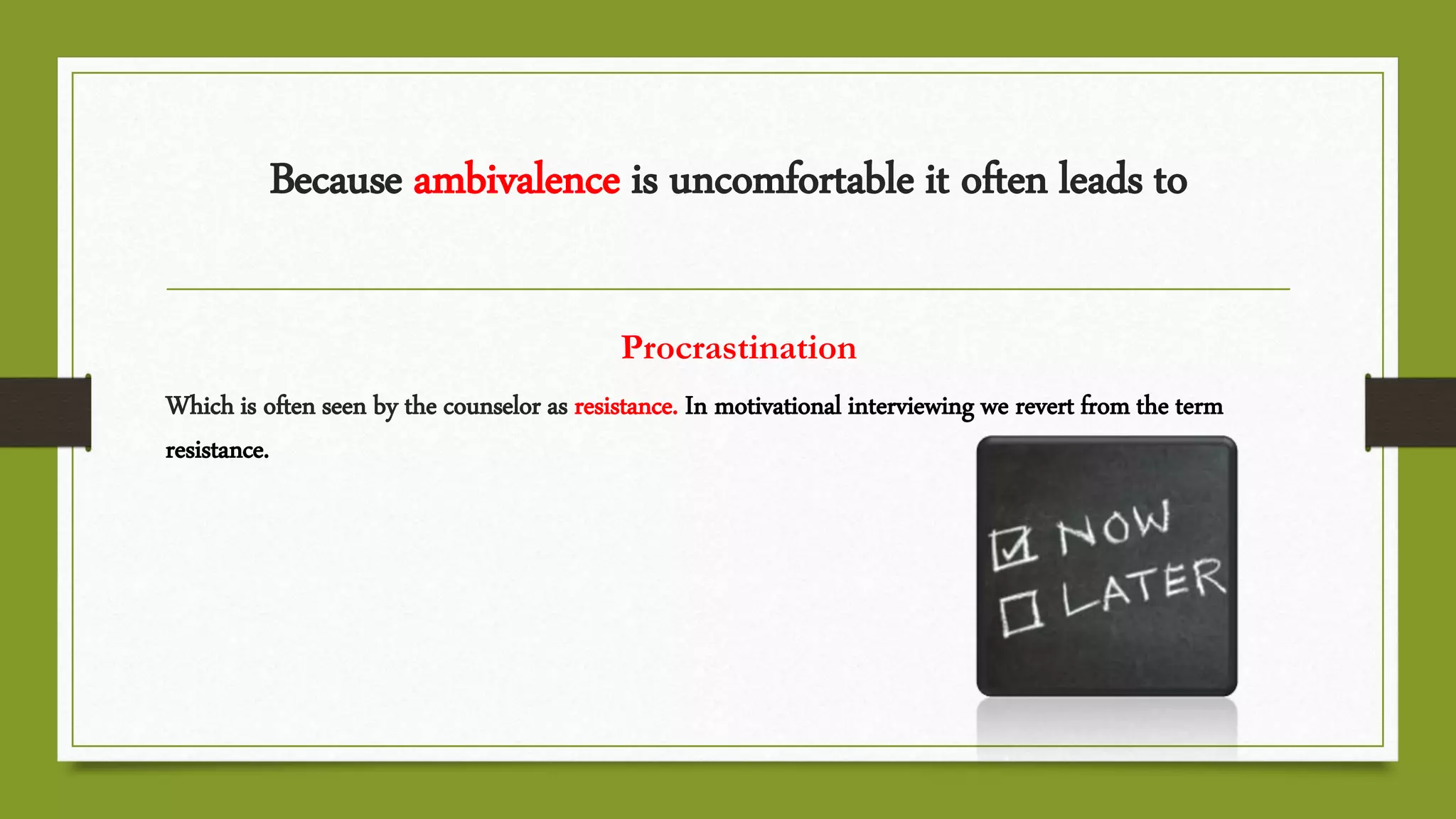
Because ambivalence is uncomfortable it often leads to
Procrastination
Which is often seen by the counselor as resistance. In motivational interviewing we revert from the term
resistance.
Partnership: Work together, avoid the role of the expert. Equal partnership working with the client. “ I value you and am
delighted to work with you”.
Acceptances: Respect the clients autonomy strength and hope.
Compassion: Keep the clients best interest in mind.
Evocation: The best ideas come from the client.
4 Skills of MI
(OARS)
1. Open Questions
2. Affirmations
3. Reflections
4. Summaries
Open Questions
1. You might ask your client:
How much alcohol do you drink everyday?
Translated into MI speak:
What role does alcohol play in your life?
2. Affirmations
Awards Words of Encouragement
Attempts
Achievements
Accomplishments
Anything the clinician see’s positive about the client.
Affirmation Examples
You really care about your family.
This is hard work that you are engaged in.
It took a lot of courage coming in today knowing that you would test positive today.
3. Reflection
Understanding what the client is thinking & feeling and saying it back to the client.
No questions just reflection. In MI the clinician use reflection to convey empathy and
understanding. To see the world through the eyes of the client.
4. Summary
A long reflection of more than one client
statement._______________________________________________________________
____________________________________________________________________
____________________________________________________________________
__________________________________________
Reinforce patient’s motivation to change
Highlight realizations
Identify transitions, progress or themes
The Four Processes
Engaging
Feeling Welcome
Feeling comfortable
Feeling Understood
Having mutual goals
Feeling Hopeful
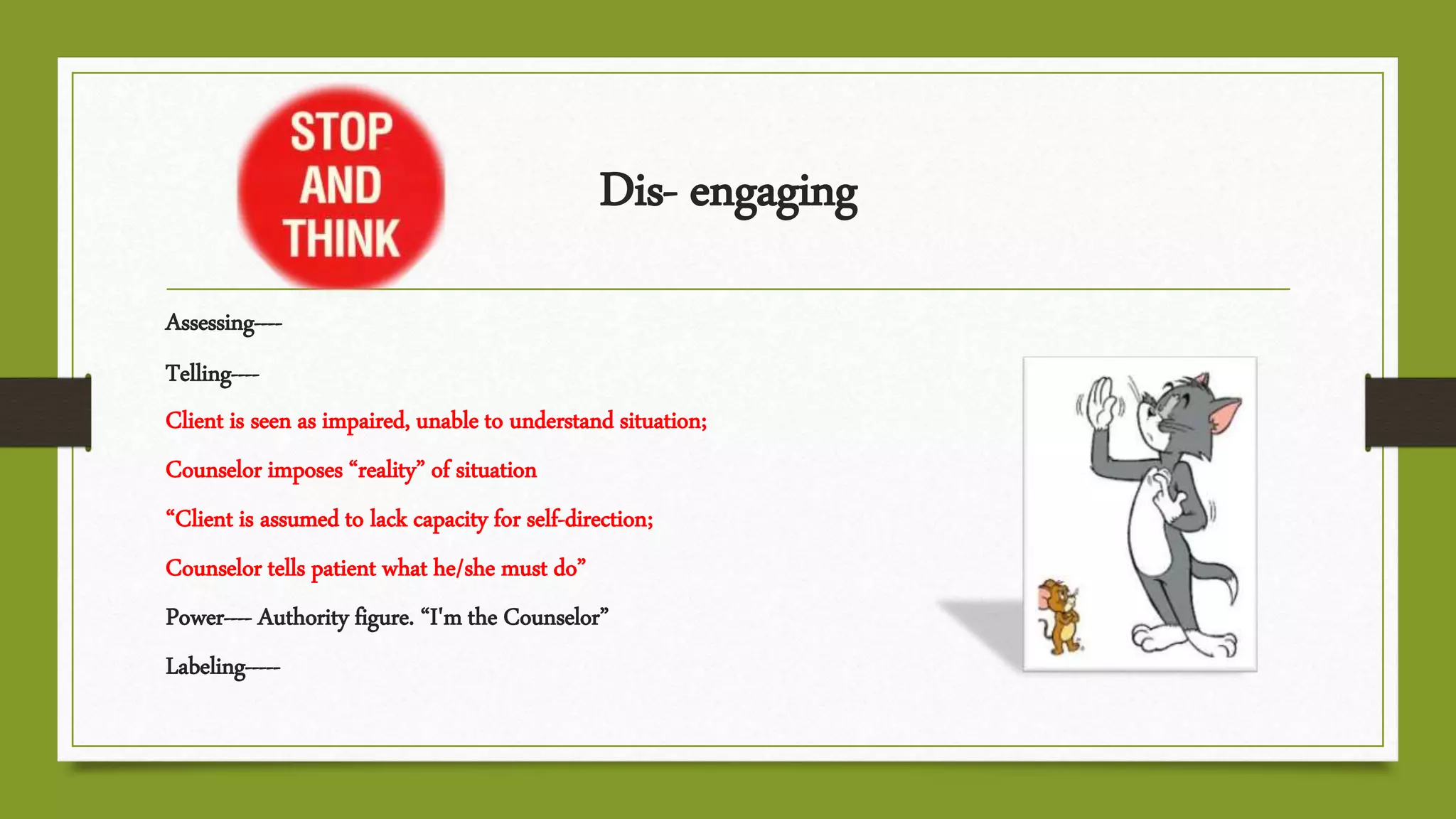
Dis- engaging
Assessing----
Telling----
Client is seen as impaired, unable to understand situation;
Counselor imposes “reality” of situation
“Client is assumed to lack capacity for self-direction;
Counselor tells patient what he/she must do”
Power---- Authority figure. “I'm the Counselor”
Labeling-----
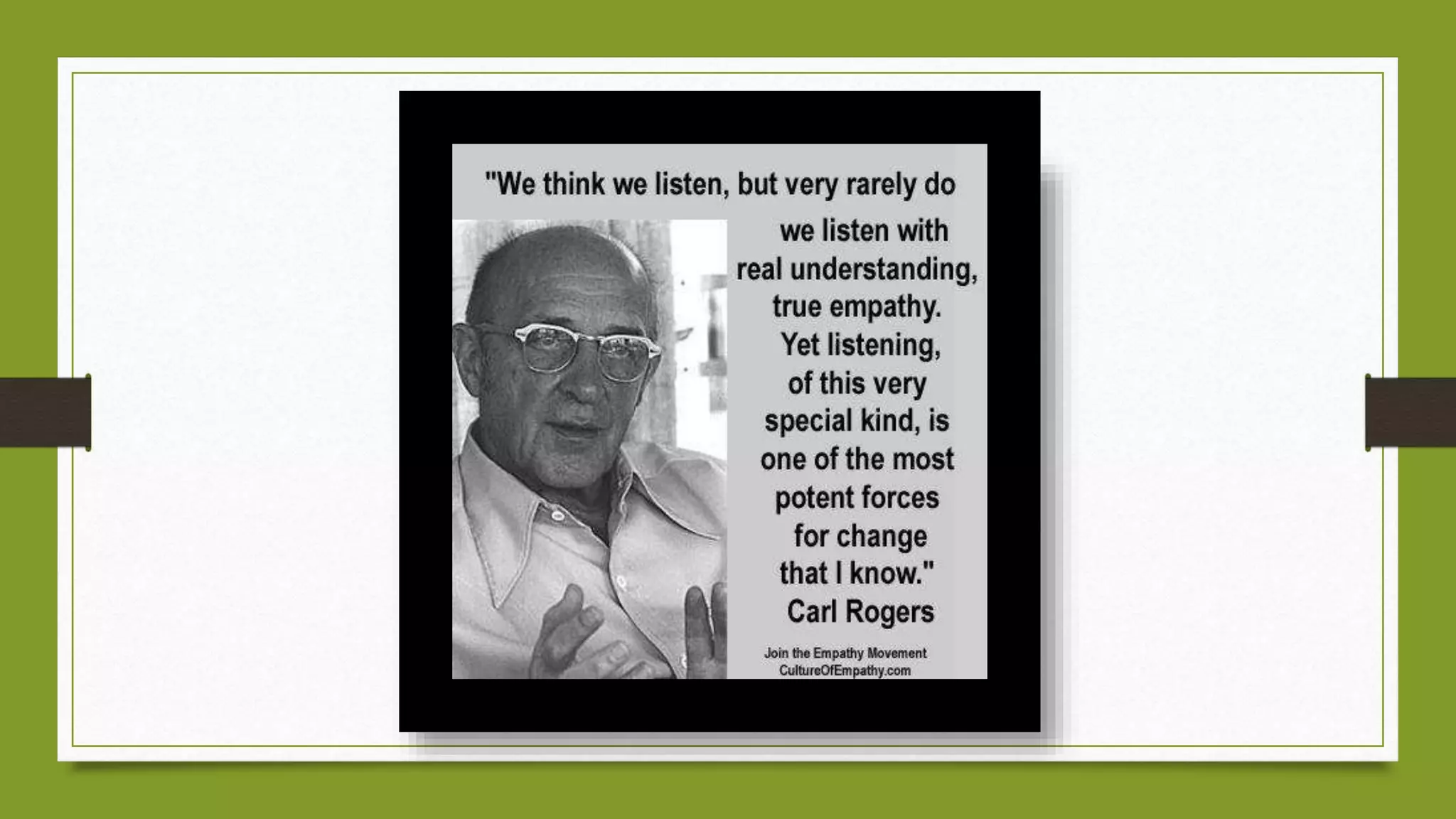
“I've learned that people will forget what you said, people will forget what you did, but people will never forget how you
made them feel.”
Maya Angelou
Focusing
An ongoing process of seeking and maintaining direction.
Agreeing on an agenda, goals & priorities, clear direction.
Evoking
Eliciting a clients own motivation for change.
Eliciting Change Talk
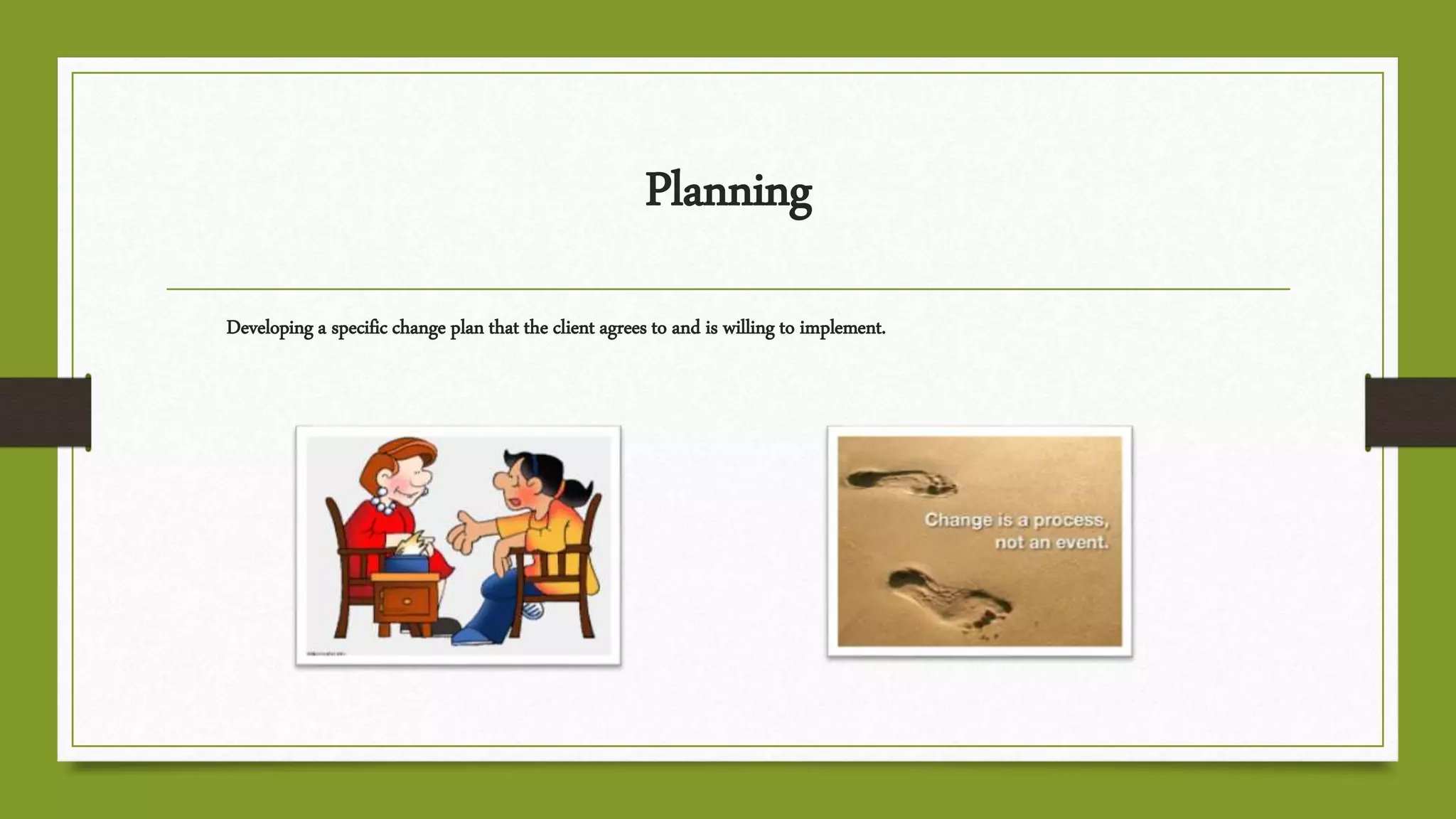
Planning
Developing a specific change plan that the client
agrees to and is willing to implement.
Change Talk
Client speech that favors movement in the direction of change.
“I want” … “I wish”…. “The reasons are” …. “ I can” … “It would solve problems”
Planning
Developing a specific change plan that the client agrees to and is willing to implement.
Smart Plan
S – Specific
M – Measureable
A – Attainable
R – Realistic
T – Timely
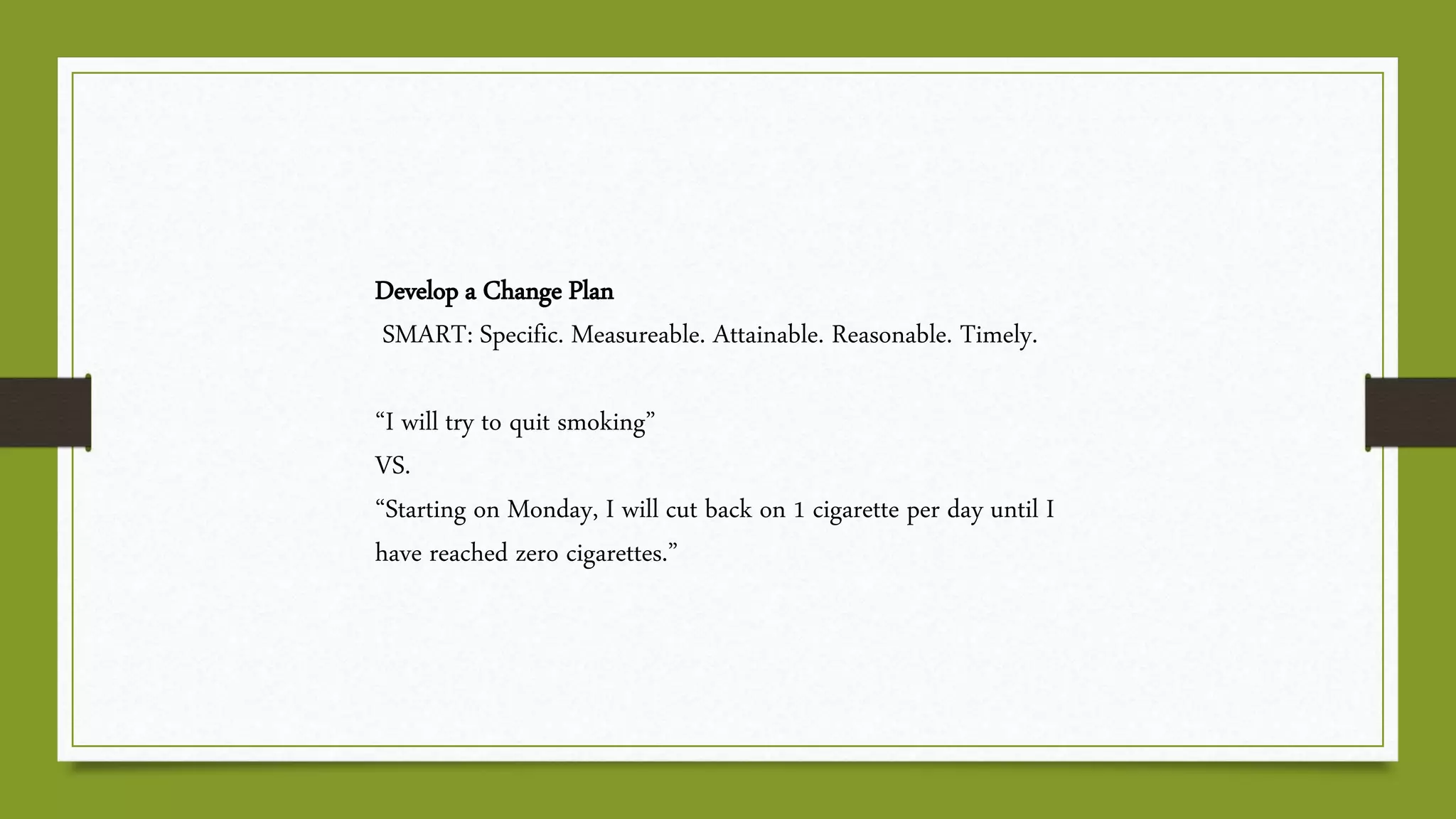
Develop a Change Plan
SMART: Specific. Measureable. Attainable. Reasonable. Timely.
“I will try to quit smoking”
VS.
“Starting on Monday, I will cut back on 1 cigarette per day until I
have reached zero cigarettes.”
Additional Resources
Miller, William and Rollnick, Stephen, Motivational
Interviewing: Helping People Change. Third Edition. New
York: Guilford Press, 2012.
Prochaska, J., Norcross, J. and DiClemente, C. Changing
for Good. New York: Harper and Collins, 1994
Rollnick, S. and Miller, W.R., What is Motivational
Interviewing? Behavioral and Cognitive Psychotherapy,
23, 325-334, 1995.
Rollnick, Stephen, Miller, William, and Butler, Christopher,
Motivational Interviewing in Health Care, New York,
Guilford Press, 2008.
Rosengren, David, Building Motivational Skills: A
Practitioner Workbook, Guilford Press, 2009.

Motivational Interviewing

  • 1.
    Motivational Interviewing The Basics JohnDyeMRC LICDC-CS Sami Clinician Twin Valley Behavioral Healthcare 2020 West Broad Street Columbus ,Ohio 43223
  • 2.
    The Definition ofMI Motivational Interviewing is an effective way of talking with individuals about the work of change.
  • 3.
    What makes MIeffective? MI is evidenced based, 1200 publications or more supports it’s effectiveness.
  • 4.
    There are fourcore principles of MI: Express empathy----Build rapport Roll with resistance---respect client autonomy Develop discrepancy----Elicit pros and cons….identify between goals and current behavior. Support self-efficacy----communicate to the client he/she is capable of change. CORE PRINCIPLES
  • 6.
    Change is notquick or easy. What kind of change are we talking about? People face many decisions that require change at every stage of life. Addictions/Drugs Housing Career Marriage/Relationships That’s just to name a few.
  • 7.
    Difficult decisions laterin life include. Medical Decisions Retirement Living alone Accepting Help
  • 9.
    When change ishard its NOT always because of Lack of information Laziness Oppositional personality Denial
  • 10.
    When change ishard its often because of Ambivalence Wanting and not wanting change at the same time.
  • 11.
    Because ambivalence isuncomfortable it often leads to Procrastination Which is often seen by the counselor as resistance. In motivational interviewing we revert from the term resistance.
  • 13.
    Partnership: Work together,avoid the role of the expert. Equal partnership working with the client. “ I value you and am delighted to work with you”. Acceptances: Respect the clients autonomy strength and hope. Compassion: Keep the clients best interest in mind. Evocation: The best ideas come from the client.
  • 14.
    4 Skills ofMI (OARS) 1. Open Questions 2. Affirmations 3. Reflections 4. Summaries
  • 15.
    Open Questions 1. Youmight ask your client: How much alcohol do you drink everyday? Translated into MI speak: What role does alcohol play in your life?
  • 16.
    2. Affirmations Awards Wordsof Encouragement Attempts Achievements Accomplishments Anything the clinician see’s positive about the client.
  • 17.
    Affirmation Examples You reallycare about your family. This is hard work that you are engaged in. It took a lot of courage coming in today knowing that you would test positive today.
  • 19.
    3. Reflection Understanding whatthe client is thinking & feeling and saying it back to the client. No questions just reflection. In MI the clinician use reflection to convey empathy and understanding. To see the world through the eyes of the client.
  • 20.
    4. Summary A longreflection of more than one client statement._______________________________________________________________ ____________________________________________________________________ ____________________________________________________________________ __________________________________________ Reinforce patient’s motivation to change Highlight realizations Identify transitions, progress or themes
  • 21.
  • 22.
    Engaging Feeling Welcome Feeling comfortable FeelingUnderstood Having mutual goals Feeling Hopeful
  • 23.
    Dis- engaging Assessing---- Telling---- Client isseen as impaired, unable to understand situation; Counselor imposes “reality” of situation “Client is assumed to lack capacity for self-direction; Counselor tells patient what he/she must do” Power---- Authority figure. “I'm the Counselor” Labeling-----
  • 24.
    “I've learned thatpeople will forget what you said, people will forget what you did, but people will never forget how you made them feel.” Maya Angelou
  • 25.
    Focusing An ongoing processof seeking and maintaining direction. Agreeing on an agenda, goals & priorities, clear direction.
  • 26.
    Evoking Eliciting a clientsown motivation for change. Eliciting Change Talk
  • 27.
    Planning Developing a specificchange plan that the client agrees to and is willing to implement.
  • 28.
    Change Talk Client speechthat favors movement in the direction of change. “I want” … “I wish”…. “The reasons are” …. “ I can” … “It would solve problems”
  • 29.
    Planning Developing a specificchange plan that the client agrees to and is willing to implement.
  • 30.
    Smart Plan S –Specific M – Measureable A – Attainable R – Realistic T – Timely
  • 31.
    Develop a ChangePlan SMART: Specific. Measureable. Attainable. Reasonable. Timely. “I will try to quit smoking” VS. “Starting on Monday, I will cut back on 1 cigarette per day until I have reached zero cigarettes.”
  • 33.
    Additional Resources Miller, Williamand Rollnick, Stephen, Motivational Interviewing: Helping People Change. Third Edition. New York: Guilford Press, 2012. Prochaska, J., Norcross, J. and DiClemente, C. Changing for Good. New York: Harper and Collins, 1994 Rollnick, S. and Miller, W.R., What is Motivational Interviewing? Behavioral and Cognitive Psychotherapy, 23, 325-334, 1995. Rollnick, Stephen, Miller, William, and Butler, Christopher, Motivational Interviewing in Health Care, New York, Guilford Press, 2008. Rosengren, David, Building Motivational Skills: A Practitioner Workbook, Guilford Press, 2009.

Editor's Notes

  • #3 Miller & Rollnick definition is included in the handout.
  • #4  (MI) is an evidence-based treatment that addresses ambivalence to change. MI is a conversational approach designed to help people with the following: Discover their own interest in considering and/or making a change in their life (e.g., diet, exercise, managing symptoms of physical or mental illness, reducing and eliminating the use of alcohol, tobacco, and other drugs) Express in their own words their desire for change (i.e., "change-talk") Examine their ambivalence about the change Plan for and begin the process of change Elicit and strengthen change-talk Enhance their confidence in taking action and noticing that even small, incremental changes are important Strengthen their commitment to change
  • #5 MI is one of the core components of a variety of interventions used by direct-service providers, supervisors, team leaders, and organizations in the following service areas: Substance abuse (addiction services) Mental health Psychiatry Primary healthcare Nursing Supported employment Tobacco cessation & recovery Vocational rehabilitation Residential Housing Healthcare Criminal justice
  • #9 Stage #1: Pre-Contemplation People at this stage may be aware of the costs of their addiction. However, they do not see them as significant as compared to the benefits. Of course, others may view this situation differently. Characteristics of this stage are a lack of interest in change, and having no plan or intention to change. We might describe this person as unaware. Stage#2: Contemplation People in the contemplation stage have become aware of problems associated with their behavior. However, they are ambivalent about whether or not it is worthwhile to change. Characteristics of this stage are: exploring the potential to change; desiring change but lacking the confidence and commitment to change behavior; and having the intention to change at some unspecified time in the future. We might describe this person as aware and open to change. Between stage 2 and 3: A decision is made. People conclude that the negatives of their behavior outweigh the positives. They choose to change their behavior. They make a commitment to change. This decision represents an event, not a process. Stage #3: Preparation At this stage people accept responsibility to change their behavior. They evaluate and select techniques for behavioral change. Characteristics of this stage include: developing a plan to make the needed changes; building confidence and commitment to change; and having the intention to change within one month. We might describe this person as willing to change and anticipating of the benefits of change. Stage #4: Action At this stage people engage in self-directed behavioral change efforts while gaining new insights and developing new skills. Although these change efforts are self-directed, outside help may be sought. This might include rehab or therapy. Characteristics of this stage include: consciously choosing new behavior; learning to overcome the tendencies toward unwanted behavior; and engaging in change actions for less than six months. We might describe this person as enthusiastically embracing change and gaining momentum. Stage #5: Maintenance People in the maintenance stage have mastered the ability to sustain new behavior with minimal effort. They have established new behavioral patterns and self-control. Characteristics of this stage include: remaining alert to high-risk situations; maintaining a focus on relapse prevention; and behavioral change that has been sustained six months. We might describe this person as persevering and consolidating their change efforts. They are integrating change into the way they live their life.
  • #11 Ambivalence is a natural state of uncertainty that each of us experiences throughout most change processes (e.g., dieting; exercising; maintaining health; restructuring an organization). Ambivalence occurs because of conflicting feelings about the process and outcomes of change.
  • #14  Client is own expert; Counselor creates atmosphere that is conducive rather than coercive, and built on partnership /Evocation…Client has resources and motivation to change within; Counselor must evoke this from patient./ Patient is own expert; Counselor creates atmosphere that is conducive rather than coercive, and built on partnership
  • #16 OPENED-ENDED QUESTIONS Rationale: When counselors use open-ended questions it allows for a richer, deeper conversation that flows and builds empathy with clients. In contrast, too many back-to-back closed- or dead ended questions can feel like an interrogation (e. g., “How often do you use cocaine?” “How many years have you had an alcohol problem?” “How many times have you been arrested?”). Open-ended questions encourage clients to do most of the talking, while the therapist listens and responds with a reflection or summary statement. The goal is to promote further dialogue that can be reflected back to the client by the therapist. Open-ended questions allow clients to tell their stories.
  • #21 “It sounds like you’ve made some progress since last time we spoke. You have cut back to 5 cigarettes per day, and you mentioned that you don’t really miss the ones you’ve cut out. At the same time you’re nervous about cutting back further because of some stressful situations that have been happening over the past week. What else?”
  • #24 Examples of the opposite of MI
  • #27 Challenging the client to think about what are there continued reasons and motivations for change. IOP …. Motivational boxes.
  • #30 Planning ---- the client, the individual, as well as the agency.