@DocXavi
Deep Learning for Computer Vision
Image Analytics
5 May 2016
Xavier Giró-i-Nieto
Master en
Creació Multimedia
2
Densely linked slides
3
Introduction
Xavier Giro-i-Nieto
• Web: https://imatge.upc.edu/web/people/xavier-giro
Associate Professor at Universitat Politecnica de Catalunya (UPC)
4
Acknowledgments
5
Acknowledgments
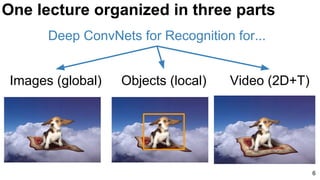
One lecture organized in three parts
6
Images (global) Objects (local)
Deep ConvNets for Recognition for...
Video (2D+T)
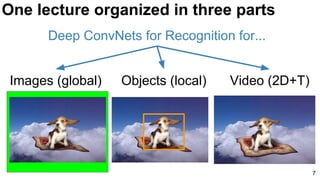
One lecture organized in three parts
7
Images (global) Objects (local)
Deep ConvNets for Recognition for...
Video (2D+T)
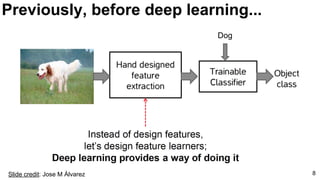
Previously, before deep learning...
8Slide credit: Jose M Àlvarez
Dog
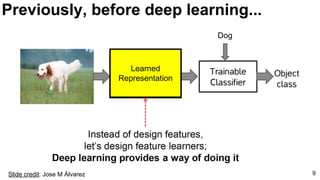
9Slide credit: Jose M Àlvarez
Dog
Learned
Representation
Previously, before deep learning...
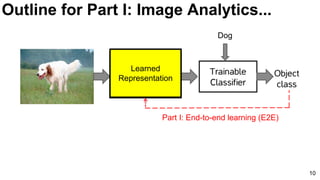
Outline for Part I: Image Analytics...
10
Dog
Learned
Representation
Part I: End-to-end learning (E2E)
11
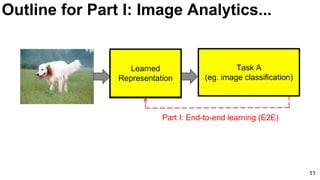
Learned
Representation
Part I: End-to-end learning (E2E)
Task A
(eg. image classification)
Outline for Part I: Image Analytics...
12
Task A
(eg. image classification)
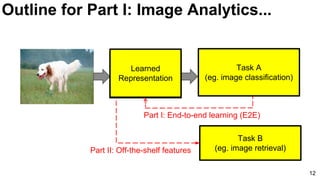
Learned
Representation
Part I: End-to-end learning (E2E)
Task B
(eg. image retrieval)Part II: Off-the-shelf features
Outline for Part I: Image Analytics...
13
Task A
(eg. image classification)
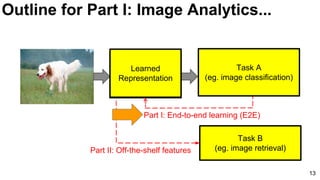
Learned
Representation
Part I: End-to-end learning (E2E)
Task B
(eg. image retrieval)Part II: Off-the-shelf features
Outline for Part I: Image Analytics...
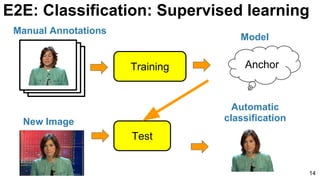
E2E: Classification: Supervised learning
14
Manual Annotations
Model
New Image
Automatic
classification
Training
Test
Anchor
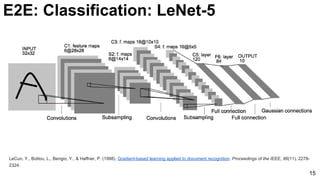
E2E: Classification: LeNet-5
15
LeCun, Y., Bottou, L., Bengio, Y., & Haffner, P. (1998). Gradient-based learning applied to document recognition. Proceedings of the IEEE, 86(11), 2278-
2324.
E2E: Classification: LeNet-5
16
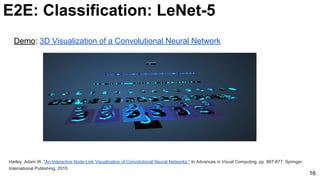
Demo: 3D Visualization of a Convolutional Neural Network
Harley, Adam W. "An Interactive Node-Link Visualization of Convolutional Neural Networks." In Advances in Visual Computing, pp. 867-877. Springer
International Publishing, 2015.
E2E: Classification: Similar to LeNet-5
17
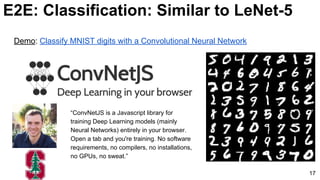
Demo: Classify MNIST digits with a Convolutional Neural Network
“ConvNetJS is a Javascript library for
training Deep Learning models (mainly
Neural Networks) entirely in your browser.
Open a tab and you're training. No software
requirements, no compilers, no installations,
no GPUs, no sweat.”
E2E: Classification: Databases
18
Li Fei-Fei, “How we’re teaching computers to understand
pictures” TEDTalks 2014.
Russakovsky, O., Deng, J., Su, H., Krause, J., Satheesh, S., Ma, S., ... & Fei-Fei, L. (2015). Imagenet large scale visual
recognition challenge. arXiv preprint arXiv:1409.0575. [web]
19
E2E: Classification: Databases
Russakovsky, O., Deng, J., Su, H., Krause, J., Satheesh, S., Ma, S., ... & Fei-Fei, L. (2015). Imagenet large scale visual
recognition challenge. arXiv preprint arXiv:1409.0575. [web]
20
Zhou, Bolei, Agata Lapedriza, Jianxiong Xiao, Antonio Torralba, and Aude Oliva. "Learning deep features for scene recognition
using places database." In Advances in neural information processing systems, pp. 487-495. 2014. [web]
E2E: Classification: Databases
● 205 scene classes (categories).
● Images:
○ 2.5M train
○ 20.5k validation
○ 41k test
21
E2E: Classification: ImageNet ILSRVC
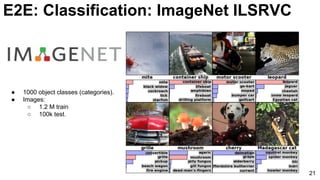
● 1000 object classes (categories).
● Images:
○ 1.2 M train
○ 100k test.
E2E: Classification: ImageNet ILSRVC
Russakovsky, O., Deng, J., Su, H., Krause, J., Satheesh, S., Ma, S., ... & Fei-Fei, L. (2015). Imagenet large scale visual
recognition challenge. arXiv preprint arXiv:1409.0575. [web]
● Predict 5 classes.
Slide credit:
Rob Fergus (NYU)
Image Classifcation 2012
-9.8%
Russakovsky, O., Deng, J., Su, H., Krause, J., Satheesh, S., Ma, S., ... & Fei-Fei, L. (2014). Imagenet large scale visual recognition challenge. arXiv
preprint arXiv:1409.0575. [web] 23
E2E: Classification: ILSRVC
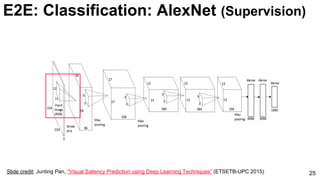
E2E: Classification: AlexNet (Supervision)
24Slide credit: Junting Pan, “Visual Saliency Prediction using Deep Learning Techniques” (ETSETB-UPC 2015)
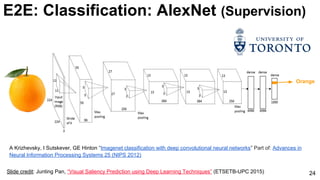
Orange
A Krizhevsky, I Sutskever, GE Hinton “Imagenet classification with deep convolutional neural networks” Part of: Advances in
Neural Information Processing Systems 25 (NIPS 2012)
25Slide credit: Junting Pan, “Visual Saliency Prediction using Deep Learning Techniques” (ETSETB-UPC 2015)
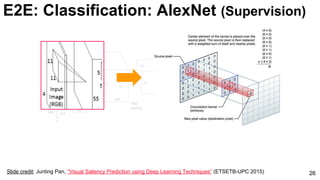
E2E: Classification: AlexNet (Supervision)
26Slide credit: Junting Pan, “Visual Saliency Prediction using Deep Learning Techniques” (ETSETB-UPC 2015)
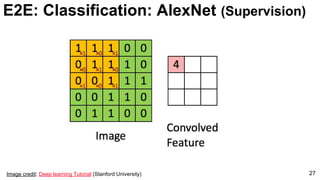
E2E: Classification: AlexNet (Supervision)
27Image credit: Deep learning Tutorial (Stanford University)
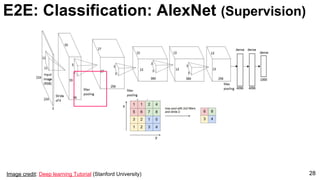
E2E: Classification: AlexNet (Supervision)
28Image credit: Deep learning Tutorial (Stanford University)
E2E: Classification: AlexNet (Supervision)
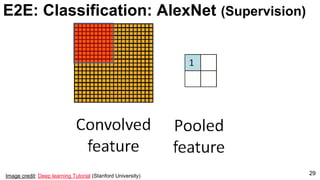
29Image credit: Deep learning Tutorial (Stanford University)
E2E: Classification: AlexNet (Supervision)
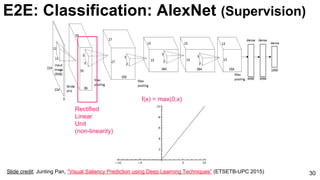
30
Rectified
Linear
Unit
(non-linearity)
f(x) = max(0,x)
Slide credit: Junting Pan, “Visual Saliency Prediction using Deep Learning Techniques” (ETSETB-UPC 2015)
E2E: Classification: AlexNet (Supervision)
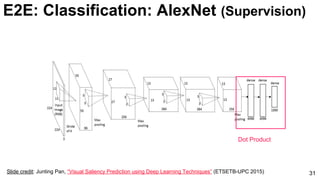
31
Dot Product
Slide credit: Junting Pan, “Visual Saliency Prediction using Deep Learning Techniques” (ETSETB-UPC 2015)
E2E: Classification: AlexNet (Supervision)
ImageNet Classification 2013
Russakovsky, O., Deng, J., Su, H., Krause, J., Satheesh, S., Ma, S., ... & Fei-Fei, L. (2015). Imagenet large scale visual recognition challenge. arXiv
preprint arXiv:1409.0575. [web]
Slide credit:
Rob Fergus (NYU)
32
E2E: Classification: ImageNet ILSRVC
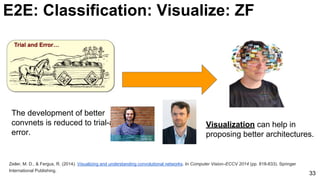
The development of better
convnets is reduced to trial-and-
error.
33
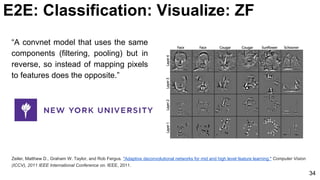
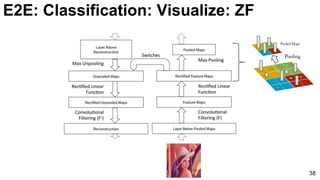
E2E: Classification: Visualize: ZF
Visualization can help in
proposing better architectures.
Zeiler, M. D., & Fergus, R. (2014). Visualizing and understanding convolutional networks. In Computer Vision–ECCV 2014 (pp. 818-833). Springer
International Publishing.
“A convnet model that uses the same
components (filtering, pooling) but in
reverse, so instead of mapping pixels
to features does the opposite.”
Zeiler, Matthew D., Graham W. Taylor, and Rob Fergus. "Adaptive deconvolutional networks for mid and high level feature learning." Computer Vision
(ICCV), 2011 IEEE International Conference on. IEEE, 2011.
34
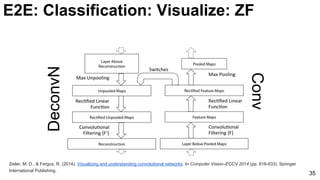
E2E: Classification: Visualize: ZF
Zeiler, M. D., & Fergus, R. (2014). Visualizing and understanding convolutional networks. In Computer Vision–ECCV 2014 (pp. 818-833). Springer
International Publishing.
DeconvN
et
Conv
Net
35
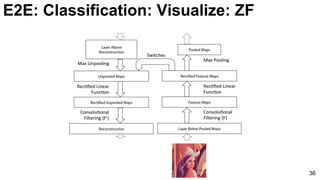
E2E: Classification: Visualize: ZF
36
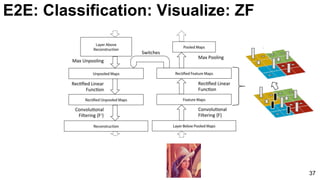
E2E: Classification: Visualize: ZF
37
E2E: Classification: Visualize: ZF
38
E2E: Classification: Visualize: ZF
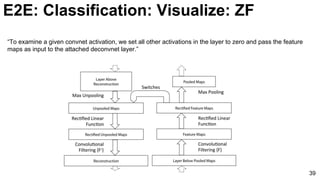
“To examine a given convnet activation, we set all other activations in the layer to zero and pass the feature
maps as input to the attached deconvnet layer.”
39
E2E: Classification: Visualize: ZF
40
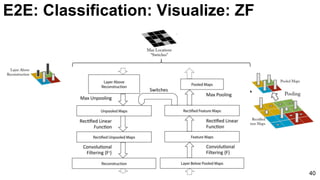
E2E: Classification: Visualize: ZF
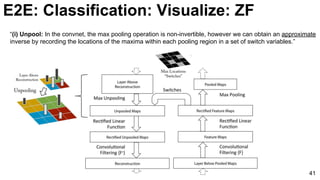
“(i) Unpool: In the convnet, the max pooling operation is non-invertible, however we can obtain an approximate
inverse by recording the locations of the maxima within each pooling region in a set of switch variables.”
41
E2E: Classification: Visualize: ZF
XX
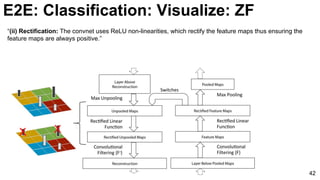
“(ii) Rectification: The convnet uses ReLU non-linearities, which rectify the feature maps thus ensuring the
feature maps are always positive.”
42
E2E: Classification: Visualize: ZF
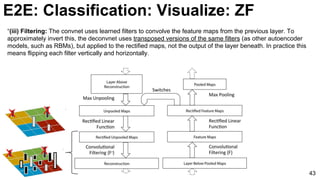
“(iii) Filtering: The convnet uses learned filters to convolve the feature maps from the previous layer. To
approximately invert this, the deconvnet uses transposed versions of the same filters (as other autoencoder
models, such as RBMs), but applied to the rectified maps, not the output of the layer beneath. In practice this
means flipping each filter vertically and horizontally.
XX
XX
43
E2E: Classification: Visualize: ZF
“(iii) Filtering: The convnet uses learned filters to convolve the feature maps from the previous layer. To
approximately invert this, the deconvnet uses transposed versions of the same filters (as other autoencoder
models, such as RBMs), but applied to the rectified maps, not the output of the layer beneath. In practice this
means flipping each filter vertically and horizontally.
XX
XX
44
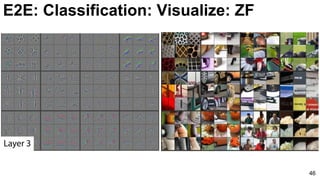
E2E: Classification: Visualize: ZF
45
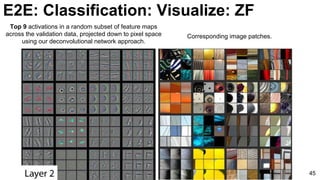
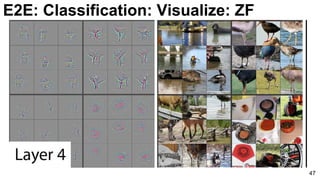
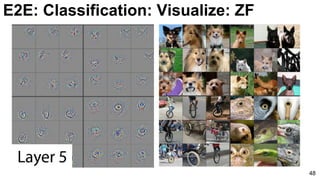
Top 9 activations in a random subset of feature maps
across the validation data, projected down to pixel space
using our deconvolutional network approach.
Corresponding image patches.
E2E: Classification: Visualize: ZF
46
E2E: Classification: Visualize: ZF
47
E2E: Classification: Visualize: ZF
48
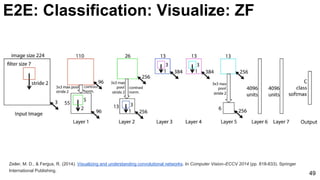
E2E: Classification: Visualize: ZF
Zeiler, M. D., & Fergus, R. (2014). Visualizing and understanding convolutional networks. In Computer Vision–ECCV 2014 (pp. 818-833). Springer
International Publishing.
49
E2E: Classification: Visualize: ZF
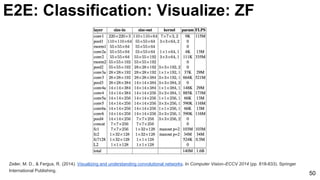
Zeiler, M. D., & Fergus, R. (2014). Visualizing and understanding convolutional networks. In Computer Vision–ECCV 2014 (pp. 818-833). Springer
International Publishing.
50
E2E: Classification: Visualize: ZF
51
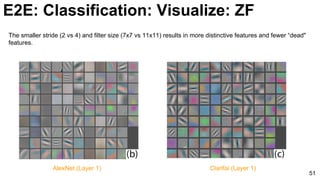
The smaller stride (2 vs 4) and filter size (7x7 vs 11x11) results in more distinctive features and fewer “dead"
features.
AlexNet (Layer 1) Clarifai (Layer 1)
E2E: Classification: Visualize: ZF
52
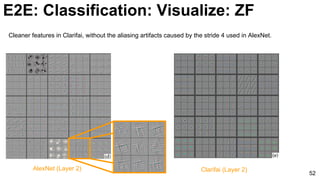
Cleaner features in Clarifai, without the aliasing artifacts caused by the stride 4 used in AlexNet.
AlexNet (Layer 2) Clarifai (Layer 2)
E2E: Classification: Visualize: ZF
53
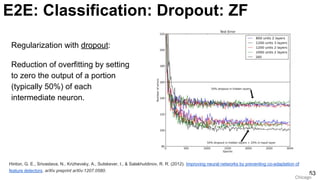
Regularization with dropout:
Reduction of overfitting by setting
to zero the output of a portion
(typically 50%) of each
intermediate neuron.
Hinton, G. E., Srivastava, N., Krizhevsky, A., Sutskever, I., & Salakhutdinov, R. R. (2012). Improving neural networks by preventing co-adaptation of
feature detectors. arXiv preprint arXiv:1207.0580.
Chicago
E2E: Classification: Dropout: ZF
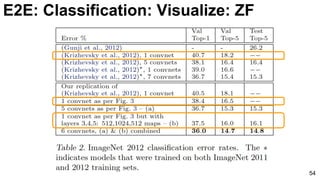
54
E2E: Classification: Visualize: ZF
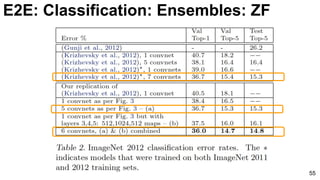
55
E2E: Classification: Ensembles: ZF
ImageNet Classification 2013
Russakovsky, O., Deng, J., Su, H., Krause, J., Satheesh, S., Ma, S., ... & Fei-Fei, L. (2015). Imagenet large scale visual recognition challenge. arXiv
preprint arXiv:1409.0575. [web]
-5%
Slide credit:
Rob Fergus (NYU)
56
E2E: Classification: ImageNet ILSRVC
ImageNet Classification 2013
Russakovsky, O., Deng, J., Su, H., Krause, J., Satheesh, S., Ma, S., ... & Fei-Fei, L. (2015). Imagenet large scale visual recognition challenge. arXiv
preprint arXiv:1409.0575. [web]
-5%
Slide credit:
Rob Fergus (NYU)
57
E2E: Classification: ImageNet ILSRVC
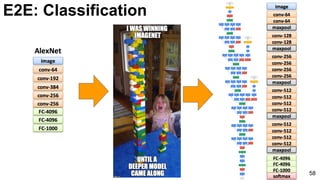
E2E: Classification
58
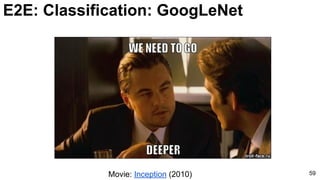
E2E: Classification: GoogLeNet
59Movie: Inception (2010)
E2E: Classification: GoogLeNet
60
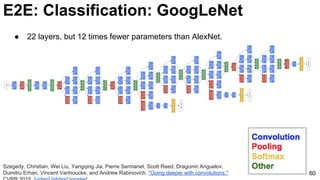
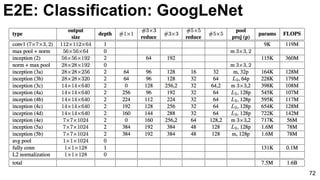
● 22 layers, but 12 times fewer parameters than AlexNet.
Szegedy, Christian, Wei Liu, Yangqing Jia, Pierre Sermanet, Scott Reed, Dragomir Anguelov,
Dumitru Erhan, Vincent Vanhoucke, and Andrew Rabinovich. "Going deeper with convolutions."
E2E: Classification: GoogLeNet
61
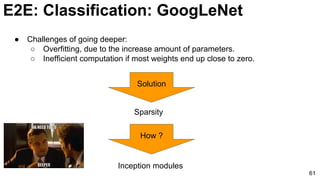
● Challenges of going deeper:
○ Overfitting, due to the increase amount of parameters.
○ Inefficient computation if most weights end up close to zero.
Solution
Sparsity
How ?
Inception modules
E2E: Classification: GoogLeNet
62
E2E: Classification: GoogLeNet
63
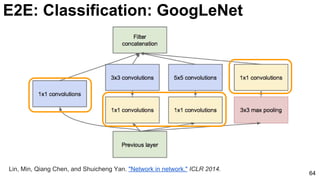
Lin, Min, Qiang Chen, and Shuicheng Yan. "Network in network." ICLR 2014.
E2E: Classification: GoogLeNet
64
Lin, Min, Qiang Chen, and Shuicheng Yan. "Network in network." ICLR 2014.
E2E: Classification: GoogLeNet (NiN)
65
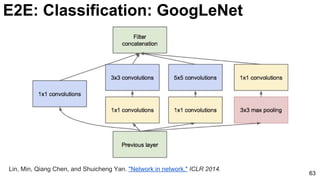
3x3 and 5x5 convolutions deal with
different scales.
Lin, Min, Qiang Chen, and Shuicheng Yan. "Network in network." ICLR 2014. [Slides]
66
1x1 convolutions does dimensionality reduction (c3<c2) and
accounts for rectified linear units (ReLU).
Lin, Min, Qiang Chen, and Shuicheng Yan. "Network in network." ICLR 2014. [Slides]
E2E: Classification: GoogLeNet (NiN)
67
In NiN, the Cascaded 1x1 Convolutions compute reductions after the
convolutions.
Lin, Min, Qiang Chen, and Shuicheng Yan. "Network in network." ICLR 2014. [Slides]
E2E: Classification: GoogLeNet (NiN)
E2E: Classification: GoogLeNet
68
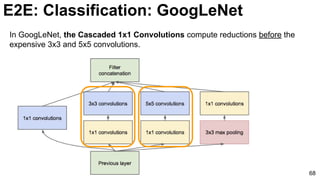
In GoogLeNet, the Cascaded 1x1 Convolutions compute reductions before the
expensive 3x3 and 5x5 convolutions.
E2E: Classification: GoogLeNet
69
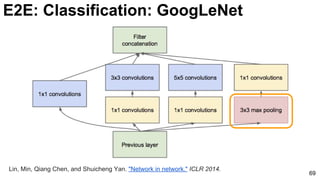
Lin, Min, Qiang Chen, and Shuicheng Yan. "Network in network." ICLR 2014.
E2E: Classification: GoogLeNet
70
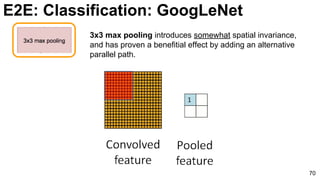
3x3 max pooling introduces somewhat spatial invariance,
and has proven a benefitial effect by adding an alternative
parallel path.
E2E: Classification: GoogLeNet
71
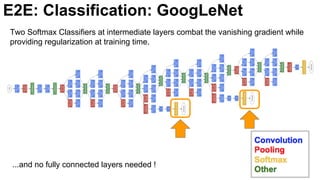
Two Softmax Classifiers at intermediate layers combat the vanishing gradient while
providing regularization at training time.
...and no fully connected layers needed !
E2E: Classification: GoogLeNet
72
E2E: Classification: GoogLeNet
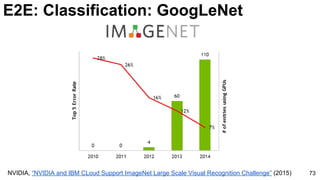
73NVIDIA, “NVIDIA and IBM CLoud Support ImageNet Large Scale Visual Recognition Challenge” (2015)
E2E: Classification: GoogLeNet
74
Szegedy, Christian, Wei Liu, Yangqing Jia, Pierre Sermanet, Scott Reed, Dragomir Anguelov, Dumitru Erhan, Vincent
Vanhoucke, and Andrew Rabinovich. "Going deeper with convolutions." CVPR 2015. [video] [slides] [poster]
E2E: Classification: VGG
75
Simonyan, Karen, and Andrew Zisserman. "Very deep convolutional networks for large-scale image recognition."
International Conference on Learning Representations (2015). [video] [slides] [project]
E2E: Classification: VGG
76
Simonyan, Karen, and Andrew Zisserman. "Very deep convolutional networks for large-scale image recognition."
International Conference on Learning Representations (2015). [video] [slides] [project]
E2E: Classification: VGG: 3x3 Stacks
77
Simonyan, Karen, and Andrew Zisserman. "Very deep convolutional networks for large-scale image
recognition." International Conference on Learning Representations (2015). [video] [slides] [project]
E2E: Classification: VGG
78
Simonyan, Karen, and Andrew Zisserman. "Very deep convolutional networks for large-scale image
recognition." International Conference on Learning Representations (2015). [video] [slides] [project]
● No poolings between some convolutional layers.
● Convolution strides of 1 (no skipping).
E2E: Classification
79
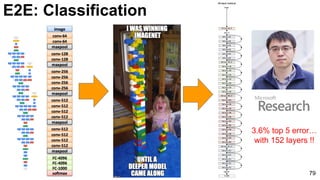
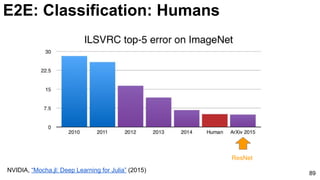
3.6% top 5 error…
with 152 layers !!
E2E: Classification: ResNet
80
He, Kaiming, Xiangyu Zhang, Shaoqing Ren, and Jian Sun. "Deep Residual Learning for Image Recognition." arXiv preprint arXiv:1512.03385
(2015). [slides]
E2E: Classification: ResNet
81
● Deeper networks (34 is deeper than 18) are more difficult to train.
He, Kaiming, Xiangyu Zhang, Shaoqing Ren, and Jian Sun. "Deep Residual Learning for Image Recognition." arXiv preprint arXiv:1512.03385
(2015). [slides]
Thin curves: training error
Bold curves: validation error
E2E: Classification: ResNet
82
● Residual learning: reformulate the layers as learning residual functions with
reference to the layer inputs, instead of learning unreferenced functions
He, Kaiming, Xiangyu Zhang, Shaoqing Ren, and Jian Sun. "Deep Residual Learning for Image Recognition." arXiv preprint arXiv:1512.03385
(2015). [slides]
E2E: Classification: ResNet
83
He, Kaiming, Xiangyu Zhang, Shaoqing Ren, and Jian Sun. "Deep Residual Learning for Image Recognition." arXiv preprint arXiv:1512.03385
(2015). [slides]
84
E2E: Classification: Humans
Russakovsky, O., Deng, J., Su, H., Krause, J., Satheesh, S., Ma, S., ... & Fei-Fei, L. (2015). Imagenet large scale visual
recognition challenge. arXiv preprint arXiv:1409.0575. [web]
85
E2E: Classification: Humans
“Is this a Border terrier” ?
Crowdsourcing
Yes
No
● Binary ground truth annotation from the crowd.
Russakovsky, O., Deng, J., Su, H., Krause, J., Satheesh, S., Ma, S., ... & Fei-Fei, L. (2015). Imagenet large scale visual
recognition challenge. arXiv preprint arXiv:1409.0575. [web]
86
● Annotation Problems:
Carlier, Axel, Amaia Salvador, Ferran Cabezas, Xavier Giro-i-Nieto, Vincent Charvillat, and Oge Marques. "Assessment of
crowdsourcing and gamification loss in user-assisted object segmentation." Multimedia Tools and Applications (2015): 1-28.
Russakovsky, O., Deng, J., Su, H., Krause, J., Satheesh, S., Ma, S., ... & Fei-Fei, L. (2015). Imagenet large scale visual
recognition challenge. arXiv preprint arXiv:1409.0575. [web]
Crowdsource loss (0.3%) More than 5 objects classes
E2E: Classification: Humans
87
Andrej Karpathy, “What I learned from competing against a computer on ImageNet” (2014)
● Test data collection from one human. [interface]
E2E: Classification: Humans
88
Andrej Karpathy, “What I learned from competing against a computer on ImageNet” (2014)
● Test data collection from one human. [interface]
“Aww, a cute dog! Would you like to spend 5 minutes scrolling through 120
breeds of dog to guess what species it is ?”
E2E: Classification: Humans
89
NVIDIA, “Mocha.jl: Deep Learning for Julia” (2015)
ResNet
9090
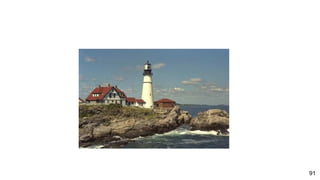
Let’s play a
game!
91
92
What have you seen?
93
Tower
94
Tower
House
95
Tower
House
Rocks
96
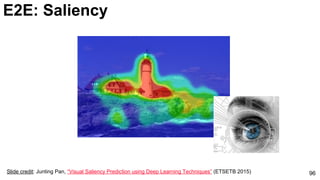
E2E: Saliency
Slide credit: Junting Pan, “Visual Saliency Prediction using Deep Learning Techniques” (ETSETB 2015)
97
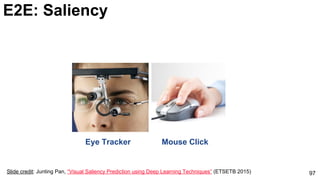
Eye Tracker Mouse Click
Slide credit: Junting Pan, “Visual Saliency Prediction using Deep Learning Techniques” (ETSETB 2015)
E2E: Saliency
98
E2E: Saliency: JuntingNet
Junting Pan, Kevin McGuinness, Elisa Sayrol, Noel O'Connor, and Xavier Giro-i-Nieto. "Shallow and Deep Convolutional
Networks for Saliency Prediction." CVPR 2016
99
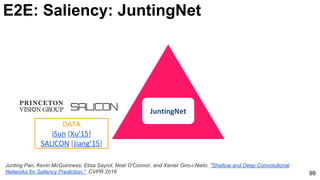
E2E: Saliency: JuntingNet
Junting Pan, Kevin McGuinness, Elisa Sayrol, Noel O'Connor, and Xavier Giro-i-Nieto. "Shallow and Deep Convolutional
Networks for Saliency Prediction." CVPR 2016
100
TRAIN VALIDATION TEST
10,000 5,000 5,000
6,000 926 2,000
CAT2000 [Borji’15] 2,000 - 2,000
MIT300 [Judd’12] 300 - -Large
Scale
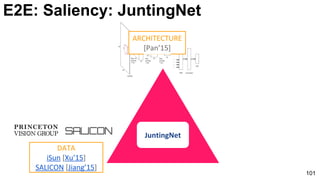
E2E: Saliency: JuntingNet
Junting Pan, Kevin McGuinness, Elisa Sayrol, Noel O'Connor, and Xavier Giro-i-Nieto. "Shallow and Deep Convolutional
Networks for Saliency Prediction." CVPR 2016
101
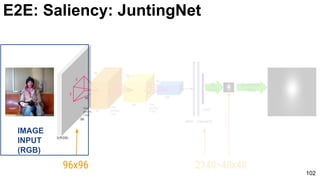
E2E: Saliency: JuntingNet
102
Upsample
+ filter
2D
map
96x96 2340=48x48
IMAGE
INPUT
(RGB)
E2E: Saliency: JuntingNet
103
Upsample
+ filter
2D
map
96x96 2340=48x48
3 CONV LAYERS
E2E: Saliency: JuntingNet
104
Upsample
+ filter
2D
map
96x96 2340=48x48
2 DENSE
LAYERS
E2E: Saliency: JuntingNet
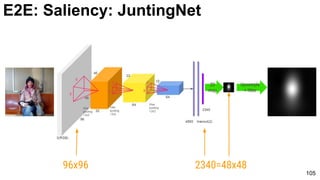
105
Upsample
+ filter
2D
map
96x96 2340=48x48
E2E: Saliency: JuntingNet
106
E2E: Saliency: JuntingNet
107
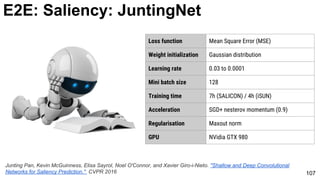
Loss function Mean Square Error (MSE)
Weight initialization Gaussian distribution
Learning rate 0.03 to 0.0001
Mini batch size 128
Training time 7h (SALICON) / 4h (iSUN)
Acceleration SGD+ nesterov momentum (0.9)
Regularisation Maxout norm
GPU NVidia GTX 980
E2E: Saliency: JuntingNet
Junting Pan, Kevin McGuinness, Elisa Sayrol, Noel O'Connor, and Xavier Giro-i-Nieto. "Shallow and Deep Convolutional
Networks for Saliency Prediction." CVPR 2016
108
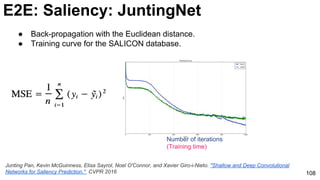
Number of iterations
(Training time)
● Back-propagation with the Euclidean distance.
● Training curve for the SALICON database.
E2E: Saliency: JuntingNet
Junting Pan, Kevin McGuinness, Elisa Sayrol, Noel O'Connor, and Xavier Giro-i-Nieto. "Shallow and Deep Convolutional
Networks for Saliency Prediction." CVPR 2016
109
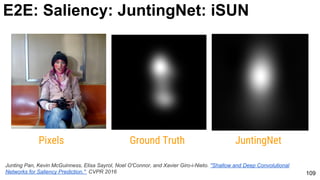
JuntingNetGround TruthPixels
E2E: Saliency: JuntingNet: iSUN
Junting Pan, Kevin McGuinness, Elisa Sayrol, Noel O'Connor, and Xavier Giro-i-Nieto. "Shallow and Deep Convolutional
Networks for Saliency Prediction." CVPR 2016
110
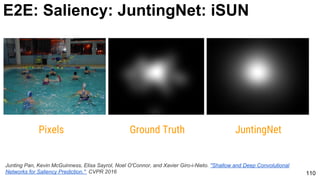
JuntingNetGround TruthPixels
E2E: Saliency: JuntingNet: iSUN
Junting Pan, Kevin McGuinness, Elisa Sayrol, Noel O'Connor, and Xavier Giro-i-Nieto. "Shallow and Deep Convolutional
Networks for Saliency Prediction." CVPR 2016
111
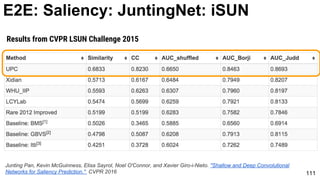
Results from CVPR LSUN Challenge 2015
E2E: Saliency: JuntingNet: iSUN
Junting Pan, Kevin McGuinness, Elisa Sayrol, Noel O'Connor, and Xavier Giro-i-Nieto. "Shallow and Deep Convolutional
Networks for Saliency Prediction." CVPR 2016
112
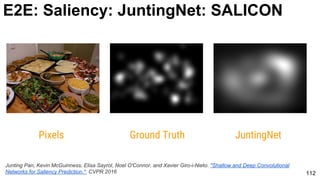
JuntingNetGround TruthPixels
E2E: Saliency: JuntingNet: SALICON
Junting Pan, Kevin McGuinness, Elisa Sayrol, Noel O'Connor, and Xavier Giro-i-Nieto. "Shallow and Deep Convolutional
Networks for Saliency Prediction." CVPR 2016
113
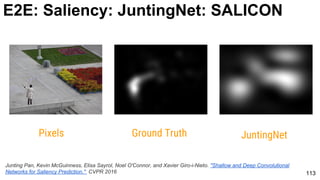
JuntingNetGround TruthPixels
E2E: Saliency: JuntingNet: SALICON
Junting Pan, Kevin McGuinness, Elisa Sayrol, Noel O'Connor, and Xavier Giro-i-Nieto. "Shallow and Deep Convolutional
Networks for Saliency Prediction." CVPR 2016
114
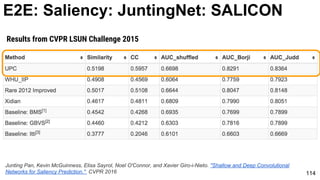
Results from CVPR LSUN Challenge 2015
E2E: Saliency: JuntingNet: SALICON
Junting Pan, Kevin McGuinness, Elisa Sayrol, Noel O'Connor, and Xavier Giro-i-Nieto. "Shallow and Deep Convolutional
Networks for Saliency Prediction." CVPR 2016
115
E2E: Saliency: JuntingNet
Junting Pan, Kevin McGuinness, Elisa Sayrol, Noel O'Connor, and Xavier Giro-i-Nieto. "Shallow and Deep Convolutional
Networks for Saliency Prediction." CVPR 2016
116
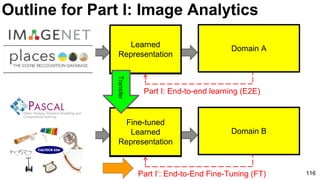
Part I: End-to-end learning (E2E)
Domain B
Fine-tuned
Learned
Representation
Part I’: End-to-End Fine-Tuning (FT)
Part I: End-to-end learning (E2E)
Domain ALearned
Representation
Part I: End-to-end learning (E2E)
Transfer
Outline for Part I: Image Analytics
117
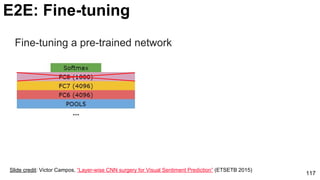
E2E: Fine-tuning
Fine-tuning a pre-trained network
Slide credit: Victor Campos, “Layer-wise CNN surgery for Visual Sentiment Prediction” (ETSETB 2015)
118
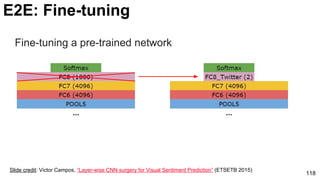
E2E: Fine-tuning
Slide credit: Victor Campos, “Layer-wise CNN surgery for Visual Sentiment Prediction” (ETSETB 2015)
Fine-tuning a pre-trained network
119
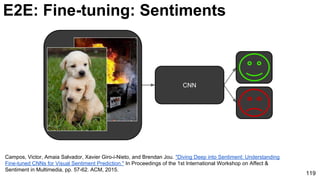
E2E: Fine-tuning: Sentiments
CNN
Campos, Victor, Amaia Salvador, Xavier Giro-i-Nieto, and Brendan Jou. "Diving Deep into Sentiment: Understanding
Fine-tuned CNNs for Visual Sentiment Prediction." In Proceedings of the 1st International Workshop on Affect &
Sentiment in Multimedia, pp. 57-62. ACM, 2015.
120
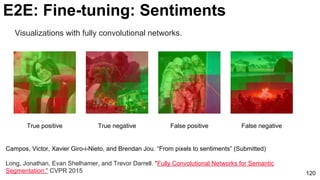
Campos, Victor, Xavier Giro-i-Nieto, and Brendan Jou. “From pixels to sentiments” (Submitted)
Long, Jonathan, Evan Shelhamer, and Trevor Darrell. "Fully Convolutional Networks for Semantic
Segmentation." CVPR 2015
E2E: Fine-tuning: Sentiments
True positive True negative False positive False negative
Visualizations with fully convolutional networks.
121
E2E: Fine-tuning: Cultural events
ChaLearn Workshop
A. Salvador, Zeppelzauer, M., Manchon-Vizuete, D., Calafell-Orós, A., and Giró-i-Nieto, X., “Cultural
Event Recognition with Visual ConvNets and Temporal Models”, in CVPR ChaLearn Looking at People
Workshop 2015, 2015. [slides]
122
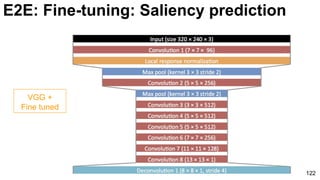
VGG +
Fine tuned
E2E: Fine-tuning: Saliency prediction
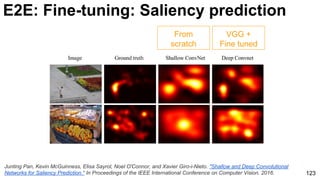
123
E2E: Fine-tuning: Saliency prediction
Junting Pan, Kevin McGuinness, Elisa Sayrol, Noel O'Connor, and Xavier Giro-i-Nieto. "Shallow and Deep Convolutional
Networks for Saliency Prediction." In Proceedings of the IEEE International Conference on Computer Vision. 2016.
From
scratch
VGG +
Fine tuned
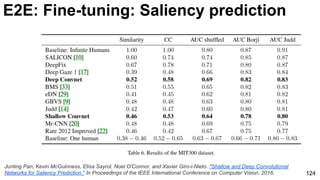
124
E2E: Fine-tuning: Saliency prediction
Junting Pan, Kevin McGuinness, Elisa Sayrol, Noel O'Connor, and Xavier Giro-i-Nieto. "Shallow and Deep Convolutional
Networks for Saliency Prediction." In Proceedings of the IEEE International Conference on Computer Vision. 2016.
125
Task A
(eg. image classification)
Learned
Representation
Part I: End-to-end learning (E2E)
Task B
(eg. image retrieval)
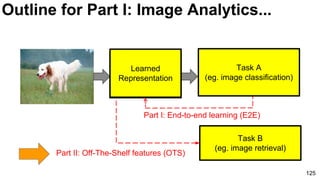
Part II: Off-The-Shelf features (OTS)
Outline for Part I: Image Analytics...
126
Razavian, Ali, Hossein Azizpour, Josephine Sullivan, and Stefan Carlsson. "CNN features off-the-shelf:
an astounding baseline for recognition." CVPRW 2014
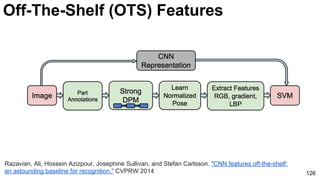
Off-The-Shelf (OTS) Features
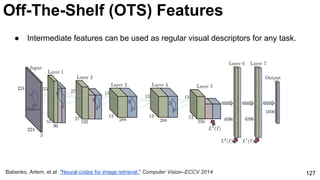
● Intermediate features can be used as regular visual descriptors for any task.
127
Off-The-Shelf (OTS) Features
Babenko, Artem, et al. "Neural codes for image retrieval." Computer Vision–ECCV 2014
128
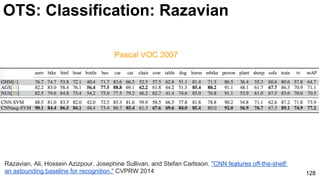
OTS: Classification: Razavian
Razavian, Ali, Hossein Azizpour, Josephine Sullivan, and Stefan Carlsson. "CNN features off-the-shelf:
an astounding baseline for recognition." CVPRW 2014
Pascal VOC 2007
129
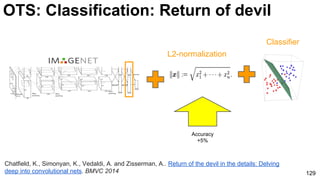
OTS: Classification: Return of devil
Chatfield, K., Simonyan, K., Vedaldi, A. and Zisserman, A.. Return of the devil in the details: Delving
deep into convolutional nets. BMVC 2014
Classifier
L2-normalization
Accuracy
+5%
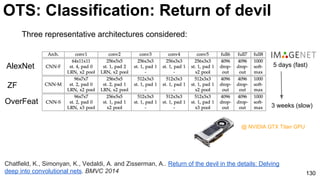
Three representative architectures considered:
AlexNet
ZF
OverFeat
5 days (fast)
3 weeks (slow)
@ NVIDIA GTX Titan GPU
130
OTS: Classification: Return of devil
Chatfield, K., Simonyan, K., Vedaldi, A. and Zisserman, A.. Return of the devil in the details: Delving
deep into convolutional nets. BMVC 2014
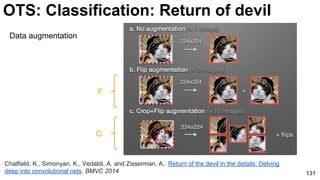
F
C
131
OTS: Classification: Return of devil
Data augmentation
Chatfield, K., Simonyan, K., Vedaldi, A. and Zisserman, A.. Return of the devil in the details: Delving
deep into convolutional nets. BMVC 2014
132
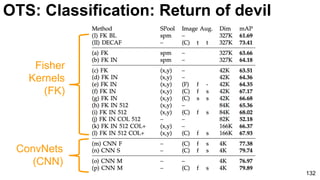
OTS: Classification: Return of devil
Fisher
Kernels
(FK)
ConvNets
(CNN)
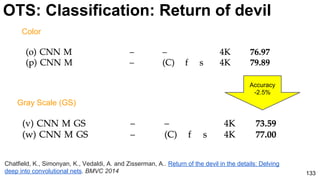
Color
Gray Scale (GS)
Accuracy
-2.5%
133
OTS: Classification: Return of devil
Chatfield, K., Simonyan, K., Vedaldi, A. and Zisserman, A.. Return of the devil in the details: Delving
deep into convolutional nets. BMVC 2014
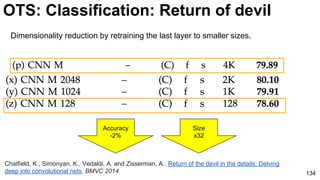
Dimensionality reduction by retraining the last layer to smaller sizes.
Accuracy
-2%
Size
x32
134
OTS: Classification: Return of devil
Chatfield, K., Simonyan, K., Vedaldi, A. and Zisserman, A.. Return of the devil in the details: Delving
deep into convolutional nets. BMVC 2014
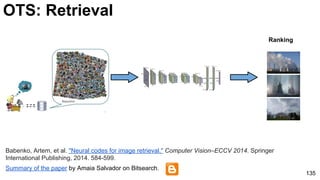
Ranking
Summary of the paper by Amaia Salvador on Bitsearch.
Babenko, Artem, et al. "Neural codes for image retrieval." Computer Vision–ECCV 2014. Springer
International Publishing, 2014. 584-599.
135
OTS: Retrieval
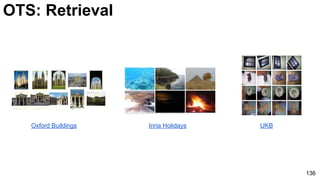
Oxford Buildings Inria Holidays UKB
136
OTS: Retrieval
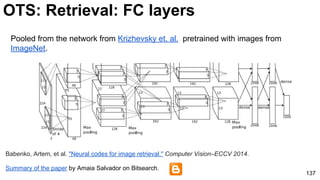
Pooled from the network from Krizhevsky et. al. pretrained with images from
ImageNet.
137
OTS: Retrieval: FC layers
Summary of the paper by Amaia Salvador on Bitsearch.
Babenko, Artem, et al. "Neural codes for image retrieval." Computer Vision–ECCV 2014.
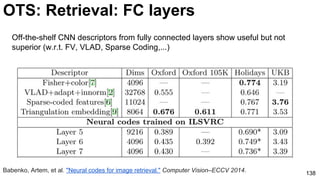
Off-the-shelf CNN descriptors from fully connected layers show useful but not
superior (w.r.t. FV, VLAD, Sparse Coding,...)
138Babenko, Artem, et al. "Neural codes for image retrieval." Computer Vision–ECCV 2014.
OTS: Retrieval: FC layers
Razavian et al, A baseline for visual instance retrieval with deep convolutional networks, ICLR 2015.
139
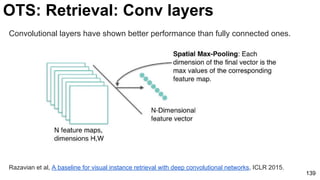
Convolutional layers have shown better performance than fully connected ones.
OTS: Retrieval: Conv layers
Razavian et al, A baseline for visual instance retrieval with deep convolutional networks, ICLR 2015.
140
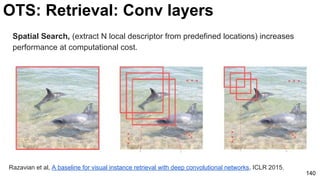
Spatial Search, (extract N local descriptor from predefined locations) increases
performance at computational cost.
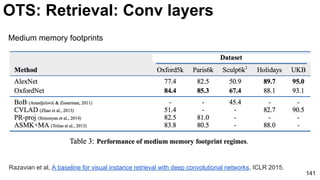
Medium memory footprints
Razavian et al, A baseline for visual instance retrieval with deep convolutional networks, ICLR 2015.
141
OTS: Retrieval: Conv layers
142
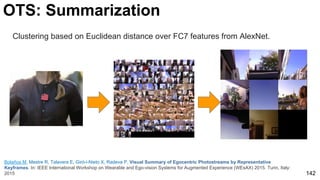
OTS: Summarization
Bolaños M, Mestre R, Talavera E, Giró-i-Nieto X, Radeva P. Visual Summary of Egocentric Photostreams by Representative
Keyframes. In: IEEE International Workshop on Wearable and Ego-vision Systems for Augmented Experience (WEsAX) 2015. Turin, Italy:
2015
Clustering based on Euclidean distance over FC7 features from AlexNet.
143
Thank you !
https://imatge.upc.edu/web/people/xavier-giro
https://twitter.com/DocXavi
https://www.facebook.com/ProfessorXavi
xavier.giro@upc.edu
Xavier Giró-i-Nieto

Deep Learning for Computer Vision (1/4): Image Analytics @ laSalle 2016

  • 1.
    @DocXavi Deep Learning forComputer Vision Image Analytics 5 May 2016 Xavier Giró-i-Nieto Master en Creació Multimedia
  • 2.
  • 3.
    3 Introduction Xavier Giro-i-Nieto • Web:https://imatge.upc.edu/web/people/xavier-giro Associate Professor at Universitat Politecnica de Catalunya (UPC)
  • 4.
  • 5.
  • 6.
    One lecture organizedin three parts 6 Images (global) Objects (local) Deep ConvNets for Recognition for... Video (2D+T)
  • 7.
    One lecture organizedin three parts 7 Images (global) Objects (local) Deep ConvNets for Recognition for... Video (2D+T)
  • 8.
    Previously, before deeplearning... 8Slide credit: Jose M Àlvarez Dog
  • 9.
    9Slide credit: JoseM Àlvarez Dog Learned Representation Previously, before deep learning...
  • 10.
    Outline for PartI: Image Analytics... 10 Dog Learned Representation Part I: End-to-end learning (E2E)
  • 11.
    11 Learned Representation Part I: End-to-endlearning (E2E) Task A (eg. image classification) Outline for Part I: Image Analytics...
  • 12.
    12 Task A (eg. imageclassification) Learned Representation Part I: End-to-end learning (E2E) Task B (eg. image retrieval)Part II: Off-the-shelf features Outline for Part I: Image Analytics...
  • 13.
    13 Task A (eg. imageclassification) Learned Representation Part I: End-to-end learning (E2E) Task B (eg. image retrieval)Part II: Off-the-shelf features Outline for Part I: Image Analytics...
  • 14.
    E2E: Classification: Supervisedlearning 14 Manual Annotations Model New Image Automatic classification Training Test Anchor
  • 15.
    E2E: Classification: LeNet-5 15 LeCun,Y., Bottou, L., Bengio, Y., & Haffner, P. (1998). Gradient-based learning applied to document recognition. Proceedings of the IEEE, 86(11), 2278- 2324.
  • 16.
    E2E: Classification: LeNet-5 16 Demo:3D Visualization of a Convolutional Neural Network Harley, Adam W. "An Interactive Node-Link Visualization of Convolutional Neural Networks." In Advances in Visual Computing, pp. 867-877. Springer International Publishing, 2015.
  • 17.
    E2E: Classification: Similarto LeNet-5 17 Demo: Classify MNIST digits with a Convolutional Neural Network “ConvNetJS is a Javascript library for training Deep Learning models (mainly Neural Networks) entirely in your browser. Open a tab and you're training. No software requirements, no compilers, no installations, no GPUs, no sweat.”
  • 18.
    E2E: Classification: Databases 18 LiFei-Fei, “How we’re teaching computers to understand pictures” TEDTalks 2014. Russakovsky, O., Deng, J., Su, H., Krause, J., Satheesh, S., Ma, S., ... & Fei-Fei, L. (2015). Imagenet large scale visual recognition challenge. arXiv preprint arXiv:1409.0575. [web]
  • 19.
    19 E2E: Classification: Databases Russakovsky,O., Deng, J., Su, H., Krause, J., Satheesh, S., Ma, S., ... & Fei-Fei, L. (2015). Imagenet large scale visual recognition challenge. arXiv preprint arXiv:1409.0575. [web]
  • 20.
    20 Zhou, Bolei, AgataLapedriza, Jianxiong Xiao, Antonio Torralba, and Aude Oliva. "Learning deep features for scene recognition using places database." In Advances in neural information processing systems, pp. 487-495. 2014. [web] E2E: Classification: Databases ● 205 scene classes (categories). ● Images: ○ 2.5M train ○ 20.5k validation ○ 41k test
  • 21.
    21 E2E: Classification: ImageNetILSRVC ● 1000 object classes (categories). ● Images: ○ 1.2 M train ○ 100k test.
  • 22.
    E2E: Classification: ImageNetILSRVC Russakovsky, O., Deng, J., Su, H., Krause, J., Satheesh, S., Ma, S., ... & Fei-Fei, L. (2015). Imagenet large scale visual recognition challenge. arXiv preprint arXiv:1409.0575. [web] ● Predict 5 classes.
  • 23.
    Slide credit: Rob Fergus(NYU) Image Classifcation 2012 -9.8% Russakovsky, O., Deng, J., Su, H., Krause, J., Satheesh, S., Ma, S., ... & Fei-Fei, L. (2014). Imagenet large scale visual recognition challenge. arXiv preprint arXiv:1409.0575. [web] 23 E2E: Classification: ILSRVC
  • 24.
    E2E: Classification: AlexNet(Supervision) 24Slide credit: Junting Pan, “Visual Saliency Prediction using Deep Learning Techniques” (ETSETB-UPC 2015) Orange A Krizhevsky, I Sutskever, GE Hinton “Imagenet classification with deep convolutional neural networks” Part of: Advances in Neural Information Processing Systems 25 (NIPS 2012)
  • 25.
    25Slide credit: JuntingPan, “Visual Saliency Prediction using Deep Learning Techniques” (ETSETB-UPC 2015) E2E: Classification: AlexNet (Supervision)
  • 26.
    26Slide credit: JuntingPan, “Visual Saliency Prediction using Deep Learning Techniques” (ETSETB-UPC 2015) E2E: Classification: AlexNet (Supervision)
  • 27.
    27Image credit: Deeplearning Tutorial (Stanford University) E2E: Classification: AlexNet (Supervision)
  • 28.
    28Image credit: Deeplearning Tutorial (Stanford University) E2E: Classification: AlexNet (Supervision)
  • 29.
    29Image credit: Deeplearning Tutorial (Stanford University) E2E: Classification: AlexNet (Supervision)
  • 30.
    30 Rectified Linear Unit (non-linearity) f(x) = max(0,x) Slidecredit: Junting Pan, “Visual Saliency Prediction using Deep Learning Techniques” (ETSETB-UPC 2015) E2E: Classification: AlexNet (Supervision)
  • 31.
    31 Dot Product Slide credit:Junting Pan, “Visual Saliency Prediction using Deep Learning Techniques” (ETSETB-UPC 2015) E2E: Classification: AlexNet (Supervision)
  • 32.
    ImageNet Classification 2013 Russakovsky,O., Deng, J., Su, H., Krause, J., Satheesh, S., Ma, S., ... & Fei-Fei, L. (2015). Imagenet large scale visual recognition challenge. arXiv preprint arXiv:1409.0575. [web] Slide credit: Rob Fergus (NYU) 32 E2E: Classification: ImageNet ILSRVC
  • 33.
    The development ofbetter convnets is reduced to trial-and- error. 33 E2E: Classification: Visualize: ZF Visualization can help in proposing better architectures. Zeiler, M. D., & Fergus, R. (2014). Visualizing and understanding convolutional networks. In Computer Vision–ECCV 2014 (pp. 818-833). Springer International Publishing.
  • 34.
    “A convnet modelthat uses the same components (filtering, pooling) but in reverse, so instead of mapping pixels to features does the opposite.” Zeiler, Matthew D., Graham W. Taylor, and Rob Fergus. "Adaptive deconvolutional networks for mid and high level feature learning." Computer Vision (ICCV), 2011 IEEE International Conference on. IEEE, 2011. 34 E2E: Classification: Visualize: ZF
  • 35.
    Zeiler, M. D.,& Fergus, R. (2014). Visualizing and understanding convolutional networks. In Computer Vision–ECCV 2014 (pp. 818-833). Springer International Publishing. DeconvN et Conv Net 35 E2E: Classification: Visualize: ZF
  • 36.
  • 37.
  • 38.
  • 39.
    “To examine agiven convnet activation, we set all other activations in the layer to zero and pass the feature maps as input to the attached deconvnet layer.” 39 E2E: Classification: Visualize: ZF
  • 40.
  • 41.
    “(i) Unpool: Inthe convnet, the max pooling operation is non-invertible, however we can obtain an approximate inverse by recording the locations of the maxima within each pooling region in a set of switch variables.” 41 E2E: Classification: Visualize: ZF
  • 42.
    XX “(ii) Rectification: Theconvnet uses ReLU non-linearities, which rectify the feature maps thus ensuring the feature maps are always positive.” 42 E2E: Classification: Visualize: ZF
  • 43.
    “(iii) Filtering: Theconvnet uses learned filters to convolve the feature maps from the previous layer. To approximately invert this, the deconvnet uses transposed versions of the same filters (as other autoencoder models, such as RBMs), but applied to the rectified maps, not the output of the layer beneath. In practice this means flipping each filter vertically and horizontally. XX XX 43 E2E: Classification: Visualize: ZF
  • 44.
    “(iii) Filtering: Theconvnet uses learned filters to convolve the feature maps from the previous layer. To approximately invert this, the deconvnet uses transposed versions of the same filters (as other autoencoder models, such as RBMs), but applied to the rectified maps, not the output of the layer beneath. In practice this means flipping each filter vertically and horizontally. XX XX 44 E2E: Classification: Visualize: ZF
  • 45.
    45 Top 9 activationsin a random subset of feature maps across the validation data, projected down to pixel space using our deconvolutional network approach. Corresponding image patches. E2E: Classification: Visualize: ZF
  • 46.
  • 47.
  • 48.
  • 49.
    Zeiler, M. D.,& Fergus, R. (2014). Visualizing and understanding convolutional networks. In Computer Vision–ECCV 2014 (pp. 818-833). Springer International Publishing. 49 E2E: Classification: Visualize: ZF
  • 50.
    Zeiler, M. D.,& Fergus, R. (2014). Visualizing and understanding convolutional networks. In Computer Vision–ECCV 2014 (pp. 818-833). Springer International Publishing. 50 E2E: Classification: Visualize: ZF
  • 51.
    51 The smaller stride(2 vs 4) and filter size (7x7 vs 11x11) results in more distinctive features and fewer “dead" features. AlexNet (Layer 1) Clarifai (Layer 1) E2E: Classification: Visualize: ZF
  • 52.
    52 Cleaner features inClarifai, without the aliasing artifacts caused by the stride 4 used in AlexNet. AlexNet (Layer 2) Clarifai (Layer 2) E2E: Classification: Visualize: ZF
  • 53.
    53 Regularization with dropout: Reductionof overfitting by setting to zero the output of a portion (typically 50%) of each intermediate neuron. Hinton, G. E., Srivastava, N., Krizhevsky, A., Sutskever, I., & Salakhutdinov, R. R. (2012). Improving neural networks by preventing co-adaptation of feature detectors. arXiv preprint arXiv:1207.0580. Chicago E2E: Classification: Dropout: ZF
  • 54.
  • 55.
  • 56.
    ImageNet Classification 2013 Russakovsky,O., Deng, J., Su, H., Krause, J., Satheesh, S., Ma, S., ... & Fei-Fei, L. (2015). Imagenet large scale visual recognition challenge. arXiv preprint arXiv:1409.0575. [web] -5% Slide credit: Rob Fergus (NYU) 56 E2E: Classification: ImageNet ILSRVC
  • 57.
    ImageNet Classification 2013 Russakovsky,O., Deng, J., Su, H., Krause, J., Satheesh, S., Ma, S., ... & Fei-Fei, L. (2015). Imagenet large scale visual recognition challenge. arXiv preprint arXiv:1409.0575. [web] -5% Slide credit: Rob Fergus (NYU) 57 E2E: Classification: ImageNet ILSRVC
  • 58.
  • 59.
  • 60.
    E2E: Classification: GoogLeNet 60 ●22 layers, but 12 times fewer parameters than AlexNet. Szegedy, Christian, Wei Liu, Yangqing Jia, Pierre Sermanet, Scott Reed, Dragomir Anguelov, Dumitru Erhan, Vincent Vanhoucke, and Andrew Rabinovich. "Going deeper with convolutions."
  • 61.
    E2E: Classification: GoogLeNet 61 ●Challenges of going deeper: ○ Overfitting, due to the increase amount of parameters. ○ Inefficient computation if most weights end up close to zero. Solution Sparsity How ? Inception modules
  • 62.
  • 63.
    E2E: Classification: GoogLeNet 63 Lin,Min, Qiang Chen, and Shuicheng Yan. "Network in network." ICLR 2014.
  • 64.
    E2E: Classification: GoogLeNet 64 Lin,Min, Qiang Chen, and Shuicheng Yan. "Network in network." ICLR 2014.
  • 65.
    E2E: Classification: GoogLeNet(NiN) 65 3x3 and 5x5 convolutions deal with different scales. Lin, Min, Qiang Chen, and Shuicheng Yan. "Network in network." ICLR 2014. [Slides]
  • 66.
    66 1x1 convolutions doesdimensionality reduction (c3<c2) and accounts for rectified linear units (ReLU). Lin, Min, Qiang Chen, and Shuicheng Yan. "Network in network." ICLR 2014. [Slides] E2E: Classification: GoogLeNet (NiN)
  • 67.
    67 In NiN, theCascaded 1x1 Convolutions compute reductions after the convolutions. Lin, Min, Qiang Chen, and Shuicheng Yan. "Network in network." ICLR 2014. [Slides] E2E: Classification: GoogLeNet (NiN)
  • 68.
    E2E: Classification: GoogLeNet 68 InGoogLeNet, the Cascaded 1x1 Convolutions compute reductions before the expensive 3x3 and 5x5 convolutions.
  • 69.
    E2E: Classification: GoogLeNet 69 Lin,Min, Qiang Chen, and Shuicheng Yan. "Network in network." ICLR 2014.
  • 70.
    E2E: Classification: GoogLeNet 70 3x3max pooling introduces somewhat spatial invariance, and has proven a benefitial effect by adding an alternative parallel path.
  • 71.
    E2E: Classification: GoogLeNet 71 TwoSoftmax Classifiers at intermediate layers combat the vanishing gradient while providing regularization at training time. ...and no fully connected layers needed !
  • 72.
  • 73.
    E2E: Classification: GoogLeNet 73NVIDIA,“NVIDIA and IBM CLoud Support ImageNet Large Scale Visual Recognition Challenge” (2015)
  • 74.
    E2E: Classification: GoogLeNet 74 Szegedy,Christian, Wei Liu, Yangqing Jia, Pierre Sermanet, Scott Reed, Dragomir Anguelov, Dumitru Erhan, Vincent Vanhoucke, and Andrew Rabinovich. "Going deeper with convolutions." CVPR 2015. [video] [slides] [poster]
  • 75.
    E2E: Classification: VGG 75 Simonyan,Karen, and Andrew Zisserman. "Very deep convolutional networks for large-scale image recognition." International Conference on Learning Representations (2015). [video] [slides] [project]
  • 76.
    E2E: Classification: VGG 76 Simonyan,Karen, and Andrew Zisserman. "Very deep convolutional networks for large-scale image recognition." International Conference on Learning Representations (2015). [video] [slides] [project]
  • 77.
    E2E: Classification: VGG:3x3 Stacks 77 Simonyan, Karen, and Andrew Zisserman. "Very deep convolutional networks for large-scale image recognition." International Conference on Learning Representations (2015). [video] [slides] [project]
  • 78.
    E2E: Classification: VGG 78 Simonyan,Karen, and Andrew Zisserman. "Very deep convolutional networks for large-scale image recognition." International Conference on Learning Representations (2015). [video] [slides] [project] ● No poolings between some convolutional layers. ● Convolution strides of 1 (no skipping).
  • 79.
    E2E: Classification 79 3.6% top5 error… with 152 layers !!
  • 80.
    E2E: Classification: ResNet 80 He,Kaiming, Xiangyu Zhang, Shaoqing Ren, and Jian Sun. "Deep Residual Learning for Image Recognition." arXiv preprint arXiv:1512.03385 (2015). [slides]
  • 81.
    E2E: Classification: ResNet 81 ●Deeper networks (34 is deeper than 18) are more difficult to train. He, Kaiming, Xiangyu Zhang, Shaoqing Ren, and Jian Sun. "Deep Residual Learning for Image Recognition." arXiv preprint arXiv:1512.03385 (2015). [slides] Thin curves: training error Bold curves: validation error
  • 82.
    E2E: Classification: ResNet 82 ●Residual learning: reformulate the layers as learning residual functions with reference to the layer inputs, instead of learning unreferenced functions He, Kaiming, Xiangyu Zhang, Shaoqing Ren, and Jian Sun. "Deep Residual Learning for Image Recognition." arXiv preprint arXiv:1512.03385 (2015). [slides]
  • 83.
    E2E: Classification: ResNet 83 He,Kaiming, Xiangyu Zhang, Shaoqing Ren, and Jian Sun. "Deep Residual Learning for Image Recognition." arXiv preprint arXiv:1512.03385 (2015). [slides]
  • 84.
    84 E2E: Classification: Humans Russakovsky,O., Deng, J., Su, H., Krause, J., Satheesh, S., Ma, S., ... & Fei-Fei, L. (2015). Imagenet large scale visual recognition challenge. arXiv preprint arXiv:1409.0575. [web]
  • 85.
    85 E2E: Classification: Humans “Isthis a Border terrier” ? Crowdsourcing Yes No ● Binary ground truth annotation from the crowd. Russakovsky, O., Deng, J., Su, H., Krause, J., Satheesh, S., Ma, S., ... & Fei-Fei, L. (2015). Imagenet large scale visual recognition challenge. arXiv preprint arXiv:1409.0575. [web]
  • 86.
    86 ● Annotation Problems: Carlier,Axel, Amaia Salvador, Ferran Cabezas, Xavier Giro-i-Nieto, Vincent Charvillat, and Oge Marques. "Assessment of crowdsourcing and gamification loss in user-assisted object segmentation." Multimedia Tools and Applications (2015): 1-28. Russakovsky, O., Deng, J., Su, H., Krause, J., Satheesh, S., Ma, S., ... & Fei-Fei, L. (2015). Imagenet large scale visual recognition challenge. arXiv preprint arXiv:1409.0575. [web] Crowdsource loss (0.3%) More than 5 objects classes E2E: Classification: Humans
  • 87.
    87 Andrej Karpathy, “WhatI learned from competing against a computer on ImageNet” (2014) ● Test data collection from one human. [interface] E2E: Classification: Humans
  • 88.
    88 Andrej Karpathy, “WhatI learned from competing against a computer on ImageNet” (2014) ● Test data collection from one human. [interface] “Aww, a cute dog! Would you like to spend 5 minutes scrolling through 120 breeds of dog to guess what species it is ?” E2E: Classification: Humans
  • 89.
    E2E: Classification: Humans 89 NVIDIA,“Mocha.jl: Deep Learning for Julia” (2015) ResNet
  • 90.
  • 91.
  • 92.
  • 93.
  • 94.
  • 95.
  • 96.
    96 E2E: Saliency Slide credit:Junting Pan, “Visual Saliency Prediction using Deep Learning Techniques” (ETSETB 2015)
  • 97.
    97 Eye Tracker MouseClick Slide credit: Junting Pan, “Visual Saliency Prediction using Deep Learning Techniques” (ETSETB 2015) E2E: Saliency
  • 98.
    98 E2E: Saliency: JuntingNet JuntingPan, Kevin McGuinness, Elisa Sayrol, Noel O'Connor, and Xavier Giro-i-Nieto. "Shallow and Deep Convolutional Networks for Saliency Prediction." CVPR 2016
  • 99.
    99 E2E: Saliency: JuntingNet JuntingPan, Kevin McGuinness, Elisa Sayrol, Noel O'Connor, and Xavier Giro-i-Nieto. "Shallow and Deep Convolutional Networks for Saliency Prediction." CVPR 2016
  • 100.
    100 TRAIN VALIDATION TEST 10,0005,000 5,000 6,000 926 2,000 CAT2000 [Borji’15] 2,000 - 2,000 MIT300 [Judd’12] 300 - -Large Scale E2E: Saliency: JuntingNet Junting Pan, Kevin McGuinness, Elisa Sayrol, Noel O'Connor, and Xavier Giro-i-Nieto. "Shallow and Deep Convolutional Networks for Saliency Prediction." CVPR 2016
  • 101.
  • 102.
  • 103.
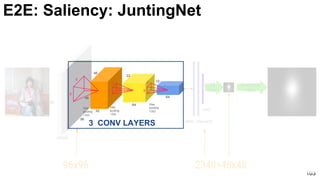
    103 Upsample + filter 2D map 96x96 2340=48x48 3CONV LAYERS E2E: Saliency: JuntingNet
  • 104.
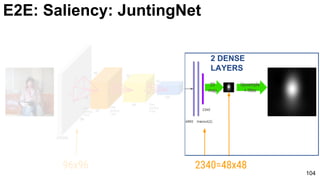
    104 Upsample + filter 2D map 96x96 2340=48x48 2DENSE LAYERS E2E: Saliency: JuntingNet
  • 105.
  • 106.
  • 107.
    107 Loss function MeanSquare Error (MSE) Weight initialization Gaussian distribution Learning rate 0.03 to 0.0001 Mini batch size 128 Training time 7h (SALICON) / 4h (iSUN) Acceleration SGD+ nesterov momentum (0.9) Regularisation Maxout norm GPU NVidia GTX 980 E2E: Saliency: JuntingNet Junting Pan, Kevin McGuinness, Elisa Sayrol, Noel O'Connor, and Xavier Giro-i-Nieto. "Shallow and Deep Convolutional Networks for Saliency Prediction." CVPR 2016
  • 108.
    108 Number of iterations (Trainingtime) ● Back-propagation with the Euclidean distance. ● Training curve for the SALICON database. E2E: Saliency: JuntingNet Junting Pan, Kevin McGuinness, Elisa Sayrol, Noel O'Connor, and Xavier Giro-i-Nieto. "Shallow and Deep Convolutional Networks for Saliency Prediction." CVPR 2016
  • 109.
    109 JuntingNetGround TruthPixels E2E: Saliency:JuntingNet: iSUN Junting Pan, Kevin McGuinness, Elisa Sayrol, Noel O'Connor, and Xavier Giro-i-Nieto. "Shallow and Deep Convolutional Networks for Saliency Prediction." CVPR 2016
  • 110.
    110 JuntingNetGround TruthPixels E2E: Saliency:JuntingNet: iSUN Junting Pan, Kevin McGuinness, Elisa Sayrol, Noel O'Connor, and Xavier Giro-i-Nieto. "Shallow and Deep Convolutional Networks for Saliency Prediction." CVPR 2016
  • 111.
    111 Results from CVPRLSUN Challenge 2015 E2E: Saliency: JuntingNet: iSUN Junting Pan, Kevin McGuinness, Elisa Sayrol, Noel O'Connor, and Xavier Giro-i-Nieto. "Shallow and Deep Convolutional Networks for Saliency Prediction." CVPR 2016
  • 112.
    112 JuntingNetGround TruthPixels E2E: Saliency:JuntingNet: SALICON Junting Pan, Kevin McGuinness, Elisa Sayrol, Noel O'Connor, and Xavier Giro-i-Nieto. "Shallow and Deep Convolutional Networks for Saliency Prediction." CVPR 2016
  • 113.
    113 JuntingNetGround TruthPixels E2E: Saliency:JuntingNet: SALICON Junting Pan, Kevin McGuinness, Elisa Sayrol, Noel O'Connor, and Xavier Giro-i-Nieto. "Shallow and Deep Convolutional Networks for Saliency Prediction." CVPR 2016
  • 114.
    114 Results from CVPRLSUN Challenge 2015 E2E: Saliency: JuntingNet: SALICON Junting Pan, Kevin McGuinness, Elisa Sayrol, Noel O'Connor, and Xavier Giro-i-Nieto. "Shallow and Deep Convolutional Networks for Saliency Prediction." CVPR 2016
  • 115.
    115 E2E: Saliency: JuntingNet JuntingPan, Kevin McGuinness, Elisa Sayrol, Noel O'Connor, and Xavier Giro-i-Nieto. "Shallow and Deep Convolutional Networks for Saliency Prediction." CVPR 2016
  • 116.
    116 Part I: End-to-endlearning (E2E) Domain B Fine-tuned Learned Representation Part I’: End-to-End Fine-Tuning (FT) Part I: End-to-end learning (E2E) Domain ALearned Representation Part I: End-to-end learning (E2E) Transfer Outline for Part I: Image Analytics
  • 117.
    117 E2E: Fine-tuning Fine-tuning apre-trained network Slide credit: Victor Campos, “Layer-wise CNN surgery for Visual Sentiment Prediction” (ETSETB 2015)
  • 118.
    118 E2E: Fine-tuning Slide credit:Victor Campos, “Layer-wise CNN surgery for Visual Sentiment Prediction” (ETSETB 2015) Fine-tuning a pre-trained network
  • 119.
    119 E2E: Fine-tuning: Sentiments CNN Campos,Victor, Amaia Salvador, Xavier Giro-i-Nieto, and Brendan Jou. "Diving Deep into Sentiment: Understanding Fine-tuned CNNs for Visual Sentiment Prediction." In Proceedings of the 1st International Workshop on Affect & Sentiment in Multimedia, pp. 57-62. ACM, 2015.
  • 120.
    120 Campos, Victor, XavierGiro-i-Nieto, and Brendan Jou. “From pixels to sentiments” (Submitted) Long, Jonathan, Evan Shelhamer, and Trevor Darrell. "Fully Convolutional Networks for Semantic Segmentation." CVPR 2015 E2E: Fine-tuning: Sentiments True positive True negative False positive False negative Visualizations with fully convolutional networks.
  • 121.
    121 E2E: Fine-tuning: Culturalevents ChaLearn Workshop A. Salvador, Zeppelzauer, M., Manchon-Vizuete, D., Calafell-Orós, A., and Giró-i-Nieto, X., “Cultural Event Recognition with Visual ConvNets and Temporal Models”, in CVPR ChaLearn Looking at People Workshop 2015, 2015. [slides]
  • 122.
    122 VGG + Fine tuned E2E:Fine-tuning: Saliency prediction
  • 123.
    123 E2E: Fine-tuning: Saliencyprediction Junting Pan, Kevin McGuinness, Elisa Sayrol, Noel O'Connor, and Xavier Giro-i-Nieto. "Shallow and Deep Convolutional Networks for Saliency Prediction." In Proceedings of the IEEE International Conference on Computer Vision. 2016. From scratch VGG + Fine tuned
  • 124.
    124 E2E: Fine-tuning: Saliencyprediction Junting Pan, Kevin McGuinness, Elisa Sayrol, Noel O'Connor, and Xavier Giro-i-Nieto. "Shallow and Deep Convolutional Networks for Saliency Prediction." In Proceedings of the IEEE International Conference on Computer Vision. 2016.
  • 125.
    125 Task A (eg. imageclassification) Learned Representation Part I: End-to-end learning (E2E) Task B (eg. image retrieval) Part II: Off-The-Shelf features (OTS) Outline for Part I: Image Analytics...
  • 126.
    126 Razavian, Ali, HosseinAzizpour, Josephine Sullivan, and Stefan Carlsson. "CNN features off-the-shelf: an astounding baseline for recognition." CVPRW 2014 Off-The-Shelf (OTS) Features
  • 127.
    ● Intermediate featurescan be used as regular visual descriptors for any task. 127 Off-The-Shelf (OTS) Features Babenko, Artem, et al. "Neural codes for image retrieval." Computer Vision–ECCV 2014
  • 128.
    128 OTS: Classification: Razavian Razavian,Ali, Hossein Azizpour, Josephine Sullivan, and Stefan Carlsson. "CNN features off-the-shelf: an astounding baseline for recognition." CVPRW 2014 Pascal VOC 2007
  • 129.
    129 OTS: Classification: Returnof devil Chatfield, K., Simonyan, K., Vedaldi, A. and Zisserman, A.. Return of the devil in the details: Delving deep into convolutional nets. BMVC 2014 Classifier L2-normalization Accuracy +5%
  • 130.
    Three representative architecturesconsidered: AlexNet ZF OverFeat 5 days (fast) 3 weeks (slow) @ NVIDIA GTX Titan GPU 130 OTS: Classification: Return of devil Chatfield, K., Simonyan, K., Vedaldi, A. and Zisserman, A.. Return of the devil in the details: Delving deep into convolutional nets. BMVC 2014
  • 131.
    F C 131 OTS: Classification: Returnof devil Data augmentation Chatfield, K., Simonyan, K., Vedaldi, A. and Zisserman, A.. Return of the devil in the details: Delving deep into convolutional nets. BMVC 2014
  • 132.
    132 OTS: Classification: Returnof devil Fisher Kernels (FK) ConvNets (CNN)
  • 133.
    Color Gray Scale (GS) Accuracy -2.5% 133 OTS:Classification: Return of devil Chatfield, K., Simonyan, K., Vedaldi, A. and Zisserman, A.. Return of the devil in the details: Delving deep into convolutional nets. BMVC 2014
  • 134.
    Dimensionality reduction byretraining the last layer to smaller sizes. Accuracy -2% Size x32 134 OTS: Classification: Return of devil Chatfield, K., Simonyan, K., Vedaldi, A. and Zisserman, A.. Return of the devil in the details: Delving deep into convolutional nets. BMVC 2014
  • 135.
    Ranking Summary of thepaper by Amaia Salvador on Bitsearch. Babenko, Artem, et al. "Neural codes for image retrieval." Computer Vision–ECCV 2014. Springer International Publishing, 2014. 584-599. 135 OTS: Retrieval
  • 136.
    Oxford Buildings InriaHolidays UKB 136 OTS: Retrieval
  • 137.
    Pooled from thenetwork from Krizhevsky et. al. pretrained with images from ImageNet. 137 OTS: Retrieval: FC layers Summary of the paper by Amaia Salvador on Bitsearch. Babenko, Artem, et al. "Neural codes for image retrieval." Computer Vision–ECCV 2014.
  • 138.
    Off-the-shelf CNN descriptorsfrom fully connected layers show useful but not superior (w.r.t. FV, VLAD, Sparse Coding,...) 138Babenko, Artem, et al. "Neural codes for image retrieval." Computer Vision–ECCV 2014. OTS: Retrieval: FC layers
  • 139.
    Razavian et al,A baseline for visual instance retrieval with deep convolutional networks, ICLR 2015. 139 Convolutional layers have shown better performance than fully connected ones. OTS: Retrieval: Conv layers
  • 140.
    OTS: Retrieval: Convlayers Razavian et al, A baseline for visual instance retrieval with deep convolutional networks, ICLR 2015. 140 Spatial Search, (extract N local descriptor from predefined locations) increases performance at computational cost.
  • 141.
    Medium memory footprints Razavianet al, A baseline for visual instance retrieval with deep convolutional networks, ICLR 2015. 141 OTS: Retrieval: Conv layers
  • 142.
    142 OTS: Summarization Bolaños M,Mestre R, Talavera E, Giró-i-Nieto X, Radeva P. Visual Summary of Egocentric Photostreams by Representative Keyframes. In: IEEE International Workshop on Wearable and Ego-vision Systems for Augmented Experience (WEsAX) 2015. Turin, Italy: 2015 Clustering based on Euclidean distance over FC7 features from AlexNet.
  • 143.