Apache Cassandra:

   Distributed DB for Massive Scale

                  Austin JUG
Stu Hood (@stuhood) – Technical Lead, Rackspace
               January 26th 2010
My, what a large/volatile dataset you
               have...
●   Large
    ●   Larger than 1 node can handle
●   Volatile
    ●   More than 25% (ish) writes
●   Expensive
    ●   More than you can afford with a commercial
        solution
My, what a large/volatile dataset you
               have...
●   For example
    ●   Event/log data
    ●   Output of batch processing or log analytics jobs
        –   In Hadoop, particularly
    ●   Social network relationships/updates
What about sharding?
●   shard n. - A horizontal partition in a database
    ●   Example: Sharding by userid
●   Limitations (for the partitioned dimension)
    ●   No more joins
    ●   No more indexes
What about sharding?
●   Options
    ●   Provided by ORM?
        –   Fixed partitions: manual rebalancing
    ●   Developing from scratch?
        –   Adding/removing nodes
        –   Handling failover
        –   As a library? As a middle tier?
What about sharding?


    Pain in the ass.
Case Study: Digg
1.Vertical partitioning and master/slave trees
2.Developed sharding solution
  ●   IDDB
  ●   Awkward replication, fragile scaling
3.Began populating Cassandra in parallel
  ●   Initial dataset for 'green badges'
      –   3 TB
      –   76 billion kv pairs
  ●   Most applications being ported to Cassandra
Relationship trouble: The NoSQL
           Movement
Lessons from the NoSQL Movement
●   Not Only SQL: Specialization!
    ●   Relational is not always the answer
    ●   Need highly specialized systems to distribute:
        –   Transactions
        –   Joins
    ●   Normalization strives to remove duplication
        –   But duplication is an interesting alternative to joins
Lessons from the NoSQL Movement
●   Understanding your data, finding the most efficient
    model
    ●   Key-value / Document
        –   Hint: already denormalized? fits in memcache?
        –   Cassandra, Riak, Voldemort, CouchDB, MongoDB
    ●   Graph/RDF
        –   Hint: frequent schema changes or deeply nested joins?
        –   Neo4j, Sesame
    ●   Column store
        –   Hint: all writes go to the end of a few tables?
        –   Cassandra, SDB, Hbase, Hypertable
Lessons from the NoSQL Movement
●   Replication is not one-size-fits-all
    ●   Facebook multi datacenter caching
        –   Writes occurring in one DC need to expire caches
            elsewhere
        –   Label events as requiring cache expiration
    ●   Google semi-synchronous replication patches
        –   Selective synchronous replication
    ●   Fragile write master
        –   DRBD for high availability
Lessons from the NoSQL Movement
●   Partition tolerance vs. consistency
    ●   Brewer's CAP Theorem
        –   Consistency, Availability, Partition tolerance
        –   Choose 2:
             ●   CA – Corruption possible if live nodes can’t communicate
                 (network partition)
             ●   CP – Completely inaccessible if any nodes are dead
             ●   AP – Always available, but may not always read most recent
    ●   Tunables!
        –   Cassandra chooses AP, but makes consistency
            configurable
Cassandra's Elders
Standing on the shoulders of:
             Amazon Dynamo
●   No node in the cluster is special
    ●   No special roles
    ●   No scaling bottlenecks
    ●   No single point of failure
●   Techniques
    ●   Gossip
    ●   Eventual consistency
Standing on the shoulders of:
              Google Bigtable
●   Column family data model
●   Range queries for rows:
    ●   Scan rows in order
●   Memtable/SSTable structure
    ●   Always writes sequentially to disk
    ●   Bloom filters to minimize random reads
    ●   Trounces B-Trees for big data
        –   Linear insert performance
        –   Log growth for reads
Enter Cassandra
●   Hybrid of ancestors
    ●   Adopts listed features
●   And adds:
    ●   A sweet logo!
    ●   Pluggable partitioning
    ●   Multi datacenter support
        –   Pluggable locality
            awareness
    ●   Datamodel
        improvements
Enter Cassandra
●   Project status
    ●   Open sourced by Facebook (no longer active)
    ●   Apache License
    ●   Incubating with Apache: graduation in progress
    ●   Major releases: 0.3, 0.4, 0.5 (this past weekend!)
Enter Cassandra
●   The code base
    ●   Java, Apache Ant, Git/SVN
    ●   5+ committers from 3+ companies
●   Known deployments at:
    ●   Rackspace, Digg, Twitter, Mahalo, SimpleGeo,
        Cloudkick
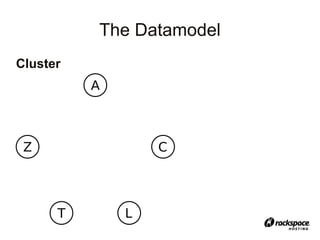
The Datamodel
Cluster
The Datamodel
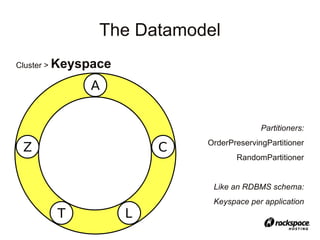
Cluster >   Keyspace


                                           Partitioners:
                             OrderPreservingPartitioner
                                    RandomPartitioner


                              Like an RDBMS schema:
                              Keyspace per application
The Datamodel
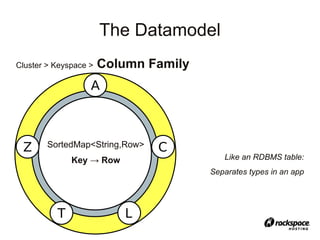
Cluster > Keyspace >   Column Family


        SortedMap<String,Row>
              Key → Row                   Like an RDBMS table:
                                       Separates types in an app
The Datamodel
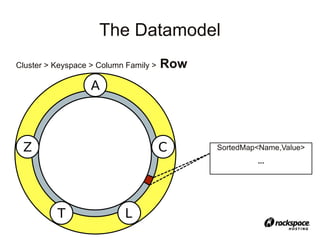
Cluster > Keyspace > Column Family >   Row


                                             SortedMap<Name,Value>
                                                      ...
The Datamodel
Cluster > Keyspace > Column Family > Row >   “Column”

                                                Not like an RDBMS column:
                                          Attribute of the row: each row can
                                        contain millions of different columns


                                                               …
                                                       Name → Value
                                                          byte[] → byte[]

                                                     +version timestamp
StatusApp: another Twitter clone.
StatusApp Example
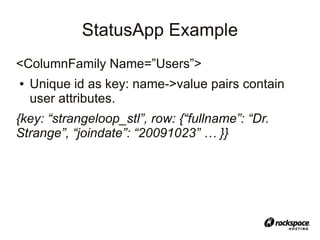
<ColumnFamily Name=”Users”>
●   Unique id as key: name->value pairs contain
    user attributes.
{key: “strangeloop_stl”, row: {“fullname”: “Dr.
Strange”, “joindate”: “20091023” … }}
StatusApp Example
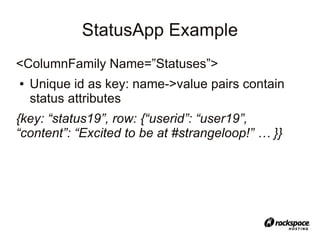
<ColumnFamily Name=”Statuses”>
●   Unique id as key: name->value pairs contain
    status attributes
{key: “status19”, row: {“userid”: “user19”,
“content”: “Excited to be at #strangeloop!” … }}
StatusApp Example
<ColumnFamily Name=”Timelines”
ColumnType=”Super”>
●   User id as key: row contains lists of timelines
    that the user cares about. Each list contains
    name:value pairs representing ordered statuses
{key: “user19”, row: {“personal”: [<timeuuid>:
“status19”, … ], “following”: [<timeuuid>:
“status21”, … ] }}
Client API
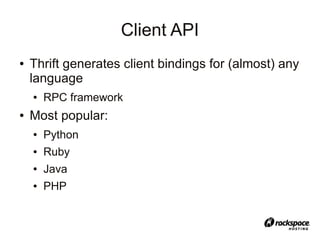
●   Thrift generates client bindings for (almost) any
    language
    ●   RPC framework
●   Most popular:
    ●   Python
    ●   Ruby
    ●   Java
    ●   PHP
Client API
1. Get the full name for a user:
●   get(keyspace, key, [column_family,
    column_name], consistency_level)
●   get(“statusapp”, “userid19”, [“Users”,
    “fullname”], ONE)
> “Dr. Strange”
Client API
2. Get the 50 most recent statuses in a user's
personal timeline:
●   get_slice(keyspace, key, [column_family,
    column_name], predicate, consistency_level)
●   get_slice(“statusapp”, “userid19”, [“Timelines”,
    “personal”], {start: ””, count: 50}, QUORUM)
> [<timeuuid>: “status19”, <timeuuid>: “status24”
…]
Consistency Levels?
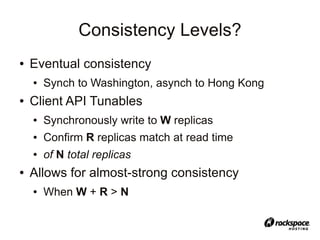
●   Eventual consistency
    ●   Synch to Washington, asynch to Hong Kong
●   Client API Tunables
    ●   Synchronously write to W replicas
    ●   Confirm R replicas match at read time
    ●   of N total replicas
●   Allows for almost-strong consistency
    ●   When W + R > N
Caveat consumptor
●   No secondary indexes:
    ●   Querying the content of rows always involves
        iterating over them
    ●   Example: Finding users with a certain last name
●   Solution: Manually maintain indexes
    ●   Implications:
        –   Indexes must by synced with the indexed data manually
        –   New indexes mean new writes, reads
Caveat consumptor
●   No joins:
    ●   No server side method to re-query based on a first
        query
●   Solution: Denormalize some queries, client join
    the rest
The bright side: Ops
●   Need N new nodes?
    ●   Start more nodes with the same config file
    ●   New nodes request load information from the
        cluster and join with a token that balances the
        cluster
The bright side: Ops
●   Dead drive?
    ●   Swap the drive, restart, run 'repair'
    ●   Streams missing data from other replicas
The bright side: Ops
●   Dead node?
    ●   Start a new node with the same IP and token, run
        'repair'
The bright side: Ops
●   Adding a datacenter?
    ●   Extend the 'EndpointSnitch' class to describe the
        location of your nodes
    ●   Add new nodes as before
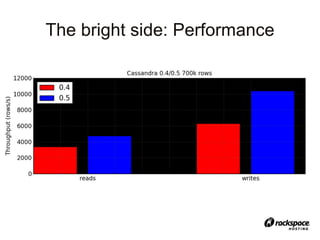
The bright side: Performance
Getting started
●   http://incubator.apache.org/cassandra/
●   Read "Getting Started"... Roughly:
    ●   Start one node
    ●   Test/develop app, editing node config as necessary
        –   Don't skip: exposes partitioner, data model
            strengths/weaknesses
    ●   Launch cluster by starting more nodes with chosen
        config
Getting started
●   Resources
    ●   http://incubator.apache.org/cassandra/
    ●   Wiki
    ●   Mailing List
    ●   #cassandra on freenode.net
Thanks!
Austin JUG
   UT
Rackspace
Questions?
References
●   Digg Technology Blog
    ●   http://about.digg.com/blog/looking-future-cassandra
    ●   http://about.digg.com/blog/introducing-digg’s-iddb-
        infrastructure
●   Cassandra Wiki
    ●   http://wiki.apache.org/cassandra/
●   Werner Vogels – Eventual Consistency
    ●   http://www.allthingsdistributed.com/2008/12/eventually_consist
        ent.html
●   Jonathan Ellis's Blog
    ●   http://spyced.blogspot.com/2010/01/cassandra-05.html

Cassandra Talk: Austin JUG

  • 1.
    Apache Cassandra: Distributed DB for Massive Scale Austin JUG Stu Hood (@stuhood) – Technical Lead, Rackspace January 26th 2010
  • 2.
    My, what alarge/volatile dataset you have... ● Large ● Larger than 1 node can handle ● Volatile ● More than 25% (ish) writes ● Expensive ● More than you can afford with a commercial solution
  • 3.
    My, what alarge/volatile dataset you have... ● For example ● Event/log data ● Output of batch processing or log analytics jobs – In Hadoop, particularly ● Social network relationships/updates
  • 4.
    What about sharding? ● shard n. - A horizontal partition in a database ● Example: Sharding by userid ● Limitations (for the partitioned dimension) ● No more joins ● No more indexes
  • 5.
    What about sharding? ● Options ● Provided by ORM? – Fixed partitions: manual rebalancing ● Developing from scratch? – Adding/removing nodes – Handling failover – As a library? As a middle tier?
  • 6.
    What about sharding? Pain in the ass.
  • 7.
    Case Study: Digg 1.Verticalpartitioning and master/slave trees 2.Developed sharding solution ● IDDB ● Awkward replication, fragile scaling 3.Began populating Cassandra in parallel ● Initial dataset for 'green badges' – 3 TB – 76 billion kv pairs ● Most applications being ported to Cassandra
  • 8.
  • 9.
    Lessons from theNoSQL Movement ● Not Only SQL: Specialization! ● Relational is not always the answer ● Need highly specialized systems to distribute: – Transactions – Joins ● Normalization strives to remove duplication – But duplication is an interesting alternative to joins
  • 10.
    Lessons from theNoSQL Movement ● Understanding your data, finding the most efficient model ● Key-value / Document – Hint: already denormalized? fits in memcache? – Cassandra, Riak, Voldemort, CouchDB, MongoDB ● Graph/RDF – Hint: frequent schema changes or deeply nested joins? – Neo4j, Sesame ● Column store – Hint: all writes go to the end of a few tables? – Cassandra, SDB, Hbase, Hypertable
  • 11.
    Lessons from theNoSQL Movement ● Replication is not one-size-fits-all ● Facebook multi datacenter caching – Writes occurring in one DC need to expire caches elsewhere – Label events as requiring cache expiration ● Google semi-synchronous replication patches – Selective synchronous replication ● Fragile write master – DRBD for high availability
  • 12.
    Lessons from theNoSQL Movement ● Partition tolerance vs. consistency ● Brewer's CAP Theorem – Consistency, Availability, Partition tolerance – Choose 2: ● CA – Corruption possible if live nodes can’t communicate (network partition) ● CP – Completely inaccessible if any nodes are dead ● AP – Always available, but may not always read most recent ● Tunables! – Cassandra chooses AP, but makes consistency configurable
  • 13.
  • 14.
    Standing on theshoulders of: Amazon Dynamo ● No node in the cluster is special ● No special roles ● No scaling bottlenecks ● No single point of failure ● Techniques ● Gossip ● Eventual consistency
  • 15.
    Standing on theshoulders of: Google Bigtable ● Column family data model ● Range queries for rows: ● Scan rows in order ● Memtable/SSTable structure ● Always writes sequentially to disk ● Bloom filters to minimize random reads ● Trounces B-Trees for big data – Linear insert performance – Log growth for reads
  • 16.
    Enter Cassandra ● Hybrid of ancestors ● Adopts listed features ● And adds: ● A sweet logo! ● Pluggable partitioning ● Multi datacenter support – Pluggable locality awareness ● Datamodel improvements
  • 17.
    Enter Cassandra ● Project status ● Open sourced by Facebook (no longer active) ● Apache License ● Incubating with Apache: graduation in progress ● Major releases: 0.3, 0.4, 0.5 (this past weekend!)
  • 18.
    Enter Cassandra ● The code base ● Java, Apache Ant, Git/SVN ● 5+ committers from 3+ companies ● Known deployments at: ● Rackspace, Digg, Twitter, Mahalo, SimpleGeo, Cloudkick
  • 19.
  • 20.
    The Datamodel Cluster > Keyspace Partitioners: OrderPreservingPartitioner RandomPartitioner Like an RDBMS schema: Keyspace per application
  • 21.
    The Datamodel Cluster >Keyspace > Column Family SortedMap<String,Row> Key → Row Like an RDBMS table: Separates types in an app
  • 22.
    The Datamodel Cluster >Keyspace > Column Family > Row SortedMap<Name,Value> ...
  • 23.
    The Datamodel Cluster >Keyspace > Column Family > Row > “Column” Not like an RDBMS column: Attribute of the row: each row can contain millions of different columns … Name → Value byte[] → byte[] +version timestamp
  • 24.
  • 25.
    StatusApp Example <ColumnFamily Name=”Users”> ● Unique id as key: name->value pairs contain user attributes. {key: “strangeloop_stl”, row: {“fullname”: “Dr. Strange”, “joindate”: “20091023” … }}
  • 26.
    StatusApp Example <ColumnFamily Name=”Statuses”> ● Unique id as key: name->value pairs contain status attributes {key: “status19”, row: {“userid”: “user19”, “content”: “Excited to be at #strangeloop!” … }}
  • 27.
    StatusApp Example <ColumnFamily Name=”Timelines” ColumnType=”Super”> ● User id as key: row contains lists of timelines that the user cares about. Each list contains name:value pairs representing ordered statuses {key: “user19”, row: {“personal”: [<timeuuid>: “status19”, … ], “following”: [<timeuuid>: “status21”, … ] }}
  • 28.
    Client API ● Thrift generates client bindings for (almost) any language ● RPC framework ● Most popular: ● Python ● Ruby ● Java ● PHP
  • 29.
    Client API 1. Getthe full name for a user: ● get(keyspace, key, [column_family, column_name], consistency_level) ● get(“statusapp”, “userid19”, [“Users”, “fullname”], ONE) > “Dr. Strange”
  • 30.
    Client API 2. Getthe 50 most recent statuses in a user's personal timeline: ● get_slice(keyspace, key, [column_family, column_name], predicate, consistency_level) ● get_slice(“statusapp”, “userid19”, [“Timelines”, “personal”], {start: ””, count: 50}, QUORUM) > [<timeuuid>: “status19”, <timeuuid>: “status24” …]
  • 31.
    Consistency Levels? ● Eventual consistency ● Synch to Washington, asynch to Hong Kong ● Client API Tunables ● Synchronously write to W replicas ● Confirm R replicas match at read time ● of N total replicas ● Allows for almost-strong consistency ● When W + R > N
  • 32.
    Caveat consumptor ● No secondary indexes: ● Querying the content of rows always involves iterating over them ● Example: Finding users with a certain last name ● Solution: Manually maintain indexes ● Implications: – Indexes must by synced with the indexed data manually – New indexes mean new writes, reads
  • 33.
    Caveat consumptor ● No joins: ● No server side method to re-query based on a first query ● Solution: Denormalize some queries, client join the rest
  • 34.
    The bright side:Ops ● Need N new nodes? ● Start more nodes with the same config file ● New nodes request load information from the cluster and join with a token that balances the cluster
  • 35.
    The bright side:Ops ● Dead drive? ● Swap the drive, restart, run 'repair' ● Streams missing data from other replicas
  • 36.
    The bright side:Ops ● Dead node? ● Start a new node with the same IP and token, run 'repair'
  • 37.
    The bright side:Ops ● Adding a datacenter? ● Extend the 'EndpointSnitch' class to describe the location of your nodes ● Add new nodes as before
  • 38.
    The bright side:Performance
  • 39.
    Getting started ● http://incubator.apache.org/cassandra/ ● Read "Getting Started"... Roughly: ● Start one node ● Test/develop app, editing node config as necessary – Don't skip: exposes partitioner, data model strengths/weaknesses ● Launch cluster by starting more nodes with chosen config
  • 40.
    Getting started ● Resources ● http://incubator.apache.org/cassandra/ ● Wiki ● Mailing List ● #cassandra on freenode.net
  • 41.
    Thanks! Austin JUG UT Rackspace
  • 42.
  • 43.
    References ● Digg Technology Blog ● http://about.digg.com/blog/looking-future-cassandra ● http://about.digg.com/blog/introducing-digg’s-iddb- infrastructure ● Cassandra Wiki ● http://wiki.apache.org/cassandra/ ● Werner Vogels – Eventual Consistency ● http://www.allthingsdistributed.com/2008/12/eventually_consist ent.html ● Jonathan Ellis's Blog ● http://spyced.blogspot.com/2010/01/cassandra-05.html