WHAT IS AUTHENTICASSESSMENT?
Refers to a unique way of learning. A
learning style that deviates from the
traditional way.
Learning that occurs in actual setting
that are relevant to today’s real world
problems and to the students life
experiences.
3.
As constructivistclaim, the most
effective learning takes place when
meaning is created from experiences
and the process of education is
optimized when the meaning made
by the learners are congruent with
their own experiences, talents and
aspirations.
4.
WHAT IS AUTHENTICLEARNING
ASSESSMENT
Geared towards the improvement of the
teaching-learning processes, authentic
learning assessment is a holistic
process.
A form of assessment in which students
are asked to perform real world task that
demonstrate meaningful application of
essential knowledge and skills.
5.
AUTHENTIC ASSESSMENT ARE
DIRECTMEASURES
If a student does well on a test of
knowledge, we might infer that the student
could also apply that knowledge. But that
is rather indirect evidence . We could more
directly check for the ability to apply by
asking the students to use what they have
learned in some meaningful way. We would
want to see more direct , authentic
evidence.
6.
CONT’D
If we wantto know if our students can
interpret literature, calculate potential
savings on sale items, test a
hypothesis, develop a fitness plan,
converse in a foreign language, or apply
other knowledge and skills they have
learned , then authentic assessments
will provide the most direct evidence.
7.
Authentic learning assessment
directlyexamines student
accomplishment/ performance of
significant and integrative task. It is
competency-based, thus student
performance is enhanced by the
quality of test items given.
8.
HOW IS AUTHENTICASSESSMENT
SIMILAR TO OR DIFFERENT FROM
TRADITIONAL ASSESSMENT?
The provided comparison hopes to illuminate the
different assumptions of the two approaches to
assessment. Traditional assessment refers to the
forced-choice measures of multiple choice tests,
fill-in the blanks, true-false, matching type and
the like that has been and remain so common in
education. Students typically select an answer or
recall information to complete the assessment.
9.
Thus, alternative assessment
drivesthe curriculum. That is,
teachers first determine the task that
students will perform to demonstrate
their mastery, and then a curriculum
is developed that will enable students
to perform those tasks well, which
would include the acquisition of
essential knowledge and skills.
10.
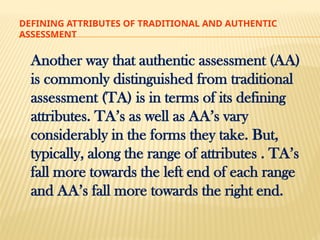
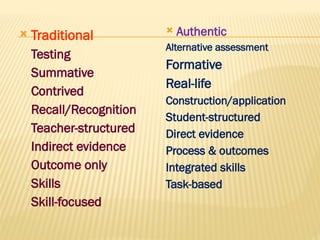
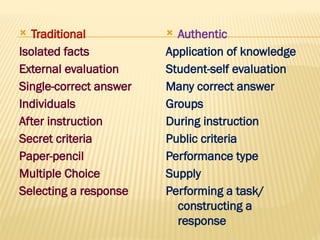
DEFINING ATTRIBUTES OFTRADITIONAL AND AUTHENTIC
ASSESSMENT
Another way that authentic assessment (AA)
is commonly distinguished from traditional
assessment (TA) is in terms of its defining
attributes. TA’s as well as AA’s vary
considerably in the forms they take. But,
typically, along the range of attributes . TA’s
fall more towards the left end of each range
and AA’s fall more towards the right end.
Traditional
Isolated facts
Externalevaluation
Single-correct answer
Individuals
After instruction
Secret criteria
Paper-pencil
Multiple Choice
Selecting a response
Authentic
Application of knowledge
Student-self evaluation
Many correct answer
Groups
During instruction
Public criteria
Performance type
Supply
Performing a task/
constructing a
response
13.
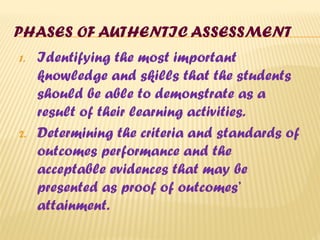
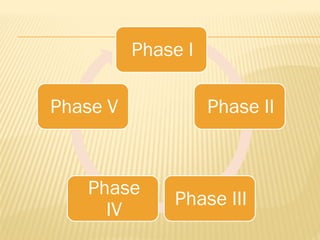
PHASES OF AUTHENTICASSESSMENT
1. Identifying the most important
knowledge and skills that the students
should be able to demonstrate as a
result of their learning activities.
2. Determining the criteria and standards of
outcomes performance and the
acceptable evidences that may be
presented as proof of outcomes’
attainment.
14.
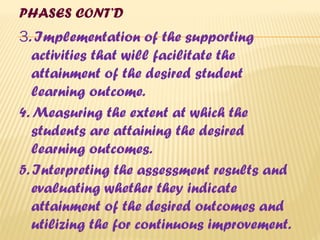
PHASES CONT’D
3. Implementationof the supporting
activities that will facilitate the
attainment of the desired student
learning outcome.
4. Measuring the extent at which the
students are attaining the desired
learning outcomes.
5. Interpreting the assessment results and
evaluating whether they indicate
attainment of the desired outcomes and
utilizing the for continuous improvement.
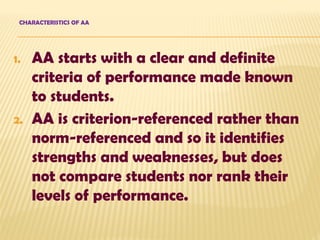
CHARACTERISTICS OF AA
1.AA starts with a clear and definite
criteria of performance made known
to students.
2. AA is criterion-referenced rather than
norm-referenced and so it identifies
strengths and weaknesses, but does
not compare students nor rank their
levels of performance.
17.
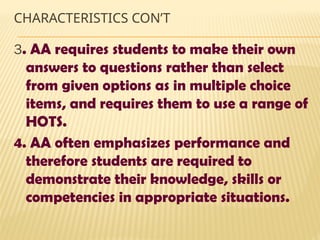
CHARACTERISTICS CON’T
3. AArequires students to make their own
answers to questions rather than select
from given options as in multiple choice
items, and requires them to use a range of
HOTS.
4. AA often emphasizes performance and
therefore students are required to
demonstrate their knowledge, skills or
competencies in appropriate situations.
18.
5. AA encouragesboth teacher and students
to determine their rate of progress in
cooperatively attaining the desired SLO.
6. AA does not encourage rote learning and
passive taking of test.
7. AA changes the role of students as passive
test takers into becoming active and
involved participants in assessment
activities.




![제 23회 보아즈(BOAZ) 빅데이터 컨퍼런스 - [MBOAX] : ABSA를 활용한 소비자 반응 분석 기반 운영 효율화 대시보드 설계](https://cdn.slidesharecdn.com/ss_thumbnails/3-1boaz23rdconferencemboax-260203102709-9d519923-thumbnail.jpg?width=640&height=640&fit=bounds)


