Project Tungsten

Bringing Spark Closer to Bare Metal
Nong Li
nong@databricks.com
Feb, 2016
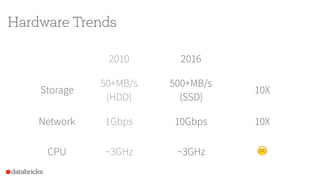
Hardware Trends
Storage
Network
CPU
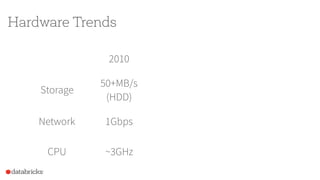
Hardware Trends
2010
Storage
50+MB/s
(HDD)
Network 1Gbps
CPU ~3GHz
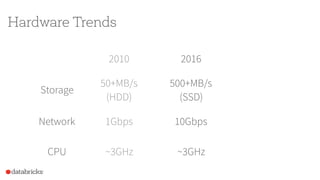
Hardware Trends
2010 2016
Storage
50+MB/s
(HDD)
500+MB/s
(SSD)
Network 1Gbps 10Gbps
CPU ~3GHz ~3GHz
Hardware Trends
2010 2016
Storage
50+MB/s
(HDD)
500+MB/s
(SSD)
10X
Network 1Gbps 10Gbps 10X
CPU ~3GHz ~3GHz ☹
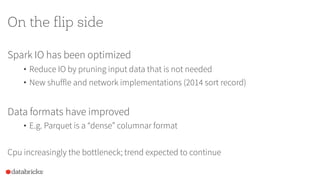
On the flip side
Spark IO has been optimized
• Reduce IO by pruning input data that is not needed
• New shuffle and network implementations (2014 sort record)
Data formats have improved
• E.g. Parquet is a “dense” columnar format
Cpu increasingly the bottleneck; trend expected to continue
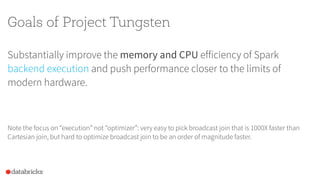
Goals of Project Tungsten
Substantially improve the memory and CPU efficiency of Spark
backend execution and push performance closer to the limits of
modern hardware.
Note the focus on “execution” not “optimizer”: very easy to pick broadcast join that is 1000X faster than
Cartesian join, but hard to optimize broadcast join to be an order of magnitude faster.
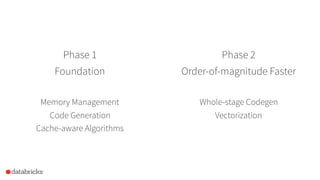
Phase 1
Foundation
Memory Management
Code Generation
Cache-aware Algorithms
Phase 2
Order-of-magnitude Faster
Whole-stage Codegen
Vectorization
Phase 1

Laying The Foundation
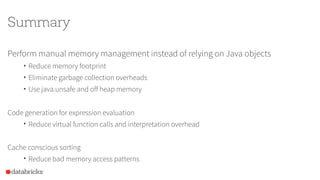
Summary
Perform manual memory management instead of relying on Java objects
• Reduce memory footprint
• Eliminate garbage collection overheads
• Use java.unsafe and off heap memory
Code generation for expression evaluation
• Reduce virtual function calls and interpretation overhead
Cache conscious sorting
• Reduce bad memory access patterns
Phase 2

Order-of-magnitude Faster
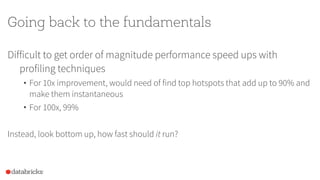
Going back to the fundamentals
Difficult to get order of magnitude performance speed ups with
profiling techniques
• For 10x improvement, would need of find top hotspots that add up to 90% and
make them instantaneous
• For 100x, 99%
Instead, look bottom up, how fast should it run?
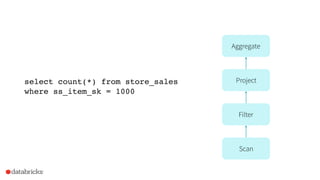
Scan
Filter
Project
Aggregate
select count(*) from store_sales

where ss_item_sk = 1000
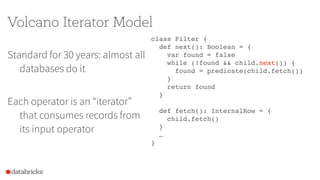
Volcano Iterator Model
Standard for 30 years: almost all
databases do it
Each operator is an “iterator”
that consumes records from
its input operator
class Filter {
def next(): Boolean = {
var found = false
while (!found && child.next()) {
found = predicate(child.fetch())
}
return found
}
def fetch(): InternalRow = {
child.fetch()
}
…
}
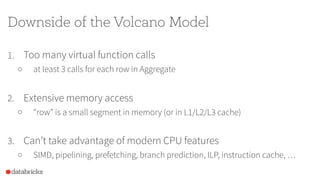
Downside of the Volcano Model
1. Too many virtual function calls
o at least 3 calls for each row in Aggregate
2. Extensive memory access
o “row” is a small segment in memory (or in L1/L2/L3 cache)
3. Can’t take advantage of modern CPU features
o SIMD, pipelining, prefetching, branch prediction, ILP, instruction cache, …
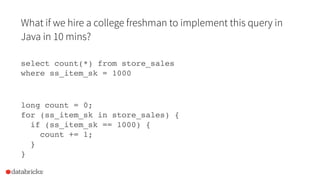
What if we hire a college freshman to implement this query in
Java in 10 mins?
select count(*) from store_sales

where ss_item_sk = 1000
long count = 0;
for (ss_item_sk in store_sales) {
if (ss_item_sk == 1000) {
count += 1;
}
}
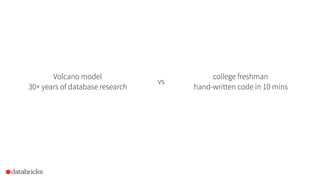
Volcano model
30+ years of database research
college freshman
hand-written code in 10 mins
vs
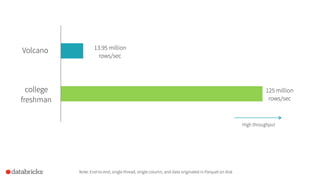
Volcano 13.95 million
rows/sec
college
freshman
125 million
rows/sec
Note: End-to-end, single thread, single column, and data originated in Parquet on disk
High throughput
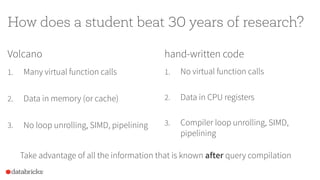
How does a student beat 30 years of research?
Volcano
1. Many virtual function calls
2. Data in memory (or cache)
3. No loop unrolling, SIMD, pipelining
hand-written code
1. No virtual function calls
2. Data in CPU registers
3. Compiler loop unrolling, SIMD,
pipelining
Take advantage of all the information that is known after query compilation
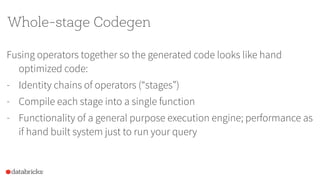
Whole-stage Codegen
Fusing operators together so the generated code looks like hand
optimized code:
- Identity chains of operators (“stages”)
- Compile each stage into a single function
- Functionality of a general purpose execution engine; performance as
if hand built system just to run your query
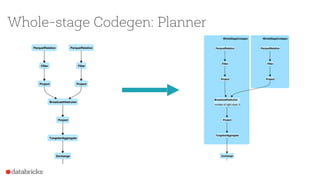
Whole-stage Codegen: Planner
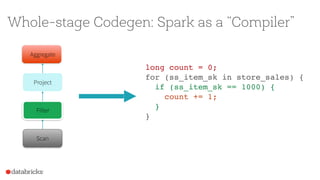
Scan
Filter
Project
Aggregate
long count = 0;
for (ss_item_sk in store_sales) {
if (ss_item_sk == 1000) {
count += 1;
}
}
Whole-stage Codegen: Spark as a “Compiler”
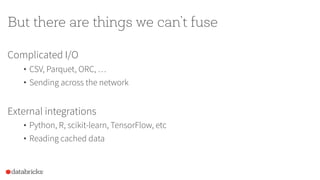
But there are things we can’t fuse
Complicated I/O
• CSV, Parquet, ORC, …
• Sending across the network
External integrations
• Python, R, scikit-learn, TensorFlow, etc
• Reading cached data
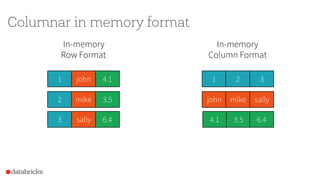
Columnar in memory format
mike
In-memory
Row Format
1 john 4.1
2 3.5
3 sally 6.4
1 2 3
john mike sally
4.1 3.5 6.4
In-memory
Column Format
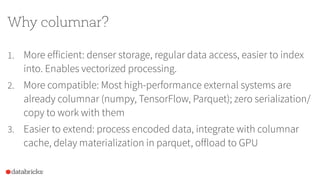
Why columnar?
1. More efficient: denser storage, regular data access, easier to index
into. Enables vectorized processing.
2. More compatible: Most high-performance external systems are
already columnar (numpy, TensorFlow, Parquet); zero serialization/
copy to work with them
3. Easier to extend: process encoded data, integrate with columnar
cache, delay materialization in parquet, offload to GPU
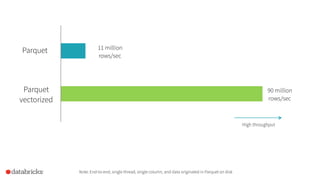
Parquet 11 million
rows/sec
Parquet
vectorized
90 million
rows/sec
Note: End-to-end, single thread, single column, and data originated in Parquet on disk
High throughput
Putting it all together
• Preliminary results
• Goal of 5 to 10x improvement for 2.0
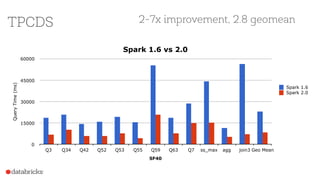
Spark 1.6 vs 2.0
QueryTime(ms)
0
15000
30000
45000
60000
SF40
Q3 Q34 Q42 Q52 Q53 Q55 Q59 Q63 Q7 ss_max agg join3 Geo Mean
Spark 1.6
Spark 2.0
TPCDS 2-7x improvement, 2.8 geomean
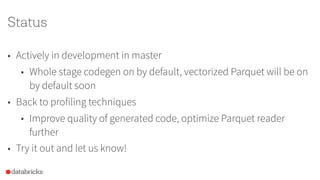
Status
• Actively in development in master
• Whole stage codegen on by default, vectorized Parquet will be on
by default soon
• Back to profiling techniques
• Improve quality of generated code, optimize Parquet reader
further
• Try it out and let us know!
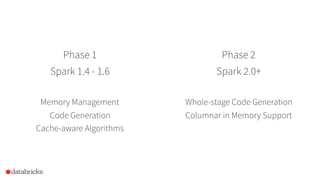
Phase 1
Spark 1.4 - 1.6
Memory Management
Code Generation
Cache-aware Algorithms
Phase 2
Spark 2.0+
Whole-stage Code Generation
Columnar in Memory Support
Questions?
@nongli

Project Tungsten: Bringing Spark Closer to Bare Metal

  • 1.
    Project Tungsten
 Bringing SparkCloser to Bare Metal Nong Li nong@databricks.com Feb, 2016
  • 2.
  • 3.
  • 4.
  • 5.
  • 6.
    On the flipside Spark IO has been optimized • Reduce IO by pruning input data that is not needed • New shuffle and network implementations (2014 sort record) Data formats have improved • E.g. Parquet is a “dense” columnar format Cpu increasingly the bottleneck; trend expected to continue
  • 7.
    Goals of ProjectTungsten Substantially improve the memory and CPU efficiency of Spark backend execution and push performance closer to the limits of modern hardware. Note the focus on “execution” not “optimizer”: very easy to pick broadcast join that is 1000X faster than Cartesian join, but hard to optimize broadcast join to be an order of magnitude faster.
  • 8.
    Phase 1 Foundation Memory Management CodeGeneration Cache-aware Algorithms Phase 2 Order-of-magnitude Faster Whole-stage Codegen Vectorization
  • 9.
  • 10.
    Summary Perform manual memorymanagement instead of relying on Java objects • Reduce memory footprint • Eliminate garbage collection overheads • Use java.unsafe and off heap memory Code generation for expression evaluation • Reduce virtual function calls and interpretation overhead Cache conscious sorting • Reduce bad memory access patterns
  • 11.
  • 12.
    Going back tothe fundamentals Difficult to get order of magnitude performance speed ups with profiling techniques • For 10x improvement, would need of find top hotspots that add up to 90% and make them instantaneous • For 100x, 99% Instead, look bottom up, how fast should it run?
  • 13.
    Scan Filter Project Aggregate select count(*) fromstore_sales
 where ss_item_sk = 1000
  • 14.
    Volcano Iterator Model Standardfor 30 years: almost all databases do it Each operator is an “iterator” that consumes records from its input operator class Filter { def next(): Boolean = { var found = false while (!found && child.next()) { found = predicate(child.fetch()) } return found } def fetch(): InternalRow = { child.fetch() } … }
  • 15.
    Downside of theVolcano Model 1. Too many virtual function calls o at least 3 calls for each row in Aggregate 2. Extensive memory access o “row” is a small segment in memory (or in L1/L2/L3 cache) 3. Can’t take advantage of modern CPU features o SIMD, pipelining, prefetching, branch prediction, ILP, instruction cache, …
  • 16.
    What if wehire a college freshman to implement this query in Java in 10 mins? select count(*) from store_sales
 where ss_item_sk = 1000 long count = 0; for (ss_item_sk in store_sales) { if (ss_item_sk == 1000) { count += 1; } }
  • 17.
    Volcano model 30+ yearsof database research college freshman hand-written code in 10 mins vs
  • 18.
    Volcano 13.95 million rows/sec college freshman 125million rows/sec Note: End-to-end, single thread, single column, and data originated in Parquet on disk High throughput
  • 19.
    How does astudent beat 30 years of research? Volcano 1. Many virtual function calls 2. Data in memory (or cache) 3. No loop unrolling, SIMD, pipelining hand-written code 1. No virtual function calls 2. Data in CPU registers 3. Compiler loop unrolling, SIMD, pipelining Take advantage of all the information that is known after query compilation
  • 20.
    Whole-stage Codegen Fusing operatorstogether so the generated code looks like hand optimized code: - Identity chains of operators (“stages”) - Compile each stage into a single function - Functionality of a general purpose execution engine; performance as if hand built system just to run your query
  • 21.
  • 22.
    Scan Filter Project Aggregate long count =0; for (ss_item_sk in store_sales) { if (ss_item_sk == 1000) { count += 1; } } Whole-stage Codegen: Spark as a “Compiler”
  • 23.
    But there arethings we can’t fuse Complicated I/O • CSV, Parquet, ORC, … • Sending across the network External integrations • Python, R, scikit-learn, TensorFlow, etc • Reading cached data
  • 24.
    Columnar in memoryformat mike In-memory Row Format 1 john 4.1 2 3.5 3 sally 6.4 1 2 3 john mike sally 4.1 3.5 6.4 In-memory Column Format
  • 25.
    Why columnar? 1. Moreefficient: denser storage, regular data access, easier to index into. Enables vectorized processing. 2. More compatible: Most high-performance external systems are already columnar (numpy, TensorFlow, Parquet); zero serialization/ copy to work with them 3. Easier to extend: process encoded data, integrate with columnar cache, delay materialization in parquet, offload to GPU
  • 26.
    Parquet 11 million rows/sec Parquet vectorized 90million rows/sec Note: End-to-end, single thread, single column, and data originated in Parquet on disk High throughput
  • 27.
    Putting it alltogether • Preliminary results • Goal of 5 to 10x improvement for 2.0
  • 28.
    Spark 1.6 vs2.0 QueryTime(ms) 0 15000 30000 45000 60000 SF40 Q3 Q34 Q42 Q52 Q53 Q55 Q59 Q63 Q7 ss_max agg join3 Geo Mean Spark 1.6 Spark 2.0 TPCDS 2-7x improvement, 2.8 geomean
  • 29.
    Status • Actively indevelopment in master • Whole stage codegen on by default, vectorized Parquet will be on by default soon • Back to profiling techniques • Improve quality of generated code, optimize Parquet reader further • Try it out and let us know!
  • 30.
    Phase 1 Spark 1.4- 1.6 Memory Management Code Generation Cache-aware Algorithms Phase 2 Spark 2.0+ Whole-stage Code Generation Columnar in Memory Support
  • 31.