HELPING STUDENTS TO LEARN DEVELOPING DEEP APPROACH TO LEARNING PROCESS IN HIGHER EDUCATION
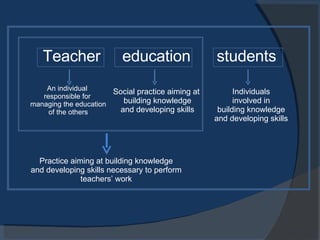
Teacher  education  students Individuals involved in building knowledge and developing skills Social practice aiming at  building knowledge and developing skills An individual  responsible for  managing the education of the others Practice aiming at building knowledge and developing skills necessary to perform teachers’ work
What  knowledge  should teacher students build ? What  skills  should teacher students develop?
Knowledge of the world Socio-cultural reality (humanities) Physical reality (sciences)
Skills?   F  L  E  X  I  B  I  L  I  T  Y Social skills  Managing  social interaction Managing the contents  of messages Communication skills Managerial skills Managing the activities of students (pace, level,  structure)
What sort of  competence  can enable teacher education  students to build knowledge and develop skills necessary to perform their job? ?
Knowledge Skills  Competence  ?
Continuum of understanding Processing of information  as basic proceedings for  building knowledge
Key competence in information society  Information  processing (the change of information in any manner  detectable by an observer) Computation Transduction  Translation
Learning  Environment Learner Teacher Fellow learner ICT tools Learning  material
Information  processing Computation Transduction  Translation  Learner Teacher Fellow learner ICT tools Learning  material
“ A picture is worth a thousand words” Great power  of visual images to inform (influence, educate) Creation of visual image to communicate concepts Holistic character of visual images Configurational  reception  versus  Sequentional reception Connotation versus Denotation
25%  of population thinks  exclusively in words 45 %  uses both visual/spatial thinking  and thinking in the forms of words 30%  strongly uses visual/spatial thinking Research by Child Development Theorist Linda Kreger Silverman
Media culture Visual culture
Structure of mediasphere Visual language  Media literacy Cultural literacy Ic onos phere (images) L ogos phere (words) S onos phere (sounds) G alenos phere (silence)
Visual narration as a way to express  understanding
Working with visual language  Academic skills  and ?
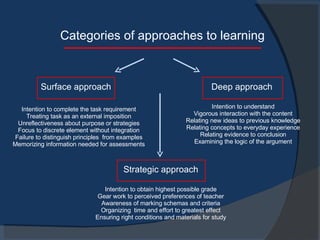
Categories of approaches to learning Surface approach Strategic approach Deep approach Intention to understand Vigorous interaction with the content Relating new ideas to previous knowledge Relating concepts to everyday experience Relating evidence to conclusion Examining the logic of the argument Intention to complete the task requirement Treating task as an external imposition Unreflectiveness about purpose or strategies Focus to discrete element without integration Failure to distinguish principles  from examples Memorizing information needed for assessments Intention to obtain highest possible grade Gear work to perceived preferences of teacher Awareness of marking schemas and criteria Organizing  time and effort to greatest effect Ensuring right conditions and materials for study
Deep approach to learning Vigorous  interaction with the content Intention to understand Relating new ideas to previous knowledge Relating concept to everyday experience Relating evidence to conclusions Examining the logic of the argument
Abstract concept and generalisation Concrete experience Visual images r e f l e  c t i o n  r e f l e  c t i o n  r e f l e  c t i o n  r e f l e  c t i o n
Motivation as motivation raising factor Cognitive competence ICT / media competence Deep approach to learning Competence
Knowledge of the world Socio-cultural reality Physical reality Social skills  Managing  social interaction Managing the contents  of messages Communication skills Managerial skills Managing the activities of students (pace, level,  structure)
Thank you for your attention
References : Fiske J,  Wprowadzenie do badan nad komunikowaniem , Wroclaw 1999 Lepa A. ,   Media a postawy , Łódz  2002 Newell A.,  Unified theories of cognition , Cambridge 1990 Nosal Cz.,  Diagnoza typow umyslu , Warszawa 1992 Raaheim K., Wankowski J., Radford J.,  Helping Students to Learn.  Teaching, Counselling, Research,  Great Britain 1993 6.  Stipek d., Seal K.,  Motivated Minds , New York 2001 7.  http://www.nwlink.com/~donclark/knowledge/knowledge.html

Deep Approach

  • 1.
    HELPING STUDENTS TOLEARN DEVELOPING DEEP APPROACH TO LEARNING PROCESS IN HIGHER EDUCATION
  • 2.
    Teacher education students Individuals involved in building knowledge and developing skills Social practice aiming at building knowledge and developing skills An individual responsible for managing the education of the others Practice aiming at building knowledge and developing skills necessary to perform teachers’ work
  • 3.
    What knowledge should teacher students build ? What skills should teacher students develop?
  • 4.
    Knowledge of theworld Socio-cultural reality (humanities) Physical reality (sciences)
  • 5.
    Skills? F L E X I B I L I T Y Social skills Managing social interaction Managing the contents of messages Communication skills Managerial skills Managing the activities of students (pace, level, structure)
  • 6.
    What sort of competence can enable teacher education students to build knowledge and develop skills necessary to perform their job? ?
  • 7.
    Knowledge Skills Competence ?
  • 8.
    Continuum of understandingProcessing of information as basic proceedings for building knowledge
  • 9.
    Key competence ininformation society Information processing (the change of information in any manner detectable by an observer) Computation Transduction Translation
  • 10.
    Learning EnvironmentLearner Teacher Fellow learner ICT tools Learning material
  • 11.
    Information processingComputation Transduction Translation Learner Teacher Fellow learner ICT tools Learning material
  • 12.
    “ A pictureis worth a thousand words” Great power of visual images to inform (influence, educate) Creation of visual image to communicate concepts Holistic character of visual images Configurational reception versus Sequentional reception Connotation versus Denotation
  • 13.
    25% ofpopulation thinks exclusively in words 45 % uses both visual/spatial thinking and thinking in the forms of words 30% strongly uses visual/spatial thinking Research by Child Development Theorist Linda Kreger Silverman
  • 14.
  • 15.
    Structure of mediasphereVisual language Media literacy Cultural literacy Ic onos phere (images) L ogos phere (words) S onos phere (sounds) G alenos phere (silence)
  • 16.
    Visual narration asa way to express understanding
  • 17.
    Working with visuallanguage Academic skills and ?
  • 18.
    Categories of approachesto learning Surface approach Strategic approach Deep approach Intention to understand Vigorous interaction with the content Relating new ideas to previous knowledge Relating concepts to everyday experience Relating evidence to conclusion Examining the logic of the argument Intention to complete the task requirement Treating task as an external imposition Unreflectiveness about purpose or strategies Focus to discrete element without integration Failure to distinguish principles from examples Memorizing information needed for assessments Intention to obtain highest possible grade Gear work to perceived preferences of teacher Awareness of marking schemas and criteria Organizing time and effort to greatest effect Ensuring right conditions and materials for study
  • 19.
    Deep approach tolearning Vigorous interaction with the content Intention to understand Relating new ideas to previous knowledge Relating concept to everyday experience Relating evidence to conclusions Examining the logic of the argument
  • 20.
    Abstract concept andgeneralisation Concrete experience Visual images r e f l e c t i o n r e f l e c t i o n r e f l e c t i o n r e f l e c t i o n
  • 21.
    Motivation as motivationraising factor Cognitive competence ICT / media competence Deep approach to learning Competence
  • 22.
    Knowledge of theworld Socio-cultural reality Physical reality Social skills Managing social interaction Managing the contents of messages Communication skills Managerial skills Managing the activities of students (pace, level, structure)
  • 23.
    Thank you foryour attention
  • 24.
    References : FiskeJ, Wprowadzenie do badan nad komunikowaniem , Wroclaw 1999 Lepa A. , Media a postawy , Łódz 2002 Newell A., Unified theories of cognition , Cambridge 1990 Nosal Cz., Diagnoza typow umyslu , Warszawa 1992 Raaheim K., Wankowski J., Radford J., Helping Students to Learn. Teaching, Counselling, Research, Great Britain 1993 6. Stipek d., Seal K., Motivated Minds , New York 2001 7. http://www.nwlink.com/~donclark/knowledge/knowledge.html

Editor's Notes

  • #2 Prezentacja dotyczy jednego z aspektow poruszonych przy okazji realizacji projektu dotyczacego mozliwosci Moodle jako srodowiska edukacyjnego