Development of a
Pedagogical Design Matrix
- for ICT-based BoundaryCrossing in DualVET
Marianne Riis, Senior lecturer, ph.d. - University College Absalon, Denmark
Carsten Lund Rasmussen, University College Copenhagen, Denmark
Anna Brodersen, University College Copenhagen, Denmark
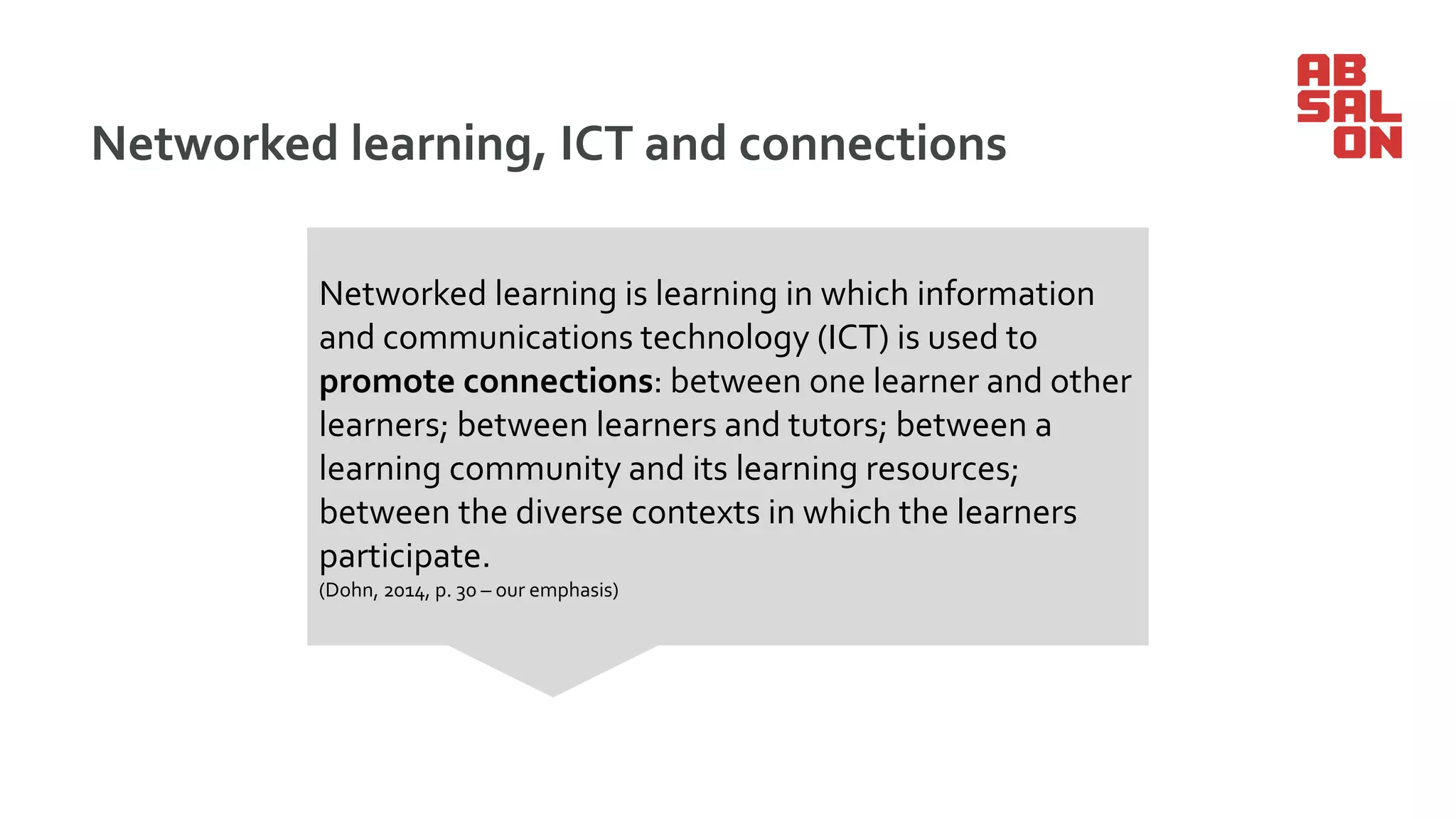
Networked learning, ICT and connections
Networked learning is learning in which information
and communications technology (ICT) is used to
promote connections: between one learner and other
learners; between learners and tutors; between a
learning community and its learning resources;
between the diverse contexts in which the learners
participate.
(Dohn, 2014, p. 30 – our emphasis)
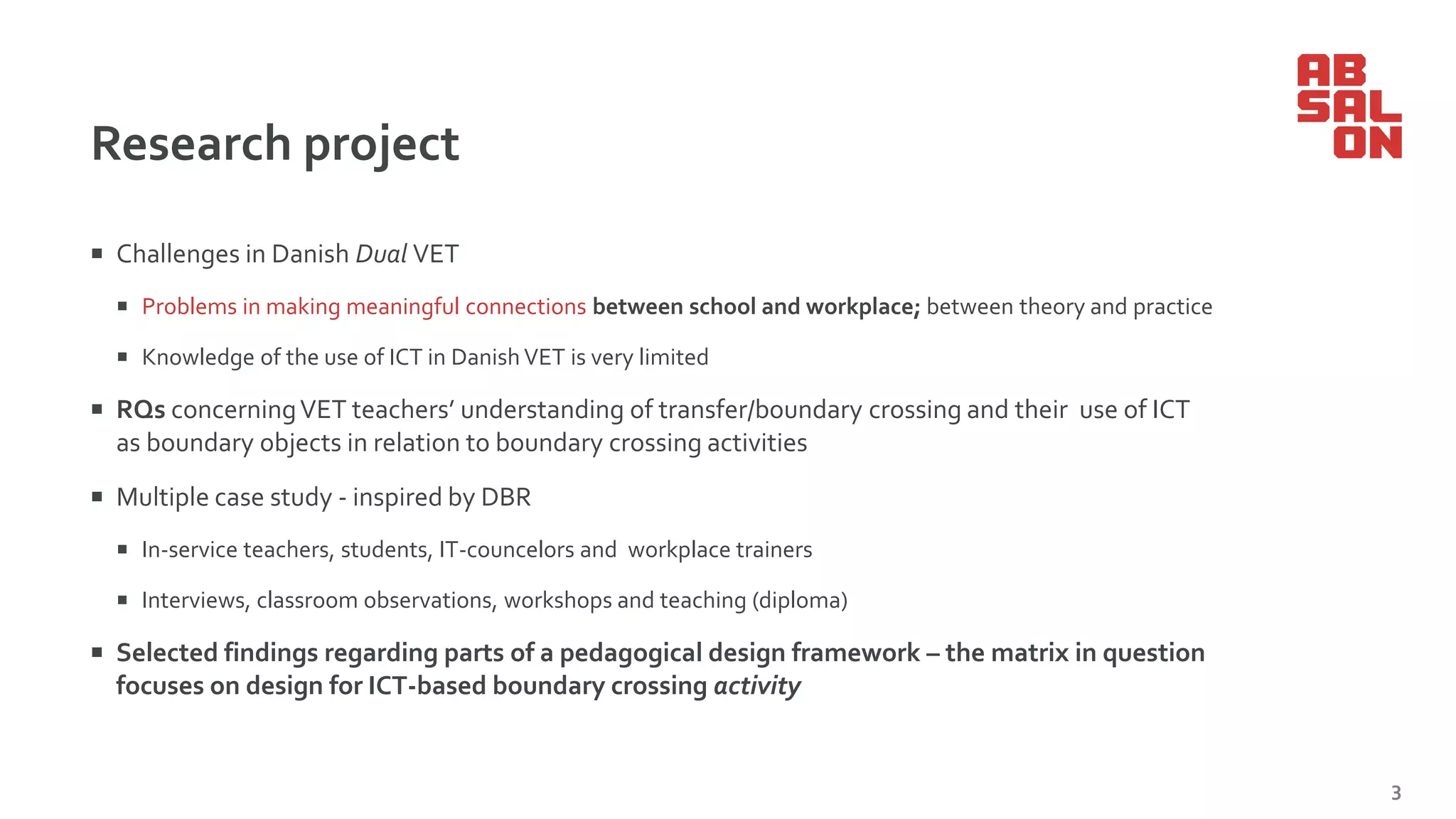
Research project
 Challenges in Danish Dual VET
 Problems in making meaningful connections between school and workplace; between theory and practice
 Knowledge of the use of ICT in Danish VET is very limited
 RQs concerningVET teachers’ understanding of transfer/boundary crossing and their use of ICT
as boundary objects in relation to boundary crossing activities
 Multiple case study - inspired by DBR
 In-service teachers, students, IT-councelors and workplace trainers
 Interviews, classroom observations, workshops and teaching (diploma)
 Selected findings regarding parts of a pedagogical design framework – the matrix in question
focuses on design for ICT-based boundary crossing activity
3
Conceptions in the field
4
“Our job is to give them
[the students] theory,
and then the
companies will give
them the practical
knowledge.”
“You know: the
companies aren’t
educational institutions –
they want to make
money off an apprentice.
But that also means that
they’re interested in
getting good
apprentices.”
“We [the teachers] have
no influence on the
learning goals in the
apprenticeship periods.”
“Unfortunately, when I let
the students go on Friday
[last day of the school
period], I don’t necessarily
meet them again.”
Boundaries
 A socio-cultural perspective (CHAT, CoP and Dialogism)
 Dual system → vertical and horizontal learning → boundary crossing theory
 Boundary crossing as a critical enhancement of the transfer concept – focusing on using differences and
boundaries in domains, practices and contexts as learning assets
5
A boundary is as a socio-cultural difference leading
to discontinuity in action or interaction.
(Akkerman & Bakker, 2011, p. 133 – our emphasis)
Dialogical boundary crossing
6
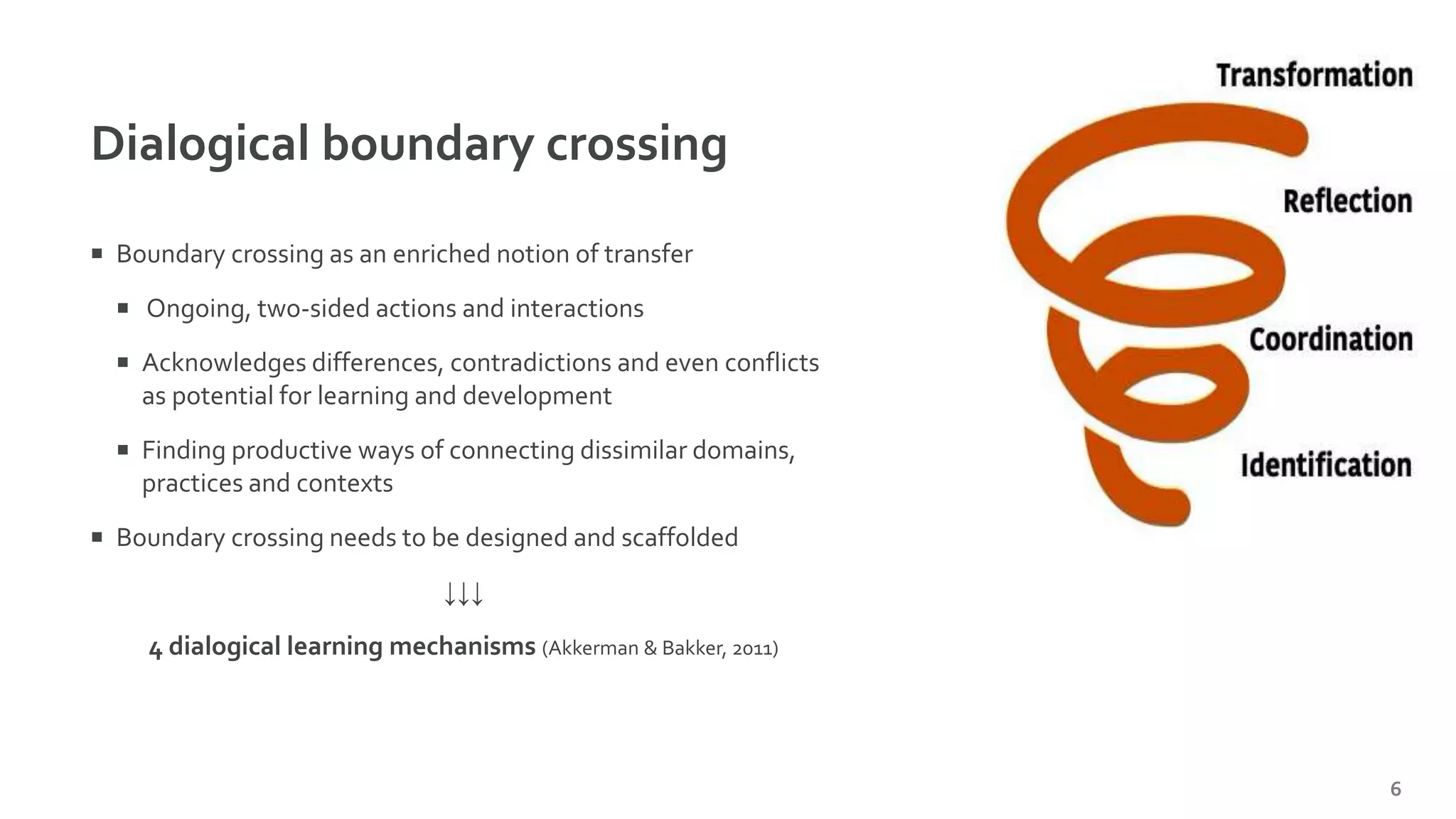
 Boundary crossing as an enriched notion of transfer
 Ongoing, two-sided actions and interactions
 Acknowledges differences, contradictions and even conflicts
as potential for learning and development
 Finding productive ways of connecting dissimilar domains,
practices and contexts
 Boundary crossing needs to be designed and scaffolded
↓↓↓
4 dialogical learning mechanisms (Akkerman & Bakker, 2011)
ICT-based boundary objects and affordances
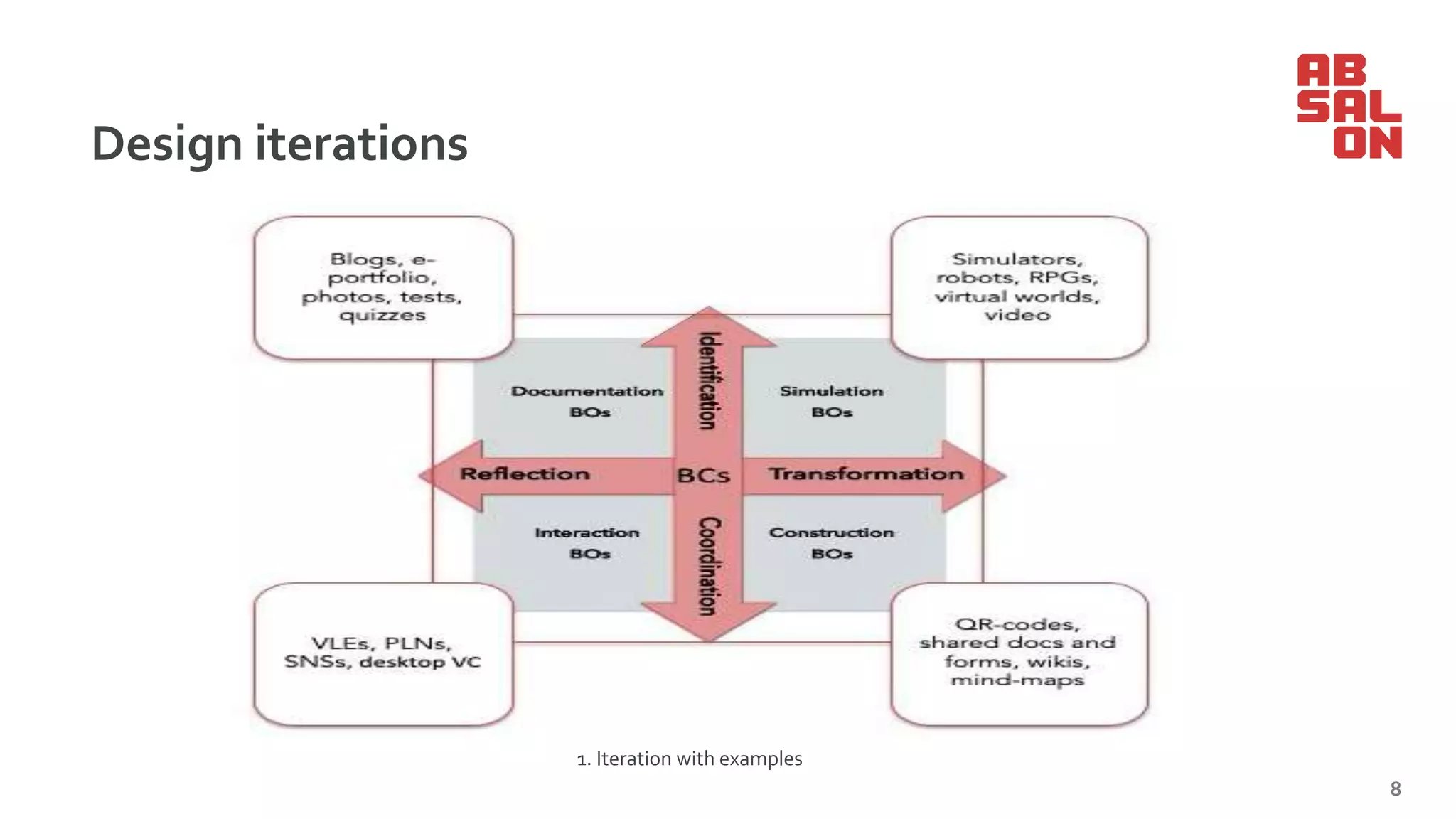
Dominant affordances – revised from Henningsen & Mogensen (2013):
 Documentation, simulation, construction and interaction
7
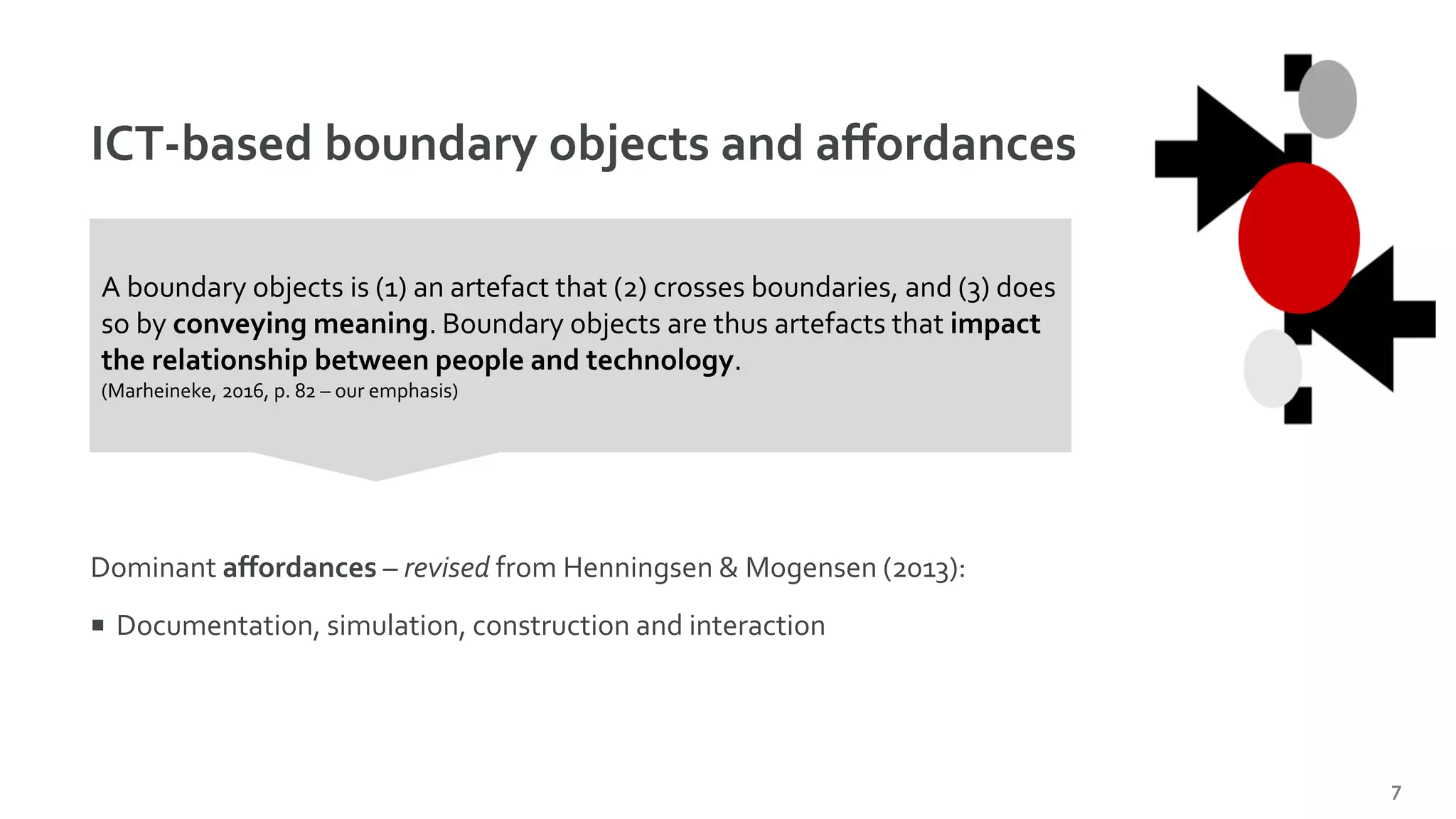
A boundary objects is (1) an artefact that (2) crosses boundaries, and (3) does
so by conveying meaning. Boundary objects are thus artefacts that impact
the relationship between people and technology.
(Marheineke, 2016, p. 82 – our emphasis)
Design iterations
1. Iteration with examples
8
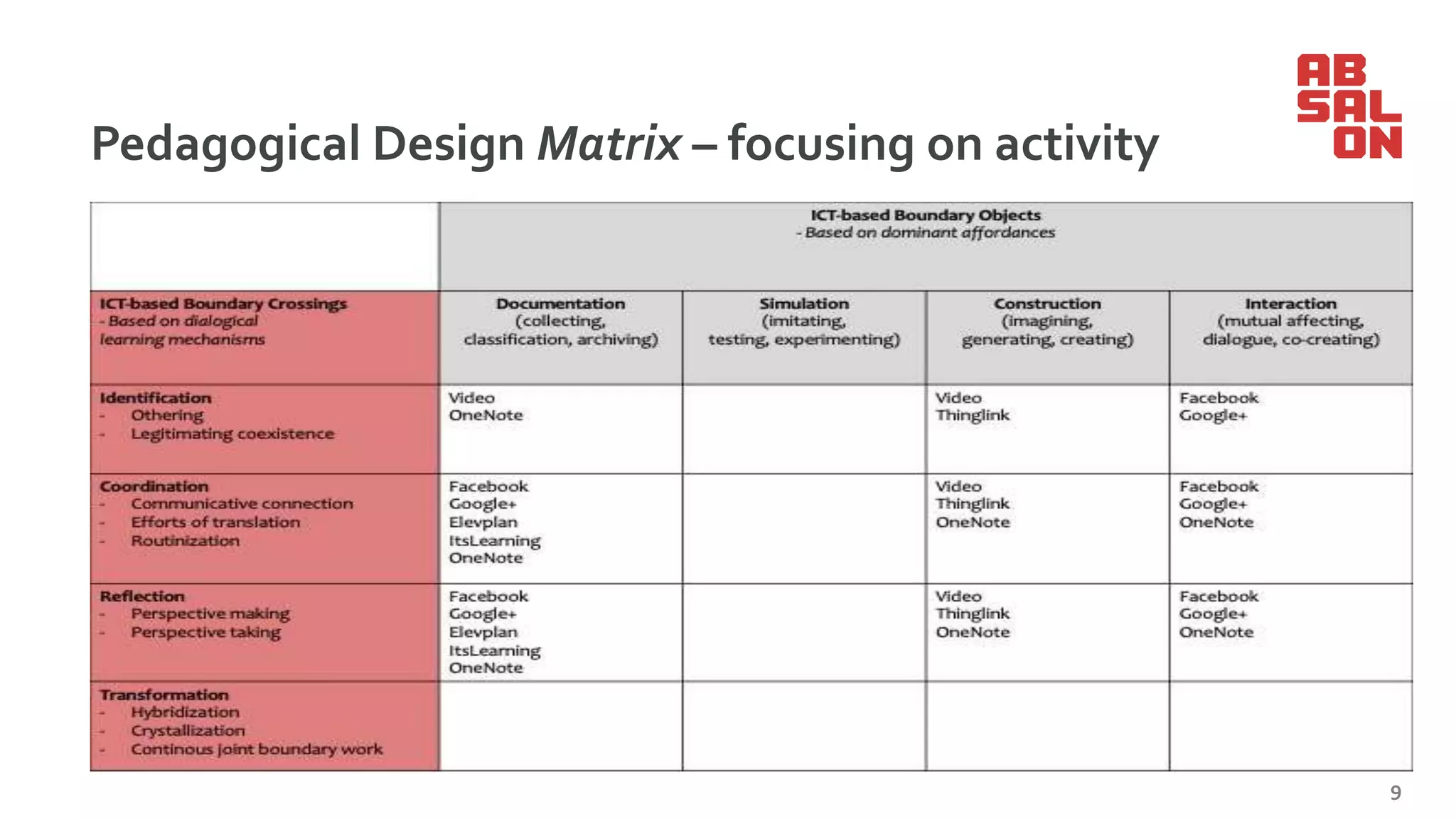
Pedagogical Design Matrix – focusing on activity
9
Design for boundary crossing - OneNote
10
Critical issues and future work
Theory
 Boundaries and boundary objects in socio-cultural theory vs. socio-material theory
 Agency, intentionality and relational materiality
Methodology
 User involvement and authentic experiments (DBR vs. AR)
 Technology-in-action → a plethora of ICTs inVET!We only focused on pedagogical ICTs
Analytical unit and level
 We analysed different units at different levels in different periods of the project
 Pedagogical leadership is crucial → current research on boundary crossing digital pedagogical leadership in
VET ..
11
Blurring the boundaries …
12
The critical issues here are that there are no inherent
and clear borders between matter and discourse, and
no clear borders between being and knowing.This
makes knowing just as much a matter of the body and
the material as it is a matter of understanding and
thinking through discourse/language, which of course
has vast consequences for teaching and learning.
(Taguchi, 2009, p. 40 – our emphasis)
References
 Akkerman, S.F., and Bakker, A. (2011). Boundary Crossing and Boundary Objects. Review of Educational
Research, 81(2), 132-169.
 Dohn, N. B. (2014). Implications for networked learning of the “practice” side of social practice theories:
A tacit-knowledge perspective. Hodgson,V., de Laat; McConnell, D. & Ryberg,T. (Eds.), The design,
experience and practice of networked learning. pp. 29–49. NewYork, NY: Springer International
Publishing.
 Henningsen, S.E. & Mogensen, F. (2013). Mellem teori og praksis.Om transfer i professionsuddannelse.VIA
Systime.
 Marheineke, M. (2016). Designing boundary objects for virtual collaboration. SpringerGabler. Dissertation
HHL Leipzig Graduate School of Management.
 Taguchi, H.L. (2009). Going beyond the theory/practice divide in early childhood education. Introducing an
intra-active pedagogy. Routledge.
13

Development of a Pedagogical Design Matrix - for ICT-based Boundary Crossing in Dual VET

  • 1.
    Development of a PedagogicalDesign Matrix - for ICT-based BoundaryCrossing in DualVET Marianne Riis, Senior lecturer, ph.d. - University College Absalon, Denmark Carsten Lund Rasmussen, University College Copenhagen, Denmark Anna Brodersen, University College Copenhagen, Denmark
  • 2.
    Networked learning, ICTand connections Networked learning is learning in which information and communications technology (ICT) is used to promote connections: between one learner and other learners; between learners and tutors; between a learning community and its learning resources; between the diverse contexts in which the learners participate. (Dohn, 2014, p. 30 – our emphasis)
  • 3.
    Research project  Challengesin Danish Dual VET  Problems in making meaningful connections between school and workplace; between theory and practice  Knowledge of the use of ICT in Danish VET is very limited  RQs concerningVET teachers’ understanding of transfer/boundary crossing and their use of ICT as boundary objects in relation to boundary crossing activities  Multiple case study - inspired by DBR  In-service teachers, students, IT-councelors and workplace trainers  Interviews, classroom observations, workshops and teaching (diploma)  Selected findings regarding parts of a pedagogical design framework – the matrix in question focuses on design for ICT-based boundary crossing activity 3
  • 4.
    Conceptions in thefield 4 “Our job is to give them [the students] theory, and then the companies will give them the practical knowledge.” “You know: the companies aren’t educational institutions – they want to make money off an apprentice. But that also means that they’re interested in getting good apprentices.” “We [the teachers] have no influence on the learning goals in the apprenticeship periods.” “Unfortunately, when I let the students go on Friday [last day of the school period], I don’t necessarily meet them again.”
  • 5.
    Boundaries  A socio-culturalperspective (CHAT, CoP and Dialogism)  Dual system → vertical and horizontal learning → boundary crossing theory  Boundary crossing as a critical enhancement of the transfer concept – focusing on using differences and boundaries in domains, practices and contexts as learning assets 5 A boundary is as a socio-cultural difference leading to discontinuity in action or interaction. (Akkerman & Bakker, 2011, p. 133 – our emphasis)
  • 6.
    Dialogical boundary crossing 6 Boundary crossing as an enriched notion of transfer  Ongoing, two-sided actions and interactions  Acknowledges differences, contradictions and even conflicts as potential for learning and development  Finding productive ways of connecting dissimilar domains, practices and contexts  Boundary crossing needs to be designed and scaffolded ↓↓↓ 4 dialogical learning mechanisms (Akkerman & Bakker, 2011)
  • 7.
    ICT-based boundary objectsand affordances Dominant affordances – revised from Henningsen & Mogensen (2013):  Documentation, simulation, construction and interaction 7 A boundary objects is (1) an artefact that (2) crosses boundaries, and (3) does so by conveying meaning. Boundary objects are thus artefacts that impact the relationship between people and technology. (Marheineke, 2016, p. 82 – our emphasis)
  • 8.
  • 9.
    Pedagogical Design Matrix– focusing on activity 9
  • 10.
    Design for boundarycrossing - OneNote 10
  • 11.
    Critical issues andfuture work Theory  Boundaries and boundary objects in socio-cultural theory vs. socio-material theory  Agency, intentionality and relational materiality Methodology  User involvement and authentic experiments (DBR vs. AR)  Technology-in-action → a plethora of ICTs inVET!We only focused on pedagogical ICTs Analytical unit and level  We analysed different units at different levels in different periods of the project  Pedagogical leadership is crucial → current research on boundary crossing digital pedagogical leadership in VET .. 11
  • 12.
    Blurring the boundaries… 12 The critical issues here are that there are no inherent and clear borders between matter and discourse, and no clear borders between being and knowing.This makes knowing just as much a matter of the body and the material as it is a matter of understanding and thinking through discourse/language, which of course has vast consequences for teaching and learning. (Taguchi, 2009, p. 40 – our emphasis)
  • 13.
    References  Akkerman, S.F.,and Bakker, A. (2011). Boundary Crossing and Boundary Objects. Review of Educational Research, 81(2), 132-169.  Dohn, N. B. (2014). Implications for networked learning of the “practice” side of social practice theories: A tacit-knowledge perspective. Hodgson,V., de Laat; McConnell, D. & Ryberg,T. (Eds.), The design, experience and practice of networked learning. pp. 29–49. NewYork, NY: Springer International Publishing.  Henningsen, S.E. & Mogensen, F. (2013). Mellem teori og praksis.Om transfer i professionsuddannelse.VIA Systime.  Marheineke, M. (2016). Designing boundary objects for virtual collaboration. SpringerGabler. Dissertation HHL Leipzig Graduate School of Management.  Taguchi, H.L. (2009). Going beyond the theory/practice divide in early childhood education. Introducing an intra-active pedagogy. Routledge. 13