TeleLearning in Practice What is the Business Case? Sylvia Currie, scurrie@sfu.ca Research Associate TeleLearning•NCE Simon Fraser University
Why me? Work life Post Secondary Administration  curriculum development educational advising admissions and transfer (residency requirements, prior learning assessment) Educational Technology technician instructional support  research and development changed jobs 7 times in past 10 years
Why me?  Student life TeleLearning reason I returned to SFU to pursue graduate work  First hand experience using as a student using online technologies enrolled in first SFU FirstClass course enrolled in first SFU Virtual-U course (1995) Research Associate - Virtual-U Project
Virtual-U Project Field trials began in 1996 across Canada Data collected from 14 sites, 229 courses Virtual-U web-based software Tools and resources to design, manage, and evaluate online courses Supports active, collaborative learning Designed by educators
What is unique about Virtual-U? Flexible framework to support varied content and instructional approaches Emphasis on user involvement in designing learning environments Focus on understanding new roles, techniques, and teaching models Environment for design, management, and evaluation
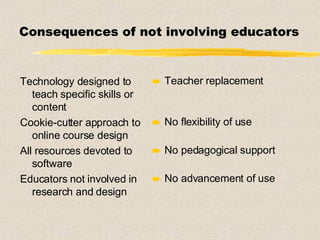
Consequences of not involving educators Technology designed to teach specific skills or content Cookie-cutter approach to online course design All resources devoted to software Educators not involved in research and design Teacher replacement No flexibility of use No pedagogical support No advancement of use
My observations Focus on consumer model of telelearning (quantity, convenience, access, cost)  Focus on specialized training for job-related skills Not enough focus on telelearning as a new environment to improve quality of learning
“ Current” Problems with Universities “ ...relentlessly inelastic packing-case” “ We seem to have multiplied [universities] greatly in the past hundred years, but we seem to have multiplied them altogether too much upon the old pattern” H.G. Wells (1938) World Brain
Levels of Intellectual Development  of Adult Learners 1. Keeping up-to-date 2. Learning with initiative and from new  experiences 3. Accumulate, rectify, and change human experience  H.G. Wells (1938) World Brain
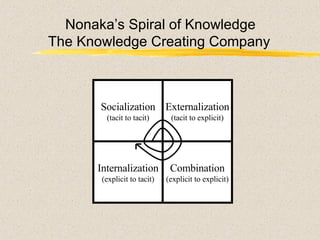
Socialization (tacit to tacit) Internalization (explicit to tacit) Externalization (tacit to explicit) Combination (explicit to explicit) Nonaka’s Spiral of Knowledge The Knowledge Creating Company
Downfalls: Traditional Models People deluged with highly specific information Individuals discouraged or inhibited to share knowledge Measurement of success is quantitative Equate information flow with solution for a knowledge society  Focus on “know what” instead of “know how” Private nature of work Inequality among participants
What works? Socialization “ Combination” is not sufficient  Many new technologies attend to individuals and explicit information that passes between them Ease of creating and sharing knowledge is a reflection of its social context Online environment contributes to more reflective and in-depth discourse For organizational knowledge to be created, tacit individual knowledge must be shared Equity in participation / freedom to articulate ideas
What works? Externalization Multimedia representations Portfolios of work Documentation of experiences (writing as a heuristic) Translating knowledge in understandable formats “ Repurposing” (I repurposed this word  from Curtis Bonk’s presentation)
What works? Strategic rotation   Exposure to multiple perspectives Understanding contributions of others to achieving goals Rely on individual expertise in new situation Logic of redundancy
What works? Team Approach Develop different approaches to same problem Synthesize Participation not limited to project members Participants take on more responsibility
What works? Changing Roles Instructor (manager) as facilitator  Participant rather than provider Ask questions rather than give answers Provide conceptual framework Equity in participation Increased expectations of participants
What works? Add Value to Information Enhance “combination” typical of traditional models  Store and reconfigure information Sort and categorize Annotate Information distributed in a purposeful way No discrimination in access of information Leads to new knowledge (e.g. CSILE)
“ Current” Solutions “ I imagine…something added to the world network of universities, linking and coordinating them with one another and with the general intelligence of the world” H.G. Wells (1938) World Brain
Summary: Learning Networks Challenge existing organization boundaries and hierarchies Make knowledge accessible within and outside of organizations Provide equity of access to all participants Support sustained engagement for knowledge creation to occur  Enable external input to propel knowledge creation Prepare learners with a different set of skills to communicate, work collaboratively, solve problems, think critically, and cope with change Provide unique opportunities for lifelong learning
References Brown, J.S. & Duguid,P. (1998) Organizing Knowledge, California Management Review 40 (3) Keating, D. (1996) Habits of mind for a learning society: Educating for human development. In D.R. Olson & N. Torrance, The handbook of education and human development: New models of learning, teaching, and schooling, Cambridge, MA: Blackwell Publishers Nonaka, I. (1991) The knowledge-creating company, Harvard Business Review, Nov. Wells, H.G. (1938) World Brain, Freeport: Books for Libraries Press

TeleLearning in Practice: What is the Business Case?

  • 1.
    TeleLearning in PracticeWhat is the Business Case? Sylvia Currie, scurrie@sfu.ca Research Associate TeleLearning•NCE Simon Fraser University
  • 2.
    Why me? Worklife Post Secondary Administration curriculum development educational advising admissions and transfer (residency requirements, prior learning assessment) Educational Technology technician instructional support research and development changed jobs 7 times in past 10 years
  • 3.
    Why me? Student life TeleLearning reason I returned to SFU to pursue graduate work First hand experience using as a student using online technologies enrolled in first SFU FirstClass course enrolled in first SFU Virtual-U course (1995) Research Associate - Virtual-U Project
  • 4.
    Virtual-U Project Fieldtrials began in 1996 across Canada Data collected from 14 sites, 229 courses Virtual-U web-based software Tools and resources to design, manage, and evaluate online courses Supports active, collaborative learning Designed by educators
  • 5.
    What is uniqueabout Virtual-U? Flexible framework to support varied content and instructional approaches Emphasis on user involvement in designing learning environments Focus on understanding new roles, techniques, and teaching models Environment for design, management, and evaluation
  • 6.
    Consequences of notinvolving educators Technology designed to teach specific skills or content Cookie-cutter approach to online course design All resources devoted to software Educators not involved in research and design Teacher replacement No flexibility of use No pedagogical support No advancement of use
  • 7.
    My observations Focuson consumer model of telelearning (quantity, convenience, access, cost) Focus on specialized training for job-related skills Not enough focus on telelearning as a new environment to improve quality of learning
  • 8.
    “ Current” Problemswith Universities “ ...relentlessly inelastic packing-case” “ We seem to have multiplied [universities] greatly in the past hundred years, but we seem to have multiplied them altogether too much upon the old pattern” H.G. Wells (1938) World Brain
  • 9.
    Levels of IntellectualDevelopment of Adult Learners 1. Keeping up-to-date 2. Learning with initiative and from new experiences 3. Accumulate, rectify, and change human experience H.G. Wells (1938) World Brain
  • 10.
    Socialization (tacit totacit) Internalization (explicit to tacit) Externalization (tacit to explicit) Combination (explicit to explicit) Nonaka’s Spiral of Knowledge The Knowledge Creating Company
  • 11.
    Downfalls: Traditional ModelsPeople deluged with highly specific information Individuals discouraged or inhibited to share knowledge Measurement of success is quantitative Equate information flow with solution for a knowledge society Focus on “know what” instead of “know how” Private nature of work Inequality among participants
  • 12.
    What works? Socialization“ Combination” is not sufficient Many new technologies attend to individuals and explicit information that passes between them Ease of creating and sharing knowledge is a reflection of its social context Online environment contributes to more reflective and in-depth discourse For organizational knowledge to be created, tacit individual knowledge must be shared Equity in participation / freedom to articulate ideas
  • 13.
    What works? ExternalizationMultimedia representations Portfolios of work Documentation of experiences (writing as a heuristic) Translating knowledge in understandable formats “ Repurposing” (I repurposed this word from Curtis Bonk’s presentation)
  • 14.
    What works? Strategicrotation Exposure to multiple perspectives Understanding contributions of others to achieving goals Rely on individual expertise in new situation Logic of redundancy
  • 15.
    What works? TeamApproach Develop different approaches to same problem Synthesize Participation not limited to project members Participants take on more responsibility
  • 16.
    What works? ChangingRoles Instructor (manager) as facilitator Participant rather than provider Ask questions rather than give answers Provide conceptual framework Equity in participation Increased expectations of participants
  • 17.
    What works? AddValue to Information Enhance “combination” typical of traditional models Store and reconfigure information Sort and categorize Annotate Information distributed in a purposeful way No discrimination in access of information Leads to new knowledge (e.g. CSILE)
  • 18.
    “ Current” Solutions“ I imagine…something added to the world network of universities, linking and coordinating them with one another and with the general intelligence of the world” H.G. Wells (1938) World Brain
  • 19.
    Summary: Learning NetworksChallenge existing organization boundaries and hierarchies Make knowledge accessible within and outside of organizations Provide equity of access to all participants Support sustained engagement for knowledge creation to occur Enable external input to propel knowledge creation Prepare learners with a different set of skills to communicate, work collaboratively, solve problems, think critically, and cope with change Provide unique opportunities for lifelong learning
  • 20.
    References Brown, J.S.& Duguid,P. (1998) Organizing Knowledge, California Management Review 40 (3) Keating, D. (1996) Habits of mind for a learning society: Educating for human development. In D.R. Olson & N. Torrance, The handbook of education and human development: New models of learning, teaching, and schooling, Cambridge, MA: Blackwell Publishers Nonaka, I. (1991) The knowledge-creating company, Harvard Business Review, Nov. Wells, H.G. (1938) World Brain, Freeport: Books for Libraries Press