(Computer-supported) collaborative learning 
Introduction into the field 
09/25/14 
Essi Vuopala/ LET 
Introduction to Learning and Educational Technology 
Essi Vuopala
Content of the lecture 
• Defining collaborative 
learning and CSCL 
• Group task I 
• Technology to 
support learning 
• Group task II
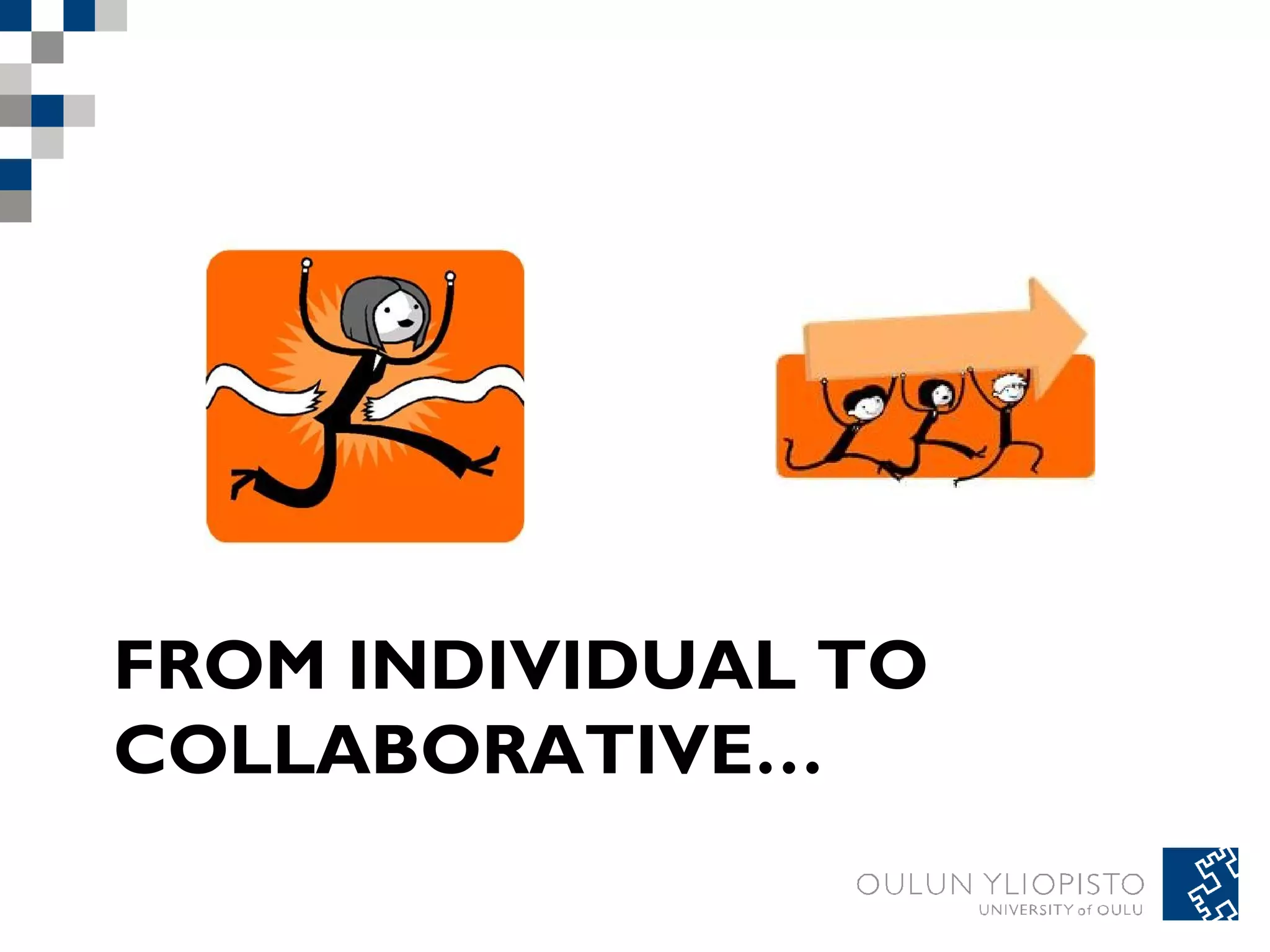
FROM INDIVIDUAL TO 
COLLABORATIVE…
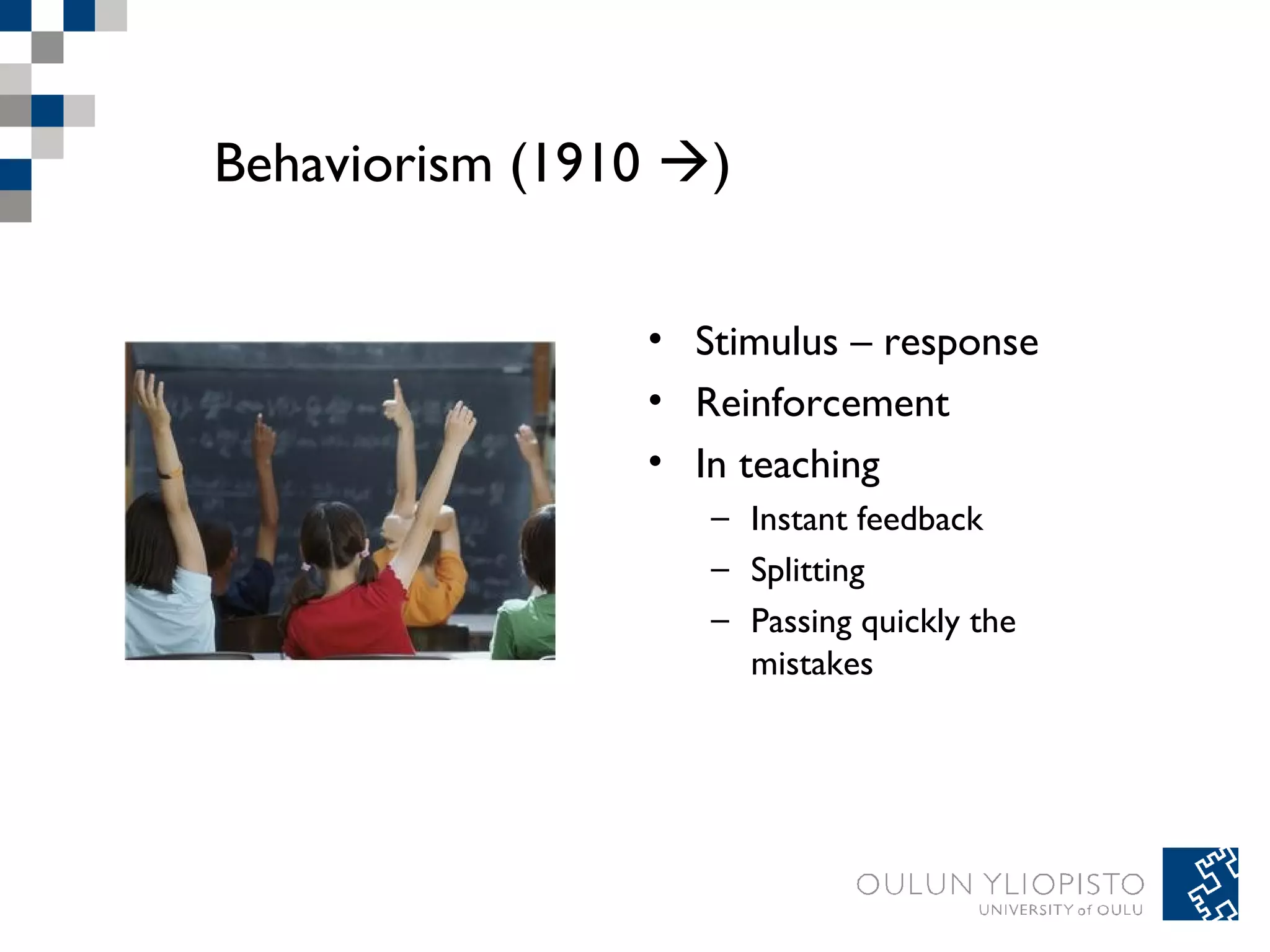
Behaviorism (1910 ) 
• Stimulus – response 
• Reinforcement 
• In teaching 
– Instant feedback 
– Splitting 
– Passing quickly the 
mistakes
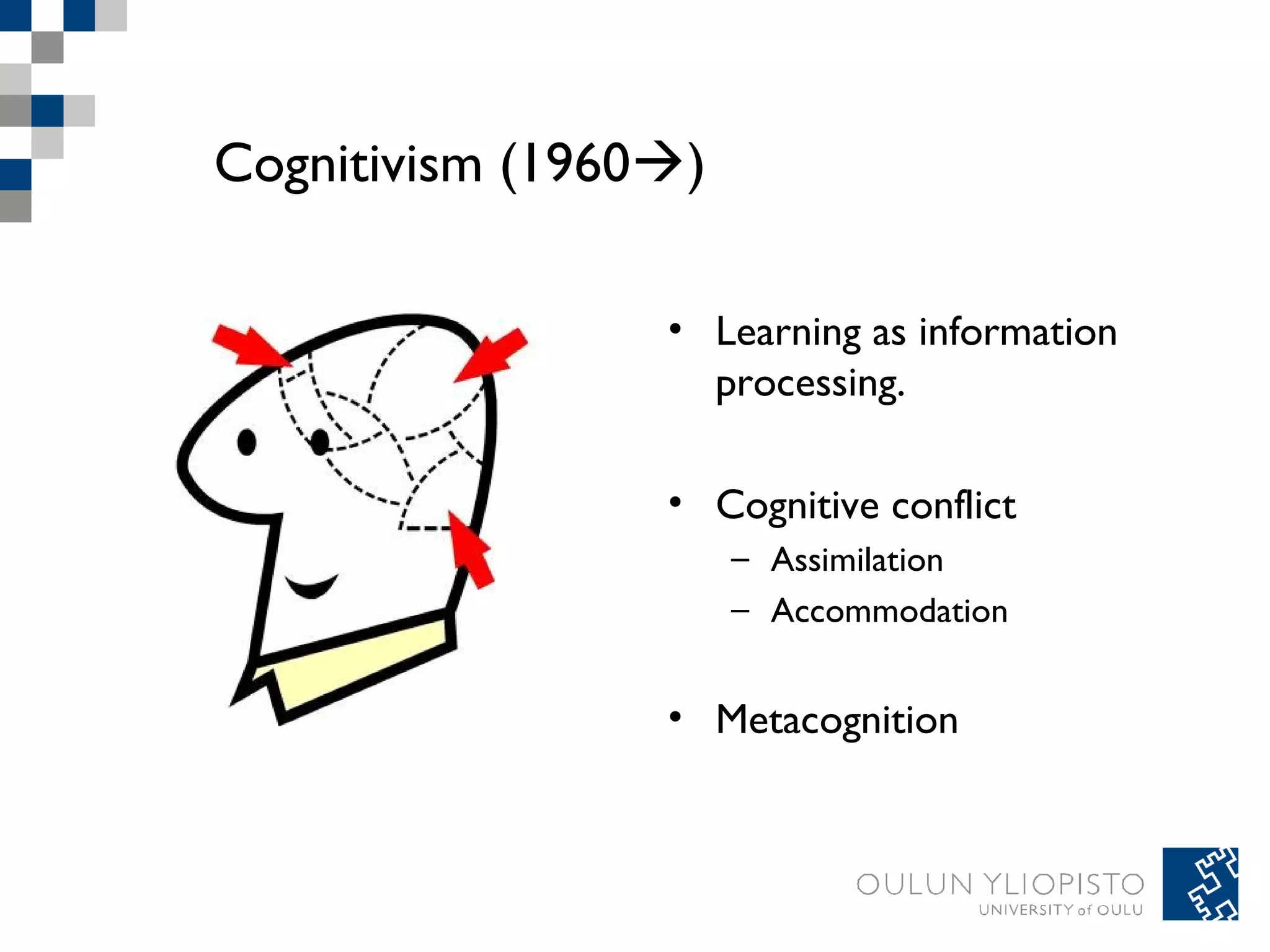
Cognitivism (1960) 
• Learning as information 
processing. 
• Cognitive conflict 
– Assimilation 
– Accommodation 
• Metacognition
What is collaborative learning 
(Crook 2000; Dillenbourg 2002) 
Collaborative learning refers to studying method where group members have joint 
task and they are committed to construct a joint understanding through social 
interaction. 
(Lave & Wenger 1991) 
Collaborative learning refers to the culture of knowledge building and learning is considered 
equal to learners’ growing ability to participate in learning communities’ actions. 
(Baker 2002) 
Collaborative learning can be seen as a space where the group members create new knowledge 
together. 
And what it is not… 
• one specific theory 
• single pedagogical method or psychological process
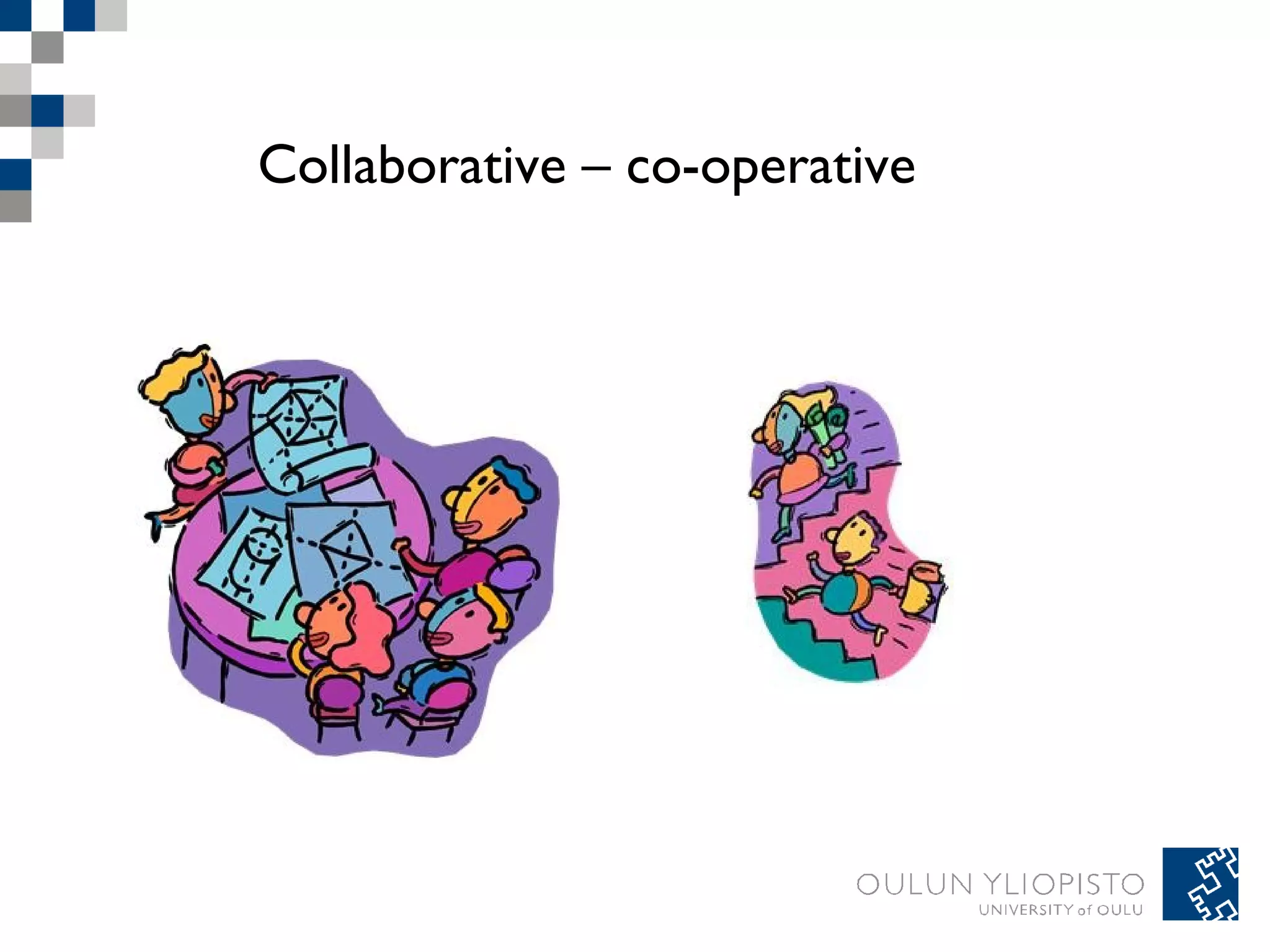
Collaborative – co-operative
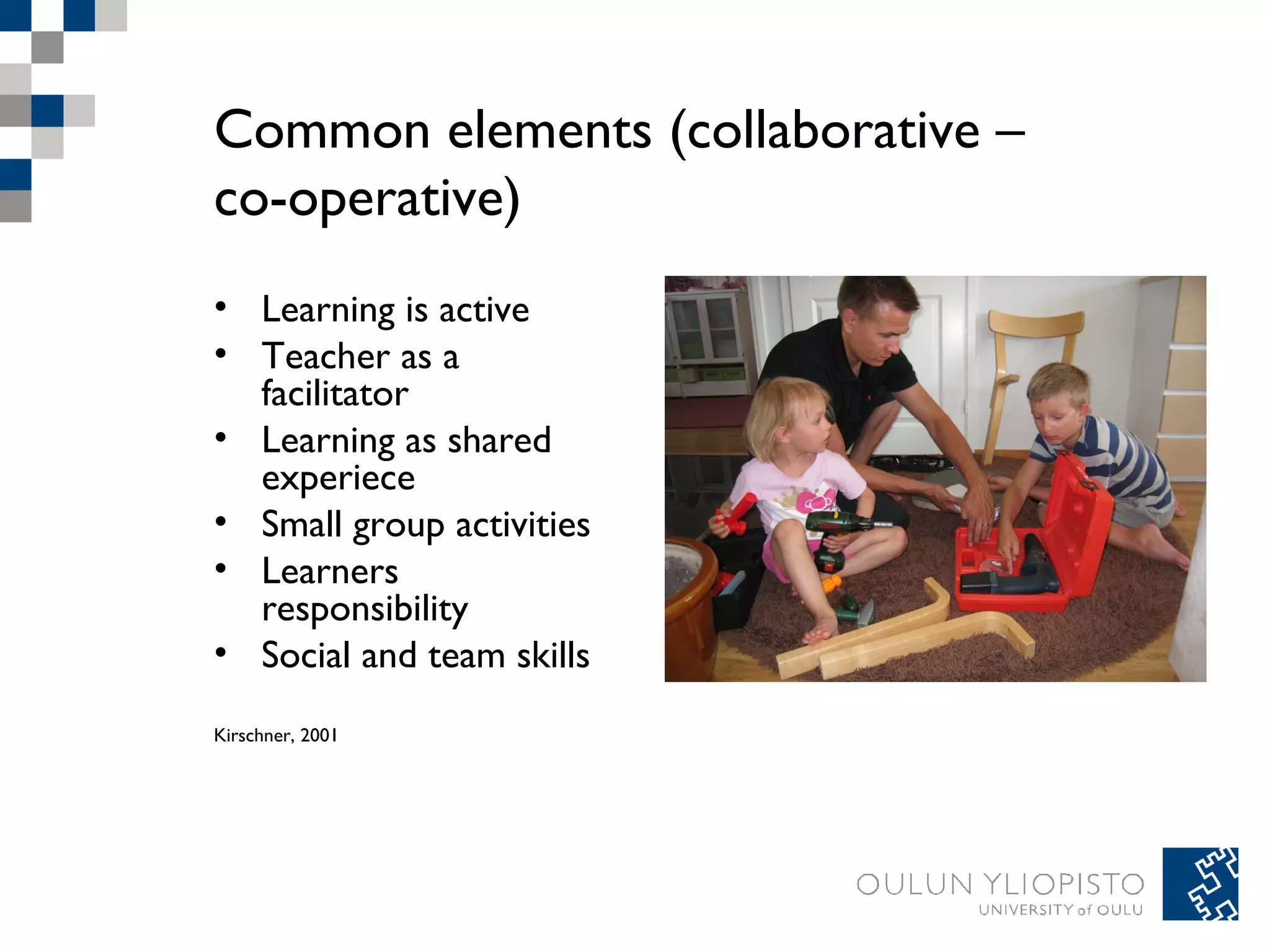
Common elements (collaborative – 
co-operative) 
• Learning is active 
• Teacher as a 
facilitator 
• Learning as shared 
experiece 
• Small group activities 
• Learners 
responsibility 
• Social and team skills 
Kirschner, 2001
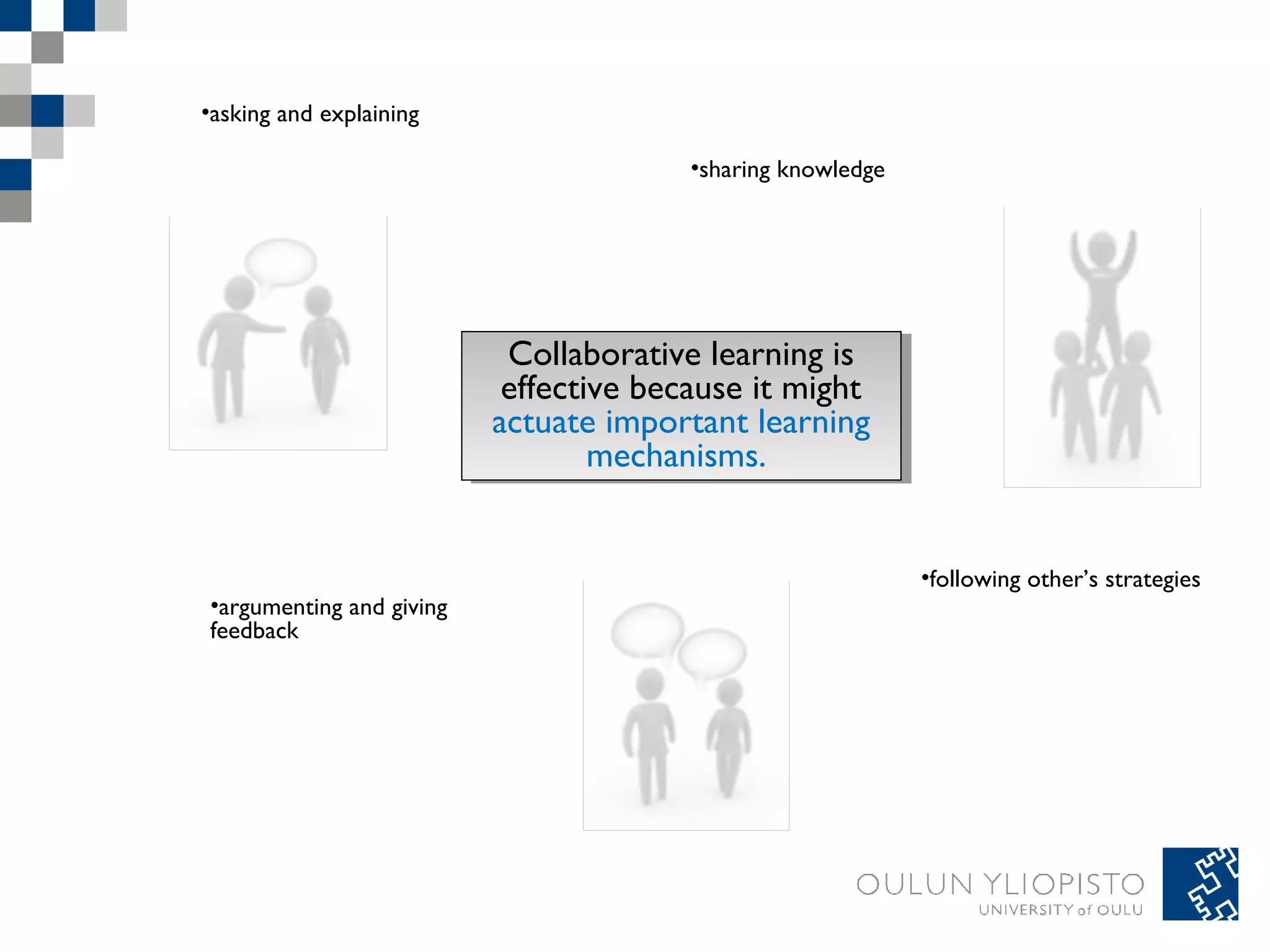
Collaborative learning is 
effective because it might 
actuate important learning 
Collaborative learning is 
effective because it might 
actuate important learning 
mechanisms. 
mechanisms. 
•asking and explaining 
•argumenting and giving 
feedback 
•sharing knowledge 
•following other’s strategies
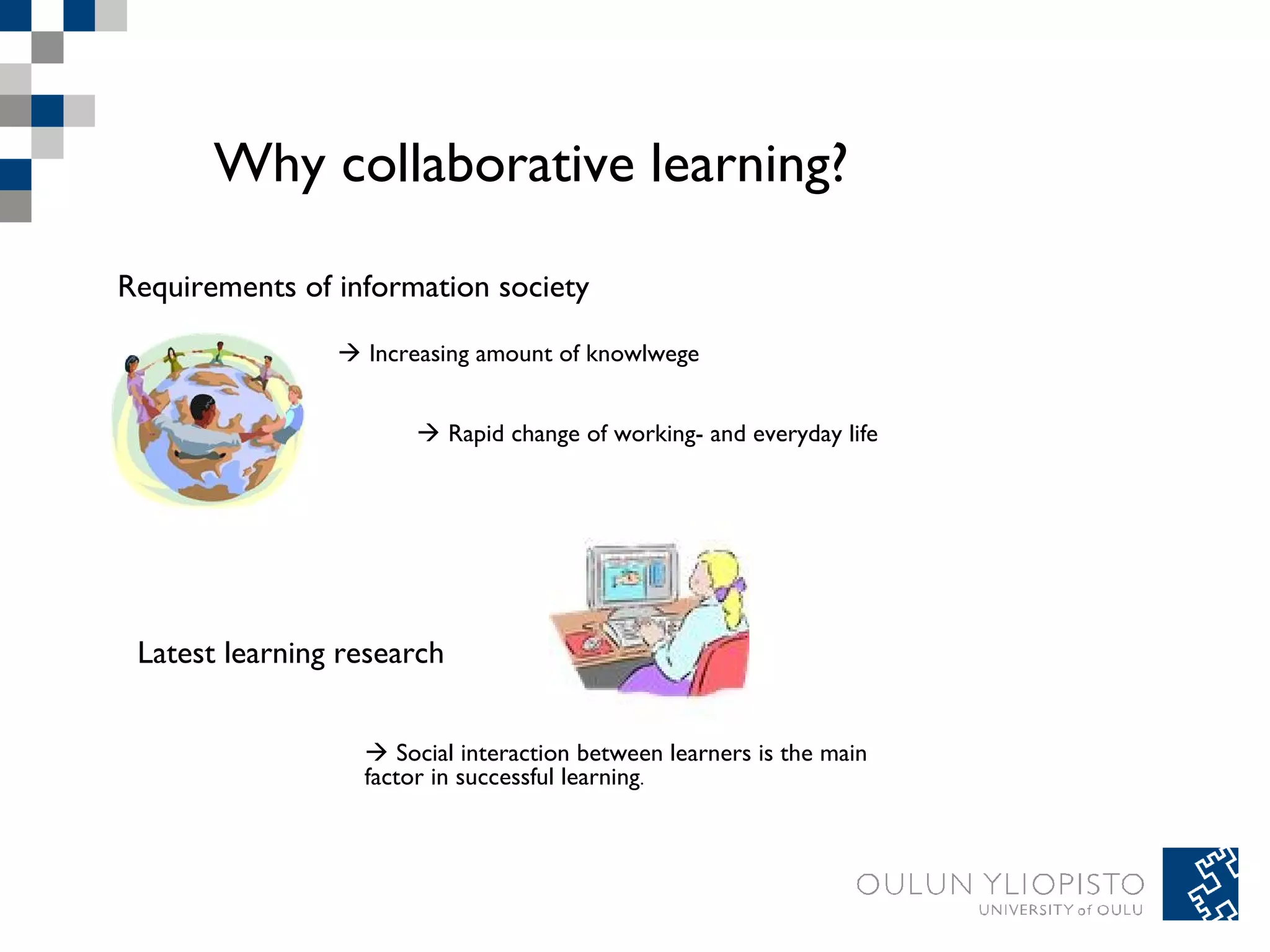
Why collaborative learning? 
Requirements of information society 
 Increasing amount of knowlwege 
 Rapid change of working- and everyday life 
Latest learning research 
 Social interaction between learners is the main 
factor in successful learning.
However… 
– Not all types of interaction lead to high-level of 
collaborative learning. 
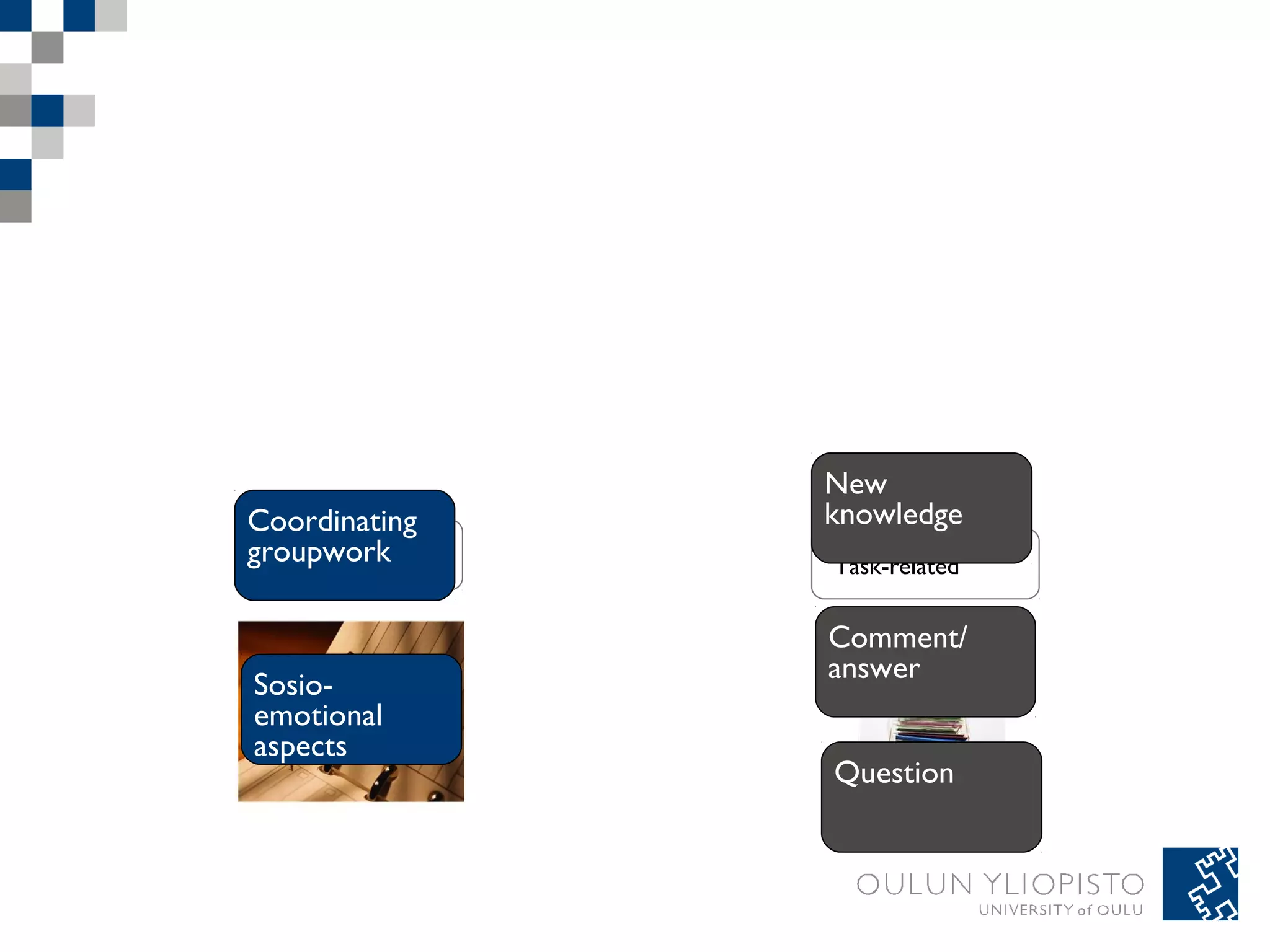
Interaction forms in successful collaborative learning (Vuopala 2013, in press) 
Group-related Task-related
Coordinating 
groupwork 
Group-related Task-related 
Sosio-emotional 
aspects 
New 
knowledge 
Comment/ 
answer 
Question
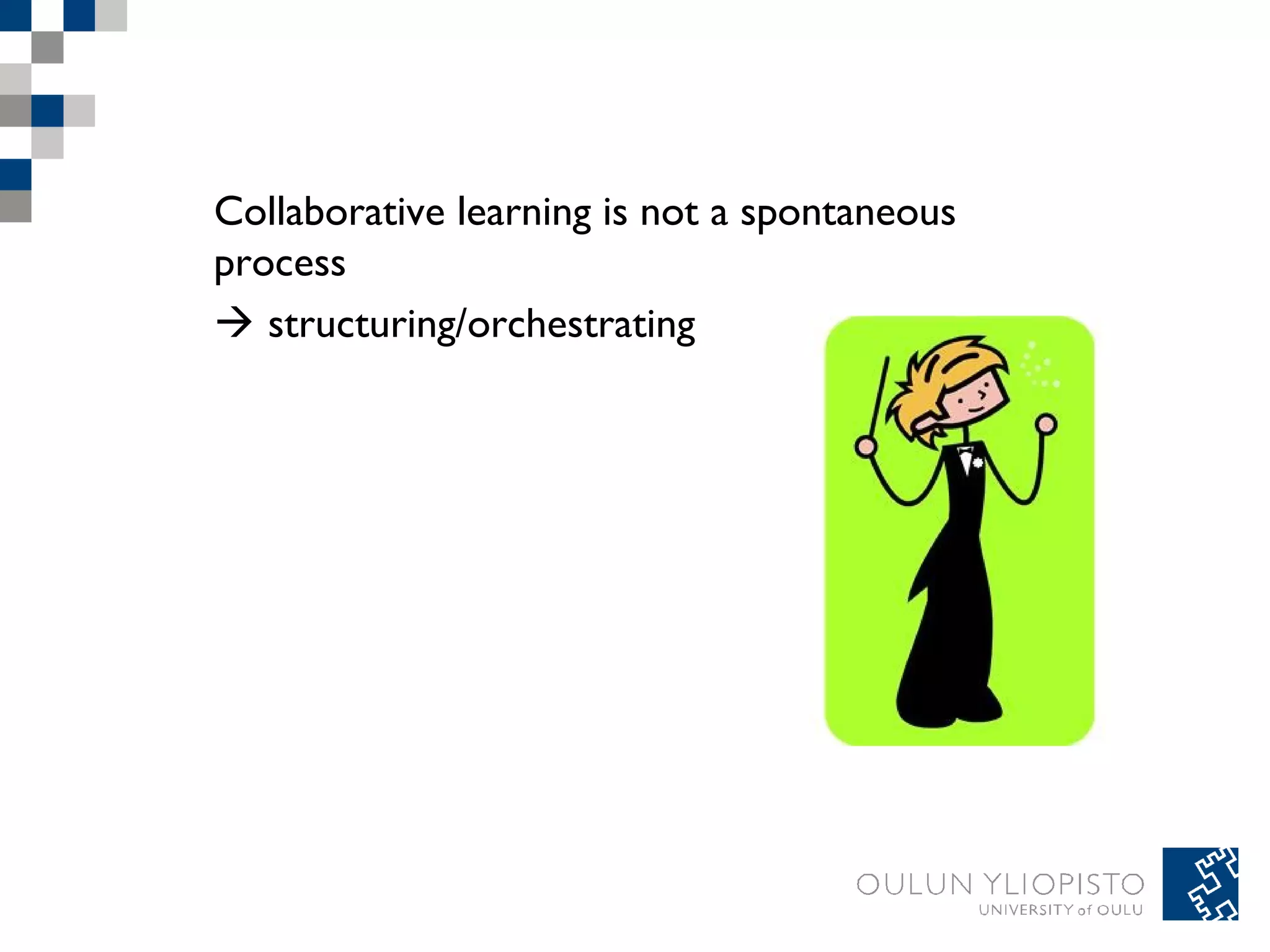
Collaborative learning is not a spontaneous 
process 
 structuring/orchestrating
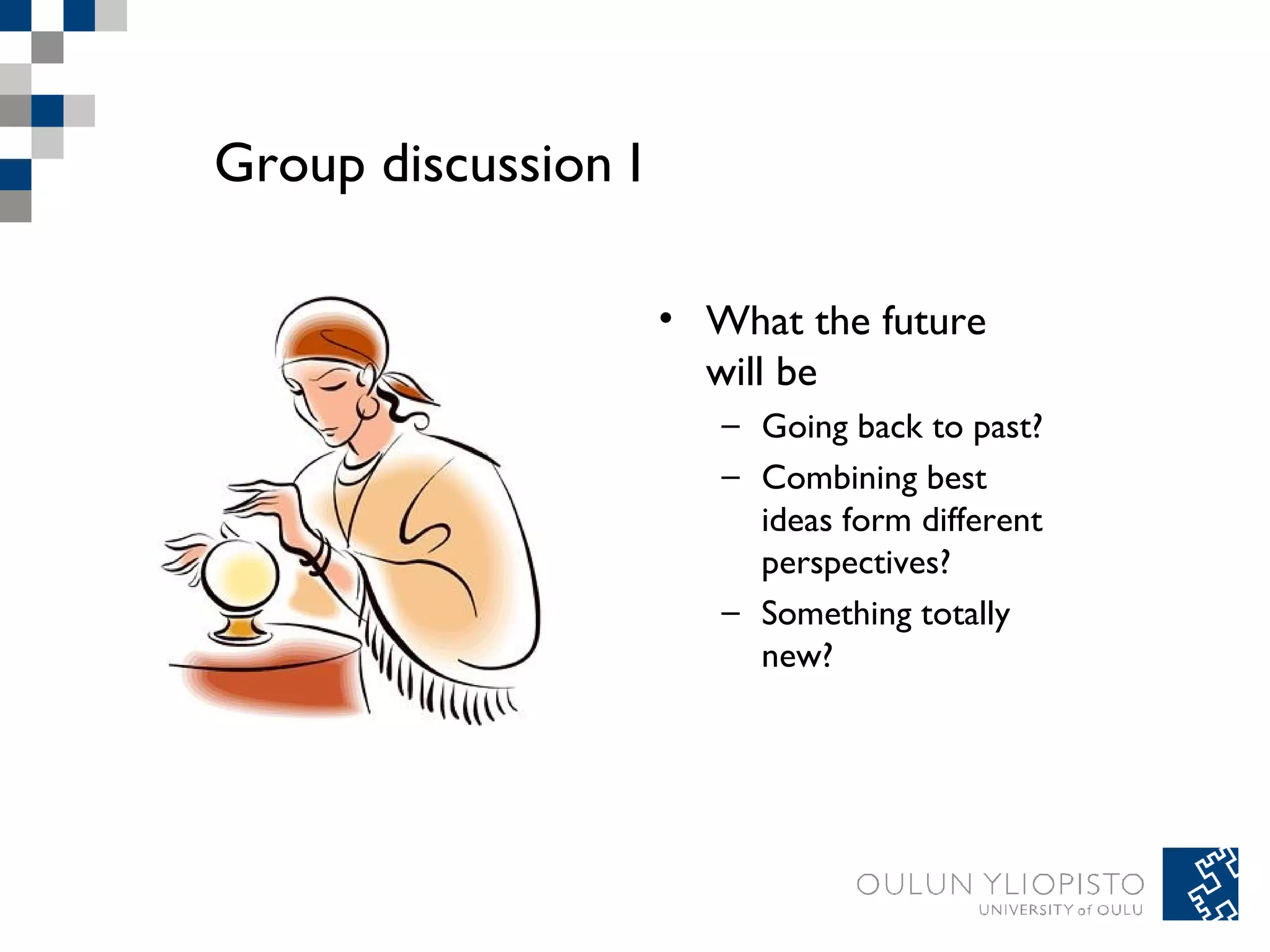
Group discussion I 
• What the future 
will be 
– Going back to past? 
– Combining best 
ideas form different 
perspectives? 
– Something totally 
new?
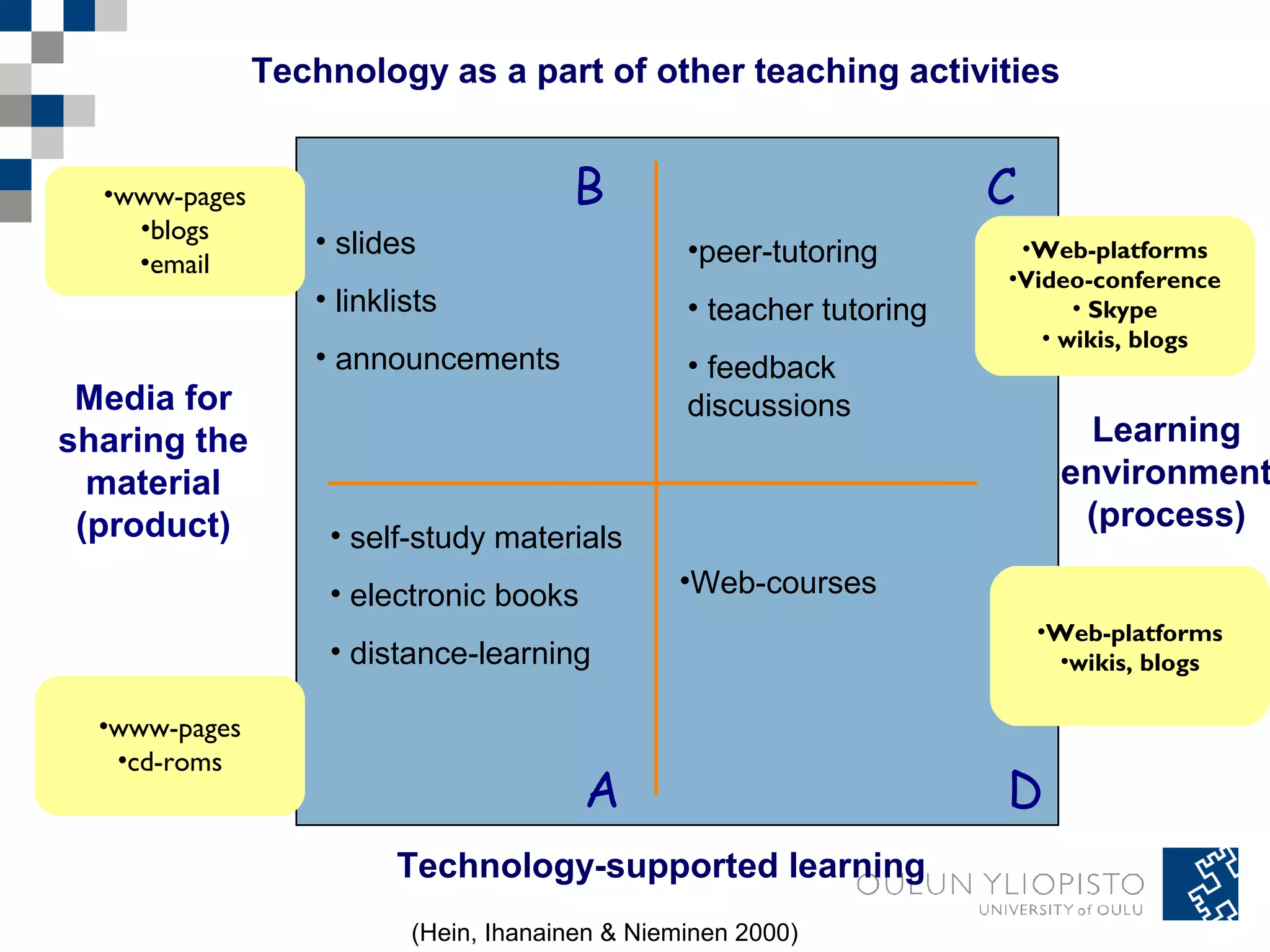
SUPPORTING LEARNING 
WITH TECHNOLOGY
Learning 
environment 
(process) 
Technology as a part of other teaching activities 
• slides 
• linklists 
• announcements 
B C 
•peer-tutoring 
• teacher tutoring 
• feedback 
discussions 
•Web-courses 
• self-study materials 
• electronic books 
• distance-learning 
A D 
Technology-supported learning 
Media for 
sharing the 
material 
(product) 
(Hein, Ihanainen & Nieminen 2000) 
•www-pages 
•blogs 
•email 
•www-pages 
•cd-roms 
•Web-platforms 
•Video-conference 
• Skype 
• wikis, blogs 
•Web-platforms 
•wikis, blogs
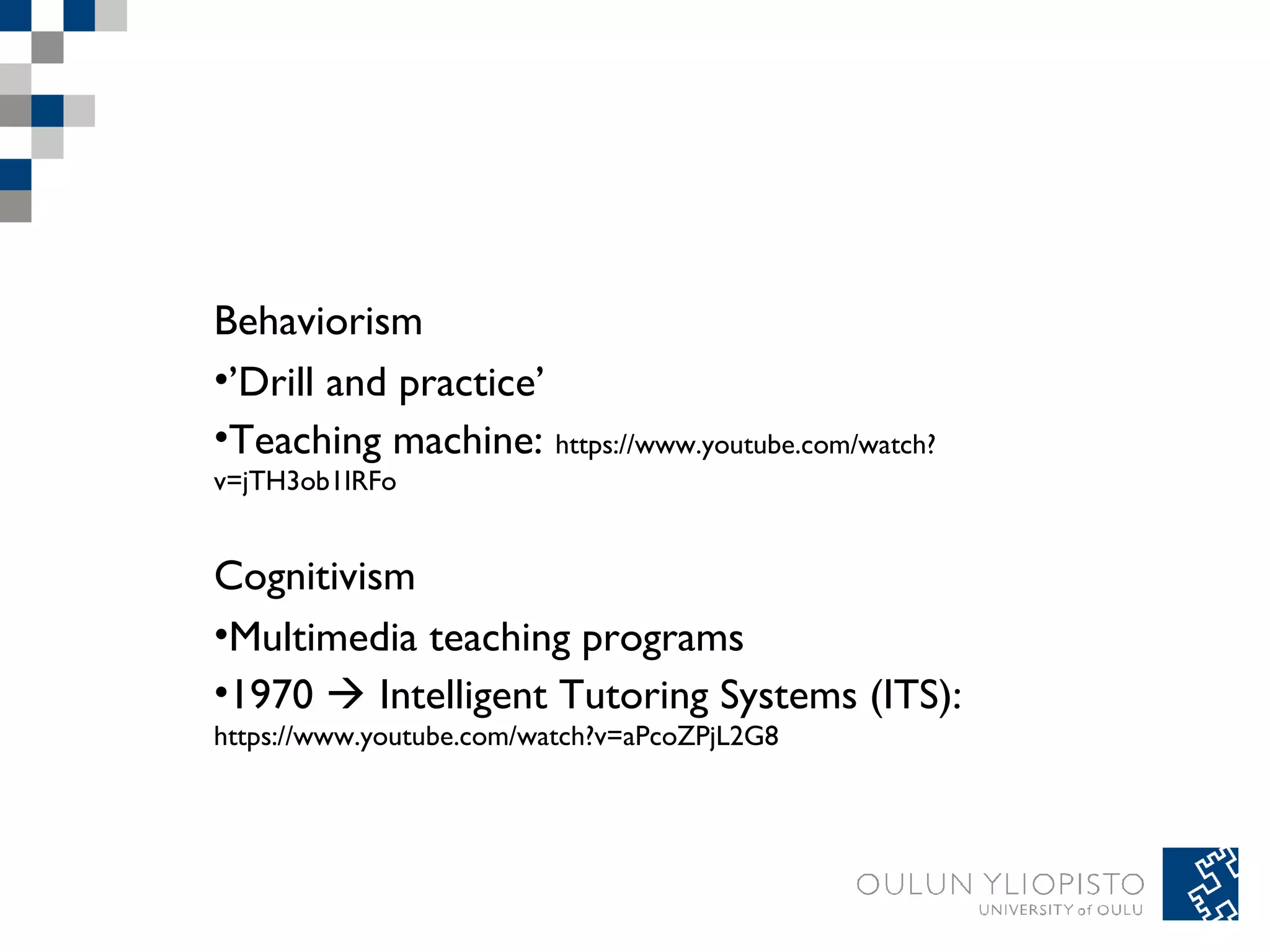
Behaviorism 
•’Drill and practice’ 
•Teaching machine: https://www.youtube.com/watch? 
v=jTH3ob1IRFo 
Cognitivism 
•Multimedia teaching programs 
•1970  Intelligent Tutoring Systems (ITS): 
https://www.youtube.com/watch?v=aPcoZPjL2G8
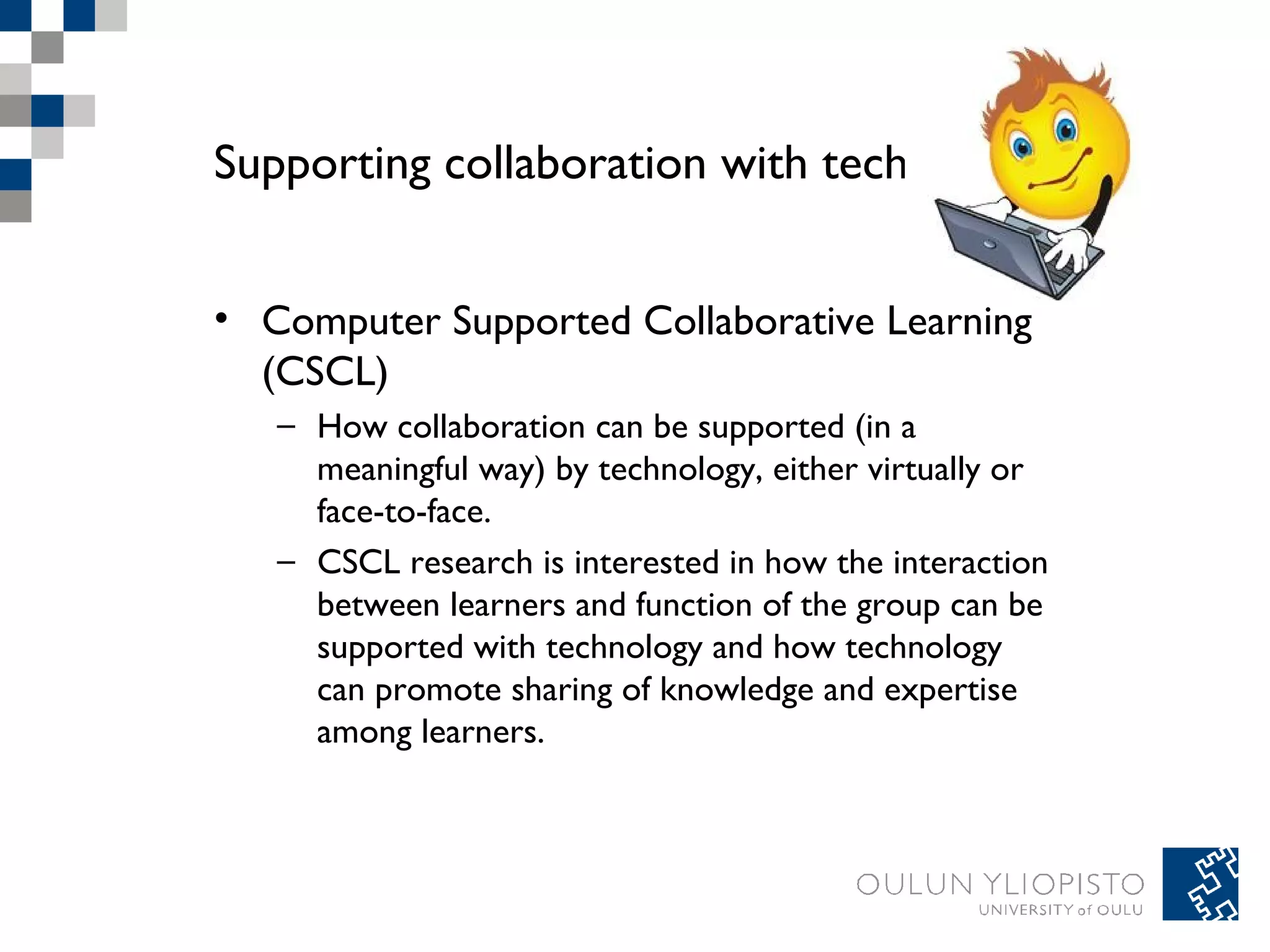
Supporting collaboration with technology 
• Computer Supported Collaborative Learning 
(CSCL) 
– How collaboration can be supported (in a 
meaningful way) by technology, either virtually or 
face-to-face. 
– CSCL research is interested in how the interaction 
between learners and function of the group can be 
supported with technology and how technology 
can promote sharing of knowledge and expertise 
among learners.
CSCL research in general 
• …covers small scale studies (two learners collaborating for 
30 minutes) and large scale studies (several thousand learners 
studying collaboratively over several years), 
• …includes contexts where collaboration take place only 
virtually and contexts where face-to-face collaboration is 
supported with technology, 
• …covers both quantitative, qualitative and mixed-methods 
approaches, and 
• …is based in various theoretical approahces (socio-cultural, 
socio-cognitive, group dynamical etc.) 
09/25/14 
Essi Vuopala/ LET
CSCL research 
•Current: 
– Identify interactions that leads to learning (based on socio-cognitive 
conflict theory)  engaging learners to argumentation with each other. 
– Collaboration scripts: making interaction more productive 
– Affordances: relationships between agents and their environments, 
relationships that offer potentials for action. 
– Affective issues in CSCL: Socially shared regulation, emotions and 
motivation during CSCL 
– Orhestration: process of coordinating supportive interventions across 
multiple learning activities occuring at multiple social levels. 
•Future: 
– Combining individual and group approaches. 
(Suthers, D. D. (2012). Computer-Supported Collaborative Learning. In N. M. Seel (Ed.), Encyclopedia of the Sciences of Learning. New York: Springer. 
Dillenbourg, Järvelä, & Fischer, 2009) 
09/25/14 
Essi Vuopala/ LET
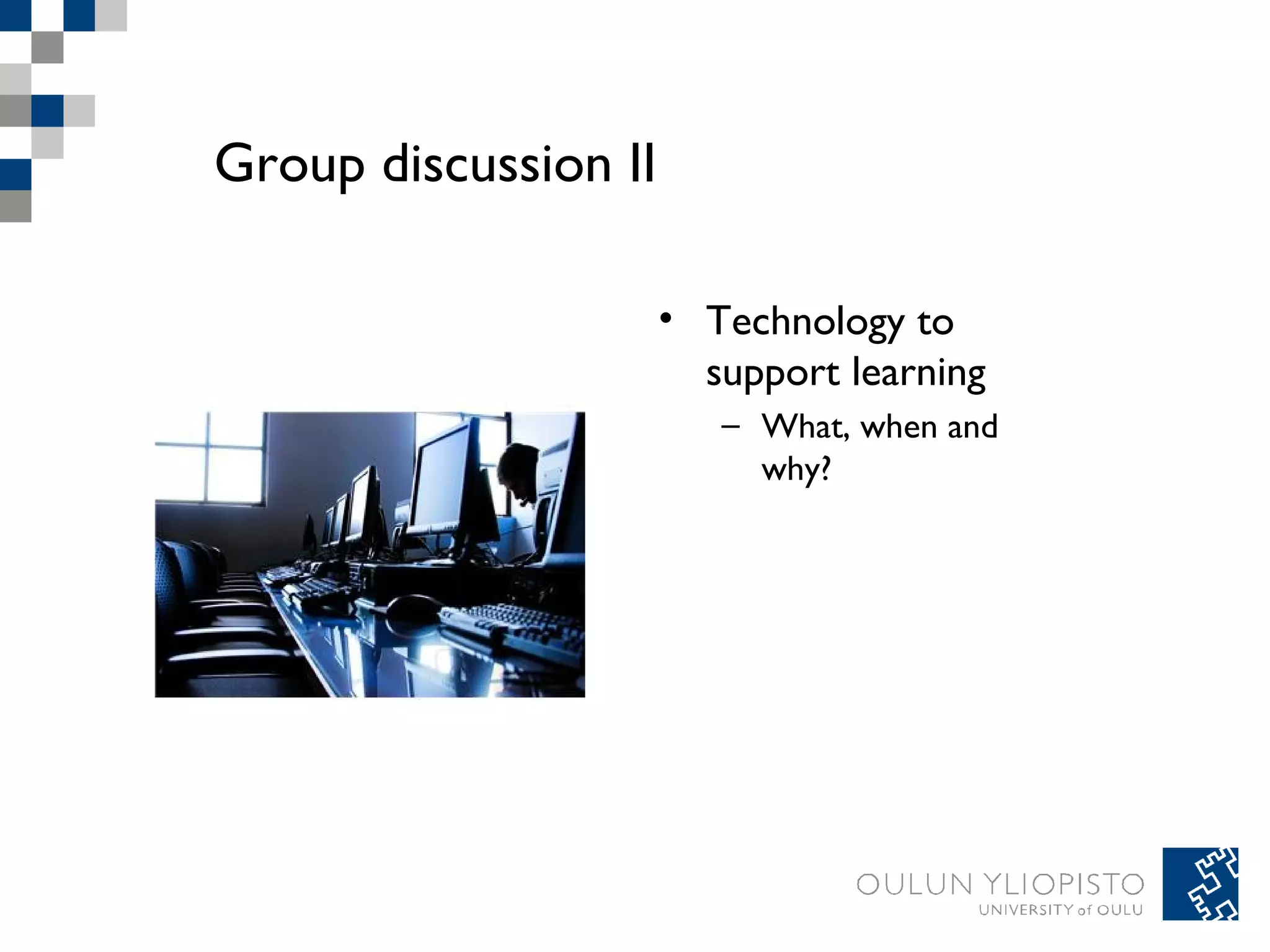
Group discussion II 
• Technology to 
support learning 
– What, when and 
why?
Questions? 
Thank you!
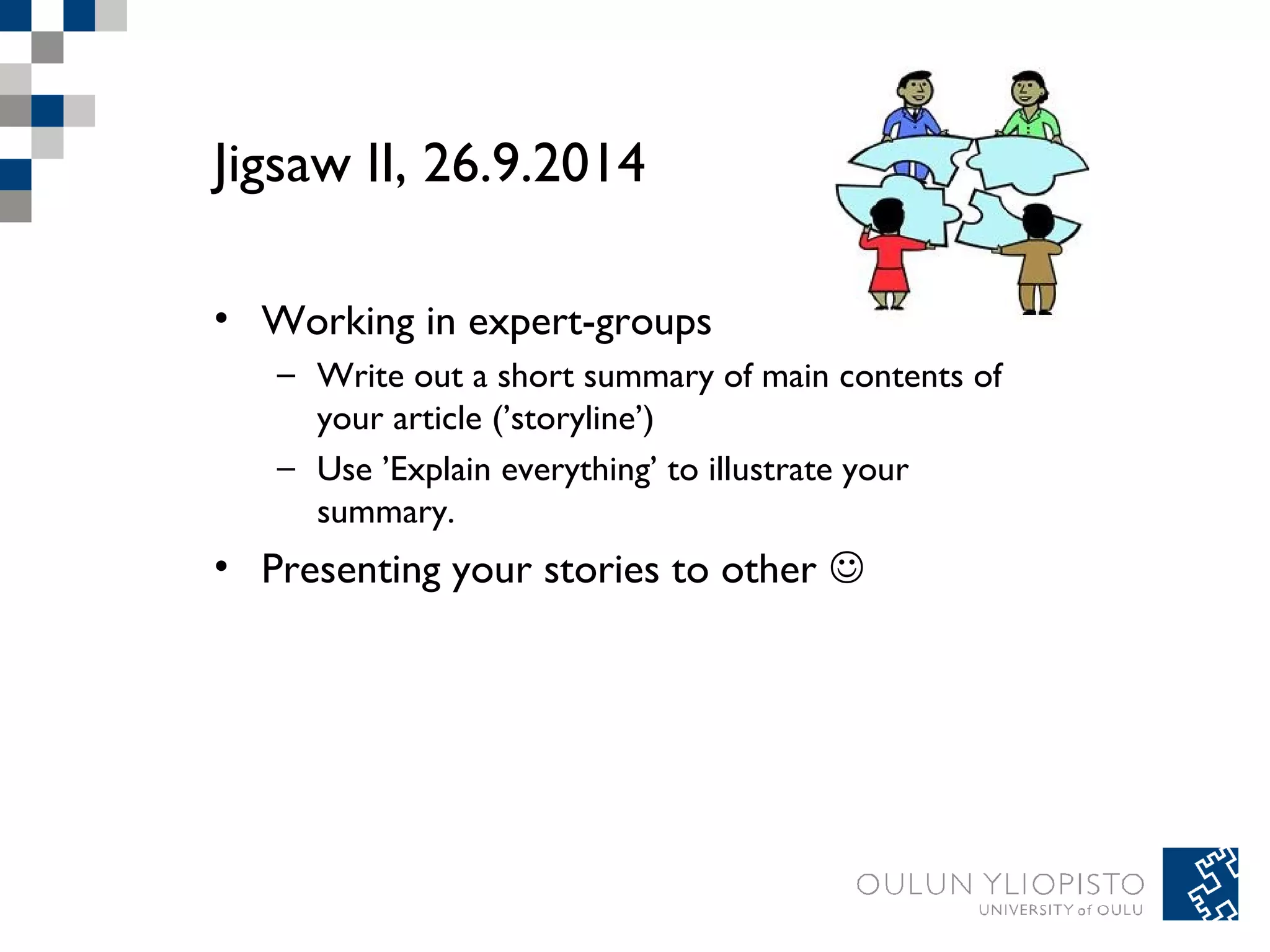
Jigsaw II, 26.9.2014 
• Working in expert-groups 
– Write out a short summary of main contents of 
your article (’storyline’) 
– Use ’Explain everything’ to illustrate your 
summary. 
• Presenting your stories to other 

Cscl-Introduction into the field (Essi Vuopala, 25.9.2014)

  • 1.
    (Computer-supported) collaborative learning Introduction into the field 09/25/14 Essi Vuopala/ LET Introduction to Learning and Educational Technology Essi Vuopala
  • 2.
    Content of thelecture • Defining collaborative learning and CSCL • Group task I • Technology to support learning • Group task II
  • 3.
    FROM INDIVIDUAL TO COLLABORATIVE…
  • 4.
    Behaviorism (1910 ) • Stimulus – response • Reinforcement • In teaching – Instant feedback – Splitting – Passing quickly the mistakes
  • 5.
    Cognitivism (1960) •Learning as information processing. • Cognitive conflict – Assimilation – Accommodation • Metacognition
  • 7.
    What is collaborativelearning (Crook 2000; Dillenbourg 2002) Collaborative learning refers to studying method where group members have joint task and they are committed to construct a joint understanding through social interaction. (Lave & Wenger 1991) Collaborative learning refers to the culture of knowledge building and learning is considered equal to learners’ growing ability to participate in learning communities’ actions. (Baker 2002) Collaborative learning can be seen as a space where the group members create new knowledge together. And what it is not… • one specific theory • single pedagogical method or psychological process
  • 8.
  • 9.
    Common elements (collaborative– co-operative) • Learning is active • Teacher as a facilitator • Learning as shared experiece • Small group activities • Learners responsibility • Social and team skills Kirschner, 2001
  • 10.
    Collaborative learning is effective because it might actuate important learning Collaborative learning is effective because it might actuate important learning mechanisms. mechanisms. •asking and explaining •argumenting and giving feedback •sharing knowledge •following other’s strategies
  • 11.
    Why collaborative learning? Requirements of information society  Increasing amount of knowlwege  Rapid change of working- and everyday life Latest learning research  Social interaction between learners is the main factor in successful learning.
  • 12.
    However… – Notall types of interaction lead to high-level of collaborative learning. Interaction forms in successful collaborative learning (Vuopala 2013, in press) Group-related Task-related
  • 13.
    Coordinating groupwork Group-relatedTask-related Sosio-emotional aspects New knowledge Comment/ answer Question
  • 14.
    Collaborative learning isnot a spontaneous process  structuring/orchestrating
  • 15.
    Group discussion I • What the future will be – Going back to past? – Combining best ideas form different perspectives? – Something totally new?
  • 16.
  • 17.
    Learning environment (process) Technology as a part of other teaching activities • slides • linklists • announcements B C •peer-tutoring • teacher tutoring • feedback discussions •Web-courses • self-study materials • electronic books • distance-learning A D Technology-supported learning Media for sharing the material (product) (Hein, Ihanainen & Nieminen 2000) •www-pages •blogs •email •www-pages •cd-roms •Web-platforms •Video-conference • Skype • wikis, blogs •Web-platforms •wikis, blogs
  • 18.
    Behaviorism •’Drill andpractice’ •Teaching machine: https://www.youtube.com/watch? v=jTH3ob1IRFo Cognitivism •Multimedia teaching programs •1970  Intelligent Tutoring Systems (ITS): https://www.youtube.com/watch?v=aPcoZPjL2G8
  • 19.
    Supporting collaboration withtechnology • Computer Supported Collaborative Learning (CSCL) – How collaboration can be supported (in a meaningful way) by technology, either virtually or face-to-face. – CSCL research is interested in how the interaction between learners and function of the group can be supported with technology and how technology can promote sharing of knowledge and expertise among learners.
  • 20.
    CSCL research ingeneral • …covers small scale studies (two learners collaborating for 30 minutes) and large scale studies (several thousand learners studying collaboratively over several years), • …includes contexts where collaboration take place only virtually and contexts where face-to-face collaboration is supported with technology, • …covers both quantitative, qualitative and mixed-methods approaches, and • …is based in various theoretical approahces (socio-cultural, socio-cognitive, group dynamical etc.) 09/25/14 Essi Vuopala/ LET
  • 21.
    CSCL research •Current: – Identify interactions that leads to learning (based on socio-cognitive conflict theory)  engaging learners to argumentation with each other. – Collaboration scripts: making interaction more productive – Affordances: relationships between agents and their environments, relationships that offer potentials for action. – Affective issues in CSCL: Socially shared regulation, emotions and motivation during CSCL – Orhestration: process of coordinating supportive interventions across multiple learning activities occuring at multiple social levels. •Future: – Combining individual and group approaches. (Suthers, D. D. (2012). Computer-Supported Collaborative Learning. In N. M. Seel (Ed.), Encyclopedia of the Sciences of Learning. New York: Springer. Dillenbourg, Järvelä, & Fischer, 2009) 09/25/14 Essi Vuopala/ LET
  • 22.
    Group discussion II • Technology to support learning – What, when and why?
  • 23.
  • 24.
    Jigsaw II, 26.9.2014 • Working in expert-groups – Write out a short summary of main contents of your article (’storyline’) – Use ’Explain everything’ to illustrate your summary. • Presenting your stories to other 

Editor's Notes

  • #5 Behaviorismissa oppiminen nähdään ärsyke-reaktiokytkentöjen muodostumisena, ja sitä voidaan säädellä vahvistamisella. Oletuksena on, että opetuksen tavoitteena oleva reaktio (R) vakiintuu pysyväksi käyttäytymiseksi eli se opitaan, kun se yhdistetään ympäristöstä tulevaan ärsykkeeseen (S). Käyttäytymistä säädellään oppijan ulkopuolelta vahvistamisella (O). Toivotusta käyttäytymisestä annetaan palkkio, ei-toivottua käyttäytymistä heikennetään rangaistuksella. (Tynjälä 1999, 29 -31.) Behavioristisen oppimiskäsityksen juuret ovat luonnontieteellisessä ajattelussa. Ihmisen ja eläimen oppiminen nähdään perusmuodoiltaan samanlaisena. Tietoa maailmasta saadaan kokemusten ja aistihavaintojen kautta, oppija on tyhjä taulu (tabula rasa), johon kokemukset piirtävät jälkiä. Behaviorismin pedagogisia periaatteita ovat: vahvistamisen periaate välittömän palautteen periaate opetettavan aineksen pilkkominen pieniin osiin virheellisten vastausten nopea sivuuttaminen. Kasvatuksen tehtävänä on ohjata ulkoisesti näyttäytyvää tai kuuluvaa toimintaa siten, että suoritus voidaan todeta hyväksi ja oppimistavoitteet saavutetuiksi. Opetus keskittyy tietojen ja taitojen ulkoiseen ohjaukseen, säätelyyn ja vakiinnuttamiseen. Oppijan valmiuksia ajatella ja ymmärtää opittavina olevia asioita ei tueta. (Sava 1993, 18.)
  • #6 Kognitiivinen suuntaus syntyi 1960-luvun alussa, kun ulkoisen sijaan alettiin kiinnittää huomiota ihmismielen sisäisiin ilmiöihin, kognitiivisiin prosesseihin. Kognitiivisessa oppimisessa kiinnostus kohdistuu siihen, miten ihminen prosessoi tietoa: oppiminen nähdään tiedon prosessointina. Oppija nähdään erilaisen tiedon aktiivisena käsittelijänä: tietoa vastaanottavana, havaintoja tekevänä, valikoivana, taltioivana, tulkitsevana ja aktiivisesti kehittävänä olentona. Painopiste on viime vuosina siirtynyt yksilöllisen tiedonrakennus- ja merkitysten asemasta jaetun kognition eli oppimisen yhteisöllisen prosessin tutkimukseen (Nevgi & Lindblom-Ylänne, 2003,16). Mielekäs oppiminen alkaa käytännön elämän ongelmista ja ristiriidoista. Oppijan mielessä syntyy tiedollinen ristiriita, kun hänen tietonsa ja taitonsa eivät riitäkään tilanteen hallitsemiseen. Oppija pyrkii ratkaisemaan ristiriidan joko hankkimalla uutta tietoa (assimilaatio) tai hän järjestää aiemman tiedon uudella tavalla (akkommodaatio). Oppimisen tuloksena syntyy jäsentyneitä ajatuksia sekä selittäviä periaatteita, joista muodostuu oppijalle toimintaa ohjaavia sisäisiä rakenteita ja malleja, skeemoja. Uuden tiedon omaksuminen nähdään aina riippuvaisena aikaisemmasta tiedosta. Kognitiivinen oppimisajattelu pitää tärkeänä myös oppijoiden metakognitiivisten taitojen kehittämistä. Metakognitiivisilla taidoilla tarkoitetaan oman oppimisen kriittistä arviointia: miten oppii ja miten voi kehittää oppimistaan. Nämä taidot kuvaavat kykyä tulla tietoiseksi omasta tiedonkäsittely- ja oppimisprosessistaan. (Sava 1993, 25). Arkikielisesti voisi sanoa, että metakognitiiviset taidot tarkoittavat sitä, että “oppija ymmärtää, mitä ymmärtää ja ymmärtää, mitä ei ymmärrä”. Kognitiivinen suuntaus syntyi 1960-luvun alussa, kun ulkoisen sijaan alettiin kiinnittää huomiota ihmismielen sisäisiin ilmiöihin, kognitiivisiin prosesseihin. Kognitiivisessa oppimisessa kiinnostus kohdistuu siihen, miten ihminen prosessoi tietoa: oppiminen nähdään tiedon prosessointina. Oppija nähdään erilaisen tiedon aktiivisena käsittelijänä: tietoa vastaanottavana, havaintoja tekevänä, valikoivana, taltioivana, tulkitsevana ja aktiivisesti kehittävänä olentona. Painopiste on viime vuosina siirtynyt yksilöllisen tiedonrakennus- ja merkitysten asemasta jaetun kognition eli oppimisen yhteisöllisen prosessin tutkimukseen (Nevgi & Lindblom-Ylänne, 2003,16). Mielekäs oppiminen alkaa käytännön elämän ongelmista ja ristiriidoista. Oppijan mielessä syntyy tiedollinen ristiriita, kun hänen tietonsa ja taitonsa eivät riitäkään tilanteen hallitsemiseen. Oppija pyrkii ratkaisemaan ristiriidan joko hankkimalla uutta tietoa (assimilaatio) tai hän järjestää aiemman tiedon uudella tavalla (akkommodaatio). Oppimisen tuloksena syntyy jäsentyneitä ajatuksia sekä selittäviä periaatteita, joista muodostuu oppijalle toimintaa ohjaavia sisäisiä rakenteita ja malleja, skeemoja. Uuden tiedon omaksuminen nähdään aina riippuvaisena aikaisemmasta tiedosta. Kognitiivinen oppimisajattelu pitää tärkeänä myös oppijoiden metakognitiivisten taitojen kehittämistä. Metakognitiivisilla taidoilla tarkoitetaan oman oppimisen kriittistä arviointia: miten oppii ja miten voi kehittää oppimistaan. Nämä taidot kuvaavat kykyä tulla tietoiseksi omasta tiedonkäsittely- ja oppimisprosessistaan. (Sava 1993, 25). Arkikielisesti voisi sanoa, että metakognitiiviset taidot tarkoittavat sitä, että “oppija ymmärtää, mitä ymmärtää ja ymmärtää, mitä ei ymmärrä”. Teknologian uskottiin voivan esimerkiksi tarjota monipuolisia työvälineitä aineistojen käsittelyyn, luokitteluun ja hallintaan ja vapauttaa näin yksilön kognitiivista kapasiteettia muihin oppimisen prosesseihin.
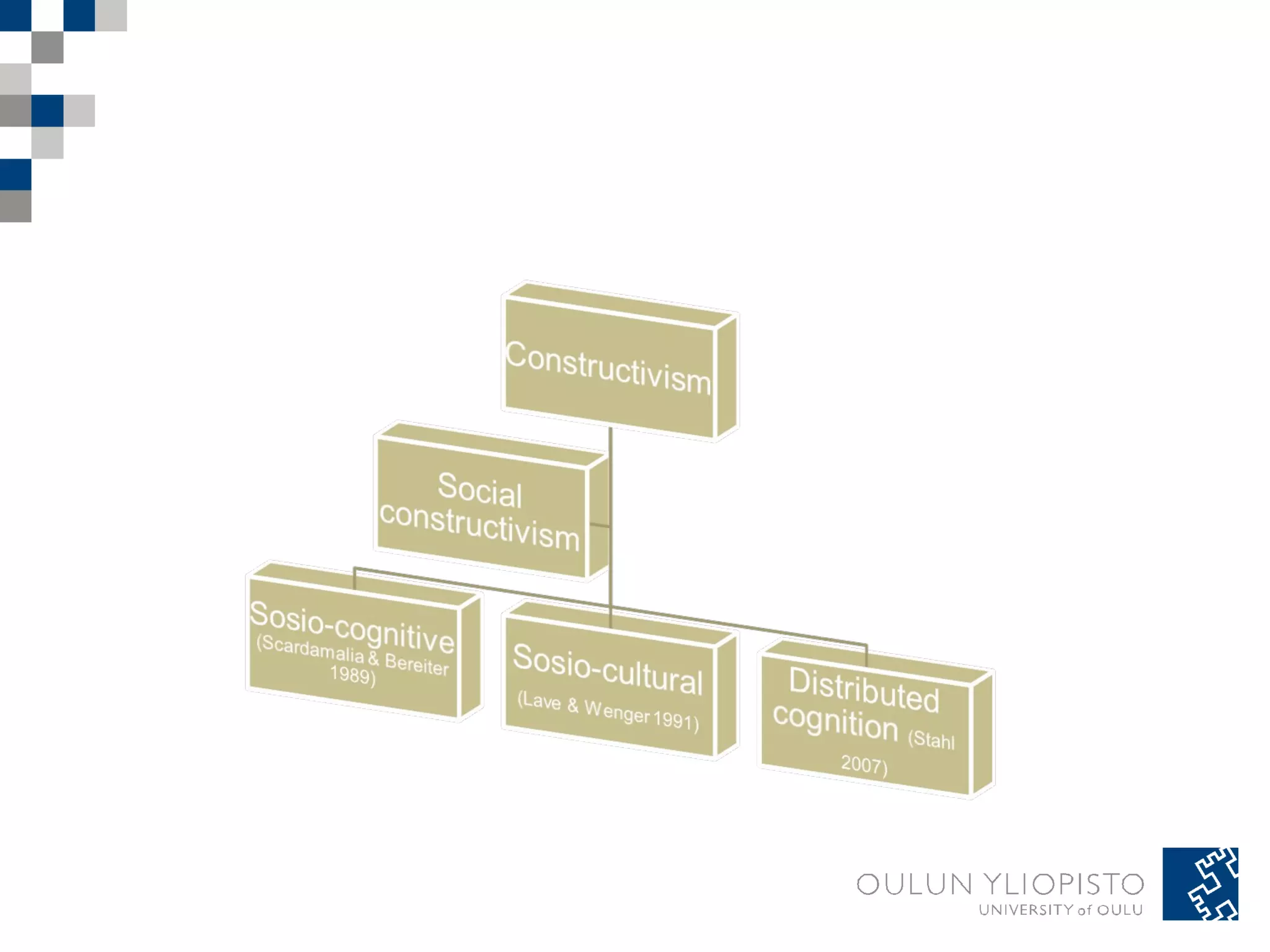
  • #7 Social constructivism Social nature of knowledge. Production of new knowledge as a social action. Reality is a social construction, which is created through interaction between individuals (Resnick, 1991). Sosiocultural (Vygotsky) and sosiocognitive (Piaget) perspectives Sosiocultural and sosiocognitive perspectives for learning Sosio-cultural: Emphasizes the social nature of knowledge building and learning and considers tools (like language) and environments as mediators in the process of knowledge construction. Sosio-cognitive:Emphasis on the social interaction between group members and its’ influence for individual’s learning Socio-cognitive conflict which occurs when learners are interacting with each others and they confront a contradiction between they own and other learners’ thoughts. Solving this conflict can lead to conceptual change which forces learner to re-organize his knowledge structures. The idea of sosio-cognitive conflict is based on Piaget’s idea of cognitive conflict
  • #8 Process in which individuals negotiate and share meanings and knowledge. Main focus in collaboration is in group members’ intentions to construct and maintain the shared notion about the problem. Collaborative learning is making thinking visible and developing one’s own thinking through social interaction. Collaboration can be seen as a space where the group members create new knowledge together (e.g. Baker, 2002). Essential requirement for collaboration is that group members are committed to shared goal and that they participate equally in collaborative knowledge building (Arvaja, 2005).
  • #9 Collaborative learning: Each member of the group has same task and goal. The purpose of the action is to build shared understanding by interacting with each others. (Crook, 2000; Dillenbourg, 2002) Co-operative learning: ”Traditional groupwork”: The task is divided in smaller parts and each group member does just his own part of the hole task.
  • #12 Requirements of the information society Increasing amount of knowledge Rapid change of working- and everyday life Challenges for learning: requirements to master multiple problems and rapid changes, requirements to master skills for information processing and communication, abilities to collaborate with other individuals. (Nurmi & Jaakola, 2002.) Social interaction between learners is the main factor in successful learning. Knowledge sharing and interaction improve learners’ achievements and strengthen learners’ feelings of satisfaction. (e.g. Gear, & al, 2003; Lebie & al., 1996; Wanger, 1995; Webb & Palincsar, 1996; Vrasidas & M Isaac, 1999).
  • #14 Coordinating units Organizing ongoing meeting Organizing upcoming work Technological issues Sosio-emotional units Expressing cohesion Decrease tension Accompanying Presenting new knowledge Theory-based Experience –based Statement Question Independent question Clarifying question Suggestion Answer or comment Short, declaratory comment Comment with explanation
  • #16 Tuotetaan iPadeilla kuva/visio/kaavio, miltä tulevaisuuden oppiminen näyttää ja mitä se pitää sisällään.
  • #23 Tuotetaan iPadeilla kuva/visio/kaavio, miltä tulevaisuuden oppiminen näyttää ja mitä se pitää sisällään.