Alpesh C Jadhav
B. Sc. (Hons.) Sports & Exercise Sciences
LIVE HIGH
TRAIN LOW
LIVE HIGH, TRAIN LOW
• “Staying” at Altitude, or Altitude Simulated
Environments and “Training” at Sea-Level.
• An Effective Strategy, as Training Intensity cannot
be Maintained at Altitude, and a Reduction in
Training Intensity may affect Performance
Negatively.
• (Levine and Stray-Gundersen)
Mechanism
1. Exposure to Reduced Oxygen Levels
(altitude or hypoxia) is a challenge to the
human body because oxygen is the
primary source of energy for our cells.
2. Under a state of hypoxia, the body strives
to produce required amounts of Energy
with Less Oxygen Available.
3. To do so, a protein called Hypoxia
Inducible Factor (HIF-1) sets off a “Host
of Reactions” geared toward improving
the body’s ability to utilize oxygen.
Boosted Production of
Erythropoietin Hormone
(EPO) by the Kidneys.
Which, Stimulates
Generation of Red Blood
Cells (RBCs) and Enhances
Oxygen Transportation
through the body
ALTITUDE
EXPOSURE
The Ergogenic Effects
• Increased VO2max and Lactate Threshold
• Increased Capillarisation (Density and Length),
Enabling Increased O2 Delivery to tissues
• Boost in Mitochondrial Enzymes allowing More
Efficient Use of O2 for Energy
• Improved Exercise Economy
Possible Side-Effects
Longer recovery times between training sessions
Sleep disturbances
Reductions in Immune Health (Increased risk of infections, Colds
and Flu)
A Sleep Protocol
• To minimise Sleep Disturbances, Introduce a Sleeping Protocol at a
Conservative Level of Inspired O2 (between 1,800-2,000m)
• Gradually Decrease this (or increase the simulated altitude level) in a
Stepwise Fashion; where the concentration of inspired O2 is lowered
the equivalent of ~500m every 2 or 3days during a 2-3 week LHTL
protocol.
Supplementation
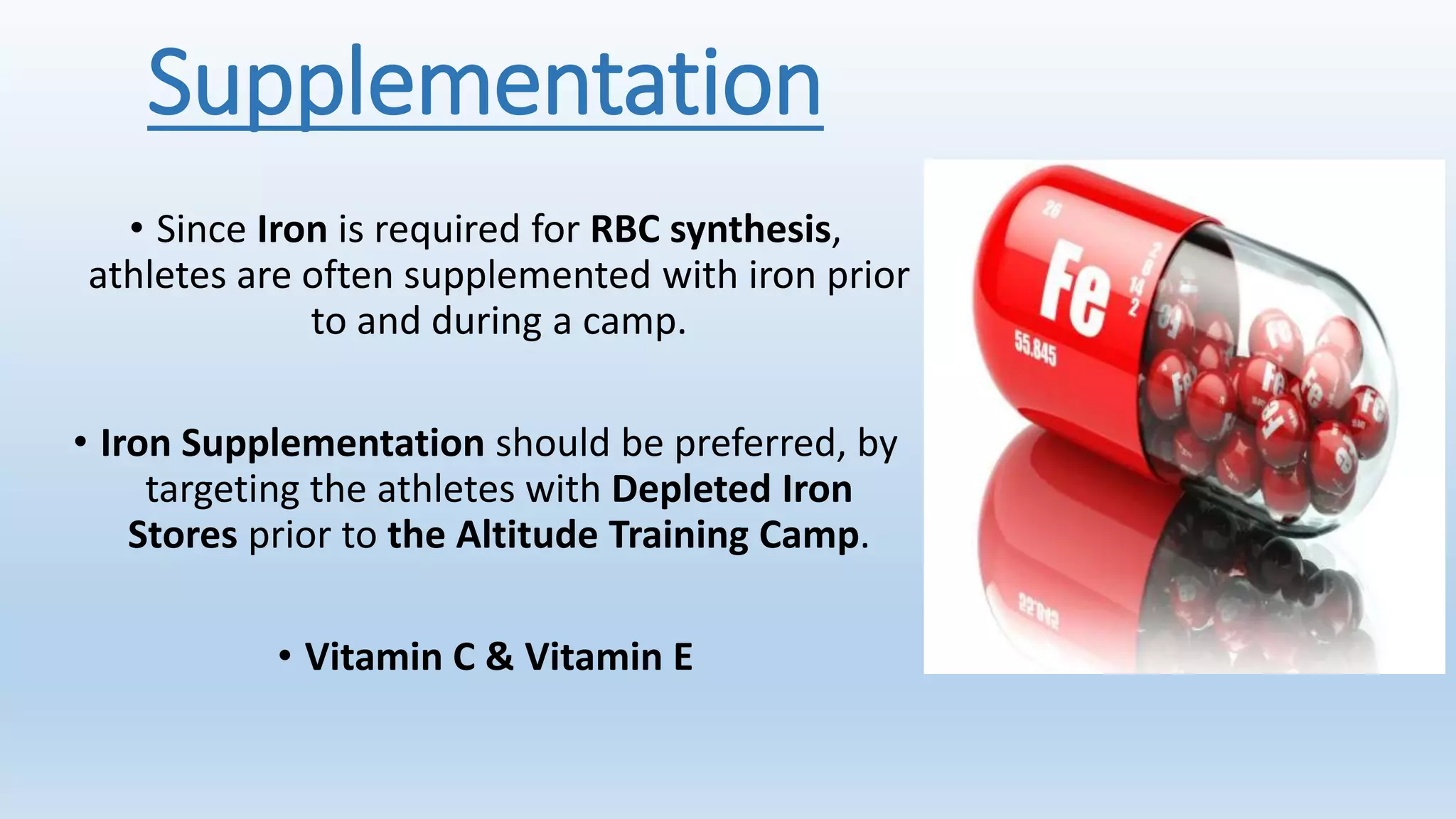
• Since Iron is required for RBC synthesis,
athletes are often supplemented with iron prior
to and during a camp.
• Iron Supplementation should be preferred, by
targeting the athletes with Depleted Iron
Stores prior to the Altitude Training Camp.
• Vitamin C & Vitamin E
REASEARCH TALKS
• Athletes who lived at 2500 m but Returned
regularly to Lower Altitudes (1000 to 1250 m) to
train at near–sea-level intensity (i.e., Live High–
Train Low)
• Showed Greater Average Increases in VO2max
and 5000-m Run Performance
• Than athletes who lived and Trained only at
2500m or those who lived and Trained only at
Sea Level.
WHY ?
• Strategies that combine altitude acclimatization
and maintenance of sea-level training intensity
provide Synergistic Benefits to Sea-level
Endurance Performance.
• Regular Training Exposure to a Near–Sea-level
Environment Prevents The Impaired Systolic
Function (i.e., Reduced Maximum Stroke Volume
and Cardiac Output) typically observed during
altitude training.
COST EFFECTIVENESS
•To remove the Inconvenience and
Cost of the Live High–Train Low
strategy, a modification applies
Supplemental Oxygen during
training at altitude.
Supplemental Oxygen Increases:
1. Arterial OxyHemoglobin Saturation
2. Exercise Oxygen Consumption, and
3. Average Power Output during High-
Intensity Workouts at Moderate
Altitude.
•Minimal Travel Expense
and Inconvenience
•Without Inducing
additional Free Radical
Oxidative Stress.
• Not All Individuals Benefit to the Same Degree from the Living High,
Training Low Strategy.
• Within the Group that Showed Physiologic and Performance Increases with
This Protocol, Some individuals were “Responders”, while others
showed little positive adjustment.
• The “Non-Responders” displayed:
A Smaller Increase in Plasma Concentration of the Erythrocyte- Producing
Hormone EPO after 30 hours at Altitude than the Responders.
• Such individuals experience a Depressed Increase in Haematocrit During
Acclimatization to Altitude Exposure.
• Three prerequisites are required
to benefit from combining
Altitude Living and Lower Altitude
Training:
1. “The Elevation must be High Enough” to
Raise EPO Concentrations to increase
Total Red Blood Cell volume and VO2max.
2. The Athlete must respond Positively with
Increased EPO Output.
• Training must take place at an Elevation
Low Enough to maintain Training Intensity
and Exercise Oxygen Consumption at
“Near–Sea-Level Values”.
At-Home
Acclimatization
•Altitude’s Beneficial Effects on
Erythropoiesis and Aerobic
Capacity may require relatively
Short-Term Exposures to
Hypoxia.
What Does Study Say ?
• Daily Intermittent Exposures of 3 to 5 hours
for 9 days to Simulated Altitudes of 4000 to
5500 m in a Hypobaric Chamber
• Increased Endurance Performance, Red
Blood Cell Count, and Hemoglobin
Concentration in Elite Mountain Climbers
This approach also Decreases the Rate of
Lactate Appearance during Intense Exercise.
HYPPOBARIC CHAMBERS
•In the Absence of a
Hypobaric Chamber,
•3 Approaches can
create an “Altitude”.
1. Gamow Hypobaric
Chamber
• A Person Rests and Sleeps for about 10
hours Each Day.
• The chamber’s Total Air Pressure
Decreases to simulate the Barometric
Pressure of a Preselected Altitude.
• Reduced Barometric Pressure
proportionately reduces the Inspired
Air’s PO2 to simulate Altitude Exposure
and Induce Physiologic Adaptations.
SIMULATED ALTITUDE AT SEA LEVEL
SIMULATED ALTITUDE AT
SEA LEVEL
•Simulate Altitude at Sea Level by
Increasing the Nitrogen % of the Air
within an Enclosure.
•Increased “Nitrogen %”
correspondingly Reduces the Air’s
“Oxygen %”, thus decreasing
“Inspired Air PO2”.
• Nordic skiers have applied this technique by
living for 3 to 4 weeks in a house that
provides “Air” with only 15.3% oxygen rather
than its normal concentration of 20.9%.
• The System Requires Mixing Nitrogen Gas
and Carefully Monitoring the Breathing
Mixture.
• Interestingly, the Norwegian Olympic
Organization has Banned these “Altitude
Houses” for its own athletes because they
consider this practice “Grey-Zone” doping.
GREY-ZONE DOPING
Substance which are still Under
Investigation and Effect on
Performance of which are “Not
Clearly Understood”
3. Hypoxico Altitude Tent
• Supplies Air with an Oxygen Content of
approximately 15% to simulate an altitude of
2500 m.
• The 70-lb Unit consists of a Portable Tent that
fits over a Normal Bed.
• A “Hypoxic Generator” continually feeds
Altitude-Simulating Hypoxic Air into the
Tent.
• The Porosity of the Tent’s Material limits
the Rate of Diffusion of Outside Oxygen
into the tent and Maintains the 15%
oxygen concentration.
• Equilibration of the Tent’s Environment at
the 15% Oxygen Level requires about 90
minutes.
References
• Exercise Physiology, Nutrition, Energy, and Human Performance,
Seventh Edition- William D. McArdle
• The Olympic Textbook Of Medicine In Sport
• Altitude Training System
• Hypoxico
THANKS

Live High Train Low

  • 1.
    Alpesh C Jadhav B.Sc. (Hons.) Sports & Exercise Sciences LIVE HIGH TRAIN LOW
  • 2.
    LIVE HIGH, TRAINLOW • “Staying” at Altitude, or Altitude Simulated Environments and “Training” at Sea-Level. • An Effective Strategy, as Training Intensity cannot be Maintained at Altitude, and a Reduction in Training Intensity may affect Performance Negatively. • (Levine and Stray-Gundersen)
  • 3.
    Mechanism 1. Exposure toReduced Oxygen Levels (altitude or hypoxia) is a challenge to the human body because oxygen is the primary source of energy for our cells. 2. Under a state of hypoxia, the body strives to produce required amounts of Energy with Less Oxygen Available. 3. To do so, a protein called Hypoxia Inducible Factor (HIF-1) sets off a “Host of Reactions” geared toward improving the body’s ability to utilize oxygen. Boosted Production of Erythropoietin Hormone (EPO) by the Kidneys. Which, Stimulates Generation of Red Blood Cells (RBCs) and Enhances Oxygen Transportation through the body
  • 4.
  • 5.
    The Ergogenic Effects •Increased VO2max and Lactate Threshold • Increased Capillarisation (Density and Length), Enabling Increased O2 Delivery to tissues • Boost in Mitochondrial Enzymes allowing More Efficient Use of O2 for Energy • Improved Exercise Economy
  • 6.
    Possible Side-Effects Longer recoverytimes between training sessions Sleep disturbances Reductions in Immune Health (Increased risk of infections, Colds and Flu)
  • 7.
    A Sleep Protocol •To minimise Sleep Disturbances, Introduce a Sleeping Protocol at a Conservative Level of Inspired O2 (between 1,800-2,000m) • Gradually Decrease this (or increase the simulated altitude level) in a Stepwise Fashion; where the concentration of inspired O2 is lowered the equivalent of ~500m every 2 or 3days during a 2-3 week LHTL protocol.
  • 8.
    Supplementation • Since Ironis required for RBC synthesis, athletes are often supplemented with iron prior to and during a camp. • Iron Supplementation should be preferred, by targeting the athletes with Depleted Iron Stores prior to the Altitude Training Camp. • Vitamin C & Vitamin E
  • 9.
    REASEARCH TALKS • Athleteswho lived at 2500 m but Returned regularly to Lower Altitudes (1000 to 1250 m) to train at near–sea-level intensity (i.e., Live High– Train Low) • Showed Greater Average Increases in VO2max and 5000-m Run Performance • Than athletes who lived and Trained only at 2500m or those who lived and Trained only at Sea Level.
  • 10.
    WHY ? • Strategiesthat combine altitude acclimatization and maintenance of sea-level training intensity provide Synergistic Benefits to Sea-level Endurance Performance. • Regular Training Exposure to a Near–Sea-level Environment Prevents The Impaired Systolic Function (i.e., Reduced Maximum Stroke Volume and Cardiac Output) typically observed during altitude training.
  • 11.
    COST EFFECTIVENESS •To removethe Inconvenience and Cost of the Live High–Train Low strategy, a modification applies Supplemental Oxygen during training at altitude.
  • 12.
    Supplemental Oxygen Increases: 1.Arterial OxyHemoglobin Saturation 2. Exercise Oxygen Consumption, and 3. Average Power Output during High- Intensity Workouts at Moderate Altitude.
  • 13.
    •Minimal Travel Expense andInconvenience •Without Inducing additional Free Radical Oxidative Stress.
  • 14.
    • Not AllIndividuals Benefit to the Same Degree from the Living High, Training Low Strategy. • Within the Group that Showed Physiologic and Performance Increases with This Protocol, Some individuals were “Responders”, while others showed little positive adjustment.
  • 15.
    • The “Non-Responders”displayed: A Smaller Increase in Plasma Concentration of the Erythrocyte- Producing Hormone EPO after 30 hours at Altitude than the Responders. • Such individuals experience a Depressed Increase in Haematocrit During Acclimatization to Altitude Exposure.
  • 16.
    • Three prerequisitesare required to benefit from combining Altitude Living and Lower Altitude Training: 1. “The Elevation must be High Enough” to Raise EPO Concentrations to increase Total Red Blood Cell volume and VO2max. 2. The Athlete must respond Positively with Increased EPO Output. • Training must take place at an Elevation Low Enough to maintain Training Intensity and Exercise Oxygen Consumption at “Near–Sea-Level Values”.
  • 17.
    At-Home Acclimatization •Altitude’s Beneficial Effectson Erythropoiesis and Aerobic Capacity may require relatively Short-Term Exposures to Hypoxia.
  • 18.
    What Does StudySay ? • Daily Intermittent Exposures of 3 to 5 hours for 9 days to Simulated Altitudes of 4000 to 5500 m in a Hypobaric Chamber • Increased Endurance Performance, Red Blood Cell Count, and Hemoglobin Concentration in Elite Mountain Climbers This approach also Decreases the Rate of Lactate Appearance during Intense Exercise.
  • 19.
  • 20.
    •In the Absenceof a Hypobaric Chamber, •3 Approaches can create an “Altitude”.
  • 21.
    1. Gamow Hypobaric Chamber •A Person Rests and Sleeps for about 10 hours Each Day. • The chamber’s Total Air Pressure Decreases to simulate the Barometric Pressure of a Preselected Altitude. • Reduced Barometric Pressure proportionately reduces the Inspired Air’s PO2 to simulate Altitude Exposure and Induce Physiologic Adaptations.
  • 22.
  • 23.
    SIMULATED ALTITUDE AT SEALEVEL •Simulate Altitude at Sea Level by Increasing the Nitrogen % of the Air within an Enclosure. •Increased “Nitrogen %” correspondingly Reduces the Air’s “Oxygen %”, thus decreasing “Inspired Air PO2”.
  • 24.
    • Nordic skiershave applied this technique by living for 3 to 4 weeks in a house that provides “Air” with only 15.3% oxygen rather than its normal concentration of 20.9%. • The System Requires Mixing Nitrogen Gas and Carefully Monitoring the Breathing Mixture. • Interestingly, the Norwegian Olympic Organization has Banned these “Altitude Houses” for its own athletes because they consider this practice “Grey-Zone” doping.
  • 25.
    GREY-ZONE DOPING Substance whichare still Under Investigation and Effect on Performance of which are “Not Clearly Understood”
  • 26.
    3. Hypoxico AltitudeTent • Supplies Air with an Oxygen Content of approximately 15% to simulate an altitude of 2500 m. • The 70-lb Unit consists of a Portable Tent that fits over a Normal Bed.
  • 27.
    • A “HypoxicGenerator” continually feeds Altitude-Simulating Hypoxic Air into the Tent. • The Porosity of the Tent’s Material limits the Rate of Diffusion of Outside Oxygen into the tent and Maintains the 15% oxygen concentration. • Equilibration of the Tent’s Environment at the 15% Oxygen Level requires about 90 minutes.
  • 32.
    References • Exercise Physiology,Nutrition, Energy, and Human Performance, Seventh Edition- William D. McArdle • The Olympic Textbook Of Medicine In Sport • Altitude Training System • Hypoxico
  • 33.

Editor's Notes

  • #11 Check about the impaired systolic function due to altitude training
  • #16 HAEMATOCRIT: the ratio of the volume of red blood cells to the total volume of blood