
NOTATIONAL
ANALYSIS
OF
COACHING
BEHAVIOUR
Alpesh C
Jadhav
1
Primary Function of Every Coach
•To Provide Athletes with the Opportunity to acquire,
refine, and learn skills that will produce a “Successful
Performance” in competition.
2
Responsibilities of Coach
• Identify the technical and strategic skills required for
successful performance
• Observe and analyse their athlete’s competence in the
execution of these skills
• Design training opportunities to assist the acquisition and
learning of these skills
• Provide instruction and feedback on these skills in the
training environment
3
Effective Coaching
•Crucial to the Pursuit of “Optimal Sporting
Performance”
•The More Effective the Coaching, the More Fully the
Coach’s Role will benefit “Athlete Performance”
4
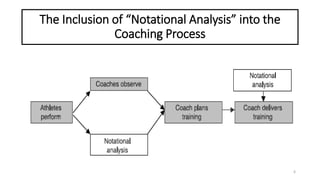
Notational analysis of the “Instructional
Process”
•Promotes the objective assessment of “Coaching
Behaviour”
•provide insight into variables deemed important in
Determining Effectiveness
5
The Inclusion of “Notational Analysis” into the
Coaching Process
6
Systematic Observation
• Observation: a key element in efforts to improve teaching skills
• ‘Systematic Observation’ Methods could the observation and data
acquisition process provide reliable, accurate and consistent information for
the assessment of teacher effectiveness
• Permits a Trained Observer to use a set method (The Observational
Instrument) to Observe, Record, and Analyse Events and Behaviours.
• With the Assumption that other Observers, using the Same Observational
Instrument, and Viewing the Same Sequence of Events, would agree with the
recorded data
7
• Observation methods: designed to produce information on specific
teacher and student variables
• The Instrument Chosen: should be tailored to the goals of the particular
observation.
• Once the Technique Best Suited to the Observational Goal is identified, a
means for Data Acquisition and Analysis is then chosen.
• This would consider:
I. Whether Real-Time or Post-Event acquisition was Desirable or
Achievable
II. Whether it required Hand Notation or the Recruitment of a Computer-
Assisted Tool
8
•The Data Obtained from “Systematic
Observation”:
•can serve as Information by which Teaching
Skills can be Improved
9
Systematic Observation Instruments
•Used to Observe “Instructional Behaviour”
10
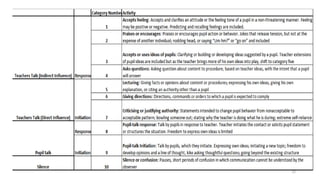
Flanders Interaction Analysis Categories
System (FIACS)
•designed to Analyse “Verbal Teaching Behaviour”
under the headings of Teacher Talk, Student Talk and
Silence/Confusion.
11
12
The Computerized Coaching Analysis
System (CCAS)
Designed to be an On-Site, Real-Time Computer-Driven System,
capable of In-Depth Analysis of “Coaching Behaviour”
1) Collected Data on the “Individual Comments” made by the coach
(CAI)
2) The Technical Success of Athletes during Practice Sessions (AAI)
3) The Time Management Skills of the coach (ATEI)
13
14
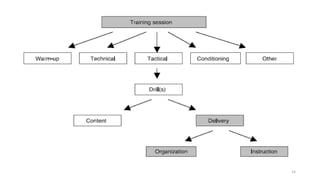
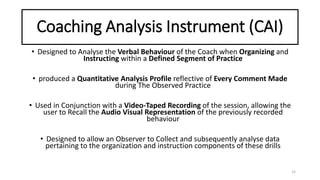
Coaching Analysis Instrument (CAI)
• Designed to Analyse the Verbal Behaviour of the Coach when Organizing and
Instructing within a Defined Segment of Practice
• produced a Quantitative Analysis Profile reflective of Every Comment Made
during The Observed Practice
• Used in Conjunction with a Video-Taped Recording of the session, allowing the
user to Recall the Audio Visual Representation of the previously recorded
behaviour
• Designed to allow an Observer to Collect and subsequently analyse data
pertaining to the organization and instruction components of these drills
15
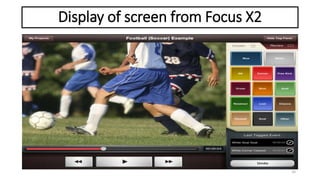
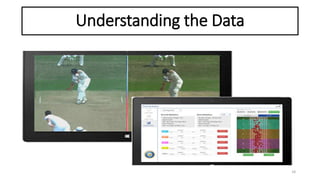
Display of screen from Focus X2
16
EFFECTIVE COACHING BEHAVIOURS
•Understanding the Data
•Should Comments be Skill- or Non-Skill Related?
• The focus of skill-related comments
•The timing of skill-related comments
•The delivery of skill-related comments
•The emphasis of skill-related comments
17
Understanding the Data
18
Should Comments be Skill- or Non-Skill
Related?
• Skill-Related Comments:
• Interactions directed at the Athletic Performance of the Learners
• Non Skill-Related Comments:
• Interactions directed at the Organization and Social Behaviour of the
learners
19
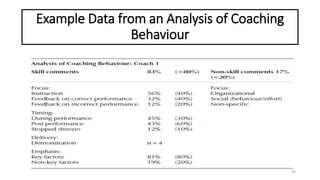
Example Data from an Analysis of Coaching
Behaviour
20
Should Comments be Skill- or Non-Skill
Related?
•More Effective Coaches Spend More Time instructing
the Proposed Content of the Session and Providing
Skill Related Feedback than do those who are Less
Effective
21
The Focus of Skill-Related Comments
• When Coaching Comments given in the form of Instructions, the
Comments will relate to how the Skill should be Performed, and
should pertain Specifically to the Skills and Concepts that the Drill is
Designed to Improve.
• Once the Skill has been Executed the Coach can Make Comment on
the Quality of the Performance in relation to its Goal.
22
The Timing of Skill-Related Comments
• In Developing a Strategy for their Verbal Behaviour, the Coach should
be Aware of the Attention Capacity of Athletes as they Learn.
• If the Skill is Low in Complexity, or Familiar to the Athlete, the
Athlete’s Information-Processing System can effectively handle other
Stimuli at that time.
• This is Not True if the Task Requires Full Allocation of Their Attention
23
The Timing of Skill-Related Comments
• Consideration must be given to the Amount and Timing of Instruction
and Feedback
• Successful Coaches have been shown to Deliver a Significant Amount
of Information as soon as Their Athletes are Free from the Immediate
Demands of Performance
24
The Timing of Skill-Related Comments
• A Related Issue to the Timing of Instruction and Feedback is the
Frequency with which it is given.
• Practice with the Athletes Receiving Feedback after Every
Performance has been shown to be Beneficial for the (temporary)
Performance of Skill, but Detrimental to the (relatively permanent)
Learning of Skill
25
Guidance Hypothesis
• Suggests that, Immediate Performance is Facilitated because the
Athlete is Guided toward the Target Performance, but that Learning
is Degraded as the athlete is Not Forced to Attend to Sensory
Feedback or Detect Errors
• In Practice, Feedback should be Frequent in Initial Practice to guide
the Athlete toward the Goal of the Action, then Systematically
Smaller as Practice continues to force these Self Detection Processes
26
The Delivery of Skill-Related Comments
• A Very Effective Way of Delivering Information is to Support
it with a Visual Demonstration
• Also known as Modelling
27
Demonstration
• Can Aid Learning by Accurately and Skilfully Portraying the Critical
Features of Performance.
• Creates an Internal Model which Guides the Athlete’s Response and
provides a Standard against which Feedback is Compared
• Should be Accompanied by briefly and clearly expressed Verbal
Instructions that Ensure the Athlete’s Attention is directed to the Key
Aspects of Performance.
28
The Emphasis of Skill-Related Comments
•The Information given should pertain to the
Skills and Concepts that the Drill is Designed to
Improve
29
The Case for Non-Skill-Related Comments
• Those Comments considered to be Non-Skill-Related, i.e.
Organizational, Effort, Behaviour and Non-Specific, also
Contribute to the Quality of the Learning Environment
30
MODIFICATION OF COACHING BEHAVIOUR
• Components that help guide the Modification of Behaviour Process:
1. A Baseline of Coaching Behaviour from Three or more Observations
should be Established.
2. Behaviour’s for Change or Reinforcement should be identified from the
Data Generated
3. Strategies to Facilitate the Change or Reinforcement of Targeted
Behaviour’s should be Specified.
4. Criteria for Evaluating the Targeted Behaviour’s should be Established
5. Start and Finish Dates for the Targeted Behaviour’s can be indicated
31
BIBLIOGRAPHY
32
THANKS
33

Notational analysis of coaching

  • 1.
  • 2.
    Primary Function ofEvery Coach •To Provide Athletes with the Opportunity to acquire, refine, and learn skills that will produce a “Successful Performance” in competition. 2
  • 3.
    Responsibilities of Coach •Identify the technical and strategic skills required for successful performance • Observe and analyse their athlete’s competence in the execution of these skills • Design training opportunities to assist the acquisition and learning of these skills • Provide instruction and feedback on these skills in the training environment 3
  • 4.
    Effective Coaching •Crucial tothe Pursuit of “Optimal Sporting Performance” •The More Effective the Coaching, the More Fully the Coach’s Role will benefit “Athlete Performance” 4
  • 5.
    Notational analysis ofthe “Instructional Process” •Promotes the objective assessment of “Coaching Behaviour” •provide insight into variables deemed important in Determining Effectiveness 5
  • 6.
    The Inclusion of“Notational Analysis” into the Coaching Process 6
  • 7.
    Systematic Observation • Observation:a key element in efforts to improve teaching skills • ‘Systematic Observation’ Methods could the observation and data acquisition process provide reliable, accurate and consistent information for the assessment of teacher effectiveness • Permits a Trained Observer to use a set method (The Observational Instrument) to Observe, Record, and Analyse Events and Behaviours. • With the Assumption that other Observers, using the Same Observational Instrument, and Viewing the Same Sequence of Events, would agree with the recorded data 7
  • 8.
    • Observation methods:designed to produce information on specific teacher and student variables • The Instrument Chosen: should be tailored to the goals of the particular observation. • Once the Technique Best Suited to the Observational Goal is identified, a means for Data Acquisition and Analysis is then chosen. • This would consider: I. Whether Real-Time or Post-Event acquisition was Desirable or Achievable II. Whether it required Hand Notation or the Recruitment of a Computer- Assisted Tool 8
  • 9.
    •The Data Obtainedfrom “Systematic Observation”: •can serve as Information by which Teaching Skills can be Improved 9
  • 10.
    Systematic Observation Instruments •Usedto Observe “Instructional Behaviour” 10
  • 11.
    Flanders Interaction AnalysisCategories System (FIACS) •designed to Analyse “Verbal Teaching Behaviour” under the headings of Teacher Talk, Student Talk and Silence/Confusion. 11
  • 12.
  • 13.
    The Computerized CoachingAnalysis System (CCAS) Designed to be an On-Site, Real-Time Computer-Driven System, capable of In-Depth Analysis of “Coaching Behaviour” 1) Collected Data on the “Individual Comments” made by the coach (CAI) 2) The Technical Success of Athletes during Practice Sessions (AAI) 3) The Time Management Skills of the coach (ATEI) 13
  • 14.
  • 15.
    Coaching Analysis Instrument(CAI) • Designed to Analyse the Verbal Behaviour of the Coach when Organizing and Instructing within a Defined Segment of Practice • produced a Quantitative Analysis Profile reflective of Every Comment Made during The Observed Practice • Used in Conjunction with a Video-Taped Recording of the session, allowing the user to Recall the Audio Visual Representation of the previously recorded behaviour • Designed to allow an Observer to Collect and subsequently analyse data pertaining to the organization and instruction components of these drills 15
  • 16.
    Display of screenfrom Focus X2 16
  • 17.
    EFFECTIVE COACHING BEHAVIOURS •Understandingthe Data •Should Comments be Skill- or Non-Skill Related? • The focus of skill-related comments •The timing of skill-related comments •The delivery of skill-related comments •The emphasis of skill-related comments 17
  • 18.
  • 19.
    Should Comments beSkill- or Non-Skill Related? • Skill-Related Comments: • Interactions directed at the Athletic Performance of the Learners • Non Skill-Related Comments: • Interactions directed at the Organization and Social Behaviour of the learners 19
  • 20.
    Example Data froman Analysis of Coaching Behaviour 20
  • 21.
    Should Comments beSkill- or Non-Skill Related? •More Effective Coaches Spend More Time instructing the Proposed Content of the Session and Providing Skill Related Feedback than do those who are Less Effective 21
  • 22.
    The Focus ofSkill-Related Comments • When Coaching Comments given in the form of Instructions, the Comments will relate to how the Skill should be Performed, and should pertain Specifically to the Skills and Concepts that the Drill is Designed to Improve. • Once the Skill has been Executed the Coach can Make Comment on the Quality of the Performance in relation to its Goal. 22
  • 23.
    The Timing ofSkill-Related Comments • In Developing a Strategy for their Verbal Behaviour, the Coach should be Aware of the Attention Capacity of Athletes as they Learn. • If the Skill is Low in Complexity, or Familiar to the Athlete, the Athlete’s Information-Processing System can effectively handle other Stimuli at that time. • This is Not True if the Task Requires Full Allocation of Their Attention 23
  • 24.
    The Timing ofSkill-Related Comments • Consideration must be given to the Amount and Timing of Instruction and Feedback • Successful Coaches have been shown to Deliver a Significant Amount of Information as soon as Their Athletes are Free from the Immediate Demands of Performance 24
  • 25.
    The Timing ofSkill-Related Comments • A Related Issue to the Timing of Instruction and Feedback is the Frequency with which it is given. • Practice with the Athletes Receiving Feedback after Every Performance has been shown to be Beneficial for the (temporary) Performance of Skill, but Detrimental to the (relatively permanent) Learning of Skill 25
  • 26.
    Guidance Hypothesis • Suggeststhat, Immediate Performance is Facilitated because the Athlete is Guided toward the Target Performance, but that Learning is Degraded as the athlete is Not Forced to Attend to Sensory Feedback or Detect Errors • In Practice, Feedback should be Frequent in Initial Practice to guide the Athlete toward the Goal of the Action, then Systematically Smaller as Practice continues to force these Self Detection Processes 26
  • 27.
    The Delivery ofSkill-Related Comments • A Very Effective Way of Delivering Information is to Support it with a Visual Demonstration • Also known as Modelling 27
  • 28.
    Demonstration • Can AidLearning by Accurately and Skilfully Portraying the Critical Features of Performance. • Creates an Internal Model which Guides the Athlete’s Response and provides a Standard against which Feedback is Compared • Should be Accompanied by briefly and clearly expressed Verbal Instructions that Ensure the Athlete’s Attention is directed to the Key Aspects of Performance. 28
  • 29.
    The Emphasis ofSkill-Related Comments •The Information given should pertain to the Skills and Concepts that the Drill is Designed to Improve 29
  • 30.
    The Case forNon-Skill-Related Comments • Those Comments considered to be Non-Skill-Related, i.e. Organizational, Effort, Behaviour and Non-Specific, also Contribute to the Quality of the Learning Environment 30
  • 31.
    MODIFICATION OF COACHINGBEHAVIOUR • Components that help guide the Modification of Behaviour Process: 1. A Baseline of Coaching Behaviour from Three or more Observations should be Established. 2. Behaviour’s for Change or Reinforcement should be identified from the Data Generated 3. Strategies to Facilitate the Change or Reinforcement of Targeted Behaviour’s should be Specified. 4. Criteria for Evaluating the Targeted Behaviour’s should be Established 5. Start and Finish Dates for the Targeted Behaviour’s can be indicated 31
  • 32.
  • 33.