The Yo-Yo intermittent
recovery tests
Alpesh Jadhav
The Yo-Yo intermittent recovery tests
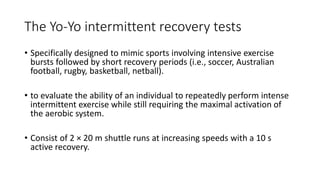
• Specifically designed to mimic sports involving intensive exercise
bursts followed by short recovery periods (i.e., soccer, Australian
football, rugby, basketball, netball).
• to evaluate the ability of an individual to repeatedly perform intense
intermittent exercise while still requiring the maximal activation of
the aerobic system.
• Consist of 2 × 20 m shuttle runs at increasing speeds with a 10 s
active recovery.
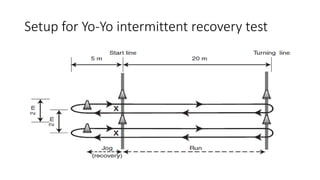
Setup for Yo-Yo intermittent recovery test
Test Procedure
• Using a measuring tape, measure out a 20 m test course.
• Place markers 2 m apart at both ends of the 20m test course.
• In addition to marking the 20 m line, measure out a 5 m distance
behind the start line.
• Place a marker on the recovery line aligned to the middle of the two
markers on the start line.
Test Procedure
• Athletes assume a starting position on the start line.
• The Yo-Yo test CD is started.
• At the time of the first signal, athletes run forward to the turning line.
• At the sound of the second signal, athletes arrive and turn at the
turning line and then run back to the start line arriving on the next
beep.
Test Procedure
• When the start marker is passed, the athletes continue forward at a
reduced pace (jogging) toward the 5 m mark, where they then turn around
the cone and return to the start line.
• At this point the athletes stop and wait for the next signal to sound.
• It is important that the athletes are stationary on the start line before the
commencement of each sprint.
• Athletes are required to place one foot either on or over the start or
turning lines at the sound of each beep.
TEST PROTOCOLS
• Athletes should continue running for as long as possible, until they are
unable to maintain the speed as indicated by the CD (or MP3 file).
• The end of the test is indicated by the inability of an athlete to maintain the
required pace for two trials.
• The first time the start line is not reached, a warning is given; the second
time the athlete must withdraw.
• When the athlete withdraws, the last level and the number of 2 × 20 m
intervals performed at this level are recorded on the appropriate recording
sheet.
TEST PROTOCOLS
• Additional indicators of maximal effort such as rating of perceived exertion, heart rate,
and blood lactate concentration can be collected at the completion of the test.
• The Yo-Yo IRT is effort dependent, so for valid results athletes must attempt to reach the
highest level possible before stopping.
• Verbal encouragement should be given to the athletes throughout the test.
• Upon completion of the test, all athletes should be encouraged to perform a warm
down.
• The final Yo-Yo intermittent recovery speed and interval score obtained by each athlete
are used to calculate the total distance covered by the athlete during the test.
Limitations
• The test can be affected by player motivation, running and turning
technique, and environmental conditions.
• The test is limited if athletes do not know how to push themselves to
their physiological limit.
Thanks

The yo yo intermittent recovery tests

  • 1.
  • 2.
    The Yo-Yo intermittentrecovery tests • Specifically designed to mimic sports involving intensive exercise bursts followed by short recovery periods (i.e., soccer, Australian football, rugby, basketball, netball). • to evaluate the ability of an individual to repeatedly perform intense intermittent exercise while still requiring the maximal activation of the aerobic system. • Consist of 2 × 20 m shuttle runs at increasing speeds with a 10 s active recovery.
  • 3.
    Setup for Yo-Yointermittent recovery test
  • 4.
    Test Procedure • Usinga measuring tape, measure out a 20 m test course. • Place markers 2 m apart at both ends of the 20m test course. • In addition to marking the 20 m line, measure out a 5 m distance behind the start line. • Place a marker on the recovery line aligned to the middle of the two markers on the start line.
  • 5.
    Test Procedure • Athletesassume a starting position on the start line. • The Yo-Yo test CD is started. • At the time of the first signal, athletes run forward to the turning line. • At the sound of the second signal, athletes arrive and turn at the turning line and then run back to the start line arriving on the next beep.
  • 6.
    Test Procedure • Whenthe start marker is passed, the athletes continue forward at a reduced pace (jogging) toward the 5 m mark, where they then turn around the cone and return to the start line. • At this point the athletes stop and wait for the next signal to sound. • It is important that the athletes are stationary on the start line before the commencement of each sprint. • Athletes are required to place one foot either on or over the start or turning lines at the sound of each beep.
  • 7.
    TEST PROTOCOLS • Athletesshould continue running for as long as possible, until they are unable to maintain the speed as indicated by the CD (or MP3 file). • The end of the test is indicated by the inability of an athlete to maintain the required pace for two trials. • The first time the start line is not reached, a warning is given; the second time the athlete must withdraw. • When the athlete withdraws, the last level and the number of 2 × 20 m intervals performed at this level are recorded on the appropriate recording sheet.
  • 8.
    TEST PROTOCOLS • Additionalindicators of maximal effort such as rating of perceived exertion, heart rate, and blood lactate concentration can be collected at the completion of the test. • The Yo-Yo IRT is effort dependent, so for valid results athletes must attempt to reach the highest level possible before stopping. • Verbal encouragement should be given to the athletes throughout the test. • Upon completion of the test, all athletes should be encouraged to perform a warm down. • The final Yo-Yo intermittent recovery speed and interval score obtained by each athlete are used to calculate the total distance covered by the athlete during the test.
  • 9.
    Limitations • The testcan be affected by player motivation, running and turning technique, and environmental conditions. • The test is limited if athletes do not know how to push themselves to their physiological limit.
  • 10.