DECLINING
BALANCE METHOD
J. Becios, C. Torres, R. Valesco, C. Varias
DEFINITION
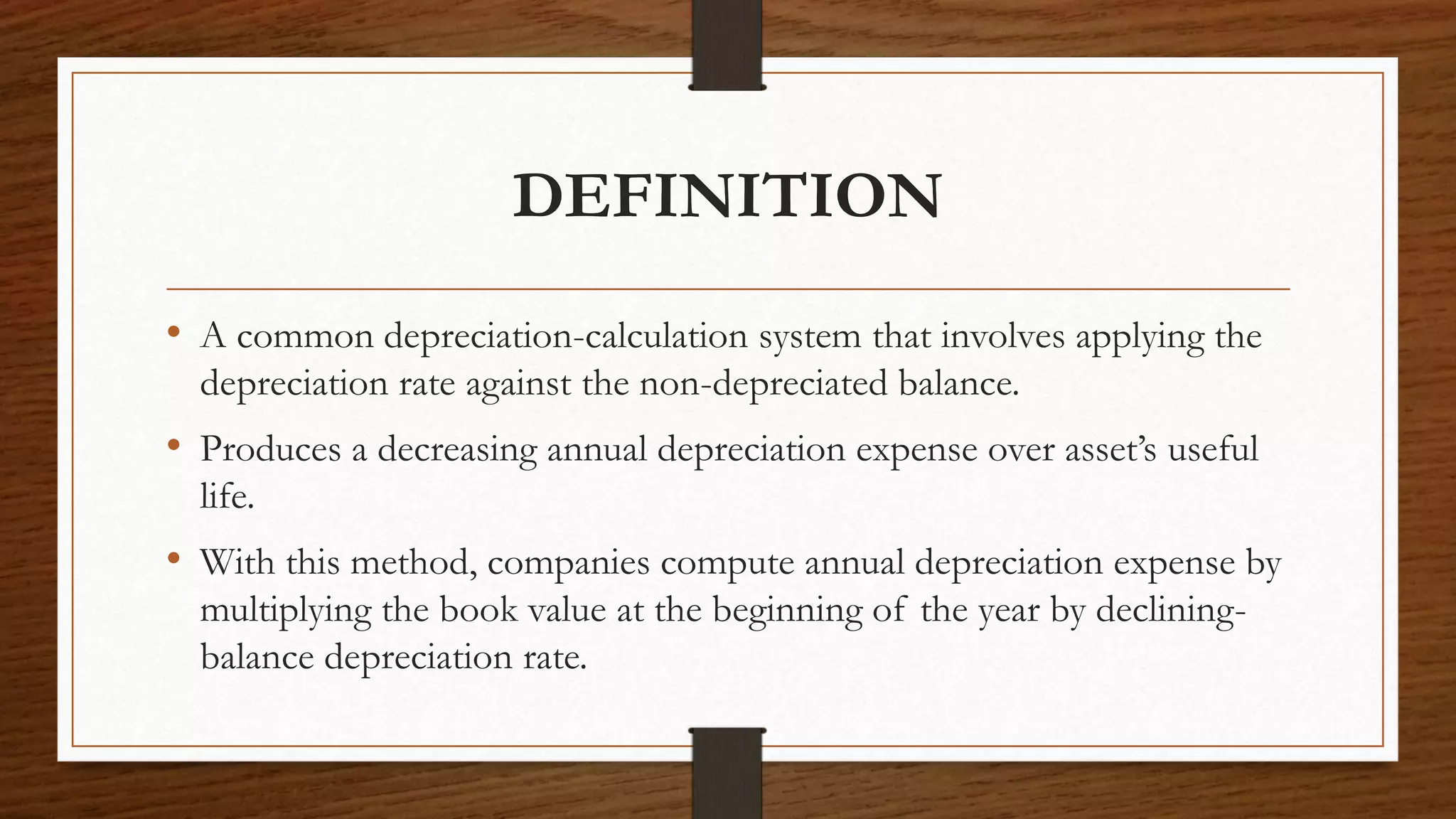
• A common depreciation-calculation system that involves applying the
depreciation rate against the non-depreciated balance.
• Produces a decreasing annual depreciation expense over asset’s useful
life.
• With this method, companies compute annual depreciation expense by
multiplying the book value at the beginning of the year by declining-
balance depreciation rate.
ADVANTAGES
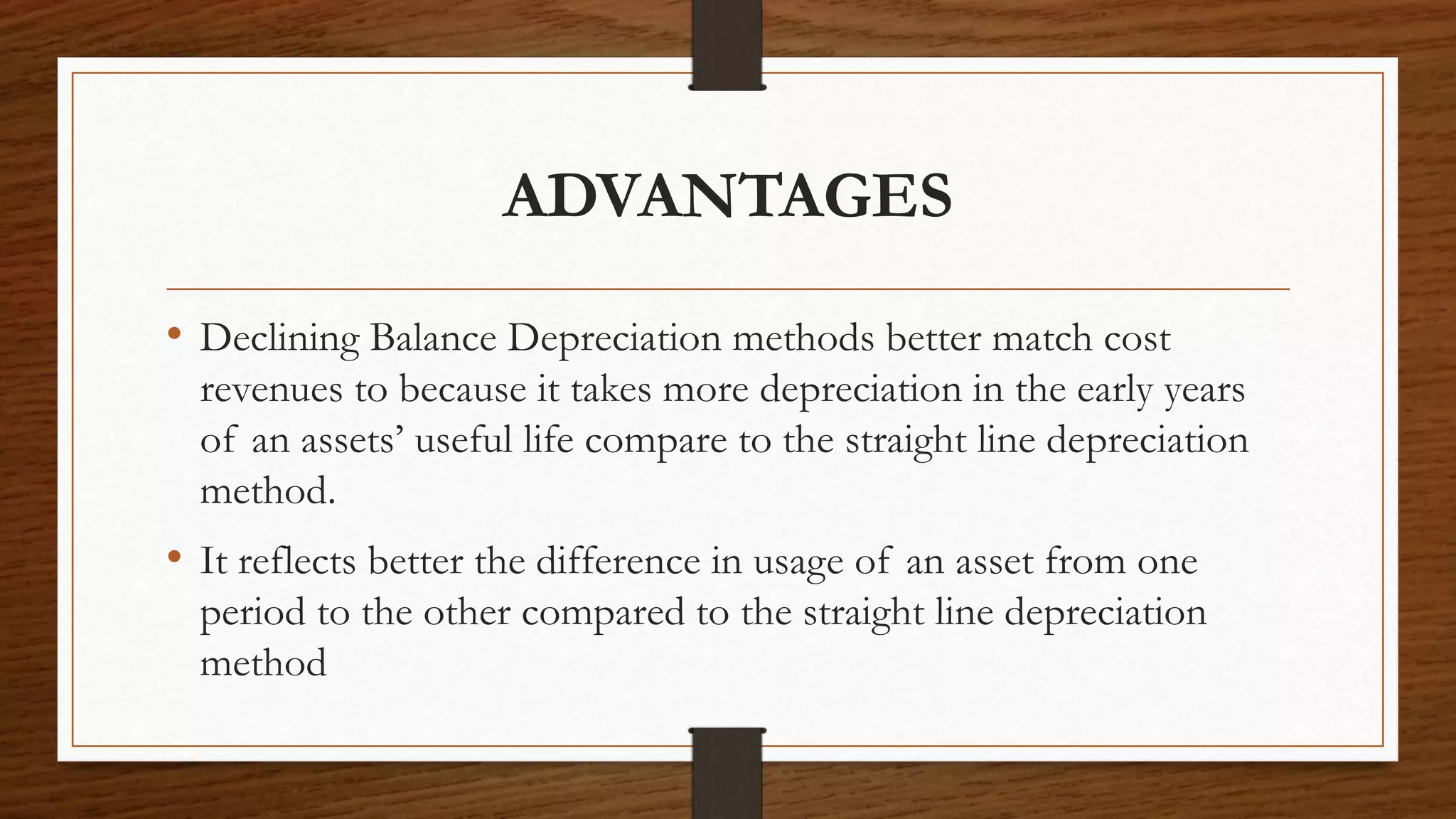
• Declining Balance Depreciation methods better match cost
revenues to because it takes more depreciation in the early years
of an assets’ useful life compare to the straight line depreciation
method.
• It reflects better the difference in usage of an asset from one
period to the other compared to the straight line depreciation
method
DISADVANTAGES
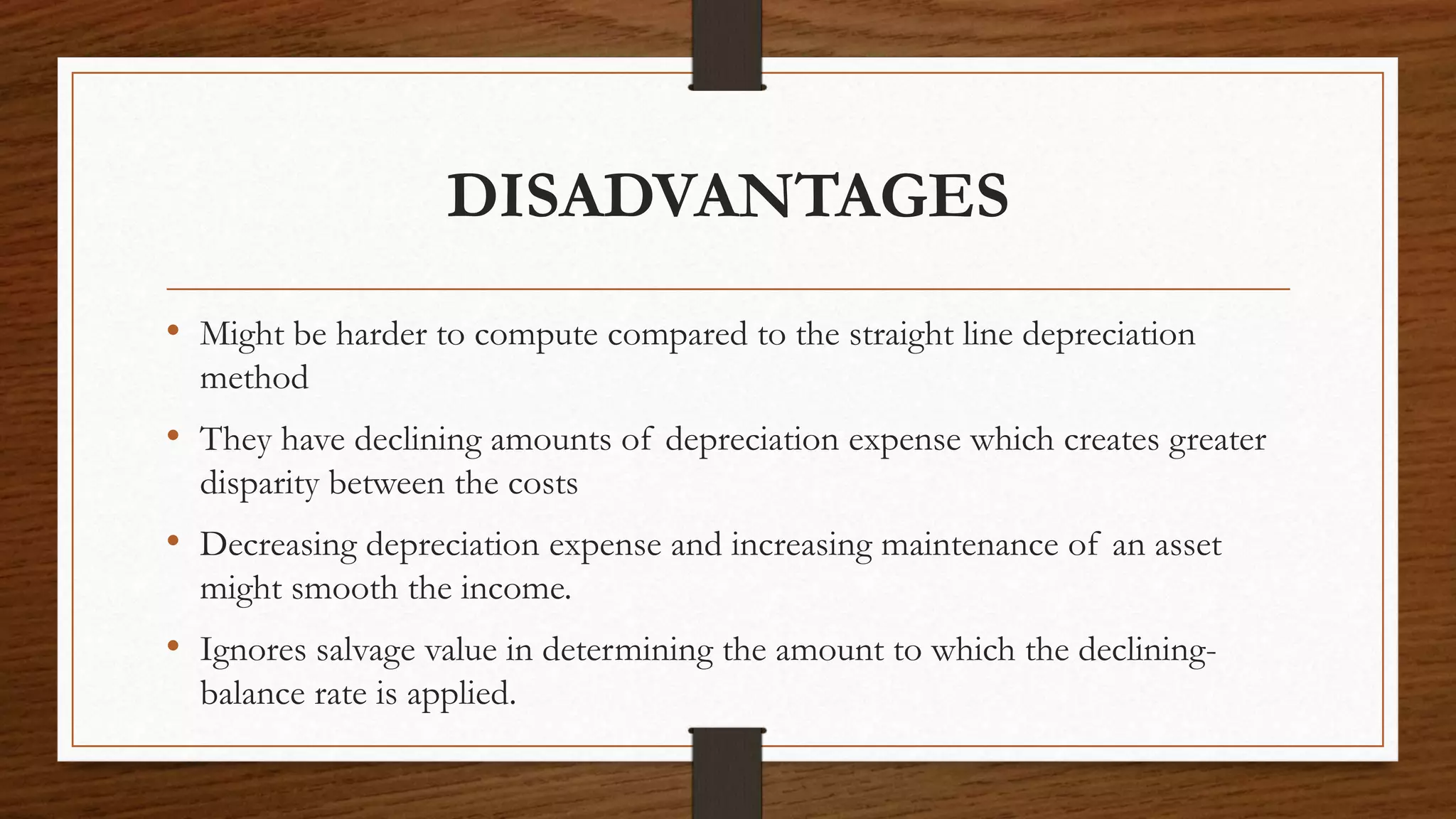
• Might be harder to compute compared to the straight line depreciation
method
• They have declining amounts of depreciation expense which creates greater
disparity between the costs
• Decreasing depreciation expense and increasing maintenance of an asset
might smooth the income.
• Ignores salvage value in determining the amount to which the declining-
balance rate is applied.
FORMULA
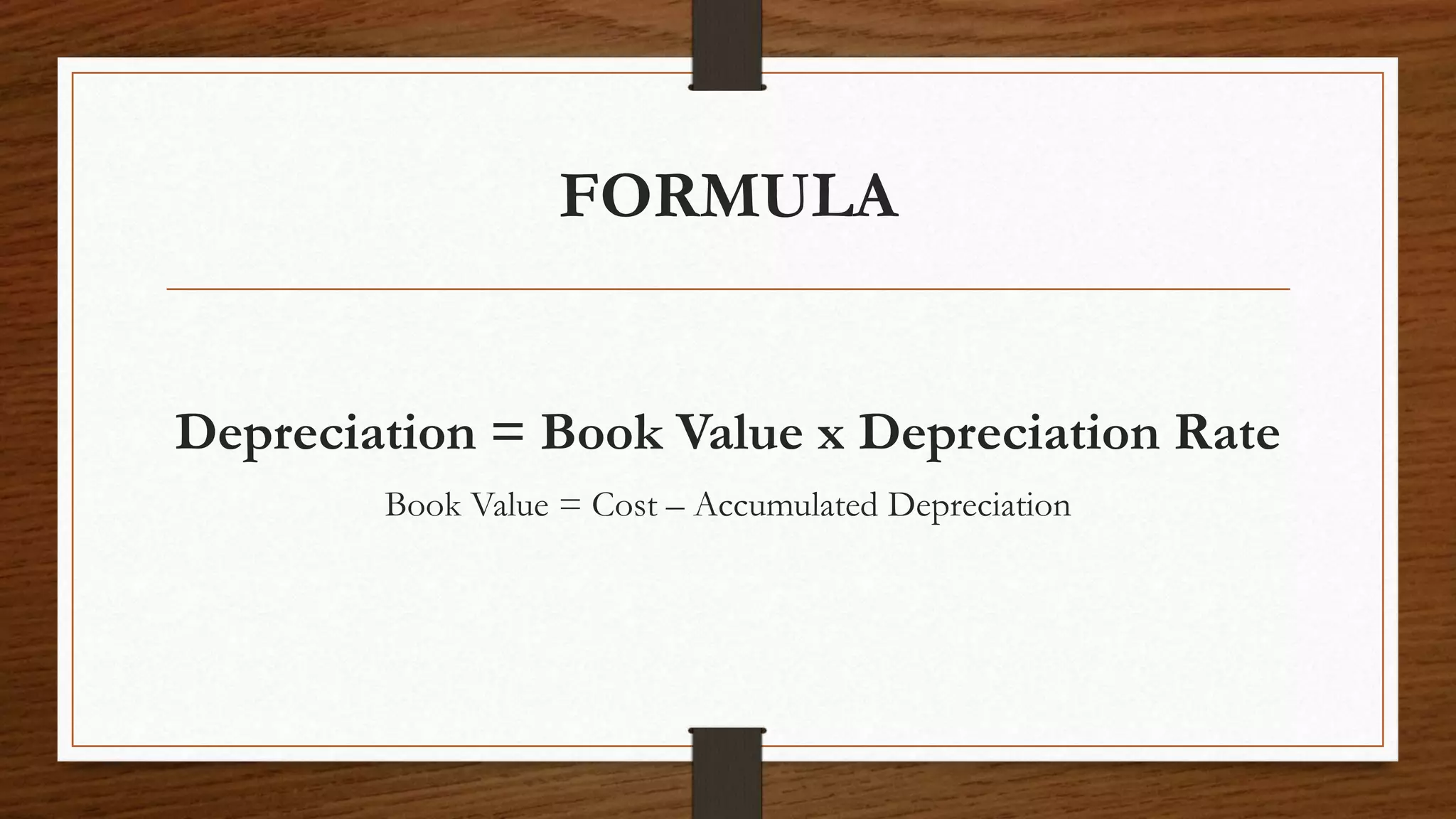
Depreciation = Book Value x Depreciation Rate
Book Value = Cost – Accumulated Depreciation
SAMPLE PROBLEMS
1. On January 2011, a Company purchased an equipment at a
cost of P140,000, having a life span of 5 years. The
depreciation rate is 20%
Calculate the depreciation from 2011 to 2015 using Declining
Balance Depreciation Method. Also calculate the salvage value of
the equipment at the end of the year 2015.
Answer (Prob. #1)
Year Book Value in the Beginning Depreciation
2011 140,000 (140,000) (20 / 100) = 28,000
2012 140,000 – 28,000 = 112,000 (112,000) (20 / 100) = 22,400
2013 112,000 – 22,400 = 89,600 (89,600) (20 / 100) = 17,920
2014 89,600 – 27,920 = 71, 680 (71,680) (20/100) = 14,336
2015 71, 680 – 14,336 = 57,344 (57, 344) (20 /100) = 11,469
At the end of the year 2015, the SALVAGE VALUE = 57,334 – 11,469 = 45,875
SAMPLE PROBLEMS
2.A machine had a cost of $24,000. Salvage
Value of $2,000. Estimated life of five years.
Compute depreciation.
Answer (Prob. #2)
Year Cost Accumulated
Depreciation
Book Value at the
Beginning of the
Year
Rate Depreciation Book Value at
the End of the
Year
1 $24,000 $24,000 40% $9,600 $14,400
2 24,000 9,600 14,400 40% 5,760 8,640
3 24,000 15,360 8,640 40% 3,456 5,184
4 24,000 18,816 5,184 40% 2,073.60 3,110.40
5 24,000 20,889.60 3,110.40 1,110.40 2,000
SAMPLE PROBLEMS
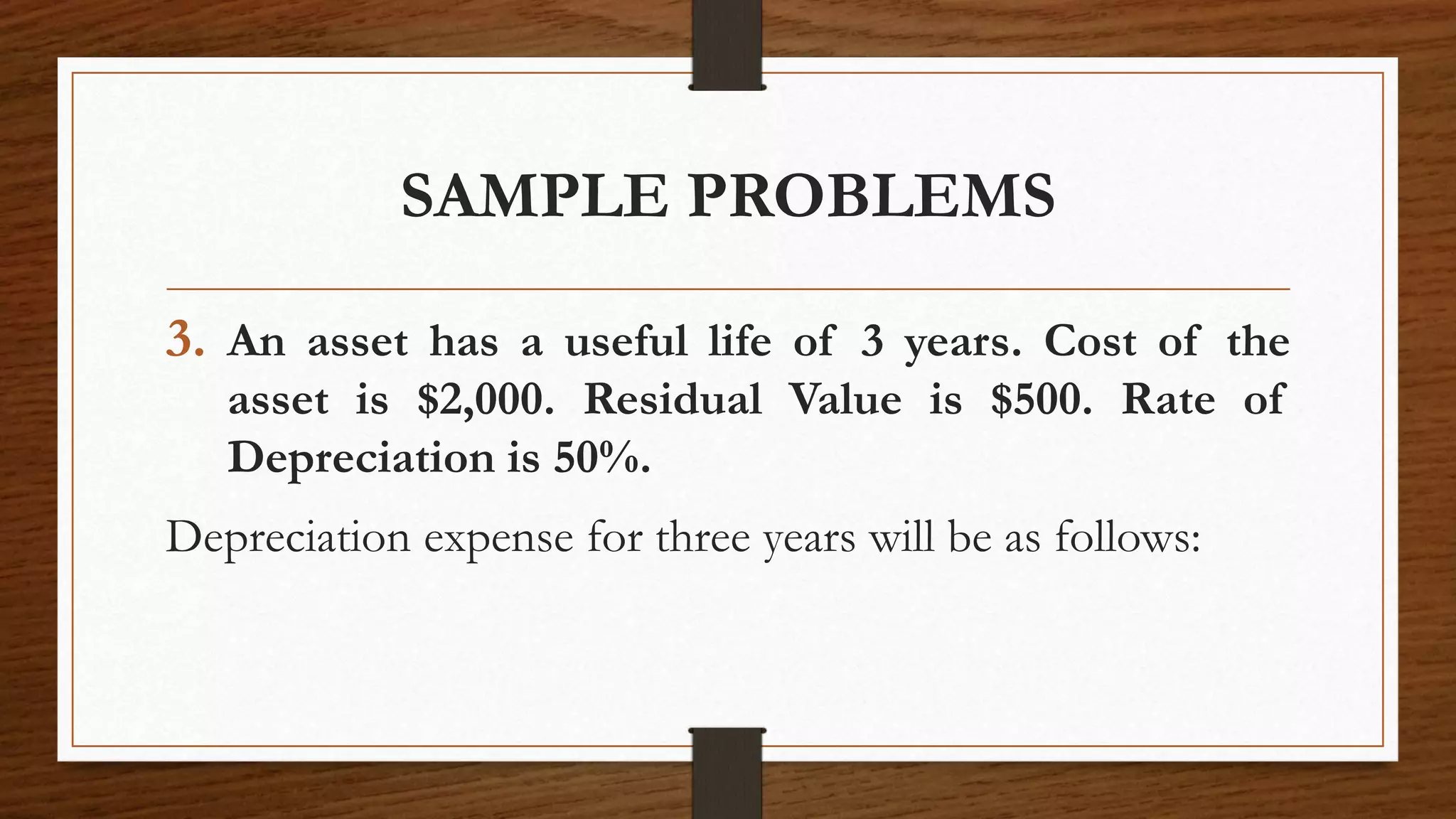
3. An asset has a useful life of 3 years. Cost of the
asset is $2,000. Residual Value is $500. Rate of
Depreciation is 50%.
Depreciation expense for three years will be as follows:
Answer (Prob. #3)
NBV RV Rate Depreciation Accumulated
Depreciation
Year 1 ( 2000 - 500 ) x 50% = 750 750
Year 2 ( 1250 - 500 ) x 50% = 375 1125
Year 3 ( 875 - 500 ) x 50% = 375* 1500
*Depreciation for the last year of the asset’s useful life is the difference between net book value at the
start of the period and the estimated residual value. This is to ensure that depreciation is charged in
full.

Declining balance method es07

  • 1.
    DECLINING BALANCE METHOD J. Becios,C. Torres, R. Valesco, C. Varias
  • 2.
    DEFINITION • A commondepreciation-calculation system that involves applying the depreciation rate against the non-depreciated balance. • Produces a decreasing annual depreciation expense over asset’s useful life. • With this method, companies compute annual depreciation expense by multiplying the book value at the beginning of the year by declining- balance depreciation rate.
  • 3.
    ADVANTAGES • Declining BalanceDepreciation methods better match cost revenues to because it takes more depreciation in the early years of an assets’ useful life compare to the straight line depreciation method. • It reflects better the difference in usage of an asset from one period to the other compared to the straight line depreciation method
  • 4.
    DISADVANTAGES • Might beharder to compute compared to the straight line depreciation method • They have declining amounts of depreciation expense which creates greater disparity between the costs • Decreasing depreciation expense and increasing maintenance of an asset might smooth the income. • Ignores salvage value in determining the amount to which the declining- balance rate is applied.
  • 5.
    FORMULA Depreciation = BookValue x Depreciation Rate Book Value = Cost – Accumulated Depreciation
  • 6.
    SAMPLE PROBLEMS 1. OnJanuary 2011, a Company purchased an equipment at a cost of P140,000, having a life span of 5 years. The depreciation rate is 20% Calculate the depreciation from 2011 to 2015 using Declining Balance Depreciation Method. Also calculate the salvage value of the equipment at the end of the year 2015.
  • 7.
    Answer (Prob. #1) YearBook Value in the Beginning Depreciation 2011 140,000 (140,000) (20 / 100) = 28,000 2012 140,000 – 28,000 = 112,000 (112,000) (20 / 100) = 22,400 2013 112,000 – 22,400 = 89,600 (89,600) (20 / 100) = 17,920 2014 89,600 – 27,920 = 71, 680 (71,680) (20/100) = 14,336 2015 71, 680 – 14,336 = 57,344 (57, 344) (20 /100) = 11,469 At the end of the year 2015, the SALVAGE VALUE = 57,334 – 11,469 = 45,875
  • 8.
    SAMPLE PROBLEMS 2.A machinehad a cost of $24,000. Salvage Value of $2,000. Estimated life of five years. Compute depreciation.
  • 9.
    Answer (Prob. #2) YearCost Accumulated Depreciation Book Value at the Beginning of the Year Rate Depreciation Book Value at the End of the Year 1 $24,000 $24,000 40% $9,600 $14,400 2 24,000 9,600 14,400 40% 5,760 8,640 3 24,000 15,360 8,640 40% 3,456 5,184 4 24,000 18,816 5,184 40% 2,073.60 3,110.40 5 24,000 20,889.60 3,110.40 1,110.40 2,000
  • 10.
    SAMPLE PROBLEMS 3. Anasset has a useful life of 3 years. Cost of the asset is $2,000. Residual Value is $500. Rate of Depreciation is 50%. Depreciation expense for three years will be as follows:
  • 11.
    Answer (Prob. #3) NBVRV Rate Depreciation Accumulated Depreciation Year 1 ( 2000 - 500 ) x 50% = 750 750 Year 2 ( 1250 - 500 ) x 50% = 375 1125 Year 3 ( 875 - 500 ) x 50% = 375* 1500 *Depreciation for the last year of the asset’s useful life is the difference between net book value at the start of the period and the estimated residual value. This is to ensure that depreciation is charged in full.