DEPRECIATION BY
MANIKANDAN S
DEPRECIATION : DEFINITION
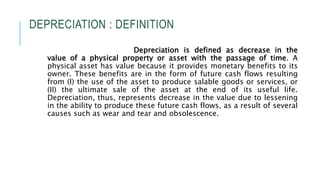
Depreciation is defined as decrease in the
value of a physical property or asset with the passage of time. A
physical asset has value because it provides monetary benefits to its
owner. These benefits are in the form of future cash flows resulting
from (I) the use of the asset to produce salable goods or services, or
(II) the ultimate sale of the asset at the end of its useful life.
Depreciation, thus, represents decrease in the value due to lessening
in the ability to produce these future cash flows, as a result of several
causes such as wear and tear and obsolescence.
METHODS OF DEPRECIATION:
There are several methods of accounting depreciation
fund. These are as follow;
1. Straight line method of depreciation,
2. Declining method of depreciation,
3. Sum of the year-digits method of depreciation,
4. Sinking-fund method of depreciation,
5. Service output method of depreciation.
STRAIGHT LINE METHOD OF DEPRECIATION
In this method of depreciation, a fixed sum is charged as the
depreciation
amount throughout the lifetime of an asset such that the accumulated
sum at the
end of the life of the asset is exactly equal to the purchase value of
the asset.
Here, we make an important assumption that inflation is absent.
Let
P = first cost of the asset,
F = salvage value of the asset,
n = life of the asset,
Bt = book value of the asset at the end of the period t,
Dt = depreciation amount for the period t.
The formulae for depreciation and book value are as follows:
Dt = (P – F)/n --------------- Eqn.1
Bt = Bt–1 – Dt = (P – t) X [(P – F)/n] -----------------Eqn.2
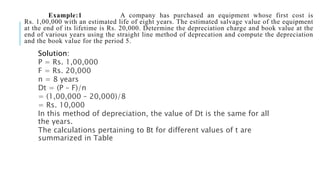
Example:1 A company has purchased an equipment whose first cost is
Rs. 1,00,000 with an estimated life of eight years. The estimated salvage value of the equipment
at the end of its lifetime is Rs. 20,000. Determine the depreciation charge and book value at the
end of various years using the straight line method of deprecation and compute the depreciation
and the book value for the period 5.
Solution:
P = Rs. 1,00,000
F = Rs. 20,000
n = 8 years
Dt = (P – F)/n
= (1,00,000 – 20,000)/8
= Rs. 10,000
In this method of depreciation, the value of Dt is the same for all
the years.
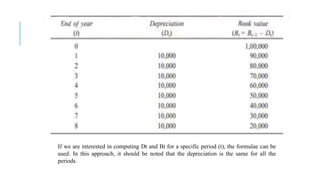
The calculations pertaining to Bt for different values of t are
summarized in Table
If we are interested in computing Dt and Bt for a specific period (t), the formulae can be
used. In this approach, it should be noted that the depreciation is the same for all the
periods.
To compute the depreciation and the book value for the period 5.
Solution:
P = Rs. 1,00,000
F = Rs. 20,000
n = 8 years
D5 = (P – F)/n
= (1,00,000 – 20,000)/8
= Rs. 10,000 (This is independent of the time period.)
Bt = (P – t) X (P – F)/n
B5 = (1,00,000 – 5) X (1,00,000 – 20,000)/8
B5= Rs. 50,000
DECLINING BALANCE METHOD OF
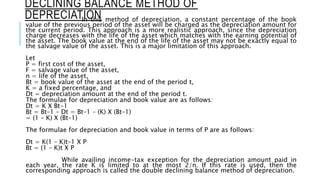
DEPRECIATIONIn this method of depreciation, a constant percentage of the book
value of the previous period of the asset will be charged as the depreciation amount for
the current period. This approach is a more realistic approach, since the depreciation
charge decreases with the life of the asset which matches with the earning potential of
the asset. The book value at the end of the life of the asset may not be exactly equal to
the salvage value of the asset. This is a major limitation of this approach.
Let
P = first cost of the asset,
F = salvage value of the asset,
n = life of the asset,
Bt = book value of the asset at the end of the period t,
K = a fixed percentage, and
Dt = depreciation amount at the end of the period t.
The formulae for depreciation and book value are as follows:
Dt = K X Bt-1
Bt = Bt–1 – Dt = Bt–1 – (K) X (Bt–1)
= (1 – K) X (Bt–1)
The formulae for depreciation and book value in terms of P are as follows:
Dt = K(1 – K)t–1 X P
Bt = (1 – K)t X P
While availing income-tax exception for the depreciation amount paid in
each year, the rate K is limited to at the most 2/n. If this rate is used, then the
corresponding approach is called the double declining balance method of depreciation.
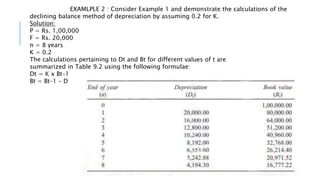
EXAMLPLE 2 : Consider Example 1 and demonstrate the calculations of the
declining balance method of depreciation by assuming 0.2 for K.
Solution:
P = Rs. 1,00,000
F = Rs. 20,000
n = 8 years
K = 0.2
The calculations pertaining to Dt and Bt for different values of t are
summarized in Table 9.2 using the following formulae:
Dt = K x Bt–1
Bt = Bt–1 – D
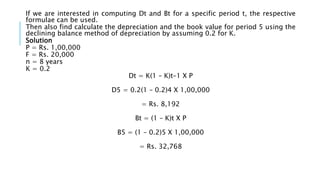
If we are interested in computing Dt and Bt for a specific period t, the respective
formulae can be used.
Then also find calculate the depreciation and the book value for period 5 using the
declining balance method of depreciation by assuming 0.2 for K.
Solution
P = Rs. 1,00,000
F = Rs. 20,000
n = 8 years
K = 0.2
Dt = K(1 – K)t–1 X P
D5 = 0.2(1 – 0.2)4 X 1,00,000
= Rs. 8,192
Bt = (1 – K)t X P
B5 = (1 – 0.2)5 X 1,00,000
= Rs. 32,768
SUM OF THE YEAR-DIGITS METHOD OF
DEPRECIATION
In this method of depreciation also, it is assumed that the book value of
the asset
decreases at a decreasing rate. If the asset has a life of eight years, first
the sum
of the years is computed as
Sum of the years = 1 + 2 + 3 + 4 + 5 + 6 + 7 + 8
= 36 = n(n + 1)/2
The rate of depreciation charge for the first year is assumed as
the highest and then it decreases. The rates of depreciation for the years
1–8, respectively are as
follows: 8/36, 7/36, 6/36, 5/36, 4/36, 3/36, 2/36, and
1/36.
For any year, the depreciation is calculated by multiplying the
corresponding rate of depreciation with (P – F).
Dt = Rate X (P – F)
Bt = Bt–1 – Dt
The formulae for Dt and Bt for a specific year t are as follows:
Dt = n X (t +1) (P – F)
n(n + 1)/2
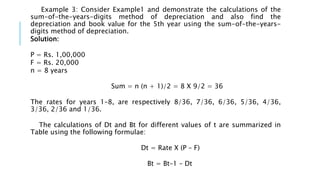
Example 3: Consider Example1 and demonstrate the calculations of the
sum-of-the-years-digits method of depreciation and also find the
depreciation and book value for the 5th year using the sum-of-the-years-
digits method of depreciation.
Solution:
P = Rs. 1,00,000
F = Rs. 20,000
n = 8 years
Sum = n (n + 1)/2 = 8 X 9/2 = 36
The rates for years 1–8, are respectively 8/36, 7/36, 6/36, 5/36, 4/36,
3/36, 2/36 and 1/36.
The calculations of Dt and Bt for different values of t are summarized in
Table using the following formulae:
Dt = Rate X (P – F)
Bt = Bt–1 – Dt
If we are interested in calculating Dt and Bt for a specific t, then the usage of the
formulae would be better.
P = Rs. 1,00,000
F = Rs. 20,000
n = 8 years
Dt = n X (t +1) (P – F)
n(n + 1)/2
D5 = Rs. 8,888.88
Bt = (P – F) (n − t) (n − t + 1) + F
n (n + 1)
B5 = 80,000 X (3/8) X (4/9) + 20,000
B5 = Rs. 33,333.33
SINKING-FUND METHOD OF DEPRECIATION
In this method of depreciation, the book value decreases at increasing rates with
respect to the life of the asset.
Let
P = first cost of the asset,
F = salvage value of the asset,
n = life of the asset,
i = rate of return compounded annually,
A = the annual equivalent amount,
Bt = the book value of the asset at the end of the period t, and
Dt = the depreciation amount at the end of the period t.
The loss in value of the asset (P – F) is made available an the form
of cumulative depreciation amount at the end of the life of the asset by setting
up an equal depreciation amount (A) at the end of each period during the
lifetime of the asset.
A = (P – F) X [A/F, i, n]
The fixed sum depreciated at the end of every time period earns an
interest at the rate of i% compounded annually, and hence the actual
depreciation amount will be in the increasing manner with respect to the time
period. A generalized formula for Dt is
Dt = (P – F) X (A/F, i, n) X (F/P, i, t – 1)
The formula to calculate the book value at the end of period t is
Bt = P – (P – F) (A/F, I , n) (F/A, I , t)
The above two formulae are very useful if we have to calculate Dt and Bt for any
specific period. If we calculate Dt and Bt for all the periods, then the tabular
approach would be better.
Example 4. Consider Example 1 and give the calculations regarding the sinking
fund method of depreciation with an interest rate of 12%, compounded annually.
Solution
P = Rs. 1,00,000
F = Rs. 20,000
n = 8 years
I = 12%
A = (P – F) X [A/F, 12%, 8]
= (1,00,000 – 20,000) X 0.0813
= Rs. 6,504
In this method of depreciation, a fixed amount of Rs. 6,504 will be depreciated
at the end of every year from the earning of the asset. The depreciated amount
will earn interest for the remaining period of life of the asset at an interest rate
of 12%, compounded annually. For example, the calculations of net depreciation
for some periods are as follows:
Depreciation at the end of year 1 (D1) = Rs. 6,504.
Depreciation at the end of year 2 (D2) = 6,504 + 6,504 X 0.12
= Rs. 7,284.48
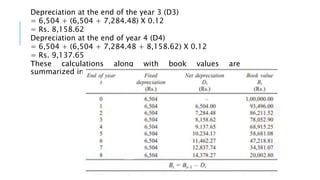
Depreciation at the end of the year 3 (D3)
= 6,504 + (6,504 + 7,284.48) X 0.12
= Rs. 8,158.62
Depreciation at the end of year 4 (D4)
= 6,504 + (6,504 + 7,284.48 + 8,158.62) X 0.12
= Rs. 9,137.65
These calculations along with book values are
summarized in Table
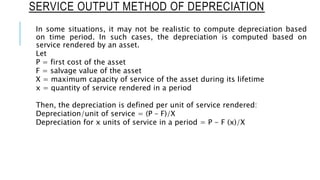
SERVICE OUTPUT METHOD OF DEPRECIATION
In some situations, it may not be realistic to compute depreciation based
on time period. In such cases, the depreciation is computed based on
service rendered by an asset.
Let
P = first cost of the asset
F = salvage value of the asset
X = maximum capacity of service of the asset during its lifetime
x = quantity of service rendered in a period
Then, the depreciation is defined per unit of service rendered:
Depreciation/unit of service = (P – F)/X
Depreciation for x units of service in a period = P - F (x)/X
Example 5: The first coat of a road laying machine is Rs. 80,00,000. Its
salvage value after five years is Rs. 50,000. The length of road that can be
laid by the machine during its lifetime is 75,000 km. In its third year of
operation, the length of road laid is 2,000 km. Find the depreciation of the
equipment for that year.
Solution
P = Rs. 80,00,000
F = Rs. 50,000
X = 75,000 km
x = 2,000 km
Depreciation for x units of service in a period = (P − F) (x)/X
Depreciation for year 3 = (80,00,000 − 50,000) X 2,000/75,000
= Rs. 2,12,000
REFERENCE:
1. R.Paneerselvam, Engineering Economics, PHI publication
Thank you

Depreciation and its types

  • 1.
  • 2.
    DEPRECIATION : DEFINITION Depreciationis defined as decrease in the value of a physical property or asset with the passage of time. A physical asset has value because it provides monetary benefits to its owner. These benefits are in the form of future cash flows resulting from (I) the use of the asset to produce salable goods or services, or (II) the ultimate sale of the asset at the end of its useful life. Depreciation, thus, represents decrease in the value due to lessening in the ability to produce these future cash flows, as a result of several causes such as wear and tear and obsolescence.
  • 3.
    METHODS OF DEPRECIATION: Thereare several methods of accounting depreciation fund. These are as follow; 1. Straight line method of depreciation, 2. Declining method of depreciation, 3. Sum of the year-digits method of depreciation, 4. Sinking-fund method of depreciation, 5. Service output method of depreciation.
  • 4.
    STRAIGHT LINE METHODOF DEPRECIATION In this method of depreciation, a fixed sum is charged as the depreciation amount throughout the lifetime of an asset such that the accumulated sum at the end of the life of the asset is exactly equal to the purchase value of the asset. Here, we make an important assumption that inflation is absent. Let P = first cost of the asset, F = salvage value of the asset, n = life of the asset, Bt = book value of the asset at the end of the period t, Dt = depreciation amount for the period t. The formulae for depreciation and book value are as follows: Dt = (P – F)/n --------------- Eqn.1 Bt = Bt–1 – Dt = (P – t) X [(P – F)/n] -----------------Eqn.2
  • 5.
    Example:1 A companyhas purchased an equipment whose first cost is Rs. 1,00,000 with an estimated life of eight years. The estimated salvage value of the equipment at the end of its lifetime is Rs. 20,000. Determine the depreciation charge and book value at the end of various years using the straight line method of deprecation and compute the depreciation and the book value for the period 5. Solution: P = Rs. 1,00,000 F = Rs. 20,000 n = 8 years Dt = (P – F)/n = (1,00,000 – 20,000)/8 = Rs. 10,000 In this method of depreciation, the value of Dt is the same for all the years. The calculations pertaining to Bt for different values of t are summarized in Table
  • 6.
    If we areinterested in computing Dt and Bt for a specific period (t), the formulae can be used. In this approach, it should be noted that the depreciation is the same for all the periods.
  • 7.
    To compute thedepreciation and the book value for the period 5. Solution: P = Rs. 1,00,000 F = Rs. 20,000 n = 8 years D5 = (P – F)/n = (1,00,000 – 20,000)/8 = Rs. 10,000 (This is independent of the time period.) Bt = (P – t) X (P – F)/n B5 = (1,00,000 – 5) X (1,00,000 – 20,000)/8 B5= Rs. 50,000
  • 8.
    DECLINING BALANCE METHODOF DEPRECIATIONIn this method of depreciation, a constant percentage of the book value of the previous period of the asset will be charged as the depreciation amount for the current period. This approach is a more realistic approach, since the depreciation charge decreases with the life of the asset which matches with the earning potential of the asset. The book value at the end of the life of the asset may not be exactly equal to the salvage value of the asset. This is a major limitation of this approach. Let P = first cost of the asset, F = salvage value of the asset, n = life of the asset, Bt = book value of the asset at the end of the period t, K = a fixed percentage, and Dt = depreciation amount at the end of the period t. The formulae for depreciation and book value are as follows: Dt = K X Bt-1 Bt = Bt–1 – Dt = Bt–1 – (K) X (Bt–1) = (1 – K) X (Bt–1) The formulae for depreciation and book value in terms of P are as follows: Dt = K(1 – K)t–1 X P Bt = (1 – K)t X P While availing income-tax exception for the depreciation amount paid in each year, the rate K is limited to at the most 2/n. If this rate is used, then the corresponding approach is called the double declining balance method of depreciation.
  • 9.
    EXAMLPLE 2 :Consider Example 1 and demonstrate the calculations of the declining balance method of depreciation by assuming 0.2 for K. Solution: P = Rs. 1,00,000 F = Rs. 20,000 n = 8 years K = 0.2 The calculations pertaining to Dt and Bt for different values of t are summarized in Table 9.2 using the following formulae: Dt = K x Bt–1 Bt = Bt–1 – D
  • 10.
    If we areinterested in computing Dt and Bt for a specific period t, the respective formulae can be used. Then also find calculate the depreciation and the book value for period 5 using the declining balance method of depreciation by assuming 0.2 for K. Solution P = Rs. 1,00,000 F = Rs. 20,000 n = 8 years K = 0.2 Dt = K(1 – K)t–1 X P D5 = 0.2(1 – 0.2)4 X 1,00,000 = Rs. 8,192 Bt = (1 – K)t X P B5 = (1 – 0.2)5 X 1,00,000 = Rs. 32,768
  • 11.
    SUM OF THEYEAR-DIGITS METHOD OF DEPRECIATION In this method of depreciation also, it is assumed that the book value of the asset decreases at a decreasing rate. If the asset has a life of eight years, first the sum of the years is computed as Sum of the years = 1 + 2 + 3 + 4 + 5 + 6 + 7 + 8 = 36 = n(n + 1)/2 The rate of depreciation charge for the first year is assumed as the highest and then it decreases. The rates of depreciation for the years 1–8, respectively are as follows: 8/36, 7/36, 6/36, 5/36, 4/36, 3/36, 2/36, and 1/36. For any year, the depreciation is calculated by multiplying the corresponding rate of depreciation with (P – F). Dt = Rate X (P – F) Bt = Bt–1 – Dt The formulae for Dt and Bt for a specific year t are as follows: Dt = n X (t +1) (P – F) n(n + 1)/2
  • 12.
    Example 3: ConsiderExample1 and demonstrate the calculations of the sum-of-the-years-digits method of depreciation and also find the depreciation and book value for the 5th year using the sum-of-the-years- digits method of depreciation. Solution: P = Rs. 1,00,000 F = Rs. 20,000 n = 8 years Sum = n (n + 1)/2 = 8 X 9/2 = 36 The rates for years 1–8, are respectively 8/36, 7/36, 6/36, 5/36, 4/36, 3/36, 2/36 and 1/36. The calculations of Dt and Bt for different values of t are summarized in Table using the following formulae: Dt = Rate X (P – F) Bt = Bt–1 – Dt
  • 13.
    If we areinterested in calculating Dt and Bt for a specific t, then the usage of the formulae would be better.
  • 14.
    P = Rs.1,00,000 F = Rs. 20,000 n = 8 years Dt = n X (t +1) (P – F) n(n + 1)/2 D5 = Rs. 8,888.88 Bt = (P – F) (n − t) (n − t + 1) + F n (n + 1) B5 = 80,000 X (3/8) X (4/9) + 20,000 B5 = Rs. 33,333.33
  • 15.
    SINKING-FUND METHOD OFDEPRECIATION In this method of depreciation, the book value decreases at increasing rates with respect to the life of the asset. Let P = first cost of the asset, F = salvage value of the asset, n = life of the asset, i = rate of return compounded annually, A = the annual equivalent amount, Bt = the book value of the asset at the end of the period t, and Dt = the depreciation amount at the end of the period t. The loss in value of the asset (P – F) is made available an the form of cumulative depreciation amount at the end of the life of the asset by setting up an equal depreciation amount (A) at the end of each period during the lifetime of the asset. A = (P – F) X [A/F, i, n] The fixed sum depreciated at the end of every time period earns an interest at the rate of i% compounded annually, and hence the actual depreciation amount will be in the increasing manner with respect to the time period. A generalized formula for Dt is Dt = (P – F) X (A/F, i, n) X (F/P, i, t – 1)
  • 16.
    The formula tocalculate the book value at the end of period t is Bt = P – (P – F) (A/F, I , n) (F/A, I , t) The above two formulae are very useful if we have to calculate Dt and Bt for any specific period. If we calculate Dt and Bt for all the periods, then the tabular approach would be better. Example 4. Consider Example 1 and give the calculations regarding the sinking fund method of depreciation with an interest rate of 12%, compounded annually. Solution P = Rs. 1,00,000 F = Rs. 20,000 n = 8 years I = 12% A = (P – F) X [A/F, 12%, 8] = (1,00,000 – 20,000) X 0.0813 = Rs. 6,504 In this method of depreciation, a fixed amount of Rs. 6,504 will be depreciated at the end of every year from the earning of the asset. The depreciated amount will earn interest for the remaining period of life of the asset at an interest rate of 12%, compounded annually. For example, the calculations of net depreciation for some periods are as follows: Depreciation at the end of year 1 (D1) = Rs. 6,504. Depreciation at the end of year 2 (D2) = 6,504 + 6,504 X 0.12 = Rs. 7,284.48
  • 17.
    Depreciation at theend of the year 3 (D3) = 6,504 + (6,504 + 7,284.48) X 0.12 = Rs. 8,158.62 Depreciation at the end of year 4 (D4) = 6,504 + (6,504 + 7,284.48 + 8,158.62) X 0.12 = Rs. 9,137.65 These calculations along with book values are summarized in Table
  • 18.
    SERVICE OUTPUT METHODOF DEPRECIATION In some situations, it may not be realistic to compute depreciation based on time period. In such cases, the depreciation is computed based on service rendered by an asset. Let P = first cost of the asset F = salvage value of the asset X = maximum capacity of service of the asset during its lifetime x = quantity of service rendered in a period Then, the depreciation is defined per unit of service rendered: Depreciation/unit of service = (P – F)/X Depreciation for x units of service in a period = P - F (x)/X
  • 19.
    Example 5: Thefirst coat of a road laying machine is Rs. 80,00,000. Its salvage value after five years is Rs. 50,000. The length of road that can be laid by the machine during its lifetime is 75,000 km. In its third year of operation, the length of road laid is 2,000 km. Find the depreciation of the equipment for that year. Solution P = Rs. 80,00,000 F = Rs. 50,000 X = 75,000 km x = 2,000 km Depreciation for x units of service in a period = (P − F) (x)/X Depreciation for year 3 = (80,00,000 − 50,000) X 2,000/75,000 = Rs. 2,12,000
  • 20.
  • 21.