MANAGERS AS
DECISION MAKERS
CHAPTER 7
INSTRUCTOR: NIDA RASHEED
The Decision-Making Process
• Managers at all levels and in all areas of organizations make
decisions.
• That is, they make choices.
• For instance, top-level managers make decisions about their
organization’s goals, where to locate manufacturing facilities, or what
new markets to move into.
• Middle and lower-level managers make decisions about production
schedules, product quality problems, pay raises, and employee
discipline.
• Making decisions isn’t something that just managers do; all
organizational members make decisions that affect their jobs and the
organization they work for.
Step 1: Identifying a Problem
• Your team is dysfunctional, your customers are leaving, or your
plans are no longer relevant.
• Every decision starts with a problem, a discrepancy between an
existing and a desired condition.
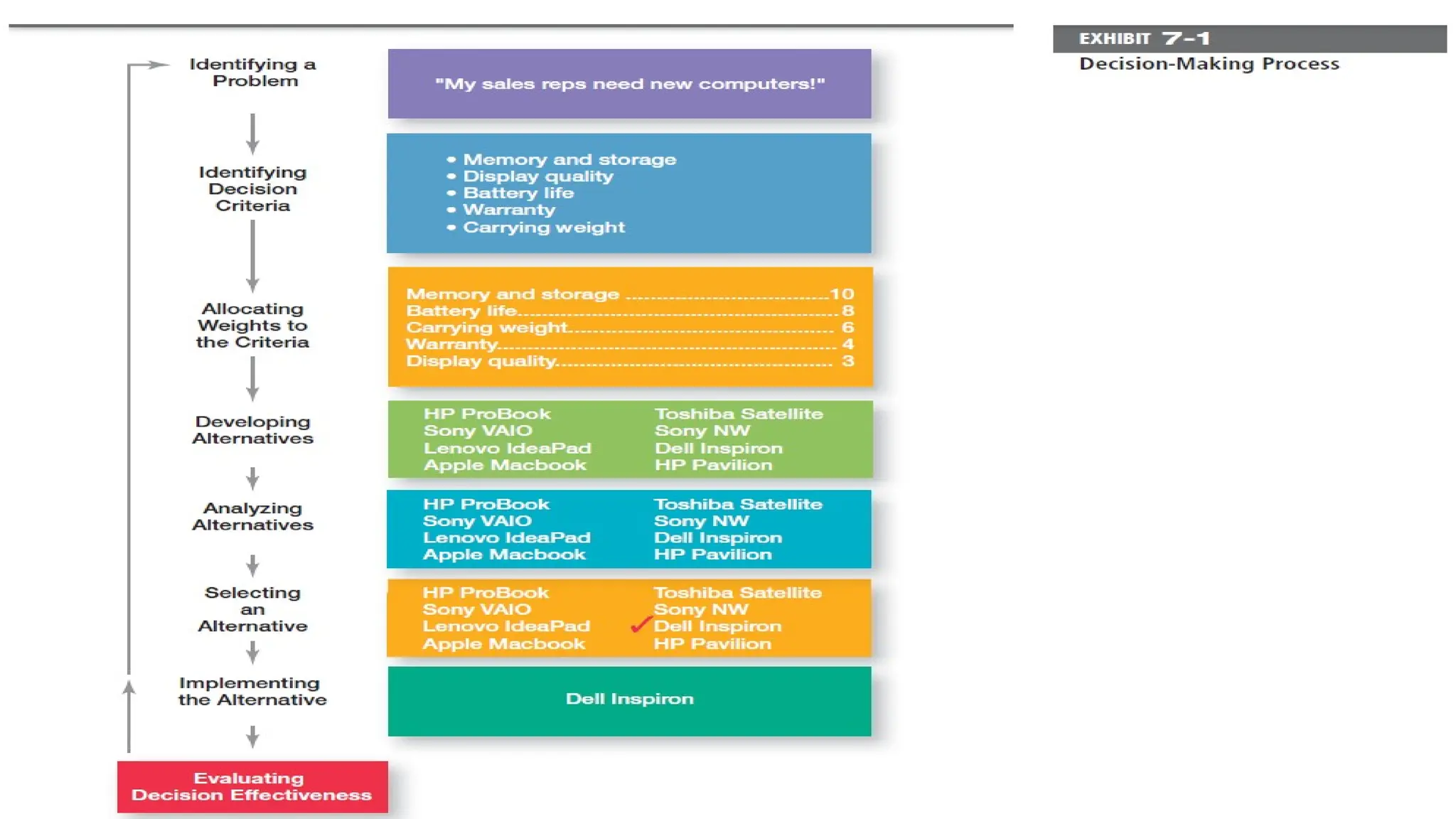
• EXAMPLE: Amanda is a sales manager whose reps need new
laptops because their old ones are outdated and inadequate
for doing their job.
• To make it simple, assume it’s not economical to add memory
to the old computers and it’s the company’s policy to purchase,
not lease. Now we have a problem—a disparity between the
sales reps’ current computers (existing condition) and their
need to have more efficient ones (desired condition). Amanda
has a decision to make.
Step 2: Identifying Decision Criteria
• Once a manager has identified a problem, he or she must identify the
decision criteria that
• are important or relevant to resolving the problem.
• Every decision maker has criteria guiding his or her decisions even if
they’re not explicitly stated.
• In our example, Amanda decides after careful consideration that
memory and storage capabilities, display quality, battery life, warranty,
and carrying weight are the relevant criteria in her decision.
Step 3: Allocating Weights to the
Criteria
• If the relevant criteria aren’t equally important, the decision maker
must weight the items in order to give them the correct priority in the
decision. How? A simple way is to give the most important criterion a
weight of 10 and then assign weights to the rest using that standard.
• Of course, you could use any number as the highest weight.
• The weighted criteria for our example are shown in Exhibit 7-2.
Step 4: Developing Alternatives
• The fourth step in the decision-making process requires the decision
maker to list viable alternatives that could resolve the problem. In this
step, a decision maker needs to be creative.
• And the alternatives are only listed, not evaluated just yet.
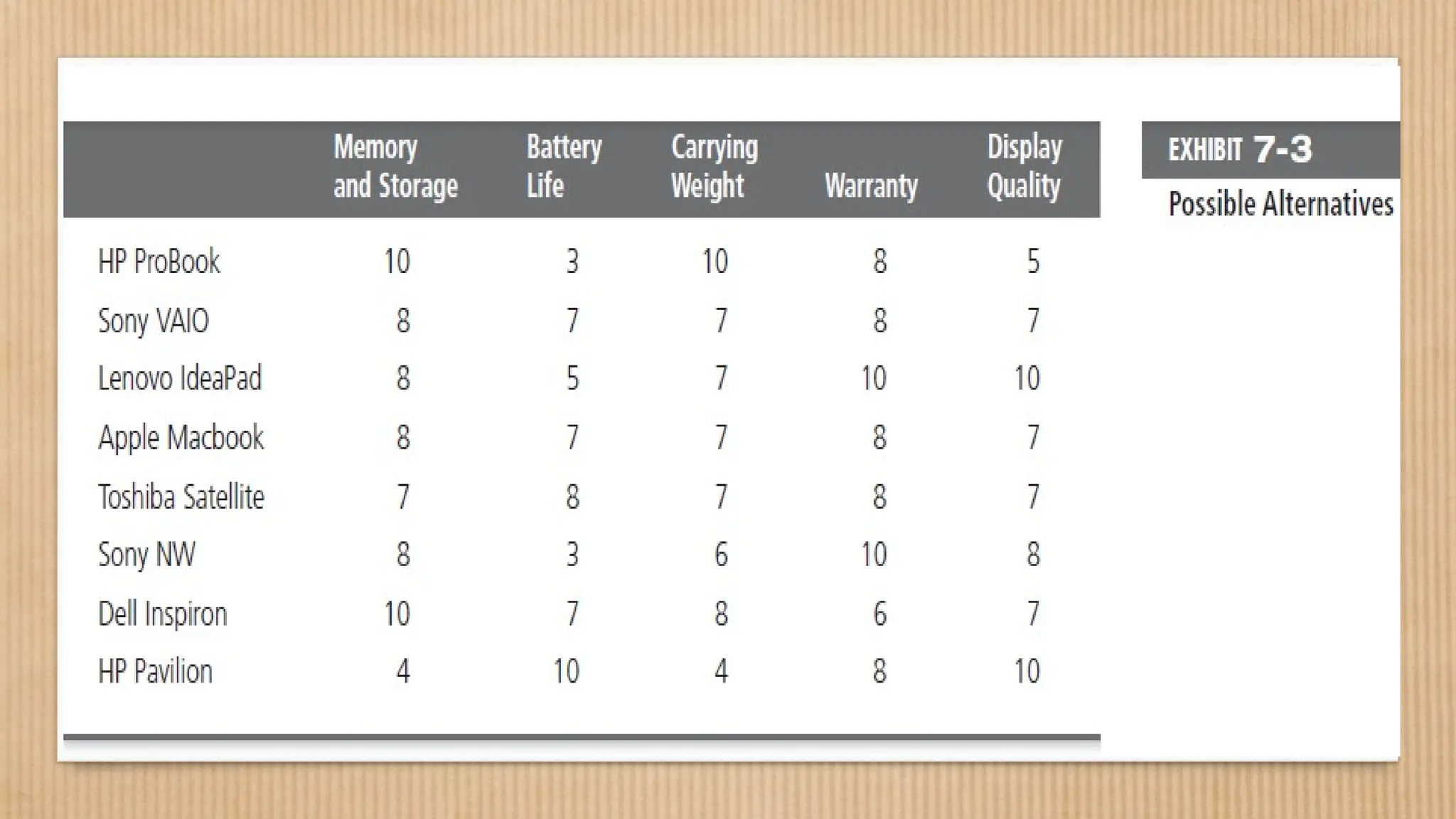
• Our sales manager, Amanda, identifies eight laptops as possible choices.
(See Exhibit 7-3.)
Step 5: Analyzing Alternatives
• Once alternatives have been identified, a decision maker must
evaluate each one. How?
• By using the criteria established in Step 2. Exhibit 7-3 shows the
assessed values that Amanda gave each alternative after doing some
research on them.
• Keep in mind that these data represent an assessment of the eight
alternatives using the decision criteria, but not the weighting.
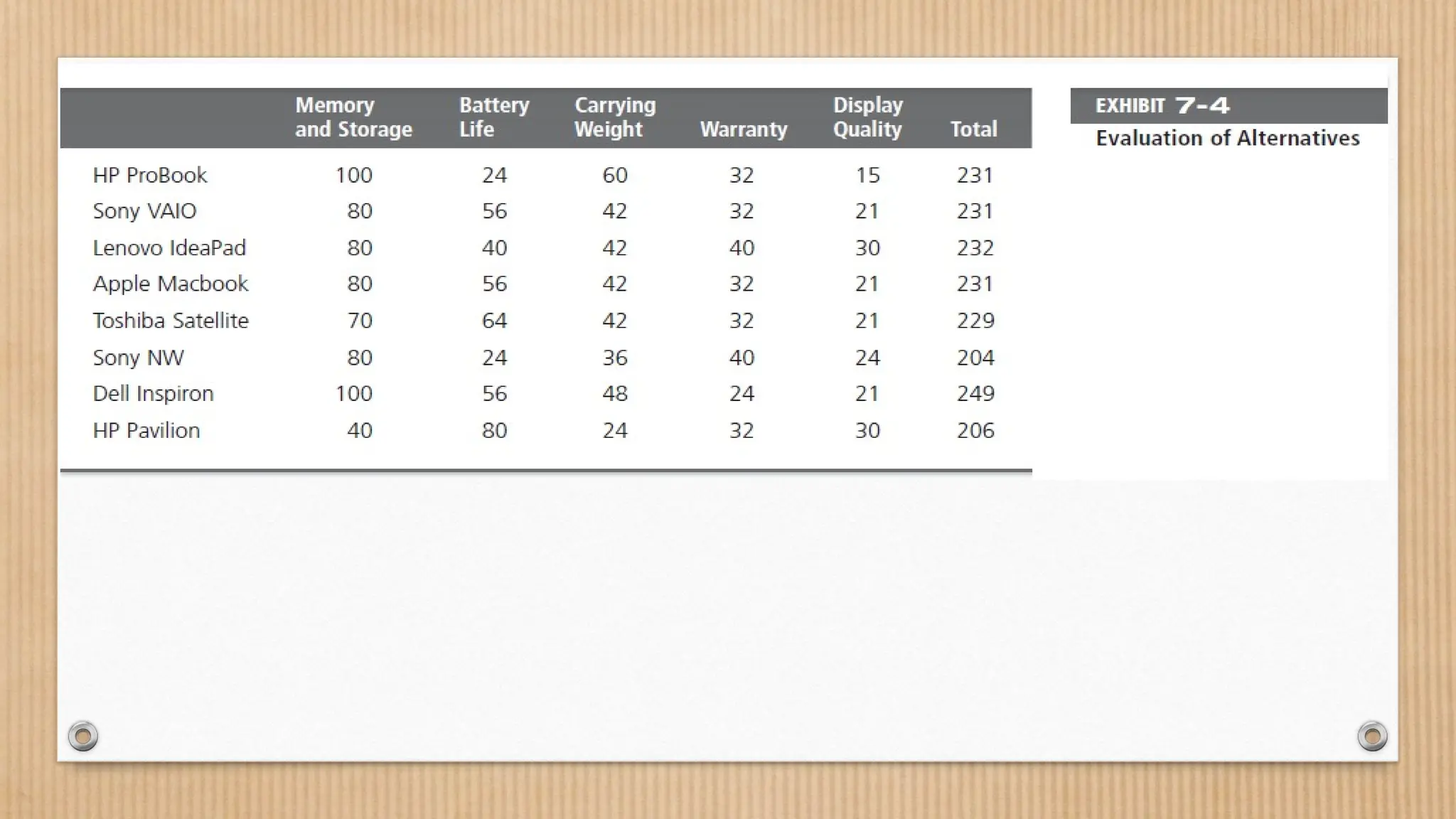
• When you multiply each alternative by the assigned weight, you get
the weighted alternatives as shown in Exhibit 7-4. The total score for
each alternative, then, is the sum of its weighted criteria.
• Sometimes a decision maker might be able to skip this step. If
one alternative scores highest on every criterion, you wouldn’t
need to consider the weights because that alternative would
already be the top choice.
• Or if the weights were all equal, you could evaluate an
alternative merely by summing up the assessed values for each
one. (Look again at Exhibit 7-3.)
• For example, the score for the HP ProBook would be 36 and the
score for the Sony NW would be 35.
Step 6: Selecting an Alternative
• The sixth step in the decision-making process is choosing the best alternative or the
one that generated the highest total in Step 5.
• In our example (Exhibit 7-4), Amanda would choose the Dell Inspiron because it
scored higher than all other alternatives (249 total).
Step 7: Implementing the Alternative
• In step 7 in the decision-making process, you put the decision into action by
conveying it to those affected and getting their commitment to it.
• We know that if the people who must implement a decision participate in the
process, they’re more likely to support it than if you just tell them what to do.
Another thing managers may need to do during implementation is reassess the
environment for any changes, especially if it’s a long-term decision.
• Are the criteria, alternatives, and choice still the best ones, or has the environment
changed in such a way that we need to reevaluate?
Step 8: Evaluating Decision Effectiveness
• The last step in the decision-making process involves evaluating the outcome or
result of the
• decision to see whether the problem was resolved. If the evaluation shows that the
problem
• still exists, then the manager needs to assess what went wrong. Was the problem
incorrectly
• defined? Were errors made when evaluating alternatives? Was the right alternative
selected
• but poorly implemented? The answers might lead you to redo an earlier step or
might even
• require starting the whole process over.

Chapter 7 Manager as decision maker Principles of management

  • 1.
    MANAGERS AS DECISION MAKERS CHAPTER7 INSTRUCTOR: NIDA RASHEED
  • 2.
    The Decision-Making Process •Managers at all levels and in all areas of organizations make decisions. • That is, they make choices. • For instance, top-level managers make decisions about their organization’s goals, where to locate manufacturing facilities, or what new markets to move into. • Middle and lower-level managers make decisions about production schedules, product quality problems, pay raises, and employee discipline. • Making decisions isn’t something that just managers do; all organizational members make decisions that affect their jobs and the organization they work for.
  • 4.
    Step 1: Identifyinga Problem • Your team is dysfunctional, your customers are leaving, or your plans are no longer relevant. • Every decision starts with a problem, a discrepancy between an existing and a desired condition. • EXAMPLE: Amanda is a sales manager whose reps need new laptops because their old ones are outdated and inadequate for doing their job. • To make it simple, assume it’s not economical to add memory to the old computers and it’s the company’s policy to purchase, not lease. Now we have a problem—a disparity between the sales reps’ current computers (existing condition) and their need to have more efficient ones (desired condition). Amanda has a decision to make.
  • 5.
    Step 2: IdentifyingDecision Criteria • Once a manager has identified a problem, he or she must identify the decision criteria that • are important or relevant to resolving the problem. • Every decision maker has criteria guiding his or her decisions even if they’re not explicitly stated. • In our example, Amanda decides after careful consideration that memory and storage capabilities, display quality, battery life, warranty, and carrying weight are the relevant criteria in her decision.
  • 6.
    Step 3: AllocatingWeights to the Criteria • If the relevant criteria aren’t equally important, the decision maker must weight the items in order to give them the correct priority in the decision. How? A simple way is to give the most important criterion a weight of 10 and then assign weights to the rest using that standard. • Of course, you could use any number as the highest weight. • The weighted criteria for our example are shown in Exhibit 7-2.
  • 8.
    Step 4: DevelopingAlternatives • The fourth step in the decision-making process requires the decision maker to list viable alternatives that could resolve the problem. In this step, a decision maker needs to be creative. • And the alternatives are only listed, not evaluated just yet. • Our sales manager, Amanda, identifies eight laptops as possible choices. (See Exhibit 7-3.)
  • 9.
    Step 5: AnalyzingAlternatives • Once alternatives have been identified, a decision maker must evaluate each one. How? • By using the criteria established in Step 2. Exhibit 7-3 shows the assessed values that Amanda gave each alternative after doing some research on them. • Keep in mind that these data represent an assessment of the eight alternatives using the decision criteria, but not the weighting. • When you multiply each alternative by the assigned weight, you get the weighted alternatives as shown in Exhibit 7-4. The total score for each alternative, then, is the sum of its weighted criteria.
  • 10.
    • Sometimes adecision maker might be able to skip this step. If one alternative scores highest on every criterion, you wouldn’t need to consider the weights because that alternative would already be the top choice. • Or if the weights were all equal, you could evaluate an alternative merely by summing up the assessed values for each one. (Look again at Exhibit 7-3.) • For example, the score for the HP ProBook would be 36 and the score for the Sony NW would be 35.
  • 12.
    Step 6: Selectingan Alternative • The sixth step in the decision-making process is choosing the best alternative or the one that generated the highest total in Step 5. • In our example (Exhibit 7-4), Amanda would choose the Dell Inspiron because it scored higher than all other alternatives (249 total).
  • 13.
    Step 7: Implementingthe Alternative • In step 7 in the decision-making process, you put the decision into action by conveying it to those affected and getting their commitment to it. • We know that if the people who must implement a decision participate in the process, they’re more likely to support it than if you just tell them what to do. Another thing managers may need to do during implementation is reassess the environment for any changes, especially if it’s a long-term decision. • Are the criteria, alternatives, and choice still the best ones, or has the environment changed in such a way that we need to reevaluate?
  • 14.
    Step 8: EvaluatingDecision Effectiveness • The last step in the decision-making process involves evaluating the outcome or result of the • decision to see whether the problem was resolved. If the evaluation shows that the problem • still exists, then the manager needs to assess what went wrong. Was the problem incorrectly • defined? Were errors made when evaluating alternatives? Was the right alternative selected • but poorly implemented? The answers might lead you to redo an earlier step or might even • require starting the whole process over.