PRINCIPLE OF MANAGEMENT
DECISION MAKING
PROCESS  Presented by :-
Roll No-32 : Bhavisha Prajapati
Roll No-24 : Kaushal Jilka
Roll No-13 : Priya Kadam
Roll No-08 : Keyur Gandhi
Roll No-15 : Munish Kumar
Roll No-24 : Snehal Panchal
DECISION MAKING
Meaning :-
 Best Choice from available Alternatives.
 Process of Identifying Problem and opportunities and Solving
the problem.
Type of Decision :-
 Programmed Decisions:- Routine Approach.
 Non-Programmed Decision:- New & Unique Decision.
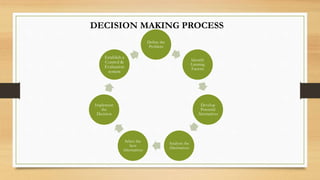
DECISION MAKING PROCESS
Define the
Problem
Identify
Limiting
Factors
Develop
Potential
Alternatives
Analysis the
Alternatives
Select the
best
Alternatives
Implement
the
Decision
Establish a
Control &
Evaluation
system
DECISION MAKING PROCESS
STEP 1. DEFINE THE PROBLEMS
 To ask Following Questions as a Manager:-
What exactly is the problem?
Why the problem should be solved?
Who are the affected parties of the Problem?
 Find Symptoms and Causes of Problem.
 Problem should be Accurate.
DECISION MAKING PROCESS
STEP 2. IDENTIFY LIMITING FACTOR
Any factor that Restrict a Company or an Organisations Activities.
Limited & Not Freely available.
Limiting factors are also called as Key Factors or Principal Budget factors.
Some examples of Limiting factor.
 Capacity of production.
 Skilled Labour shortage.
 Material shortage
 Shortage of Space and Fund
 Market Demand
 Scarce Resources should be identified.
 Maximisation of profit.
DECISION MAKING PROCESS
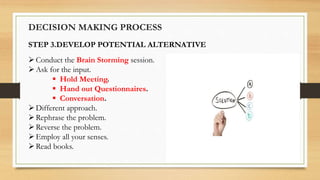
STEP 3.DEVELOP POTENTIAL ALTERNATIVE
Conduct the Brain Storming session.
Ask for the input.
 Hold Meeting.
 Hand out Questionnaires.
 Conversation.
Different approach.
Rephrase the problem.
Reverse the problem.
Employ all your senses.
Read books.
DECISION MAKING PROCESS
STEP 4. ANALYZE THE ALTERNATIVES
 Decide the Relative Merits of each idea.
 Identify the Advantages and Disadvantages
of each alternatives solutions.
 Perform a Cost Benefit Analysis for each
alternative.
 Rank/ Give Weights/ to each alternative.
 A manager needs to evaluate each alternative in
terms of Feasibility, Effectiveness &
Consequences.
 Decides which alternative is the most
Feasible and Effective less cost to
the organization chances of success.
 A Manager simply Selects the
Alternative with the Highest
Probability of success.
DECISION MAKING PROCESS
STEP 5. SELECT THE BEST ALTERNATIVE
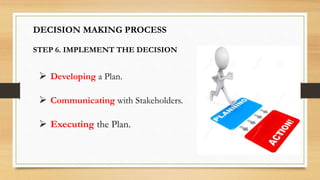
 Developing a Plan.
 Communicating with Stakeholders.
 Executing the Plan.
DECISION MAKING PROCESS
STEP 6. IMPLEMENT THE DECISION
 Evaluating outcomes.
 Appraising the Decision Process.
 Feedback from others.
DECISION MAKING PROCESS
STEP 7. ESTABLISH A CONTROL & EVALUTION SYSTEM
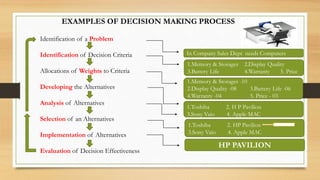
EXAMPLES OF DECISION MAKING PROCESS
Identification of a Problem
Identification of Decision Criteria
Allocations of Weights to Criteria
Developing the Alternatives
Analysis of Alternatives
Selection of an Alternatives
Implementation of Alternatives
Evaluation of Decision Effectiveness
In Company Sales Dept needs Computers
1.Memory & Storages 2.Display Quality
3.Battery Life 4.Warranty 5. Price
1.Memory & Storages -10
2.Display Quality -08 3.Battery Life -06
4.Warranty -04 5. Price - 03
1.Toshiba 2. H P Pavilion
3.Sony Vaio 4. Apple MAC
HP PAVILION
1.Toshiba 2. HP Pavilion
3.Sony Vaio 4. Apple MAC
CONCLUSION OF DECISION MAKING
 Decision Making is the Process of Seven Steps.
 Managers use the Criteria to make decision.
 Managers should Make Alternatives & Evaluate them
based on the criteria.
 Managers need to Evaluate their Decisions to make sure
they are solving the Right Problem.
DECISION MAKING PROCESS BY TIMSR

DECISION MAKING PROCESS BY TIMSR

  • 1.
    PRINCIPLE OF MANAGEMENT DECISIONMAKING PROCESS  Presented by :- Roll No-32 : Bhavisha Prajapati Roll No-24 : Kaushal Jilka Roll No-13 : Priya Kadam Roll No-08 : Keyur Gandhi Roll No-15 : Munish Kumar Roll No-24 : Snehal Panchal
  • 2.
    DECISION MAKING Meaning :- Best Choice from available Alternatives.  Process of Identifying Problem and opportunities and Solving the problem. Type of Decision :-  Programmed Decisions:- Routine Approach.  Non-Programmed Decision:- New & Unique Decision.
  • 3.
    DECISION MAKING PROCESS Definethe Problem Identify Limiting Factors Develop Potential Alternatives Analysis the Alternatives Select the best Alternatives Implement the Decision Establish a Control & Evaluation system
  • 4.
    DECISION MAKING PROCESS STEP1. DEFINE THE PROBLEMS  To ask Following Questions as a Manager:- What exactly is the problem? Why the problem should be solved? Who are the affected parties of the Problem?  Find Symptoms and Causes of Problem.  Problem should be Accurate.
  • 5.
    DECISION MAKING PROCESS STEP2. IDENTIFY LIMITING FACTOR Any factor that Restrict a Company or an Organisations Activities. Limited & Not Freely available. Limiting factors are also called as Key Factors or Principal Budget factors. Some examples of Limiting factor.  Capacity of production.  Skilled Labour shortage.  Material shortage  Shortage of Space and Fund  Market Demand  Scarce Resources should be identified.  Maximisation of profit.
  • 6.
    DECISION MAKING PROCESS STEP3.DEVELOP POTENTIAL ALTERNATIVE Conduct the Brain Storming session. Ask for the input.  Hold Meeting.  Hand out Questionnaires.  Conversation. Different approach. Rephrase the problem. Reverse the problem. Employ all your senses. Read books.
  • 7.
    DECISION MAKING PROCESS STEP4. ANALYZE THE ALTERNATIVES  Decide the Relative Merits of each idea.  Identify the Advantages and Disadvantages of each alternatives solutions.  Perform a Cost Benefit Analysis for each alternative.  Rank/ Give Weights/ to each alternative.  A manager needs to evaluate each alternative in terms of Feasibility, Effectiveness & Consequences.
  • 8.
     Decides whichalternative is the most Feasible and Effective less cost to the organization chances of success.  A Manager simply Selects the Alternative with the Highest Probability of success. DECISION MAKING PROCESS STEP 5. SELECT THE BEST ALTERNATIVE
  • 9.
     Developing aPlan.  Communicating with Stakeholders.  Executing the Plan. DECISION MAKING PROCESS STEP 6. IMPLEMENT THE DECISION
  • 10.
     Evaluating outcomes. Appraising the Decision Process.  Feedback from others. DECISION MAKING PROCESS STEP 7. ESTABLISH A CONTROL & EVALUTION SYSTEM
  • 11.
    EXAMPLES OF DECISIONMAKING PROCESS Identification of a Problem Identification of Decision Criteria Allocations of Weights to Criteria Developing the Alternatives Analysis of Alternatives Selection of an Alternatives Implementation of Alternatives Evaluation of Decision Effectiveness In Company Sales Dept needs Computers 1.Memory & Storages 2.Display Quality 3.Battery Life 4.Warranty 5. Price 1.Memory & Storages -10 2.Display Quality -08 3.Battery Life -06 4.Warranty -04 5. Price - 03 1.Toshiba 2. H P Pavilion 3.Sony Vaio 4. Apple MAC HP PAVILION 1.Toshiba 2. HP Pavilion 3.Sony Vaio 4. Apple MAC
  • 12.
    CONCLUSION OF DECISIONMAKING  Decision Making is the Process of Seven Steps.  Managers use the Criteria to make decision.  Managers should Make Alternatives & Evaluate them based on the criteria.  Managers need to Evaluate their Decisions to make sure they are solving the Right Problem.