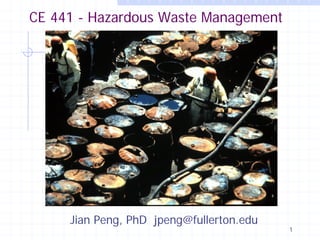
CE 441 - Hazardous Waste Management

Jian Peng, PhD jpeng@fullerton.edu

1
Introduction
Definitions
Sources
Problems
Regulations
Risk Assessment
Site Assessment
Hazardous Waste
Treatment
Groundwater/soil
remediation
2
What is a Hazardous Waste?
A solid waste, or combination of solid wastes,
which because of its quantity, concentration, or
physical, chemical or infectious characteristics
may –
(a) cause or significantly contribute to an increase
in mortality or an increase in serious
irreversible, or incapacitating reversible illness;
or
(b) pose a substantial present or potential hazard
to human health or the environment when
improperly treated, stored, transported, or
disposed of, or otherwise managed.
3
What is a Hazardous Waste?
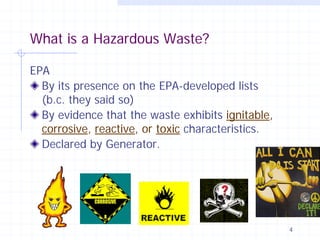
EPA
By its presence on the EPA-developed lists
(b.c. they said so)
By evidence that the waste exhibits ignitable,
corrosive, reactive, or toxic characteristics.
Declared by Generator.

4
Resource Conservation and
Recovery Act – RCRA (1976)
Establishes a “cradle to
grave” system of solid and
hazardous waste
regulations.
Defines wastes that are
regulated
Specifies requirements for
generators, transporters,
and treatment, storage and
disposal facilities (TSDFs).
5
Resource Conservation and
Recovery Act – RCRA (1976)
Uniform Hazardous
Waste Manifest
UST regulations
Landfill regulations
Hazardous and Solid
Waste Amendments
(HSWA) – 1984.

6
Comprehensive Environmental
Response, Compensation, and Liability
Act (CERCLA) - 1980
To provide a mechanism to clean up
contaminated sites and hold potentially
responsible parties (PRPs) accountable for
clean up costs
Deal with “past-sin”
CERCLA established a $1.6 billion Trust
Fund, known as Superfund.

7
Comprehensive Environmental
Response, Compensation, and Liability
Act (CERCLA) - 1980
EPA can only conduct long term remediation actions
at sites that are on the National Priorities List (NPL),
which ranks the sites eligible for Superfund clean up
through Hazard Ranking System (HRS).
Remedial Investigation (RI)
Feasibility Study (FS)
Record of Decision (ROD)

8
SARA - Emergency Planning and
Community Right-to-Know Act
Superfund amendments and
Reauthorization Act (SARA) of 1986
appropriated another $8.5 billion.
To create emergency response plans to
prepare for accidental chemical releases.
The EPA receives the Toxic Release
Inventory (TRI) reports with the
authority to inspect.
The public can know what types of
chemical are being released by
manufacturing facilities in their
communities.

9
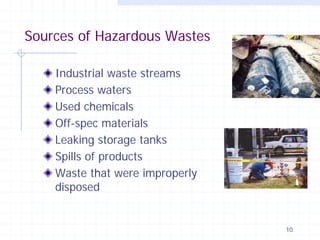
Sources of Hazardous Wastes
Industrial waste streams
Process waters
Used chemicals
Off-spec materials
Leaking storage tanks
Spills of products
Waste that were improperly
disposed

10
Solutions to the Hazardous
Wastes Problems
1. Reduce amount generated
2. Promote waste exchange
3. Recycle useful components (energy,
metals)
4. Detoxify and neutralize liquid streams
5. Reduce volume
6. Destroy combustible waste
7. Stabilize and solidify sludges and ash
8. Properly engineered landfill
11
Health
Effects of
Hazardous
Waste
Exposure

Release of HW to air, water, or land
Cause injury or death to a people, plants and animals, if:
 a large amount is released at one time (acute
exposure)
 a small amount is release many times at the same
12
location (chronic exposure)
Health
Effects of
Hazardous
Waste
Exposure

Exposure considerations
Who?
How?
At what concentration?
For how long?
How often?
Actual dosage?

Exposure pathways
Inhalation
Ingestion
Dermal contact

13
Risk
Assessment

Risk: Probability of exposure of individuals,
populations or ecosystems to toxic substances.
Risks can be lowered by reducing any
component of risk.
Risk assessment: Estimate of the severity and
likelihood of harm to populations or ecosystems
from exposure.
14
Risk
Assessment

Risk assessment:
 source assessments to identify hazard or
potential hazard
 exposure assessment to identify actual or
potential recipient
 dose-response assessment
 risk characterization (numerical estimate)
Risk Management

15
Risk Assessment – An example
When drinking water is disinfected with chlorine an
undesirable by-product, chloroform is formed.
What is the lifetime cancer risk for an adult
drinking water containing chloroform at a
concentration of 100 µg/L?
If the water supply for a city with 500,000 people
in it also drinks this water, how many extra cancers
can be expected as a result of this exposure?
Compare the extra cancers per year caused by
chloroform with the expected number of cancer
deaths from all causes.
16
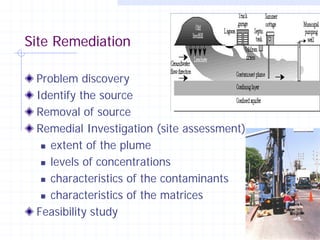
Site Remediation
Problem discovery
Identify the source
Removal of source
Remedial Investigation (site assessment)
 extent of the plume
 levels of concentrations
 characteristics of the contaminants
 characteristics of the matrices
Feasibility study
17
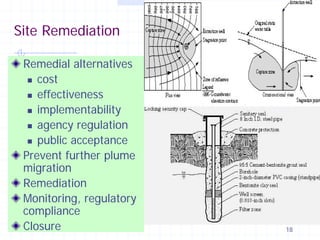
Site Remediation
Remedial alternatives
 cost
 effectiveness
 implementability
 agency regulation
 public acceptance
Prevent further plume
migration
Remediation
Monitoring, regulatory
compliance
Closure

18
Hazardous Waste
Treatment

Soil Remediation
Soil vapor extraction
Soil washing
Solidification/stabilization
Bioremedaition
Other innovative technologies

On-site, off-site
In-situ, ex-situ
Physical
Groundwater Remediation
Chemical
Air stripping
Biological
Activated Carbon Adsorption
Thermal
Bioremediation
Disposal (landfill,
deep well injection)
Ion exchange
Soil/groundwater/air
Advanced oxidation process
(AOP)
Natural attenuation
19
Others
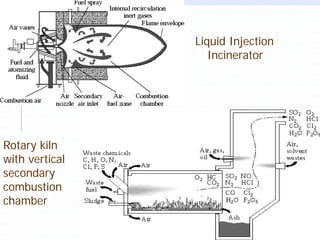
Liquid Injection
Incinerator

Rotary kiln
with vertical
secondary
combustion
chamber
20
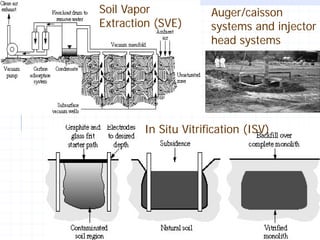
Soil Vapor
Extraction (SVE)

Auger/caisson
systems and injector
head systems

In Situ Vitrification (ISV)

21
Bioremediation

Soil Washing

22
Packed
tower Air
Stripper

Advanced Oxidation
Process (AOP) a typical UV/H2O2
system

23
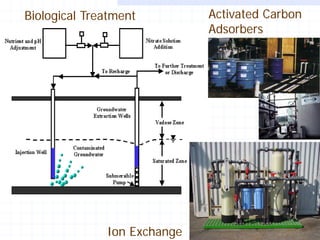
Biological Treatment

Ion Exchange

Activated Carbon
Adsorbers

24

Dec 3 haz waste

  • 1.
    CE 441 -Hazardous Waste Management Jian Peng, PhD jpeng@fullerton.edu 1
  • 2.
  • 3.
    What is aHazardous Waste? A solid waste, or combination of solid wastes, which because of its quantity, concentration, or physical, chemical or infectious characteristics may – (a) cause or significantly contribute to an increase in mortality or an increase in serious irreversible, or incapacitating reversible illness; or (b) pose a substantial present or potential hazard to human health or the environment when improperly treated, stored, transported, or disposed of, or otherwise managed. 3
  • 4.
    What is aHazardous Waste? EPA By its presence on the EPA-developed lists (b.c. they said so) By evidence that the waste exhibits ignitable, corrosive, reactive, or toxic characteristics. Declared by Generator. 4
  • 5.
    Resource Conservation and RecoveryAct – RCRA (1976) Establishes a “cradle to grave” system of solid and hazardous waste regulations. Defines wastes that are regulated Specifies requirements for generators, transporters, and treatment, storage and disposal facilities (TSDFs). 5
  • 6.
    Resource Conservation and RecoveryAct – RCRA (1976) Uniform Hazardous Waste Manifest UST regulations Landfill regulations Hazardous and Solid Waste Amendments (HSWA) – 1984. 6
  • 7.
    Comprehensive Environmental Response, Compensation,and Liability Act (CERCLA) - 1980 To provide a mechanism to clean up contaminated sites and hold potentially responsible parties (PRPs) accountable for clean up costs Deal with “past-sin” CERCLA established a $1.6 billion Trust Fund, known as Superfund. 7
  • 8.
    Comprehensive Environmental Response, Compensation,and Liability Act (CERCLA) - 1980 EPA can only conduct long term remediation actions at sites that are on the National Priorities List (NPL), which ranks the sites eligible for Superfund clean up through Hazard Ranking System (HRS). Remedial Investigation (RI) Feasibility Study (FS) Record of Decision (ROD) 8
  • 9.
    SARA - EmergencyPlanning and Community Right-to-Know Act Superfund amendments and Reauthorization Act (SARA) of 1986 appropriated another $8.5 billion. To create emergency response plans to prepare for accidental chemical releases. The EPA receives the Toxic Release Inventory (TRI) reports with the authority to inspect. The public can know what types of chemical are being released by manufacturing facilities in their communities. 9
  • 10.
    Sources of HazardousWastes Industrial waste streams Process waters Used chemicals Off-spec materials Leaking storage tanks Spills of products Waste that were improperly disposed 10
  • 11.
    Solutions to theHazardous Wastes Problems 1. Reduce amount generated 2. Promote waste exchange 3. Recycle useful components (energy, metals) 4. Detoxify and neutralize liquid streams 5. Reduce volume 6. Destroy combustible waste 7. Stabilize and solidify sludges and ash 8. Properly engineered landfill 11
  • 12.
    Health Effects of Hazardous Waste Exposure Release ofHW to air, water, or land Cause injury or death to a people, plants and animals, if:  a large amount is released at one time (acute exposure)  a small amount is release many times at the same 12 location (chronic exposure)
  • 13.
    Health Effects of Hazardous Waste Exposure Exposure considerations Who? How? Atwhat concentration? For how long? How often? Actual dosage? Exposure pathways Inhalation Ingestion Dermal contact 13
  • 14.
    Risk Assessment Risk: Probability ofexposure of individuals, populations or ecosystems to toxic substances. Risks can be lowered by reducing any component of risk. Risk assessment: Estimate of the severity and likelihood of harm to populations or ecosystems from exposure. 14
  • 15.
    Risk Assessment Risk assessment:  sourceassessments to identify hazard or potential hazard  exposure assessment to identify actual or potential recipient  dose-response assessment  risk characterization (numerical estimate) Risk Management 15
  • 16.
    Risk Assessment –An example When drinking water is disinfected with chlorine an undesirable by-product, chloroform is formed. What is the lifetime cancer risk for an adult drinking water containing chloroform at a concentration of 100 µg/L? If the water supply for a city with 500,000 people in it also drinks this water, how many extra cancers can be expected as a result of this exposure? Compare the extra cancers per year caused by chloroform with the expected number of cancer deaths from all causes. 16
  • 17.
    Site Remediation Problem discovery Identifythe source Removal of source Remedial Investigation (site assessment)  extent of the plume  levels of concentrations  characteristics of the contaminants  characteristics of the matrices Feasibility study 17
  • 18.
    Site Remediation Remedial alternatives cost  effectiveness  implementability  agency regulation  public acceptance Prevent further plume migration Remediation Monitoring, regulatory compliance Closure 18
  • 19.
    Hazardous Waste Treatment Soil Remediation Soilvapor extraction Soil washing Solidification/stabilization Bioremedaition Other innovative technologies On-site, off-site In-situ, ex-situ Physical Groundwater Remediation Chemical Air stripping Biological Activated Carbon Adsorption Thermal Bioremediation Disposal (landfill, deep well injection) Ion exchange Soil/groundwater/air Advanced oxidation process (AOP) Natural attenuation 19 Others
  • 20.
    Liquid Injection Incinerator Rotary kiln withvertical secondary combustion chamber 20
  • 21.
    Soil Vapor Extraction (SVE) Auger/caisson systemsand injector head systems In Situ Vitrification (ISV) 21
  • 22.
  • 23.
  • 24.