Nonexistent Data: The Need for
Monitoring Contaminants of Emerging
Concern in Drinking Water
Disclaimer:
This work is not a product of the United States Government or the U.S. Environmental Protection Agency. The author is not
doing this work in any governmental capacity. The views expressed are his/her own and do not necessarily represent those of
the United States or U.S. EPA.
Jay M. Patel
Patel.jay@analyzechemicals.com
Our World, Our Data
Cambridge, MA
April 30, 2017
www.AnalyzeChemicals.com
Outline
• Pollutants vs Contaminants
• Safe Water Drinking Act, 1996
• What are Contaminants of Emerging Concern (CECs) ?
• PFOS Timeline: CEC to Pollutant
• Identifying Potential CECs
• Nonexistent Data for CECs in Water
• A Citizen Science Approach for Monitoring CECs
• Conclusions
Safe Water Drinking Act (SWDA), 1996
• Mandates monitoring of water resources (except private wells used
by less than 25 people) for 114 chemicals such as organics, inorganics
[1] and microorganisms
• Sets enforceable max. contaminant levels (MCLs)
• Mandates that EPA can additionally monitor for no more than 30
unregulated contaminants every five years [2]. This is called
unregulated contaminant monitoring rule (UCMR).
[1] http://scorecard.goodguide.com/chemical-groups/one-list.tcl?short_list_name=mcl
[2] https://www.epa.gov/dwucmr
Contaminants of Emerging Concern (CECs)
European
commission
Funded
Norman
Network [1]
classifies ~900
chemicals as
CECs
[1] http://www.norman-network.net/?q=node/19
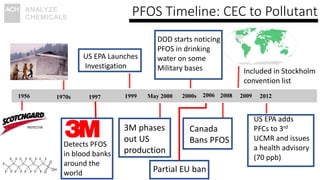
PFOS Timeline: CEC to Pollutant
1956 1970s 1999 May 2000 2000s 20061997
Detects PFOS
in blood banks
around the
world
US EPA Launches
Investigation
3M phases
out US
production
DOD starts noticing
PFOS in drinking
water on some
Military bases
Partial EU ban
2008
Canada
Bans PFOS
2009
Included in Stockholm
convention list
2012
US EPA adds
PFCs to 3rd
UCMR and issues
a health advisory
(70 ppb)
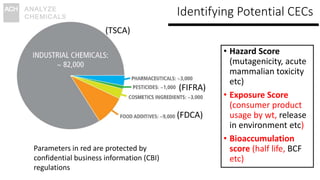
Identifying Potential CECs
• Hazard Score
(mutagenicity, acute
mammalian toxicity
etc)
• Exposure Score
(consumer product
usage by wt, release
in environment etc)
• Bioaccumulation
score (half life, BCF
etc)
(TSCA)
(FIFRA)
(FDCA)
Parameters in red are protected by
confidential business information (CBI)
regulations
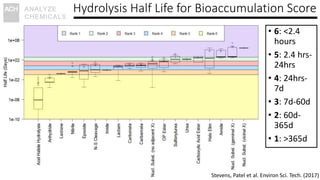
Hydrolysis Half Life for Bioaccumulation Score
• 6: <2.4
hours
• 5: 2.4 hrs-
24hrs
• 4: 24hrs-
7d
• 3: 7d-60d
• 2: 60d-
365d
• 1: >365d
Stevens, Patel et al. Environ Sci. Tech. (2017)
Nonexistent Data for CECs in water
[1] https://www2.usgs.gov/envirohealth/geohealth/full_activities_list.html
[2] Hu et al. Environ. Sci. Technol. Lett., 2016, 3 (10), pp 344–350
2013-2015 [2]
1999-2009
Public Wells [1]
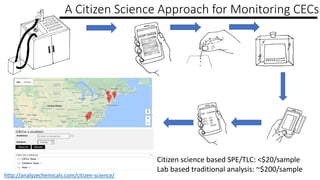
A Citizen Science Approach for Monitoring CECs
http://analyzechemicals.com/citizen-science/
Citizen science based SPE/TLC: <$20/sample
Lab based traditional analysis: ~$200/sample
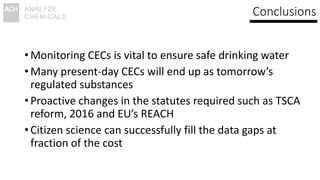
Conclusions
• Monitoring CECs is vital to ensure safe drinking water
• Many present-day CECs will end up as tomorrow’s
regulated substances
• Proactive changes in the statutes required such as TSCA
reform, 2016 and EU’s REACH
• Citizen science can successfully fill the data gaps at
fraction of the cost
Questions?
Thank You
Disclaimer:
This work is not a product of the United States Government or the U.S. Environmental Protection Agency. The author is not
doing this work in any governmental capacity. The views expressed are his/her own and do not necessarily represent those of
the United States or U.S. EPA.
Jay M. Patel
Patel.jay@analyzechemicals.com
Our World, Our Data
Cambridge, MA
April 30, 2017
www.AnalyzeChemicals.com

Owod 05-1-jay patel-nonexistent_data

  • 1.
    Nonexistent Data: TheNeed for Monitoring Contaminants of Emerging Concern in Drinking Water Disclaimer: This work is not a product of the United States Government or the U.S. Environmental Protection Agency. The author is not doing this work in any governmental capacity. The views expressed are his/her own and do not necessarily represent those of the United States or U.S. EPA. Jay M. Patel Patel.jay@analyzechemicals.com Our World, Our Data Cambridge, MA April 30, 2017 www.AnalyzeChemicals.com
  • 2.
    Outline • Pollutants vsContaminants • Safe Water Drinking Act, 1996 • What are Contaminants of Emerging Concern (CECs) ? • PFOS Timeline: CEC to Pollutant • Identifying Potential CECs • Nonexistent Data for CECs in Water • A Citizen Science Approach for Monitoring CECs • Conclusions
  • 3.
    Safe Water DrinkingAct (SWDA), 1996 • Mandates monitoring of water resources (except private wells used by less than 25 people) for 114 chemicals such as organics, inorganics [1] and microorganisms • Sets enforceable max. contaminant levels (MCLs) • Mandates that EPA can additionally monitor for no more than 30 unregulated contaminants every five years [2]. This is called unregulated contaminant monitoring rule (UCMR). [1] http://scorecard.goodguide.com/chemical-groups/one-list.tcl?short_list_name=mcl [2] https://www.epa.gov/dwucmr
  • 4.
    Contaminants of EmergingConcern (CECs) European commission Funded Norman Network [1] classifies ~900 chemicals as CECs [1] http://www.norman-network.net/?q=node/19
  • 5.
    PFOS Timeline: CECto Pollutant 1956 1970s 1999 May 2000 2000s 20061997 Detects PFOS in blood banks around the world US EPA Launches Investigation 3M phases out US production DOD starts noticing PFOS in drinking water on some Military bases Partial EU ban 2008 Canada Bans PFOS 2009 Included in Stockholm convention list 2012 US EPA adds PFCs to 3rd UCMR and issues a health advisory (70 ppb)
  • 6.
    Identifying Potential CECs •Hazard Score (mutagenicity, acute mammalian toxicity etc) • Exposure Score (consumer product usage by wt, release in environment etc) • Bioaccumulation score (half life, BCF etc) (TSCA) (FIFRA) (FDCA) Parameters in red are protected by confidential business information (CBI) regulations
  • 7.
    Hydrolysis Half Lifefor Bioaccumulation Score • 6: <2.4 hours • 5: 2.4 hrs- 24hrs • 4: 24hrs- 7d • 3: 7d-60d • 2: 60d- 365d • 1: >365d Stevens, Patel et al. Environ Sci. Tech. (2017)
  • 8.
    Nonexistent Data forCECs in water [1] https://www2.usgs.gov/envirohealth/geohealth/full_activities_list.html [2] Hu et al. Environ. Sci. Technol. Lett., 2016, 3 (10), pp 344–350 2013-2015 [2] 1999-2009 Public Wells [1]
  • 9.
    A Citizen ScienceApproach for Monitoring CECs http://analyzechemicals.com/citizen-science/ Citizen science based SPE/TLC: <$20/sample Lab based traditional analysis: ~$200/sample
  • 10.
    Conclusions • Monitoring CECsis vital to ensure safe drinking water • Many present-day CECs will end up as tomorrow’s regulated substances • Proactive changes in the statutes required such as TSCA reform, 2016 and EU’s REACH • Citizen science can successfully fill the data gaps at fraction of the cost
  • 11.
    Questions? Thank You Disclaimer: This workis not a product of the United States Government or the U.S. Environmental Protection Agency. The author is not doing this work in any governmental capacity. The views expressed are his/her own and do not necessarily represent those of the United States or U.S. EPA. Jay M. Patel Patel.jay@analyzechemicals.com Our World, Our Data Cambridge, MA April 30, 2017 www.AnalyzeChemicals.com