ETHOS: A Translation of Bio-digestion of Human Waste across Continents
Anirban Mandal
Advisor: Candida Crasto
Introduction Objective
Result Expected
Diagrammatic Representation
Methodology (Factors)
Biodigestion, an anaerobic process, can
be used for eco-friendly disposal of
human and animal waste. Some of the
benefits are:
- Removal of odor
- Safe disposal of waste
- Low cost
- Easy to construct/ maintain
- Methane generation
- High quality fertilizer
Human waste is a very potent vector for
viral and bacterial disease. About 20 %
of all such diseases (like hepatitis,
hookworm, cholera, filariasis, etc., to
name a few) is water related.
Anaerobic digestion can be used for
waste management, especially human
waste in the developing countries.
Effluent becomes pathogen-free and re-
usable which are eco-friendly and
economical.
Emitted gas (methane) may be utilized as
energy source for household purposes
Bibliography
Major objectives of this work are to:
(a) Evaluate various technologies for
best results in rural Nicaragua.
(b) Selection and fabrication of an
appropriate technology for individual
household.
(c) Study the feasibility of introducing
a community based toilet system .
(d) Use the results from the appropriate
technology for education purposes
globally.
I would like to extend my sincere gratitude to the ETHOS team
from the School of Engineering specially Candida, Christopher,
Gretchen and my Nicaragua team mates for their help and
cooperation.
Acknowledgements
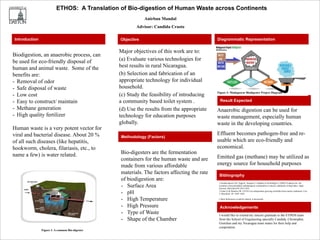
Figure 1: A common Bio-digester
Bio-digesters are the fermentation
containers for the human waste and are
made from various affordable
materials. The factors affecting the rate
of biodigestion are:
- Surface Area
- pH
- High Temperature
- High Pressure
- Type of Waste
- Shape of the Chamber
1.Nozhevnikova AN, Zepp K, Vazquez F, Zehnder AJ & Holliger C (2003) Evidence for the
existence of psychrophilic methanogenic communities in anoxic sediments of deep lakes. Appl.
Environ. Microbiol.69:1832-1835.
2.Finne G & Matches JR. (1974) Low-temperature-growing clostridia from marine sediments. Can.
J. Microbiol. 20: 1639–1645.
( More References would be shared, if interested)
Figure 2: Madagascar Biodigester Project Diagram

Stander Symposium 2014 Poster Presentation

  • 1.
    ETHOS: A Translationof Bio-digestion of Human Waste across Continents Anirban Mandal Advisor: Candida Crasto Introduction Objective Result Expected Diagrammatic Representation Methodology (Factors) Biodigestion, an anaerobic process, can be used for eco-friendly disposal of human and animal waste. Some of the benefits are: - Removal of odor - Safe disposal of waste - Low cost - Easy to construct/ maintain - Methane generation - High quality fertilizer Human waste is a very potent vector for viral and bacterial disease. About 20 % of all such diseases (like hepatitis, hookworm, cholera, filariasis, etc., to name a few) is water related. Anaerobic digestion can be used for waste management, especially human waste in the developing countries. Effluent becomes pathogen-free and re- usable which are eco-friendly and economical. Emitted gas (methane) may be utilized as energy source for household purposes Bibliography Major objectives of this work are to: (a) Evaluate various technologies for best results in rural Nicaragua. (b) Selection and fabrication of an appropriate technology for individual household. (c) Study the feasibility of introducing a community based toilet system . (d) Use the results from the appropriate technology for education purposes globally. I would like to extend my sincere gratitude to the ETHOS team from the School of Engineering specially Candida, Christopher, Gretchen and my Nicaragua team mates for their help and cooperation. Acknowledgements Figure 1: A common Bio-digester Bio-digesters are the fermentation containers for the human waste and are made from various affordable materials. The factors affecting the rate of biodigestion are: - Surface Area - pH - High Temperature - High Pressure - Type of Waste - Shape of the Chamber 1.Nozhevnikova AN, Zepp K, Vazquez F, Zehnder AJ & Holliger C (2003) Evidence for the existence of psychrophilic methanogenic communities in anoxic sediments of deep lakes. Appl. Environ. Microbiol.69:1832-1835. 2.Finne G & Matches JR. (1974) Low-temperature-growing clostridia from marine sediments. Can. J. Microbiol. 20: 1639–1645. ( More References would be shared, if interested) Figure 2: Madagascar Biodigester Project Diagram