UNIT-V
Hazardous Waste Management
Syllabus
• Hazardous waste Management: Sources and characteristics,
Effects on environment, Risk assessment – Disposal of hazardous
wastes – Secured landfills, incineration - Monitoring – Biomedical
waste disposal, E-waste management, Nuclear Wastes, Industrial
waste Management.
Sources of Hazardous Waste
Introduction
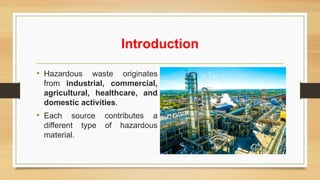
• Hazardous waste originates
from industrial, commercial,
agricultural, healthcare, and
domestic activities.
• Each source contributes a
different type of hazardous
material.
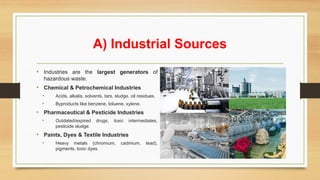
A) Industrial Sources
• Industries are the largest generators of
hazardous waste.
• Chemical & Petrochemical Industries
• Acids, alkalis, solvents, tars, sludge, oil residues.
• Byproducts like benzene, toluene, xylene.
• Pharmaceutical & Pesticide Industries
• Outdated/expired drugs, toxic intermediates,
pesticide sludge.
• Paints, Dyes & Textile Industries
• Heavy metals (chromium, cadmium, lead),
pigments, toxic dyes.
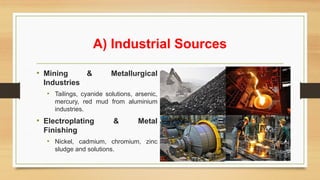
• Mining & Metallurgical
Industries
• Tailings, cyanide solutions, arsenic,
mercury, red mud from aluminium
industries.
• Electroplating & Metal
Finishing
• Nickel, cadmium, chromium, zinc
sludge and solutions.
A) Industrial Sources
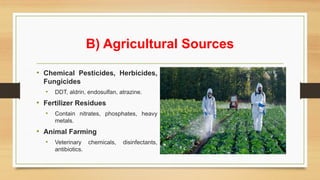
B) Agricultural Sources
• Chemical Pesticides, Herbicides,
Fungicides
• DDT, aldrin, endosulfan, atrazine.
• Fertilizer Residues
• Contain nitrates, phosphates, heavy
metals.
• Animal Farming
• Veterinary chemicals, disinfectants,
antibiotics.
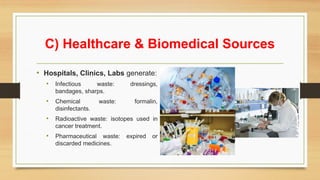
C) Healthcare & Biomedical Sources
• Hospitals, Clinics, Labs generate:
• Infectious waste: dressings,
bandages, sharps.
• Chemical waste: formalin,
disinfectants.
• Radioactive waste: isotopes used in
cancer treatment.
• Pharmaceutical waste: expired or
discarded medicines.
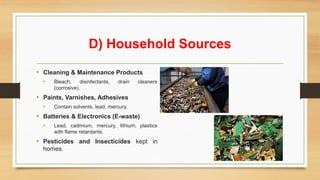
D) Household Sources
• Cleaning & Maintenance Products
• Bleach, disinfectants, drain cleaners
(corrosive).
• Paints, Varnishes, Adhesives
• Contain solvents, lead, mercury.
• Batteries & Electronics (E-waste)
• Lead, cadmium, mercury, lithium, plastics
with flame retardants.
• Pesticides and Insecticides kept in
homes.
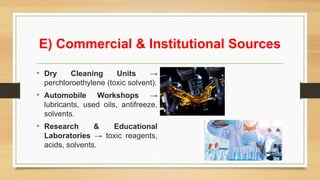
E) Commercial & Institutional Sources
• Dry Cleaning Units →
perchloroethylene (toxic solvent).
• Automobile Workshops →
lubricants, used oils, antifreeze,
solvents.
• Research & Educational
Laboratories → toxic reagents,
acids, solvents.
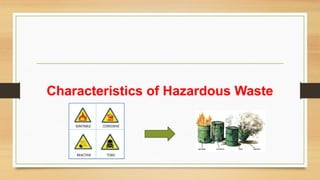
Characteristics of Hazardous Waste
Introduction
• Hazardous waste is classified as per its intrinsic properties which
make it dangerous to human health and the environment.
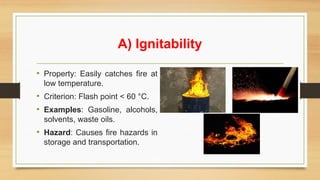
A) Ignitability
• Property: Easily catches fire at
low temperature.
• Criterion: Flash point < 60 °C.
• Examples: Gasoline, alcohols,
solvents, waste oils.
• Hazard: Causes fire hazards in
storage and transportation.
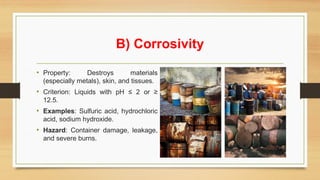
B) Corrosivity
• Property: Destroys materials
(especially metals), skin, and tissues.
• Criterion: Liquids with pH ≤ 2 or ≥
12.5.
• Examples: Sulfuric acid, hydrochloric
acid, sodium hydroxide.
• Hazard: Container damage, leakage,
and severe burns.
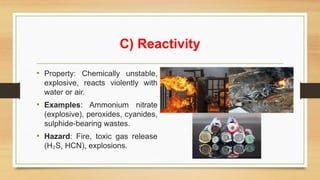
C) Reactivity
• Property: Chemically unstable,
explosive, reacts violently with
water or air.
• Examples: Ammonium nitrate
(explosive), peroxides, cyanides,
sulphide-bearing wastes.
• Hazard: Fire, toxic gas release
(H S, HCN), explosions.
₂
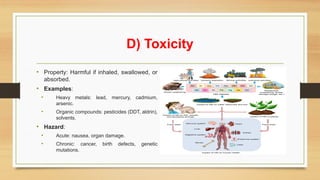
D) Toxicity
• Property: Harmful if inhaled, swallowed, or
absorbed.
• Examples:
• Heavy metals: lead, mercury, cadmium,
arsenic.
• Organic compounds: pesticides (DDT, aldrin),
solvents.
• Hazard:
• Acute: nausea, organ damage.
• Chronic: cancer, birth defects, genetic
mutations.
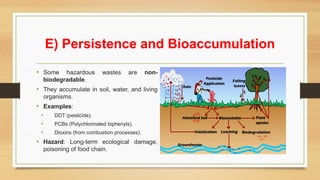
E) Persistence and Bioaccumulation
• Some hazardous wastes are non-
biodegradable.
• They accumulate in soil, water, and living
organisms.
• Examples:
• DDT (pesticide).
• PCBs (Polychlorinated biphenyls).
• Dioxins (from combustion processes).
• Hazard: Long-term ecological damage,
poisoning of food chain.
F) Infectious / Radioactive Nature
(Special Characteristics)
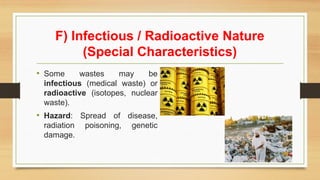
• Some wastes may be
infectious (medical waste) or
radioactive (isotopes, nuclear
waste).
• Hazard: Spread of disease,
radiation poisoning, genetic
damage.
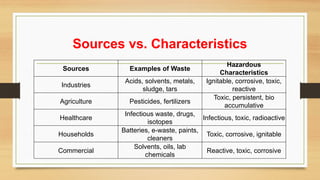
Sources vs. Characteristics
Sources Examples of Waste
Hazardous
Characteristics
Industries
Acids, solvents, metals,
sludge, tars
Ignitable, corrosive, toxic,
reactive
Agriculture Pesticides, fertilizers
Toxic, persistent, bio
accumulative
Healthcare
Infectious waste, drugs,
isotopes
Infectious, toxic, radioactive
Households
Batteries, e-waste, paints,
cleaners
Toxic, corrosive, ignitable
Commercial
Solvents, oils, lab
chemicals
Reactive, toxic, corrosive
Effects on Environment
Introduction
• Hazardous waste contains substances that are toxic, corrosive,
reactive, ignitable, infectious, or radioactive, making it
extremely harmful to natural ecosystems and human life.
• Its effects can be divided based on environmental components: air,
water, soil, biota, and global systems.
1. Effects on Air
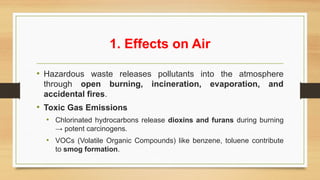
• Hazardous waste releases pollutants into the atmosphere
through open burning, incineration, evaporation, and
accidental fires.
• Toxic Gas Emissions
• Chlorinated hydrocarbons release dioxins and furans during burning
→ potent carcinogens.
• VOCs (Volatile Organic Compounds) like benzene, toluene contribute
to smog formation.
1. Effects on Air
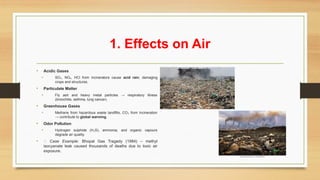
• Acidic Gases
• SO , NO , HCl from incinerators cause
₂ ₓ acid rain, damaging
crops and structures.
• Particulate Matter
• Fly ash and heavy metal particles → respiratory illness
(bronchitis, asthma, lung cancer).
• Greenhouse Gases
• Methane from hazardous waste landfills, CO from incineration
₂
→ contribute to global warming.
• Odor Pollution
• Hydrogen sulphide (H S), ammonia, and organic vapours
₂
degrade air quality.
• 📌 Case Example: Bhopal Gas Tragedy (1984) – methyl
isocyanate leak caused thousands of deaths due to toxic air
exposure.
2. Effects on Water
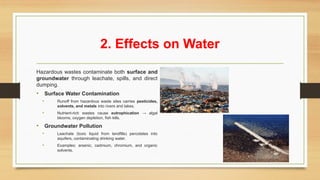
Hazardous wastes contaminate both surface and
groundwater through leachate, spills, and direct
dumping.
• Surface Water Contamination
• Runoff from hazardous waste sites carries pesticides,
solvents, and metals into rivers and lakes.
• Nutrient-rich wastes cause eutrophication → algal
blooms, oxygen depletion, fish kills.
• Groundwater Pollution
• Leachate (toxic liquid from landfills) percolates into
aquifers, contaminating drinking water.
• Examples: arsenic, cadmium, chromium, and organic
solvents.
2. Effects on Water
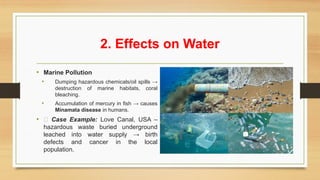
• Marine Pollution
• Dumping hazardous chemicals/oil spills →
destruction of marine habitats, coral
bleaching.
• Accumulation of mercury in fish → causes
Minamata disease in humans.
• 📌 Case Example: Love Canal, USA –
hazardous waste buried underground
leached into water supply → birth
defects and cancer in the local
population.
3. Effects on Soil
Soil acts as a sink for hazardous waste, but contamination can
render land unproductive and toxic.
• Soil Contamination
• Heavy metals (lead, mercury, arsenic, cadmium) accumulate in the soil.
• Loss of Fertility
• Strong acids, alkalis, and salts kill beneficial microorganisms → reduced
soil productivity.
3. Effects on Soil
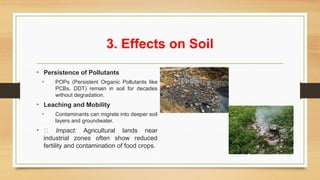
• Persistence of Pollutants
• POPs (Persistent Organic Pollutants like
PCBs, DDT) remain in soil for decades
without degradation.
• Leaching and Mobility
• Contaminants can migrate into deeper soil
layers and groundwater.
• 📌 Impact: Agricultural lands near
industrial zones often show reduced
fertility and contamination of food crops.
4. Effects on Flora & Fauna
(Ecosystems)
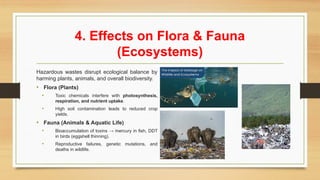
Hazardous wastes disrupt ecological balance by
harming plants, animals, and overall biodiversity.
• Flora (Plants)
• Toxic chemicals interfere with photosynthesis,
respiration, and nutrient uptake.
• High soil contamination leads to reduced crop
yields.
• Fauna (Animals & Aquatic Life)
• Bioaccumulation of toxins → mercury in fish, DDT
in birds (eggshell thinning).
• Reproductive failures, genetic mutations, and
deaths in wildlife.
4. Effects on Flora & Fauna
(Ecosystems)
• Biodiversity Loss
• Sensitive species disappear from contaminated ecosystems.
• Food Chain Contamination
• Pollutants enter the food web and bio magnify at higher trophic levels.
• 📌 Example: Mercury poisoning in fish → affects humans and
animals consuming fish (Minamata Bay, Japan).
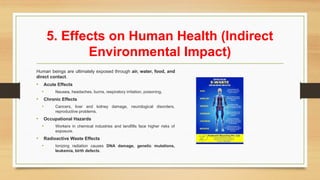
5. Effects on Human Health (Indirect
Environmental Impact)
Human beings are ultimately exposed through air, water, food, and
direct contact.
• Acute Effects
• Nausea, headaches, burns, respiratory irritation, poisoning.
• Chronic Effects
• Cancers, liver and kidney damage, neurological disorders,
reproductive problems.
• Occupational Hazards
• Workers in chemical industries and landfills face higher risks of
exposure.
• Radioactive Waste Effects
• Ionizing radiation causes DNA damage, genetic mutations,
leukemia, birth defects.
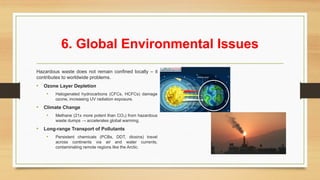
6. Global Environmental Issues
Hazardous waste does not remain confined locally – it
contributes to worldwide problems.
• Ozone Layer Depletion
• Halogenated hydrocarbons (CFCs, HCFCs) damage
ozone, increasing UV radiation exposure.
• Climate Change
• Methane (21x more potent than CO ) from hazardous
₂
waste dumps → accelerates global warming.
• Long-range Transport of Pollutants
• Persistent chemicals (PCBs, DDT, dioxins) travel
across continents via air and water currents,
contaminating remote regions like the Arctic.
Risk Assessment
Risk Assessment
• Risk assessment is a systematic process to evaluate the potential
adverse effects of hazardous waste on human health and the
environment.
• It helps in decision-making, policy framing, and designing safe
waste management practices.
Introduction
• Hazardous wastes contain toxic, reactive, corrosive, flammable,
or infectious substances.
• Risk arises when humans or ecosystems are exposed to these
wastes through air, water, soil, or food chain.
• Risk assessment quantifies the likelihood of harm and identifies
exposure pathways.
Objectives of Risk Assessment
• To identify potential hazards associated with hazardous waste.
• To estimate the extent of exposure for humans and environment.
• To evaluate short-term and long-term impacts.
• To provide a scientific basis for regulations, standards, and
mitigation strategies.
• To prioritize waste management actions (e.g., treatment,
containment, remediation).
Steps in Risk Assessment
A) Hazard Identification
B) Exposure Assessment
C) Dose–Response Assessment
D) Risk Characterization
A) Hazard Identification
• Determining which wastes or chemicals pose hazards.
• Uses toxicological and epidemiological data.
• Examples: arsenic (carcinogenic), mercury (neurotoxic), cyanide
(acutely toxic).
B) Exposure Assessment
• Evaluates how much of a hazardous substance people or ecosystems are
exposed to.
• Exposure Pathways:
• Air → inhalation of toxic gases, particulates.
• Water → ingestion of contaminated drinking water.
• Soil → dermal contact, ingestion (children playing in contaminated soil).
• Food Chain → bioaccumulation (fish, crops).
• Considers duration, frequency, and population at risk (workers, residents,
children).
C) Dose–Response Assessment
• Establishes relationship between exposure level and health effect.
• Example:
• Low dose of lead → developmental delays in children.
• High dose → kidney and neurological damage.
• Defines thresholds such as:
• NOAEL (No Observed Adverse Effect Level)
• LOAEL (Lowest Observed Adverse Effect Level)
D) Risk Characterization
• Integrates hazard, exposure, and dose–response data.
• Provides quantitative estimate of risk (e.g., probability of cancer
in a population).
• Also describes uncertainties in the assessment.
Types of Risk
• Human Health Risks → cancer, organ damage, reproductive and
neurological effects.
• Ecological Risks → biodiversity loss, food chain contamination,
ecosystem imbalance.
• Occupational Risks → exposure of workers in industries,
treatment plants, and landfills.
Tools & Methods Used
• Environmental Monitoring → air, soil, water sampling.
• Modelling Software → predicts dispersion, leaching,
bioaccumulation.
• Toxicity Tests → laboratory studies on animals and
microorganisms.
• Regulatory Frameworks → USEPA (United States Environmental
Protection Agency), WHO guidelines.
Importance of Risk Assessment
• Protects public health and ecosystems.
• Supports policy-making and setting of safe disposal standards.
• Helps in land-use planning near landfills and treatment facilities.
• Provides basis for remediation and emergency response.
Disposal of Hazardous Waste
Introduction
• Hazardous wastes require specialized treatment and disposal
methods due to their toxic, corrosive, flammable, and reactive
properties. The aim is to neutralize, reduce toxicity, immobilize
contaminants, and prevent environmental pollution.
Objectives
• To minimize risks to human health and the environment.
• To convert hazardous waste into less harmful forms.
• To ensure long-term safe containment of persistent substances.
• To comply with legal and regulatory standards (e.g., Hazardous
Waste Rules, 2016 in India, EPA guidelines in USA).
Methods
A) Physical Methods
B) Chemical Methods
C) Thermal Methods
D) Biological Methods
E) Land Disposal Methods
A) Physical Methods
• Used for separation, concentration, or solidification.
• Filtration, Sedimentation, Evaporation → separate solids/liquids.
• Encapsulation → hazardous waste is enclosed in plastic, metal
drums, or concrete blocks.
• Stabilization/Solidification → mixing waste with cement, lime, fly
ash → immobilizes contaminants and prevents leaching.
B) Chemical Methods
• Used to detoxify or neutralize wastes.
• Neutralization → acids with alkalis, alkalis with acids.
• Oxidation–Reduction (Redox Reactions) → converts toxic compounds into
stable forms.
• Example: Cyanides → converted to carbonates.
• Precipitation → converts dissolved heavy metals into insoluble compounds for
removal.
• Chemical Fixation → immobilizes hazardous components within a stable matrix.
C) Thermal Methods
• High temperature destroys organic and toxic components.
• Incineration
• Controlled burning at 1,000–1,600 °C.
• Destroys hazardous organics, reduces volume by up to 90%.
• Requires air pollution control devices (scrubbers, filters).
• Pyrolysis
• Thermal decomposition in absence of oxygen → produces
syngas, oil, and char.
• Plasma Arc Treatment
• Extremely high temperatures (up to 10,000 °C) using plasma
torch.
• Breaks down even highly toxic compounds into basic elements.
C) Thermal Methods
D) Biological Methods
• Use of microorganisms to degrade or detoxify wastes.
• Bioremediation → microbes degrade hydrocarbons, pesticides,
solvents.
• Phytoremediation → plants absorb and stabilize heavy metals
(e.g., sunflowers for uranium, vetiver grass for arsenic).
• Composting (for biodegradable hazardous fractions).
E) Land Disposal Methods
• Still widely used but must be properly engineered.
• Secure Landfills
• Designed with liners, leachate collection, gas vents, and monitoring wells.
• Suitable for solid hazardous wastes.
• Deep Well Injection
• Liquid hazardous wastes pumped into deep rock formations isolated from groundwater.
• Surface Impoundments (Lagoons, Ponds)
• Temporary containment of liquid hazardous wastes; requires lining to prevent seepage.
Modern Approaches
• Integrated Hazardous Waste Management (IHWM) →
combination of physical, chemical, biological, and thermal methods.
• Co-processing in Cement Kilns → hazardous wastes are used as
alternative fuels in cement industries.
• Waste-to-Energy Systems → recovery of energy while
neutralizing waste.
Criteria for Selecting Disposal Method
• Nature of waste (liquid, solid, gas).
• Chemical composition and toxicity.
• Volume and concentration.
• Cost and feasibility.
• Environmental regulations.
Secured Landfills
Introduction
• A secured landfill is a scientifically designed and engineered
disposal facility meant specifically for the long-term safe
containment of hazardous wastes. Unlike ordinary dumps,
secured landfills are constructed with multiple protective barriers
to prevent leachate leakage, groundwater contamination, and
toxic gas emissions.
Purpose
• To isolate hazardous wastes from the environment.
• To prevent contamination of soil, surface water, and groundwater.
• To provide safe long-term storage for wastes that cannot be
treated or destroyed economically.
Design Features of Secured Landfills
A typical secured landfill consists of the following components:
A) Liner System
B) Leachate Collection System
C) Waste Placement
D) Daily & Intermediate Cover
E) Gas Collection System
F) Final Cover / Cap
G) Monitoring Systems
A) Liner System
• Bottom Liners (Multi-layered):
• Compacted clay layer (low permeability).
• Geomembrane (HDPE plastic sheet).
• Geotextile protective layer.
• Purpose → prevents leachate from seeping into
soil/groundwater.
B) Leachate Collection System
• Network of perforated pipes placed above liners.
• Collects leachate (toxic liquid formed by waste-water interactions).
• Leachate is pumped out → treated in treatment plants before
disposal.
C) Waste Placement
• Hazardous waste is placed in cells.
• Each cell is progressively filled and then covered with soil or
temporary covers to reduce rainwater infiltration.
D) Daily & Intermediate Cover
• A layer of soil or alternative material placed daily to:
• Minimize odour, pests, and windblown waste.
• Reduce water infiltration.
E) Gas Collection System
• Hazardous wastes can generate gases (CH , CO , VOCs).
₄ ₂
• Gas vents and collection pipes are installed to capture and treat
landfill gases.
F) Final Cover / Cap
• Multi-layer cap system at closure:
• Clay or geomembrane layer (prevents water infiltration).
• Drainage layer.
• Vegetative soil cover (to prevent erosion).
• Prevents entry of rainwater and escape of gases.
G) Monitoring Systems
• Groundwater Monitoring Wells around landfill.
• Gas Monitoring Systems to detect leaks.
• Ensures compliance with environmental standards.
Operation of Secured Landfills
• Waste Acceptance & Pre-treatment – Only treated, stabilized, or
immobilized hazardous wastes are accepted.
• Waste Placement in Cells – Wastes are deposited in lined cells.
• Compaction & Covering – Daily cover applied.
• Leachate & Gas Management – Continuous collection and treatment.
• Closure & Post-closure Care – After filling, landfill is capped and
monitored for 30–50 years.
Advantages
• Highly effective for long-term containment.
• Prevents groundwater and soil contamination.
• Provides a controlled and monitored disposal method.
• Flexible design for various waste types.
Limitations
• Very high construction and maintenance cost.
• Requires large land area.
• Long-term liability (monitoring for decades).
• Risk of liner failure or leachate leakage if not properly maintained.
Incineration
Introduction
• Incineration is the controlled combustion of hazardous waste at
very high temperatures (typically 1,000–1,600 °C).
• It reduces the volume of waste by up to 90% and destroys most
organic toxins.
• Considered one of the most effective disposal methods for
hazardous waste, especially for infectious, toxic, or flammable
materials.
Objectives
• To destroy organic hazardous compounds (pesticides, solvents,
PCBs).
• To reduce waste volume and mass.
• To convert hazardous substances into inert, stable residues (ash,
slag).
• To generate energy recovery (heat, steam, electricity) in modern
plants.
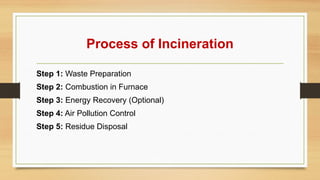
Process of Incineration
Step 1: Waste Preparation
Step 2: Combustion in Furnace
Step 3: Energy Recovery (Optional)
Step 4: Air Pollution Control
Step 5: Residue Disposal
Process of Incineration
Step 1: Waste Preparation
• Wastes may be shredded, blended, or pre-treated for uniform
feeding.
• Liquids, sludges, solids, and gases can all be incinerated.
Process of Incineration
Step 2: Combustion in Furnace
• High-temperature chambers ensure complete oxidation.
• Temperatures: 1,000–1,600 °C (sometimes higher in plasma incinerators).
• Three essential conditions (the 3 T’s of combustion):
• Temperature – sufficient heat to break down hazardous compounds.
• Time – adequate residence time (2 seconds or more) for complete combustion.
• Turbulence – thorough mixing of waste with oxygen for full oxidation.
Process of Incineration
Step 3: Energy Recovery (Optional)
• Heat generated is captured in boilers to produce steam or electricity.
Step 4: Air Pollution Control
• Flue gases pass through scrubbers, filters, and electrostatic
precipitators.
• Removes particulates, heavy metals, acid gases, and dioxins
before release.
Process of Incineration
Step 5: Residue Disposal
• Bottom Ash / Slag → collected at the base of the furnace.
• Fly Ash & Filter Residues → captured in pollution control devices.
• Residues are toxic and must be disposed of in secured landfills.
Types of Incinerators
• Rotary Kiln Incinerators → widely used; cylindrical rotating chamber;
handles solids, liquids, sludges.
• Fluidized Bed Incinerators → for uniform combustion of mixed wastes.
• Liquid Injection Incinerators → sprays liquid hazardous wastes directly
into high-temp chamber.
• Multiple Hearth Incinerators → for sludge and semi-solid wastes.
• Plasma Arc Incinerators → uses plasma torch (up to 10,000 °C) for
complete destruction.
Advantages
• Effective for toxic organic waste destruction.
• Large reduction in waste volume.
• Can handle diverse waste forms (solid, liquid, sludge).
• Energy recovery possible (waste-to-energy).
Limitations
• Very high capital and operating costs.
• Generates toxic residues and fly ash (need secure disposal).
• Requires advanced pollution control to prevent release of
dioxins, furans, heavy metals.
• Public opposition due to fear of air pollution.
Environmental Concerns
• Incomplete combustion may release toxic gases.
• Dioxins and furans are highly carcinogenic if not controlled.
• Ash and residues still classified as hazardous waste.
Monitoring
Monitoring
• Monitoring is the continuous observation, measurement, and
assessment of environmental parameters to ensure that
hazardous waste treatment, storage, and disposal facilities
(TSDFs) do not cause harm to public health and the environment.
Objectives
• To ensure compliance with environmental standards and legal rules.
• To detect leaks, spills, or emissions early.
• To evaluate the effectiveness of liners, leachate collection, and
pollution control devices.
• To prevent contamination of air, water, and soil.
• To maintain long-term safety of secured landfills and incinerators
(even after closure).
Monitoring Parameters
A) Groundwater Monitoring
B) Surface Water Monitoring
C) Leachate Monitoring
D) Air Quality Monitoring
E) Soil Monitoring
F) Gas Monitoring in Landfills
G) Incinerator Emission Monitoring
A) Groundwater Monitoring
• Install monitoring wells (upgradient & downgradient).
• Regular sampling for:
• pH, EC, TDS
• Heavy metals (Pb, Cd, Hg, As, Cr)
• Cyanides, pesticides, volatile organics
• Detects leachate migration from landfills.
B) Surface Water Monitoring
• Samples from nearby rivers, lakes, or drainage streams.
• Monitored for COD, BOD, heavy metals, phenols, toxic
organics.
• Prevents downstream contamination.
C) Leachate Monitoring
• Collected from leachate collection pipes.
• Checked for pH, chlorides, ammonia, organic pollutants, heavy
metals.
• Evaluates liner & treatment system performance.
D) Air Quality Monitoring
• Around incinerators and landfill gas vents.
• Measured for:
• SO , NOx, CO, CO , particulate matter
₂ ₂
• Toxic organics (dioxins, furans, VOCs)
• Methane (CH ) & hydrogen sulphide (H S) from landfills.
₄ ₂
E) Soil Monitoring
• Soil samples near landfill boundaries.
• Tested for heavy metals, hydrocarbons, persistent chemicals.
• Detects long-term contamination.
F) Gas Monitoring in Landfills
• Methane, CO , and trace organics
₂ monitored through gas vents.
• Prevents explosions, fires, and greenhouse gas release.
G) Incinerator Emission Monitoring
• Continuous Emission Monitoring Systems (CEMS).
• Monitored for:
• Stack gas temperature & residence time
• Oxygen levels (ensures complete combustion)
• Particulate matter
• Dioxins, furans, HCl, HF, heavy metals (Hg, Pb, Cd)
Monitoring Frequency
• Groundwater: Quarterly or bi-annually.
• Air emissions: Continuous (CEMS) or weekly sampling.
• Leachate: Monthly.
• Soil & surface water: Half-yearly to yearly.
• Post-closure landfills: 30–50 years of monitoring.
Monitoring Systems Used
• Sampling Wells – for groundwater.
• Gas Probes – for landfill gases.
• Leachate Collection Tanks – for testing wastewater.
• CEMS (Continuous Emission Monitoring Systems) – for stack
emissions.
• Remote Sensors & Drones – for large landfill surveillance.
Benefits of Monitoring
• Prevents undetected contamination.
• Ensures public health safety.
• Provides data for environmental audits.
• Builds community trust through transparency.
• Helps in corrective actions (e.g., liner repair, leachate treatment).
Biomedical Waste Disposal
Introduction
• Biomedical waste (BMW) = any waste generated during diagnosis,
treatment, immunization, research, or production/testing of biologicals.
• It forms 10–25% of hospital waste (the rest is general waste).
• If not handled properly → causes infection (HIV, HBV, HCV),
chemical poisoning, environmental pollution.
• 👉 Governed in India by the Biomedical Waste Management Rules,
2016 (amended in 2018 & 2019).
Objectives
• Minimize health hazards for patients, healthcare staff, waste handlers,
and the community.
• Prevent environmental contamination (air, water, soil).
• Ensure segregation, safe collection, transport, treatment, and final
disposal.
• Promote recycling of non-infectious treated waste (plastics, metals,
glass).
• Ensure compliance with law.
Segregation & Colour Coding (Core
Step)
Segregation is done at the point of generation (OTs, wards, labs) using color-coded containers/bags.
• Yellow Bag – Incineration/Deep Burial
• Waste types:
• Human/animal anatomical waste.
• Soiled waste (dressings, cotton swabs, bedding with blood/body fluids).
• Expired/discarded medicines, chemical waste.
• Lab cultures & microbiological waste.
• Treatment & Disposal:
• Incineration (800–1200 °C) or Plasma Pyrolysis.
• Deep burial in rural/remote areas.
Segregation & Colour Coding (Core
Step)
• Red Bag – Autoclaving & Recycling
• Waste types:
• Contaminated plastics (IV tubes, catheters, gloves, syringes without
needles).
• Treatment & Disposal:
• Autoclaving / Microwaving / Hydroclaving → sterilization.
• Shredding → plastic sent for recycling.
Segregation & Colour Coding (Core
Step)
• White/Translucent (Puncture-Proof Container) – Sharps
• Waste types:
• Needles, syringes with fixed needles, scalpels, blades.
• Treatment & Disposal:
• Collected in puncture-proof, tamper-proof containers.
• Autoclaving/dry heat sterilization/encapsulation.
• Final disposal in secured landfill or metal recycling.
Segregation & Colour Coding (Core
Step)
• Blue Box – Glassware & Metallic Waste
• Waste types:
• Glass bottles, vials, ampoules, metallic implants.
• Treatment & Disposal:
• Disinfection/autoclaving.
• Sent for recycling.
Treatment & Disposal Methods
(Detailed)
1) Incineration
• High-temperature (800–1200 °C) combustion.
• Destroys pathogens, organics, pharmaceuticals.
• Disadvantages: produces dioxins, furans → requires advanced air
pollution control.
Treatment & Disposal Methods
(Detailed)
2) Autoclaving
• Uses pressurized steam at 121–134 °C for 30–60 min.
• Kills all microorganisms (spores, bacteria, viruses).
• Treated waste → shredded & recycled.
Treatment & Disposal Methods
(Detailed)
3) Microwaving
• Uses microwave radiation (2450 MHz, 12.24 cm) to heat waste with
moisture.
• Pathogen destruction achieved by heat, not radiation.
• Used for plastics & glassware disinfection.
Treatment & Disposal Methods
(Detailed)
4) Hydroclaving
• Steam sterilization with internal mixing → better contact & heat
distribution.
• Mainly used for plastic & solid infectious waste.
Treatment & Disposal Methods
(Detailed)
5) Chemical Disinfection
• Use of 1–2% sodium hypochlorite, phenols, or other
disinfectants.
• Used for liquid biomedical waste (urine, blood, body fluids, lab
waste).
• Treated liquids discharged into sewage system.
Treatment & Disposal Methods
(Detailed)
6) Shredding
• Applied after autoclaving/microwaving.
• Converts plastic waste into unrecognizable pieces → prevents
reuse.
• Sent for plastic recycling industry.
Treatment & Disposal Methods
(Detailed)
7) Deep Burial
• Only in rural/remote areas (as per CPCB guidelines).
• Anatomical/soiled waste buried in 2 m deep pits, covered with lime
and soil.
• Not allowed in cities/towns with population >5 lakhs.
Treatment & Disposal Methods
(Detailed)
8) Encapsulation
• Sharps & heavy metals are sealed inside cement, plastic, or metal
drums.
• Prevents leaching.
• Final disposal in secured landfill.
Collection, Storage & Transportation
• Waste collected daily from hospital wards/labs.
• Barcoding & GPS tracking mandatory (to prevent pilferage/illegal
reuse).
• Transported in covered vehicles to Common Biomedical Waste
Treatment Facilities (CBMWTFs).
Safety Measures
• Personal Protective Equipment (PPE): gloves, masks, gowns,
goggles.
• Vaccination of workers: Hepatitis B, Tetanus.
• Training & awareness: segregation rules, emergency handling.
Monitoring & Regulation
• State Pollution Control Boards (SPCBs) monitor compliance.
• Annual reports & audits required from hospitals.
• CBMWTFs (one facility can serve multiple hospitals) handle
treatment & disposal.
Advantages of Proper BMW Disposal
• Prevents disease transmission (HIV, HBV, TB).
• Protects environment (air, water, soil).
• Enables recycling of disinfected materials.
• Promotes public health & hospital hygiene.
E-Waste Management
Introduction
• E-waste (electronic waste) = discarded electrical and electronic equipment (EEE) that
has reached end-of-life or become obsolete.
• Includes: computers, mobile phones, TVs, refrigerators, printers, washing machines,
lighting equipment, and medical electronics.
• Global context: ~54 million tonnes of e-waste generated annually (UN report), growing
at 3–5% per year.
• India: Generates ~3.2 million tonnes annually (CPCB, 2022–23), ranks 5th in the world.
• ⚠️ Major concern: contains valuable resources (precious metals) but also toxic
heavy metals and chemicals.
Sources of E-Waste
• Households – old TVs, mobiles, computers, kitchen appliances.
• IT & Telecom sector – servers, desktops, networking equipment.
• Industrial Sector – control panels, machinery parts, instruments.
• Government & Défense – obsolete computers, radios, radar,
electronics.
• Commercial establishments – offices, retail stores, banks, hospitals.
• Producers & Retailers – returned or defective stock, unsold items.
Composition of E-Waste
• E-waste is a complex mixture of materials:
• Metals (40–60%)
• Precious metals → gold, silver, palladium, platinum.
• Base metals → copper, aluminium, iron.
• Hazardous metals → lead, mercury, cadmium, chromium.
• Plastics (15–30%)
• Used in casings, wiring, insulation.
• Glass (5–10%)
• CRTs, screens, bulbs.
Composition of E-Waste
• Hazardous substances (2–5%)
• PCBs (polychlorinated biphenyls).
• Brominated flame retardants (BFRs).
• Arsenic, beryllium, lithium, chlorofluorocarbons (CFCs).
Hazards of Improper E-Waste Disposal
• Health hazards:
• Lead → brain & kidney damage.
• Mercury → nervous system toxicity.
• Cadmium → lung damage, cancer risk.
• BFRs → endocrine disruption, thyroid disorders.
Hazards of Improper E-Waste Disposal
• Environmental hazards:
• Soil → heavy metal contamination.
• Water → acid leaching from informal recycling pollutes groundwater.
• Air → open burning releases dioxins, furans, heavy metals.
• Social hazards:
• Informal recycling workers (including children) exposed to toxics.
E-Waste Management Process
• Step 1: Collection & Storage
• Step 2: Transportation
• Step 3: Dismantling
• Step 4: Recycling / Material Recovery
• Step 5: Treatment of Hazardous Fractions
• Step 6: Refurbishing & Reuse
Step 1: Collection & Storage
• E-waste collected at:
• Producer take-back schemes.
• Collection centres.
• Retailer drop-box systems.
• Bulk consumers (institutions, offices).
Step 2: Transportation
• Transported in sealed, labelled vehicles to prevent
spillage/leakage.
Step 3: Dismantling
• Manual dismantling of devices → separation into parts:
• PCBs, wires, plastics, metals, screens.
• Reusable components extracted.
Step 4: Recycling / Material Recovery
• Mechanical processes:
• Shredding, crushing, magnetic separation.
• Recovery of iron, copper, aluminium.
• Hydrometallurgical processes:
• Acid leaching, solvent extraction, electrolysis.
• Recovers precious metals (Au, Ag, Pd).
• Pyrometallurgical processes:
• High-temperature smelting.
• Extracts metals from complex waste.
Step 5: Treatment of Hazardous
Fractions
• CRT glass, mercury lamps, arsenic residues, plastics with BFRs →
sent to secured landfills or hazardous waste treatment plants.
Step 6: Refurbishing & Reuse
• Repairing/refurbishing electronics for second-hand use.
• Extends product life and reduces waste.
Rules & Regulations (India)
E-Waste Management Rules, 2016 (amendments: 2018, 2022).
• Extended Producer Responsibility (EPR): Producers responsible for collection & recycling.
• Collection targets: Mandatory collection & recycling percentages for producers.
• Authorization: Recyclers/dismantlers must be registered with State Pollution Control Boards
(SPCBs).
• Bulk consumers: (offices, govt. institutions, hospitals) must return e-waste to authorized
recyclers.
• Ban on informal recycling using unsafe methods (acid leaching, open burning).
• Digital tracking: Use of barcoding & digital records.
Technologies Used in E-Waste
Management
• Mechanical recycling – shredding, crushing, sorting.
• Pyrolysis – heating plastics without oxygen → oil, gas, char.
• Bio metallurgy – microbes (bacteria, fungi) used for metal
recovery.
• Cryogenic processes – freezing electronics before dismantling.
Advantages of Proper E-Waste
Management
• Recovery of precious & rare metals → reduces mining.
• Reduces landfill space requirement.
• Prevents toxic exposure to workers.
• Energy savings (recycling aluminium saves 95% energy vs. virgin
production).
• Promotes circular economy.
Challenges
• Low public awareness → people discard e-waste with household
garbage.
• Dominance of informal sector → 90% of e-waste in India
processed by unsafe methods.
• High cost of formal recycling plants.
• Lack of enforcement of EPR obligations.
• Rapid technology changes → more e-waste generated faster.
Best Practices & Solutions
• Reduce: Extend product lifespan, avoid unnecessary upgrades.
• Reuse: Donate/sell electronics.
• Recycle: Through authorized recyclers only.
• Public awareness campaigns.
• Integration of informal sector into formal recycling (training, safety
equipment).
• Stronger government enforcement of EPR and recycling targets.
Nuclear Wastes
Introduction
• Nuclear waste (radioactive waste) is any material that contains radionuclides at
concentrations above regulatory limits and for which no further use is foreseen.
• Generated from:
• Nuclear power plants (energy production).
• Nuclear weapons programs.
• Medical & industrial use of radioisotopes.
• Research and laboratories.
• Radioactive waste is unique because it remains hazardous for thousands of
years, requiring safe, long-term isolation from humans and the environment.
Sources of Nuclear Waste
• Nuclear Fuel Cycle Waste
• Medical Waste
• Industrial Waste
• Défense Waste
• Research & Educational Institutes
Nuclear Fuel Cycle Waste
• Uranium mining & milling → radioactive tailings.
• Fuel fabrication → contaminated scrap.
• Reactor operations → spent nuclear fuel, reactor coolant
residues.
• Reprocessing → high-level liquid waste, plutonium residues.
Medical Waste
• Radioisotopes for diagnostics (e.g., Technetium-99m).
• Cancer therapy (e.g., Cobalt-60, Iodine-131).
Industrial Waste
• Radiography, tracers, sterilization equipment.
Défense Waste
• Plutonium production, weapons testing.
Research & Educational Institutes
• Laboratories using small radioactive sources.
Classification of Nuclear Waste
By Radioactivity & Half-life
• Low-Level Waste (LLW)
• Intermediate-Level Waste (ILW)
• High-Level Waste (HLW)
• Transuranic Waste (TRU)
Low-Level Waste (LLW)
• Items like clothing, paper, filters, tools.
• Contains small amounts of radioactivity, often short-lived
isotopes.
• Managed by compacting, incinerating, and shallow land burial.
Intermediate-Level Waste (ILW)
• Reactor resins, chemical sludge, reactor components.
• Requires shielding but not significant heat management.
• Disposed in engineered facilities or concrete vaults.
High-Level Waste (HLW)
• Spent nuclear fuel, waste from fuel reprocessing.
• Highly radioactive and heat-generating.
• Needs cooling and deep geological disposal.
Transuranic Waste (TRU)
• Contains elements heavier than uranium (e.g., plutonium,
americium).
• Long half-lives, mainly from defence programs.
• Requires deep underground isolation.
Characteristics of Nuclear Waste
• Radioactivity: Intensity of radiation (alpha, beta, gamma, neutron
emissions).
• Half-life: Time taken for radioactivity to reduce by half (ranges from
seconds to thousands of years).
• Heat generation: HLW generates large amounts of heat.
• Toxicity: Even small quantities can cause severe biological
damage.
Environmental & Health Effects
• Health Effects
• Environmental Effects
Health Effects
• Acute radiation sickness (nausea, burns, death at high
exposure).
• Long-term cancers (leukaemia, thyroid, lung, bone).
• Genetic mutations, birth defects.
• Damage to kidneys, liver, lungs from heavy isotopes.
Environmental Effects
• Soil contamination: radionuclides accumulate in soil.
• Water pollution: Strontium-90 and Cesium-137 leach into
groundwater.
• Air pollution: Release of iodine, radon, and krypton gases.
• Bioaccumulation: radionuclides enter plants, animals, and
human food chains.
Nuclear Waste Management Methods
A. Treatment & Conditioning
B. Storage (Short- to Medium-Term)
C. Disposal (Long-Term)
A. Treatment & Conditioning
• Volume reduction → compacting LLW.
• Incineration → reduces combustible waste.
• Solidification → mixing liquid waste with cement, asphalt, or
bitumen.
• Vitrification → converting HLW into glass logs for long-term stability.
• Encapsulation → sealing waste in stainless steel or concrete
containers.
B. Storage (Short- to Medium-Term)
• Spent Fuel Pools
• Underwater storage for 5–10 years after removal from reactors.
• Water acts as both a coolant and radiation shield.
• Dry Cask Storage
• After cooling, spent fuel is stored in steel/concrete casks above ground.
• Provides passive safety for decades.
C. Disposal (Long-Term)
• Deep Geological Repositories (DGR):
• Most widely accepted solution.
• Radioactive waste placed in sealed canisters 300–1000 m deep in stable rock formations (granite, clay, salt
beds).
• Example: Onkalo repository (Finland).
• Shallow Land Burial (for LLW):
• Engineered trenches with protective liners.
• Other Proposed Methods:
• Sub-seabed disposal (burying in ocean floor sediments).
• Ice-sheet disposal (Antarctica – banned by international law).
• Space disposal (launching waste into outer space – too costly/risky).
Nuclear Waste Management in India
• Follows Closed Fuel Cycle:
• Reprocessing spent fuel to recover uranium and plutonium.
• Vitrification of HLW into glass blocks.
• Managed by Bhabha Atomic Research Centre (BARC) and
Nuclear Power Corporation of India Limited (NPCIL).
• Storage facilities: Trombay, Tarapur, Kalpakkam.
• Long-term plan: Establish Deep Geological Repositories.
International Practices
• USA: WIPP (Waste Isolation Pilot Plant) in New Mexico for TRU
waste.
• Finland: Onkalo repository – world’s first DGR (expected
operational ~2025).
• France & Japan: Reprocess spent fuel → recycle uranium &
plutonium.
• Russia: Uses centralized storage & reprocessing.
Challenges in Nuclear Waste
Management
• Extremely long-lived isotopes (e.g., Plutonium-239 ~ 24,100 years).
• High costs of waste storage and disposal.
• Technical risks → leaks, accidents, terrorism.
• Public opposition (NIMBY effect).
• Lack of permanent disposal facilities in most countries.
Safety & Monitoring
• Radiation monitoring around storage/disposal sites.
• Groundwater testing for leachate contamination.
• Airborne monitoring for radon and radioactive gases.
• International oversight: IAEA (International Atomic Energy
Agency) sets global safety standards.
Industrial Waste Management
Introduction
• Industrial Waste Management refers to the collection, treatment,
and disposal of waste generated by industrial processes.
Proper management reduces environmental pollution, health risks,
and economic losses.
• Industries produce various types of wastes, including solid, liquid,
gaseous, and hazardous wastes, depending on the raw materials
and manufacturing processes.
Objectives
• Minimize waste generation
• Recover valuable resources
• Treat waste to reduce environmental impact
• Ensure compliance with environmental laws
Sources of Industrial Waste
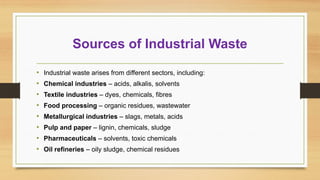
• Industrial waste arises from different sectors, including:
• Chemical industries – acids, alkalis, solvents
• Textile industries – dyes, chemicals, fibres
• Food processing – organic residues, wastewater
• Metallurgical industries – slags, metals, acids
• Pulp and paper – lignin, chemicals, sludge
• Pharmaceuticals – solvents, toxic chemicals
• Oil refineries – oily sludge, chemical residues
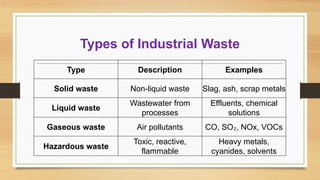
Types of Industrial Waste
Type Description Examples
Solid waste Non-liquid waste Slag, ash, scrap metals
Liquid waste
Wastewater from
processes
Effluents, chemical
solutions
Gaseous waste Air pollutants CO, SO , NOx, VOCs
₂
Hazardous waste
Toxic, reactive,
flammable
Heavy metals,
cyanides, solvents
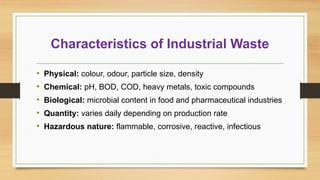
Characteristics of Industrial Waste
• Physical: colour, odour, particle size, density
• Chemical: pH, BOD, COD, heavy metals, toxic compounds
• Biological: microbial content in food and pharmaceutical industries
• Quantity: varies daily depending on production rate
• Hazardous nature: flammable, corrosive, reactive, infectious
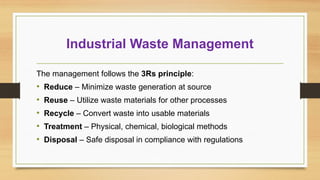
Industrial Waste Management
The management follows the 3Rs principle:
• Reduce – Minimize waste generation at source
• Reuse – Utilize waste materials for other processes
• Recycle – Convert waste into usable materials
• Treatment – Physical, chemical, biological methods
• Disposal – Safe disposal in compliance with regulations
Methods of Industrial Waste Treatment
• Solid Waste Treatment
• Liquid Waste Treatment (Effluents)
• Gaseous Waste Treatment
• Hazardous Waste Treatment
Solid Waste Treatment
• Segregation: Separate reusable, recyclable, and hazardous waste
• Compaction: Reduce volume of waste
• Incineration: Burn organic waste to reduce volume
• Landfill: Secure disposal of non-recyclable waste
Liquid Waste Treatment (Effluents)
• Primary Treatment: Sedimentation, screening
• Secondary Treatment: Biological treatment (activated sludge,
oxidation ponds)
• Tertiary Treatment: Advanced methods (chemical coagulation,
membrane filtration)
• Neutralization: Adjusting pH of acidic/alkaline wastes
Gaseous Waste Treatment
• Scrubbers: Remove particulate matter and gases
• Electrostatic precipitators: Capture fine particles
• Cyclone separators: Separate heavy particulates
• Adsorption: Activated carbon for VOCs
Hazardous Waste Treatment
• Chemical neutralization
• Encapsulation
• Secure landfilling
• Incineration under controlled conditions
• Recovery and recycling of metals or solvents
Industrial Waste Management Plan
(IWMP)
Key steps in managing industrial waste:
• Waste audit – Identify and quantify waste types
• Segregation at source – Separate hazardous from non-hazardous
• Collection & storage – Safe handling and storage
• Treatment & recovery – Physical, chemical, or biological processes
• Disposal – Landfills, deep-well injection, or secure incineration
• Monitoring & reporting – Ensure compliance with environmental laws
Stages in Industrial Waste
Management
• Generation – Waste from manufacturing, processing, power plants, chemical industries.
• Classification – Hazardous vs Non-hazardous.
• Segregation – At source to separate recyclable, reusable, and hazardous fractions.
• Minimization – Cleaner technologies, raw material substitution, process control.
• Storage & Handling – Safe containers, labeling, compatibility.
• Transport – To treatment or disposal facilities with manifest system.
• Treatment – Physical, chemical, thermal, and biological processes.
• Energy/Material Recovery – Waste-to-energy, recovery of solvents, metals, etc.
• Final Disposal – Secure landfill or stabilized inert residue.
Regulatory Framework
• India: Hazardous and Other Wastes (Management &
Transboundary Movement) Rules, 2016
• International: Basel Convention (control of transboundary
hazardous waste movements)
• Standards: ISO 14001 (Environmental Management Systems)
Benefits of Proper Industrial Waste
Management
• Reduced environmental pollution
• Conservation of resources
• Compliance with legal standards
• Enhanced public health
• Potential economic gains through recycling and recovery
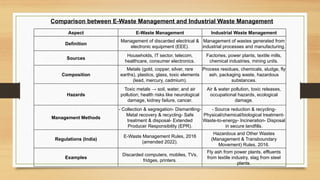
Comparison between E-Waste Management and Industrial Waste Management
Aspect E-Waste Management Industrial Waste Management
Definition
Management of discarded electrical &
electronic equipment (EEE).
Management of wastes generated from
industrial processes and manufacturing.
Sources
Households, IT sector, telecom,
healthcare, consumer electronics.
Factories, power plants, textile mills,
chemical industries, mining units.
Composition
Metals (gold, copper, silver, rare
earths), plastics, glass, toxic elements
(lead, mercury, cadmium).
Process residues, chemicals, sludge, fly
ash, packaging waste, hazardous
substances.
Hazards
Toxic metals → soil, water, and air
pollution; health risks like neurological
damage, kidney failure, cancer.
Air & water pollution, toxic releases,
occupational hazards, ecological
damage.
Management Methods
- Collection & segregation- Dismantling-
Metal recovery & recycling- Safe
treatment & disposal- Extended
Producer Responsibility (EPR).
- Source reduction & recycling-
Physical/chemical/biological treatment-
Waste-to-energy- Incineration- Disposal
in secure landfills.
Regulations (India)
E-Waste Management Rules, 2016
(amended 2022).
Hazardous and Other Wastes
(Management & Transboundary
Movement) Rules, 2016.
Examples
Discarded computers, mobiles, TVs,
fridges, printers.
Fly ash from power plants, effluents
from textile industry, slag from steel
plants.
THANK YOU

SWM UNIT-V PPT (1).pptxnhbbjkkmnbbbbvvvvv

  • 1.
  • 2.
    Syllabus • Hazardous wasteManagement: Sources and characteristics, Effects on environment, Risk assessment – Disposal of hazardous wastes – Secured landfills, incineration - Monitoring – Biomedical waste disposal, E-waste management, Nuclear Wastes, Industrial waste Management.
  • 3.
  • 4.
    Introduction • Hazardous wasteoriginates from industrial, commercial, agricultural, healthcare, and domestic activities. • Each source contributes a different type of hazardous material.
  • 5.
    A) Industrial Sources •Industries are the largest generators of hazardous waste. • Chemical & Petrochemical Industries • Acids, alkalis, solvents, tars, sludge, oil residues. • Byproducts like benzene, toluene, xylene. • Pharmaceutical & Pesticide Industries • Outdated/expired drugs, toxic intermediates, pesticide sludge. • Paints, Dyes & Textile Industries • Heavy metals (chromium, cadmium, lead), pigments, toxic dyes.
  • 6.
    • Mining &Metallurgical Industries • Tailings, cyanide solutions, arsenic, mercury, red mud from aluminium industries. • Electroplating & Metal Finishing • Nickel, cadmium, chromium, zinc sludge and solutions. A) Industrial Sources
  • 7.
    B) Agricultural Sources •Chemical Pesticides, Herbicides, Fungicides • DDT, aldrin, endosulfan, atrazine. • Fertilizer Residues • Contain nitrates, phosphates, heavy metals. • Animal Farming • Veterinary chemicals, disinfectants, antibiotics.
  • 8.
    C) Healthcare &Biomedical Sources • Hospitals, Clinics, Labs generate: • Infectious waste: dressings, bandages, sharps. • Chemical waste: formalin, disinfectants. • Radioactive waste: isotopes used in cancer treatment. • Pharmaceutical waste: expired or discarded medicines.
  • 9.
    D) Household Sources •Cleaning & Maintenance Products • Bleach, disinfectants, drain cleaners (corrosive). • Paints, Varnishes, Adhesives • Contain solvents, lead, mercury. • Batteries & Electronics (E-waste) • Lead, cadmium, mercury, lithium, plastics with flame retardants. • Pesticides and Insecticides kept in homes.
  • 10.
    E) Commercial &Institutional Sources • Dry Cleaning Units → perchloroethylene (toxic solvent). • Automobile Workshops → lubricants, used oils, antifreeze, solvents. • Research & Educational Laboratories → toxic reagents, acids, solvents.
  • 11.
  • 12.
    Introduction • Hazardous wasteis classified as per its intrinsic properties which make it dangerous to human health and the environment.
  • 13.
    A) Ignitability • Property:Easily catches fire at low temperature. • Criterion: Flash point < 60 °C. • Examples: Gasoline, alcohols, solvents, waste oils. • Hazard: Causes fire hazards in storage and transportation.
  • 14.
    B) Corrosivity • Property:Destroys materials (especially metals), skin, and tissues. • Criterion: Liquids with pH ≤ 2 or ≥ 12.5. • Examples: Sulfuric acid, hydrochloric acid, sodium hydroxide. • Hazard: Container damage, leakage, and severe burns.
  • 15.
    C) Reactivity • Property:Chemically unstable, explosive, reacts violently with water or air. • Examples: Ammonium nitrate (explosive), peroxides, cyanides, sulphide-bearing wastes. • Hazard: Fire, toxic gas release (H S, HCN), explosions. ₂
  • 16.
    D) Toxicity • Property:Harmful if inhaled, swallowed, or absorbed. • Examples: • Heavy metals: lead, mercury, cadmium, arsenic. • Organic compounds: pesticides (DDT, aldrin), solvents. • Hazard: • Acute: nausea, organ damage. • Chronic: cancer, birth defects, genetic mutations.
  • 17.
    E) Persistence andBioaccumulation • Some hazardous wastes are non- biodegradable. • They accumulate in soil, water, and living organisms. • Examples: • DDT (pesticide). • PCBs (Polychlorinated biphenyls). • Dioxins (from combustion processes). • Hazard: Long-term ecological damage, poisoning of food chain.
  • 18.
    F) Infectious /Radioactive Nature (Special Characteristics) • Some wastes may be infectious (medical waste) or radioactive (isotopes, nuclear waste). • Hazard: Spread of disease, radiation poisoning, genetic damage.
  • 19.
    Sources vs. Characteristics SourcesExamples of Waste Hazardous Characteristics Industries Acids, solvents, metals, sludge, tars Ignitable, corrosive, toxic, reactive Agriculture Pesticides, fertilizers Toxic, persistent, bio accumulative Healthcare Infectious waste, drugs, isotopes Infectious, toxic, radioactive Households Batteries, e-waste, paints, cleaners Toxic, corrosive, ignitable Commercial Solvents, oils, lab chemicals Reactive, toxic, corrosive
  • 20.
  • 21.
    Introduction • Hazardous wastecontains substances that are toxic, corrosive, reactive, ignitable, infectious, or radioactive, making it extremely harmful to natural ecosystems and human life. • Its effects can be divided based on environmental components: air, water, soil, biota, and global systems.
  • 22.
    1. Effects onAir • Hazardous waste releases pollutants into the atmosphere through open burning, incineration, evaporation, and accidental fires. • Toxic Gas Emissions • Chlorinated hydrocarbons release dioxins and furans during burning → potent carcinogens. • VOCs (Volatile Organic Compounds) like benzene, toluene contribute to smog formation.
  • 23.
    1. Effects onAir • Acidic Gases • SO , NO , HCl from incinerators cause ₂ ₓ acid rain, damaging crops and structures. • Particulate Matter • Fly ash and heavy metal particles → respiratory illness (bronchitis, asthma, lung cancer). • Greenhouse Gases • Methane from hazardous waste landfills, CO from incineration ₂ → contribute to global warming. • Odor Pollution • Hydrogen sulphide (H S), ammonia, and organic vapours ₂ degrade air quality. • 📌 Case Example: Bhopal Gas Tragedy (1984) – methyl isocyanate leak caused thousands of deaths due to toxic air exposure.
  • 24.
    2. Effects onWater Hazardous wastes contaminate both surface and groundwater through leachate, spills, and direct dumping. • Surface Water Contamination • Runoff from hazardous waste sites carries pesticides, solvents, and metals into rivers and lakes. • Nutrient-rich wastes cause eutrophication → algal blooms, oxygen depletion, fish kills. • Groundwater Pollution • Leachate (toxic liquid from landfills) percolates into aquifers, contaminating drinking water. • Examples: arsenic, cadmium, chromium, and organic solvents.
  • 25.
    2. Effects onWater • Marine Pollution • Dumping hazardous chemicals/oil spills → destruction of marine habitats, coral bleaching. • Accumulation of mercury in fish → causes Minamata disease in humans. • 📌 Case Example: Love Canal, USA – hazardous waste buried underground leached into water supply → birth defects and cancer in the local population.
  • 26.
    3. Effects onSoil Soil acts as a sink for hazardous waste, but contamination can render land unproductive and toxic. • Soil Contamination • Heavy metals (lead, mercury, arsenic, cadmium) accumulate in the soil. • Loss of Fertility • Strong acids, alkalis, and salts kill beneficial microorganisms → reduced soil productivity.
  • 27.
    3. Effects onSoil • Persistence of Pollutants • POPs (Persistent Organic Pollutants like PCBs, DDT) remain in soil for decades without degradation. • Leaching and Mobility • Contaminants can migrate into deeper soil layers and groundwater. • 📌 Impact: Agricultural lands near industrial zones often show reduced fertility and contamination of food crops.
  • 28.
    4. Effects onFlora & Fauna (Ecosystems) Hazardous wastes disrupt ecological balance by harming plants, animals, and overall biodiversity. • Flora (Plants) • Toxic chemicals interfere with photosynthesis, respiration, and nutrient uptake. • High soil contamination leads to reduced crop yields. • Fauna (Animals & Aquatic Life) • Bioaccumulation of toxins → mercury in fish, DDT in birds (eggshell thinning). • Reproductive failures, genetic mutations, and deaths in wildlife.
  • 29.
    4. Effects onFlora & Fauna (Ecosystems) • Biodiversity Loss • Sensitive species disappear from contaminated ecosystems. • Food Chain Contamination • Pollutants enter the food web and bio magnify at higher trophic levels. • 📌 Example: Mercury poisoning in fish → affects humans and animals consuming fish (Minamata Bay, Japan).
  • 30.
    5. Effects onHuman Health (Indirect Environmental Impact) Human beings are ultimately exposed through air, water, food, and direct contact. • Acute Effects • Nausea, headaches, burns, respiratory irritation, poisoning. • Chronic Effects • Cancers, liver and kidney damage, neurological disorders, reproductive problems. • Occupational Hazards • Workers in chemical industries and landfills face higher risks of exposure. • Radioactive Waste Effects • Ionizing radiation causes DNA damage, genetic mutations, leukemia, birth defects.
  • 31.
    6. Global EnvironmentalIssues Hazardous waste does not remain confined locally – it contributes to worldwide problems. • Ozone Layer Depletion • Halogenated hydrocarbons (CFCs, HCFCs) damage ozone, increasing UV radiation exposure. • Climate Change • Methane (21x more potent than CO ) from hazardous ₂ waste dumps → accelerates global warming. • Long-range Transport of Pollutants • Persistent chemicals (PCBs, DDT, dioxins) travel across continents via air and water currents, contaminating remote regions like the Arctic.
  • 32.
  • 33.
    Risk Assessment • Riskassessment is a systematic process to evaluate the potential adverse effects of hazardous waste on human health and the environment. • It helps in decision-making, policy framing, and designing safe waste management practices.
  • 34.
    Introduction • Hazardous wastescontain toxic, reactive, corrosive, flammable, or infectious substances. • Risk arises when humans or ecosystems are exposed to these wastes through air, water, soil, or food chain. • Risk assessment quantifies the likelihood of harm and identifies exposure pathways.
  • 35.
    Objectives of RiskAssessment • To identify potential hazards associated with hazardous waste. • To estimate the extent of exposure for humans and environment. • To evaluate short-term and long-term impacts. • To provide a scientific basis for regulations, standards, and mitigation strategies. • To prioritize waste management actions (e.g., treatment, containment, remediation).
  • 36.
    Steps in RiskAssessment A) Hazard Identification B) Exposure Assessment C) Dose–Response Assessment D) Risk Characterization
  • 37.
    A) Hazard Identification •Determining which wastes or chemicals pose hazards. • Uses toxicological and epidemiological data. • Examples: arsenic (carcinogenic), mercury (neurotoxic), cyanide (acutely toxic).
  • 38.
    B) Exposure Assessment •Evaluates how much of a hazardous substance people or ecosystems are exposed to. • Exposure Pathways: • Air → inhalation of toxic gases, particulates. • Water → ingestion of contaminated drinking water. • Soil → dermal contact, ingestion (children playing in contaminated soil). • Food Chain → bioaccumulation (fish, crops). • Considers duration, frequency, and population at risk (workers, residents, children).
  • 39.
    C) Dose–Response Assessment •Establishes relationship between exposure level and health effect. • Example: • Low dose of lead → developmental delays in children. • High dose → kidney and neurological damage. • Defines thresholds such as: • NOAEL (No Observed Adverse Effect Level) • LOAEL (Lowest Observed Adverse Effect Level)
  • 40.
    D) Risk Characterization •Integrates hazard, exposure, and dose–response data. • Provides quantitative estimate of risk (e.g., probability of cancer in a population). • Also describes uncertainties in the assessment.
  • 41.
    Types of Risk •Human Health Risks → cancer, organ damage, reproductive and neurological effects. • Ecological Risks → biodiversity loss, food chain contamination, ecosystem imbalance. • Occupational Risks → exposure of workers in industries, treatment plants, and landfills.
  • 42.
    Tools & MethodsUsed • Environmental Monitoring → air, soil, water sampling. • Modelling Software → predicts dispersion, leaching, bioaccumulation. • Toxicity Tests → laboratory studies on animals and microorganisms. • Regulatory Frameworks → USEPA (United States Environmental Protection Agency), WHO guidelines.
  • 43.
    Importance of RiskAssessment • Protects public health and ecosystems. • Supports policy-making and setting of safe disposal standards. • Helps in land-use planning near landfills and treatment facilities. • Provides basis for remediation and emergency response.
  • 44.
  • 45.
    Introduction • Hazardous wastesrequire specialized treatment and disposal methods due to their toxic, corrosive, flammable, and reactive properties. The aim is to neutralize, reduce toxicity, immobilize contaminants, and prevent environmental pollution.
  • 46.
    Objectives • To minimizerisks to human health and the environment. • To convert hazardous waste into less harmful forms. • To ensure long-term safe containment of persistent substances. • To comply with legal and regulatory standards (e.g., Hazardous Waste Rules, 2016 in India, EPA guidelines in USA).
  • 47.
    Methods A) Physical Methods B)Chemical Methods C) Thermal Methods D) Biological Methods E) Land Disposal Methods
  • 48.
    A) Physical Methods •Used for separation, concentration, or solidification. • Filtration, Sedimentation, Evaporation → separate solids/liquids. • Encapsulation → hazardous waste is enclosed in plastic, metal drums, or concrete blocks. • Stabilization/Solidification → mixing waste with cement, lime, fly ash → immobilizes contaminants and prevents leaching.
  • 49.
    B) Chemical Methods •Used to detoxify or neutralize wastes. • Neutralization → acids with alkalis, alkalis with acids. • Oxidation–Reduction (Redox Reactions) → converts toxic compounds into stable forms. • Example: Cyanides → converted to carbonates. • Precipitation → converts dissolved heavy metals into insoluble compounds for removal. • Chemical Fixation → immobilizes hazardous components within a stable matrix.
  • 50.
    C) Thermal Methods •High temperature destroys organic and toxic components. • Incineration • Controlled burning at 1,000–1,600 °C. • Destroys hazardous organics, reduces volume by up to 90%. • Requires air pollution control devices (scrubbers, filters).
  • 51.
    • Pyrolysis • Thermaldecomposition in absence of oxygen → produces syngas, oil, and char. • Plasma Arc Treatment • Extremely high temperatures (up to 10,000 °C) using plasma torch. • Breaks down even highly toxic compounds into basic elements. C) Thermal Methods
  • 52.
    D) Biological Methods •Use of microorganisms to degrade or detoxify wastes. • Bioremediation → microbes degrade hydrocarbons, pesticides, solvents. • Phytoremediation → plants absorb and stabilize heavy metals (e.g., sunflowers for uranium, vetiver grass for arsenic). • Composting (for biodegradable hazardous fractions).
  • 53.
    E) Land DisposalMethods • Still widely used but must be properly engineered. • Secure Landfills • Designed with liners, leachate collection, gas vents, and monitoring wells. • Suitable for solid hazardous wastes. • Deep Well Injection • Liquid hazardous wastes pumped into deep rock formations isolated from groundwater. • Surface Impoundments (Lagoons, Ponds) • Temporary containment of liquid hazardous wastes; requires lining to prevent seepage.
  • 54.
    Modern Approaches • IntegratedHazardous Waste Management (IHWM) → combination of physical, chemical, biological, and thermal methods. • Co-processing in Cement Kilns → hazardous wastes are used as alternative fuels in cement industries. • Waste-to-Energy Systems → recovery of energy while neutralizing waste.
  • 55.
    Criteria for SelectingDisposal Method • Nature of waste (liquid, solid, gas). • Chemical composition and toxicity. • Volume and concentration. • Cost and feasibility. • Environmental regulations.
  • 56.
  • 57.
    Introduction • A securedlandfill is a scientifically designed and engineered disposal facility meant specifically for the long-term safe containment of hazardous wastes. Unlike ordinary dumps, secured landfills are constructed with multiple protective barriers to prevent leachate leakage, groundwater contamination, and toxic gas emissions.
  • 58.
    Purpose • To isolatehazardous wastes from the environment. • To prevent contamination of soil, surface water, and groundwater. • To provide safe long-term storage for wastes that cannot be treated or destroyed economically.
  • 59.
    Design Features ofSecured Landfills A typical secured landfill consists of the following components: A) Liner System B) Leachate Collection System C) Waste Placement D) Daily & Intermediate Cover E) Gas Collection System F) Final Cover / Cap G) Monitoring Systems
  • 60.
    A) Liner System •Bottom Liners (Multi-layered): • Compacted clay layer (low permeability). • Geomembrane (HDPE plastic sheet). • Geotextile protective layer. • Purpose → prevents leachate from seeping into soil/groundwater.
  • 61.
    B) Leachate CollectionSystem • Network of perforated pipes placed above liners. • Collects leachate (toxic liquid formed by waste-water interactions). • Leachate is pumped out → treated in treatment plants before disposal.
  • 62.
    C) Waste Placement •Hazardous waste is placed in cells. • Each cell is progressively filled and then covered with soil or temporary covers to reduce rainwater infiltration.
  • 63.
    D) Daily &Intermediate Cover • A layer of soil or alternative material placed daily to: • Minimize odour, pests, and windblown waste. • Reduce water infiltration.
  • 64.
    E) Gas CollectionSystem • Hazardous wastes can generate gases (CH , CO , VOCs). ₄ ₂ • Gas vents and collection pipes are installed to capture and treat landfill gases.
  • 65.
    F) Final Cover/ Cap • Multi-layer cap system at closure: • Clay or geomembrane layer (prevents water infiltration). • Drainage layer. • Vegetative soil cover (to prevent erosion). • Prevents entry of rainwater and escape of gases.
  • 66.
    G) Monitoring Systems •Groundwater Monitoring Wells around landfill. • Gas Monitoring Systems to detect leaks. • Ensures compliance with environmental standards.
  • 67.
    Operation of SecuredLandfills • Waste Acceptance & Pre-treatment – Only treated, stabilized, or immobilized hazardous wastes are accepted. • Waste Placement in Cells – Wastes are deposited in lined cells. • Compaction & Covering – Daily cover applied. • Leachate & Gas Management – Continuous collection and treatment. • Closure & Post-closure Care – After filling, landfill is capped and monitored for 30–50 years.
  • 68.
    Advantages • Highly effectivefor long-term containment. • Prevents groundwater and soil contamination. • Provides a controlled and monitored disposal method. • Flexible design for various waste types.
  • 69.
    Limitations • Very highconstruction and maintenance cost. • Requires large land area. • Long-term liability (monitoring for decades). • Risk of liner failure or leachate leakage if not properly maintained.
  • 70.
  • 71.
    Introduction • Incineration isthe controlled combustion of hazardous waste at very high temperatures (typically 1,000–1,600 °C). • It reduces the volume of waste by up to 90% and destroys most organic toxins. • Considered one of the most effective disposal methods for hazardous waste, especially for infectious, toxic, or flammable materials.
  • 72.
    Objectives • To destroyorganic hazardous compounds (pesticides, solvents, PCBs). • To reduce waste volume and mass. • To convert hazardous substances into inert, stable residues (ash, slag). • To generate energy recovery (heat, steam, electricity) in modern plants.
  • 73.
    Process of Incineration Step1: Waste Preparation Step 2: Combustion in Furnace Step 3: Energy Recovery (Optional) Step 4: Air Pollution Control Step 5: Residue Disposal
  • 74.
    Process of Incineration Step1: Waste Preparation • Wastes may be shredded, blended, or pre-treated for uniform feeding. • Liquids, sludges, solids, and gases can all be incinerated.
  • 75.
    Process of Incineration Step2: Combustion in Furnace • High-temperature chambers ensure complete oxidation. • Temperatures: 1,000–1,600 °C (sometimes higher in plasma incinerators). • Three essential conditions (the 3 T’s of combustion): • Temperature – sufficient heat to break down hazardous compounds. • Time – adequate residence time (2 seconds or more) for complete combustion. • Turbulence – thorough mixing of waste with oxygen for full oxidation.
  • 76.
    Process of Incineration Step3: Energy Recovery (Optional) • Heat generated is captured in boilers to produce steam or electricity. Step 4: Air Pollution Control • Flue gases pass through scrubbers, filters, and electrostatic precipitators. • Removes particulates, heavy metals, acid gases, and dioxins before release.
  • 77.
    Process of Incineration Step5: Residue Disposal • Bottom Ash / Slag → collected at the base of the furnace. • Fly Ash & Filter Residues → captured in pollution control devices. • Residues are toxic and must be disposed of in secured landfills.
  • 78.
    Types of Incinerators •Rotary Kiln Incinerators → widely used; cylindrical rotating chamber; handles solids, liquids, sludges. • Fluidized Bed Incinerators → for uniform combustion of mixed wastes. • Liquid Injection Incinerators → sprays liquid hazardous wastes directly into high-temp chamber. • Multiple Hearth Incinerators → for sludge and semi-solid wastes. • Plasma Arc Incinerators → uses plasma torch (up to 10,000 °C) for complete destruction.
  • 79.
    Advantages • Effective fortoxic organic waste destruction. • Large reduction in waste volume. • Can handle diverse waste forms (solid, liquid, sludge). • Energy recovery possible (waste-to-energy).
  • 80.
    Limitations • Very highcapital and operating costs. • Generates toxic residues and fly ash (need secure disposal). • Requires advanced pollution control to prevent release of dioxins, furans, heavy metals. • Public opposition due to fear of air pollution.
  • 81.
    Environmental Concerns • Incompletecombustion may release toxic gases. • Dioxins and furans are highly carcinogenic if not controlled. • Ash and residues still classified as hazardous waste.
  • 82.
  • 83.
    Monitoring • Monitoring isthe continuous observation, measurement, and assessment of environmental parameters to ensure that hazardous waste treatment, storage, and disposal facilities (TSDFs) do not cause harm to public health and the environment.
  • 84.
    Objectives • To ensurecompliance with environmental standards and legal rules. • To detect leaks, spills, or emissions early. • To evaluate the effectiveness of liners, leachate collection, and pollution control devices. • To prevent contamination of air, water, and soil. • To maintain long-term safety of secured landfills and incinerators (even after closure).
  • 85.
    Monitoring Parameters A) GroundwaterMonitoring B) Surface Water Monitoring C) Leachate Monitoring D) Air Quality Monitoring E) Soil Monitoring F) Gas Monitoring in Landfills G) Incinerator Emission Monitoring
  • 86.
    A) Groundwater Monitoring •Install monitoring wells (upgradient & downgradient). • Regular sampling for: • pH, EC, TDS • Heavy metals (Pb, Cd, Hg, As, Cr) • Cyanides, pesticides, volatile organics • Detects leachate migration from landfills.
  • 87.
    B) Surface WaterMonitoring • Samples from nearby rivers, lakes, or drainage streams. • Monitored for COD, BOD, heavy metals, phenols, toxic organics. • Prevents downstream contamination.
  • 88.
    C) Leachate Monitoring •Collected from leachate collection pipes. • Checked for pH, chlorides, ammonia, organic pollutants, heavy metals. • Evaluates liner & treatment system performance.
  • 89.
    D) Air QualityMonitoring • Around incinerators and landfill gas vents. • Measured for: • SO , NOx, CO, CO , particulate matter ₂ ₂ • Toxic organics (dioxins, furans, VOCs) • Methane (CH ) & hydrogen sulphide (H S) from landfills. ₄ ₂
  • 90.
    E) Soil Monitoring •Soil samples near landfill boundaries. • Tested for heavy metals, hydrocarbons, persistent chemicals. • Detects long-term contamination.
  • 91.
    F) Gas Monitoringin Landfills • Methane, CO , and trace organics ₂ monitored through gas vents. • Prevents explosions, fires, and greenhouse gas release.
  • 92.
    G) Incinerator EmissionMonitoring • Continuous Emission Monitoring Systems (CEMS). • Monitored for: • Stack gas temperature & residence time • Oxygen levels (ensures complete combustion) • Particulate matter • Dioxins, furans, HCl, HF, heavy metals (Hg, Pb, Cd)
  • 93.
    Monitoring Frequency • Groundwater:Quarterly or bi-annually. • Air emissions: Continuous (CEMS) or weekly sampling. • Leachate: Monthly. • Soil & surface water: Half-yearly to yearly. • Post-closure landfills: 30–50 years of monitoring.
  • 94.
    Monitoring Systems Used •Sampling Wells – for groundwater. • Gas Probes – for landfill gases. • Leachate Collection Tanks – for testing wastewater. • CEMS (Continuous Emission Monitoring Systems) – for stack emissions. • Remote Sensors & Drones – for large landfill surveillance.
  • 95.
    Benefits of Monitoring •Prevents undetected contamination. • Ensures public health safety. • Provides data for environmental audits. • Builds community trust through transparency. • Helps in corrective actions (e.g., liner repair, leachate treatment).
  • 96.
  • 97.
    Introduction • Biomedical waste(BMW) = any waste generated during diagnosis, treatment, immunization, research, or production/testing of biologicals. • It forms 10–25% of hospital waste (the rest is general waste). • If not handled properly → causes infection (HIV, HBV, HCV), chemical poisoning, environmental pollution. • 👉 Governed in India by the Biomedical Waste Management Rules, 2016 (amended in 2018 & 2019).
  • 98.
    Objectives • Minimize healthhazards for patients, healthcare staff, waste handlers, and the community. • Prevent environmental contamination (air, water, soil). • Ensure segregation, safe collection, transport, treatment, and final disposal. • Promote recycling of non-infectious treated waste (plastics, metals, glass). • Ensure compliance with law.
  • 99.
    Segregation & ColourCoding (Core Step) Segregation is done at the point of generation (OTs, wards, labs) using color-coded containers/bags. • Yellow Bag – Incineration/Deep Burial • Waste types: • Human/animal anatomical waste. • Soiled waste (dressings, cotton swabs, bedding with blood/body fluids). • Expired/discarded medicines, chemical waste. • Lab cultures & microbiological waste. • Treatment & Disposal: • Incineration (800–1200 °C) or Plasma Pyrolysis. • Deep burial in rural/remote areas.
  • 100.
    Segregation & ColourCoding (Core Step) • Red Bag – Autoclaving & Recycling • Waste types: • Contaminated plastics (IV tubes, catheters, gloves, syringes without needles). • Treatment & Disposal: • Autoclaving / Microwaving / Hydroclaving → sterilization. • Shredding → plastic sent for recycling.
  • 101.
    Segregation & ColourCoding (Core Step) • White/Translucent (Puncture-Proof Container) – Sharps • Waste types: • Needles, syringes with fixed needles, scalpels, blades. • Treatment & Disposal: • Collected in puncture-proof, tamper-proof containers. • Autoclaving/dry heat sterilization/encapsulation. • Final disposal in secured landfill or metal recycling.
  • 102.
    Segregation & ColourCoding (Core Step) • Blue Box – Glassware & Metallic Waste • Waste types: • Glass bottles, vials, ampoules, metallic implants. • Treatment & Disposal: • Disinfection/autoclaving. • Sent for recycling.
  • 103.
    Treatment & DisposalMethods (Detailed) 1) Incineration • High-temperature (800–1200 °C) combustion. • Destroys pathogens, organics, pharmaceuticals. • Disadvantages: produces dioxins, furans → requires advanced air pollution control.
  • 104.
    Treatment & DisposalMethods (Detailed) 2) Autoclaving • Uses pressurized steam at 121–134 °C for 30–60 min. • Kills all microorganisms (spores, bacteria, viruses). • Treated waste → shredded & recycled.
  • 105.
    Treatment & DisposalMethods (Detailed) 3) Microwaving • Uses microwave radiation (2450 MHz, 12.24 cm) to heat waste with moisture. • Pathogen destruction achieved by heat, not radiation. • Used for plastics & glassware disinfection.
  • 106.
    Treatment & DisposalMethods (Detailed) 4) Hydroclaving • Steam sterilization with internal mixing → better contact & heat distribution. • Mainly used for plastic & solid infectious waste.
  • 107.
    Treatment & DisposalMethods (Detailed) 5) Chemical Disinfection • Use of 1–2% sodium hypochlorite, phenols, or other disinfectants. • Used for liquid biomedical waste (urine, blood, body fluids, lab waste). • Treated liquids discharged into sewage system.
  • 108.
    Treatment & DisposalMethods (Detailed) 6) Shredding • Applied after autoclaving/microwaving. • Converts plastic waste into unrecognizable pieces → prevents reuse. • Sent for plastic recycling industry.
  • 109.
    Treatment & DisposalMethods (Detailed) 7) Deep Burial • Only in rural/remote areas (as per CPCB guidelines). • Anatomical/soiled waste buried in 2 m deep pits, covered with lime and soil. • Not allowed in cities/towns with population >5 lakhs.
  • 110.
    Treatment & DisposalMethods (Detailed) 8) Encapsulation • Sharps & heavy metals are sealed inside cement, plastic, or metal drums. • Prevents leaching. • Final disposal in secured landfill.
  • 111.
    Collection, Storage &Transportation • Waste collected daily from hospital wards/labs. • Barcoding & GPS tracking mandatory (to prevent pilferage/illegal reuse). • Transported in covered vehicles to Common Biomedical Waste Treatment Facilities (CBMWTFs).
  • 112.
    Safety Measures • PersonalProtective Equipment (PPE): gloves, masks, gowns, goggles. • Vaccination of workers: Hepatitis B, Tetanus. • Training & awareness: segregation rules, emergency handling.
  • 113.
    Monitoring & Regulation •State Pollution Control Boards (SPCBs) monitor compliance. • Annual reports & audits required from hospitals. • CBMWTFs (one facility can serve multiple hospitals) handle treatment & disposal.
  • 114.
    Advantages of ProperBMW Disposal • Prevents disease transmission (HIV, HBV, TB). • Protects environment (air, water, soil). • Enables recycling of disinfected materials. • Promotes public health & hospital hygiene.
  • 115.
  • 116.
    Introduction • E-waste (electronicwaste) = discarded electrical and electronic equipment (EEE) that has reached end-of-life or become obsolete. • Includes: computers, mobile phones, TVs, refrigerators, printers, washing machines, lighting equipment, and medical electronics. • Global context: ~54 million tonnes of e-waste generated annually (UN report), growing at 3–5% per year. • India: Generates ~3.2 million tonnes annually (CPCB, 2022–23), ranks 5th in the world. • ⚠️ Major concern: contains valuable resources (precious metals) but also toxic heavy metals and chemicals.
  • 117.
    Sources of E-Waste •Households – old TVs, mobiles, computers, kitchen appliances. • IT & Telecom sector – servers, desktops, networking equipment. • Industrial Sector – control panels, machinery parts, instruments. • Government & Défense – obsolete computers, radios, radar, electronics. • Commercial establishments – offices, retail stores, banks, hospitals. • Producers & Retailers – returned or defective stock, unsold items.
  • 118.
    Composition of E-Waste •E-waste is a complex mixture of materials: • Metals (40–60%) • Precious metals → gold, silver, palladium, platinum. • Base metals → copper, aluminium, iron. • Hazardous metals → lead, mercury, cadmium, chromium. • Plastics (15–30%) • Used in casings, wiring, insulation. • Glass (5–10%) • CRTs, screens, bulbs.
  • 119.
    Composition of E-Waste •Hazardous substances (2–5%) • PCBs (polychlorinated biphenyls). • Brominated flame retardants (BFRs). • Arsenic, beryllium, lithium, chlorofluorocarbons (CFCs).
  • 120.
    Hazards of ImproperE-Waste Disposal • Health hazards: • Lead → brain & kidney damage. • Mercury → nervous system toxicity. • Cadmium → lung damage, cancer risk. • BFRs → endocrine disruption, thyroid disorders.
  • 121.
    Hazards of ImproperE-Waste Disposal • Environmental hazards: • Soil → heavy metal contamination. • Water → acid leaching from informal recycling pollutes groundwater. • Air → open burning releases dioxins, furans, heavy metals. • Social hazards: • Informal recycling workers (including children) exposed to toxics.
  • 122.
    E-Waste Management Process •Step 1: Collection & Storage • Step 2: Transportation • Step 3: Dismantling • Step 4: Recycling / Material Recovery • Step 5: Treatment of Hazardous Fractions • Step 6: Refurbishing & Reuse
  • 123.
    Step 1: Collection& Storage • E-waste collected at: • Producer take-back schemes. • Collection centres. • Retailer drop-box systems. • Bulk consumers (institutions, offices).
  • 124.
    Step 2: Transportation •Transported in sealed, labelled vehicles to prevent spillage/leakage.
  • 125.
    Step 3: Dismantling •Manual dismantling of devices → separation into parts: • PCBs, wires, plastics, metals, screens. • Reusable components extracted.
  • 126.
    Step 4: Recycling/ Material Recovery • Mechanical processes: • Shredding, crushing, magnetic separation. • Recovery of iron, copper, aluminium. • Hydrometallurgical processes: • Acid leaching, solvent extraction, electrolysis. • Recovers precious metals (Au, Ag, Pd). • Pyrometallurgical processes: • High-temperature smelting. • Extracts metals from complex waste.
  • 127.
    Step 5: Treatmentof Hazardous Fractions • CRT glass, mercury lamps, arsenic residues, plastics with BFRs → sent to secured landfills or hazardous waste treatment plants.
  • 128.
    Step 6: Refurbishing& Reuse • Repairing/refurbishing electronics for second-hand use. • Extends product life and reduces waste.
  • 129.
    Rules & Regulations(India) E-Waste Management Rules, 2016 (amendments: 2018, 2022). • Extended Producer Responsibility (EPR): Producers responsible for collection & recycling. • Collection targets: Mandatory collection & recycling percentages for producers. • Authorization: Recyclers/dismantlers must be registered with State Pollution Control Boards (SPCBs). • Bulk consumers: (offices, govt. institutions, hospitals) must return e-waste to authorized recyclers. • Ban on informal recycling using unsafe methods (acid leaching, open burning). • Digital tracking: Use of barcoding & digital records.
  • 130.
    Technologies Used inE-Waste Management • Mechanical recycling – shredding, crushing, sorting. • Pyrolysis – heating plastics without oxygen → oil, gas, char. • Bio metallurgy – microbes (bacteria, fungi) used for metal recovery. • Cryogenic processes – freezing electronics before dismantling.
  • 131.
    Advantages of ProperE-Waste Management • Recovery of precious & rare metals → reduces mining. • Reduces landfill space requirement. • Prevents toxic exposure to workers. • Energy savings (recycling aluminium saves 95% energy vs. virgin production). • Promotes circular economy.
  • 132.
    Challenges • Low publicawareness → people discard e-waste with household garbage. • Dominance of informal sector → 90% of e-waste in India processed by unsafe methods. • High cost of formal recycling plants. • Lack of enforcement of EPR obligations. • Rapid technology changes → more e-waste generated faster.
  • 133.
    Best Practices &Solutions • Reduce: Extend product lifespan, avoid unnecessary upgrades. • Reuse: Donate/sell electronics. • Recycle: Through authorized recyclers only. • Public awareness campaigns. • Integration of informal sector into formal recycling (training, safety equipment). • Stronger government enforcement of EPR and recycling targets.
  • 134.
  • 135.
    Introduction • Nuclear waste(radioactive waste) is any material that contains radionuclides at concentrations above regulatory limits and for which no further use is foreseen. • Generated from: • Nuclear power plants (energy production). • Nuclear weapons programs. • Medical & industrial use of radioisotopes. • Research and laboratories. • Radioactive waste is unique because it remains hazardous for thousands of years, requiring safe, long-term isolation from humans and the environment.
  • 136.
    Sources of NuclearWaste • Nuclear Fuel Cycle Waste • Medical Waste • Industrial Waste • Défense Waste • Research & Educational Institutes
  • 137.
    Nuclear Fuel CycleWaste • Uranium mining & milling → radioactive tailings. • Fuel fabrication → contaminated scrap. • Reactor operations → spent nuclear fuel, reactor coolant residues. • Reprocessing → high-level liquid waste, plutonium residues.
  • 138.
    Medical Waste • Radioisotopesfor diagnostics (e.g., Technetium-99m). • Cancer therapy (e.g., Cobalt-60, Iodine-131).
  • 139.
    Industrial Waste • Radiography,tracers, sterilization equipment.
  • 140.
    Défense Waste • Plutoniumproduction, weapons testing.
  • 141.
    Research & EducationalInstitutes • Laboratories using small radioactive sources.
  • 142.
    Classification of NuclearWaste By Radioactivity & Half-life • Low-Level Waste (LLW) • Intermediate-Level Waste (ILW) • High-Level Waste (HLW) • Transuranic Waste (TRU)
  • 143.
    Low-Level Waste (LLW) •Items like clothing, paper, filters, tools. • Contains small amounts of radioactivity, often short-lived isotopes. • Managed by compacting, incinerating, and shallow land burial.
  • 144.
    Intermediate-Level Waste (ILW) •Reactor resins, chemical sludge, reactor components. • Requires shielding but not significant heat management. • Disposed in engineered facilities or concrete vaults.
  • 145.
    High-Level Waste (HLW) •Spent nuclear fuel, waste from fuel reprocessing. • Highly radioactive and heat-generating. • Needs cooling and deep geological disposal.
  • 146.
    Transuranic Waste (TRU) •Contains elements heavier than uranium (e.g., plutonium, americium). • Long half-lives, mainly from defence programs. • Requires deep underground isolation.
  • 147.
    Characteristics of NuclearWaste • Radioactivity: Intensity of radiation (alpha, beta, gamma, neutron emissions). • Half-life: Time taken for radioactivity to reduce by half (ranges from seconds to thousands of years). • Heat generation: HLW generates large amounts of heat. • Toxicity: Even small quantities can cause severe biological damage.
  • 148.
    Environmental & HealthEffects • Health Effects • Environmental Effects
  • 149.
    Health Effects • Acuteradiation sickness (nausea, burns, death at high exposure). • Long-term cancers (leukaemia, thyroid, lung, bone). • Genetic mutations, birth defects. • Damage to kidneys, liver, lungs from heavy isotopes.
  • 150.
    Environmental Effects • Soilcontamination: radionuclides accumulate in soil. • Water pollution: Strontium-90 and Cesium-137 leach into groundwater. • Air pollution: Release of iodine, radon, and krypton gases. • Bioaccumulation: radionuclides enter plants, animals, and human food chains.
  • 151.
    Nuclear Waste ManagementMethods A. Treatment & Conditioning B. Storage (Short- to Medium-Term) C. Disposal (Long-Term)
  • 152.
    A. Treatment &Conditioning • Volume reduction → compacting LLW. • Incineration → reduces combustible waste. • Solidification → mixing liquid waste with cement, asphalt, or bitumen. • Vitrification → converting HLW into glass logs for long-term stability. • Encapsulation → sealing waste in stainless steel or concrete containers.
  • 153.
    B. Storage (Short-to Medium-Term) • Spent Fuel Pools • Underwater storage for 5–10 years after removal from reactors. • Water acts as both a coolant and radiation shield. • Dry Cask Storage • After cooling, spent fuel is stored in steel/concrete casks above ground. • Provides passive safety for decades.
  • 154.
    C. Disposal (Long-Term) •Deep Geological Repositories (DGR): • Most widely accepted solution. • Radioactive waste placed in sealed canisters 300–1000 m deep in stable rock formations (granite, clay, salt beds). • Example: Onkalo repository (Finland). • Shallow Land Burial (for LLW): • Engineered trenches with protective liners. • Other Proposed Methods: • Sub-seabed disposal (burying in ocean floor sediments). • Ice-sheet disposal (Antarctica – banned by international law). • Space disposal (launching waste into outer space – too costly/risky).
  • 155.
    Nuclear Waste Managementin India • Follows Closed Fuel Cycle: • Reprocessing spent fuel to recover uranium and plutonium. • Vitrification of HLW into glass blocks. • Managed by Bhabha Atomic Research Centre (BARC) and Nuclear Power Corporation of India Limited (NPCIL). • Storage facilities: Trombay, Tarapur, Kalpakkam. • Long-term plan: Establish Deep Geological Repositories.
  • 156.
    International Practices • USA:WIPP (Waste Isolation Pilot Plant) in New Mexico for TRU waste. • Finland: Onkalo repository – world’s first DGR (expected operational ~2025). • France & Japan: Reprocess spent fuel → recycle uranium & plutonium. • Russia: Uses centralized storage & reprocessing.
  • 157.
    Challenges in NuclearWaste Management • Extremely long-lived isotopes (e.g., Plutonium-239 ~ 24,100 years). • High costs of waste storage and disposal. • Technical risks → leaks, accidents, terrorism. • Public opposition (NIMBY effect). • Lack of permanent disposal facilities in most countries.
  • 158.
    Safety & Monitoring •Radiation monitoring around storage/disposal sites. • Groundwater testing for leachate contamination. • Airborne monitoring for radon and radioactive gases. • International oversight: IAEA (International Atomic Energy Agency) sets global safety standards.
  • 159.
  • 160.
    Introduction • Industrial WasteManagement refers to the collection, treatment, and disposal of waste generated by industrial processes. Proper management reduces environmental pollution, health risks, and economic losses. • Industries produce various types of wastes, including solid, liquid, gaseous, and hazardous wastes, depending on the raw materials and manufacturing processes.
  • 161.
    Objectives • Minimize wastegeneration • Recover valuable resources • Treat waste to reduce environmental impact • Ensure compliance with environmental laws
  • 162.
    Sources of IndustrialWaste • Industrial waste arises from different sectors, including: • Chemical industries – acids, alkalis, solvents • Textile industries – dyes, chemicals, fibres • Food processing – organic residues, wastewater • Metallurgical industries – slags, metals, acids • Pulp and paper – lignin, chemicals, sludge • Pharmaceuticals – solvents, toxic chemicals • Oil refineries – oily sludge, chemical residues
  • 163.
    Types of IndustrialWaste Type Description Examples Solid waste Non-liquid waste Slag, ash, scrap metals Liquid waste Wastewater from processes Effluents, chemical solutions Gaseous waste Air pollutants CO, SO , NOx, VOCs ₂ Hazardous waste Toxic, reactive, flammable Heavy metals, cyanides, solvents
  • 164.
    Characteristics of IndustrialWaste • Physical: colour, odour, particle size, density • Chemical: pH, BOD, COD, heavy metals, toxic compounds • Biological: microbial content in food and pharmaceutical industries • Quantity: varies daily depending on production rate • Hazardous nature: flammable, corrosive, reactive, infectious
  • 165.
    Industrial Waste Management Themanagement follows the 3Rs principle: • Reduce – Minimize waste generation at source • Reuse – Utilize waste materials for other processes • Recycle – Convert waste into usable materials • Treatment – Physical, chemical, biological methods • Disposal – Safe disposal in compliance with regulations
  • 166.
    Methods of IndustrialWaste Treatment • Solid Waste Treatment • Liquid Waste Treatment (Effluents) • Gaseous Waste Treatment • Hazardous Waste Treatment
  • 167.
    Solid Waste Treatment •Segregation: Separate reusable, recyclable, and hazardous waste • Compaction: Reduce volume of waste • Incineration: Burn organic waste to reduce volume • Landfill: Secure disposal of non-recyclable waste
  • 168.
    Liquid Waste Treatment(Effluents) • Primary Treatment: Sedimentation, screening • Secondary Treatment: Biological treatment (activated sludge, oxidation ponds) • Tertiary Treatment: Advanced methods (chemical coagulation, membrane filtration) • Neutralization: Adjusting pH of acidic/alkaline wastes
  • 169.
    Gaseous Waste Treatment •Scrubbers: Remove particulate matter and gases • Electrostatic precipitators: Capture fine particles • Cyclone separators: Separate heavy particulates • Adsorption: Activated carbon for VOCs
  • 170.
    Hazardous Waste Treatment •Chemical neutralization • Encapsulation • Secure landfilling • Incineration under controlled conditions • Recovery and recycling of metals or solvents
  • 171.
    Industrial Waste ManagementPlan (IWMP) Key steps in managing industrial waste: • Waste audit – Identify and quantify waste types • Segregation at source – Separate hazardous from non-hazardous • Collection & storage – Safe handling and storage • Treatment & recovery – Physical, chemical, or biological processes • Disposal – Landfills, deep-well injection, or secure incineration • Monitoring & reporting – Ensure compliance with environmental laws
  • 172.
    Stages in IndustrialWaste Management • Generation – Waste from manufacturing, processing, power plants, chemical industries. • Classification – Hazardous vs Non-hazardous. • Segregation – At source to separate recyclable, reusable, and hazardous fractions. • Minimization – Cleaner technologies, raw material substitution, process control. • Storage & Handling – Safe containers, labeling, compatibility. • Transport – To treatment or disposal facilities with manifest system. • Treatment – Physical, chemical, thermal, and biological processes. • Energy/Material Recovery – Waste-to-energy, recovery of solvents, metals, etc. • Final Disposal – Secure landfill or stabilized inert residue.
  • 173.
    Regulatory Framework • India:Hazardous and Other Wastes (Management & Transboundary Movement) Rules, 2016 • International: Basel Convention (control of transboundary hazardous waste movements) • Standards: ISO 14001 (Environmental Management Systems)
  • 174.
    Benefits of ProperIndustrial Waste Management • Reduced environmental pollution • Conservation of resources • Compliance with legal standards • Enhanced public health • Potential economic gains through recycling and recovery
  • 175.
    Comparison between E-WasteManagement and Industrial Waste Management Aspect E-Waste Management Industrial Waste Management Definition Management of discarded electrical & electronic equipment (EEE). Management of wastes generated from industrial processes and manufacturing. Sources Households, IT sector, telecom, healthcare, consumer electronics. Factories, power plants, textile mills, chemical industries, mining units. Composition Metals (gold, copper, silver, rare earths), plastics, glass, toxic elements (lead, mercury, cadmium). Process residues, chemicals, sludge, fly ash, packaging waste, hazardous substances. Hazards Toxic metals → soil, water, and air pollution; health risks like neurological damage, kidney failure, cancer. Air & water pollution, toxic releases, occupational hazards, ecological damage. Management Methods - Collection & segregation- Dismantling- Metal recovery & recycling- Safe treatment & disposal- Extended Producer Responsibility (EPR). - Source reduction & recycling- Physical/chemical/biological treatment- Waste-to-energy- Incineration- Disposal in secure landfills. Regulations (India) E-Waste Management Rules, 2016 (amended 2022). Hazardous and Other Wastes (Management & Transboundary Movement) Rules, 2016. Examples Discarded computers, mobiles, TVs, fridges, printers. Fly ash from power plants, effluents from textile industry, slag from steel plants.
  • 176.