CE 441 - Introduction to Environmental Engineering

8-27-13
Jian Peng, Ph.D
jpeng@fullerton.edu

1
Jian Peng
Educational
Background
 B.S. in
Environmental
Geochemistry
 M.S. in Electrical
Engineering and
Organic
Geochemistry
 Ph.D. in Marine
Geochemistry

Industrial Experiences
 Procter and Gamble
 SCCWRP
 Orange County
Water District
 OC Public Works, OC
Watersheds Program

2
Jian Peng, cont’d
Licenses
 EIT (PE in 2014)
 WTO/WDO
 HAZWOPER
 QSD/QSP/CPSWQ
 PMP
Teaching Experiences
 USC
 Oceanography
 Oceans, Climate, and the Environment
 Geochemistry and Hydrogeology

3
Jian Peng, cont’d
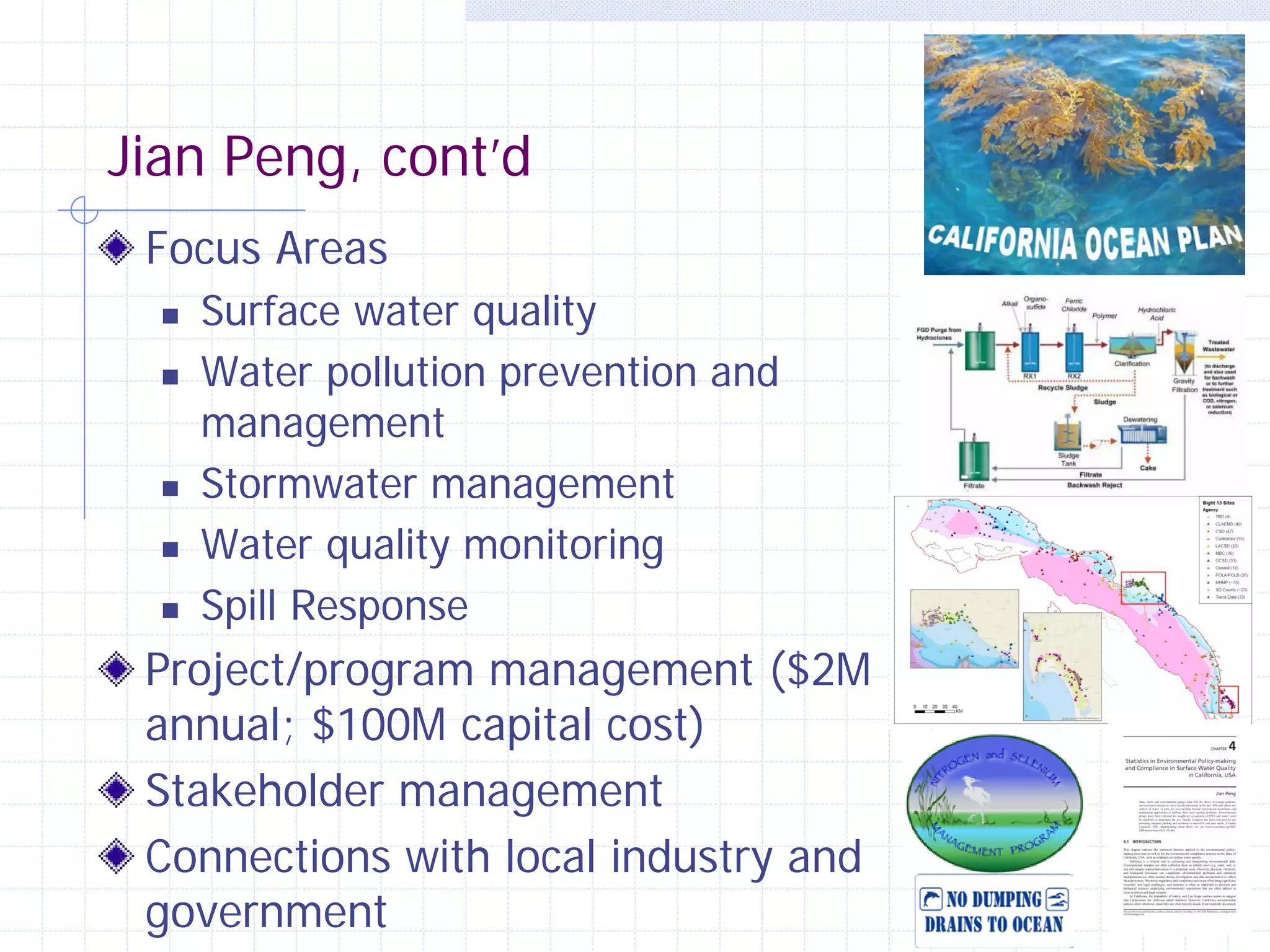
Focus Areas







Surface water quality
Water pollution prevention and
management
Stormwater management
Water quality monitoring
Spill Response

Project/program management ($2M
annual; $100M capital cost)
Stakeholder management
Connections with local industry and
government

4
Your Expectation
An easy course?
A required course?
Learn Chinese?
Learn something about
environmental engineering
EIT/PE
 Career advice/Jobs

Course evaluations



Interactive
Constant feedback

5
Course Goals/Objectives
Objectives
Fundamental concepts in environmental
engineering
Understanding of water and wastewater
treatment and air pollution control processes
Learn advanced environmental topics
Environmental regulations and their impact on
environmental engineering

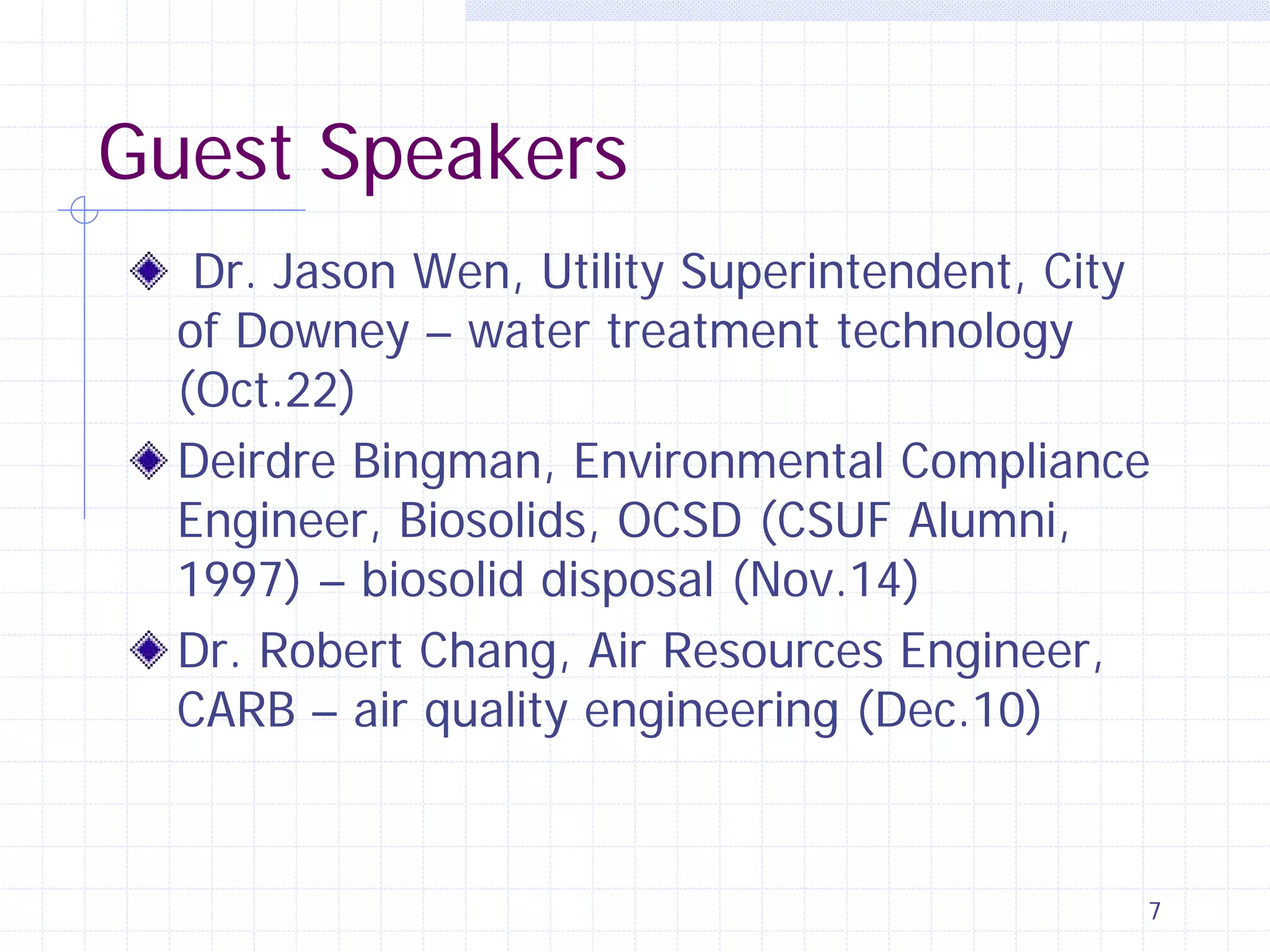
Textbook
Homework
Office hours: Thursdays 1:30-2:30pm
Fairness
Disability accommodation

6
Guest Speakers
Dr. Jason Wen, Utility Superintendent, City
of Downey – water treatment technology
(Oct.22)
Deirdre Bingman, Environmental Compliance
Engineer, Biosolids, OCSD (CSUF Alumni,
1997) – biosolid disposal (Nov.14)
Dr. Robert Chang, Air Resources Engineer,
CARB – air quality engineering (Dec.10)

7
Important Dates/Deadlines
10/3: midterm #1
11/7: midterm #2
11/15: last day to withdraw (with ‘W’)
11/25-11/29: Thanksgiving recess
12/12: last lecture
12/19: final exam
1/2/14: grades due

8
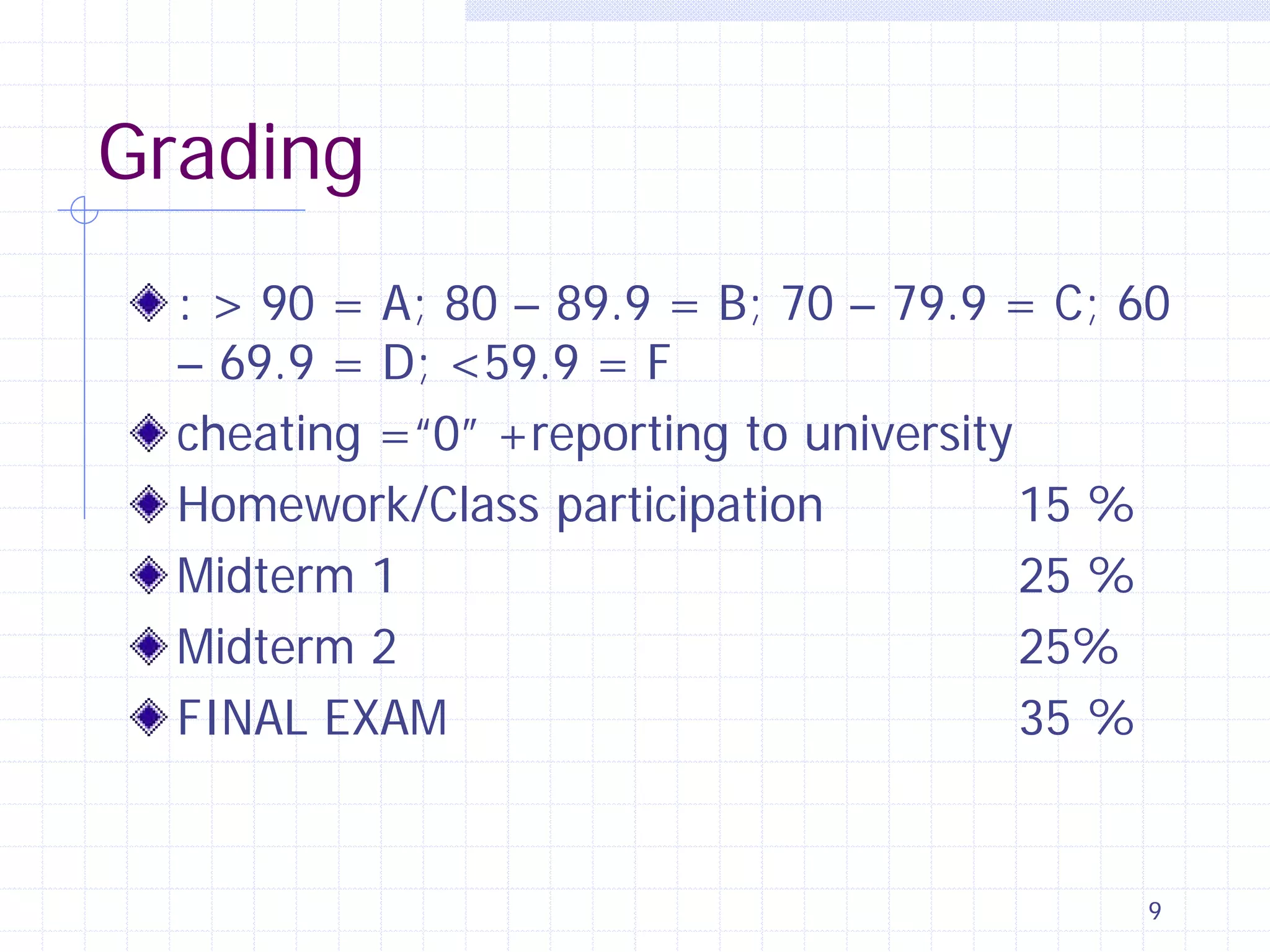
Grading
: > 90 = A; 80 – 89.9 = B; 70 – 79.9 = C; 60
– 69.9 = D; <59.9 = F
cheating =“0” +reporting to university
Homework/Class participation
15 %
Midterm 1
25 %
Midterm 2
25%
FINAL EXAM
35 %

9
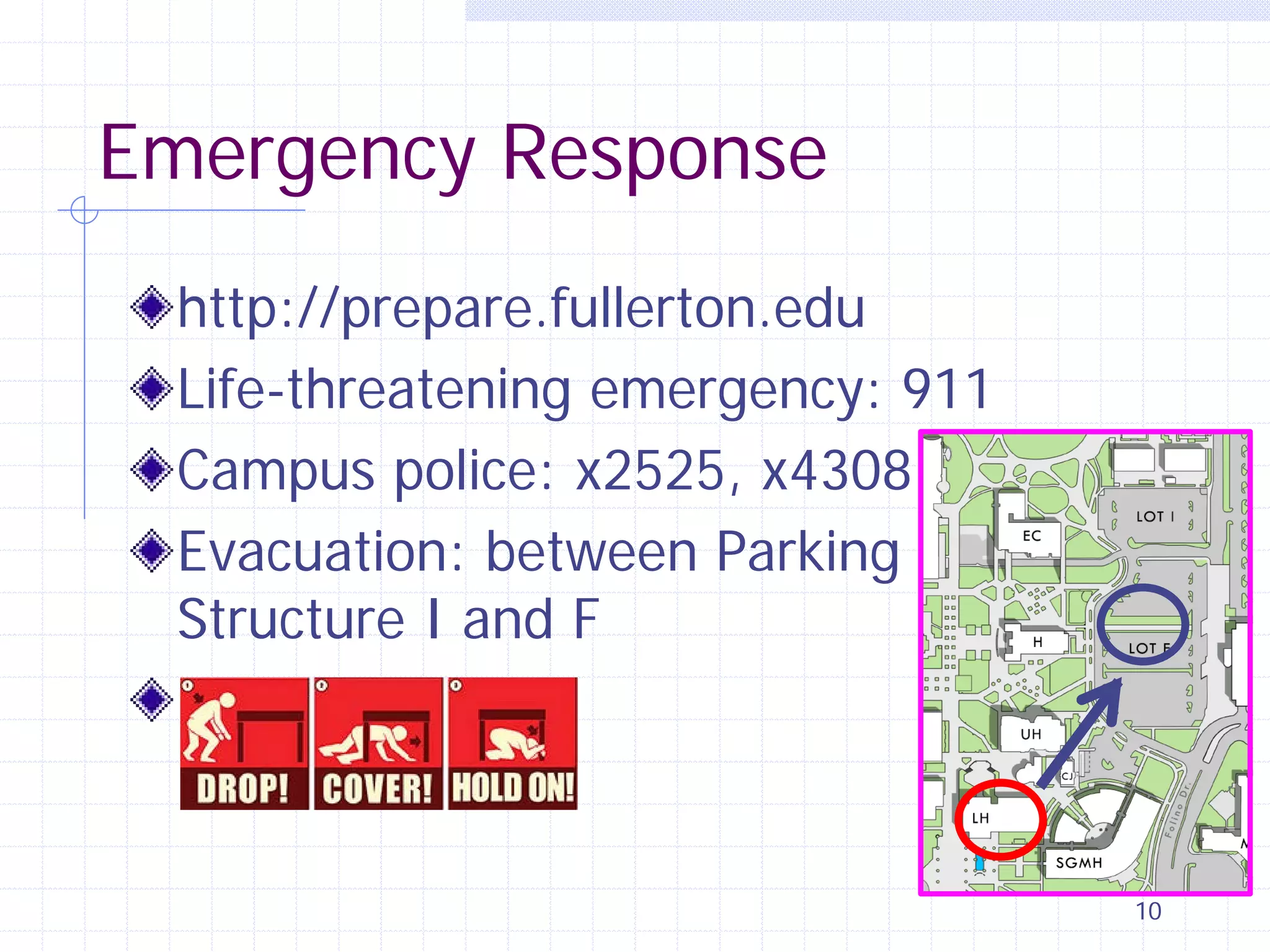
Emergency Response
http://prepare.fullerton.edu
Life-threatening emergency: 911
Campus police: x2525, x4308
Evacuation: between Parking
Structure I and F
Earthquake

10
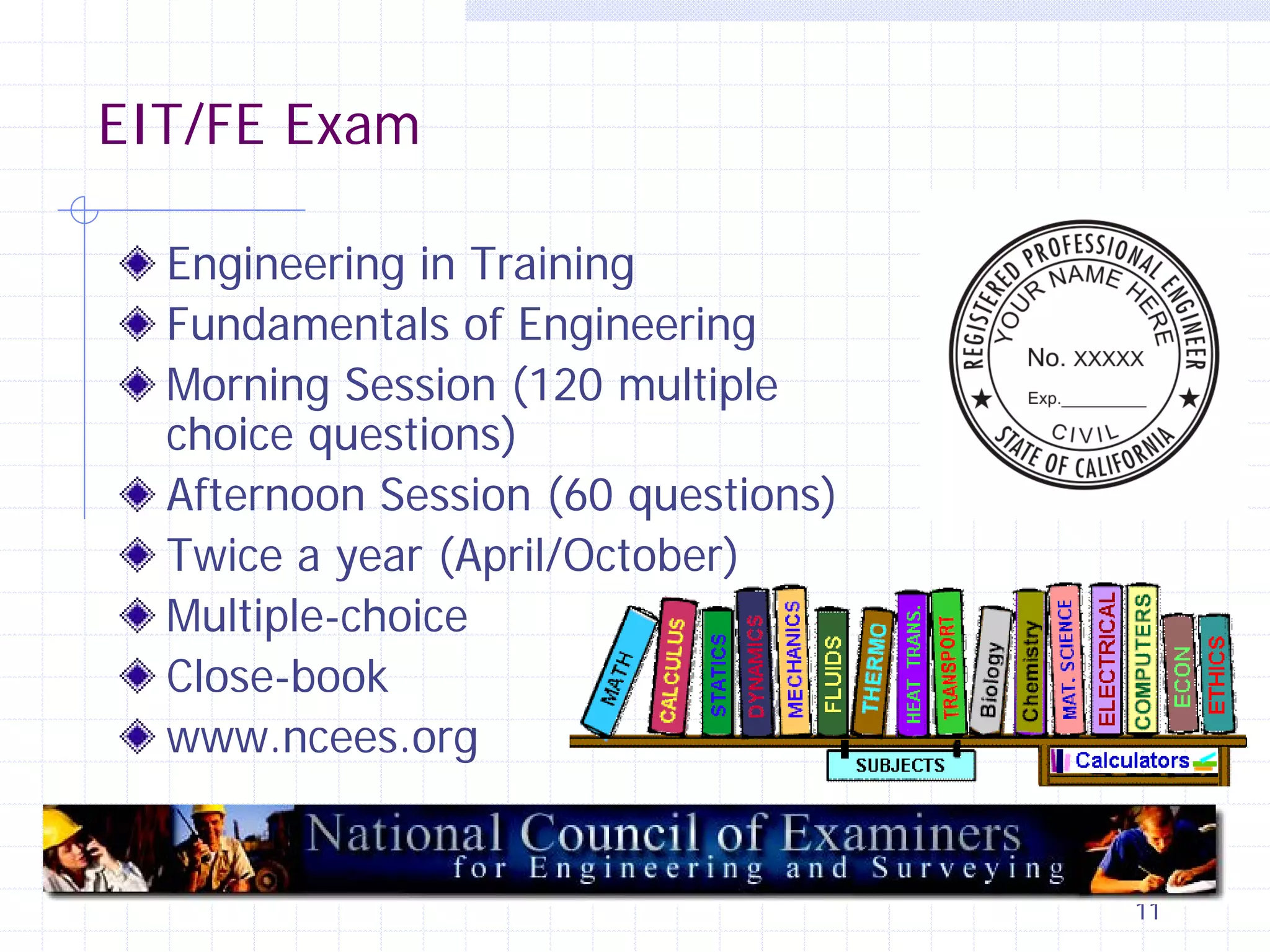
EIT/FE Exam
Engineering in Training
Fundamentals of Engineering
Morning Session (120 multiple
choice questions)
Afternoon Session (60 questions)
Twice a year (April/October)
Multiple-choice
Close-book
www.ncees.org

11
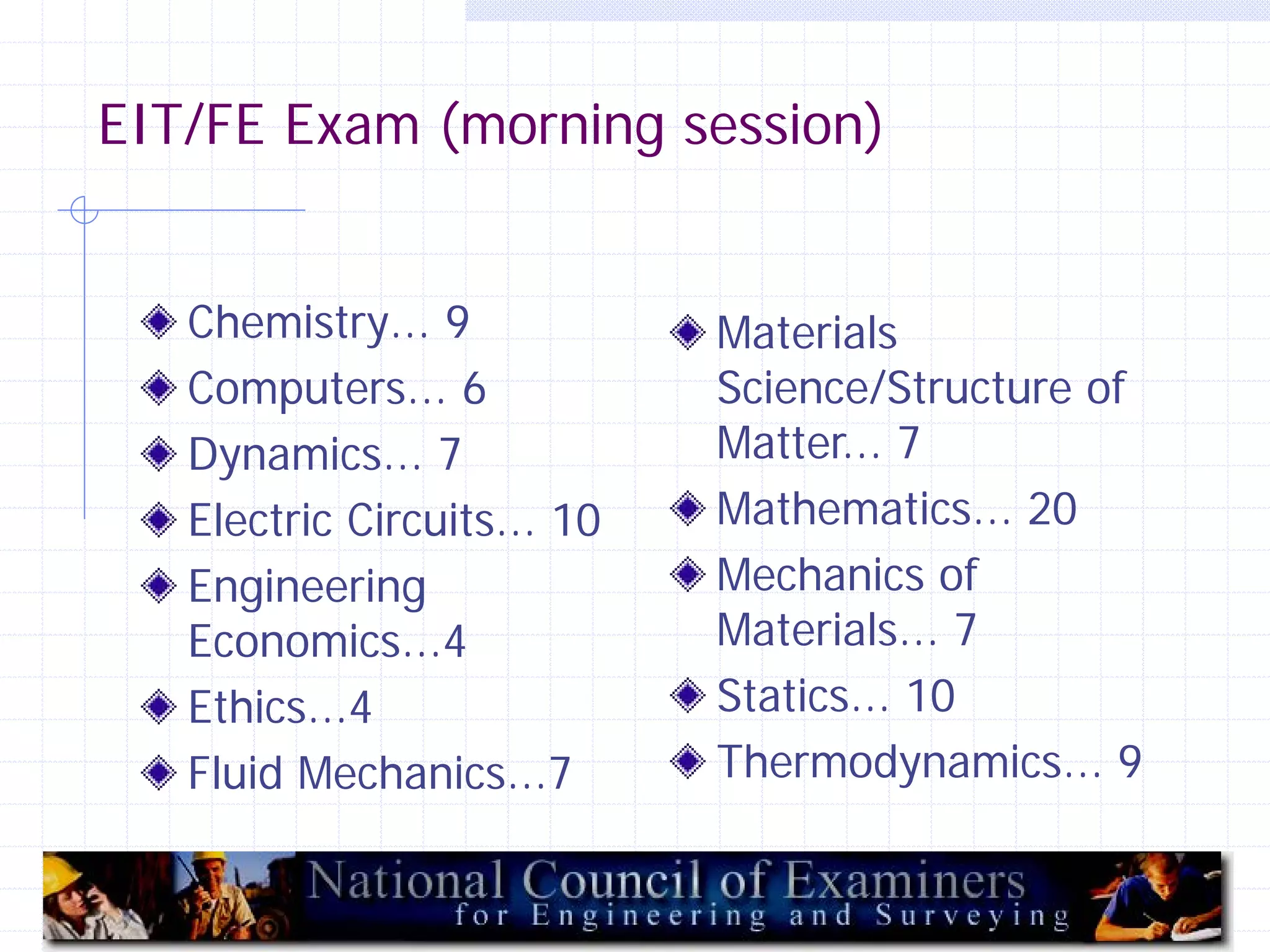
EIT/FE Exam (morning session)
Chemistry... 9
Computers... 6
Dynamics... 7
Electric Circuits... 10
Engineering
Economics...4
Ethics...4
Fluid Mechanics...7

Materials
Science/Structure of
Matter... 7
Mathematics... 20
Mechanics of
Materials... 7
Statics... 10
Thermodynamics... 9
12
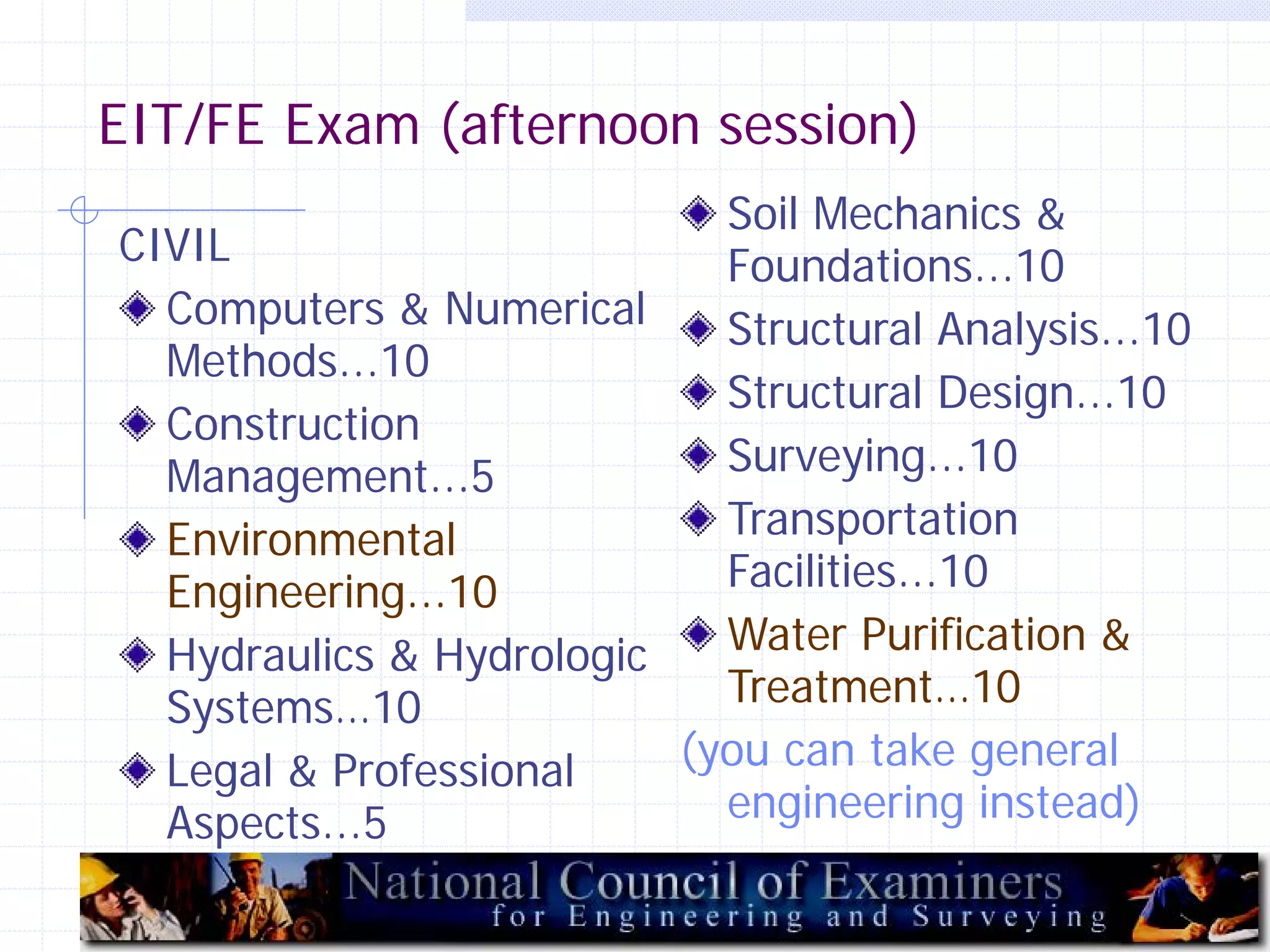
EIT/FE Exam (afternoon session)
Soil Mechanics &
CIVIL
Foundations...10
Computers & Numerical
Structural Analysis...10
Methods...10
Structural Design...10
Construction
Surveying...10
Management...5
Transportation
Environmental
Facilities...10
Engineering...10
Water Purification &
Hydraulics & Hydrologic
Treatment…10
Systems…10
(you can take general
Legal & Professional
engineering instead)
Aspects...5
13
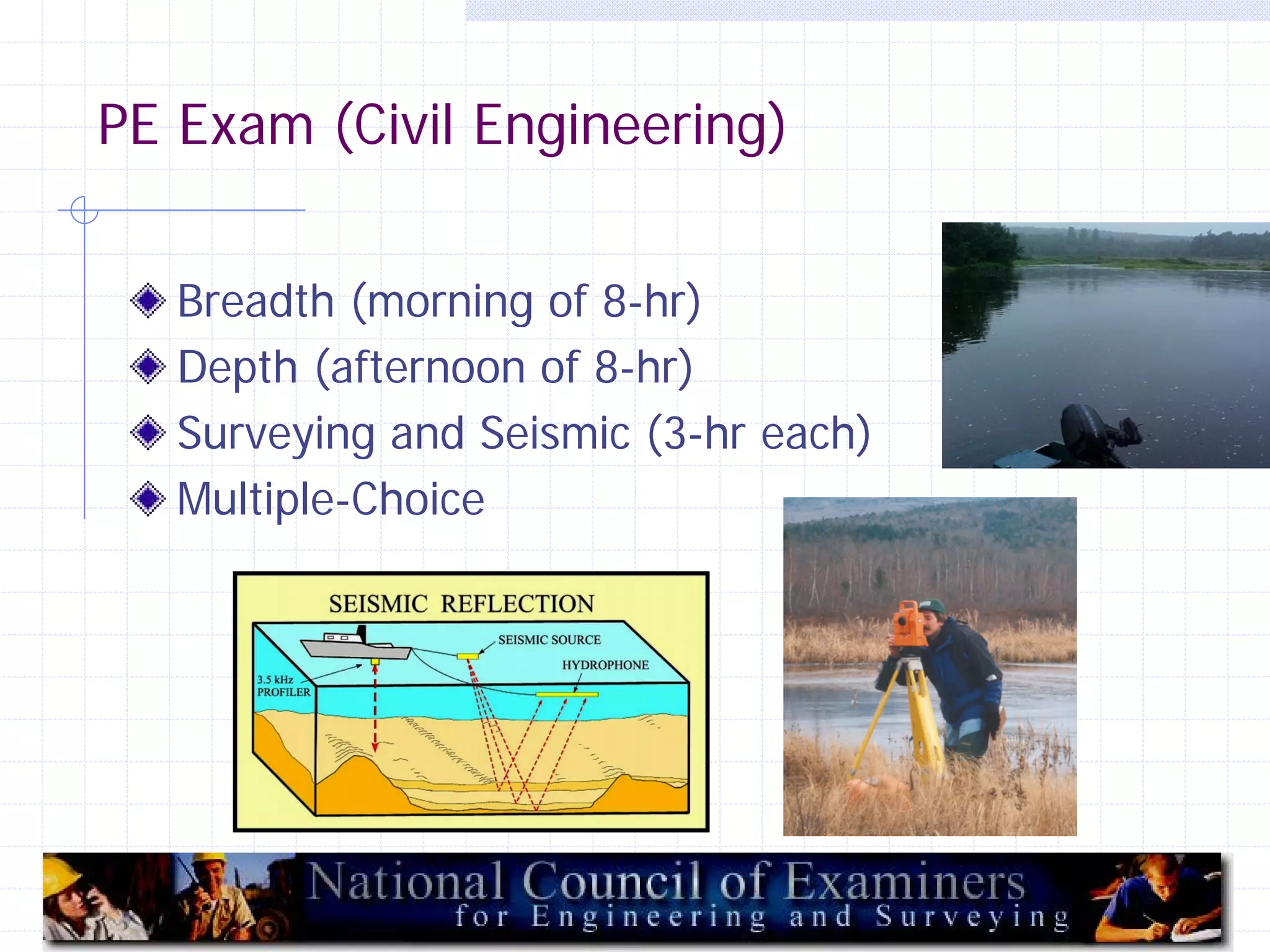
PE Exam (Civil Engineering)
Breadth (morning of 8-hr)
Depth (afternoon of 8-hr)
Surveying and Seismic (3-hr each)
Multiple-Choice

14
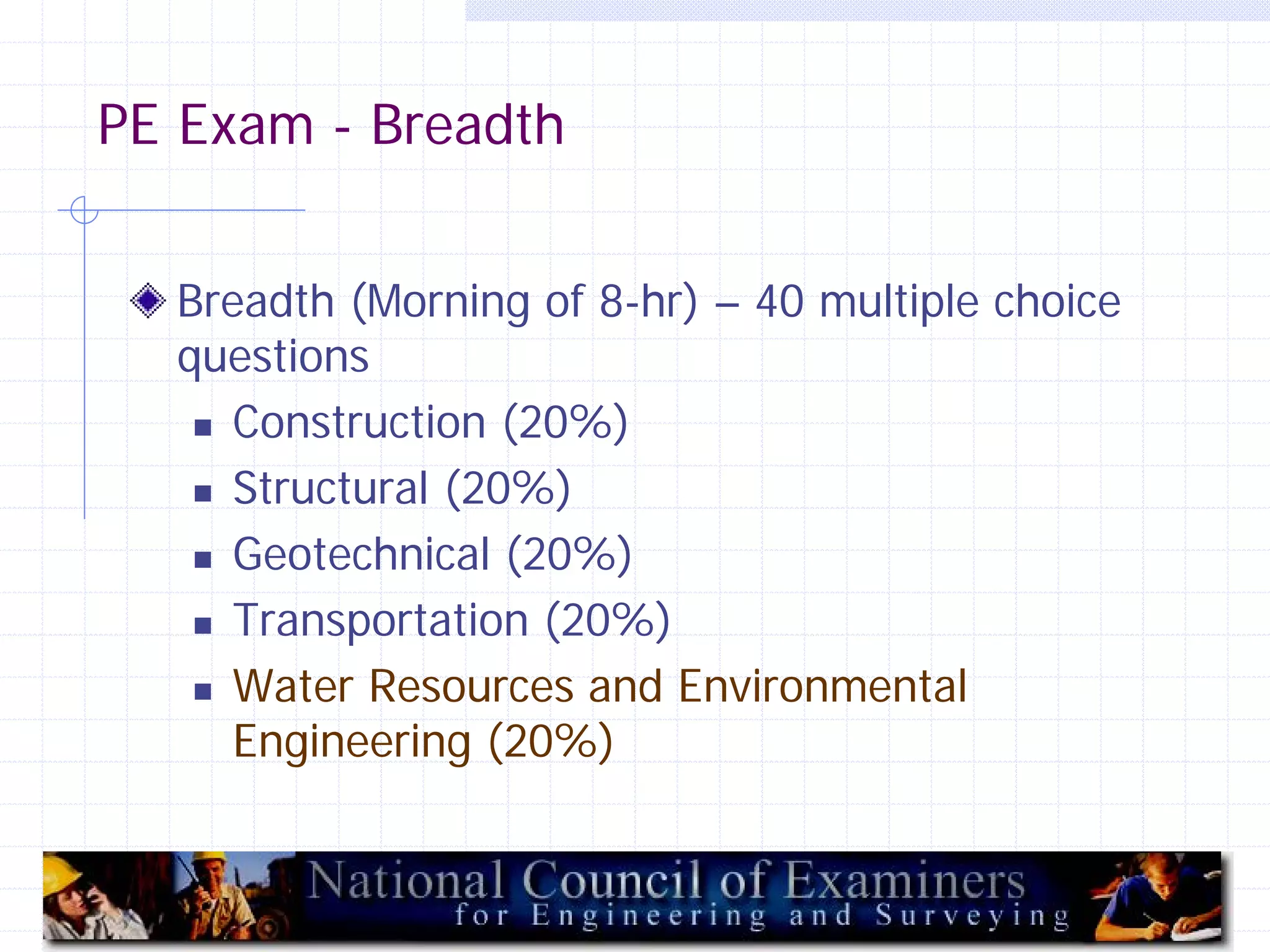
PE Exam - Breadth
Breadth (Morning of 8-hr) – 40 multiple choice
questions
 Construction (20%)
 Structural (20%)
 Geotechnical (20%)
 Transportation (20%)
 Water Resources and Environmental
Engineering (20%)

15
Water Resources and Environmental –
Breadth Exam
Hydraulics – Closed conduit
Hydraulics – Open channel
Hydrology
Wastewater Treatment
Water Treatment

16
Water Resources and Environmental –
Depth Exam
Hydraulics – Closed conduit
Hydraulics – Open channel
Hydrology
Groundwater and Well Fields
Wastewater Treatment
Water Quality
Water Treatment
Engineering Economics

17
What is Environmental Engineering?
sound engineering thought and practice
solution of problems of environmental sanitation
safe, palatable, and ample water supplies
proper disposal of or recycle of wastewater and
solid waste
• adequate drainage of urban and rural area for
proper sanitation
• control of water, soil, and atmospheric pollution
• effect of technological advances on the
environment.

•
•
•
•

18
Recap
Introduction
Course logistics and expectations






Office Hours
Syllabus and Course Schedule
Important deadlines
Policies and emergency response
Course expectations and outcome

FE/PE exams
19
Questions?

20
CE 441 Introduction to
Environmental Engineering

8-29-13
Jian Peng, Ph.D
jpeng@fullerton.edu
714-640-7991

21
Recap of August 27 Lecture
Introduction
Course logistics and expectations
FE/PE exams

22
Housekeeping Items
Coastal Cleanup (Sept.21)
HW1
Extra Credit
HW0 collection
Textbook
Roll Call
Waitlist
Office Hours/Emails
23
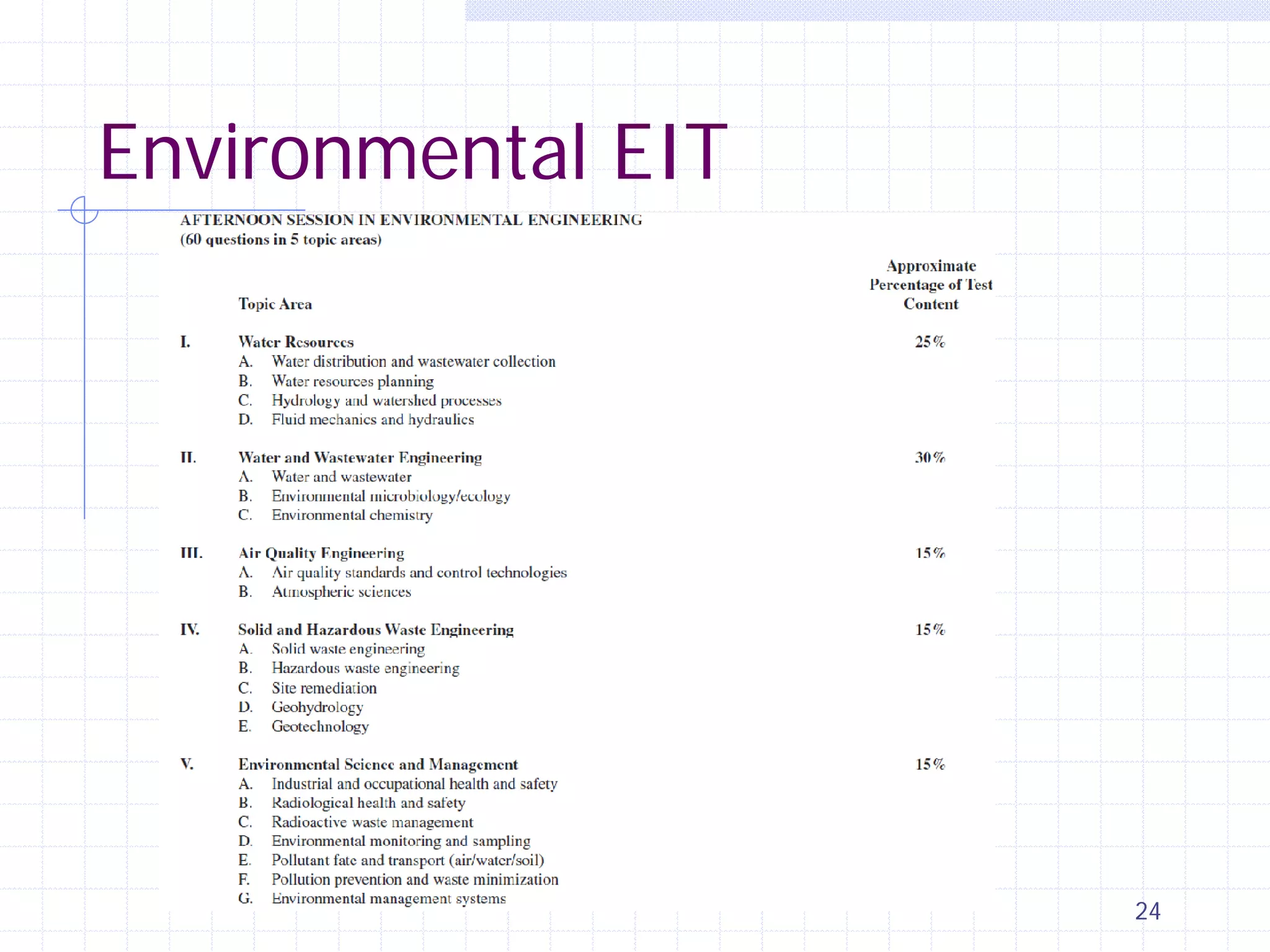
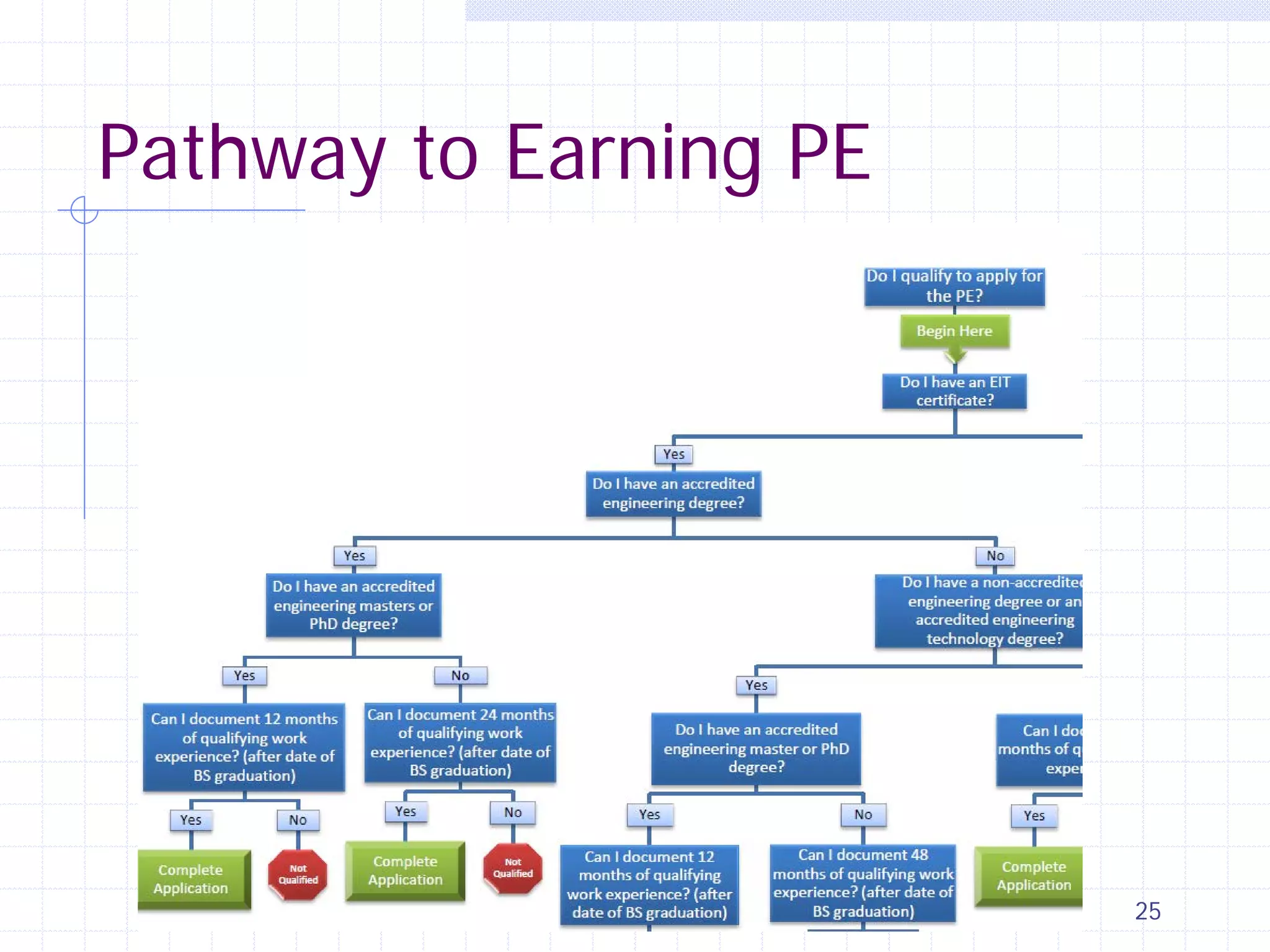
Environmental EIT

24
Pathway to Earning PE

25
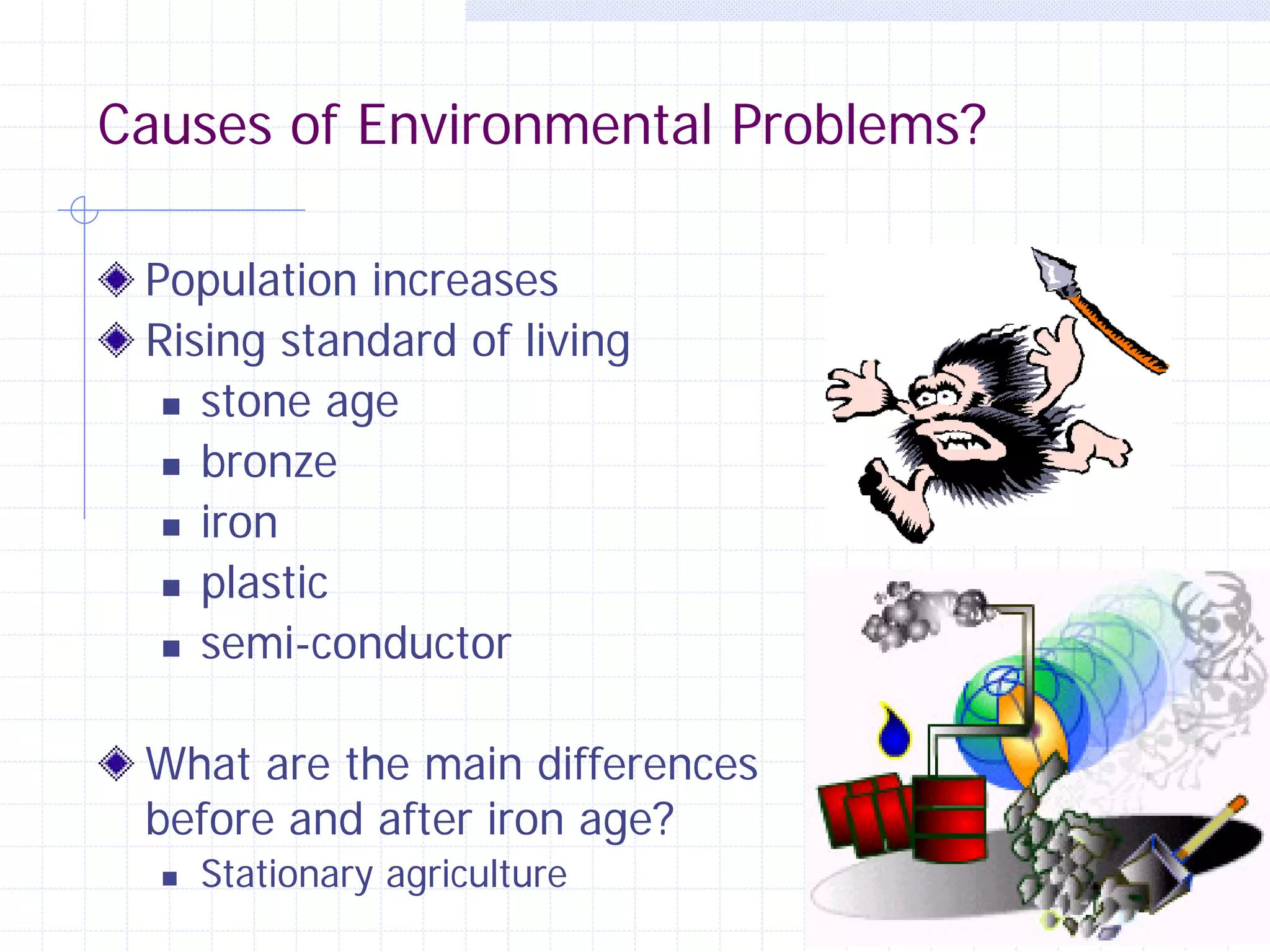
Causes of Environmental Problems?
Population increases
Rising standard of living
 stone age
 bronze
 iron
 plastic
 semi-conductor
What are the main differences
before and after iron age?


Stationary agriculture

26
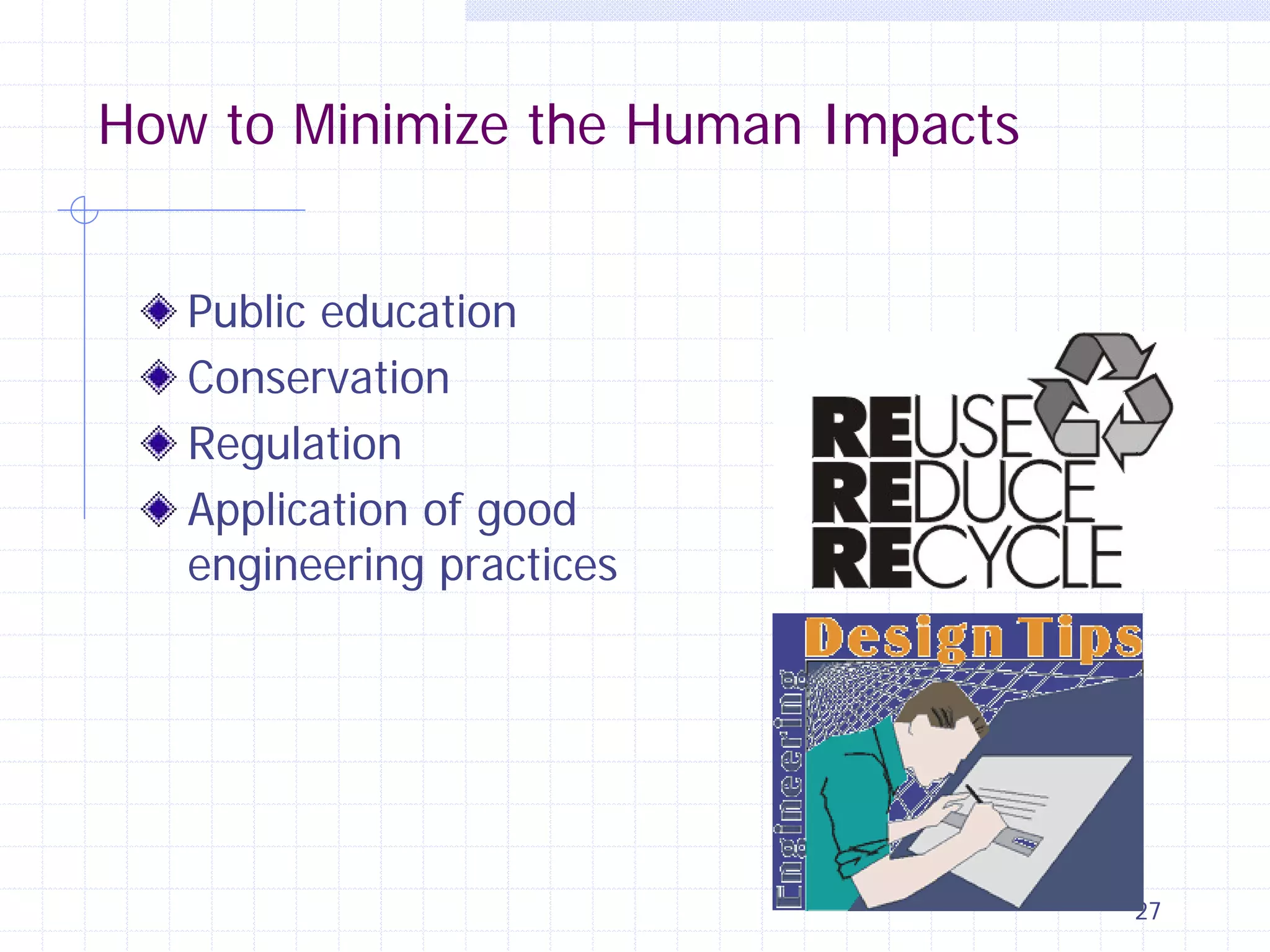
How to Minimize the Human Impacts
Public education
Conservation
Regulation
Application of good
engineering practices

27
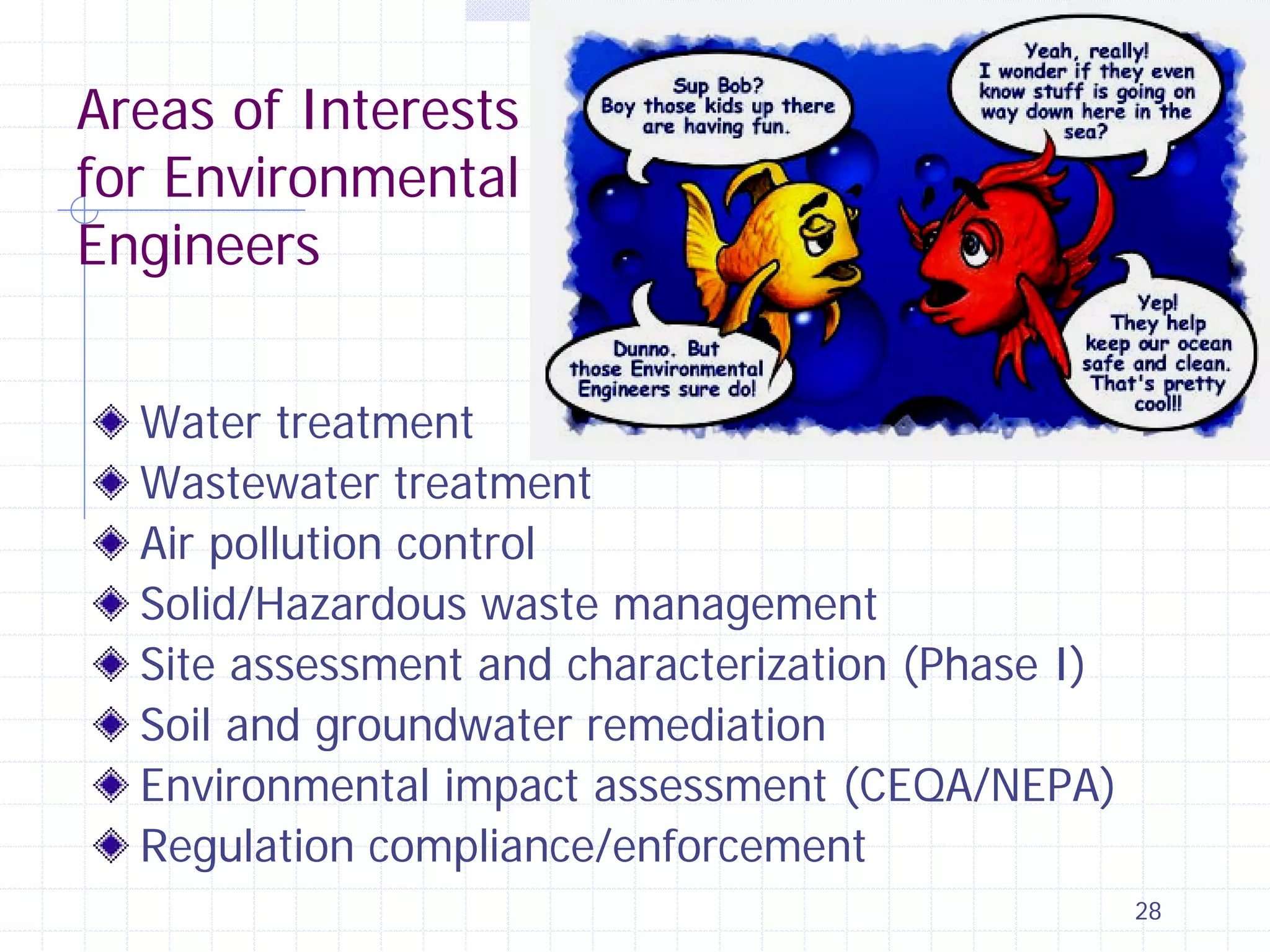
Areas of Interests
for Environmental
Engineers
Water treatment
Wastewater treatment
Air pollution control
Solid/Hazardous waste management
Site assessment and characterization (Phase I)
Soil and groundwater remediation
Environmental impact assessment (CEQA/NEPA)
Regulation compliance/enforcement
28
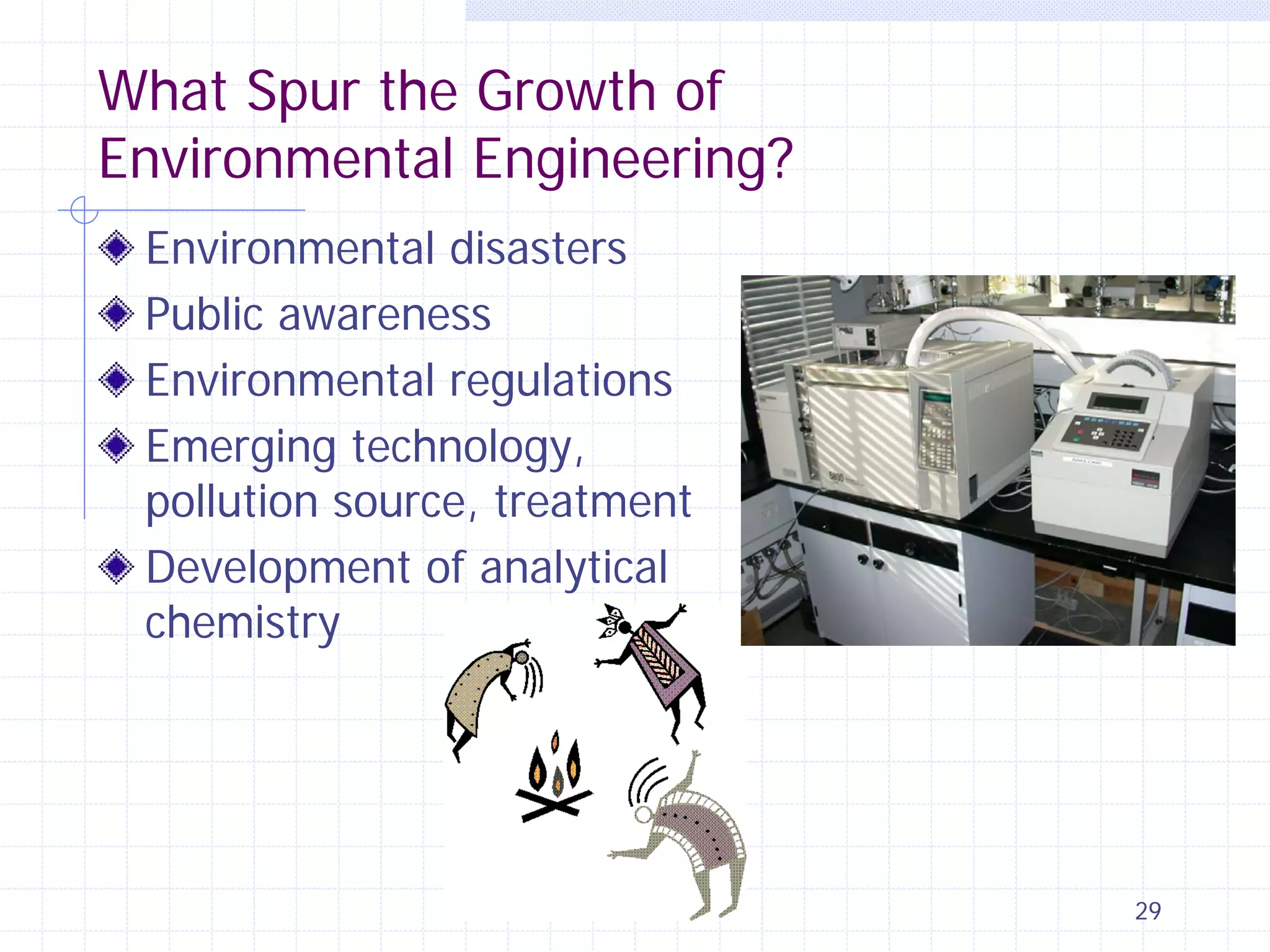
What Spur the Growth of
Environmental Engineering?
Environmental disasters
Public awareness
Environmental regulations
Emerging technology,
pollution source, treatment
Development of analytical
chemistry

29
Career Perspectives
Process/design engineer for
treatment plants
Water district engineers
Regulatory agencies
Consulting engineers
R&D for new process or
equipment
Remediation engineer
Air/groundwater modeling
Planning/management
30
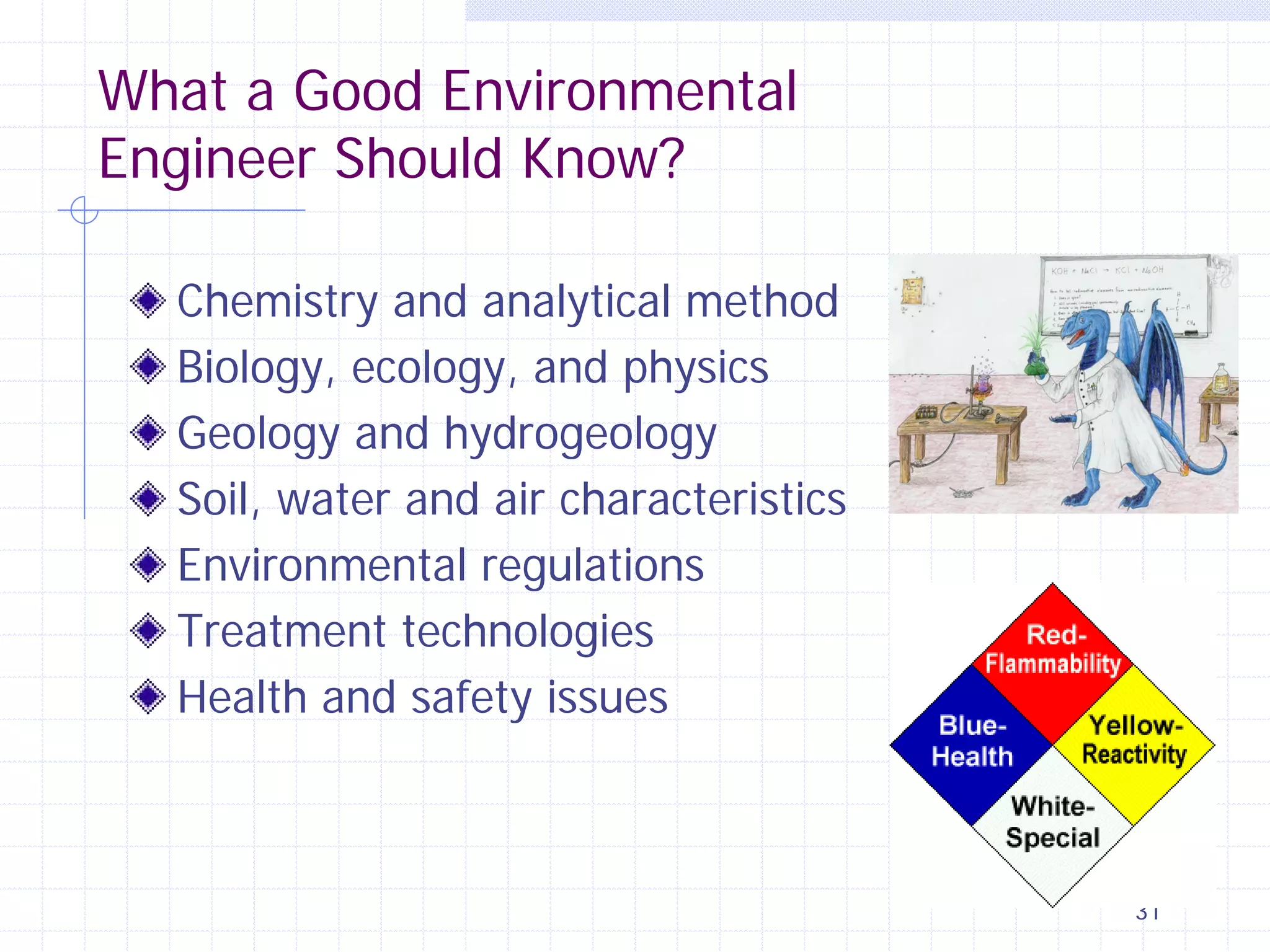
What a Good Environmental
Engineer Should Know?
Chemistry and analytical method
Biology, ecology, and physics
Geology and hydrogeology
Soil, water and air characteristics
Environmental regulations
Treatment technologies
Health and safety issues

31
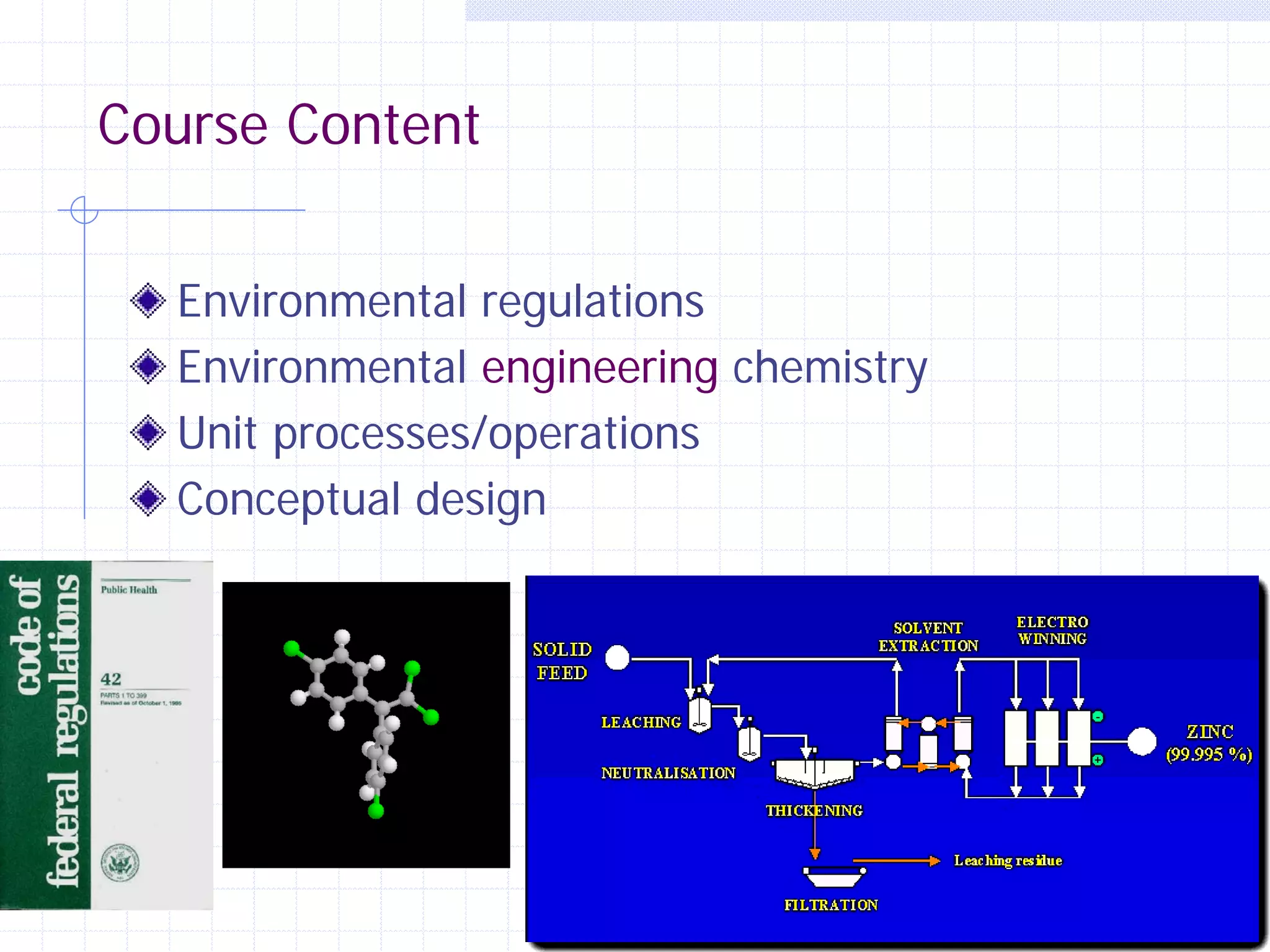
Course Content
Environmental regulations
Environmental engineering chemistry
Unit processes/operations
Conceptual design

32
Components of the Course
Environmental Engineering Chemistry
Water Treatment
Wastewater Treatment
Solid/Hazardous Waste Management
Goundwater and Soil Remediation
Air Pollution Control Engineering

33
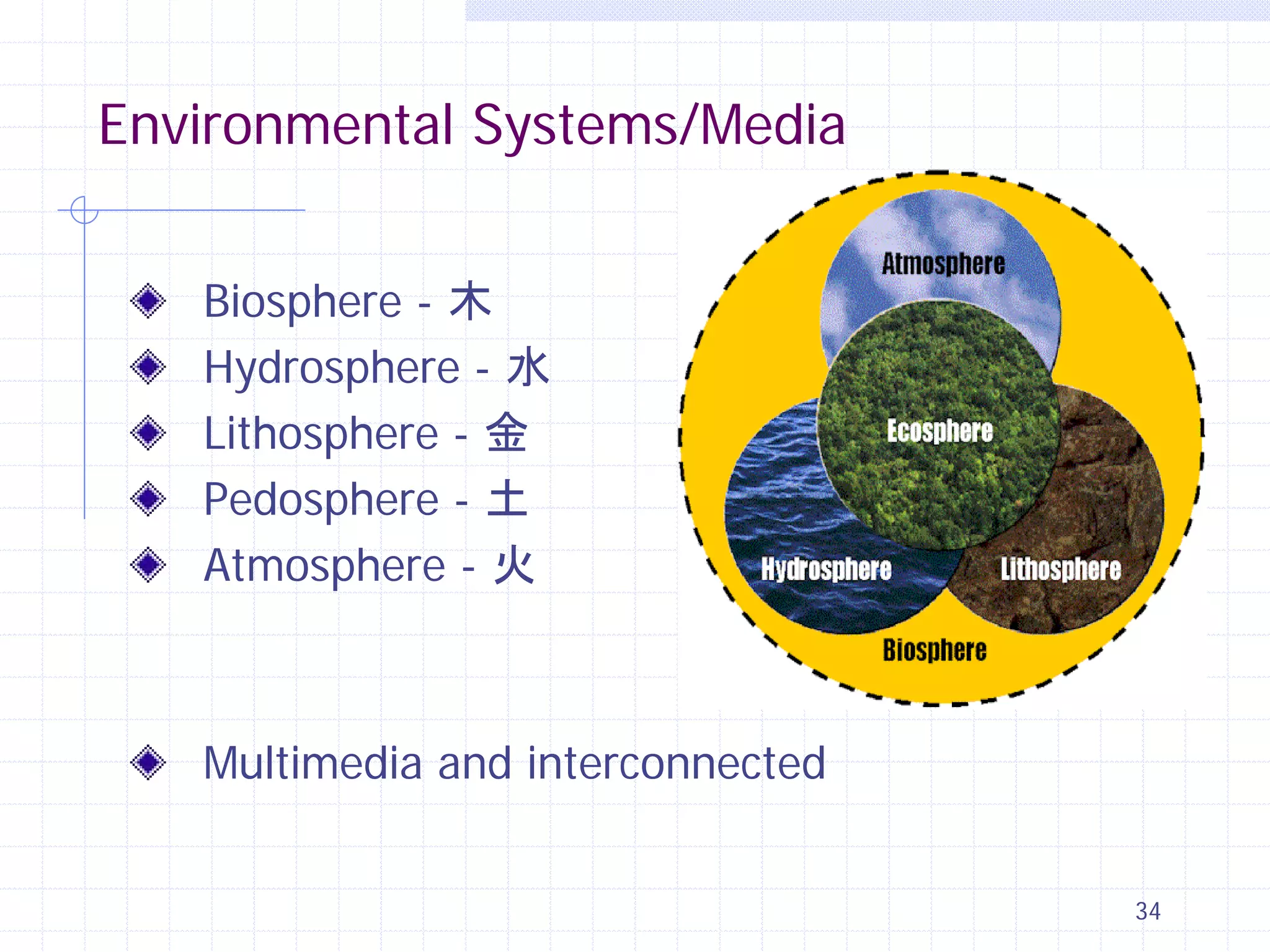
Environmental Systems/Media
Biosphere - 木
Hydrosphere - 水
Lithosphere - 金
Pedosphere - 土
Atmosphere - 火

Multimedia and interconnected
34
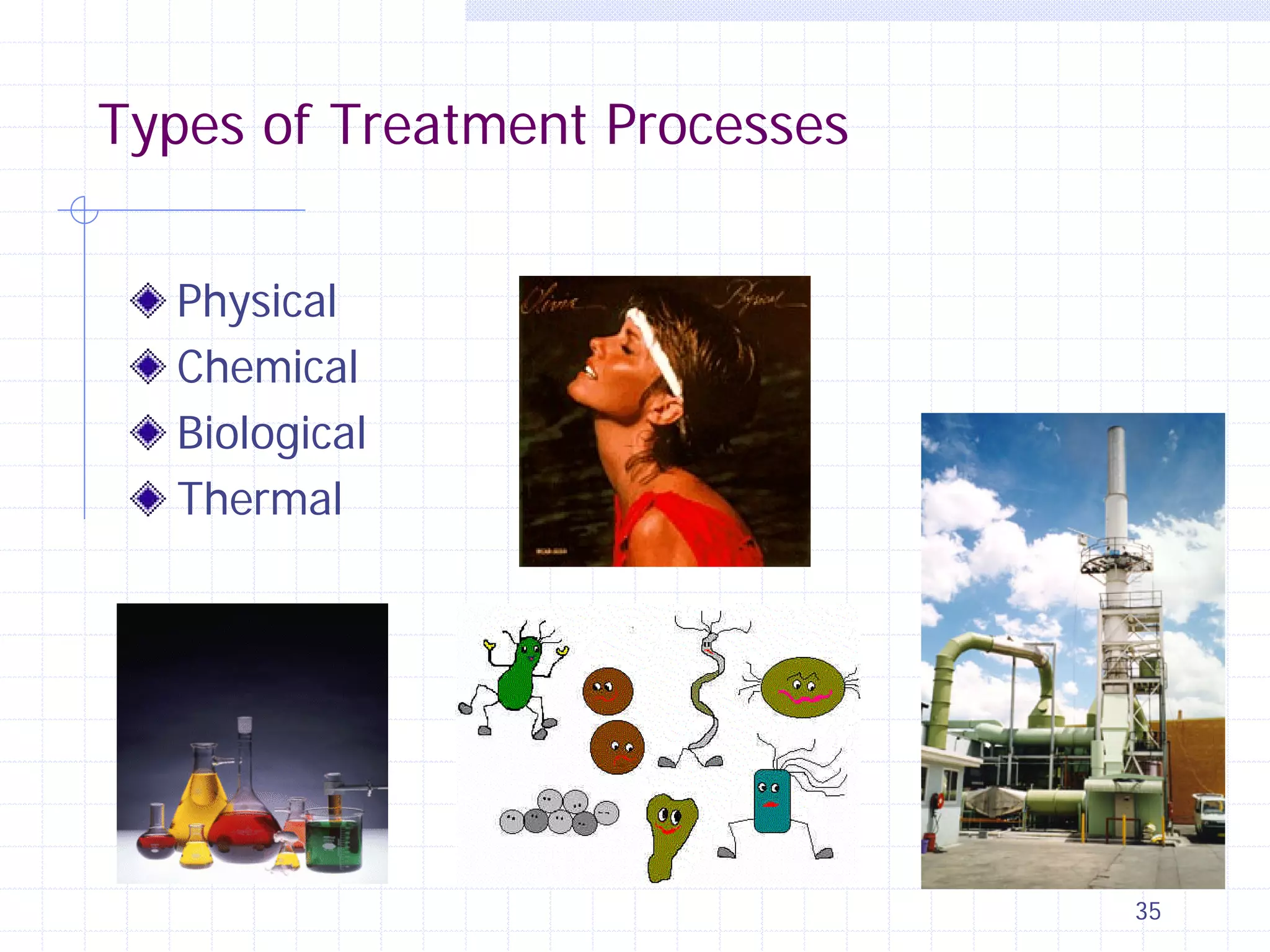
Types of Treatment Processes
Physical
Chemical
Biological
Thermal

35
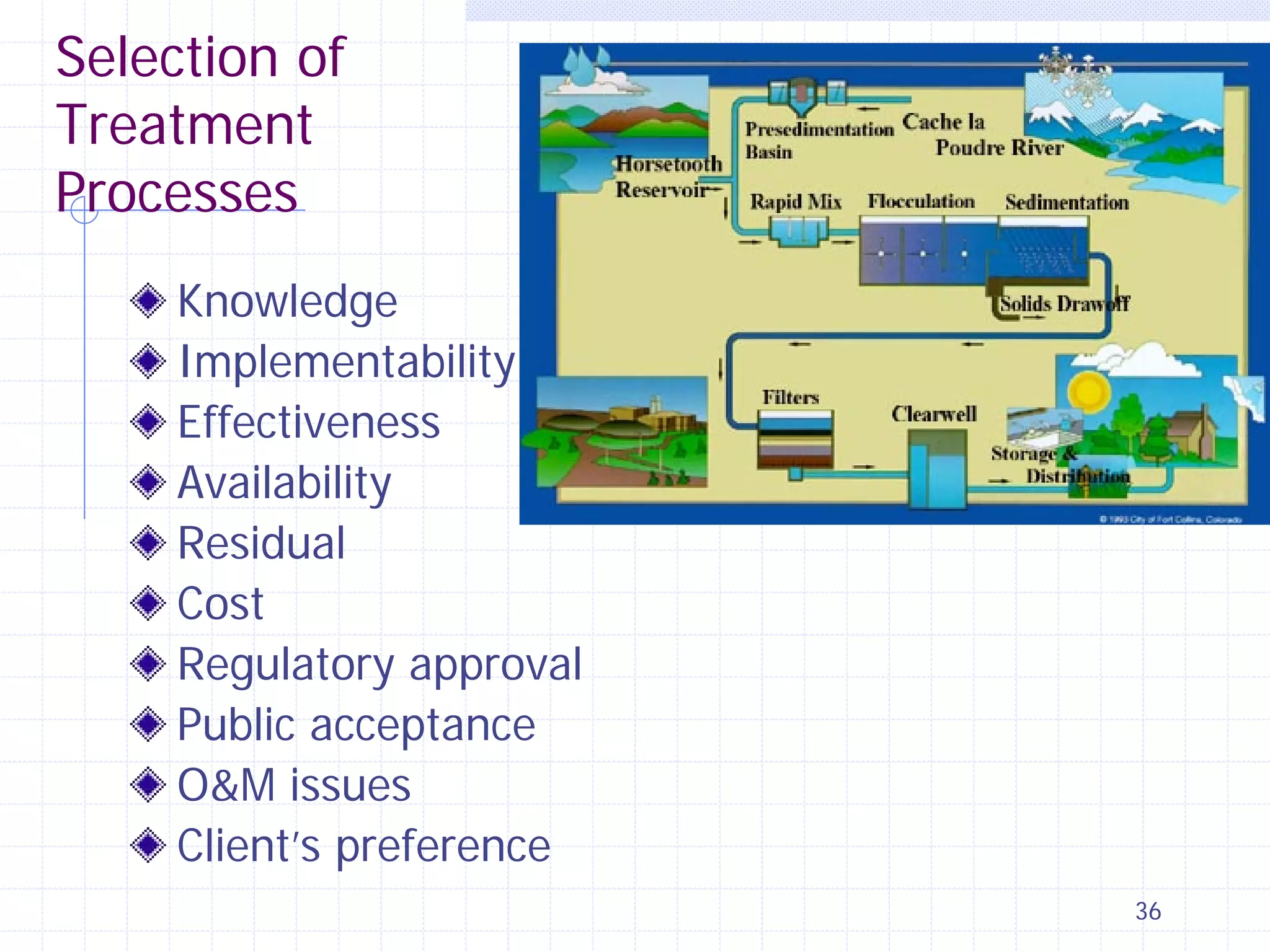
Selection of
Treatment
Processes
Knowledge
Implementability
Effectiveness
Availability
Residual
Cost
Regulatory approval
Public acceptance
O&M issues
Client’s preference
36
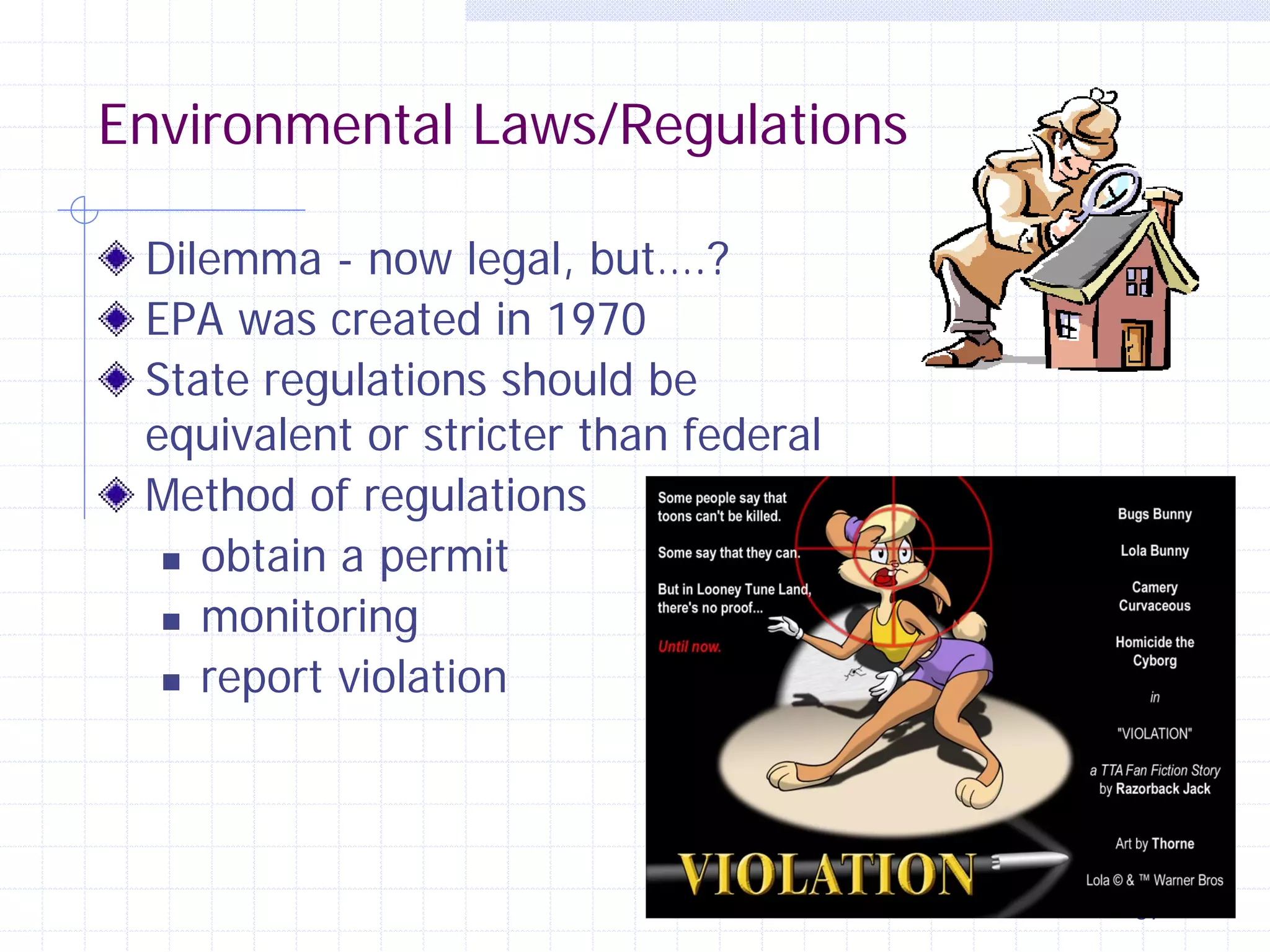
Environmental Laws/Regulations
Dilemma - now legal, but….?
EPA was created in 1970
State regulations should be
equivalent or stricter than federal
Method of regulations
 obtain a permit
 monitoring
 report violation

37
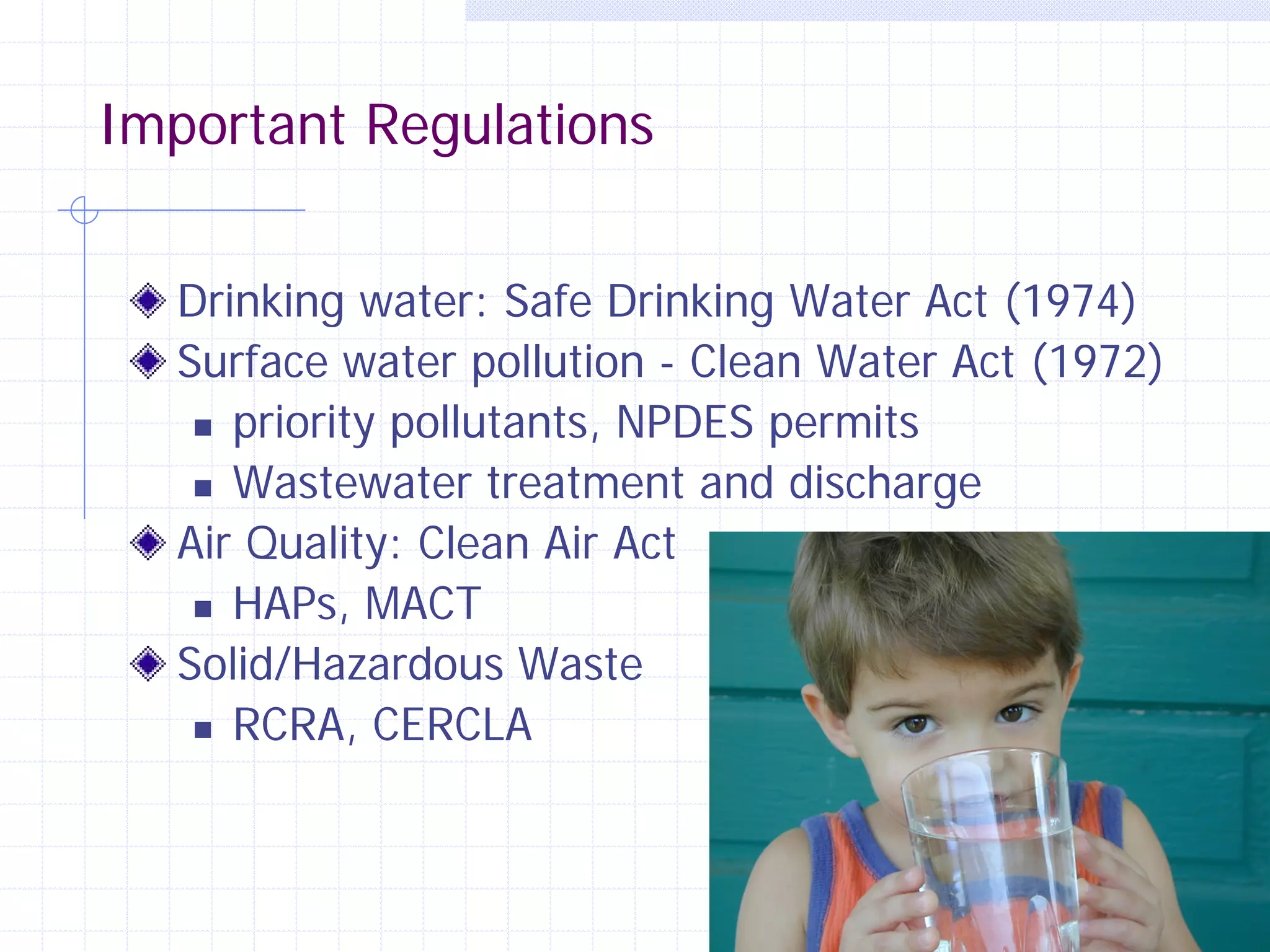
Important Regulations
Drinking water: Safe Drinking Water Act (1974)
Surface water pollution - Clean Water Act (1972)
 priority pollutants, NPDES permits
 Wastewater treatment and discharge
Air Quality: Clean Air Act
 HAPs, MACT
Solid/Hazardous Waste
 RCRA, CERCLA

38
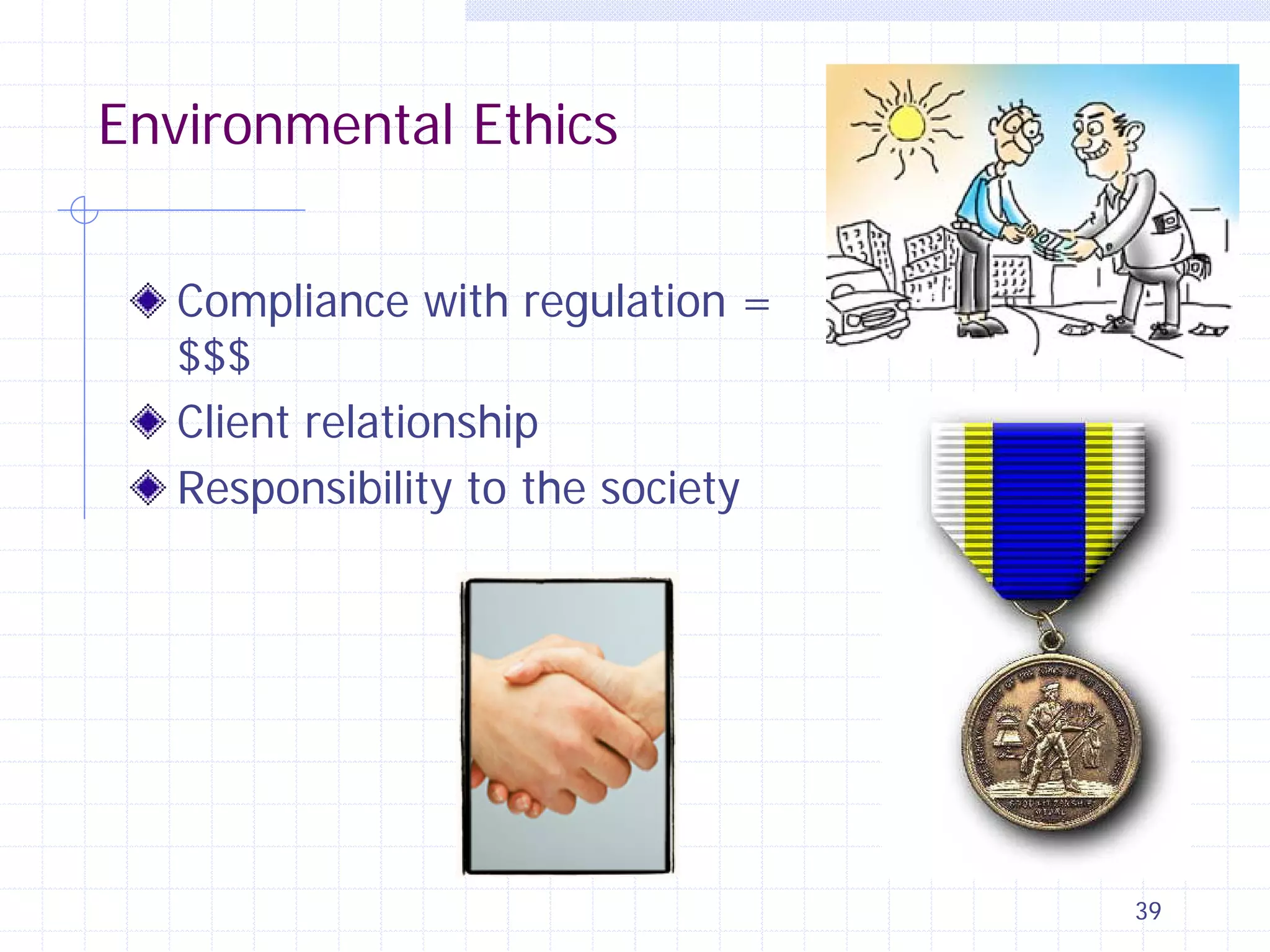
Environmental Ethics
Compliance with regulation =
$$$
Client relationship
Responsibility to the society

39
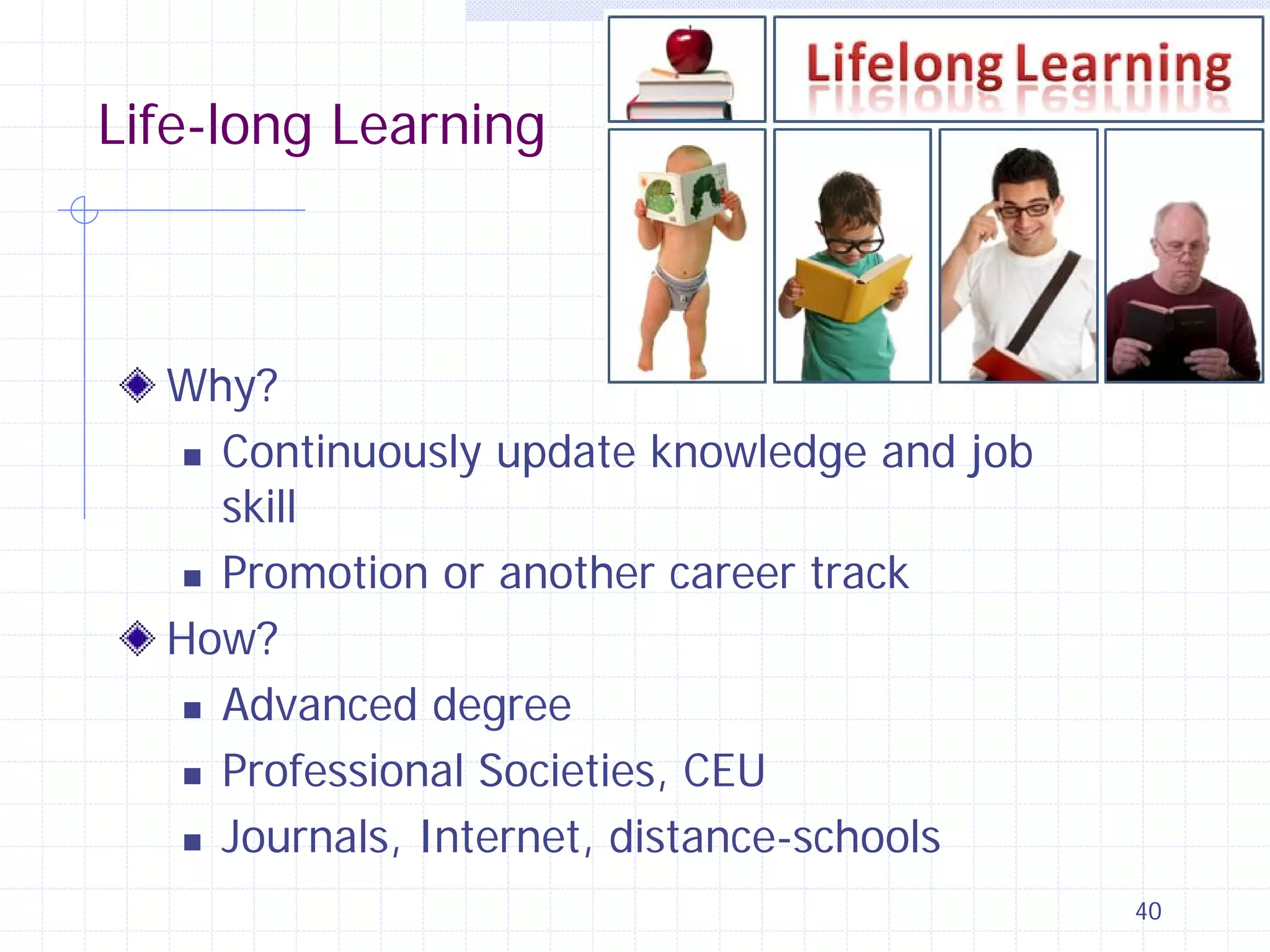
Life-long Learning

Why?
 Continuously update knowledge and job
skill
 Promotion or another career track
How?
 Advanced degree
 Professional Societies, CEU
 Journals, Internet, distance-schools
40

1. 441 intro to environmental engineering peng

  • 1.
    CE 441 -Introduction to Environmental Engineering 8-27-13 Jian Peng, Ph.D jpeng@fullerton.edu 1
  • 2.
    Jian Peng Educational Background  B.S.in Environmental Geochemistry  M.S. in Electrical Engineering and Organic Geochemistry  Ph.D. in Marine Geochemistry Industrial Experiences  Procter and Gamble  SCCWRP  Orange County Water District  OC Public Works, OC Watersheds Program 2
  • 3.
    Jian Peng, cont’d Licenses EIT (PE in 2014)  WTO/WDO  HAZWOPER  QSD/QSP/CPSWQ  PMP Teaching Experiences  USC  Oceanography  Oceans, Climate, and the Environment  Geochemistry and Hydrogeology 3
  • 4.
    Jian Peng, cont’d FocusAreas      Surface water quality Water pollution prevention and management Stormwater management Water quality monitoring Spill Response Project/program management ($2M annual; $100M capital cost) Stakeholder management Connections with local industry and government 4
  • 5.
    Your Expectation An easycourse? A required course? Learn Chinese? Learn something about environmental engineering EIT/PE  Career advice/Jobs Course evaluations   Interactive Constant feedback 5
  • 6.
    Course Goals/Objectives Objectives Fundamental conceptsin environmental engineering Understanding of water and wastewater treatment and air pollution control processes Learn advanced environmental topics Environmental regulations and their impact on environmental engineering Textbook Homework Office hours: Thursdays 1:30-2:30pm Fairness Disability accommodation 6
  • 7.
    Guest Speakers Dr. JasonWen, Utility Superintendent, City of Downey – water treatment technology (Oct.22) Deirdre Bingman, Environmental Compliance Engineer, Biosolids, OCSD (CSUF Alumni, 1997) – biosolid disposal (Nov.14) Dr. Robert Chang, Air Resources Engineer, CARB – air quality engineering (Dec.10) 7
  • 8.
    Important Dates/Deadlines 10/3: midterm#1 11/7: midterm #2 11/15: last day to withdraw (with ‘W’) 11/25-11/29: Thanksgiving recess 12/12: last lecture 12/19: final exam 1/2/14: grades due 8
  • 9.
    Grading : > 90= A; 80 – 89.9 = B; 70 – 79.9 = C; 60 – 69.9 = D; <59.9 = F cheating =“0” +reporting to university Homework/Class participation 15 % Midterm 1 25 % Midterm 2 25% FINAL EXAM 35 % 9
  • 10.
    Emergency Response http://prepare.fullerton.edu Life-threatening emergency:911 Campus police: x2525, x4308 Evacuation: between Parking Structure I and F Earthquake 10
  • 11.
    EIT/FE Exam Engineering inTraining Fundamentals of Engineering Morning Session (120 multiple choice questions) Afternoon Session (60 questions) Twice a year (April/October) Multiple-choice Close-book www.ncees.org 11
  • 12.
    EIT/FE Exam (morningsession) Chemistry... 9 Computers... 6 Dynamics... 7 Electric Circuits... 10 Engineering Economics...4 Ethics...4 Fluid Mechanics...7 Materials Science/Structure of Matter... 7 Mathematics... 20 Mechanics of Materials... 7 Statics... 10 Thermodynamics... 9 12
  • 13.
    EIT/FE Exam (afternoonsession) Soil Mechanics & CIVIL Foundations...10 Computers & Numerical Structural Analysis...10 Methods...10 Structural Design...10 Construction Surveying...10 Management...5 Transportation Environmental Facilities...10 Engineering...10 Water Purification & Hydraulics & Hydrologic Treatment…10 Systems…10 (you can take general Legal & Professional engineering instead) Aspects...5 13
  • 14.
    PE Exam (CivilEngineering) Breadth (morning of 8-hr) Depth (afternoon of 8-hr) Surveying and Seismic (3-hr each) Multiple-Choice 14
  • 15.
    PE Exam -Breadth Breadth (Morning of 8-hr) – 40 multiple choice questions  Construction (20%)  Structural (20%)  Geotechnical (20%)  Transportation (20%)  Water Resources and Environmental Engineering (20%) 15
  • 16.
    Water Resources andEnvironmental – Breadth Exam Hydraulics – Closed conduit Hydraulics – Open channel Hydrology Wastewater Treatment Water Treatment 16
  • 17.
    Water Resources andEnvironmental – Depth Exam Hydraulics – Closed conduit Hydraulics – Open channel Hydrology Groundwater and Well Fields Wastewater Treatment Water Quality Water Treatment Engineering Economics 17
  • 18.
    What is EnvironmentalEngineering? sound engineering thought and practice solution of problems of environmental sanitation safe, palatable, and ample water supplies proper disposal of or recycle of wastewater and solid waste • adequate drainage of urban and rural area for proper sanitation • control of water, soil, and atmospheric pollution • effect of technological advances on the environment. • • • • 18
  • 19.
    Recap Introduction Course logistics andexpectations      Office Hours Syllabus and Course Schedule Important deadlines Policies and emergency response Course expectations and outcome FE/PE exams 19
  • 20.
  • 21.
    CE 441 Introductionto Environmental Engineering 8-29-13 Jian Peng, Ph.D jpeng@fullerton.edu 714-640-7991 21
  • 22.
    Recap of August27 Lecture Introduction Course logistics and expectations FE/PE exams 22
  • 23.
    Housekeeping Items Coastal Cleanup(Sept.21) HW1 Extra Credit HW0 collection Textbook Roll Call Waitlist Office Hours/Emails 23
  • 24.
  • 25.
  • 26.
    Causes of EnvironmentalProblems? Population increases Rising standard of living  stone age  bronze  iron  plastic  semi-conductor What are the main differences before and after iron age?  Stationary agriculture 26
  • 27.
    How to Minimizethe Human Impacts Public education Conservation Regulation Application of good engineering practices 27
  • 28.
    Areas of Interests forEnvironmental Engineers Water treatment Wastewater treatment Air pollution control Solid/Hazardous waste management Site assessment and characterization (Phase I) Soil and groundwater remediation Environmental impact assessment (CEQA/NEPA) Regulation compliance/enforcement 28
  • 29.
    What Spur theGrowth of Environmental Engineering? Environmental disasters Public awareness Environmental regulations Emerging technology, pollution source, treatment Development of analytical chemistry 29
  • 30.
    Career Perspectives Process/design engineerfor treatment plants Water district engineers Regulatory agencies Consulting engineers R&D for new process or equipment Remediation engineer Air/groundwater modeling Planning/management 30
  • 31.
    What a GoodEnvironmental Engineer Should Know? Chemistry and analytical method Biology, ecology, and physics Geology and hydrogeology Soil, water and air characteristics Environmental regulations Treatment technologies Health and safety issues 31
  • 32.
    Course Content Environmental regulations Environmentalengineering chemistry Unit processes/operations Conceptual design 32
  • 33.
    Components of theCourse Environmental Engineering Chemistry Water Treatment Wastewater Treatment Solid/Hazardous Waste Management Goundwater and Soil Remediation Air Pollution Control Engineering 33
  • 34.
    Environmental Systems/Media Biosphere -木 Hydrosphere - 水 Lithosphere - 金 Pedosphere - 土 Atmosphere - 火 Multimedia and interconnected 34
  • 35.
    Types of TreatmentProcesses Physical Chemical Biological Thermal 35
  • 36.
  • 37.
    Environmental Laws/Regulations Dilemma -now legal, but….? EPA was created in 1970 State regulations should be equivalent or stricter than federal Method of regulations  obtain a permit  monitoring  report violation 37
  • 38.
    Important Regulations Drinking water:Safe Drinking Water Act (1974) Surface water pollution - Clean Water Act (1972)  priority pollutants, NPDES permits  Wastewater treatment and discharge Air Quality: Clean Air Act  HAPs, MACT Solid/Hazardous Waste  RCRA, CERCLA 38
  • 39.
    Environmental Ethics Compliance withregulation = $$$ Client relationship Responsibility to the society 39
  • 40.
    Life-long Learning Why?  Continuouslyupdate knowledge and job skill  Promotion or another career track How?  Advanced degree  Professional Societies, CEU  Journals, Internet, distance-schools 40