Is a method of interactive
and representational
argument.
Intelligent exchange of
points between the
affirmative and negative
sides.
Is a disciplined form of
argument or exchange of
different viewpoints about a
given subject matter.
Proposition
Topic or issue that is argued
upon.
is a fun way for students to
discuss controversial topics. It is
excellent for speaking and
listening practice.
Evidence
Rebuttal
- is the information that
helps in the formation of
a conclusion or
judgment.
direct attach of the
opponents’ comments
(made during the
constructive speech).
The summary and defense
of each team’s arguments
and evidence, to be delivered
by the team captain.
Introduction
Discussion Conclusion
To arouse the interest
of the audience.
To explain the
proposition.To state the issues to
be debated.
To state the
parameters of the
debate.
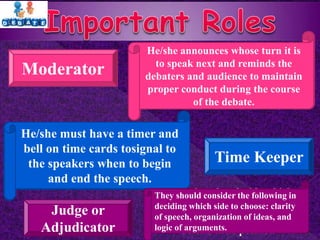
Moderator
Time Keeper
Judge or
Adjudicator
the person who introduces
the speakers and gives the
instructions in a debate.
the person who introduces
the speakers and gives the
instructions in a debate.
He/she announces whose turn it is
to speak next and reminds the
debaters and audience to maintain
proper conduct during the course
of the debate.
keep times and gives
count down
warnings.
Assigned to ensure that
the speakers do not
exceed the given time.
He/she must have a timer and
bell on time cards tosignal to
the speakers when to begin
and end the speech.
are assigned to decide which
side has presented clear, logical,
and convincing arguments to
defend their position
They should consider the following in
deciding which side to choose: clarity
of speech, organization of ideas, and
logic of arguments.
Lincoln- Douglas Debate
(The Two Men Debate)
primarily a form of United
States high school debate (though
it also has a college form called
NFA LD) named after the Lincoln-
Douglas Debates of 1858.
It is a one-on-one event
focused mainly on applying
philosophical theories to
real world issues.
Parliamentary Debate
(sometimes referred to as
"parli" in the United States) is
conducted under rules derived
from British parliamentary
procedure
It features the competition
of individuals in a multi-
person setting.
It is usually conducted by
proposing a law, or
changes to a law.
Emergency Debate
are specific and limited
debates requested by a
members on short notice (not
scheduled) and granted by
the Speaker.
British Parliamentary
Debate
involves 4 teams; "government" or
"proposition" (one opening, one
closing) teams support the motion,
and two "opposition" teams (one
opening, one closing) oppose it.
Canadian Parliamentary
Debate
involves one "government" team and
one"opposition" team. On the government
side, there is the "Prime Minister" and the
"Minister of the Crown". On the opposition
(often referred to as Her Majesty's loyal
opposition), there is the "Leader of the
Opposition" and the "Shadow Minister".
American
Parliamentary Debate
is the oldest national
parliamentary debating
organization, based on the East
Coast and including all of
the Ivy League.
Oxford Style debate
is a competitive debate
format featuring a sharply
framed motion that is
proposed by one side and
opposed by another.
allows two to three
speakers in both the
affirmative and the side
negative side.
OPPOSING SIDES
Affirmativ
e
Negative
Burden of proof
Prove all aspects of the
case
Cannot win based on
inability of the negative
Burden of rebuttal
Must destroy either the
necessity, beneficiality
and practicability of (+)
Cannot discuss anything
the affirmative didn’t
discuss
NECESSITY
BENEFICIALITY
PRACTICABILITY
NON-NECESSITY
NON-BENEFICIALITY
NON-
PRACTICABILITY
Need for the
proposition
Discusses the
presence/absence of an
inherent flaw in the status
quo
Discusses the
advantages or
disadvantages of
adopting or
rejecting the
resolution
feasibility of a
proposition
includes matter of:
*law *clamor
*finance
Constructive
speech
Interpellatio
n
Rebuttal
Constructive speech
presentation of each
team member’s
arguments and
evidence for each
aspect of the case
Interpellation
The opportunity for
the opposing debater
to ask questions
regarding the speech
of the speaker
Debate

Debate

  • 2.
    Is a methodof interactive and representational argument. Intelligent exchange of points between the affirmative and negative sides. Is a disciplined form of argument or exchange of different viewpoints about a given subject matter.
  • 3.
    Proposition Topic or issuethat is argued upon.
  • 4.
    is a funway for students to discuss controversial topics. It is excellent for speaking and listening practice.
  • 5.
    Evidence Rebuttal - is theinformation that helps in the formation of a conclusion or judgment. direct attach of the opponents’ comments (made during the constructive speech). The summary and defense of each team’s arguments and evidence, to be delivered by the team captain.
  • 6.
    Introduction Discussion Conclusion To arousethe interest of the audience. To explain the proposition.To state the issues to be debated. To state the parameters of the debate.
  • 7.
    Moderator Time Keeper Judge or Adjudicator theperson who introduces the speakers and gives the instructions in a debate. the person who introduces the speakers and gives the instructions in a debate. He/she announces whose turn it is to speak next and reminds the debaters and audience to maintain proper conduct during the course of the debate. keep times and gives count down warnings. Assigned to ensure that the speakers do not exceed the given time. He/she must have a timer and bell on time cards tosignal to the speakers when to begin and end the speech. are assigned to decide which side has presented clear, logical, and convincing arguments to defend their position They should consider the following in deciding which side to choose: clarity of speech, organization of ideas, and logic of arguments.
  • 8.
    Lincoln- Douglas Debate (TheTwo Men Debate) primarily a form of United States high school debate (though it also has a college form called NFA LD) named after the Lincoln- Douglas Debates of 1858. It is a one-on-one event focused mainly on applying philosophical theories to real world issues. Parliamentary Debate (sometimes referred to as "parli" in the United States) is conducted under rules derived from British parliamentary procedure It features the competition of individuals in a multi- person setting. It is usually conducted by proposing a law, or changes to a law.
  • 9.
    Emergency Debate are specificand limited debates requested by a members on short notice (not scheduled) and granted by the Speaker. British Parliamentary Debate involves 4 teams; "government" or "proposition" (one opening, one closing) teams support the motion, and two "opposition" teams (one opening, one closing) oppose it. Canadian Parliamentary Debate involves one "government" team and one"opposition" team. On the government side, there is the "Prime Minister" and the "Minister of the Crown". On the opposition (often referred to as Her Majesty's loyal opposition), there is the "Leader of the Opposition" and the "Shadow Minister". American Parliamentary Debate is the oldest national parliamentary debating organization, based on the East Coast and including all of the Ivy League.
  • 10.
    Oxford Style debate isa competitive debate format featuring a sharply framed motion that is proposed by one side and opposed by another. allows two to three speakers in both the affirmative and the side negative side.
  • 11.
  • 12.
    Burden of proof Proveall aspects of the case Cannot win based on inability of the negative
  • 13.
    Burden of rebuttal Mustdestroy either the necessity, beneficiality and practicability of (+) Cannot discuss anything the affirmative didn’t discuss
  • 14.
  • 15.
  • 16.
    Need for the proposition Discussesthe presence/absence of an inherent flaw in the status quo
  • 17.
    Discusses the advantages or disadvantagesof adopting or rejecting the resolution
  • 18.
    feasibility of a proposition includesmatter of: *law *clamor *finance
  • 19.
  • 20.
    Constructive speech presentation ofeach team member’s arguments and evidence for each aspect of the case
  • 21.
    Interpellation The opportunity for theopposing debater to ask questions regarding the speech of the speaker