Academic Debate Teaches Reading Comprehension Critical Thinking Organization Skills Effective Communication
When debating, teams explore arguments for and against a specific proposition Debating can be an effective and practical learning tool Debating allows several different qualities to emerge, including  collecting and organizing ideas,  evaluating ideas,  seeing logical connections between ideas,  adapting to new situations quickly and efficiently, and  speaking persuasively.
As the audience is acting as a judge in the debate, the debaters should remember a few rules:  The debater should  not  deliver too many facts in a short time.  The debater should present the information to the audience as a completed work, not short facts glued together.  The language used in a debate must be intelligible, free of jargon and clichés.  The speech must be clear, well-organized, and  informative Good use of transitions is the key to a good debate.
Debate is controversial and controversy often becomes heated. However, trying to attack opponents gains nothing.  Debaters should display courtesy and show respect for opponents and for the worth of ideas at all times.  It is not realistic to take a "right or wrong" attitude toward debate.  Speakers should never forget that a good debate is an honest attempt to provide the audience with two different answers to the question asked in the proposition.
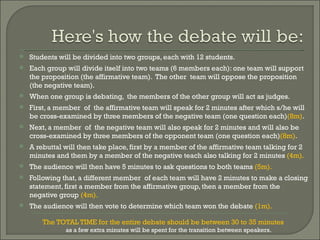
Students will be divided into two groups, each with 12 students.  Each group will divide itself into two teams (6 members each): one team will support the proposition (the affirmative team).  The other  team will oppose the proposition (the negative team). When one group is debating,  the members of the other group will act as judges.  First, a member  of  the affirmative team will speak for 2 minutes after which s/he will be cross-examined by three members of the negative team (one question each) (8m) .  Next, a member  of  the negative team will also speak for 2 minutes and will also be cross-examined by three members of the opponent team (one question each) (8m) .  A rebuttal will then take place, first by a member of the affirmative team talking for 2 minutes and them by a member of the negative teach also talking for 2 minutes  (4m).  The audience will then have 5 minutes to ask questions to both teams  (5m). Following that, a different member  of each team will have 2 minutes to make a closing statement, first a member from the affirmative group, then a member from the negative group  (4m).  The audience will then vote to determine which team won the debate  (1m). The TOTAL TIME for the entire debate should be between 30 to 35 minutes  as a few extra minutes will be spent for the transition between speakers.
How well did the speakers communicate their ideas? How much information did the speakers know about their topic? Were the team members polite? Did the second speaker on each team build on what the first team member had said? Consider…
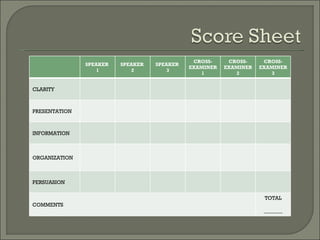
SPEAKER  1 SPEAKER  2 SPEAKER  3 CROSS-EXAMINER 1 CROSS-EXAMINER 2 CROSS-EXAMINER 3 CLARITY PRESENTATION INFORMATION ORGANIZATION PERSUASION COMMENTS TOTAL _______
Each group will be given a proposition.  Research is crucial. Researching and learning specific vocabulary is equally crucial. Here are some links that may be of help: DEBATE CENTRAL http://www.uvm.edu/~debate/learndebate.html INTERNATIONAL DEBATE EDUCATION ASSOCIATION http://www.idebate.org/debatabase/
In recent years, more juveniles (under 18) are being tried as adults when they commit adult crimes. What do you think about this? Hold a classroom debate on the following proposition:  Juveniles should be tried as adults when they commit adult crimes.
Marriage is arguably losing its appeal, claim many social scientists. Divorce is on the increase and statistics show that one out of every three marriages end in divorce.  Hold a classroom debate on the following proposition: The institution of marriage as a religious and legal bond may be considered outdated in today’s society.
DEBATE PROPOSITION 3 Life quality is improving worldwide. People are getting healthier and, as a consequence, living longer than ever. Increased life expectancy has become a major social problem in modern societies.  Hold a classroom debate on the following proposition: State pension age should be determined individually by a medical evaluation taken after 65.
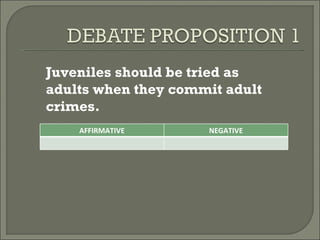
Juveniles should be tried as adults when they commit adult crimes. AFFIRMATIVE NEGATIVE
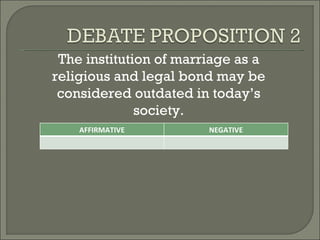
The institution of marriage as a religious and legal bond may be considered outdated in today’s society. AFFIRMATIVE NEGATIVE
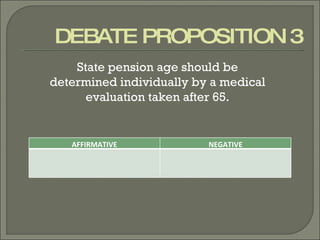
DEBATE PROPOSITION 3 State pension age should be determined individually by a medical evaluation taken after 65. AFFIRMATIVE NEGATIVE
 

Presentation on Debate

  • 1.
    Academic Debate TeachesReading Comprehension Critical Thinking Organization Skills Effective Communication
  • 2.
    When debating, teamsexplore arguments for and against a specific proposition Debating can be an effective and practical learning tool Debating allows several different qualities to emerge, including collecting and organizing ideas, evaluating ideas, seeing logical connections between ideas, adapting to new situations quickly and efficiently, and speaking persuasively.
  • 3.
    As the audienceis acting as a judge in the debate, the debaters should remember a few rules: The debater should not deliver too many facts in a short time. The debater should present the information to the audience as a completed work, not short facts glued together. The language used in a debate must be intelligible, free of jargon and clichés. The speech must be clear, well-organized, and informative Good use of transitions is the key to a good debate.
  • 4.
    Debate is controversialand controversy often becomes heated. However, trying to attack opponents gains nothing. Debaters should display courtesy and show respect for opponents and for the worth of ideas at all times. It is not realistic to take a "right or wrong" attitude toward debate. Speakers should never forget that a good debate is an honest attempt to provide the audience with two different answers to the question asked in the proposition.
  • 5.
    Students will bedivided into two groups, each with 12 students. Each group will divide itself into two teams (6 members each): one team will support the proposition (the affirmative team). The other team will oppose the proposition (the negative team). When one group is debating, the members of the other group will act as judges. First, a member of the affirmative team will speak for 2 minutes after which s/he will be cross-examined by three members of the negative team (one question each) (8m) . Next, a member of the negative team will also speak for 2 minutes and will also be cross-examined by three members of the opponent team (one question each) (8m) . A rebuttal will then take place, first by a member of the affirmative team talking for 2 minutes and them by a member of the negative teach also talking for 2 minutes (4m). The audience will then have 5 minutes to ask questions to both teams (5m). Following that, a different member of each team will have 2 minutes to make a closing statement, first a member from the affirmative group, then a member from the negative group (4m). The audience will then vote to determine which team won the debate (1m). The TOTAL TIME for the entire debate should be between 30 to 35 minutes as a few extra minutes will be spent for the transition between speakers.
  • 6.
    How well didthe speakers communicate their ideas? How much information did the speakers know about their topic? Were the team members polite? Did the second speaker on each team build on what the first team member had said? Consider…
  • 7.
    SPEAKER 1SPEAKER 2 SPEAKER 3 CROSS-EXAMINER 1 CROSS-EXAMINER 2 CROSS-EXAMINER 3 CLARITY PRESENTATION INFORMATION ORGANIZATION PERSUASION COMMENTS TOTAL _______
  • 8.
    Each group willbe given a proposition. Research is crucial. Researching and learning specific vocabulary is equally crucial. Here are some links that may be of help: DEBATE CENTRAL http://www.uvm.edu/~debate/learndebate.html INTERNATIONAL DEBATE EDUCATION ASSOCIATION http://www.idebate.org/debatabase/
  • 9.
    In recent years,more juveniles (under 18) are being tried as adults when they commit adult crimes. What do you think about this? Hold a classroom debate on the following proposition: Juveniles should be tried as adults when they commit adult crimes.
  • 10.
    Marriage is arguablylosing its appeal, claim many social scientists. Divorce is on the increase and statistics show that one out of every three marriages end in divorce. Hold a classroom debate on the following proposition: The institution of marriage as a religious and legal bond may be considered outdated in today’s society.
  • 11.
    DEBATE PROPOSITION 3Life quality is improving worldwide. People are getting healthier and, as a consequence, living longer than ever. Increased life expectancy has become a major social problem in modern societies. Hold a classroom debate on the following proposition: State pension age should be determined individually by a medical evaluation taken after 65.
  • 12.
    Juveniles should betried as adults when they commit adult crimes. AFFIRMATIVE NEGATIVE
  • 13.
    The institution ofmarriage as a religious and legal bond may be considered outdated in today’s society. AFFIRMATIVE NEGATIVE
  • 14.
    DEBATE PROPOSITION 3State pension age should be determined individually by a medical evaluation taken after 65. AFFIRMATIVE NEGATIVE
  • 15.