DEBATE
AND
INTERVIEW
Presented by
T. Nivya
21BDP24
DEBATE
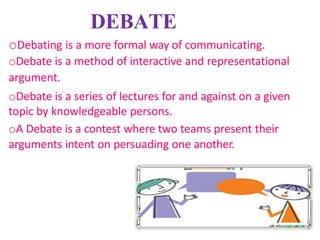
oDebating is a more formal way of communicating.
oDebate is a method of interactive and representational
argument.
oDebate is a series of lectures for and against on a given
topic by knowledgeable persons.
oA Debate is a contest where two teams present their
arguments intent on persuading one another.
RULES OF DEBATE
A debate has two teams: an Affirmative and a Negative.
Each side consists of Three Speakers.
The First Affirmative speaker begins the debate, and is
then followed by the First Negative speaker.
This pattern is maintained for the second and third
speakers of each team.
Each speaker speaks for a set time, with a warning bell, to
give them a little time to sum up and finish, then a final
bell.
There will be a Chair Or Moderator who presides over the
discussion.
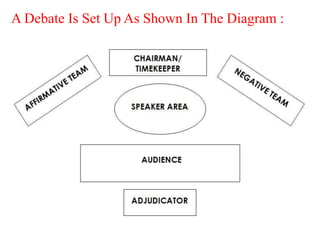
A Debate Is Set Up As Shown In The Diagram :
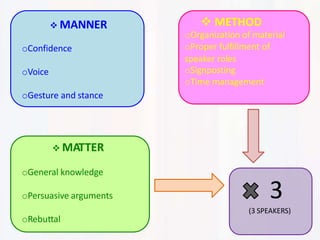
 MANNER
oConfidence
oVoice
oGesture and stance
 METHOD
oOrganization of material
oProper fulfillment of
speaker roles
oSignposting
oTime management
 MATTER
oGeneral knowledge
oPersuasive arguments
oRebuttal
3
(3 SPEAKERS)
Characteristics Of Debate
• It can be easily organized at short notice.
• It helps to attract the attention of audience and hold
it to the end.
• Topics with reference to felt needs may be identified
so as to enthuse the audience throughout the
debate.
• Audience are instigated to think seriously and
analyses by the proceedings of the debate.
• The range of the topic as well as the time can be
prefixed on agreement.
• It enables the participants to have a complete and
unreserved expression of their ideas.
PURPOSES OF DEBATE
Topics of controversial nature are dealt with.
When the group needs to be exposed to the pros
and cons of the topic or decision.
When the participants have the capacity to
present their side in a meaningful and interesting
manner.
There is favorable atmosphere in the group to
accept ideas presented by logical arguments of the
participants.
INTERVIEW
• According to witles
“face to face conversation”
• According to Bingham and Moore (1924) “A conversation with a
purpose”
• According to Lindzey Gardner (1968)
A two-person conversation initiated by the
interviewer for the specific purpose of obtaining
research-relevant information and focused by him
on the content specified by the research objective
of description and explanation.
Characteristics of Interview
• Personal communication: face to face contact,
conversational exchange and verbal interaction.
• Equal status
• Question are asked and responses received
verbally.
• Information is recorded by the interviewer
• The relationship between them is transitory
• The interview is not necessarily limited to two
persons.
• Flexibility in the format of the interview.
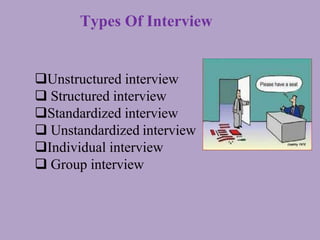
Types Of Interview
Unstructured interview
 Structured interview
Standardized interview
 Unstandardized interview
Individual interview
 Group interview
debate and interview ppt.pptx

debate and interview ppt.pptx

  • 1.
  • 2.
    DEBATE oDebating is amore formal way of communicating. oDebate is a method of interactive and representational argument. oDebate is a series of lectures for and against on a given topic by knowledgeable persons. oA Debate is a contest where two teams present their arguments intent on persuading one another.
  • 3.
    RULES OF DEBATE Adebate has two teams: an Affirmative and a Negative. Each side consists of Three Speakers. The First Affirmative speaker begins the debate, and is then followed by the First Negative speaker. This pattern is maintained for the second and third speakers of each team. Each speaker speaks for a set time, with a warning bell, to give them a little time to sum up and finish, then a final bell. There will be a Chair Or Moderator who presides over the discussion.
  • 4.
    A Debate IsSet Up As Shown In The Diagram :
  • 5.
     MANNER oConfidence oVoice oGesture andstance  METHOD oOrganization of material oProper fulfillment of speaker roles oSignposting oTime management  MATTER oGeneral knowledge oPersuasive arguments oRebuttal 3 (3 SPEAKERS)
  • 6.
    Characteristics Of Debate •It can be easily organized at short notice. • It helps to attract the attention of audience and hold it to the end. • Topics with reference to felt needs may be identified so as to enthuse the audience throughout the debate. • Audience are instigated to think seriously and analyses by the proceedings of the debate. • The range of the topic as well as the time can be prefixed on agreement. • It enables the participants to have a complete and unreserved expression of their ideas.
  • 7.
    PURPOSES OF DEBATE Topicsof controversial nature are dealt with. When the group needs to be exposed to the pros and cons of the topic or decision. When the participants have the capacity to present their side in a meaningful and interesting manner. There is favorable atmosphere in the group to accept ideas presented by logical arguments of the participants.
  • 8.
    INTERVIEW • According towitles “face to face conversation” • According to Bingham and Moore (1924) “A conversation with a purpose”
  • 9.
    • According toLindzey Gardner (1968) A two-person conversation initiated by the interviewer for the specific purpose of obtaining research-relevant information and focused by him on the content specified by the research objective of description and explanation.
  • 10.
    Characteristics of Interview •Personal communication: face to face contact, conversational exchange and verbal interaction. • Equal status • Question are asked and responses received verbally. • Information is recorded by the interviewer • The relationship between them is transitory • The interview is not necessarily limited to two persons. • Flexibility in the format of the interview.
  • 11.
    Types Of Interview Unstructuredinterview  Structured interview Standardized interview  Unstandardized interview Individual interview  Group interview