Academic Debate Teaches

     Reading Comprehension
Academic Debate Teaches

     Reading Comprehension
            Critical Thinking
Academic Debate Teaches

     Reading Comprehension
            Critical Thinking
          Organization Skills
Academic Debate Teaches

     Reading Comprehension
             Critical Thinking
          Organization Skills
     Effective Communication
When debating, teams
explore arguments for and
against a specific
proposition
 Debating  can be an effective and
 practical learning tool
 Debating  allows several different
 qualities to emerge, including
 Debating  allows several different
 qualities to emerge, including
   collecting and organizing ideas,
 Debating  allows several different
 qualities to emerge, including
   collecting and organizing ideas,
   evaluating ideas,
 Debating  allows several different
 qualities to emerge, including
   collecting and organizing ideas,
   evaluating ideas,
   seeing logical connections between ideas,
 Debating  allows several different
 qualities to emerge, including
   collecting and organizing ideas,
   evaluating ideas,
   seeing logical connections between ideas,
   adapting to new situations quickly and
    efficiently, and
 Debating  allows several different
 qualities to emerge, including
   collecting and organizing ideas,
   evaluating ideas,
   seeing logical connections between ideas,
   adapting to new situations quickly and
    efficiently, and
   speaking persuasively.
As the audience is acting
as a judge in the debate,
the debaters should
remember a few rules:
 The debater should not
  deliver too many facts in a
  short time.
 The debater should present the information
  to the audience as a completed work, not
  short facts glued together:
 The debater should present the information
  to the audience as a completed work, not
  short facts glued together:
  STATE your answer to the proposition
   (question)
 The debater should present the information
  to the audience as a completed work, not
  short facts glued together:
  STATE your answer to the proposition
   (question)
  TRANSITION to the PROOF (your
   example[s])
 The debater should present the information
  to the audience as a completed work, not
  short facts glued together:
  STATE your answer to the proposition
   (question)
  TRANSITION to the PROOF (your
   example[s])
  EXPLAIN your example[s] CLEARLY
 The debater should present the information
  to the audience as a completed work, not
  short facts glued together:
  STATE your answer to the proposition
   (question)
  TRANSITION to the PROOF (your
   example[s])
  EXPLAIN your example[s] CLEARLY
  LISTEN to team mates & the opposing side
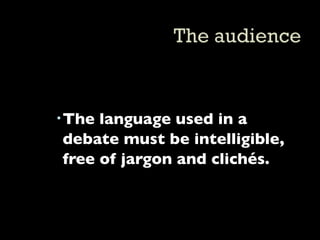
 The language used in a
  debate must be intelligible,
  free of jargon and clichés.
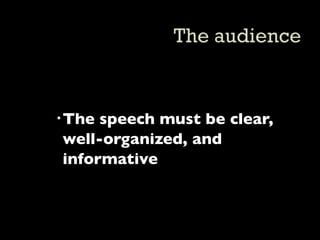
 The speech must be clear,
  well-organized, and
  informative
 Good use of transitions is
  the key to a good debate.
Debate is controversial
and controversy often
becomes heated. However,
trying to attack opponents
gains nothing.
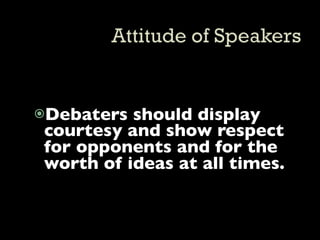
Debaters should display
courtesy and show respect
for opponents and for the
worth of ideas at all times.
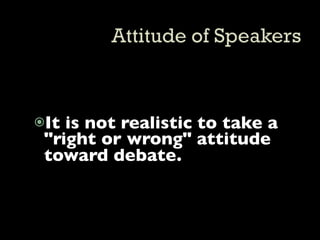
It is not realistic to take a
 "right or wrong" attitude
 toward debate.
Speakers  should never
 forget that a good debate
 is an honest attempt to
 provide the audience with
 two different answers to
 the question asked in the
 proposition.
•Students people each) into 10
 teams (3
          will be divided
•Students people each) into 10
 teams (3
          will be divided
• Odd-numbered teams will support
  the proposition (the affirmative).
• Odd-numbered teams will support
  the proposition (the affirmative).
• The even-numbered teams will
  oppose the proposition (the
 negative).
• Odd-numbered teams will support
  the proposition (the affirmative).
• The even-numbered teams will
  oppose the proposition (the
 negative).
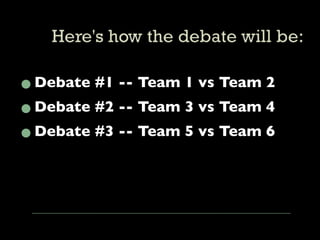
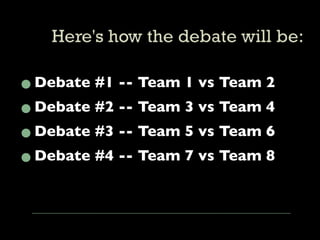
• Debate #1 -- Team 1 vs Team 2
• Debate #2 -- Team 3 vs Team 4
• Debate #1 -- Team 1 vs Team 2
• Debate #2 -- Team 3 vs Team 4
• Debate #3 -- Team 5 vs Team 6
• Debate #1 -- Team 1 vs Team 2
• Debate #2 -- Team 3 vs Team 4
• Debate #3 -- Team 5 vs Team 6
• Debate #4 -- Team 7 vs Team 8
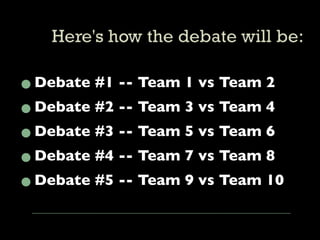
• Debate #1 -- Team 1 vs Team 2
• Debate #2 -- Team 3 vs Team 4
• Debate #3 -- Team 5 vs Team 6
• Debate #4 -- Team 7 vs Team 8
• Debate #5 -- Team 9 vs Team 10
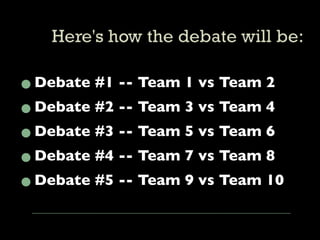
• Debate #1 -- Team 1 vs Team 2
• Debate #2 -- Team 3 vs Team 4
• Debate #3 -- Team 5 vs Team 6
• Debate #4 -- Team 7 vs Team 8
• Debate #5 -- Team 9 vs Team 10
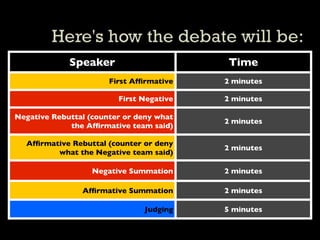
Speaker                       Time
                       First Affirmative   2 minutes

                         First Negative   2 minutes

Negative Rebuttal (counter or deny what
                                          2 minutes
             the Affirmative team said)

  Affirmative Rebuttal (counter or deny
                                          2 minutes
         what the Negative team said)

                   Negative Summation     2 minutes

                Affirmative Summation      2 minutes

                                Judging   5 minutes
The Chairperson’s job:
1. Introduce all participants.
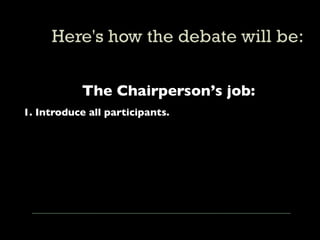
The Chairperson’s job:
1. Introduce all participants.
2. Call on each of them in turn.
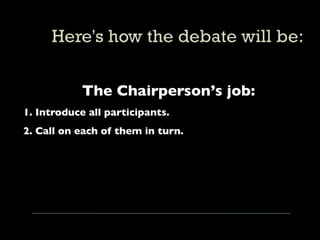
The Chairperson’s job:
1. Introduce all participants.
2. Call on each of them in turn.
3. Act as the timer to indicate to the debaters how
  much time remains in their speeches.
The Chairperson’s job:
1. Introduce all participants.
2. Call on each of them in turn.
3. Act as the timer to indicate to the debaters how
  much time remains in their speeches.
4. Collect the assessment slips, add up the scores, and
  announce the winning team.
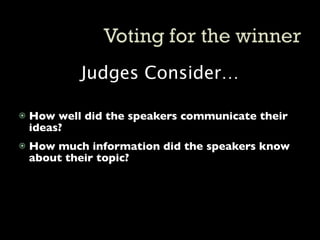
Judges Consider…
Judges Consider…

   How well did the speakers communicate their
    ideas?
Judges Consider…

   How well did the speakers communicate their
    ideas?
   How much information did the speakers know
    about their topic?
Judges Consider…

   How well did the speakers communicate their
    ideas?
   How much information did the speakers know
    about their topic?
   Were the team members polite?
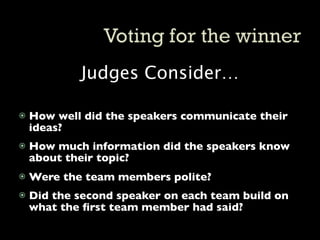
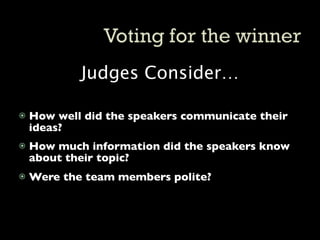
Judges Consider…

   How well did the speakers communicate their
    ideas?
   How much information did the speakers know
    about their topic?
   Were the team members polite?
   Did the second speaker on each team build on
    what the first team member had said?
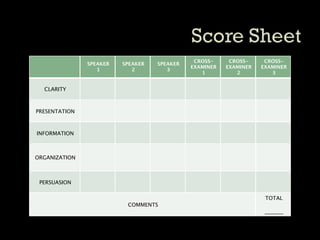
CROSS-     CROSS-     CROSS-
               SPEAKER   SPEAKER   SPEAKER
                                             EXAMINER   EXAMINER   EXAMINER
                  1         2         3
                                                1          2          3


  CLARITY


PRESENTATION


INFORMATION


ORGANIZATION


 PERSUASION

                                                                    TOTAL
                          COMMENTS
                                                                    _______
 Each   group will be given a proposition.
 Research   is crucial.
 Each   group will be given a proposition.
 Research is crucial.
 Researching and learning specific
  vocabulary is equally crucial.
 Each   group will be given a proposition.
 Research is crucial.
 Researching and learning specific
  vocabulary is equally crucial.
 Each   group will be given a proposition.
 Research is crucial.
 Researching and learning specific
  vocabulary is equally crucial.


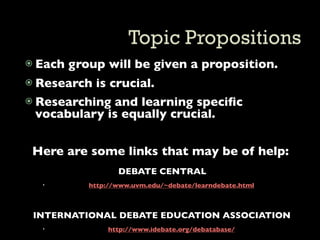
 Here are some links that may be of help:
 Each   group will be given a proposition.
 Research is crucial.
 Researching and learning specific
  vocabulary is equally crucial.


 Here are some links that may be of help:
                   DEBATE CENTRAL
           http://www.uvm.edu/~debate/learndebate.html
 Each   group will be given a proposition.
 Research is crucial.
 Researching and learning specific
  vocabulary is equally crucial.


 Here are some links that may be of help:
                   DEBATE CENTRAL
           http://www.uvm.edu/~debate/learndebate.html
 Each   group will be given a proposition.
 Research is crucial.
 Researching and learning specific
  vocabulary is equally crucial.


 Here are some links that may be of help:
                   DEBATE CENTRAL
           http://www.uvm.edu/~debate/learndebate.html


 INTERNATIONAL DEBATE EDUCATION ASSOCIATION
                http://www.idebate.org/debatabase/
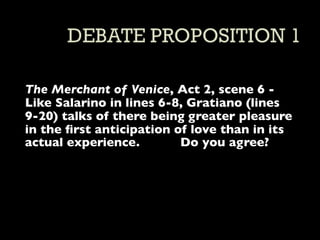
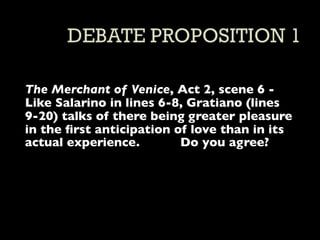
The Merchant of Venice, Act 2, scene 6 -
Like Salarino in lines 6-8, Gratiano (lines
9-20) talks of there being greater pleasure
in the first anticipation of love than in its
actual experience.        Do you agree?
The Merchant of Venice, Act 2, scene 6 -
Like Salarino in lines 6-8, Gratiano (lines
9-20) talks of there being greater pleasure
in the first anticipation of love than in its
actual experience.        Do you agree?
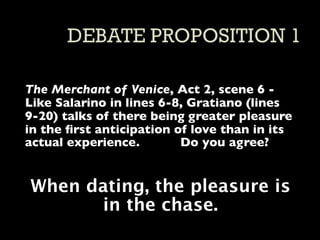
The Merchant of Venice, Act 2, scene 6 -
Like Salarino in lines 6-8, Gratiano (lines
9-20) talks of there being greater pleasure
in the first anticipation of love than in its
actual experience.        Do you agree?


When dating, the pleasure is
      in the chase.

Debates2012

  • 2.
  • 3.
  • 4.
    Academic Debate Teaches Reading Comprehension
  • 5.
    Academic Debate Teaches Reading Comprehension Critical Thinking
  • 6.
    Academic Debate Teaches Reading Comprehension Critical Thinking Organization Skills
  • 7.
    Academic Debate Teaches Reading Comprehension Critical Thinking Organization Skills Effective Communication
  • 9.
    When debating, teams explorearguments for and against a specific proposition
  • 11.
     Debating can be an effective and practical learning tool
  • 14.
     Debating allows several different qualities to emerge, including
  • 15.
     Debating allows several different qualities to emerge, including  collecting and organizing ideas,
  • 16.
     Debating allows several different qualities to emerge, including  collecting and organizing ideas,  evaluating ideas,
  • 17.
     Debating allows several different qualities to emerge, including  collecting and organizing ideas,  evaluating ideas,  seeing logical connections between ideas,
  • 18.
     Debating allows several different qualities to emerge, including  collecting and organizing ideas,  evaluating ideas,  seeing logical connections between ideas,  adapting to new situations quickly and efficiently, and
  • 19.
     Debating allows several different qualities to emerge, including  collecting and organizing ideas,  evaluating ideas,  seeing logical connections between ideas,  adapting to new situations quickly and efficiently, and  speaking persuasively.
  • 21.
    As the audienceis acting as a judge in the debate, the debaters should remember a few rules:
  • 23.
     The debatershould not deliver too many facts in a short time.
  • 25.
     The debatershould present the information to the audience as a completed work, not short facts glued together:
  • 26.
     The debatershould present the information to the audience as a completed work, not short facts glued together:  STATE your answer to the proposition (question)
  • 27.
     The debatershould present the information to the audience as a completed work, not short facts glued together:  STATE your answer to the proposition (question)  TRANSITION to the PROOF (your example[s])
  • 28.
     The debatershould present the information to the audience as a completed work, not short facts glued together:  STATE your answer to the proposition (question)  TRANSITION to the PROOF (your example[s])  EXPLAIN your example[s] CLEARLY
  • 29.
     The debatershould present the information to the audience as a completed work, not short facts glued together:  STATE your answer to the proposition (question)  TRANSITION to the PROOF (your example[s])  EXPLAIN your example[s] CLEARLY  LISTEN to team mates & the opposing side
  • 31.
     The languageused in a debate must be intelligible, free of jargon and clichés.
  • 33.
     The speechmust be clear, well-organized, and informative
  • 35.
     Good useof transitions is the key to a good debate.
  • 37.
    Debate is controversial andcontroversy often becomes heated. However, trying to attack opponents gains nothing.
  • 39.
    Debaters should display courtesyand show respect for opponents and for the worth of ideas at all times.
  • 41.
    It is notrealistic to take a "right or wrong" attitude toward debate.
  • 43.
    Speakers shouldnever forget that a good debate is an honest attempt to provide the audience with two different answers to the question asked in the proposition.
  • 45.
    •Students people each)into 10 teams (3 will be divided
  • 46.
    •Students people each)into 10 teams (3 will be divided
  • 48.
    • Odd-numbered teamswill support the proposition (the affirmative).
  • 49.
    • Odd-numbered teamswill support the proposition (the affirmative). • The even-numbered teams will oppose the proposition (the negative).
  • 50.
    • Odd-numbered teamswill support the proposition (the affirmative). • The even-numbered teams will oppose the proposition (the negative).
  • 52.
    • Debate #1-- Team 1 vs Team 2
  • 53.
    • Debate #1-- Team 1 vs Team 2 • Debate #2 -- Team 3 vs Team 4
  • 54.
    • Debate #1-- Team 1 vs Team 2 • Debate #2 -- Team 3 vs Team 4 • Debate #3 -- Team 5 vs Team 6
  • 55.
    • Debate #1-- Team 1 vs Team 2 • Debate #2 -- Team 3 vs Team 4 • Debate #3 -- Team 5 vs Team 6 • Debate #4 -- Team 7 vs Team 8
  • 56.
    • Debate #1-- Team 1 vs Team 2 • Debate #2 -- Team 3 vs Team 4 • Debate #3 -- Team 5 vs Team 6 • Debate #4 -- Team 7 vs Team 8 • Debate #5 -- Team 9 vs Team 10
  • 57.
    • Debate #1-- Team 1 vs Team 2 • Debate #2 -- Team 3 vs Team 4 • Debate #3 -- Team 5 vs Team 6 • Debate #4 -- Team 7 vs Team 8 • Debate #5 -- Team 9 vs Team 10
  • 58.
    Speaker Time First Affirmative 2 minutes First Negative 2 minutes Negative Rebuttal (counter or deny what 2 minutes the Affirmative team said) Affirmative Rebuttal (counter or deny 2 minutes what the Negative team said) Negative Summation 2 minutes Affirmative Summation 2 minutes Judging 5 minutes
  • 60.
  • 61.
    The Chairperson’s job: 1.Introduce all participants.
  • 62.
    The Chairperson’s job: 1.Introduce all participants. 2. Call on each of them in turn.
  • 63.
    The Chairperson’s job: 1.Introduce all participants. 2. Call on each of them in turn. 3. Act as the timer to indicate to the debaters how much time remains in their speeches.
  • 64.
    The Chairperson’s job: 1.Introduce all participants. 2. Call on each of them in turn. 3. Act as the timer to indicate to the debaters how much time remains in their speeches. 4. Collect the assessment slips, add up the scores, and announce the winning team.
  • 65.
  • 66.
    Judges Consider…  How well did the speakers communicate their ideas?
  • 67.
    Judges Consider…  How well did the speakers communicate their ideas?  How much information did the speakers know about their topic?
  • 68.
    Judges Consider…  How well did the speakers communicate their ideas?  How much information did the speakers know about their topic?  Were the team members polite?
  • 69.
    Judges Consider…  How well did the speakers communicate their ideas?  How much information did the speakers know about their topic?  Were the team members polite?  Did the second speaker on each team build on what the first team member had said?
  • 70.
    CROSS- CROSS- CROSS- SPEAKER SPEAKER SPEAKER EXAMINER EXAMINER EXAMINER 1 2 3 1 2 3 CLARITY PRESENTATION INFORMATION ORGANIZATION PERSUASION TOTAL COMMENTS _______
  • 72.
     Each group will be given a proposition.
  • 73.
     Each group will be given a proposition.  Research is crucial.
  • 74.
     Each group will be given a proposition.  Research is crucial.  Researching and learning specific vocabulary is equally crucial.
  • 75.
     Each group will be given a proposition.  Research is crucial.  Researching and learning specific vocabulary is equally crucial.
  • 76.
     Each group will be given a proposition.  Research is crucial.  Researching and learning specific vocabulary is equally crucial. Here are some links that may be of help:
  • 77.
     Each group will be given a proposition.  Research is crucial.  Researching and learning specific vocabulary is equally crucial. Here are some links that may be of help: DEBATE CENTRAL  http://www.uvm.edu/~debate/learndebate.html
  • 78.
     Each group will be given a proposition.  Research is crucial.  Researching and learning specific vocabulary is equally crucial. Here are some links that may be of help: DEBATE CENTRAL  http://www.uvm.edu/~debate/learndebate.html
  • 79.
     Each group will be given a proposition.  Research is crucial.  Researching and learning specific vocabulary is equally crucial. Here are some links that may be of help: DEBATE CENTRAL  http://www.uvm.edu/~debate/learndebate.html INTERNATIONAL DEBATE EDUCATION ASSOCIATION  http://www.idebate.org/debatabase/
  • 81.
    The Merchant ofVenice, Act 2, scene 6 - Like Salarino in lines 6-8, Gratiano (lines 9-20) talks of there being greater pleasure in the first anticipation of love than in its actual experience. Do you agree?
  • 82.
    The Merchant ofVenice, Act 2, scene 6 - Like Salarino in lines 6-8, Gratiano (lines 9-20) talks of there being greater pleasure in the first anticipation of love than in its actual experience. Do you agree?
  • 83.
    The Merchant ofVenice, Act 2, scene 6 - Like Salarino in lines 6-8, Gratiano (lines 9-20) talks of there being greater pleasure in the first anticipation of love than in its actual experience. Do you agree? When dating, the pleasure is in the chase.