Managing Absenteeism Danielle Gonzalez, Director · Office of Human Resources dg3@williams.edu · x 3129
dg3@Williams.edu | ext 3129
Director of Human Resources
Danielle Gonzalez
Dealing with Performance Problems
Managing Absenteeism Danielle Gonzalez, Director · Office of Human Resources dg3@williams.edu · x 3129
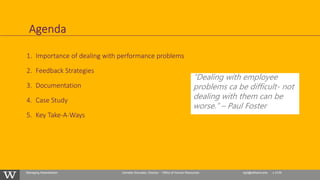
1. Importance of dealing with performance problems
2. Feedback Strategies
3. Documentation
4. Case Study
5. Key Take-A-Ways
Agenda
“Dealing with employee
problems ca be difficult- not
dealing with them can be
worse.” – Paul Foster
Managing Absenteeism Danielle Gonzalez, Director · Office of Human Resources dg3@williams.edu · x 3129
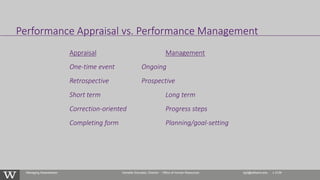
Performance Appraisal vs. Performance Management
Appraisal Management
One-time event Ongoing
Retrospective Prospective
Short term Long term
Correction-oriented Progress steps
Completing form Planning/goal-setting
Managing Absenteeism Danielle Gonzalez, Director · Office of Human Resources dg3@williams.edu · x 3129
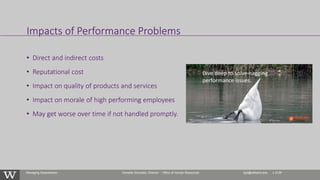
• Direct and indirect costs
• Reputational cost
• Impact on quality of products and services
• Impact on morale of high performing employees
• May get worse over time if not handled promptly.
Impacts of Performance Problems
Managing Absenteeism Danielle Gonzalez, Director · Office of Human Resources dg3@williams.edu · x 3129
Feedback
Managing Absenteeism Danielle Gonzalez, Director · Office of Human Resources dg3@williams.edu · x 3129
• What are the specific behaviors that are problematic?
• What positive behaviors would you like to see in the future?
• What are the impacts? How do you notice them? Can they
be measured?
• How frequent and sustained are the behaviors?
• What do you NOT know about this situation? How can you
find out?
Research and Prepare
Managing Absenteeism Danielle Gonzalez, Director · Office of Human Resources dg3@williams.edu · x 3129
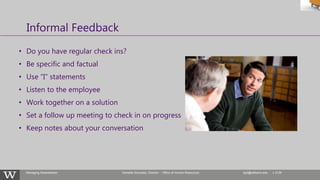
Informal Feedback
• Do you have regular check ins?
• Be specific and factual
• Use “I” statements
• Listen to the employee
• Work together on a solution
• Set a follow up meeting to check in on progress
• Keep notes about your conversation
Managing Absenteeism Danielle Gonzalez, Director · Office of Human Resources dg3@williams.edu · x 3129
• Many performance problems can be an indirect result of
employee personal problems.
• Refer employee to the Employee Assistance Program
If Employee Mentions Other Personal Problems
Managing Absenteeism Danielle Gonzalez, Director · Office of Human Resources dg3@williams.edu · x 3129
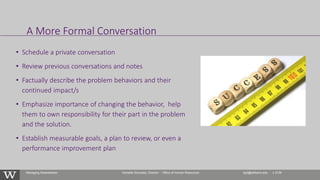
• Schedule a private conversation
• Review previous conversations and notes
• Factually describe the problem behaviors and their
continued impact/s
• Emphasize importance of changing the behavior, help
them to own responsibility for their part in the problem
and the solution.
• Establish measurable goals, a plan to review, or even a
performance improvement plan
A More Formal Conversation
Managing Absenteeism Danielle Gonzalez, Director · Office of Human Resources dg3@williams.edu · x 3129
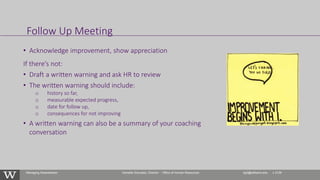
• Acknowledge improvement, show appreciation
If there’s not:
• Draft a written warning and ask HR to review
• The written warning should include:
o history so far,
o measurable expected progress,
o date for follow up,
o consequences for not improving
• A written warning can also be a summary of your coaching
conversation
Follow Up Meeting
Managing Absenteeism Danielle Gonzalez, Director · Office of Human Resources dg3@williams.edu · x 3129
Documentation
Managing Absenteeism Danielle Gonzalez, Director · Office of Human Resources dg3@williams.edu · x 3129
• Establishes a record of employment actions taken and the reasons for the actions. Memories fail,
managers move on and other circumstances change.
• Informs employees of what is expected of them and the consequences if they do not meet
expectations. Employees should never be surprised when they are in a termination meeting.
• From a performance management standpoint, it serves as a written record to guide both the
employer’s and the employee’s future behavior. It gives the employee the opportunity to improve.
• Serves as evidence of the employer’s business reasons for actions taken, in the event an employee
takes formal or informal steps with a claim against a manager or employer.
• Brings about fair and equitable treatment. No one wants to be blindsided or treated differently than
other employees.
Why Its Important
Managing Absenteeism Danielle Gonzalez, Director · Office of Human Resources dg3@williams.edu · x 3129
• Handwritten or typed notes from coaching and counseling sessions with employees.
• Follow-up email summarizing a performance discussion meeting.
• Written comments including specific examples in performance reviews.
• Disciplinary actions, such as warning documents with specific examples and consequences.
• Explanations with business reasons for employment actions such as demotions, promotions,
and layoffs.
Type of Documentation
Managing Absenteeism Danielle Gonzalez, Director · Office of Human Resources dg3@williams.edu · x 3129
• The employer’s expectation.
• How the employee has failed to meet that expectation.
• Prior counseling or discipline.
• The employer’s expectations for the employee going
forward.
• The consequences of the employee’s failure to make
the requisite improvement.
Effective Documentation
Managing Absenteeism Danielle Gonzalez, Director · Office of Human Resources dg3@williams.edu · x 3129
• Using labels without providing behavioral examples.
• Using words that sound like “proxies” for bias or retaliation.
• Focusing on the employee’s intent (as opposed to results).
• Focusing on the perceived cause of a performance problem as opposed to the
problem itself.
• Using absolutes that are not credible.
• Including everything an employee has ever done wrong/overkill.
• Using technical rather than plain language.
• Failing to make clear the consequences of lack of improvement.
Common disciplinary documentation mistakes include:
Managing Absenteeism Danielle Gonzalez, Director · Office of Human Resources dg3@williams.edu · x 3129
• Performance or attendance does not improve, and there are negative impacts to work,
morale, and eventually the manager’s own performance.
• Increased frustration by manager and co-workers.
• Misunderstandings on interpretation of discussion.
• Employees not equitably treated; may have discrimination claims.
• Employees not treated fairly; may have wrongful termination claims.
• Lack of documented formal evidence for defense in the event of legal claims.
Implications For Not Documenting
Managing Absenteeism Danielle Gonzalez, Director · Office of Human Resources dg3@williams.edu · x 3129
• Draft and send to HR (Danielle or Tammi) for approval before
giving to employee
• Write in factual, non-pejorative language. Describe behaviors,
don’t label the person.
• Ongoing concerns may be accompanied by a Performance
Improvement Plan
• Copy will be put into personnel file
Formal Written Warnings
Managing Absenteeism Danielle Gonzalez, Director · Office of Human Resources dg3@williams.edu · x 3129
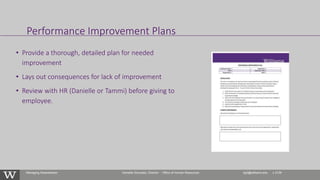
• Provide a thorough, detailed plan for needed
improvement
• Lays out consequences for lack of improvement
• Review with HR (Danielle or Tammi) before giving to
employee.
Performance Improvement Plans
Managing Absenteeism Danielle Gonzalez, Director · Office of Human Resources dg3@williams.edu · x 3129
If no progress after first written warning:
• Draft a final written warning
• Have it reviewed by HR
• Meet with employee to review lack of progress
• Give final written warning to employee
Final Written Warning
Managing Absenteeism Danielle Gonzalez, Director · Office of Human Resources dg3@williams.edu · x 3129
Ask yourself, will this be a surprise to the employee?
Have you made performance expectations clear?
Have you given the individual the opportunity to correct
the behavior?
If no progress after final written warning, consult with
HR for advice on termination procedures.
Discharge
Managing Absenteeism Danielle Gonzalez, Director · Office of Human Resources dg3@williams.edu · x 3129
What would you do?
Case Study
Managing Absenteeism Danielle Gonzalez, Director · Office of Human Resources dg3@williams.edu · x 3129
Key Take-A-Ways
Managing Absenteeism Danielle Gonzalez, Director · Office of Human Resources dg3@williams.edu · x 3129
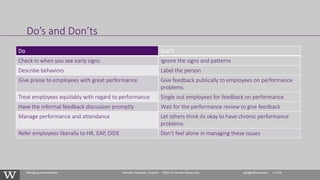
Do’s and Don’ts
Do Don’t
Check in when you see early signs Ignore the signs and patterns
Describe behaviors Label the person
Give praise to employees with great performance Give feedback publically to employees on performance
problems
Treat employees equitably with regard to performance Single out employees for feedback on performance
Have the informal feedback discussion promptly Wait for the performance review to give feedback
Manage performance and attendance Let others think its okay to have chronic performance
problems
Refer employees liberally to HR, EAP, OIDE Don’t feel alone in managing these issues
Managing Absenteeism Danielle Gonzalez, Director · Office of Human Resources dg3@williams.edu · x 3129
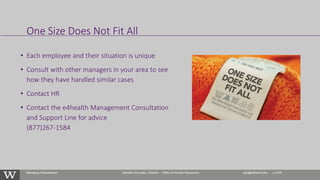
• Each employee and their situation is unique
• Consult with other managers in your area to see
how they have handled similar cases
• Contact HR
• Contact the e4health Management Consultation
and Support Line for advice
(877)267-1584
One Size Does Not Fit All
Managing Absenteeism Danielle Gonzalez, Director · Office of Human Resources dg3@williams.edu · x 3129
• Documentation is important for both the employer and the employee.
• Good documentation answers the questions who, what, where, and when.
• Document early. Do not wait.
• Discussion without documentation equals misunderstandings.
• Discuss and document only the facts.
• Give specific examples for how the employee is not meeting expectations and specific guidance
for how the employee can improve.
Summary
Managing Absenteeism Danielle Gonzalez, Director · Office of Human Resources dg3@williams.edu · x 3129
At the heart of a positive employee relations strategy,
its about managing relationships and communicating
effectively.

Dealing with Performance Problems

  • 1.
    Managing Absenteeism DanielleGonzalez, Director · Office of Human Resources dg3@williams.edu · x 3129 dg3@Williams.edu | ext 3129 Director of Human Resources Danielle Gonzalez Dealing with Performance Problems
  • 2.
    Managing Absenteeism DanielleGonzalez, Director · Office of Human Resources dg3@williams.edu · x 3129 1. Importance of dealing with performance problems 2. Feedback Strategies 3. Documentation 4. Case Study 5. Key Take-A-Ways Agenda “Dealing with employee problems ca be difficult- not dealing with them can be worse.” – Paul Foster
  • 3.
    Managing Absenteeism DanielleGonzalez, Director · Office of Human Resources dg3@williams.edu · x 3129 Performance Appraisal vs. Performance Management Appraisal Management One-time event Ongoing Retrospective Prospective Short term Long term Correction-oriented Progress steps Completing form Planning/goal-setting
  • 4.
    Managing Absenteeism DanielleGonzalez, Director · Office of Human Resources dg3@williams.edu · x 3129 • Direct and indirect costs • Reputational cost • Impact on quality of products and services • Impact on morale of high performing employees • May get worse over time if not handled promptly. Impacts of Performance Problems
  • 5.
    Managing Absenteeism DanielleGonzalez, Director · Office of Human Resources dg3@williams.edu · x 3129 Feedback
  • 6.
    Managing Absenteeism DanielleGonzalez, Director · Office of Human Resources dg3@williams.edu · x 3129 • What are the specific behaviors that are problematic? • What positive behaviors would you like to see in the future? • What are the impacts? How do you notice them? Can they be measured? • How frequent and sustained are the behaviors? • What do you NOT know about this situation? How can you find out? Research and Prepare
  • 7.
    Managing Absenteeism DanielleGonzalez, Director · Office of Human Resources dg3@williams.edu · x 3129 Informal Feedback • Do you have regular check ins? • Be specific and factual • Use “I” statements • Listen to the employee • Work together on a solution • Set a follow up meeting to check in on progress • Keep notes about your conversation
  • 8.
    Managing Absenteeism DanielleGonzalez, Director · Office of Human Resources dg3@williams.edu · x 3129 • Many performance problems can be an indirect result of employee personal problems. • Refer employee to the Employee Assistance Program If Employee Mentions Other Personal Problems
  • 9.
    Managing Absenteeism DanielleGonzalez, Director · Office of Human Resources dg3@williams.edu · x 3129 • Schedule a private conversation • Review previous conversations and notes • Factually describe the problem behaviors and their continued impact/s • Emphasize importance of changing the behavior, help them to own responsibility for their part in the problem and the solution. • Establish measurable goals, a plan to review, or even a performance improvement plan A More Formal Conversation
  • 10.
    Managing Absenteeism DanielleGonzalez, Director · Office of Human Resources dg3@williams.edu · x 3129 • Acknowledge improvement, show appreciation If there’s not: • Draft a written warning and ask HR to review • The written warning should include: o history so far, o measurable expected progress, o date for follow up, o consequences for not improving • A written warning can also be a summary of your coaching conversation Follow Up Meeting
  • 11.
    Managing Absenteeism DanielleGonzalez, Director · Office of Human Resources dg3@williams.edu · x 3129 Documentation
  • 12.
    Managing Absenteeism DanielleGonzalez, Director · Office of Human Resources dg3@williams.edu · x 3129 • Establishes a record of employment actions taken and the reasons for the actions. Memories fail, managers move on and other circumstances change. • Informs employees of what is expected of them and the consequences if they do not meet expectations. Employees should never be surprised when they are in a termination meeting. • From a performance management standpoint, it serves as a written record to guide both the employer’s and the employee’s future behavior. It gives the employee the opportunity to improve. • Serves as evidence of the employer’s business reasons for actions taken, in the event an employee takes formal or informal steps with a claim against a manager or employer. • Brings about fair and equitable treatment. No one wants to be blindsided or treated differently than other employees. Why Its Important
  • 13.
    Managing Absenteeism DanielleGonzalez, Director · Office of Human Resources dg3@williams.edu · x 3129 • Handwritten or typed notes from coaching and counseling sessions with employees. • Follow-up email summarizing a performance discussion meeting. • Written comments including specific examples in performance reviews. • Disciplinary actions, such as warning documents with specific examples and consequences. • Explanations with business reasons for employment actions such as demotions, promotions, and layoffs. Type of Documentation
  • 14.
    Managing Absenteeism DanielleGonzalez, Director · Office of Human Resources dg3@williams.edu · x 3129 • The employer’s expectation. • How the employee has failed to meet that expectation. • Prior counseling or discipline. • The employer’s expectations for the employee going forward. • The consequences of the employee’s failure to make the requisite improvement. Effective Documentation
  • 15.
    Managing Absenteeism DanielleGonzalez, Director · Office of Human Resources dg3@williams.edu · x 3129 • Using labels without providing behavioral examples. • Using words that sound like “proxies” for bias or retaliation. • Focusing on the employee’s intent (as opposed to results). • Focusing on the perceived cause of a performance problem as opposed to the problem itself. • Using absolutes that are not credible. • Including everything an employee has ever done wrong/overkill. • Using technical rather than plain language. • Failing to make clear the consequences of lack of improvement. Common disciplinary documentation mistakes include:
  • 16.
    Managing Absenteeism DanielleGonzalez, Director · Office of Human Resources dg3@williams.edu · x 3129 • Performance or attendance does not improve, and there are negative impacts to work, morale, and eventually the manager’s own performance. • Increased frustration by manager and co-workers. • Misunderstandings on interpretation of discussion. • Employees not equitably treated; may have discrimination claims. • Employees not treated fairly; may have wrongful termination claims. • Lack of documented formal evidence for defense in the event of legal claims. Implications For Not Documenting
  • 17.
    Managing Absenteeism DanielleGonzalez, Director · Office of Human Resources dg3@williams.edu · x 3129 • Draft and send to HR (Danielle or Tammi) for approval before giving to employee • Write in factual, non-pejorative language. Describe behaviors, don’t label the person. • Ongoing concerns may be accompanied by a Performance Improvement Plan • Copy will be put into personnel file Formal Written Warnings
  • 18.
    Managing Absenteeism DanielleGonzalez, Director · Office of Human Resources dg3@williams.edu · x 3129 • Provide a thorough, detailed plan for needed improvement • Lays out consequences for lack of improvement • Review with HR (Danielle or Tammi) before giving to employee. Performance Improvement Plans
  • 19.
    Managing Absenteeism DanielleGonzalez, Director · Office of Human Resources dg3@williams.edu · x 3129 If no progress after first written warning: • Draft a final written warning • Have it reviewed by HR • Meet with employee to review lack of progress • Give final written warning to employee Final Written Warning
  • 20.
    Managing Absenteeism DanielleGonzalez, Director · Office of Human Resources dg3@williams.edu · x 3129 Ask yourself, will this be a surprise to the employee? Have you made performance expectations clear? Have you given the individual the opportunity to correct the behavior? If no progress after final written warning, consult with HR for advice on termination procedures. Discharge
  • 21.
    Managing Absenteeism DanielleGonzalez, Director · Office of Human Resources dg3@williams.edu · x 3129 What would you do? Case Study
  • 22.
    Managing Absenteeism DanielleGonzalez, Director · Office of Human Resources dg3@williams.edu · x 3129 Key Take-A-Ways
  • 23.
    Managing Absenteeism DanielleGonzalez, Director · Office of Human Resources dg3@williams.edu · x 3129 Do’s and Don’ts Do Don’t Check in when you see early signs Ignore the signs and patterns Describe behaviors Label the person Give praise to employees with great performance Give feedback publically to employees on performance problems Treat employees equitably with regard to performance Single out employees for feedback on performance Have the informal feedback discussion promptly Wait for the performance review to give feedback Manage performance and attendance Let others think its okay to have chronic performance problems Refer employees liberally to HR, EAP, OIDE Don’t feel alone in managing these issues
  • 24.
    Managing Absenteeism DanielleGonzalez, Director · Office of Human Resources dg3@williams.edu · x 3129 • Each employee and their situation is unique • Consult with other managers in your area to see how they have handled similar cases • Contact HR • Contact the e4health Management Consultation and Support Line for advice (877)267-1584 One Size Does Not Fit All
  • 25.
    Managing Absenteeism DanielleGonzalez, Director · Office of Human Resources dg3@williams.edu · x 3129 • Documentation is important for both the employer and the employee. • Good documentation answers the questions who, what, where, and when. • Document early. Do not wait. • Discussion without documentation equals misunderstandings. • Discuss and document only the facts. • Give specific examples for how the employee is not meeting expectations and specific guidance for how the employee can improve. Summary
  • 26.
    Managing Absenteeism DanielleGonzalez, Director · Office of Human Resources dg3@williams.edu · x 3129 At the heart of a positive employee relations strategy, its about managing relationships and communicating effectively.

Editor's Notes

  • #9 The Management Resource Consultation (MRC) line is a dedicated number, staffed by senior clinical consultants who are specifically equipped to provide high level consultation and response around critical incidents, performance issues, and sensitive or high risk cases.