High..Middle..Low..
By: Rachel Provau
Conducting High Middle Low conversations
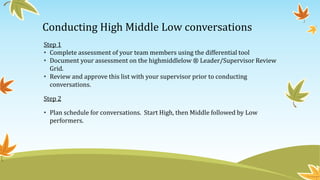
Step 1
• Complete assessment of your team members using the differential tool
• Document your assessment on the highmiddlelow ® Leader/Supervisor Review
Grid.
• Review and approve this list with your supervisor prior to conducting
conversations.
Step 2
• Plan schedule for conversations. Start High, then Middle followed by Low
performers.
Conducting High Middle Low conversations
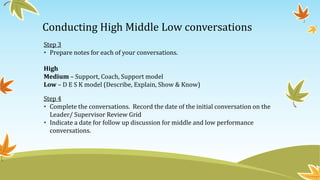
Step 3
• Prepare notes for each of your conversations.
High
Medium – Support, Coach, Support model
Low – D E S K model (Describe, Explain, Show & Know)
Step 4
• Complete the conversations. Record the date of the initial conversation on the
Leader/ Supervisor Review Grid
• Indicate a date for follow up discussion for middle and low performance
conversations.
Conducting High Middle Low conversations
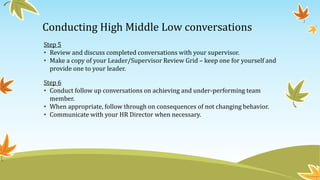
Step 5
• Review and discuss completed conversations with your supervisor.
• Make a copy of your Leader/Supervisor Review Grid – keep one for yourself and
provide one to your leader.
Step 6
• Conduct follow up conversations on achieving and under-performing team
member.
• When appropriate, follow through on consequences of not changing behavior.
• Communicate with your HR Director when necessary.
Highmiddlelow ® Conversations
• What it is?
• Why we do it?
• How we do it?
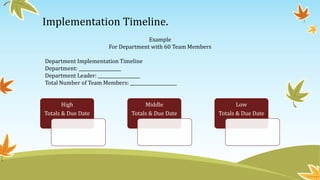
Implementation Timeline.
High
Totals & Due Date
Middle
Totals & Due Date
Low
Totals & Due Date
Example
For Department with 60 Team Members
Department Implementation Timeline
Department: ___________________
Department Leader: ___________________
Total Number of Team Members: _____________________
Differentiating Leaders Worksheet
Overall:
• Aggressively asks for input from staff?
• Becomes complacent when goals are met. Is a spectator who waits for
someone else to go first.
• Only knows how to impact their own department/ organization to get a
task accomplished. Does not transfer knowledge or information across
the organization/ system.
Behavior:
• Requires coaching to make tough decisions.
• Does not make excuses.
• Loyal to staff rather than patients.
Safety Awareness:
• You relax when you know they are scheduled.
• Helps manager to be aware of problems.
• Passive aggressive.
Differentiating Leaders Worksheet
Professionalism:
• Demonstrates little commitment to the work unit and the organization.
• Adheres to unit policy concerning breaks, personal phone calls, leaving
the work area, and other absences from work.
• Committed to improving performance of the work unit and
organization. May require coaching to fully execute.
Teamwork:
• Usually adheres to unit policies, concerning breaks, personal phone
calls, leaving the work area, and other absences from work.
• Demonstrates high commitment to making things better for the work
unit and organization as a whole.
• Does not communicate effectively about absences from work areas.
Handles personal phone calls in a manner that interferes with work.
Breaks last longer than allowed.
Differentiating Leaders Worksheet
Knowledge & Competence:
• Eager to change for the good of the organization.
• Invested in own professional development.
• Shows little interest in improving own performance or the
performance of the organization.
Communication:
• Comes to work with a positive attitude.
• Usually comes to work with a positive attitude.
• Comes to work with a negative attitude.
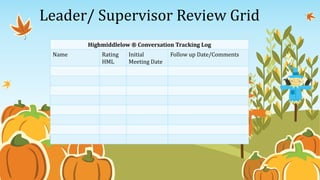
Leader/ Supervisor Review Grid
Highmiddlelow ® Conversation Tracking Log
Name Rating
HML
Initial
Meeting Date
Follow up Date/Comments
Handling Difficult Situations..
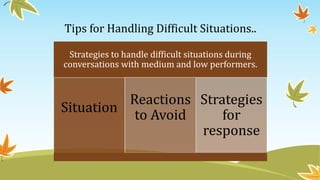
Tips for Handling Difficult Situations..
Strategies to handle difficult situations during
conversations with medium and low performers.
Situation
Reactions
to Avoid
Strategies
for
response
Highmiddlelow ® Performer conversations –
Role Play Scenarios.
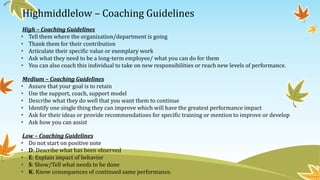
Highmiddlelow – Coaching Guidelines
High – Coaching Guidelines
• Tell them where the organization/department is going
• Thank them for their contribution
• Articulate their specific value or exemplary work
• Ask what they need to be a long-term employee/ what you can do for them
• You can also coach this individual to take on new responsibilities or reach new levels of performance.
Medium – Coaching Guidelines
• Assure that your goal is to retain
• Use the support, coach, support model
• Describe what they do well that you want them to continue
• Identify one single thing they can improve which will have the greatest performance impact
• Ask for their ideas or provide recommendations for specific training or mention to improve or develop
• Ask how you can assist
Low – Coaching Guidelines
• Do not start on positive note
• D: Describe what has been observed
• E: Explain impact of behavior
• S: Show/Tell what needs to be done
• K: Know consequences of continued same performance.
What is High Middle and Low ?

What is High Middle and Low ?

  • 1.
  • 2.
    Conducting High MiddleLow conversations Step 1 • Complete assessment of your team members using the differential tool • Document your assessment on the highmiddlelow ® Leader/Supervisor Review Grid. • Review and approve this list with your supervisor prior to conducting conversations. Step 2 • Plan schedule for conversations. Start High, then Middle followed by Low performers.
  • 3.
    Conducting High MiddleLow conversations Step 3 • Prepare notes for each of your conversations. High Medium – Support, Coach, Support model Low – D E S K model (Describe, Explain, Show & Know) Step 4 • Complete the conversations. Record the date of the initial conversation on the Leader/ Supervisor Review Grid • Indicate a date for follow up discussion for middle and low performance conversations.
  • 4.
    Conducting High MiddleLow conversations Step 5 • Review and discuss completed conversations with your supervisor. • Make a copy of your Leader/Supervisor Review Grid – keep one for yourself and provide one to your leader. Step 6 • Conduct follow up conversations on achieving and under-performing team member. • When appropriate, follow through on consequences of not changing behavior. • Communicate with your HR Director when necessary.
  • 5.
    Highmiddlelow ® Conversations •What it is? • Why we do it? • How we do it?
  • 6.
    Implementation Timeline. High Totals &Due Date Middle Totals & Due Date Low Totals & Due Date Example For Department with 60 Team Members Department Implementation Timeline Department: ___________________ Department Leader: ___________________ Total Number of Team Members: _____________________
  • 7.
    Differentiating Leaders Worksheet Overall: •Aggressively asks for input from staff? • Becomes complacent when goals are met. Is a spectator who waits for someone else to go first. • Only knows how to impact their own department/ organization to get a task accomplished. Does not transfer knowledge or information across the organization/ system. Behavior: • Requires coaching to make tough decisions. • Does not make excuses. • Loyal to staff rather than patients. Safety Awareness: • You relax when you know they are scheduled. • Helps manager to be aware of problems. • Passive aggressive.
  • 8.
    Differentiating Leaders Worksheet Professionalism: •Demonstrates little commitment to the work unit and the organization. • Adheres to unit policy concerning breaks, personal phone calls, leaving the work area, and other absences from work. • Committed to improving performance of the work unit and organization. May require coaching to fully execute. Teamwork: • Usually adheres to unit policies, concerning breaks, personal phone calls, leaving the work area, and other absences from work. • Demonstrates high commitment to making things better for the work unit and organization as a whole. • Does not communicate effectively about absences from work areas. Handles personal phone calls in a manner that interferes with work. Breaks last longer than allowed.
  • 9.
    Differentiating Leaders Worksheet Knowledge& Competence: • Eager to change for the good of the organization. • Invested in own professional development. • Shows little interest in improving own performance or the performance of the organization. Communication: • Comes to work with a positive attitude. • Usually comes to work with a positive attitude. • Comes to work with a negative attitude.
  • 10.
    Leader/ Supervisor ReviewGrid Highmiddlelow ® Conversation Tracking Log Name Rating HML Initial Meeting Date Follow up Date/Comments
  • 11.
  • 12.
    Tips for HandlingDifficult Situations.. Strategies to handle difficult situations during conversations with medium and low performers. Situation Reactions to Avoid Strategies for response
  • 13.
    Highmiddlelow ® Performerconversations – Role Play Scenarios.
  • 14.
    Highmiddlelow – CoachingGuidelines High – Coaching Guidelines • Tell them where the organization/department is going • Thank them for their contribution • Articulate their specific value or exemplary work • Ask what they need to be a long-term employee/ what you can do for them • You can also coach this individual to take on new responsibilities or reach new levels of performance. Medium – Coaching Guidelines • Assure that your goal is to retain • Use the support, coach, support model • Describe what they do well that you want them to continue • Identify one single thing they can improve which will have the greatest performance impact • Ask for their ideas or provide recommendations for specific training or mention to improve or develop • Ask how you can assist Low – Coaching Guidelines • Do not start on positive note • D: Describe what has been observed • E: Explain impact of behavior • S: Show/Tell what needs to be done • K: Know consequences of continued same performance.