DE QUERVAIN TENOSYNOVITIS
-Dr.Dharani Mavuru
MPT ORTHO
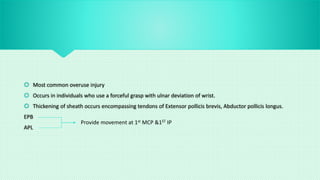
 Most common overuse injury
 Occurs in individuals who use a forceful grasp with ulnar deviation of wrist.
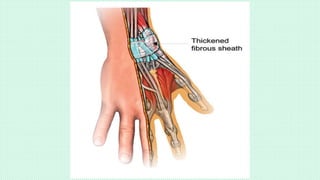
 Thickening of sheath occurs encompassing tendons of Extensor pollicis brevis, Abductor pollicis longus.
EPB
APL
Provide movement at 1st MCP &1ST IP
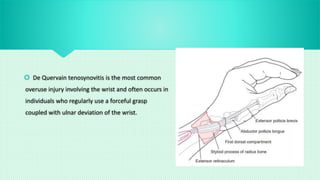
 De Quervain tenosynovitis is the most common
overuse injury involving the wrist and often occurs in
individuals who regularly use a forceful grasp
coupled with ulnar deviation of the wrist.
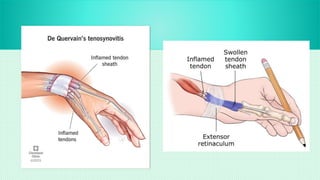
 Stenosis of the synovial sheath encompassing these tendons, with resultant resisted gliding of the APL and
EPB, leads to pain with movement of the thumb, especially with repetitive extension and abduction.
 Women > Men
 Dominant hand affected during middle age.
 Acute- inflammation in the tendon sheath may contribute to pain.
 Chronic – collagen disorients & mucoid formation occurs.
Clinical signs
 Tenderness
 Pain
 Edema at radial aspect of the wrist.
Examination
 Palpation directly over the area may elicit pain.
 Pain can result in weakness with pinching or grasping.
 Pain with resisted thumb abduction or extension.
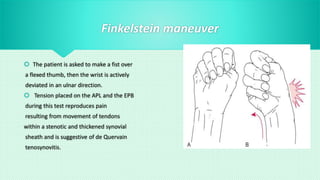
 Pain may further be elicited by the Finkelstein maneuver.
Finkelstein maneuver
 The patient is asked to make a fist over
a flexed thumb, then the wrist is actively
deviated in an ulnar direction.
 Tension placed on the APL and the EPB
during this test reproduces pain
resulting from movement of tendons
within a stenotic and thickened synovial
sheath and is suggestive of de Quervain
tenosynovitis.
Investigations
 Plain radiographs of the hand and wrist can be obtained to rule out fractures and degenerative disease of
the thumb carpometacarpal (CMC) joint, but these can be differentiated .
Differential diagnosis:
 Osteoarthritis
 Wartenbergs syndrome
 Intersection syndrome
Treatment
 Conservative measures are effective in up to 90% of patients.
 Education: Educating the patient on the basic anatomy of the area and functional activities. Patients should
be advised to avoid motions that evoke pain, such as those involving twisting of the wrist and pinching with
the thumb (activity modification). Workspaces and hobbies can be evaluated and modified ergonomically to
accommodate neutral alignment of the wrists and hands with activities such as typing. This helps to
decrease chronic overuse of the APL and EPB tendons.
Immobilization
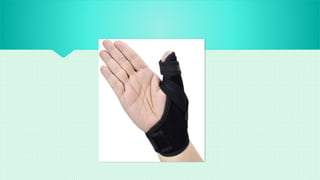
 A period of immobilization in a radial thumb-spica splint to allow the tendons of the first dorsal
compartment to
 A properly fitting thumb-spica splint should position the wrist in neutral and the thumb in 30 degrees of
flexion and 30 degrees of abduction
 It is important that the interphalangeal joint be free with full mobility. Immobilization should be maintained
constantly until pain subsides, usually in 2 to 4 weeks.
 Nearly 20% of patients have resolution of their symptoms with immobilization alone.
 Passive stretching and tendon glide exercises for the APB and EPL can then be introduced
Anti-inflammatories:
 NSAIDs - The combination of oral NSAID therapy along with immobilization has been found to improve
symptoms in more than 80% of patients who initially present with mild disease and around 30% of those
with a moderate to severe presentation.
Modalities
 Ultrasound
 Ionotophorosis
 Ice massage/ Cryotherapy
 Contrast bath
Corticosteroid injection
 A corticosteroid injection into the sheath surrounding the first dorsal compartment of the forearm often is
done.
Surgery
 If conservative measures and injections consistently fail, surgical intervention may be necessary in some
patients with de Quervain tenosynovitis.
 Local anesthesia often is sufficient and through a small incision over the first dorsal compartment, the
thickened sheath encompassing the EPL and APB tendons is divided to decompress the compartment and
allow the tendons to glide freely.
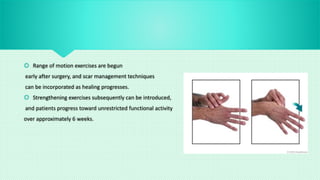
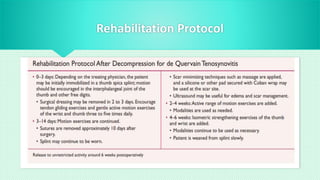
 Range of motion exercises are begun
early after surgery, and scar management techniques
can be incorporated as healing progresses.
 Strengthening exercises subsequently can be introduced,
and patients progress toward unrestricted functional activity
over approximately 6 weeks.
Rehabilitation Protocol

De-quervain tenosynovitis- PHYSIOTHERAPY

  • 1.
  • 2.
     Most commonoveruse injury  Occurs in individuals who use a forceful grasp with ulnar deviation of wrist.  Thickening of sheath occurs encompassing tendons of Extensor pollicis brevis, Abductor pollicis longus. EPB APL Provide movement at 1st MCP &1ST IP
  • 4.
     De Quervaintenosynovitis is the most common overuse injury involving the wrist and often occurs in individuals who regularly use a forceful grasp coupled with ulnar deviation of the wrist.
  • 6.
     Stenosis ofthe synovial sheath encompassing these tendons, with resultant resisted gliding of the APL and EPB, leads to pain with movement of the thumb, especially with repetitive extension and abduction.  Women > Men  Dominant hand affected during middle age.  Acute- inflammation in the tendon sheath may contribute to pain.  Chronic – collagen disorients & mucoid formation occurs.
  • 7.
    Clinical signs  Tenderness Pain  Edema at radial aspect of the wrist.
  • 8.
    Examination  Palpation directlyover the area may elicit pain.  Pain can result in weakness with pinching or grasping.  Pain with resisted thumb abduction or extension.  Pain may further be elicited by the Finkelstein maneuver.
  • 9.
    Finkelstein maneuver  Thepatient is asked to make a fist over a flexed thumb, then the wrist is actively deviated in an ulnar direction.  Tension placed on the APL and the EPB during this test reproduces pain resulting from movement of tendons within a stenotic and thickened synovial sheath and is suggestive of de Quervain tenosynovitis.
  • 10.
    Investigations  Plain radiographsof the hand and wrist can be obtained to rule out fractures and degenerative disease of the thumb carpometacarpal (CMC) joint, but these can be differentiated . Differential diagnosis:  Osteoarthritis  Wartenbergs syndrome  Intersection syndrome
  • 11.
    Treatment  Conservative measuresare effective in up to 90% of patients.  Education: Educating the patient on the basic anatomy of the area and functional activities. Patients should be advised to avoid motions that evoke pain, such as those involving twisting of the wrist and pinching with the thumb (activity modification). Workspaces and hobbies can be evaluated and modified ergonomically to accommodate neutral alignment of the wrists and hands with activities such as typing. This helps to decrease chronic overuse of the APL and EPB tendons.
  • 12.
    Immobilization  A periodof immobilization in a radial thumb-spica splint to allow the tendons of the first dorsal compartment to  A properly fitting thumb-spica splint should position the wrist in neutral and the thumb in 30 degrees of flexion and 30 degrees of abduction  It is important that the interphalangeal joint be free with full mobility. Immobilization should be maintained constantly until pain subsides, usually in 2 to 4 weeks.  Nearly 20% of patients have resolution of their symptoms with immobilization alone.  Passive stretching and tendon glide exercises for the APB and EPL can then be introduced
  • 14.
    Anti-inflammatories:  NSAIDs -The combination of oral NSAID therapy along with immobilization has been found to improve symptoms in more than 80% of patients who initially present with mild disease and around 30% of those with a moderate to severe presentation.
  • 15.
    Modalities  Ultrasound  Ionotophorosis Ice massage/ Cryotherapy  Contrast bath
  • 16.
    Corticosteroid injection  Acorticosteroid injection into the sheath surrounding the first dorsal compartment of the forearm often is done.
  • 17.
    Surgery  If conservativemeasures and injections consistently fail, surgical intervention may be necessary in some patients with de Quervain tenosynovitis.  Local anesthesia often is sufficient and through a small incision over the first dorsal compartment, the thickened sheath encompassing the EPL and APB tendons is divided to decompress the compartment and allow the tendons to glide freely.
  • 18.
     Range ofmotion exercises are begun early after surgery, and scar management techniques can be incorporated as healing progresses.  Strengthening exercises subsequently can be introduced, and patients progress toward unrestricted functional activity over approximately 6 weeks.
  • 19.