-Dr.
Yeshwanth
De Quervains Tenosynovitis
Introduction
 Named after a Swiss surgeon, Fritz de
Quervain, who first described the problem in
1895.
 De Quervain disease is a stenosing
tenosynovitis of the first dorsal compartment of
the wrist containing Abductor pollicis longus
and Extensor pollicis brevis.
 It is characterised by degeneration and fibrosis
of the tendon sheath.
 Occurs most often in individuals age between
30 and 50 years
 It affects women up to six times more often
than men
 Is commonly associated with dominant hand.
Anatomy
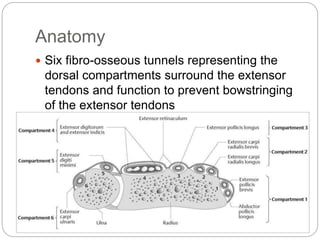
 Six fibro-osseous tunnels representing the
dorsal compartments surround the extensor
tendons and function to prevent bowstringing
of the extensor tendons
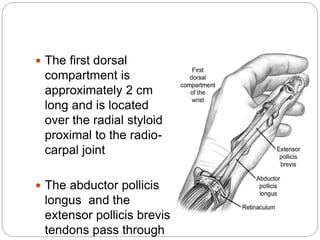
 The first dorsal
compartment is
approximately 2 cm
long and is located
over the radial styloid
proximal to the radio-
carpal joint
 The abductor pollicis
longus and the
extensor pollicis brevis
tendons pass through
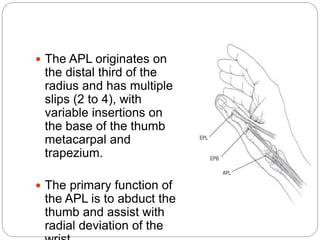
 The APL originates on
the distal third of the
radius and has multiple
slips (2 to 4), with
variable insertions on
the base of the thumb
metacarpal and
trapezium.
 The primary function of
the APL is to abduct the
thumb and assist with
radial deviation of the
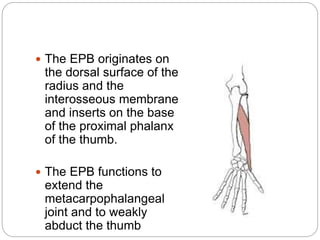
 The EPB originates on
the dorsal surface of the
radius and the
interosseous membrane
and inserts on the base
of the proximal phalanx
of the thumb.
 The EPB functions to
extend the
metacarpophalangeal
joint and to weakly
abduct the thumb
Etiology
 The etiology is thought to be secondary to
repetitive or sustained tension on the tendons of
the first dorsal compartment
 Possible etiologies include
Trauma
Increased frictional forces
Anatomic Variations that include septation of the
first dorsal compartment and the presence of
multiple slips of the APL and, occasionally, of the
EPB tendon
Biomechanical compression,
Repetitive microtrauma
Inflammatory disease, and
Increased volume states, such as occurs
during pregnancy
Pathophysiology
Resisted gliding of the APL and the EPB within
the narrowed canal
Fibroblastic response, resulting in thickening and
swelling of the compartment
Degeneration
 Microanatomic findings of the tendon sheaths
and synovium showed thickening of the tendon
sheaths to be up to five times because of
deposition of dense fibrous tissue, increased
vascularity of the tendon sheaths, and
accumulation of mucopolysaccharides, which are
indicators of myxoid degeneration
 Notably, the synovial linings were preserved and
were histologically normal.
 These changes indicate that de Quervain’s is a
result of an intrinsic degenerative mechanism
rather than an inflammatory one.
Clinical features
 localized pain along the radial side of the wrist
-Gradual in onset
-Aggravating on grasping and raising objects
with the wrist in neutral rotation
 Localised swelling may be seen.
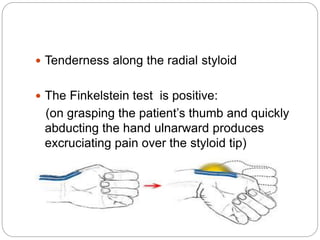
 Tenderness along the radial styloid
 The Finkelstein test is positive:
(on grasping the patient’s thumb and quickly
abducting the hand ulnarward produces
excruciating pain over the styloid tip)
Differential diagnosis
 Intersection syndrome
 Radial styloid fracture
 Scaphoid fracture
 Basilar arthritis of the thumb and
 Radial neuritis
Investigations
 Diagnosed is mainly through clinically
 Wrist imaging is required only in the presence
of associated processes such as previous
distal radius or scaphoid fracture, arthritis of
the thumb, and instability of the wrist
Conservative Treatment
 Nonsurgical treatment should be the first course
of action for de Quervain disease.
 The patient presenting with mild to moderate pain
that does not limit activities of daily living may be
treated with -
 Rest,
 Splinting,
 Nonsteroidal anti-inflammatory drugs or
 corticosteroid injection.
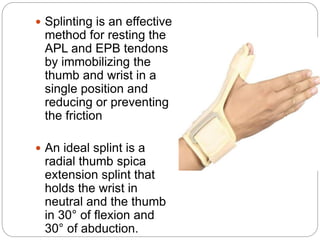
 Splinting is an effective
method for resting the
APL and EPB tendons
by immobilizing the
thumb and wrist in a
single position and
reducing or preventing
the friction
 An ideal splint is a
radial thumb spica
extension splint that
holds the wrist in
neutral and the thumb
in 30° of flexion and
30° of abduction.
Corticosteroid injection
 Corticosteroid injection into the first dorsal
compartment is perhaps the most common
and effective treatment of de Quervain
disease.
 Failure of response to corticosteroid injection
has been attributed to poor technique and
anatomic variations within the first dorsal
compartment
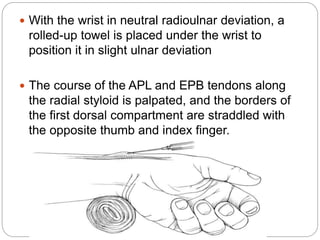
 With the wrist in neutral radioulnar deviation, a
rolled-up towel is placed under the wrist to
position it in slight ulnar deviation
 The course of the APL and EPB tendons along
the radial styloid is palpated, and the borders of
the first dorsal compartment are straddled with
the opposite thumb and index finger.
 A 25-gauge needle is introduced into the tendon
sheath at the level of the styloid, parallel to the
tendons..
 The needle is carefully backed out while
maintaining pressure on the plunger of the
syringe.
 The injectable medication should flow smoothly
and easily, with both visual and palpable inflation
of the compartment.
 An additional injection may be offered after a
4- to 8-week interval for the patient who has
experienced some improvement with the initial
injection
 When pain does not resolve after two
corticosteroid injections and 6 months of
nonsurgical management, then surgical
release of the first dorsal compartment is
recommended.
Complications
 Neuritis,
 Fat necrosis, and
 Postinjection flare
 Sub dermal atrophy and
 Hypopigmentation
Surgical treatment
 Surgical treatment is based on release of the
fibro-osseous roof of the first dorsal
compartment and decompressing the
stenosed APL and EPB tendons
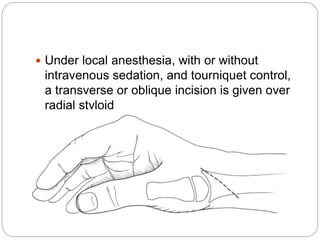
 Under local anesthesia, with or without
intravenous sedation, and tourniquet control,
a transverse or oblique incision is given over
radial styloid
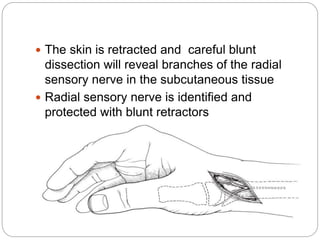
 The skin is retracted and careful blunt
dissection will reveal branches of the radial
sensory nerve in the subcutaneous tissue
 Radial sensory nerve is identified and
protected with blunt retractors
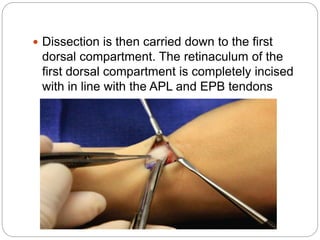
 Dissection is then carried down to the first
dorsal compartment. The retinaculum of the
first dorsal compartment is completely incised
with in line with the APL and EPB tendons
 Any intra-compartmental septae should be
released and excised.
 Anatomic variations of the compartment are
the rule rather than the exception.
 Active and free thumb abduction and
extension then can be performed on the
awake patient
 Postoperatively, thumb and hand motion is
immediately encouraged except for forceful
wrist flexion,
which may predispose the tendons toward
subluxation during the first 2 weeks after
surgery
Complications
 Radial sensory nerve injury
 Incomplete decompression,
 Volar subluxation of the tendons
De Quervain

De Quervain

  • 1.
  • 2.
    Introduction  Named aftera Swiss surgeon, Fritz de Quervain, who first described the problem in 1895.  De Quervain disease is a stenosing tenosynovitis of the first dorsal compartment of the wrist containing Abductor pollicis longus and Extensor pollicis brevis.  It is characterised by degeneration and fibrosis of the tendon sheath.
  • 3.
     Occurs mostoften in individuals age between 30 and 50 years  It affects women up to six times more often than men  Is commonly associated with dominant hand.
  • 4.
    Anatomy  Six fibro-osseoustunnels representing the dorsal compartments surround the extensor tendons and function to prevent bowstringing of the extensor tendons
  • 5.
     The firstdorsal compartment is approximately 2 cm long and is located over the radial styloid proximal to the radio- carpal joint  The abductor pollicis longus and the extensor pollicis brevis tendons pass through
  • 6.
     The APLoriginates on the distal third of the radius and has multiple slips (2 to 4), with variable insertions on the base of the thumb metacarpal and trapezium.  The primary function of the APL is to abduct the thumb and assist with radial deviation of the
  • 7.
     The EPBoriginates on the dorsal surface of the radius and the interosseous membrane and inserts on the base of the proximal phalanx of the thumb.  The EPB functions to extend the metacarpophalangeal joint and to weakly abduct the thumb
  • 8.
    Etiology  The etiologyis thought to be secondary to repetitive or sustained tension on the tendons of the first dorsal compartment  Possible etiologies include Trauma Increased frictional forces Anatomic Variations that include septation of the first dorsal compartment and the presence of multiple slips of the APL and, occasionally, of the EPB tendon
  • 9.
    Biomechanical compression, Repetitive microtrauma Inflammatorydisease, and Increased volume states, such as occurs during pregnancy
  • 10.
    Pathophysiology Resisted gliding ofthe APL and the EPB within the narrowed canal Fibroblastic response, resulting in thickening and swelling of the compartment Degeneration
  • 11.
     Microanatomic findingsof the tendon sheaths and synovium showed thickening of the tendon sheaths to be up to five times because of deposition of dense fibrous tissue, increased vascularity of the tendon sheaths, and accumulation of mucopolysaccharides, which are indicators of myxoid degeneration  Notably, the synovial linings were preserved and were histologically normal.  These changes indicate that de Quervain’s is a result of an intrinsic degenerative mechanism rather than an inflammatory one.
  • 12.
    Clinical features  localizedpain along the radial side of the wrist -Gradual in onset -Aggravating on grasping and raising objects with the wrist in neutral rotation  Localised swelling may be seen.
  • 13.
     Tenderness alongthe radial styloid  The Finkelstein test is positive: (on grasping the patient’s thumb and quickly abducting the hand ulnarward produces excruciating pain over the styloid tip)
  • 14.
    Differential diagnosis  Intersectionsyndrome  Radial styloid fracture  Scaphoid fracture  Basilar arthritis of the thumb and  Radial neuritis
  • 15.
    Investigations  Diagnosed ismainly through clinically  Wrist imaging is required only in the presence of associated processes such as previous distal radius or scaphoid fracture, arthritis of the thumb, and instability of the wrist
  • 16.
    Conservative Treatment  Nonsurgicaltreatment should be the first course of action for de Quervain disease.  The patient presenting with mild to moderate pain that does not limit activities of daily living may be treated with -  Rest,  Splinting,  Nonsteroidal anti-inflammatory drugs or  corticosteroid injection.
  • 17.
     Splinting isan effective method for resting the APL and EPB tendons by immobilizing the thumb and wrist in a single position and reducing or preventing the friction  An ideal splint is a radial thumb spica extension splint that holds the wrist in neutral and the thumb in 30° of flexion and 30° of abduction.
  • 18.
    Corticosteroid injection  Corticosteroidinjection into the first dorsal compartment is perhaps the most common and effective treatment of de Quervain disease.  Failure of response to corticosteroid injection has been attributed to poor technique and anatomic variations within the first dorsal compartment
  • 19.
     With thewrist in neutral radioulnar deviation, a rolled-up towel is placed under the wrist to position it in slight ulnar deviation  The course of the APL and EPB tendons along the radial styloid is palpated, and the borders of the first dorsal compartment are straddled with the opposite thumb and index finger.
  • 20.
     A 25-gaugeneedle is introduced into the tendon sheath at the level of the styloid, parallel to the tendons..  The needle is carefully backed out while maintaining pressure on the plunger of the syringe.  The injectable medication should flow smoothly and easily, with both visual and palpable inflation of the compartment.
  • 21.
     An additionalinjection may be offered after a 4- to 8-week interval for the patient who has experienced some improvement with the initial injection  When pain does not resolve after two corticosteroid injections and 6 months of nonsurgical management, then surgical release of the first dorsal compartment is recommended.
  • 22.
    Complications  Neuritis,  Fatnecrosis, and  Postinjection flare  Sub dermal atrophy and  Hypopigmentation
  • 23.
    Surgical treatment  Surgicaltreatment is based on release of the fibro-osseous roof of the first dorsal compartment and decompressing the stenosed APL and EPB tendons
  • 24.
     Under localanesthesia, with or without intravenous sedation, and tourniquet control, a transverse or oblique incision is given over radial styloid
  • 25.
     The skinis retracted and careful blunt dissection will reveal branches of the radial sensory nerve in the subcutaneous tissue  Radial sensory nerve is identified and protected with blunt retractors
  • 26.
     Dissection isthen carried down to the first dorsal compartment. The retinaculum of the first dorsal compartment is completely incised with in line with the APL and EPB tendons
  • 27.
     Any intra-compartmentalseptae should be released and excised.  Anatomic variations of the compartment are the rule rather than the exception.  Active and free thumb abduction and extension then can be performed on the awake patient
  • 28.
     Postoperatively, thumband hand motion is immediately encouraged except for forceful wrist flexion, which may predispose the tendons toward subluxation during the first 2 weeks after surgery
  • 29.
    Complications  Radial sensorynerve injury  Incomplete decompression,  Volar subluxation of the tendons