MALLET FINGER
-Dr.DHARANI MAVURU
MPT ORTHO
• After a sudden flexion injury, the distal phalanx droops and cannot be straightened
actively.
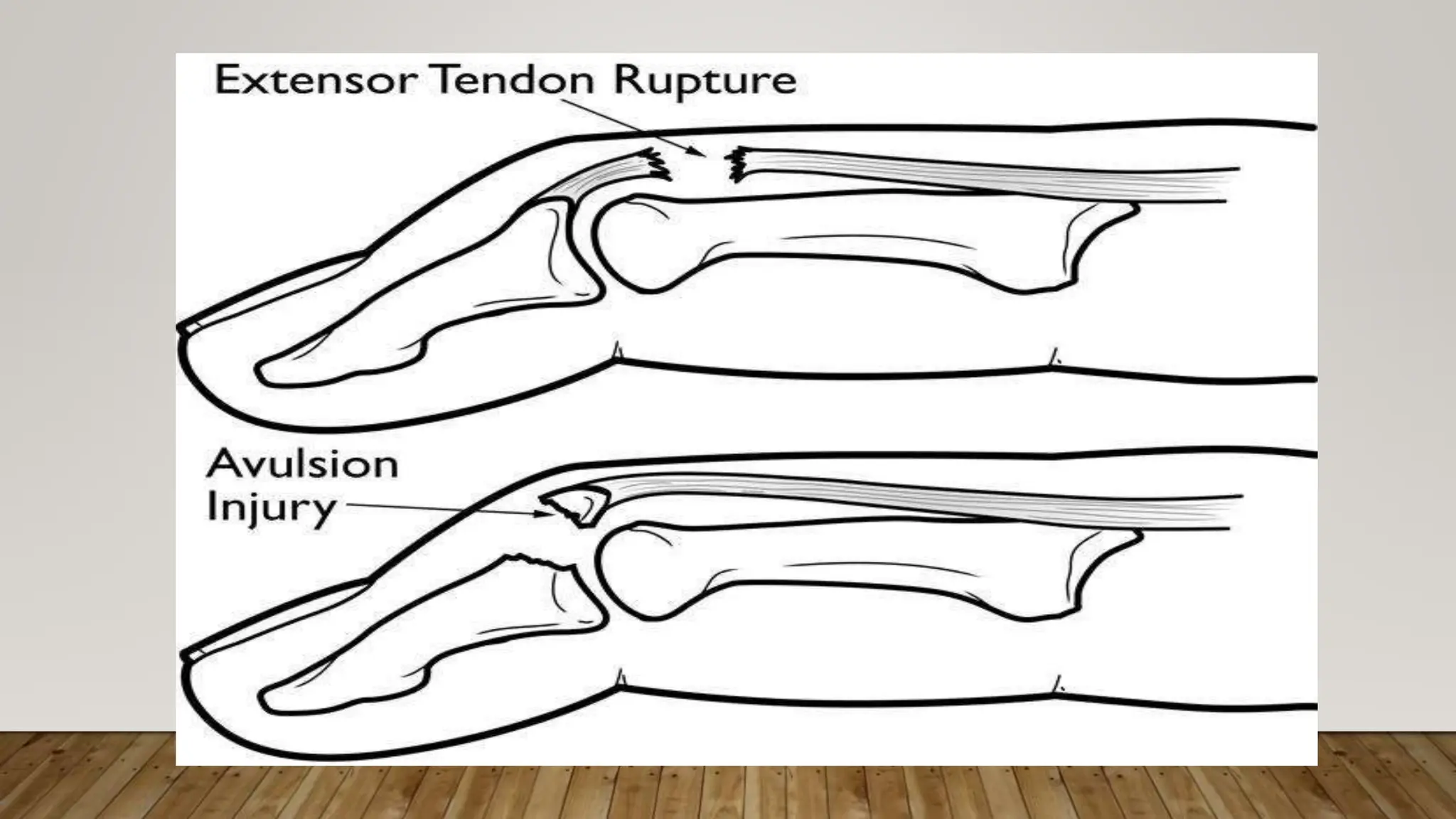
• Three types of injury are recognised.
1. Rupture of the most distal part of the extensor tendon.
2. Avulsion of small flake of bone from the base of the terminal phalanx with the
joint line affected.
3. Avulsion of a large dorsal bone fragment, sometimes with subluxuation of the DIP
joint
MECHANISM OF INJURY
Sudden forced flexion of the distal phalanx
CLINICAL FEATURES
• Pain
• Swelling
• Loss of ROM at distal phalanx.
• Hyperextension of PIP joint due to unbalanced extensor mechanism.
TREATMENT
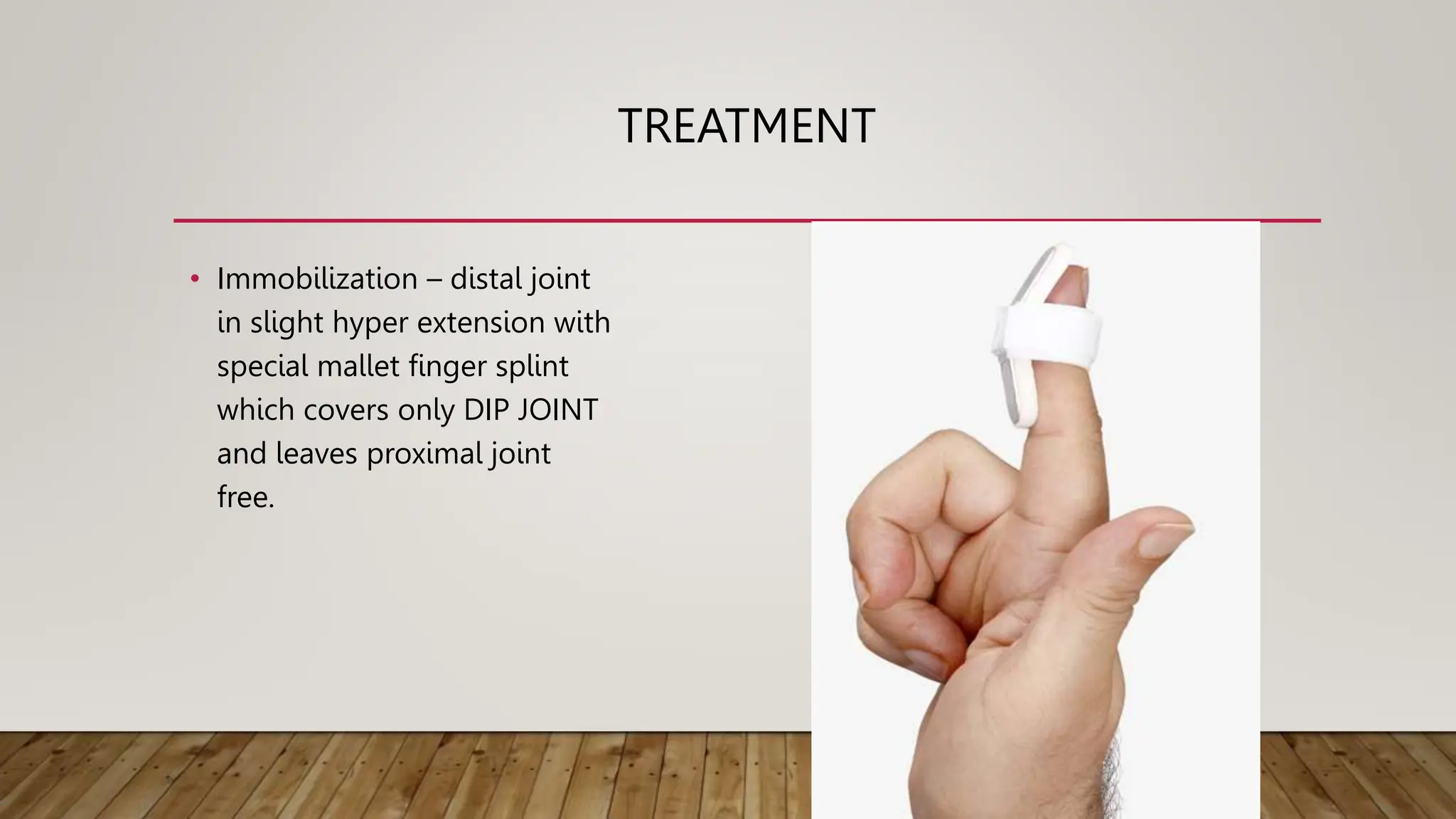
• Immobilization – distal joint
in slight hyper extension with
special mallet finger splint
which covers only DIP JOINT
and leaves proximal joint
free.
• Pop cast with- 600 flexion of PIP
- hyperextension of DIP
• Immobilization period : 3-4 weeks
• Surgical method: extension block wiring
- 2 K wires are passed percutaneously
• Ruptured tendon is repaired by surgery sometimes.
• Avulsed bony fragment is fixed with k wire.
• Postoperatively, finger is immobilized in cast/splint for 3-4 weeks.
• Late cases- OR tendon repair
• If pain and deformity persist, arthrodesis can be done with 15degrees of flexion
of DIP.
• Post-op immobilization- 8-10 weeks.
PHYSIOTHERAPY MANAGEMENT
Aims:
• Regain ROM of the joint.
• Improve strength at DIP Joint.
• Improve voluntary extension of DIP
IMMOBILIZATION /SURGICAL REPAIR
• Patient is encouraged to use hand with splint/POP
• Vigorous movements to all fingers.
• Reduce inflammation, pain, edema
MOBILIZATION
• PWB
• AROM
• Strengthening and re education to EDC by ES
• Lumbrical exercises.
• Full function- 3-4 weeks following mobilization.
COMPLICATIONS
• Non union
• Persistant droop
• Swan neck deformity

MALLET FINGER TREATMENT & PHYSIOTHERAPY MANAGEMENT

  • 1.
  • 2.
    • After asudden flexion injury, the distal phalanx droops and cannot be straightened actively. • Three types of injury are recognised. 1. Rupture of the most distal part of the extensor tendon. 2. Avulsion of small flake of bone from the base of the terminal phalanx with the joint line affected. 3. Avulsion of a large dorsal bone fragment, sometimes with subluxuation of the DIP joint
  • 5.
    MECHANISM OF INJURY Suddenforced flexion of the distal phalanx
  • 6.
    CLINICAL FEATURES • Pain •Swelling • Loss of ROM at distal phalanx. • Hyperextension of PIP joint due to unbalanced extensor mechanism.
  • 7.
    TREATMENT • Immobilization –distal joint in slight hyper extension with special mallet finger splint which covers only DIP JOINT and leaves proximal joint free.
  • 8.
    • Pop castwith- 600 flexion of PIP - hyperextension of DIP • Immobilization period : 3-4 weeks • Surgical method: extension block wiring - 2 K wires are passed percutaneously
  • 9.
    • Ruptured tendonis repaired by surgery sometimes. • Avulsed bony fragment is fixed with k wire. • Postoperatively, finger is immobilized in cast/splint for 3-4 weeks. • Late cases- OR tendon repair • If pain and deformity persist, arthrodesis can be done with 15degrees of flexion of DIP. • Post-op immobilization- 8-10 weeks.
  • 10.
    PHYSIOTHERAPY MANAGEMENT Aims: • RegainROM of the joint. • Improve strength at DIP Joint. • Improve voluntary extension of DIP
  • 11.
    IMMOBILIZATION /SURGICAL REPAIR •Patient is encouraged to use hand with splint/POP • Vigorous movements to all fingers. • Reduce inflammation, pain, edema
  • 12.
    MOBILIZATION • PWB • AROM •Strengthening and re education to EDC by ES • Lumbrical exercises. • Full function- 3-4 weeks following mobilization.
  • 13.
    COMPLICATIONS • Non union •Persistant droop • Swan neck deformity