PRINCIPLE of D.C MOTOR
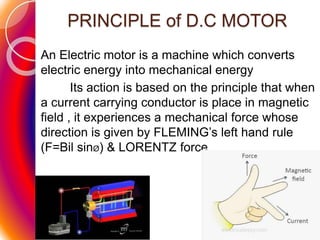
An Electric motor is a machine which converts
electric energy into mechanical energy
Its action is based on the principle that when
a current carrying conductor is place in magnetic
field , it experiences a mechanical force whose
direction is given by FLEMING’s left hand rule
(F=Bil sinØ) & LORENTZ force
Lorentz force
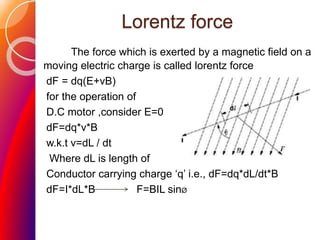
The force which is exerted by a magnetic field on a
moving electric charge is called lorentz force
dF = dq(E+vB)
for the operation of
D.C motor ,consider E=0
dF=dq*v*B
w.k.t v=dL / dt
Where dL is length of
Conductor carrying charge ‘q’ i.e., dF=dq*dL/dt*B
dF=I*dL*B F=BIL sinØ
Significance of back EMF
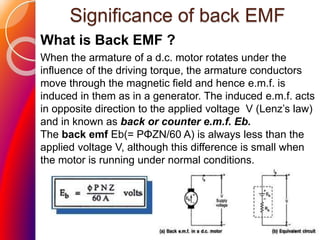
What is Back EMF ?
When the armature of a d.c. motor rotates under the
influence of the driving torque, the armature conductors
move through the magnetic field and hence e.m.f. is
induced in them as in a generator. The induced e.m.f. acts
in opposite direction to the applied voltage V (Lenz’s law)
and in known as back or counter e.m.f. Eb.
The back emf Eb(= PΦZN/60 A) is always less than the
applied voltage V, although this difference is small when
the motor is running under normal conditions.
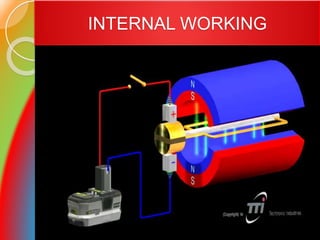
INTERNAL WORKING
HISTORY of MOTORS
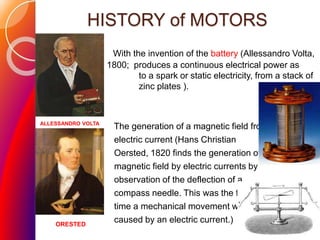
With the invention of the battery (Allessandro Volta,
1800; produces a continuous electrical power as
opposed to a spark or static electricity, from a stack of
silver and zinc plates ).
The generation of a magnetic field from
electric current (Hans Christian
Oersted, 1820 finds the generation of a
magnetic field by electric currents by
observation of the deflection of a
compass needle. This was the first time a
time a mechanical movement was
caused by an electric current.)
ALLESSANDRO VOLTA
ORESTED
HISTORY of MOTORS
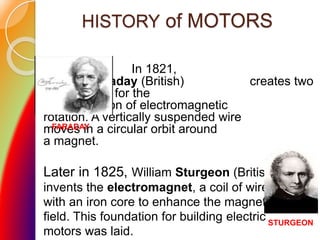
In 1821,
Michael Faraday (British) creates two
experiments for the
demonstration of electromagnetic
rotation. A vertically suspended wire
moves in a circular orbit around
a magnet.
Later in 1825, William Sturgeon (British)
invents the electromagnet, a coil of wires
with an iron core to enhance the magnetic
field. This foundation for building electric
motors was laid.
FARADAY
STURGEON
HISTORY of MOTORS
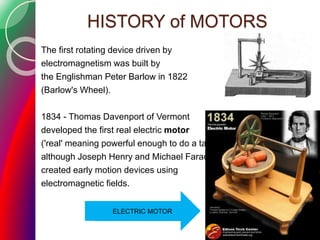
The first rotating device driven by
electromagnetism was built by
the Englishman Peter Barlow in 1822
(Barlow's Wheel).
1834 - Thomas Davenport of Vermont
developed the first real electric motor
('real' meaning powerful enough to do a task)
although Joseph Henry and Michael Faraday
created early motion devices using
electromagnetic fields.
ELECTRIC MOTOR
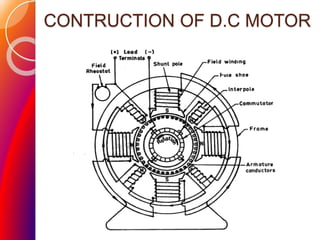
CONTRUCTION OF D.C MOTOR
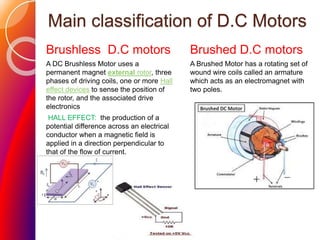
Main classification of D.C Motors
Brushless D.C motors
A DC Brushless Motor uses a
permanent magnet external rotor, three
phases of driving coils, one or more Hall
effect devices to sense the position of
the rotor, and the associated drive
electronics
HALL EFFECT: the production of a
potential difference across an electrical
conductor when a magnetic field is
applied in a direction perpendicular to
that of the flow of current.
Brushed D.C motors
A Brushed Motor has a rotating set of
wound wire coils called an armature
which acts as an electromagnet with
two poles.
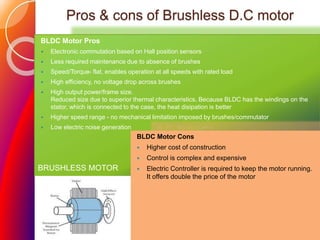
Pros & cons of Brushless D.C motor
BLDC Motor Pros
 Electronic commutation based on Hall position sensors
 Less required maintenance due to absence of brushes
 Speed/Torque- flat, enables operation at all speeds with rated load
 High efficiency, no voltage drop across brushes
 High output power/frame size.
Reduced size due to superior thermal characteristics. Because BLDC has the windings on the
stator, which is connected to the case, the heat disipation is better
 Higher speed range - no mechanical limitation imposed by brushes/commutator
 Low electric noise generation
BLDC Motor Cons
 Higher cost of construction
 Control is complex and expensive
 Electric Controller is required to keep the motor running.
It offers double the price of the motor
BRUSHLESS MOTOR
Pros & cons of Brushed D.C motor
Brushed Motor Pros
 Two wire control
 Replaceable brushes for extended life
 Low cost of construction
 Simple and inexpensive control
 No controller is required for fixed speeds
 Operates in extreme environments due to lack of electronics
Brushed Motor Cons
 Periodic maintenance is required
 Speed/torque is moderately flat. At higher speeds, brush fric
increases, thus reducing useful torque
 Poor heat dissipation due to internal rotor construction
 Higher rotor inertia which limits the dynamic characteristics
 Lower speed range due to mechanical limitations on the
brushes
 Brush Arcing will generate noise causing EMI
Function of each part of DC Motor
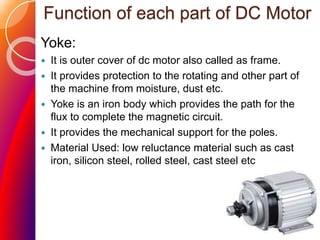
Yoke:
 It is outer cover of dc motor also called as frame.
 It provides protection to the rotating and other part of
the machine from moisture, dust etc.
 Yoke is an iron body which provides the path for the
flux to complete the magnetic circuit.
 It provides the mechanical support for the poles.
 Material Used: low reluctance material such as cast
iron, silicon steel, rolled steel, cast steel etc
Function of each part of DC Motor
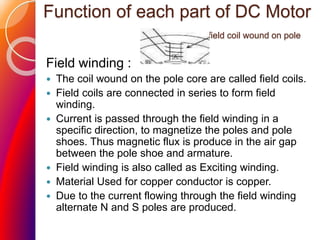
field coil wound on pole
Field winding :
 The coil wound on the pole core are called field coils.
 Field coils are connected in series to form field
winding.
 Current is passed through the field winding in a
specific direction, to magnetize the poles and pole
shoes. Thus magnetic flux is produce in the air gap
between the pole shoe and armature.
 Field winding is also called as Exciting winding.
 Material Used for copper conductor is copper.
 Due to the current flowing through the field winding
alternate N and S poles are produced.
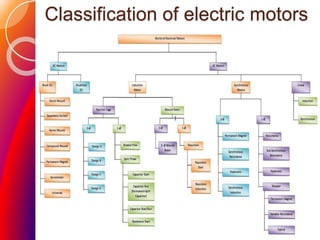
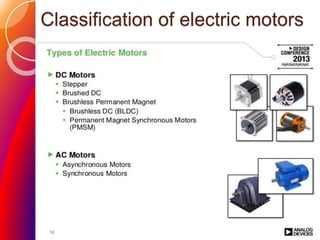
Classification of electric motors
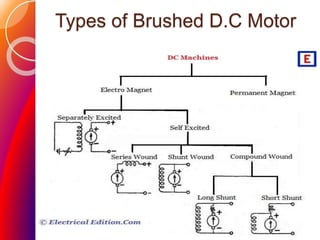
Types of Brushed D.C Motor
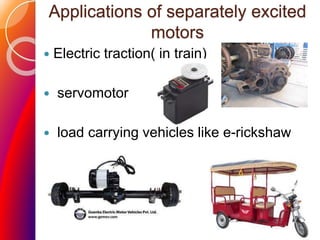
Applications of separately excited
motors
 Electric traction( in train)
 servomotor
 load carrying vehicles like e-rickshaw
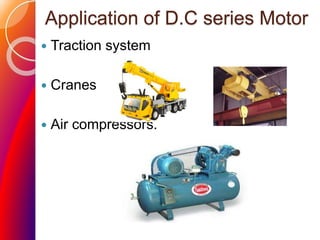
Application of D.C series Motor
 Traction system
 Cranes
 Air compressors.
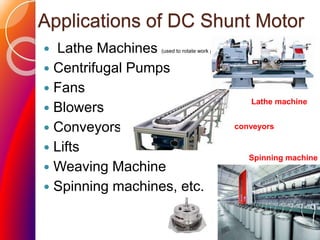
Applications of DC Shunt Motor
 Lathe Machines (used to rotate work piece)
 Centrifugal Pumps
 Fans
 Blowers
 Conveyors
 Lifts
 Weaving Machine
 Spinning machines, etc.
Lathe machine
conveyors
Spinning machine
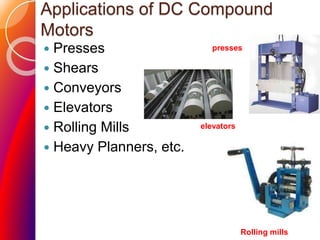
Applications of DC Compound
Motors
 Presses
 Shears
 Conveyors
 Elevators
 Rolling Mills
 Heavy Planners, etc.
presses
elevators
Rolling mills
Any queries???

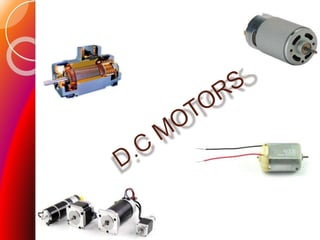
Dc motors

  • 2.
    PRINCIPLE of D.CMOTOR An Electric motor is a machine which converts electric energy into mechanical energy Its action is based on the principle that when a current carrying conductor is place in magnetic field , it experiences a mechanical force whose direction is given by FLEMING’s left hand rule (F=Bil sinØ) & LORENTZ force
  • 4.
    Lorentz force The forcewhich is exerted by a magnetic field on a moving electric charge is called lorentz force dF = dq(E+vB) for the operation of D.C motor ,consider E=0 dF=dq*v*B w.k.t v=dL / dt Where dL is length of Conductor carrying charge ‘q’ i.e., dF=dq*dL/dt*B dF=I*dL*B F=BIL sinØ
  • 5.
    Significance of backEMF What is Back EMF ? When the armature of a d.c. motor rotates under the influence of the driving torque, the armature conductors move through the magnetic field and hence e.m.f. is induced in them as in a generator. The induced e.m.f. acts in opposite direction to the applied voltage V (Lenz’s law) and in known as back or counter e.m.f. Eb. The back emf Eb(= PΦZN/60 A) is always less than the applied voltage V, although this difference is small when the motor is running under normal conditions.
  • 6.
  • 7.
    HISTORY of MOTORS Withthe invention of the battery (Allessandro Volta, 1800; produces a continuous electrical power as opposed to a spark or static electricity, from a stack of silver and zinc plates ). The generation of a magnetic field from electric current (Hans Christian Oersted, 1820 finds the generation of a magnetic field by electric currents by observation of the deflection of a compass needle. This was the first time a time a mechanical movement was caused by an electric current.) ALLESSANDRO VOLTA ORESTED
  • 8.
    HISTORY of MOTORS In1821, Michael Faraday (British) creates two experiments for the demonstration of electromagnetic rotation. A vertically suspended wire moves in a circular orbit around a magnet. Later in 1825, William Sturgeon (British) invents the electromagnet, a coil of wires with an iron core to enhance the magnetic field. This foundation for building electric motors was laid. FARADAY STURGEON
  • 9.
    HISTORY of MOTORS Thefirst rotating device driven by electromagnetism was built by the Englishman Peter Barlow in 1822 (Barlow's Wheel). 1834 - Thomas Davenport of Vermont developed the first real electric motor ('real' meaning powerful enough to do a task) although Joseph Henry and Michael Faraday created early motion devices using electromagnetic fields. ELECTRIC MOTOR
  • 10.
  • 11.
    Main classification ofD.C Motors Brushless D.C motors A DC Brushless Motor uses a permanent magnet external rotor, three phases of driving coils, one or more Hall effect devices to sense the position of the rotor, and the associated drive electronics HALL EFFECT: the production of a potential difference across an electrical conductor when a magnetic field is applied in a direction perpendicular to that of the flow of current. Brushed D.C motors A Brushed Motor has a rotating set of wound wire coils called an armature which acts as an electromagnet with two poles.
  • 12.
    Pros & consof Brushless D.C motor BLDC Motor Pros  Electronic commutation based on Hall position sensors  Less required maintenance due to absence of brushes  Speed/Torque- flat, enables operation at all speeds with rated load  High efficiency, no voltage drop across brushes  High output power/frame size. Reduced size due to superior thermal characteristics. Because BLDC has the windings on the stator, which is connected to the case, the heat disipation is better  Higher speed range - no mechanical limitation imposed by brushes/commutator  Low electric noise generation BLDC Motor Cons  Higher cost of construction  Control is complex and expensive  Electric Controller is required to keep the motor running. It offers double the price of the motor BRUSHLESS MOTOR
  • 13.
    Pros & consof Brushed D.C motor Brushed Motor Pros  Two wire control  Replaceable brushes for extended life  Low cost of construction  Simple and inexpensive control  No controller is required for fixed speeds  Operates in extreme environments due to lack of electronics Brushed Motor Cons  Periodic maintenance is required  Speed/torque is moderately flat. At higher speeds, brush fric increases, thus reducing useful torque  Poor heat dissipation due to internal rotor construction  Higher rotor inertia which limits the dynamic characteristics  Lower speed range due to mechanical limitations on the brushes  Brush Arcing will generate noise causing EMI
  • 14.
    Function of eachpart of DC Motor Yoke:  It is outer cover of dc motor also called as frame.  It provides protection to the rotating and other part of the machine from moisture, dust etc.  Yoke is an iron body which provides the path for the flux to complete the magnetic circuit.  It provides the mechanical support for the poles.  Material Used: low reluctance material such as cast iron, silicon steel, rolled steel, cast steel etc
  • 15.
    Function of eachpart of DC Motor field coil wound on pole Field winding :  The coil wound on the pole core are called field coils.  Field coils are connected in series to form field winding.  Current is passed through the field winding in a specific direction, to magnetize the poles and pole shoes. Thus magnetic flux is produce in the air gap between the pole shoe and armature.  Field winding is also called as Exciting winding.  Material Used for copper conductor is copper.  Due to the current flowing through the field winding alternate N and S poles are produced.
  • 16.
  • 17.
  • 18.
  • 19.
    Applications of separatelyexcited motors  Electric traction( in train)  servomotor  load carrying vehicles like e-rickshaw
  • 20.
    Application of D.Cseries Motor  Traction system  Cranes  Air compressors.
  • 21.
    Applications of DCShunt Motor  Lathe Machines (used to rotate work piece)  Centrifugal Pumps  Fans  Blowers  Conveyors  Lifts  Weaving Machine  Spinning machines, etc. Lathe machine conveyors Spinning machine
  • 22.
    Applications of DCCompound Motors  Presses  Shears  Conveyors  Elevators  Rolling Mills  Heavy Planners, etc. presses elevators Rolling mills
  • 23.